Showing posts with label Justices. Show all posts

Monday, April 25, 2016

From Supreme Court Review: Justice Kennedy's Jurisprudence

For a discussion of how Anthony Kennedy approaches the Constitution:

- Click here for the article.

It was clear from Kennedy's confirmation hearing that he was not an originalist, as was Bork or Scalia: he testified at his confirmation hearing: "Over time, the intentions of the framers are more remote from their particular political concerns, and so they have a certain purity and a certain generality now that they did not have previously . . . it sometimes takes humans generations to become aware of the moral consequences of their own conduct. That does not mean that moral principles have not remained the same."
For Kennedy, the liberties in the constitution are not strictly limited to the way they would have been applied at the time of the adoption of the constitution, rather they are general moral principles that may require different applications as time passes in order to maintain the generalized concepts of individuality, liberty and dignity that the framers memorialized in the constitution.
Because Justice Kennedy's philosophy is not as capable of being pigeonholed as other justices, Justice Kennedy has often confounded legal scholars who have attempted to extrapolate a rule-oriented jurisprudence from Justice Kennedy's decisions. In general, however, one can say that Justice Kennedy is reliably conservative in most areas except in cases involving individual rights. For example, Kennedy has consistently departed from his conservative colleagues in gay rights cases.

For more:

- Living in Anthony Kennedy’s World.
Anthony M. Kennedy: A Study of His Judicial Opinions.
- Anthony Kennedy turns moderation into power.
- The Key to Justice Kennedy? Why, It’s Liberty!

Here text from the last link:

The key to Justice ­Kennedy’s votes, Mr. Colucci says, is his moral ­reading of the Constitution: He sees the document as an unfolding story of ever greater individual liberty. Thus he ­opposes laws that abridge sexual ­freedom, including laws against homosexual conduct. If an originalist reading of the Constitution does not reveal such a liberty—relying on the received meaning of the ­Constitution’s words at the time they were ­written—Justice Kennedy’s moral ­reading does. But he is skeptical of race-conscious ­programs, too, because they treat applicants as members of a group rather than as individuals who possess the right to be free from group-based policies or rules.
. . . Most valuably, Mr. Colucci shows Justice Kennedy’s judicial philosophy to be a deeply rooted one and not, as one might suspect, the result of varied decisions that require a casuist or law professor to make coherent. He unearths a speech from 1986 in which Justice Kennedy (then an appeals-court judge) criticized ­Bowers v. Hardwick, a case in which the Supreme Court upheld a conviction for sodomy. At the time the judge did not argue, as others had, that the decision ­violated the right to privacy minted more than a ­decade before in Roe v. Wade. He argued instead that the liberty interests of gay Americans had been breached. In 2003, the court overruled Bowers v. Hardwick, and Justice Kennedy wrote the majority opinion using the rhetoric of liberty rather than privacy.

Tuesday, April 5, 2016

From Vox: There hasn’t been a criminal defense lawyer on the Supreme Court in 25 years. That’s a problem.

For our look at the criminal justice system in - mostly - 2306.

- Click here for the article.

It's been a quarter-century since a former criminal defense lawyer sat on the Supreme Court.
Since then, crime has fallen by half. Incarceration has risen, then fallen (slightly) again. Americans are becoming more and more critical of the "tough-on-crime" mindset that defined the end of the 20th century, and more skeptical that police and prosecutors will always use their powers for good — in other words, they're coming in line with how defense lawyers see the world.
But when Barack Obama made his third (and likely final) Supreme Court nomination last week, he nominated Merrick Garland.
Garland is a former prosecutor with a tough-on-crime record. The Court already has two ex-prosecutors.
Appellate defense lawyer Timothy O'Toole points out that the Court has veterans of both sides of civil cases (defendants' and plaintiffs' lawyers) and one side of criminal cases (prosecutors). "But the one group that seems kind of outside that box, particularly on the Supreme Court, are defense lawyers. And that's a shame."
Defense lawyers and scholars worry this isn't an accident; it's the result of the structure that shapes who can get nominated to the Supreme Court to begin with. Federal judges tend to be people who "ticked all the political checkboxes on their career starting from when they were 15," says Tejas Bhatt, assistant public defender for New Haven, Connecticut. Often one of those boxes is working as a prosecutor.
Even beyond any particular career experience, the system rewards "people who don't take controversial positions, they don't do controversial things, who don't issue controversial opinions, who do seem to hew more toward law and order and enforcement."Chip Somodevilla/Getty
There's good reason to be concerned about the jurisprudence of a court that only understands one side of a criminal case from experience — and since the high-water mark of the 1960s, defense lawyers have seen the Supreme Court put serious restrictions on the right against self-incrimination, the right against unreasonable search, and even the right to a lawyer.
But to many of them, this isn't just a problem with jurisprudence. It's a problem with the Supreme Court in a democracy — and in an increasingly diverse America. They believe the politics of Supreme Court confirmations has limited all but a very narrow, very privileged slice of America to have a shot at a seat on the highest court in the land. And one of the groups who they fear are locked out is the people whose job it is to stand up for the rights of the marginalized — and those who are on the wrong side of well-intentioned laws.

Sunday, March 6, 2016

The Chief Justice’s Biggest Decision: John Roberts can either moderate his views or let himself drift into irrelevance.

Dual credit 2305's might find this worth a look. Not only does it discuss Robert's decision making process as chief justice - but it looks ta one of the cases I assigned this semester.

- Click here for the article.

. . . last term, Roberts played a . . . savvy game in Williams-Yulee v. The Florida Bar, a judicial campaign speech case. Williams-Yulee involved a Florida rule that forbade judicial candidates from personally soliciting campaign contributions. We don’t yet have an inside account of how the justices first split on Williams-Yulee, but it’s pretty clear—from the final opinions and from oral arguments—that Roberts had a dual agenda. First, he wanted to uphold the measure, an extraordinarily sensible and slight rule designed to prevent judicial panhandling and preserve judicial impartiality. (Roberts can be almost winsomely obsessive about maintaining America’s trust in judges.) Second, he wanted to retain the stringent “strict scrutiny” standard for laws that restrict judicial candidates’ speech, allowing Florida’s rule to survive while reminding states that any suppression of such speech must be narrowly tailored.

The other four conservatives were eager to strike down the Florida rule; the four liberals wanted to uphold it, but almost certainly preferred a lower standard of scrutiny. Ultimately, Roberts split the baby: He sided with the liberals to uphold the measure, but agreed with the conservatives that judicial speech laws must be subject to strict scrutiny. The compromise drew two grumbling opinions from Justices Ruth Bader Ginsburg and Stephen Breyer about the unsuitability of strict scrutiny in the judicial campaign context. But both justices signed onto the bulk of Roberts’ majority opinion, allowing the chief to strike a deft balance between the two blocs.

Sunday, February 21, 2016

Scalia was a funny guy.

For a Supreme Court justice anyway. Click here for audio.

- A “view” from the Courtroom: “I’m Scalia” and other quips.

Justice Antonin Scalia was known for his sharp-elbowed writing, which is preserved for posterity in his opinions. But his many memorable quips from the bench, usually during oral argument, are also an important part of his legacy.
Justice Scalia regularly topped the scholarly and quasi-scholarly lists of “funniest justice.” As Adam Liptak observed in The New York Times in writing about one of the first such studies, in 2005: “What passes for humor at the Supreme Court would probably not kill at the local comedy club.”
Nevertheless, Justice Scalia could crack up a room of his eight colleagues, dozens of lawyers, and scores of tourists and other spectators. Oral arguments will not be the same without him.
Thanks to recordings preserved (for now) on the Oyez website, we can listen to the late Justice’s quips the way they should be heard: in his own voice.

Monday, February 15, 2016

Thursday, February 27, 2014

From the Atlantic: What Is Clarence Thomas Thinking?

Thomas is perhaps the most consistently conservative justice on the court - and is famously silent during oral arguments. He asks no questions, though his opinions tend to be very forceful. This has led some to wonder about his though process. Including this author. For 2305's look at the judiciary.

- Click here for the article.

For his own part, Thomas doesn't seem to feel that there's any reason to speak up. "Maybe it's the Southerner in me," he has mused. "Maybe it's the introvert in me, I don't know. I think that when somebody's talking, somebody ought to listen." But while I am not sure I would label his silence a “disgrace,” as Toobin did, it is a lost opportunity for all of us. Thomas is a complex figure. I think his legal ideas profoundly wrong. Over the years he has expressed deep resentment over the battle over his confirmation—resentment that his admirers may find understandable but that to me seems excessive. (“Whoop-de-damn-do,” Thomas reports himself as saying when confirmed. But winning a Supreme Court Justiceship, even in ugly circumstances, is an honor. A slight show of gratitude might have been becoming.)

Like every justice, Thomas has a number of areas where he can offer special understanding. He's the only justice who has studied for the priesthood and the only one who has worked in state government. Most relevant to the clean air case, he's the only one who has served as head of an important executive agency (in his case, the Equal Employment Opportunity Commission). I am not sure I would label his silence a “disgrace,” but it is a lost opportunity for all of us.

And when he has spoken out, the results have on occasion been extraordinary. Consider the 2003 case of Virginia v. Black. Several convicted defendants challenged a Virginia statute that made it a felony to burn a cross where others could see it “with the intent of intimidating any person or group.” Not long before, in R.A.V. v. City of St. Paul, the Court had struck down a city ordinance making it a crime to use any symbol in public with the knowledge that it “arouses anger, alarm or resentment in others on the basis of race, color, creed, religion or gender.” Even though the Virginia law was narrower, many observers were confident the majority would also strike the Virginia law as an invalid ban on “symbolic expression.”

Thomas, the only African American on the court, was born into poverty in a segregated community, and he knows a few things that most of his gently raised colleagues do not. He calmly interrupted: “[A]ren't you understating the—the effects of—of the burning cross? . . . Now, it's my understanding that we had almost 100 years of lynching and activity in the South. The Knights of Camellia and—and the Ku Klux Klan, and this was a reign of terror and the cross was a symbol of that reign of terror. Was—isn't that significantly greater than intimidation or a threat?”

Saturday, July 30, 2011

How would the Supreme Court rule if Obama uses the 14th Amendment to borrow money if the debt ceiling is not raised?

A few previous posts have highlighted the ongoing dispute concerning the language in the 14th Amendment which mandates that the full faith and credit of the US should be maintained and whether this means that Obama can go ahead and keep borrowing money to meet obligations.

So what if he does and a challenge to that action is brought up in court?

There is reason to believe that the Supreme Court may not even rule on that case since few if any people will be able to state that they have standing before the court:

When it comes to Congress’s ability to stop the Obama administration from ignoring the debt ceiling, legal experts note that the first obstacle standing in its way is the question of standing, or whether a certain party has the right to sue over an issue in the first place. Jonathan Zasloff, a professor at the UCLA School of Law who has discussed this idea on a blog that he writes with several other academics, told me that while an order from the president for the Treasury Department to continue issuing new debt sounded extreme, it was unclear who could prove sufficient injury from the decision that would qualify the person to sue the administration in court. “Who has some kind of particularized injury, in fact?” Zasloff asked, and he could not come up with a satisfying answer.

Part of the reason for Zasloff’s difficulty in identifying an appropriate plaintiff is that members of Congress have tried before to sue the president for diminishing their legislative and appropriating power and have typically failed. . . .

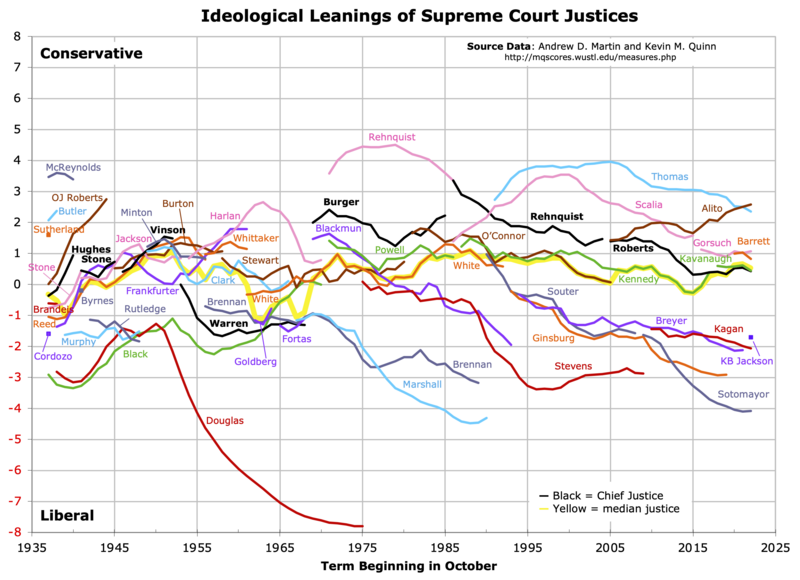
Even if they do decide to hear it, past voting records and philosophies suggest that Most justices - with the exception of Thomas - would side with the president.

A post in Volock Conspiracy argues that a recently decided Supreme Court decision might provide an opportunity for standing to be granted.

All this aside, Andrew Sullivan seems to think this is all an impeachment trap.

Wednesday, June 29, 2011

Extrajudicial Activity

For 2302: An NYT story highlighted in the Atlantic regarding extrajudicial activity and whether it might undermine the impartiality (or the appearance of it) of the courts:

Jeff Shesol on an Excess of Extrajudicial Activity: Jeff Shesol observes that all nine Supreme Court justices have been "giving speeches, signing books, leading workshops, posing for pictures at charity functions" lately and asks, "is there something wrong with extrajudicial activity?" Shesol, a former speechwriter for Bill Clinton, acknowledges in today's New York Times that "surely there is nothing new or unnatural about justices holding political views and seeking the company of others who share them," but, for example, "there are few, if any, precedents for the involvement of Justices Thomas and Scalia with the fund-raising efforts of the Koch brothers." Justice Alito has associated himself with conservative magazine The American Spectator, just as "Justice Ruth Bader Ginsburg has taken part in the Aspen Institute seminars, which receive some financing from George Soros... [and] Justice Stephen Breyer has turned up at Renaissance Weekend, the conclave that the Clintons put on the map in the 1990s." The problem with these extrajudicial activities, Shesol explains, is that "the public's faith in the rule of law depends, to no small degree, on the idea that judges try, as best they can, to maintain a judicial temperament--that they keep a certain distance from public and even private events that appear, in the truest sense of the word, partisan, and that they maintain an open mind. Not a blank mind, devoid of a judicial philosophy, but an open mind — a certain receptiveness to reason, argument and fact."

Thursday, December 9, 2010

The Tribe Memo

A great insider's analysis of the personalities and dynamics on the Supreme Court.

Wednesday, October 6, 2010

Thursday, April 29, 2010

Should Cameras be Placed in the Supreme Court?

Legislation has been introduced in the Senate and House to do so.

Is this a good or bad idea? Proponents argue that it makes the court more transparent, opponents argue that it will lead to grandstanding by the justices and encourage them to play to constituencies outside the court. Hamilton, in Fed #78, wanted the court to stick to the Constitution and the laws. Might cameras compromise this?

Friday, April 16, 2010

Whisper Campaigns

Here's an interesting use of the media, an influential individual -- an opinion leader -- starts a rumor (that one of the top potential Supreme Court nominees is lesbian) in a public, though somewhat discrete place, and the rumor takes off. The White House backlash has led some to speculate that she might be the eventual nominee.

- Wikipedia - Whisper Campaigns.

The Swing Justice

A National Journal Story on perhaps the most powerful man in America, Anthony Kennedy. In an otherwise 4-4 court, he picks the winner.

Wednesday, April 14, 2010

Explaining the Ideological Drift of Supreme Court Justices

Stuart Taylor gives it a good try. Yes, he says, Stevens has in fact gone to the left. The court hasn't simply shifted to the right. He argues that part of the reason Republican justices turn liberal more than Democratic justices turn conservative is that the nature of the news sources, interest groups and auxiliary organizations that surround the courts reward liberal rulings over conservative ones.

Perhaps the Supreme Court isn't as independent as we think.