Vice President Kamala Harris laid out her economic proposals in a speech on August 16 given at a community college in North Carolina.
Let's walk through it and see what she says:
- Click here for the transcript.
Here are some parts that we can analyze in class:
- As attorney general in California, I went after companies that illegally increased prices, including wholesalers that inflated the price of prescription medication and companies that conspired with competitors to keep prices of electronics high. I won more than $1 billion for consumers. So, believe me, as president, I will go after the bad actors. And I will work to pass the first-ever federal ban on prou- — price gauging [gouging] on food. My plan will include new penalties for opportunistic companies that exploit crises and break the rules, and we will support smaller food businesses that are trying to play by the rules and get ahead.
- As president, I’ll attack and take on the issue of the cost of health care. As attorney general, I took on insurance companies and Big Pharma and got them to lower their prices. And together with President Biden, we’ve gone even further. We capped the price of insulin at $35 a month and the total cost — (applause) — and the total cost of prescription drugs at $2,000 a year for seniors. We let Medicare negotiate lower drug prices for seniors. And just yesterday — and just yesterday, we announced that we are lowering the price by up to 80 percent for 10 more lifesaving drugs. And I pledge to continue this progress. I’ll lower the cost of insulin and prescription drugs for everyone with your support, not only our seniors — (applause) — and demand transparency from the middlemen who operate between Big Pharma and the insurance companies, who use opaque practices to raise your drug prices and profit off your need for medicine. Two months ago, I announced that medical debt will no longer be used against your credit score. (Applause.) And I will work, as president, with states like here in North Carolina — Roy Cooper, thank you again — to cancel medical debt for more and more — millions more Americans.
- So, now, the housing market can be complicated, but, look, I’m not new to this issue. As state attorney general, I drafted and helped pass a homeowner bill of rights, one of the first in America. And during the foreclosure crisis, I took on the big banks for predatory lending with many of my colleagues, including Roy Cooper, and won $20 billion for California families when I was attorney general.
. . . As president, I will work in partnership with industry to build the housing we need, both to rent and to buy. We will take down barriers and cut red tape, including at the state and local levels. And by the end of my first term, we will end America’s housing shortage by building 3 million new homes and rentals that are affordable for the middle class, and we will do that together. We will do that together. And — and we will make sure those homes actually go to working- and middle-class Americans not just investors.
. . . Some corporate landlords collude with each other to set artificially high rental prices, often using algorithms and price-fixing software to do it. It’s anticompetitive, and it drives up costs. I will fight for a law that cracks down on these practices. We also know that as the price of housing has gone up, the size of down payments have gone up as well. Even if aspiring homeowners save for years, it often still is not enough. So, in addition, while we work on the housing shortage, my administration will provide first-time homebuyers with $25,000 to help with the down payment on a new home.
- Under my plan, more than 100 million Americans will get a tax cut, and we will do this by restoring two tax cuts designed to help middle-class and working Americans: the Earned Income Tax Credit — (applause) — and the Child Tax Credit — (applause) — through which millions of Americans with children got to keep more of their hard-earned income. We know this works and has a direct impact on so many issues, including child poverty. We know it works. So, as president, I’ll not only restore that tax cut but expand it. We will provide $6,000 in tax relief to families during the first year of a child’s life.
Here are the basics:
- Food Price Gouging
- Health Care Costs
- Housing Costs
- Tax Cuts
Showing posts with label economic policymaking. Show all posts
Showing posts with label economic policymaking. Show all posts
Monday, August 19, 2024
From the White House: Remarks by Vice President Harris at a Campaign Event in Raleigh, NC


Wednesday, December 16, 2015
Why did the Fed raise the Federal Funds Rate?
It appears they believe the economy has recovered to the point where it is warranted. There is political debate about whether this is correct, but the Fed issued a statements explaining their reasoning. There appears to be a concern that the current trajectory of the economy might lead to inflation - over 2% - down the road. The increase is an early adjustment to ensure that does not occur.
- Click here for the statement.
For commentary:
- CNBC: FED RAISES RATES BY 25 BASIS POINTS, FIRST SINCE 2006.
- Market Watch: OK, the Fed’s raised interest rates — now what?
- Nerd Wallet: Federal Funds Rate: What Rising Interest Rates Mean for You.
- Wall Street Journal: Fed Plans to Signal Gradual, Cautious Path on Rate Hikes.
- Click here for the statement.
Information received since the Federal Open Market Committee met in October suggests that economic activity has been expanding at a moderate pace. Household spending and business fixed investment have been increasing at solid rates in recent months, and the housing sector has improved further; however, net exports have been soft. A range of recent labor market indicators, including ongoing job gains and declining unemployment, shows further improvement and confirms that underutilization of labor resources has diminished appreciably since early this year. Inflation has continued to run below the Committee's 2 percent longer-run objective, partly reflecting declines in energy prices and in prices of non-energy imports. Market-based measures of inflation compensation remain low; some survey-based measures of longer-term inflation expectations have edged down.
Consistent with its statutory mandate, the Committee seeks to foster maximum employment and price stability. The Committee currently expects that, with gradual adjustments in the stance of monetary policy, economic activity will continue to expand at a moderate pace and labor market indicators will continue to strengthen. Overall, taking into account domestic and international developments, the Committee sees the risks to the outlook for both economic activity and the labor market as balanced. Inflation is expected to rise to 2 percent over the medium term as the transitory effects of declines in energy and import prices dissipate and the labor market strengthens further. The Committee continues to monitor inflation developments closely.
The Committee judges that there has been considerable improvement in labor market conditions this year, and it is reasonably confident that inflation will rise, over the medium term, to its 2 percent objective. Given the economic outlook, and recognizing the time it takes for policy actions to affect future economic outcomes, the Committee decided to raise the target range for the federal funds rate to 1/4 to 1/2 percent. The stance of monetary policy remains accommodative after this increase, thereby supporting further improvement in labor market conditions and a return to 2 percent inflation.
For commentary:
- CNBC: FED RAISES RATES BY 25 BASIS POINTS, FIRST SINCE 2006.
- Market Watch: OK, the Fed’s raised interest rates — now what?
- Nerd Wallet: Federal Funds Rate: What Rising Interest Rates Mean for You.
- Wall Street Journal: Fed Plans to Signal Gradual, Cautious Path on Rate Hikes.
The Federal Reserve increases the Federal Funds Rate
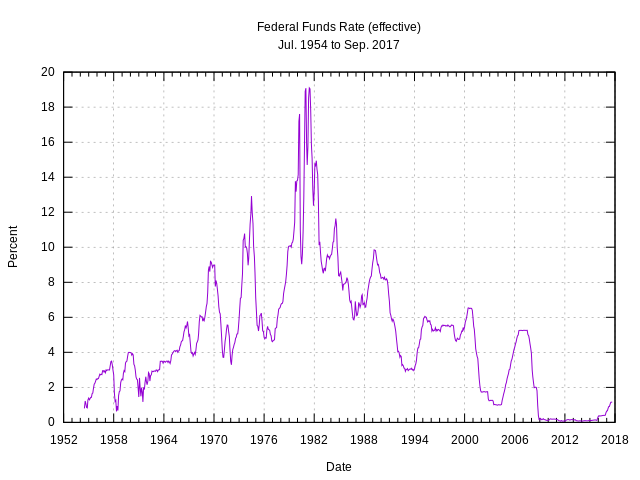
2305 students will be looking at the executive branch and at economic policy making - especially monetary policy - over the course of the semester. This story regarding the Fed touches on both. Let's look at some basic facts before digging into why the Fed did what it did. In a sense, this marks the end of the policies related to addressing the problems stemming from the Great Recession.
Three background questions
So, what is the Federal Funds Rate?
While we are at it, what is the Federal Reserve?
So what does the Federal Reserve Do?
Three background questions
So, what is the Federal Funds Rate?
The interest rate at which a depository institution lends funds maintained at the Federal Reserve to another depository institution overnight. The federal funds rate is generally only applicable to the most creditworthy institutions when they borrow and lend overnight funds to each other. The federal funds rate is one of the most influential interest rates in the U.S. economy, since it affects monetary and financial conditions, which in turn have a bearing on key aspects of the broad economy including employment, growth and inflation. The Federal Open Market Committee (FOMC), which is the Federal Reserve’s primary monetary policymaking body, telegraphs its desired target for the federal funds rate through open market operations. Also known as the “fed funds rate".
While we are at it, what is the Federal Reserve?
The central bank of the United States. The Fed, as it is commonly called, regulates the U.S. monetary and financial system. The Federal Reserve System is composed of a central governmental agency in Washington, D.C. (the Board of Governors) and twelve regional Federal Reserve Banks in major cities throughout the United States.
So what does the Federal Reserve Do?
Current functions of the Federal Reserve System include:
- To address the problem of banking panics
- To serve as the central bank for the United States
- To strike a balance between private interests of banks and the centralized responsibility of government
- To supervise and regulate banking institutions
- To protect the credit rights of consumers
- To manage the nation's money supply through monetary policy to achieve the sometimes-conflicting goals of
- - maximum employment
- - stable prices, including prevention of either inflation or deflation
- - moderate long-term interest rates
- To maintain the stability of the financial system and contain systemic risk in financial markets
- To provide financial services to depository institutions, the U.S. government, and foreign official institutions, including playing a major role in operating the nation's payments system
- To facilitate the exchange of payments among regions
- To respond to local liquidity needs
- To strengthen U.S. standing in the world economy
Friday, November 13, 2015
On state and local economic policy
Both of these articles are form Governing Magazine. The first investigates whether private efforts to spur economic development are preferable to public efforts and finds mixed results. The second questions a standard line made about cities, that they are economic entities oriented towards growth, but growth can upset existing power structures - so there can be resistance to it.
- Welcome to Jobs Inc., Where States Have Little Say in Economic Development.
- Welcome to Jobs Inc., Where States Have Little Say in Economic Development.
Go down the list and every apparent advantage of privatization seems to have an equal and opposite downside as well. Proponents claim that private economic development corporations are more responsive, but looser rules open up the possibility that they’ll cut corners in dubious ways. And they may not be more nimble at all, since new entities add their own layers of bureaucracy to the mix. The privatized entities typically are more flexible when it comes to managing their own personnel, but there have already been examples of staff being grossly overpaid as a result.
In short, while it might make sense to give development officials a leash longer than is the norm for government work, that approach offers no guarantee of success. “There is no evidence that privatizing economic development either helps or hurts economic development,” Timothy Bartik, an economist at the W.E. Upjohn Institute for Employment Research, says flatly.
- Do Cities Really Want Economic Development?
. . . economic struggle can be a cultural unifier in a community that people tacitly want to hold onto in order to preserve civic cohesion.
Jane Jacobs took it even further. As she noted in The Economy of Cities, “Economic development, whenever and wherever it occurs, is profoundly subversive of the status quo.” And it isn’t hard to figure out that even in cities and states with serious problems, many people inside the system are benefiting from the status quo.
They have political power, an inside track on government contracts, a nice gig at a civic organization or nonprofit, and so on. All of these people, who are disproportionately in the power broker class of most places, potentially stand to lose if economic decline is reversed. That’s not to say they are evil, but they all have an interest to protect.
From the Fiscal Times: The Mega-Danger of Mega-Deals: Monopolies Are Crushing U.S. Workers and Consumers
In 2305 - in our discussion of economic policy and specifically market failure - we mentioned that most economists argue that one role of the government in enhancing the free market is in breaking apart monopolies, or preventing them from forming in the first place.
Here's a story about concerns over recent mergers and what they might do to a freely functioning marketplace. There is a trend towards market concentration apparently.
- Click here for it.
Here's a story about concerns over recent mergers and what they might do to a freely functioning marketplace. There is a trend towards market concentration apparently.
- Click here for it.
This week, the American Medical Association formally asked the Department of Justice to block two health insurance mergers (Aetna’s purchase of Humana and Anthem’s acquisition of Cigna) that would reduce that industry to effectively three participants. Left unmentioned was the significant consolidation among health care providers that has helped spur the monopoly formation on the insurer side. After all, insurers lose bargaining power on prices when facing giant medical conglomerates, and regain it when they grow themselves.
This week, Anheuser-Busch InBev and SABMiller completed their $106 billion plan to combine, forming the world’s largest brewery, responsible for 30 percent of global beer sales. The new company said it would sell its stake in U.S. bottler MillerCoors to show regulators its commitment to competition. But it’s selling that stake to Molson Coors Brewing, its joint partner in the MillerCoors venture, diminishing its monopoly only by bolstering a large oligopoly partner. Molson Coors would instantly become the second-largest brewer in the U.S., right behind Anheuser-Busch InBev.
This week, Apple, Google and Amazon joined forces in a lobbying venture to promote technology-based financial services, or “fintech.” All the founding members of Financial Innovation Now have investments or outright subsidiaries in the fintech space. The teaming of three of the most powerful Silicon Valley firms to exploit a gap in financial regulation represents at least the appearance of collusion between companies nominally thought to oppose one another. It comes at a time when the same tech giants, along with Facebook and Microsoft, have entrenched control over the entire Internet infrastructure, from search to messaging to advertising to video and audio distribution to applications to storage.
Despite all these shifts in the economy, all moving toward greater market concentration, influencing every major issue for workers and consumers, the nation has met these changes with virtual silence. None of the major-party debates have posed a question about antitrust policy. Republican candidates talk around issues like high drug prices without mentioning that they are the by-products of monopoly. Stories pass through the news — like T-Mobile giving preferential treatment to a handful of companies for streaming services — without any recognition of how large companies get the benefit of a narrow market.
That story, and others like it, show how the new Gilded Age allows monopolists to help other monopolists, carving up the pie together and keeping out everyone else.
For more: Bring Back Antitrust.
Thursday, November 12, 2015
From the Fiscal Times: Here’s Why the GOP Can’t Stop Talking About the Gold Standard
While candidates for public office love talking about the gold standard, economists don't. Here's why:
- Click here for the article.
And more:
- Wall Street Journal: Greg Ip: What Republicans Get Wrong About the Gold Standard.
- The Atlantic: Why Are Republicans So Obsessed With the Gold Standard?
- Click here for the article.
And more:
- Wall Street Journal: Greg Ip: What Republicans Get Wrong About the Gold Standard.
- The Atlantic: Why Are Republicans So Obsessed With the Gold Standard?
Economic policy and the 4th Republican Debate
Conveniently enough, the fourth Republican debate was oriented towards economic policy. Here's commentary on the various claims and statements made by the candidates:
Forbes: The (Fourth) GOP Debate In Tweets From Investors, Economists And Pundits.
Update: Ballotpedia's entry on the debate highlighted the following discussion segments. A good number of them focused on economic policy.
- Click here for the page.
Here's the complete list - economic topics in bold:
1 - Minimum wage
2 - National debt and cutting federal spending
3 - Job creation
4 - Income inequality
5 - Media portrayal of candidates
6 - Economic impact of illegal immigration
7 - Technological advancement causing the loss of traditional jobs
8 - Entitlements
9 - Regulations on businesses
10 - Taxes
11 - The Trans-Pacific Partnership trade deal (TPP)
12 - National security and foreign affairs
13 - The financial crisis and bailouts
14 - Hillary Clinton
15 - Tax loopholes and businesses leaving the country
16 - Climate change
17 - Closing statements
Forbes: The (Fourth) GOP Debate In Tweets From Investors, Economists And Pundits.
Update: Ballotpedia's entry on the debate highlighted the following discussion segments. A good number of them focused on economic policy.
- Click here for the page.
Here's the complete list - economic topics in bold:
1 - Minimum wage
2 - National debt and cutting federal spending
3 - Job creation
4 - Income inequality
5 - Media portrayal of candidates
6 - Economic impact of illegal immigration
7 - Technological advancement causing the loss of traditional jobs
8 - Entitlements
9 - Regulations on businesses
10 - Taxes
11 - The Trans-Pacific Partnership trade deal (TPP)
12 - National security and foreign affairs
13 - The financial crisis and bailouts
14 - Hillary Clinton
15 - Tax loopholes and businesses leaving the country
16 - Climate change
17 - Closing statements
Will the Fed increase interest rates? If so, what will the effect be?
We've discussing economic policy in 2305, which involves a look at fiscal and monetary policy.
A key aspect of monetary policy involves the Fed's ability to influence interest rates. Since 2008 the Federal Funds Rate has been at 0% in order to stimulate the economy by making it cheaper to borrow money in order to boost the economy. We are a consumer based economy so that's how things roll.
For background:
- Wikipedia: Federal Funds Rate.
- Investopedia: Discount Rate.
But low interest rates have a tendency - historically - to overheat the economy, which leads to inflation, which leads to another crash. Pressure has built on the Fed to nip this in the bud by raising the federal funds rate, but it has resisted because doing so prematurely raising the rates can also weaken the economy and lead to a crash.
There's your dilemma - and what the Fed has to weigh as they make their decision.
Here's commentary from smarter people than me:
- NYT: When Will the Fed Raise Rates?
- The Fiscal Times: 10 Ways the Fed’s Looming Rate Hike Touches You.
- Here's a bit from Quartz's analysis:

A key aspect of monetary policy involves the Fed's ability to influence interest rates. Since 2008 the Federal Funds Rate has been at 0% in order to stimulate the economy by making it cheaper to borrow money in order to boost the economy. We are a consumer based economy so that's how things roll.
For background:
- Wikipedia: Federal Funds Rate.
- Investopedia: Discount Rate.
But low interest rates have a tendency - historically - to overheat the economy, which leads to inflation, which leads to another crash. Pressure has built on the Fed to nip this in the bud by raising the federal funds rate, but it has resisted because doing so prematurely raising the rates can also weaken the economy and lead to a crash.
There's your dilemma - and what the Fed has to weigh as they make their decision.
Here's commentary from smarter people than me:
- NYT: When Will the Fed Raise Rates?
- The Fiscal Times: 10 Ways the Fed’s Looming Rate Hike Touches You.
- Here's a bit from Quartz's analysis:
Americans are borrowing big again. The Federal Reserve’s credit numbers showed American consumers borrowed at an all-time record of $28.9 billion in September, besting the previous high-water mark set in November 2001. The surge wasn’t driven by mortgage lending, but by an ongoing rise in non-revolving credit—essentially car and student loans, which surged by more than $22 billion. Revolving debt—mainly credit-card debt—also increased, by $6.7 billion.
Wednesday, November 11, 2015
To do list for 2305
A couple subjects to cover:
1 - A look at market failure - an economists' look at what might justify governmental intervention in the economy:
monopolies
negative externalities
public goods
asymmetric information
2 - A brief walk through main episode in the history of economic policy making in the US:
- Hamiltonian Economic Program.
- First Bank of the United States.
- American School of Economics.
- Bank War.
- The Free Banking Era.
- Panic of 1837.
- Sherman Anti Trust Act.
- Panic of 1907.
- Federal Reserve System.
- Stock Market Crash.
- Great Depression.
- Keynesianism.
- Bretton Woods Conference.
- Deregulation and Reaganomics.
- North American Free Trade Agreement.
- Great Recession.
1 - A look at market failure - an economists' look at what might justify governmental intervention in the economy:
monopolies
negative externalities
public goods
asymmetric information
2 - A brief walk through main episode in the history of economic policy making in the US:
- Hamiltonian Economic Program.
- First Bank of the United States.
- American School of Economics.
- Bank War.
- The Free Banking Era.
- Panic of 1837.
- Sherman Anti Trust Act.
- Panic of 1907.
- Federal Reserve System.
- Stock Market Crash.
- Great Depression.
- Keynesianism.
- Bretton Woods Conference.
- Deregulation and Reaganomics.
- North American Free Trade Agreement.
- Great Recession.
Monday, November 9, 2015
From Federal Reserve Education.org: Monetary Policy Basics
For this week in 2305 as we begin to look at economic policy:
- Here's a link to the page.
Some highlights:
- Here's a link to the page.
Some highlights:
What is monetary policy? The term "monetary policy" refers to what the Federal Reserve, the nation's central bank, does to influence the amount of money and credit in the U.S. economy. What happens to money and credit affects interest rates (the cost of credit) and the performance of the U.S. economy.
What is inflation and how does it affect the economy? Inflation is a sustained increase in the general level of prices, which is equivalent to a decline in the value or purchasing power of money. If the supply of money and credit increases too rapidly over time, the result could be inflation.
What are the goals of monetary policy? The goals of monetary policy are to promote maximum employment, stable prices and moderate long-term interest rates. By implementing effective monetary policy, the Fed can maintain stable prices, thereby supporting conditions for long-term economic growth and maximum employment.
What are the tools of monetary policy? The Federal Reserve’s three instruments of monetary policy are open market operations, the discount rate and reserve requirements.
Open market operations involve the buying and selling of government securities. The term “open market” means that the Fed doesn’t decide on its own which securities dealers it will do business with on a particular day. Rather, the choice emerges from an “open market” in which the various securities dealers that the Fed does business with – the primary dealers – compete on the basis of price. Open market operations are flexible, and thus, the most frequently used tool of monetary policy.
The discount rate is the interest rate charged by Federal Reserve Banks to depository institutions on short-term loans.
Reserve requirements are the portions of deposits that banks must maintain either in their vaults or on deposit at a Federal Reserve Bank.
Thursday, July 2, 2015
Where did the proposal to increase overtime pay come from?
According to the New York Times, it came from an economist - Jared Bernstein - who had worked in the White House as the Chief Economist and Economic Adviser to Vice President Joseph Biden.
Upon leaving wrote a report describing the benefits of increasing the number of people who qualify for overtime pay. His idea was to set the level to where it as in 1975 and inflation-adjust it to today, and keep it set at the level of inflation. They also allow white collar workers - executives - to be eligible for overtime.
- Click here for the report.
Increasing overtime pay fits within the overall goals of increasing middle class incomes.
Liberal interest groups have been pushing this proposal for some time. Their arguments can be sumarized here:
- fixoverime.org.
- What the New Proposed Overtime Rules Mean for Workers.
For more:
- Obama's new overtime rules: How they'd work and who they'd affect.
- One Industry That Will Hate Obama’s New Overtime Rules: The Media.
- Republicans will hate Obama’s new overtime rule, but they can’t do anything about it.
Upon leaving wrote a report describing the benefits of increasing the number of people who qualify for overtime pay. His idea was to set the level to where it as in 1975 and inflation-adjust it to today, and keep it set at the level of inflation. They also allow white collar workers - executives - to be eligible for overtime.
- Click here for the report.
Increasing overtime pay fits within the overall goals of increasing middle class incomes.
Liberal interest groups have been pushing this proposal for some time. Their arguments can be sumarized here:
- fixoverime.org.
- What the New Proposed Overtime Rules Mean for Workers.
For more:
- Obama's new overtime rules: How they'd work and who they'd affect.
- One Industry That Will Hate Obama’s New Overtime Rules: The Media.
- Republicans will hate Obama’s new overtime rule, but they can’t do anything about it.
Thursday, June 18, 2015
Has the United States always promoted free trade?
In a word, no.
Until the end of World War 2 the United States actively protected domestic industry through tariffs in addition to a series of policies collectively known as the American School of Economics, which can be traced back to policies initiated by Alexander Hamilton.
The simple reason for the switch was that prior to the end of the war, the economy United States was still relatively small - albeit growing. Protecting emerging industries from larger, more powerful competitors was politically necessary. After the war - thanks to the needs of war production coupled with the destruction of its economic competitors - the United States was the world's dominant economy and did not have to worry about foreign competition. It was in a better position to turn the tables and dominate those economies that it has previously feared. It was also in a better position to establish and dominate international trading organizations in order to ensure that the rules it established would benefit domestic industry.
That said, it is still commonly pointed out that the United States still protects domestic industry, often due to the political pressures that those industries can place on elected officeholders. Economic policy is not set by economists immune from public pressure, but by politicians subject to removal from office in each and every election.
- 25 American Products That Rely On Huge Protective Tariffs To Survive.
For background:
- Economic Nationalism.
- American School.
- American System.
- Tariffs in United States history.
Some historical milestones - I'll add some commentary later:
Protectionist Period:
1789 - Tariffs of 1789.
1791 - Alexander Hamilton's Report on Manufactures.
1812 - War of 1812.
1816 - Tariff of 1816.
1828 - The Tariff of Abominations:
1842 - Tariff of 1842.
1844 - James Polk elected on a platform that opposed high tariffs.
1860 - Republican Party platform includes support for high tariffs.
1861 - The Morrill Tariff.
1905 - Taft-Katsura Agreement.
1913 - the Underwood Tariff - AKA - Revenue Act of 1913. The establishment of the income tax reduced the need for tariffs.
1922 - Fordney–McCumber Tariff.
1930 - The Smoot-Hawley Tariff.
1934 - Reciprocal Tariff Act.
Free Trade Period:
1944 - The Bretton Woods Conference.
1944 - World Bank.
1944 - International Monetary Fund.
1948 - General Agreement on Tariffs and Trade.
1986 to 1994 - Uruguay Round.
1994 - Marrakesh Agreement.
1994: North American Free Trade Agreement.
1995: World Trade Organization.
The Department of Commerce has a list of all the free trade agreements the United States has. It states that there are 14 in force with 20 countries.
- Click here for them.
Until the end of World War 2 the United States actively protected domestic industry through tariffs in addition to a series of policies collectively known as the American School of Economics, which can be traced back to policies initiated by Alexander Hamilton.
The simple reason for the switch was that prior to the end of the war, the economy United States was still relatively small - albeit growing. Protecting emerging industries from larger, more powerful competitors was politically necessary. After the war - thanks to the needs of war production coupled with the destruction of its economic competitors - the United States was the world's dominant economy and did not have to worry about foreign competition. It was in a better position to turn the tables and dominate those economies that it has previously feared. It was also in a better position to establish and dominate international trading organizations in order to ensure that the rules it established would benefit domestic industry.
That said, it is still commonly pointed out that the United States still protects domestic industry, often due to the political pressures that those industries can place on elected officeholders. Economic policy is not set by economists immune from public pressure, but by politicians subject to removal from office in each and every election.
- 25 American Products That Rely On Huge Protective Tariffs To Survive.
For background:
- Economic Nationalism.
- American School.
- American System.
- Tariffs in United States history.
Some historical milestones - I'll add some commentary later:
Protectionist Period:
1789 - Tariffs of 1789.
1791 - Alexander Hamilton's Report on Manufactures.
1812 - War of 1812.
1816 - Tariff of 1816.
1828 - The Tariff of Abominations:
1842 - Tariff of 1842.
1844 - James Polk elected on a platform that opposed high tariffs.
1860 - Republican Party platform includes support for high tariffs.
1861 - The Morrill Tariff.
1905 - Taft-Katsura Agreement.
1913 - the Underwood Tariff - AKA - Revenue Act of 1913. The establishment of the income tax reduced the need for tariffs.
1922 - Fordney–McCumber Tariff.
1930 - The Smoot-Hawley Tariff.
1934 - Reciprocal Tariff Act.
Free Trade Period:
1944 - The Bretton Woods Conference.
1944 - World Bank.
1944 - International Monetary Fund.
1948 - General Agreement on Tariffs and Trade.
1986 to 1994 - Uruguay Round.
1994 - Marrakesh Agreement.
1994: North American Free Trade Agreement.
1995: World Trade Organization.
The Department of Commerce has a list of all the free trade agreements the United States has. It states that there are 14 in force with 20 countries.
- Click here for them.
Wednesday, June 17, 2015
What is free trade and what is the point of it?
I'll start posting now items relate to the Trans Pacific Partnership, as promised. Since the agreement promotes free trade, it's not unwise to define what that means and how it differs from alternatives.
Here's a quick definition from Investopedia:
Along with a justification of it:
Free trade allows nations to concentrate on what they do best. It is then assumed that that increases overall wealth in the nation better than if it made everything itself. Countries that engage in free trade with other nations control their economies less than those that do. Free trade might then be best described as what it lacks than what it has. It protects its domestic businesses less than other nations meaning that it is less likely to impose protective tariffs and duties. But nations that engage in free trade are more likely to see outside forces disrupt internal institutions.
It is closely related to the ideas put forward in classical economics, which held that government should disrupt the economy as little as possible. The wealth of a nation had less to do with how much gold it had, or how much it did on its own, but in the value of the trade it could engage in.
Some definitions:
- Protectionism: These are trade policies which seek to protect domestic businesses and workers that might be harmed by external competition.
- Protective Tariff: A duty imposed on imports to raise their price, making them less attractive to consumers and thus protecting domestic industries from foreign competition.
- Tariffs: A tariff is a tax on imports or exports.
- Subsidies: A form of financial aid or support extended to an economic sector (or institution, business, or individual) generally with the aim of promoting economic and social policy.
For more:
- Library of Economics and Liberty: Free Trade.
The unrestricted purchase and sale of goods and services between countries without the imposition of constraints such as tariffs, duties and quotas.
Along with a justification of it:
Free trade is a win-win proposition because it enables nations to focus on their core competitive advantage(s), thereby maximizing economic output and fostering income growth for their citizens. Free trade enables nations to concentrate their efforts on manufacturing products or providing services where they have a distinct comparative advantage, according to the theory first espoused by economist David Ricardo two centuries ago. A free trade policy should enable a nation to generate enough foreign currency to purchase the products or services that it does not produce indigenously.
Free trade allows nations to concentrate on what they do best. It is then assumed that that increases overall wealth in the nation better than if it made everything itself. Countries that engage in free trade with other nations control their economies less than those that do. Free trade might then be best described as what it lacks than what it has. It protects its domestic businesses less than other nations meaning that it is less likely to impose protective tariffs and duties. But nations that engage in free trade are more likely to see outside forces disrupt internal institutions.
It is closely related to the ideas put forward in classical economics, which held that government should disrupt the economy as little as possible. The wealth of a nation had less to do with how much gold it had, or how much it did on its own, but in the value of the trade it could engage in.
Some definitions:
- Protectionism: These are trade policies which seek to protect domestic businesses and workers that might be harmed by external competition.
- Protective Tariff: A duty imposed on imports to raise their price, making them less attractive to consumers and thus protecting domestic industries from foreign competition.
- Tariffs: A tariff is a tax on imports or exports.
- Subsidies: A form of financial aid or support extended to an economic sector (or institution, business, or individual) generally with the aim of promoting economic and social policy.
For more:
- Library of Economics and Liberty: Free Trade.
Tuesday, April 8, 2014
From the Washinton Post: Obama to sign two executive orders aimed at narrowing gender gap in wages
This fits our discussion of economic policy making and civil rights and executive power - probably a few others as well.
- Click here for the article.
- Click here for the article.
President Obama will take two executive actions Tuesday aimed at narrowing the wage gap between men and women, forcing federal contractors to let their workers discuss their earnings with one another and to disclose more information about what their employees earn.
The push by Obama, who also is commemorating Tuesday as “National Equal Pay Day,” is part of a broader effort by Democrats to increase turnout among female voters during the 2014 midterm elections, which party strategists consider critical to limiting Republican gains this fall.
One of the new measures is an executive order prohibiting federal contractors from retaliating against workers who discuss their salaries with one another. The other is a presidential memorandum ordering new rules for contractors to file data with the federal government showing how they compensate employees, including by sex and race.
White House senior adviser Valerie Jarrett said Monday that the two policies aim to address the “pay secrecy” that often keeps workers from seeking more equitable compensation.
“Unfortunately, pay inequity is a real and persistent problem that continues to shortchange women, their families and our economy as a whole,” she told reporters in a conference call.
The first bill that Obama signed into law in 2009 was the Lilly Ledbetter Fair Pay Act, which gave employees more time to file discrimination claims. Jarrett said the administration is disappointed that Republicans in Congress have opposed another bill, the Paycheck Fairness Act, which includes reforms like the ones that Obama is applying to federal contractors.
Sunday, February 23, 2014
From the Atlantic: The Zombie Numbers That Rule the U.S. Economy
In 2305 we looked briefly at the budgeting process and will also look at economic policy making soon enough. Both make use of numbers that purport to tell us how the economy is doing - but here's a suggestion that those numbers are misleading.
- Click here for the article:
- Click here for the article:
We act as if they are markers from time immemorial, but in fact they were invented for modern industrial nations after the Depression and World War II and are now seriously outdated.
Take gross domestic product. Derived from formulas set down by the economist Simon Kuznets and others in the 1930s, its limitations have long been recognized, none more eloquently than by Robert F. Kennedy in a famous speech in 1968 when he declared that it measured everything except that which is worth measuring.
GDP treats all output as a positive. When you buy LED lights that obviate the need to spend on incandescent bulbs and reduce energy consumption, GDP goes down and what should be an unmitigated good becomes a statistical negative. If a coal company pollutes a river, the cleanup costs are positive for GDP, as are any health care costs for those harmed.
What’s more, we have also come to assume that with output comes more spending and employment, but factories today are powered by robotics and software, and robots don’t buy more lattes and shoes.
GDP is a good number for a nation that produces lots of stuff made by lots of workers, but for an information economy grounded in services and intellectual property and awash in apps that cost nothing yet enable commerce, it is not up to the task. Nor are many of our indicators. Our trade figures treat an iPhone made—more accurately, assembled—in China with no reference to the intellectual property created by Apple in California.
Sunday, February 9, 2014
From the Texas Tribune: Craft Brewers Celebrate New Beer Laws
The Texas Legislature made selling craft beer much easier last year:
This ties into our look at economic development policy in the state as well as the influence of interest groups in the state.
Marking the passage of sweeping Texas beer industry reform, Uncle Billy’s Brew & Que in Austin on Friday will load a keg onto a distributor’s truck, which, for the first time since Prohibition, will transport the beer to a bar six minutes up the street.
It will be the first transaction in what some predict could become a multibillion-dollar industry over the next decade.
Until January 1 of this year, brewpubs like Uncle Billy’s could only sell their product on site: If you wanted an Uncle Billy’s beer, you had to go to Uncle Billy’s. That changed with the passage of Senate Bills 515, 516, 517, 518 and 639 last year, the largest overhaul of the beer industry since the Legislature legalized brewpubs in 1993.
Under the new rules, the cap on brewpub production doubled, growing from 5,000 barrels a year to 10,000. Now, brewpubs can distribute their beer using third-party distributors, and they can sell limited amounts of their own beer directly to retailers.
Rick Engel, the co-founder of Uncle Billy’s, opened Texas’ first brewpub in Houston in 1993, the first year brewpubs were made legal since Prohibition. Since then he has been working with members of the Texas Craft Brewers Guild to pass major reforms to beer laws.
Sunday, September 29, 2013
380 agreements
The article linked to in the previous post mentions 380 agreements. Here's my best at describing what these are and what they tell us about state and local policy making. I've added the appropriate links so you can find out where they are described more fully and what the issues surrounding them tend to be.
The simple description is that they are allowances for Texas cities to enter into agreements with private entities in order to provide assistance for economic development.
The are named after Chapter 380 of the Texas Local Government Code.
- Click here for a presentation by the Texas City Attorney Association about the agreements.
- Click here for the actual code.
Here's a description from the Comptroller's Office:
There is a comparable agreement - 381 - that allows counties to offer similar incentives.
You can also find a good run description by clicking on the website of the International Business District. From what I can see the district appears to be promoting 380's to individuals and business who seek to work with them.
The City of Houston has entered into over a dozen 380 agreements since they were established - no more than six can be funded at one time.
- Click here for a list of them.
The Parker Administration has entered into a great number of these - we had a question in class about her tenure in office and what she has accomplished. She makes the argument that these agreements have increased the economic vitality of certain areas of town and the quality of life there as well.
That doesn't mean they have not been controversial. One of the agreements was with the developer who helped build a Walmart in the Heights. Critics argued that the largest corporation in the US did not need a local tax abatement, but it got one anyway.
Here are a few related links that ought to help fill in gaps. One of the areas where I am deficient is in discussing land use policy on the state and local level. Hopefully this helps fill in some of that gap.
- Residents don't like details of 380 agreement.
- Mayor Parker defends incentives to lure development.
- Comment of the day.
- That mysterious 380 agreement.
The simple description is that they are allowances for Texas cities to enter into agreements with private entities in order to provide assistance for economic development.
The are named after Chapter 380 of the Texas Local Government Code.
- Click here for a presentation by the Texas City Attorney Association about the agreements.
- Click here for the actual code.
Here's a description from the Comptroller's Office:
Chapter 380 of the Local Government Code authorizes municipalities to offer incentives designed to promote economic development such as commercial and retail projects. Specifically, it provides for offering loans and grants of city funds or services at little or no cost to promote state and local economic development and to stimulate business and commercial activity.
In order to provide a grant or loan, a city must establish a program to implement the incentives. Before proceeding, cities must review their city charters or local policies that may restrict a city's ability provide a load or grant.
There is a comparable agreement - 381 - that allows counties to offer similar incentives.
You can also find a good run description by clicking on the website of the International Business District. From what I can see the district appears to be promoting 380's to individuals and business who seek to work with them.
The City of Houston has entered into over a dozen 380 agreements since they were established - no more than six can be funded at one time.
- Click here for a list of them.
The Parker Administration has entered into a great number of these - we had a question in class about her tenure in office and what she has accomplished. She makes the argument that these agreements have increased the economic vitality of certain areas of town and the quality of life there as well.
That doesn't mean they have not been controversial. One of the agreements was with the developer who helped build a Walmart in the Heights. Critics argued that the largest corporation in the US did not need a local tax abatement, but it got one anyway.
Here are a few related links that ought to help fill in gaps. One of the areas where I am deficient is in discussing land use policy on the state and local level. Hopefully this helps fill in some of that gap.
- Residents don't like details of 380 agreement.
- Mayor Parker defends incentives to lure development.
- Comment of the day.
- That mysterious 380 agreement.
Saturday, August 31, 2013
Is Texas' economic growth due to economic policies or increased oil production?
One of the books available for 2306 argues that Texas' economic policies have created recent boom in jobs, and that other states should emulate them. But here's an observation that that states that have grown the most in recent years have oil based economies.
That's tough to replicate.

That's tough to replicate.
Is it possible that the Great Plains simply have better zoning laws, better governors, better entrepreneurial incentives, better schools, and better [other things that you typically associate with growth]? Yes, it is possible that the entire central time zone is magically gifted at matching people and jobs. It's also really, really unlikely. More likely is that the Great Plains have some of the positive aforementioned qualities -- Houston's zoning policies are exemplary, e.g. -- but most importantly, they did well because many of them shared something in common at the trans-state level: bountiful energy resources under their feet.
Take the five or so states with fastest-growing oil production -- ND, TX, OK, CO, NM -- and draw their post-crash job performance against the rest of the country. This is the picture you get. Except for New Mexico, the four top oil-growth states fell lower and have climbed higher than the rest of the country.
Sunday, May 19, 2013
Seven Myths about Keynesian Economics
From the Fiscal Times, something to sock away for our look at economic policymaking soon enough.
Wednesday, April 10, 2013
The metro goods to services ratio
This is a measure of which cities primarily provide services and which primarily produce goods. There's no detail about this data, so I don't know what to make of it, but we can see how Houston stands apart from other areas in the nation. We still make stuff - or more accurately, refine stuff.

Subscribe to:
Posts (Atom)