- "Don't panic": Texas Education Agency sends instructions on police interaction curriculum.
- Senate passes bill requiring schools to teach teens about interacting with police.
- The Texas Commision on Law Enforcement.
- Here’s what Texas voters should know for the 2018 midterms.
- Legislation and procedural changes affectingTexas Commission on Law Enforcement.
- Oyez: Gill v Whitford.
- Supreme Court Agrees To Hear Wisconsin Gerrymandering Case.
Monday, October 8, 2018
The Living New Deal
This site might help make sense of the concept of cooperative federalism.
It has a map with links to the various projects funded by the national government.
- Click here for the site.
- For New Deal sites in Texas click here.
It has a map with links to the various projects funded by the national government.
- Click here for the site.
- For New Deal sites in Texas click here.


Friday, October 5, 2018
Sample Ballots
For perusal prior to election day
- Brazoria County.
- Fort Bend County.
- Galveston County.
- Harris County.
- Brazoria County.
- Fort Bend County.
- Galveston County.
- Harris County.
From the Texas Tribune: Army Corps set to propose hurricane protection plan for Houston
For 2306, a national response - not to Harvey, but to Ike.
- Click here for the article.
- Background: The Army Corp of Engineers.
/https://static.texastribune.org/media/images/Galveston-IkeDike.png)
The Army Corps estimates that the cost of the recommended plan will range between $22 billion and $30 billion. The Houston-area barrier may cost as much as $17 billion with the rest going toward ecosystem restoration projects.
Members of the public — even those living outside Texas — will have until Jan. 9 to weigh in on the Army Corps’ chosen plan. Six public meetings are in the works, although the Army Corps also plans to take feedback online and via mail. Three meetings will be held in the Houston-Galveston area, the others in communities further down the coast that would be impacted by the ecosystem restorations projects.
The Army Corps may tweak the plan based on public feedback, Burks-Copes said. The final version is expected to be complete by 2021, when it will be eligible for funding by Congress.
How soon that could happen is anyone’s guess given the uncertainty of politics, though several members of Texas’ congressional delegation — including Sen. John Cornyn, a Republican — have championed the cause.
- Click here for the article.
- Background: The Army Corp of Engineers.
The Army Corps estimates that the cost of the recommended plan will range between $22 billion and $30 billion. The Houston-area barrier may cost as much as $17 billion with the rest going toward ecosystem restoration projects.
Members of the public — even those living outside Texas — will have until Jan. 9 to weigh in on the Army Corps’ chosen plan. Six public meetings are in the works, although the Army Corps also plans to take feedback online and via mail. Three meetings will be held in the Houston-Galveston area, the others in communities further down the coast that would be impacted by the ecosystem restorations projects.
The Army Corps may tweak the plan based on public feedback, Burks-Copes said. The final version is expected to be complete by 2021, when it will be eligible for funding by Congress.
How soon that could happen is anyone’s guess given the uncertainty of politics, though several members of Texas’ congressional delegation — including Sen. John Cornyn, a Republican — have championed the cause.
Thursday, October 4, 2018
From the NYT: Planning to Vote in the November Election? Why Most Americans Probably Won’t
No news here.
- Click for the article.
This year’s election carries enormous political stakes, but if history is any guide, the vast majority of eligible voters will stay home on Election Day. Slightly more than a third of eligible voters turned out across the country in the last midterm elections, the lowest share since 1942, according to Michael McDonald, a political scientist at the University of Florida, who runs the United States Elections Project that tracks voting data back to 1789.
And while turnout has been higher in this season’s special elections and primaries, experts say that in November it is still unlikely to break out of the middling range it has been stuck in for nearly a century.
People typically cite one of two reasons for why they do not vote in midterm elections: they are either too busy or not interested, according to Dr. McDonald’s analysis of responses to the Census Bureau from 2000 to 2016.
“The costs of voting are not terribly high compared to the way they’ve been at times in American history,” said Benjamin Highton, a political scientist at the University of California at Davis, who has studied voter ID laws. “People simply have other things they are more interested in, like making ends meet on a day-to-day basis.”
- Click for the article.
This year’s election carries enormous political stakes, but if history is any guide, the vast majority of eligible voters will stay home on Election Day. Slightly more than a third of eligible voters turned out across the country in the last midterm elections, the lowest share since 1942, according to Michael McDonald, a political scientist at the University of Florida, who runs the United States Elections Project that tracks voting data back to 1789.
And while turnout has been higher in this season’s special elections and primaries, experts say that in November it is still unlikely to break out of the middling range it has been stuck in for nearly a century.
People typically cite one of two reasons for why they do not vote in midterm elections: they are either too busy or not interested, according to Dr. McDonald’s analysis of responses to the Census Bureau from 2000 to 2016.
“The costs of voting are not terribly high compared to the way they’ve been at times in American history,” said Benjamin Highton, a political scientist at the University of California at Davis, who has studied voter ID laws. “People simply have other things they are more interested in, like making ends meet on a day-to-day basis.”
Tuesday, October 2, 2018
From Vox: Brett Kavanaugh and the Supreme Court’s drastic shift to the right, cartoonsplained President Trump’s pick to replace Anthony Kennedy will lead to a much more conservative Court.
This should help explain why the conflict over the Kavanaugh appointment is so heated.
- Click here for the article.
:no_upscale()/cdn.vox-cdn.com/uploads/chorus_asset/file/11665903/top.png)
- Click here for the article.
From Vox: The Trump administration’s threat against safe injection sites is working No US city has opened a safe injection site. The Trump administration wants to keep it that way.
California is to Trump what Texas was to Obama.
Background: What Is Harm Reduction?
- Click here for the article.
Background: What Is Harm Reduction?
- Click here for the article.
The idea: While in an ideal world, no one would use dangerous and potentially deadly drugs, many people do. So it’s better to give these people a space where they can use drugs with some sort of supervision. It’s a harm reduction approach.
Brown was unreceptive to this idea, describing it as “enabling illegal drug use.” But he also cited another concern: “[A]lthough this bill creates immunity under state law, it can’t create such immunity under federal law. In fact, the United States Attorney General has already threatened prosecution and it would be irresponsible to expose local officials and health care professionals to potential federal criminal charges.”
Under Attorney General Jeff Sessions and Deputy Attorney General Rod Rosenstein, the Trump administration — particularly the US Department of Justice — has threatened states and cities looking to open supervised consumption sites. Rosenstein recently published an op-ed in the New York Times criticizing the sites; he also issued a warning to city officials and potential beneficiaries of supervised consumption sites on the NPR member station WHYY in Philadelphia.
“It remains illegal under federal law,” Rosenstein said. “And people engaged in that activity remain vulnerable to civil and criminal enforcement.”
To defend its position, the Justice Department has cited a law originally meant to stop crack houses, noting, “It is a crime, not only to use illicit narcotics, but to manage and maintain sites on which such drugs are used and distributed.”
This threat appears to have deterred Brown from allowing supervised consumption sites in his own state, citing the possibility of federal prosecution. In other words, the threat is working.
Three stories from Governing Magazine. Two on policy diffusion, one on state referenda elections on Medicaid expansion
Policy Diffusion
California's New Marijuana Law Is a First But Likely Not the Last.
California Becomes First State to End Cash-Bail System.
Referenda Elections
November Offers Major Test of Medicaid Expansion's Support in Red States.
California's New Marijuana Law Is a First But Likely Not the Last.
California Becomes First State to End Cash-Bail System.
Referenda Elections
November Offers Major Test of Medicaid Expansion's Support in Red States.
Monday, October 1, 2018
From the New York Times: How a Conservative TV Giant Is Ridding Itself of Regulation
A look at the increasing influence of media company that owns a large number of television stations around the nation.
Related items:
Sinclair Broadcast Group.
Ajit V. Pai.
Federal Communications Commission.
Tribune Media.
National Association of Broadcasters.
- Click here for the article.
The day before President Trump’s inauguration, the top executive of the Sinclair Broadcast Group, the nation’s largest owner of television stations, invited an important guest to the headquarters of the company’s Washington-area ABC affiliate.
The trip was, in the parlance of the business world, a deal closer.
The invitation from David D. Smith, the chairman of Sinclair, went to Ajit V. Pai, a commissioner on the Federal Communications Commission who was about to be named the broadcast industry’s chief regulator. Mr. Smith wanted Mr. Pai to ease up on efforts under President Barack Obama to crack down on media consolidation, which were threatening Sinclair’s ambitions to grow even bigger.
Mr. Smith did not have to wait long.
Within days of their meeting, Mr. Pai was named chairman of the F.C.C. And during his first 10 days on the job, he relaxed a restriction on television stations’ sharing of advertising revenue and other resources — the exact topic that Mr. Pai discussed with Mr. Smith and one of his business partners, according to records examined by The New York Times.
“These are invaluable and effective tools, which were taken away by the commission,” according to a summary of their meeting filed with the F.C.C.
It was only the beginning. Since becoming chairman in January, Mr. Pai has undertaken a deregulatory blitz, enacting or proposing a wish list of fundamental policy changes advocated by Mr. Smith and his company. Hundreds of pages of emails and other documents obtained under the Freedom of Information Act reveal a rush of regulatory actions has been carefully aligned with Sinclair’s business objectives.
The moves, which include easing a cap on how many stations a broadcaster can own, have opened up lucrative opportunities for Mr. Smith, among them a $3.9 billion bid to buy Tribune Media, another large owner of stations.
Related items:
Sinclair Broadcast Group.
Ajit V. Pai.
Federal Communications Commission.
Tribune Media.
National Association of Broadcasters.
- Click here for the article.
The day before President Trump’s inauguration, the top executive of the Sinclair Broadcast Group, the nation’s largest owner of television stations, invited an important guest to the headquarters of the company’s Washington-area ABC affiliate.
The trip was, in the parlance of the business world, a deal closer.
The invitation from David D. Smith, the chairman of Sinclair, went to Ajit V. Pai, a commissioner on the Federal Communications Commission who was about to be named the broadcast industry’s chief regulator. Mr. Smith wanted Mr. Pai to ease up on efforts under President Barack Obama to crack down on media consolidation, which were threatening Sinclair’s ambitions to grow even bigger.
Mr. Smith did not have to wait long.
Within days of their meeting, Mr. Pai was named chairman of the F.C.C. And during his first 10 days on the job, he relaxed a restriction on television stations’ sharing of advertising revenue and other resources — the exact topic that Mr. Pai discussed with Mr. Smith and one of his business partners, according to records examined by The New York Times.
“These are invaluable and effective tools, which were taken away by the commission,” according to a summary of their meeting filed with the F.C.C.
It was only the beginning. Since becoming chairman in January, Mr. Pai has undertaken a deregulatory blitz, enacting or proposing a wish list of fundamental policy changes advocated by Mr. Smith and his company. Hundreds of pages of emails and other documents obtained under the Freedom of Information Act reveal a rush of regulatory actions has been carefully aligned with Sinclair’s business objectives.
The moves, which include easing a cap on how many stations a broadcaster can own, have opened up lucrative opportunities for Mr. Smith, among them a $3.9 billion bid to buy Tribune Media, another large owner of stations.
Is social media to blame for political polarization?
Research seem to suggests it does not.
Vox - Something is breaking American politics, but it's not social media.
Pew Research Center: APSA conference roundup: Research on political polarization on social media and the U.S. Congress.
What if social media isn’t driving rising polarization in American politics?
That’s the conclusion of a new paper by Levi Boxell, Matthew Gentzkow, and Jesse Shapiro. Their study, released recently through the National Bureau of Economic Research, tests the conventional wisdom about polarization on social media nine ways from Sunday and finds that it’s wrong, or at least badly incomplete.
Their approach is simple. Using data from the American National Election Survey, they compare the most web-savvy voters (the young, where 80 percent used social media in 2012) and the least web-savvy voters (the old, where fewer than 20 percent used social media in 2012) on nine different tests of political polarization. The measures cover everything from feelings about political parties to ideological consistency to straight-ticket voting, and the data shows how polarization changed among these groups between 1996 and 2012.
The results? On fully eight of the nine measures, “polarization increases more for the old than the young.” If Facebook is the problem, then how come the problem is worst among those who don’t use Facebook?
Polarization is happening mostly among old folks.
Vox - Something is breaking American politics, but it's not social media.
Pew Research Center: APSA conference roundup: Research on political polarization on social media and the U.S. Congress.
What if social media isn’t driving rising polarization in American politics?
That’s the conclusion of a new paper by Levi Boxell, Matthew Gentzkow, and Jesse Shapiro. Their study, released recently through the National Bureau of Economic Research, tests the conventional wisdom about polarization on social media nine ways from Sunday and finds that it’s wrong, or at least badly incomplete.
Their approach is simple. Using data from the American National Election Survey, they compare the most web-savvy voters (the young, where 80 percent used social media in 2012) and the least web-savvy voters (the old, where fewer than 20 percent used social media in 2012) on nine different tests of political polarization. The measures cover everything from feelings about political parties to ideological consistency to straight-ticket voting, and the data shows how polarization changed among these groups between 1996 and 2012.
The results? On fully eight of the nine measures, “polarization increases more for the old than the young.” If Facebook is the problem, then how come the problem is worst among those who don’t use Facebook?
Polarization is happening mostly among old folks.
Voter Participation in Texas
We'll go over this chart in class, several times.
- Click here for it.
For more on turnout and election results in general, click on these below:
- Texas Almanac.
- United States Elections Project.
- Click here for it.
For more on turnout and election results in general, click on these below:
- Texas Almanac.
- United States Elections Project.
From the CBO: Federal Grants to State and Local Governments
This is an old report - 2013, I'll look for a newer version - but it'll give us a good look at the precise nature of the grants states and local governments get from the federal government.
- Click here for the report.
- And here.
Note the top areas of spending
1 - Health
2 - Income Security (welfare)
3 - Education
4 - Transportation
Neither Social Security nor Medicare are included since both are run by the national government.

- Click here for the report.
- And here.
Note the top areas of spending
1 - Health
2 - Income Security (welfare)
3 - Education
4 - Transportation
Neither Social Security nor Medicare are included since both are run by the national government.
From The Texas Tribune: Texas spent less on students with disabilities. But did it break the law?
Covered in 2306 this morning. More conflict between Texas and the national government.
- Click here for the article.
. . . the U.S. government says Texas violated an unambiguous federal law requiring states to maintain the same amount of funding each year for special education services in order to continue to be eligible for federal special education grants. Steering clear of literary devices to argue its case, the federal government is claiming in court that Texas needs to be stripped of $33.3 million in federal funds — the same amount that the state cut.
A panel of three judges will hear from both sides Wednesday morning in New Orleans, and determine whether Secretary of Education Betsy DeVos' decision to take away Texas' funding should stand. Texas lost its challenge at the U.S. Department of Education's Office of Hearings and Appeals in May, and in July successfully petitioned the 5th Circuit to take up the case.
If Texas fails to defend its decrease in spending, it stands to lose the equivalent of about 3 percent of its annual federal special education grant.
This week's argument comes months after the U.S. Department of Education, in a separate investigation, found Texas was failing to provide many students with disabilities with an adequate education and effectively denying services to thousands of students who needed extra support. State education officials are now tackling a long list of federally mandated reforms to special education, including closely monitoring and supporting schools struggling to properly educate kids with disabilities.
Many educators told federal investigators that they saw evaluating students for special education services as a "last resort" for students having trouble learning, a major violation of federal law. Texas spent less in 2011-12 in part because its percentage of kids in special education dropped that year to 8.6 percent — the lowest rate in the country.
- Click here for the article.
. . . the U.S. government says Texas violated an unambiguous federal law requiring states to maintain the same amount of funding each year for special education services in order to continue to be eligible for federal special education grants. Steering clear of literary devices to argue its case, the federal government is claiming in court that Texas needs to be stripped of $33.3 million in federal funds — the same amount that the state cut.
A panel of three judges will hear from both sides Wednesday morning in New Orleans, and determine whether Secretary of Education Betsy DeVos' decision to take away Texas' funding should stand. Texas lost its challenge at the U.S. Department of Education's Office of Hearings and Appeals in May, and in July successfully petitioned the 5th Circuit to take up the case.
If Texas fails to defend its decrease in spending, it stands to lose the equivalent of about 3 percent of its annual federal special education grant.
This week's argument comes months after the U.S. Department of Education, in a separate investigation, found Texas was failing to provide many students with disabilities with an adequate education and effectively denying services to thousands of students who needed extra support. State education officials are now tackling a long list of federally mandated reforms to special education, including closely monitoring and supporting schools struggling to properly educate kids with disabilities.
Many educators told federal investigators that they saw evaluating students for special education services as a "last resort" for students having trouble learning, a major violation of federal law. Texas spent less in 2011-12 in part because its percentage of kids in special education dropped that year to 8.6 percent — the lowest rate in the country.
From the Washington Post: The Trump administration is suing California to quash its new net neutrality law
Covered in 2305 this morning, this covers lots that we've hit on this semester.
A few relevant links:
- net neutrality.
- FCC.
- common carrier.
- Click here for the article.
The Trump administration said Sunday it will sue California in an effort to block what some experts have described as the toughest net neutrality law ever enacted in the United States, setting up a high-stakes legal showdown over the future of the Internet.
California on Sunday became the largest state to adopt its own rules requiring Internet providers like AT&T, Comcast and Verizon to treat all web traffic equally. Golden State legislators took the step of writing their law after the Federal Communications Commission scrapped nationwide protections last year, citing the regulatory burdens they had caused for the telecom industry.
Mere hours after California’s proposal became law, however, senior Justice Department officials told The Washington Post they would take the state to court on grounds that the federal government, not state leaders, has the exclusive power to regulate net neutrality. DOJ officials stressed the FCC had been granted such authority from Congress to ensure that all 50 states don’t seek to write their own, potentially conflicting, rules governing the web.
A few relevant links:
- net neutrality.
- FCC.
- common carrier.
- Click here for the article.
The Trump administration said Sunday it will sue California in an effort to block what some experts have described as the toughest net neutrality law ever enacted in the United States, setting up a high-stakes legal showdown over the future of the Internet.
California on Sunday became the largest state to adopt its own rules requiring Internet providers like AT&T, Comcast and Verizon to treat all web traffic equally. Golden State legislators took the step of writing their law after the Federal Communications Commission scrapped nationwide protections last year, citing the regulatory burdens they had caused for the telecom industry.
Mere hours after California’s proposal became law, however, senior Justice Department officials told The Washington Post they would take the state to court on grounds that the federal government, not state leaders, has the exclusive power to regulate net neutrality. DOJ officials stressed the FCC had been granted such authority from Congress to ensure that all 50 states don’t seek to write their own, potentially conflicting, rules governing the web.
Friday, September 28, 2018
From the Texas Tribune: Attorney General Ken Paxton defends Texas law requiring students to stand for Pledge of Allegiance
We covered this in 2306 earlier this week.
Tricky territory given the looming election and past decisions by the Supreme Court.
- Click here for the article.
The morning of Oct. 2, 2017 was not the first time that India Landry, a senior at Windfern High School outside Houston, refused to stand when the Pledge of Allegiance came on over the intercom.
The protest had gotten her kicked out of her English class five times; her law teacher told her she was disrespectful, according to a 2017 lawsuit. But on that October morning, when the then-17-year-old refused to stand, she was expelled.
Landry, who is black and had sat through the daily Pledge of Allegiance some 200 times as a form of protest, was sitting in the principal’s office that morning when the pledge rang through over the intercom. When she failed to stand, court documents allege, Principal Martha Strother told her, “Well, you’re kicked outta here.”
“This is not the NFL,” the principal’s secretary told her, according to court documents.
That expulsion — which a court filing says was reversed days later with little explanation — has sparked a legal battle that this week expanded to include Texas Attorney General Ken Paxton, who intervened in the case on Tuesday.
As tensions mount nationally over football players who kneel during the national anthem at televised games, the issue has become a new front in Texas’ culture wars. Randall Kallinen, Landry’s lawyer, is representing two Houston-area students who say administrators punished them after they after they sat through the pledge as a form of protest. Landry and Kallinen argue that a state law requiring students to stand for the pledge of allegiance violates her First Amendment right to free speech. The district declined to comment on pending litigation.
The Texas Education Code states that schools “shall require students, once during each school day at each campus,” to recite the Pledge of Allegiance. But it also directs schools to “excuse the student” from reciting the pledge “on written request from a student’s parent or guardian.”
The teenager’s mother, Kizzy Landry, was supportive of her daughter’s protest, Kallinen said, though the lawyer could not recall whether she had filed a written statement with the school.
In any case, Kallinen argues in court documents, the principal “said that sitting was disrespectful and would not be allowed.”
The law, Kallinen argues, violates students’ free speech rights even though it offers parents the chance to opt out.
The relevant Supreme Court decisions are :
- Minersville School District v. Gobitis.
- West Virginia State Board of Education v. Barnette.
While reading this, we read up on Francis Bellamy, the author of the original version of the Pledge of Allegiance and the person responsible for the Bellamy Salute.
Tricky territory given the looming election and past decisions by the Supreme Court.
- Click here for the article.
The morning of Oct. 2, 2017 was not the first time that India Landry, a senior at Windfern High School outside Houston, refused to stand when the Pledge of Allegiance came on over the intercom.
The protest had gotten her kicked out of her English class five times; her law teacher told her she was disrespectful, according to a 2017 lawsuit. But on that October morning, when the then-17-year-old refused to stand, she was expelled.
Landry, who is black and had sat through the daily Pledge of Allegiance some 200 times as a form of protest, was sitting in the principal’s office that morning when the pledge rang through over the intercom. When she failed to stand, court documents allege, Principal Martha Strother told her, “Well, you’re kicked outta here.”
“This is not the NFL,” the principal’s secretary told her, according to court documents.
That expulsion — which a court filing says was reversed days later with little explanation — has sparked a legal battle that this week expanded to include Texas Attorney General Ken Paxton, who intervened in the case on Tuesday.
As tensions mount nationally over football players who kneel during the national anthem at televised games, the issue has become a new front in Texas’ culture wars. Randall Kallinen, Landry’s lawyer, is representing two Houston-area students who say administrators punished them after they after they sat through the pledge as a form of protest. Landry and Kallinen argue that a state law requiring students to stand for the pledge of allegiance violates her First Amendment right to free speech. The district declined to comment on pending litigation.
The Texas Education Code states that schools “shall require students, once during each school day at each campus,” to recite the Pledge of Allegiance. But it also directs schools to “excuse the student” from reciting the pledge “on written request from a student’s parent or guardian.”
The teenager’s mother, Kizzy Landry, was supportive of her daughter’s protest, Kallinen said, though the lawyer could not recall whether she had filed a written statement with the school.
In any case, Kallinen argues in court documents, the principal “said that sitting was disrespectful and would not be allowed.”
The law, Kallinen argues, violates students’ free speech rights even though it offers parents the chance to opt out.
The relevant Supreme Court decisions are :
- Minersville School District v. Gobitis.
- West Virginia State Board of Education v. Barnette.
While reading this, we read up on Francis Bellamy, the author of the original version of the Pledge of Allegiance and the person responsible for the Bellamy Salute.
Wednesday, September 26, 2018
From Lawfare: Remembering the Whiskey Rebellion
A brief description of the first internal conflict using national military force.
- Click here for it.
- Click here for it.
Monday, September 17, 2018
From Governing: Shades of Purple - Colorado is one of the most closely divided states in the nation. In the race for governor, now far left is it willing to go?
For this week's written assignment for my GOVT 2306 ACC classes. The article describes how party primaries are impacting state politics. I want 2306 students to outline the argument.
This will also be useful for my 2305 students, since it touches on the topic of the 1000 word esay.
- Click here for the article.
Around the country, candidates in both parties are doing their best to fire up their bases. In campaigns for governor, candidates are talking a lot about national issues that excite partisan constituencies -- not least Trump himself, whether they’re Republicans pledging fealty to the president or Democrats who are repulsed by him. They’re not devoting nearly as much time or focus to the state-level issues they’ll actually grapple with as governor. “It probably won’t hinge on who has the best road proposal or who has the best plan for K-12,” says Bill Owens, the last Republican governor of Colorado. “It’s winnable for either party, but it’s about who is able to define the other as too extreme. It’s who can make the most ad hominem attacks.”
Although this may be a familiar scenario in many states this year, it’s still a little bit surprising that things are playing out this way in Colorado, which is among the most closely divided states in the country. Registered independents there outnumber both Democrats and Republicans. Democrats narrowly control the state House, but Republicans have a one-seat advantage in the state Senate. Hickenlooper just barely managed to hold on for reelection during the 2014 GOP wave, taking 49 percent against a weak opponent. Colorado Republicans won all the other statewide contests during that last midterm, including a U.S. Senate seat held by a Democrat. Hillary Clinton carried the state by five points in 2016 and now Trump’s approval ratings are deep underwater. “With the right candidate, this state trends slightly red,” Democratic consultant Ted Trimpa says. “Anyone who thinks it’s going to be a blowout either way is high.”
In a state split between its Democratic cities and conservative rural areas, most elections are decided by the swing voters in suburban Jefferson and Arapahoe counties. But neither Polis nor Stapleton seems to feel that his best hope lies in appealing to the mythical middle voter. Instead, both camps are working to excite their core supporters, in large part by tearing down the other guy as being beyond the pale. “Moving toward the middle is probably an outdated paradigm,” says Joe Webb, who chairs the Jefferson County Republican Party.
This will also be useful for my 2305 students, since it touches on the topic of the 1000 word esay.
- Click here for the article.
Around the country, candidates in both parties are doing their best to fire up their bases. In campaigns for governor, candidates are talking a lot about national issues that excite partisan constituencies -- not least Trump himself, whether they’re Republicans pledging fealty to the president or Democrats who are repulsed by him. They’re not devoting nearly as much time or focus to the state-level issues they’ll actually grapple with as governor. “It probably won’t hinge on who has the best road proposal or who has the best plan for K-12,” says Bill Owens, the last Republican governor of Colorado. “It’s winnable for either party, but it’s about who is able to define the other as too extreme. It’s who can make the most ad hominem attacks.”
Although this may be a familiar scenario in many states this year, it’s still a little bit surprising that things are playing out this way in Colorado, which is among the most closely divided states in the country. Registered independents there outnumber both Democrats and Republicans. Democrats narrowly control the state House, but Republicans have a one-seat advantage in the state Senate. Hickenlooper just barely managed to hold on for reelection during the 2014 GOP wave, taking 49 percent against a weak opponent. Colorado Republicans won all the other statewide contests during that last midterm, including a U.S. Senate seat held by a Democrat. Hillary Clinton carried the state by five points in 2016 and now Trump’s approval ratings are deep underwater. “With the right candidate, this state trends slightly red,” Democratic consultant Ted Trimpa says. “Anyone who thinks it’s going to be a blowout either way is high.”
In a state split between its Democratic cities and conservative rural areas, most elections are decided by the swing voters in suburban Jefferson and Arapahoe counties. But neither Polis nor Stapleton seems to feel that his best hope lies in appealing to the mythical middle voter. Instead, both camps are working to excite their core supporters, in large part by tearing down the other guy as being beyond the pale. “Moving toward the middle is probably an outdated paradigm,” says Joe Webb, who chairs the Jefferson County Republican Party.
From Vox: Why the right to vote is not enshrined in the Constitution - How voter suppression became a political weapon in American politics.
For this week's writing assignment for my ACC GOVT 2305 students. Explain the following article to me.
- Click here for the article.
The Founding Fathers made a lot of mistakes when they drafted the United States Constitution. Some of these were the result of extremely difficult compromises, and some of them were just, well, mistakes.
The biggest and most consequential mistake, one could argue, was the decision not to guarantee the right to vote to anyone. Suffrage was treated as a privilege reserved exclusively for property-owning white men, but it was not enshrined as an inalienable right in the Constitution.
Instead, these men placed power in the hands of the states, which is one reason the right to vote in the US has expanded and contracted over time with continuous battles over voter ID laws, literacy tests, poll taxes, and other measures designed to keep specific groups, like women and African Americans, from voting.
It’s difficult to overstate the price — moral and political — we’ve paid for this mistake. But a new book by American University history professor Allan Lichtman does a nice job of explaining it. The Embattled Vote in America is a sweeping look at the history of voting rights in the US, focusing on the constant struggle to extend suffrage in this country.
I spoke to Lichtman recently about how voting restrictions put American democracy at risk, why the right to vote is so important, and what we can do to solve this problem once and for all.
A lightly edited transcript of our conversation follows.
Read on ....
- Click here for the article.
The Founding Fathers made a lot of mistakes when they drafted the United States Constitution. Some of these were the result of extremely difficult compromises, and some of them were just, well, mistakes.
The biggest and most consequential mistake, one could argue, was the decision not to guarantee the right to vote to anyone. Suffrage was treated as a privilege reserved exclusively for property-owning white men, but it was not enshrined as an inalienable right in the Constitution.
Instead, these men placed power in the hands of the states, which is one reason the right to vote in the US has expanded and contracted over time with continuous battles over voter ID laws, literacy tests, poll taxes, and other measures designed to keep specific groups, like women and African Americans, from voting.
It’s difficult to overstate the price — moral and political — we’ve paid for this mistake. But a new book by American University history professor Allan Lichtman does a nice job of explaining it. The Embattled Vote in America is a sweeping look at the history of voting rights in the US, focusing on the constant struggle to extend suffrage in this country.
I spoke to Lichtman recently about how voting restrictions put American democracy at risk, why the right to vote is so important, and what we can do to solve this problem once and for all.
A lightly edited transcript of our conversation follows.
Read on ....
From the Texas Tribune: With a supermajority, Republicans have complete control of the Texas Senate. That's at risk this election cycle.
Senate Republicans might have to compromise with Democrats next session.
- Click here for the article.
Republican lawmakers in the Texas Senate were sitting pretty last year.
For years, the GOP had faced roadblocks to passing some conservative measures by the chamber’s two-thirds rule, which normally required the support of 21 members to get a bill to the floor. With 20 Republicans in the chamber, that left Republicans one short of moving out bills without the help of a single Democrat.
But then in 2015, Lt. Gov. Dan Patrick led a successful move to lower the threshold from two-thirds to three-fifths. Suddenly, any measure with the backing of all of the chamber’s Republicans had all the support it needed. For that session and the ones that followed in 2017, the GOP effectively ran the Senate floor.
Now, with less than two months until Election Day, Republicans are finding that keeping that supermajority in the Texas Senate is no longer a sure thing.
“We’re emphasizing the possibility of losses,” said Darl Easton, the Republican Party Chairman in Tarrant County, where state Sen. Konni Burton's re-election bid is seen as a potential toss-up. “The more complacent you become, the more likely it is that you won’t win. We definitely have to keep the voters alert to the possibility of losing some seats. We’re not going to take anything for granted.”
“We are working and making sure we’re leaving no stone unturned,” added Missy Shorey, the Dallas County Republican Party chairwoman, speaking of the party’s efforts in assisting state Sen. Don Huffines, R-Dallas. “People in Dallas certainly know there’s no chance that seat is going to flip. [Huffines] is working for every vote out there.”
The Senate is still poised to remain GOP-dominated during next year’s legislative session. What’s at stake for the chamber’s Republicans this election cycle is losing their three-fifths majority — the crucial threshold for bringing legislation to the Senate floor without any support from Democrats.
- Click here for the article.
Republican lawmakers in the Texas Senate were sitting pretty last year.
For years, the GOP had faced roadblocks to passing some conservative measures by the chamber’s two-thirds rule, which normally required the support of 21 members to get a bill to the floor. With 20 Republicans in the chamber, that left Republicans one short of moving out bills without the help of a single Democrat.
But then in 2015, Lt. Gov. Dan Patrick led a successful move to lower the threshold from two-thirds to three-fifths. Suddenly, any measure with the backing of all of the chamber’s Republicans had all the support it needed. For that session and the ones that followed in 2017, the GOP effectively ran the Senate floor.
Now, with less than two months until Election Day, Republicans are finding that keeping that supermajority in the Texas Senate is no longer a sure thing.
“We’re emphasizing the possibility of losses,” said Darl Easton, the Republican Party Chairman in Tarrant County, where state Sen. Konni Burton's re-election bid is seen as a potential toss-up. “The more complacent you become, the more likely it is that you won’t win. We definitely have to keep the voters alert to the possibility of losing some seats. We’re not going to take anything for granted.”
“We are working and making sure we’re leaving no stone unturned,” added Missy Shorey, the Dallas County Republican Party chairwoman, speaking of the party’s efforts in assisting state Sen. Don Huffines, R-Dallas. “People in Dallas certainly know there’s no chance that seat is going to flip. [Huffines] is working for every vote out there.”
The Senate is still poised to remain GOP-dominated during next year’s legislative session. What’s at stake for the chamber’s Republicans this election cycle is losing their three-fifths majority — the crucial threshold for bringing legislation to the Senate floor without any support from Democrats.
Thursday, September 13, 2018
For GOVT 2306
- From Governing: Transit Advocates: Is the White House Purposefully Delaying Project Funds?
Transit advocates are becoming increasingly alarmed that the Trump administration may be intentionally slowing down the process for local agencies to get the money they need to build new projects, like light rail, streetcars and bus rapid transit.
The U.S. Department of Transportation is sitting on nearly $1.8 billion for projects that are ready or nearly ready for final federal approval, according to Transportation for America, a group that promotes local transportation improvement efforts. Specifically, the group is concerned that the Federal Transit Administration (FTA) is not distributing money from its New Starts, Small Starts and Core Capacity programs, which all help local transit agencies pay for big-ticket construction projects.
The delays at the FTA affect rail projects in and around Chicago, Dallas, Minneapolis and New York City. They could impact new streetcar service in Sacramento, Calif.; Tempe, Ariz.; and Orange County, Calif. And new rapid bus service in El Paso, Jacksonville, Fla., Reno, Nev., Seattle and St. Petersburg, Fla. could be delayed as well.
The backlog may actually be even bigger than that, says Beth Osborne, a former Obama administration official who now works for Transportation for America. It’s hard to know exactly how much money is waiting to be distributed, she says, because the Trump administration has released fewer details than previous administrations about the status of projects. (The Obama administration’s 2016 report, for example, was 189 pages long, while the Trump administration’s corresponding 2018 report is just 20 pages long. The FTA says it no longer includes information on individual projects in those reports, because details are available online.)
- State Supreme Courts Increasingly Face Partisan Impeachment Threats.
Attacks on judicial independence are becoming more frequent and more partisan. The current effort to impeach the entire West Virginia Supreme Court, while not unprecedented, is taking place against a backdrop of political attacks against judges elsewhere.
"There's a kind of a war going on between the legislatures and the courts," says Chris Bonneau, a political scientist at the University of Pittsburgh. "Absolutely, we're seeing a new environment."
The West Virginia House last month voted to impeach all the sitting justices on the state Supreme Court. The state Senate is set to begin its impeachment trial Tuesday. There were legitimate reasons for legislators to go after justices, or at least some of them.
. . . West Virginia Democrats have accused Republicans of staging a coup by impeaching the entire court. The allegations of criminal impropriety had been known for months, but legislators waited until last month to act -- missing a deadline to let voters, rather than the governor, fill any vacancies. (Justice Robin Davis resigned, rather than face an impeachment trial, to give voters a chance to pick her replacement.) Republican Gov. Jim Justice did little to assuage complaints of partisan meddling in the courts by appointing two politicians, state House Speaker Tim Armstead and Congressman Evan Jenkins, to interim posts on the court last week. It's not unheard of for sitting politicians to be appointed to court seats, but it's not the common practice.
Judicial impeachments actually were rather common in earlier eras. During the 19th century, for instance, New Hampshire's legislature made a habit of clearing out the entire state Supreme Court, doing so on at least five occasions.
- Gov. Abbott orders increased readiness ahead of possible tropical storm.
Gov. Greg Abbott has ordered the Texas State Operations Center (SOC) to elevate its readiness level as a potential tropical system is expected to develop and move into the Gulf of Mexico and toward the Texas coast later this week.
The SOC will increase its readiness level from level IV (normal conditions) to level III (increased readiness) beginning at 12 p.m. on Tuesday, Sept. 11. Additionally, Gov. Abbott has made state resources available to assist local officials in their response efforts.
“We are closely monitoring a tropical system expected to approach the Gulf of Mexico and potentially impact the Texas coast in the coming days,” said Governor Abbott. “In light of recent heavy rainfall across the state, we are on high-alert as any additional rain could quickly create dangerous flash flooding conditions. I urge all Texans to take precautions and review their emergency plans now to prepare for any potential impact to their community.”
State and partner agencies engaged in this effort include:
- Texas Department of Public Safety (Texas Highway Patrol)
- Texas Department of Transportation
- Texas Engineering & Extension Service
- Texas Parks & Wildlife Department
- Texas Forest Service
- Texas Military Department
- Texas Department of State Health Services
- Texas Commission on Environmental Quality
- American Red Cross
- The Salvation Army
Transit advocates are becoming increasingly alarmed that the Trump administration may be intentionally slowing down the process for local agencies to get the money they need to build new projects, like light rail, streetcars and bus rapid transit.
The U.S. Department of Transportation is sitting on nearly $1.8 billion for projects that are ready or nearly ready for final federal approval, according to Transportation for America, a group that promotes local transportation improvement efforts. Specifically, the group is concerned that the Federal Transit Administration (FTA) is not distributing money from its New Starts, Small Starts and Core Capacity programs, which all help local transit agencies pay for big-ticket construction projects.
The delays at the FTA affect rail projects in and around Chicago, Dallas, Minneapolis and New York City. They could impact new streetcar service in Sacramento, Calif.; Tempe, Ariz.; and Orange County, Calif. And new rapid bus service in El Paso, Jacksonville, Fla., Reno, Nev., Seattle and St. Petersburg, Fla. could be delayed as well.
The backlog may actually be even bigger than that, says Beth Osborne, a former Obama administration official who now works for Transportation for America. It’s hard to know exactly how much money is waiting to be distributed, she says, because the Trump administration has released fewer details than previous administrations about the status of projects. (The Obama administration’s 2016 report, for example, was 189 pages long, while the Trump administration’s corresponding 2018 report is just 20 pages long. The FTA says it no longer includes information on individual projects in those reports, because details are available online.)
- State Supreme Courts Increasingly Face Partisan Impeachment Threats.
Attacks on judicial independence are becoming more frequent and more partisan. The current effort to impeach the entire West Virginia Supreme Court, while not unprecedented, is taking place against a backdrop of political attacks against judges elsewhere.
"There's a kind of a war going on between the legislatures and the courts," says Chris Bonneau, a political scientist at the University of Pittsburgh. "Absolutely, we're seeing a new environment."
The West Virginia House last month voted to impeach all the sitting justices on the state Supreme Court. The state Senate is set to begin its impeachment trial Tuesday. There were legitimate reasons for legislators to go after justices, or at least some of them.
. . . West Virginia Democrats have accused Republicans of staging a coup by impeaching the entire court. The allegations of criminal impropriety had been known for months, but legislators waited until last month to act -- missing a deadline to let voters, rather than the governor, fill any vacancies. (Justice Robin Davis resigned, rather than face an impeachment trial, to give voters a chance to pick her replacement.) Republican Gov. Jim Justice did little to assuage complaints of partisan meddling in the courts by appointing two politicians, state House Speaker Tim Armstead and Congressman Evan Jenkins, to interim posts on the court last week. It's not unheard of for sitting politicians to be appointed to court seats, but it's not the common practice.
Judicial impeachments actually were rather common in earlier eras. During the 19th century, for instance, New Hampshire's legislature made a habit of clearing out the entire state Supreme Court, doing so on at least five occasions.
- Gov. Abbott orders increased readiness ahead of possible tropical storm.
Gov. Greg Abbott has ordered the Texas State Operations Center (SOC) to elevate its readiness level as a potential tropical system is expected to develop and move into the Gulf of Mexico and toward the Texas coast later this week.
The SOC will increase its readiness level from level IV (normal conditions) to level III (increased readiness) beginning at 12 p.m. on Tuesday, Sept. 11. Additionally, Gov. Abbott has made state resources available to assist local officials in their response efforts.
“We are closely monitoring a tropical system expected to approach the Gulf of Mexico and potentially impact the Texas coast in the coming days,” said Governor Abbott. “In light of recent heavy rainfall across the state, we are on high-alert as any additional rain could quickly create dangerous flash flooding conditions. I urge all Texans to take precautions and review their emergency plans now to prepare for any potential impact to their community.”
State and partner agencies engaged in this effort include:
- Texas Department of Public Safety (Texas Highway Patrol)
- Texas Department of Transportation
- Texas Engineering & Extension Service
- Texas Parks & Wildlife Department
- Texas Forest Service
- Texas Military Department
- Texas Department of State Health Services
- Texas Commission on Environmental Quality
- American Red Cross
- The Salvation Army
From 538: Americans Are Shifting The Rest Of Their Identity To Match Their Politics
For ACC 2305 students, this might be helpful for the 1000 word essay.
- Click here for the article.
We generally think of a person’s race or religion as being fixed — and that those parts of identity (being black, say, or evangelical Christian) drive political views. Most African-Americans vote Democratic. Most evangelical Christians vote Republican. But New York University political scientist Patrick Egan has written a new paper showing evidence that identity and politics operate in the opposite direction too — people shift the non-political parts of their identity, including ethnicity and religion, to align better with being a Democrat or a Republican.
Egan used public opinion data collected through the General Social Survey, one of the most reliable measures of Americans’ views of political and social attitudes that we have. The GSS is conducted every two years and surveys a rotating panel of respondents. Some respondents agree to follow-up interviews two years and four years after their initial interview. Egan’s data set was made up of about 3,900 people who were interviewed three times for the GSS surveys, starting either in 2006, 2008 or 2010 (so the most recent data was from people interviewed in 2010, 2012 and 2014). All three times, respondents were asked to rank themselves on a seven-point ideological scale (from “extremely liberal,” to “moderate, middle of the road,” to “extremely conservative.”) They were also asked questions about aspects of their identity that, at least in theory, are non-ideological — questions like: 1) “From what countries or part of the world did your ancestors come?” and 2) “What is your religious preference? Is it Protestant, Catholic, Jewish, some other religion, or no religion?”
There was more inconsistency among answers to these types of questions than I would have expected. For example, about a quarter of people who identified themselves as born-again Christian in at least one of the three interviews either had not described themselves that way in a previous interview or stopped describing themselves that way in a later interview. Nearly half of respondents who identified themselves as lesbian, gay or bisexual at some point during the three interviews did not identify themselves that way in all three (meaning that some people stopped identifying as LGB, while others started to after not having done so at first).
- Click here for the article.
We generally think of a person’s race or religion as being fixed — and that those parts of identity (being black, say, or evangelical Christian) drive political views. Most African-Americans vote Democratic. Most evangelical Christians vote Republican. But New York University political scientist Patrick Egan has written a new paper showing evidence that identity and politics operate in the opposite direction too — people shift the non-political parts of their identity, including ethnicity and religion, to align better with being a Democrat or a Republican.
Egan used public opinion data collected through the General Social Survey, one of the most reliable measures of Americans’ views of political and social attitudes that we have. The GSS is conducted every two years and surveys a rotating panel of respondents. Some respondents agree to follow-up interviews two years and four years after their initial interview. Egan’s data set was made up of about 3,900 people who were interviewed three times for the GSS surveys, starting either in 2006, 2008 or 2010 (so the most recent data was from people interviewed in 2010, 2012 and 2014). All three times, respondents were asked to rank themselves on a seven-point ideological scale (from “extremely liberal,” to “moderate, middle of the road,” to “extremely conservative.”) They were also asked questions about aspects of their identity that, at least in theory, are non-ideological — questions like: 1) “From what countries or part of the world did your ancestors come?” and 2) “What is your religious preference? Is it Protestant, Catholic, Jewish, some other religion, or no religion?”
There was more inconsistency among answers to these types of questions than I would have expected. For example, about a quarter of people who identified themselves as born-again Christian in at least one of the three interviews either had not described themselves that way in a previous interview or stopped describing themselves that way in a later interview. Nearly half of respondents who identified themselves as lesbian, gay or bisexual at some point during the three interviews did not identify themselves that way in all three (meaning that some people stopped identifying as LGB, while others started to after not having done so at first).
Wednesday, September 12, 2018
From Governing: Dead Reckoning - America's system of coroners and medical examiners is facing unprecedented challenges.
For my HCC GOVT 2306 student's written assignment. Tell me what's going on in this article.
- Click here for it.
- Click here for it.
Kentucky has historically been considered a national model in its death investigations. It was the first state to implement a dual coroner and medical examiner system, something it’s had in place since 1973. That has given the state an important balance of elected leadership and forensic know-how. Coroners are elected county officials responsible for investigating any death that’s deemed unnatural. Once elected, they go through death investigation training with the Kentucky Department of Criminal Justice and are expected to keep up 18 hours of continuing education. They work with state medical examiners to determine the exact cause of death and decide whether an autopsy or toxicology test is needed, which a medical examiner would have to perform.
But it’s a system that has been strained in recent years. Pollard, who also serves as director of the Kentucky Coroner’s Association, made headlines last year for convincing one state medical examiner to stay on after the doctor had announced his resignation, citing a lack of funding and resources to properly do his job. The National Association of Medical Examiners recommends that professionals not perform more than 250 autopsies a year; Kentucky is averaging about 280, according to Pollard. “We need two more doctors. That would ease our caseload tremendously,” he says. In Henry County, Pollard used to investigate around 26 cases in his county per year in the 1990s. In recent years, that number has risen to around 66.
These issues aren’t singular to Kentucky. Coroners, medical examiners, forensic pathologists -- and people who wear more than one of those hats -- say their profession is more vital than ever before, particularly in the midst of the opioid epidemic. But low pay, long hours and heavy debt loads carried by young physicians make it hard to recruit and retain talented people.
America’s system for investigating deaths is a patchwork quilt of different laws, procedures and job descriptions. From state to state -- and even from one county to the next -- there can be variations in how sudden deaths are handled. “Unlike primary care or obstetrics, it’s the one specialty in medicine that’s practiced differently depending on where you live,” says Gregory Davis, former associate chief medical examiner for Kentucky.
Confusing matters even more, qualifications for each title also vary depending on state statute. Coroners are overwhelmingly an elected or politically appointed position, a tradition that dates back centuries to when they were simply tax collectors for the deceased; America’s first coroner took office in 1636 in Plymouth County, Mass. Some states require a coroner to be a physician; other states only stipulate that you must be 18 and have no felony convictions.
- Wikipedia: Coroner.
- Wikipedia: Coroner.
Monday, September 10, 2018
From the New York Times: Congressional G.O.P. Agenda Quietly Falls Into Place Even as Trump Steals the Spotlight
For GOVT 2305's weekly assignment. Tell me what's going on here:
- Click here for the article.
On one end of Pennsylvania Avenue this week, President Trump and his closest advisers labored to beat back perceptions, fueled by an anonymous essay in The New York Times and a bruising new book by Bob Woodward, that he had all but lost control of the presidency from within. He lashed out anew at his attorney general, shouted “TREASON” and demanded investigations of his detractors.
But as he raged, Republicans in the Senate were pressing steadily through angry liberal protests and Democratic perjury traps toward perhaps the most lasting impact of the Trump era: a conservative shift in the balance of the Supreme Court capable of shaping the country for a generation.
The dueling images of a president on the edge and a conservative Congress soldiering forward explain succinctly why almost all elected Republicans here have quietly supported Mr. Trump through his travails — or at least not chastised him too loudly. The payoffs for what Senator Jeff Flake, Republican of Arizona, called the party’s “Faustian bargain” have been rich and long awaited: deep cuts in corporate and personal tax rates, confirmation of a wave of conservative judges for the lower courts, and soon an ideological shift in the highest court of the land.
“Process and personality is what we are talking about — how they do things, how dysfunctional it is and how off the rails he can be,” said Senator Lindsey Graham, Republican of South Carolina, conceding that Mr. Trump was “a handful.” But, he said, “what I am talking about is results.”
- Click here for the article.
On one end of Pennsylvania Avenue this week, President Trump and his closest advisers labored to beat back perceptions, fueled by an anonymous essay in The New York Times and a bruising new book by Bob Woodward, that he had all but lost control of the presidency from within. He lashed out anew at his attorney general, shouted “TREASON” and demanded investigations of his detractors.
But as he raged, Republicans in the Senate were pressing steadily through angry liberal protests and Democratic perjury traps toward perhaps the most lasting impact of the Trump era: a conservative shift in the balance of the Supreme Court capable of shaping the country for a generation.
The dueling images of a president on the edge and a conservative Congress soldiering forward explain succinctly why almost all elected Republicans here have quietly supported Mr. Trump through his travails — or at least not chastised him too loudly. The payoffs for what Senator Jeff Flake, Republican of Arizona, called the party’s “Faustian bargain” have been rich and long awaited: deep cuts in corporate and personal tax rates, confirmation of a wave of conservative judges for the lower courts, and soon an ideological shift in the highest court of the land.
“Process and personality is what we are talking about — how they do things, how dysfunctional it is and how off the rails he can be,” said Senator Lindsey Graham, Republican of South Carolina, conceding that Mr. Trump was “a handful.” But, he said, “what I am talking about is results.”
From Governing: How the Midterms Could Impact Medicaid - The elections come at a crucial time for health care.
For this week's 2306 written assignment. Medicaid is the largest of the programs that fall under the category of "cooperative federalism."
I've asked students to outline the issue raised in this article.
- Click here for the article.
The fate of Medicaid expansion, a central tenet of President Obama's signature health-care legislation, is in the hands of the people in several states.
In Idaho, Nebraska and Utah, voters will decide whether to make more low-income people, those up to 138 percent of the federal poverty line, eligible for Medicaid, the government-run health insurance program. In most of the other states, who voters elect as governor and to the legislature will influence the direction of this health-care policy for years to come.
Since the Affordable Care Act passed in 2010, 33 states have expanded Medicaid, largely along partisan lines, with Republicans leading the holdout movement. But in some cases, Republican governors tried for years to convince their GOP legislatures to expand.
Health policy experts say that, generally, a state's status of expansion guides which races are most important to watch in the midterms.
"For a state that hasn’t yet expanded, the governor can’t do it all, so you have to watch what happens with the legislature," says David Jones, associate professor of health law at Boston University who recently examined where Medicaid expansion appears more vulnerable. "But for states that have already expanded, the legislature doesn’t matter as much" because the governor has authority to tweak the current law or to end expansion in some cases.
The midterms come at a crucial time for health care. The Trump administration gave states the greenlight to adopt new rules for Medicaid that the Obama administration rejected. For instance, Arkansas, Kentucky, Indiana and New Hampshire have been approved to add work requirements, and several other states have applied. In July, a federal judge struck down Kentucky's work requirements plan, putting the rest of the states' policies into legal jeopardy. Despite the ruling, the Trump administration has signaled that it plans to proceed with work requirements.
I've asked students to outline the issue raised in this article.
- Click here for the article.
The fate of Medicaid expansion, a central tenet of President Obama's signature health-care legislation, is in the hands of the people in several states.
In Idaho, Nebraska and Utah, voters will decide whether to make more low-income people, those up to 138 percent of the federal poverty line, eligible for Medicaid, the government-run health insurance program. In most of the other states, who voters elect as governor and to the legislature will influence the direction of this health-care policy for years to come.
Since the Affordable Care Act passed in 2010, 33 states have expanded Medicaid, largely along partisan lines, with Republicans leading the holdout movement. But in some cases, Republican governors tried for years to convince their GOP legislatures to expand.
Health policy experts say that, generally, a state's status of expansion guides which races are most important to watch in the midterms.
"For a state that hasn’t yet expanded, the governor can’t do it all, so you have to watch what happens with the legislature," says David Jones, associate professor of health law at Boston University who recently examined where Medicaid expansion appears more vulnerable. "But for states that have already expanded, the legislature doesn’t matter as much" because the governor has authority to tweak the current law or to end expansion in some cases.
The midterms come at a crucial time for health care. The Trump administration gave states the greenlight to adopt new rules for Medicaid that the Obama administration rejected. For instance, Arkansas, Kentucky, Indiana and New Hampshire have been approved to add work requirements, and several other states have applied. In July, a federal judge struck down Kentucky's work requirements plan, putting the rest of the states' policies into legal jeopardy. Despite the ruling, the Trump administration has signaled that it plans to proceed with work requirements.
Friday, September 7, 2018
Wednesday, September 5, 2018
For GOVT 2306 - 9/5/18
All from The Texas Tribune:
- Here's a look at who's interested in replacing Straus as House speaker.
- Why Supreme Court Justice Brett Kavanaugh would be good news for Texas Republicans.
- Federal judge denies Texas' request to halt DACA — for now.
- Dallas County’s secret bail machine.
- Judge strikes down Texas law requiring burial or cremation of fetal remains.
- Lawmakers couldn't agree on property tax reform, but Texas homeowners can still get some relief.
- Here's a look at who's interested in replacing Straus as House speaker.
- Why Supreme Court Justice Brett Kavanaugh would be good news for Texas Republicans.
- Federal judge denies Texas' request to halt DACA — for now.
- Dallas County’s secret bail machine.
- Judge strikes down Texas law requiring burial or cremation of fetal remains.
- Lawmakers couldn't agree on property tax reform, but Texas homeowners can still get some relief.
Monday, September 3, 2018
Frontiero v. Richardson
I'm watching the CNN documentary on Ruth Bader Ginsburg and it points out her role in the first case which directly addressed gender discrimination.
We'll go over it in 2305 when we cover Civil Rights.
- Oyez.
From Oyez:
Question: Did a federal law, requiring different qualification criteria for male and female military spousal dependency, unconstitutionally discriminate against women thereby violating the Fifth Amendment's Due Process Clause?
Conclusion: Yes. The Court held that the statute in question clearly commanded "dissimilar treatment for men and women who are similarly situated," violating the Due Process Clause and the equal protection requirements that clause implied. A majority could not agree on the standard of review, however. The plurality opinion written by Justice William J. Brennan, Jr., applying a strict standard of review to the sex-based classification as it would to racial classification, found that the government's interest in administrative convenience could not justify discriminatory practices. But a concurring opinion by Justice Lewis F. Powell and joined by Chief Justice Warren E. Burger and Justice Harry A. Blackmun would not go so far as to hold sex discrimination to the same standard as race, choosing instead to argue that statutes drawing lines between the sexes alone necessarily involved the "very kind of arbitrary legislative choice forbidden by the Constitution," an approach employed in the Court's prior decision in Reed v. Reed. Justice Potter Stewart concurred separately that the statutes created invidious discrimination in violation of the Constitution. Justice William H. Rehnquist dissented affirming the reasoning of the lower court opinion.
We'll go over it in 2305 when we cover Civil Rights.
- Oyez.
From Oyez:
Question: Did a federal law, requiring different qualification criteria for male and female military spousal dependency, unconstitutionally discriminate against women thereby violating the Fifth Amendment's Due Process Clause?
Conclusion: Yes. The Court held that the statute in question clearly commanded "dissimilar treatment for men and women who are similarly situated," violating the Due Process Clause and the equal protection requirements that clause implied. A majority could not agree on the standard of review, however. The plurality opinion written by Justice William J. Brennan, Jr., applying a strict standard of review to the sex-based classification as it would to racial classification, found that the government's interest in administrative convenience could not justify discriminatory practices. But a concurring opinion by Justice Lewis F. Powell and joined by Chief Justice Warren E. Burger and Justice Harry A. Blackmun would not go so far as to hold sex discrimination to the same standard as race, choosing instead to argue that statutes drawing lines between the sexes alone necessarily involved the "very kind of arbitrary legislative choice forbidden by the Constitution," an approach employed in the Court's prior decision in Reed v. Reed. Justice Potter Stewart concurred separately that the statutes created invidious discrimination in violation of the Constitution. Justice William H. Rehnquist dissented affirming the reasoning of the lower court opinion.
From Vox: California is this close to its boldest energy target yet: 100% clean electricity
Here's an example of policy diffusion:
- Click here for the article.
California is one signature away from committing to 100 percent clean electricity. If it does so, it will become the most significant political jurisdiction in the world to take that step, by a wide margin. (It is the world’s fifth-largest economy!) The state is on the verge of making history — again.
SB 100, the bill sponsored by state Sen. Kevin de León, would set a target of 100 percent carbon-free electricity by 2045. It passed the California Senate last year, passed the state Assembly on Tuesday, and was reconciled by the Senate on Thursday. All that remains is a signature from Gov. Jerry Brown, which is expected soon (though there’s a bit of fuss around that — more on that in a second).
How big a deal is this?
Very big. For one thing, there’s enormous power and symbolism in “100 percent.” This instantly sets a new marker for others to match. I guarantee, before this time next year, there will be news of ambitious states, provinces, or countries following California’s lead.
But it’s also important to understand that SB 100 is not some big leap for California, or a flash out of the blue. It’s another step in a path — toward less pollution and more clean energy — that the state has been walking steadily for more than 15 years.
- Click here for the article.
California is one signature away from committing to 100 percent clean electricity. If it does so, it will become the most significant political jurisdiction in the world to take that step, by a wide margin. (It is the world’s fifth-largest economy!) The state is on the verge of making history — again.
SB 100, the bill sponsored by state Sen. Kevin de León, would set a target of 100 percent carbon-free electricity by 2045. It passed the California Senate last year, passed the state Assembly on Tuesday, and was reconciled by the Senate on Thursday. All that remains is a signature from Gov. Jerry Brown, which is expected soon (though there’s a bit of fuss around that — more on that in a second).
How big a deal is this?
Very big. For one thing, there’s enormous power and symbolism in “100 percent.” This instantly sets a new marker for others to match. I guarantee, before this time next year, there will be news of ambitious states, provinces, or countries following California’s lead.
But it’s also important to understand that SB 100 is not some big leap for California, or a flash out of the blue. It’s another step in a path — toward less pollution and more clean energy — that the state has been walking steadily for more than 15 years.
Friday, August 31, 2018
Covered in GOVT 2306 this week
- Trump-appointed judges are shifting the country’s most politically conservative circuit court further to the right.
. . . Trump's appointments, according to interviews with experts and 5th Circuit practitioners, have begun to shift an already right-leaning court toward a more monolithic brand of conservatism. These are judges, experts say, whose views are less hidden and whose outcomes are easier to predict. Compared with their colleagues appointed by other Republican presidents, their philosophies are less idiosyncratic; so far, they have seldom surprised. And as their numbers swell, the 5th Circuit is teetering toward a tipping point — one that might, in the next close vote, mark a monumental shift on a political issue that divides the country.
“Anybody out there that runs a group that litigates will notice that vote and is going to be thinking about it,” said David Coale, an appellate lawyer who frequently appears before the 5th Circuit. “It isn’t just that they’re conservative, though they are conservative. They’re waving a big flag.”
Trump entered office with more vacancies on the federal bench than many of his predecessors, thanks in part to the machinations of Senate Majority Leader Mitch McConnell, R-Kentucky. The president’s judicial nominations outfit, centered in the White House Counsel’s Office, has been uncharacteristically efficient, churning out a steady stream of judges who are highly qualified — and, critics say, highly ideological — and sending them down the conveyor belt for confirmation by the U.S. Senate.
“Despite all the chaos in Trump world … the president’s judicial nominees team is a finely operating machine,” said Josh Blackman, a prominent conservative lawyer and a law professor at South Texas College of Law Houston.
- Texas teachers unions sue education agency over charter partnership law.
Two teacher associations sued Texas Education Commissioner Mike Morath and the Texas Education Agency on Wednesday, arguing they rolled out a law incentivizing partnerships with school districts and charter schools in a way that weakened protections for public school employees.
The lawsuit, filed in Travis County District Court, centers on Senate Bill 1882, which lets traditional school districts partner with outside organizations — including charter schools and nonprofit organizations — to turn around low-performing schools and receive a temporary reprieve from harsh state penalties and gain additional state funding.
The Texas State Teachers Association and the Texas chapter of the American Federation of Teachers, a national teachers union, argue in the suit that Morath exceeded his authority in releasing schools seeking partnerships from existing state regulations — harming teachers who benefit from those rights.
- Texas panel rejects proposal to close 87 driver's license offices. For now.
The Sunset Advisory Commission unanimously voted on Wednesday to reject a proposal to close 87 Texas Department of Public Safety driver’s license offices.
DPS had recommended that the commission — which reviews state agency performance and recommends changes — vote to close the offices, most of which are in rural areas, citing office inefficiency.
Commission members — five state senators, five state representatives and two members of the public — voted 11-0 against shuttering doors. One of the members of the public on the commission, Ronald Steinhart, was present but did not vote.
Several members said some of the offices are the only ones in rural counties and serve low-income people who would unfairly shoulder the burden of having to drive long distances to a neighboring county's driver’s license office.
. . . Trump's appointments, according to interviews with experts and 5th Circuit practitioners, have begun to shift an already right-leaning court toward a more monolithic brand of conservatism. These are judges, experts say, whose views are less hidden and whose outcomes are easier to predict. Compared with their colleagues appointed by other Republican presidents, their philosophies are less idiosyncratic; so far, they have seldom surprised. And as their numbers swell, the 5th Circuit is teetering toward a tipping point — one that might, in the next close vote, mark a monumental shift on a political issue that divides the country.
“Anybody out there that runs a group that litigates will notice that vote and is going to be thinking about it,” said David Coale, an appellate lawyer who frequently appears before the 5th Circuit. “It isn’t just that they’re conservative, though they are conservative. They’re waving a big flag.”
Trump entered office with more vacancies on the federal bench than many of his predecessors, thanks in part to the machinations of Senate Majority Leader Mitch McConnell, R-Kentucky. The president’s judicial nominations outfit, centered in the White House Counsel’s Office, has been uncharacteristically efficient, churning out a steady stream of judges who are highly qualified — and, critics say, highly ideological — and sending them down the conveyor belt for confirmation by the U.S. Senate.
“Despite all the chaos in Trump world … the president’s judicial nominees team is a finely operating machine,” said Josh Blackman, a prominent conservative lawyer and a law professor at South Texas College of Law Houston.
- Texas teachers unions sue education agency over charter partnership law.
Two teacher associations sued Texas Education Commissioner Mike Morath and the Texas Education Agency on Wednesday, arguing they rolled out a law incentivizing partnerships with school districts and charter schools in a way that weakened protections for public school employees.
The lawsuit, filed in Travis County District Court, centers on Senate Bill 1882, which lets traditional school districts partner with outside organizations — including charter schools and nonprofit organizations — to turn around low-performing schools and receive a temporary reprieve from harsh state penalties and gain additional state funding.
The Texas State Teachers Association and the Texas chapter of the American Federation of Teachers, a national teachers union, argue in the suit that Morath exceeded his authority in releasing schools seeking partnerships from existing state regulations — harming teachers who benefit from those rights.
- Texas panel rejects proposal to close 87 driver's license offices. For now.
The Sunset Advisory Commission unanimously voted on Wednesday to reject a proposal to close 87 Texas Department of Public Safety driver’s license offices.
DPS had recommended that the commission — which reviews state agency performance and recommends changes — vote to close the offices, most of which are in rural areas, citing office inefficiency.
Commission members — five state senators, five state representatives and two members of the public — voted 11-0 against shuttering doors. One of the members of the public on the commission, Ronald Steinhart, was present but did not vote.
Several members said some of the offices are the only ones in rural counties and serve low-income people who would unfairly shoulder the burden of having to drive long distances to a neighboring county's driver’s license office.
Covered in GOVT 2305 this week
- Polling got Andrew Gillum’s victory in Florida very wrong. 8 experts on how that happened.
Going into the Florida governor’s primaries on Wednesday, top-line polls had the eventual Democratic winner Andrew Gillum in fourth place, with most showing him getting just 12 percent of voters’ support on average. Gillum — the state’s first African-American gubernatorial nominee — ended up pulling off a major upset and taking the nomination with more than 34 percent of the vote.
The unexpected outcome led to many observers wondering how exactly the polls — which consistently favored a victory by establishment candidate Gwen Graham — could have gotten it so wrong, again. Polling experts say there are likely a few factors at play, including the heightened volatility of polling in primary elections, when it can be more challenging to identify likely voters.
“Only a small percentage of the electorate actually vote and that electorate is not stable from election to election,” said Chris Jackson, a vice president at Ipsos, a market research firm. Because of this, “it’s tougher sometimes to get a representative sample [during primaries],” Quinnipiac’s Peter Brown said. The sample of people polled may not have fully captured what the ultimate electorate ended up looking like.
Young voters and African-American voters — who ended up turning out heavily for Gillum — were potentially among the groups that were underrepresented in these polls, Celinda Lake, a Democratic pollster, said. Undecided voters, who accounted for more than 20 percent of the folks who were surveyed, on average, and whose preferences were likely masked in earlier surveys, appeared to go heavily for Gillum on Election Day as well, according to Florida-based political consultant Doug Kaplan.
- The battle to stop 3D-printed guns, explained: Policymakers are trying to stop the spread of firearms that could bypass federal and state laws.
With 3D printers, getting a gun could be as easy as downloading it. A person could find a schematic for a firearm online, plug it into a 3D printer with the right materials, and boom — a gun is created on the spot. No background check required, no serial number to trace the gun if it’s used in a crime.
Some policymakers are trying to prevent this method of getting firearms from going mainstream. In July, they landed a big victory: US District Judge Robert Lasnik in Seattle issued a restraining order that halted an activist’s plans to release 3D-printed gun designs online, arguing, “There is a possibility of irreparable harm because of the way these guns can be made.” Lasnik effectively extended that order on Monday.
After Monday’s order, though, the blueprints’ owner, libertarian activist Cody Wilson, found a workaround: Instead of publishing the blueprints for free on the internet, he’s selling them (for a price people can pick on their own) and distributing the blueprints via a mailed flash drive or, potentially, email or secure download links.
While Lasnik forced the State Department to continue blocking Wilson from publishing his 3D-printed gun blueprints, Lasnik also wrote that the blueprint files “can be emailed, mailed, securely transmitted, or otherwise published within the United States.” The idea is that the regulation used to block Wilson only stops an international transfer, while these other means of distribution can be solely domestic.
The wide release of the 3D-printed gun blueprints has become an issue now in large part due to President Donald Trump’s administration.
- The North Carolina gerrymandering chaos that could upend the midterms, explained: North Carolina might have to redraw its House maps mere weeks before the midterms.
A US district court ruled earlier this week that North Carolina’s partisan gerrymandered congressional districts were unconstitutional, raising the very real possibility that new maps might need to be drawn mere weeks before the 2018 House elections.
New districts would likely be a boon for Democrats: Though North Carolina is evenly or nearly evenly divided between Democrats and Republicans, Republicans currently hold 10 of the state’s 13 House seats. In their quest for a House majority, even one or two newly competitive seats in North Carolina would be a major boost to Democrats’ chances of taking over at least one chamber of Congress.
But first, state officials and the courts need to figure out if drawing new districts is even possible in such a short time and whether the congressional elections might need to be delayed in order to accommodate the court-ordered redistricting. Looming over all of it is the US Supreme Court, which could put a stay on the lower court’s decision and bring the whole mad dash to an end very quickly.
North Carolina Republican leaders accused the federal court’s decision of introducing “unmitigated chaos” to the state’s 2018 elections — and while they are surely peeved at the thought of losing congressional seats, they aren’t wrong in thinking the court has upended the 2018 landscape in North Carolina and nationwide.
Going into the Florida governor’s primaries on Wednesday, top-line polls had the eventual Democratic winner Andrew Gillum in fourth place, with most showing him getting just 12 percent of voters’ support on average. Gillum — the state’s first African-American gubernatorial nominee — ended up pulling off a major upset and taking the nomination with more than 34 percent of the vote.
The unexpected outcome led to many observers wondering how exactly the polls — which consistently favored a victory by establishment candidate Gwen Graham — could have gotten it so wrong, again. Polling experts say there are likely a few factors at play, including the heightened volatility of polling in primary elections, when it can be more challenging to identify likely voters.
“Only a small percentage of the electorate actually vote and that electorate is not stable from election to election,” said Chris Jackson, a vice president at Ipsos, a market research firm. Because of this, “it’s tougher sometimes to get a representative sample [during primaries],” Quinnipiac’s Peter Brown said. The sample of people polled may not have fully captured what the ultimate electorate ended up looking like.
Young voters and African-American voters — who ended up turning out heavily for Gillum — were potentially among the groups that were underrepresented in these polls, Celinda Lake, a Democratic pollster, said. Undecided voters, who accounted for more than 20 percent of the folks who were surveyed, on average, and whose preferences were likely masked in earlier surveys, appeared to go heavily for Gillum on Election Day as well, according to Florida-based political consultant Doug Kaplan.
- The battle to stop 3D-printed guns, explained: Policymakers are trying to stop the spread of firearms that could bypass federal and state laws.
With 3D printers, getting a gun could be as easy as downloading it. A person could find a schematic for a firearm online, plug it into a 3D printer with the right materials, and boom — a gun is created on the spot. No background check required, no serial number to trace the gun if it’s used in a crime.
Some policymakers are trying to prevent this method of getting firearms from going mainstream. In July, they landed a big victory: US District Judge Robert Lasnik in Seattle issued a restraining order that halted an activist’s plans to release 3D-printed gun designs online, arguing, “There is a possibility of irreparable harm because of the way these guns can be made.” Lasnik effectively extended that order on Monday.
After Monday’s order, though, the blueprints’ owner, libertarian activist Cody Wilson, found a workaround: Instead of publishing the blueprints for free on the internet, he’s selling them (for a price people can pick on their own) and distributing the blueprints via a mailed flash drive or, potentially, email or secure download links.
While Lasnik forced the State Department to continue blocking Wilson from publishing his 3D-printed gun blueprints, Lasnik also wrote that the blueprint files “can be emailed, mailed, securely transmitted, or otherwise published within the United States.” The idea is that the regulation used to block Wilson only stops an international transfer, while these other means of distribution can be solely domestic.
The wide release of the 3D-printed gun blueprints has become an issue now in large part due to President Donald Trump’s administration.
- The North Carolina gerrymandering chaos that could upend the midterms, explained: North Carolina might have to redraw its House maps mere weeks before the midterms.
A US district court ruled earlier this week that North Carolina’s partisan gerrymandered congressional districts were unconstitutional, raising the very real possibility that new maps might need to be drawn mere weeks before the 2018 House elections.
New districts would likely be a boon for Democrats: Though North Carolina is evenly or nearly evenly divided between Democrats and Republicans, Republicans currently hold 10 of the state’s 13 House seats. In their quest for a House majority, even one or two newly competitive seats in North Carolina would be a major boost to Democrats’ chances of taking over at least one chamber of Congress.
But first, state officials and the courts need to figure out if drawing new districts is even possible in such a short time and whether the congressional elections might need to be delayed in order to accommodate the court-ordered redistricting. Looming over all of it is the US Supreme Court, which could put a stay on the lower court’s decision and bring the whole mad dash to an end very quickly.
North Carolina Republican leaders accused the federal court’s decision of introducing “unmitigated chaos” to the state’s 2018 elections — and while they are surely peeved at the thought of losing congressional seats, they aren’t wrong in thinking the court has upended the 2018 landscape in North Carolina and nationwide.
About the Harris County bond election
2306 students should use these for your 1000 word paper
- Harris County voters pass historic $2.5 billion for flood control.
- Harris County voters pass $2.5 billion flood bond.
From the latter article:
A year to the day after Hurricane Harvey dumped 27 trillion gallons of water on southeast Texas, swamped 204,000 Harris County homes and apartments and killed more than 50 residents in the region, voters overwhelmingly approved a $2.5 billion flood infrastructure bond designed to protect the area in future storms.
The measure was leading with more than 85 percent support, according to County Clerk Stan Stanart. An estimated 150,000 of Harris County's 2.3 million registered voters cast ballots, according to preliminary numbers.
The measure is the largest bond Harris County voters have ever approved. County Judge Ed Emmett said voters have stepped up to show the rest of the country that the Houston area takes flooding seriously, and can be a model for other coastal regions grappling with stronger and more frequent storms.
And this exceptional graphic:
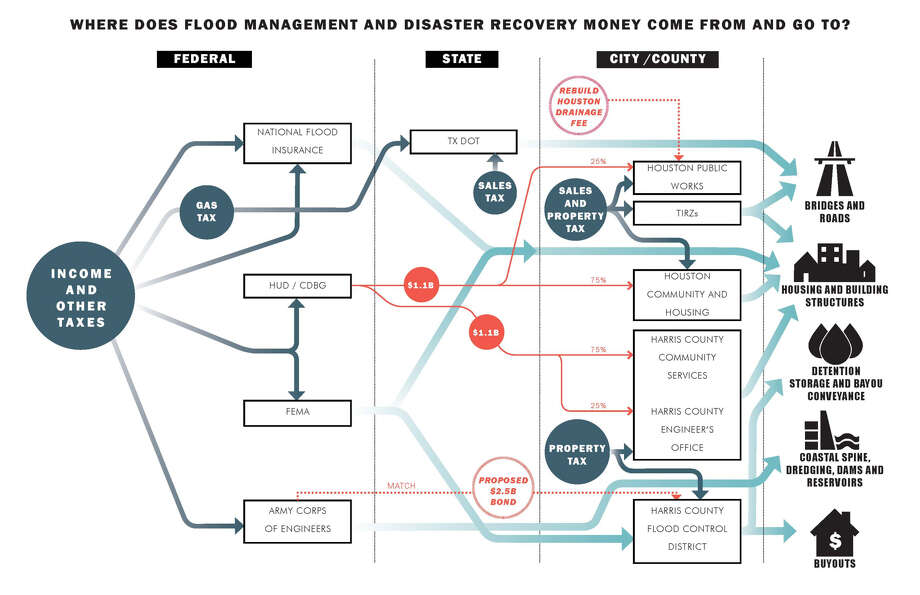
- Harris County voters pass historic $2.5 billion for flood control.
- Harris County voters pass $2.5 billion flood bond.
From the latter article:
A year to the day after Hurricane Harvey dumped 27 trillion gallons of water on southeast Texas, swamped 204,000 Harris County homes and apartments and killed more than 50 residents in the region, voters overwhelmingly approved a $2.5 billion flood infrastructure bond designed to protect the area in future storms.
The measure was leading with more than 85 percent support, according to County Clerk Stan Stanart. An estimated 150,000 of Harris County's 2.3 million registered voters cast ballots, according to preliminary numbers.
The measure is the largest bond Harris County voters have ever approved. County Judge Ed Emmett said voters have stepped up to show the rest of the country that the Houston area takes flooding seriously, and can be a model for other coastal regions grappling with stronger and more frequent storms.
And this exceptional graphic:
Wednesday, August 29, 2018
From the Texas Tribune: Election judges can carry guns to the polls, Texas attorney general says
We went over this article in GOVT 2306. It mentions a variety of governing positions as well as several parts of the Texas Statutes, in addition to linking to a non-binding opinion by the Texas Attorney General attempting to clarify an ambiguity in Texas law.
- Click here for the article.
- Click here for the article.
Firearms are generally not allowed at the polls while
voters are casting ballots in Texas. But with some limited exceptions,
presiding election judges who are licensed to carry may bring their guns
to polling places, Attorney General Ken Paxton said in a nonbinding opinion Monday.
Presiding election judges, who are generally civilians appointed
by local party officials to head up a team of poll workers, do
everything from settling election disputes to doling out “I Voted”
stickers. They’re charged with keeping their polling places calm, and
they have “the power of a district judge to enforce order and preserve
the peace,” according to Texas election law.
Paxton cited Hooks v. State, a 1913 case before
the Texas Court of Criminal Appeals where it was ruled that since
district judges can carry firearms to polling places and election judges
had been given the authority of district judges, election judges
“likewise had the authority to do so.”
“A court today would likely follow the analysis in Hooks when construing the statutes in their current form,” Paxton wrote.
Still, the attorney general noted that there are some
polling places where even election judges would likely be blocked from
carrying firearms — for example, polling places on certain campuses and
on private property where guns are prohibited and proper notice has been
given.
Paxton’s opinion, which lays out the reasoning he believes a
court would take but is not legally binding, comes in response to a
lawmaker’s inquiry. In March, on the eve of the primary elections, state
Rep. James White, R-Hillister, asked Paxton
whether licensed election judges could come armed to the polls. White
cited safety concerns from election judges who work long hours in “rural
areas in which local law enforcement must provide public safety with
limited manpower over vast areas.”
Manny Garcia, deputy executive director of the Texas
Democratic Party, slammed the opinion, criticizing Paxton for "turning
polling locations into O.K. Corral."
From 538: What Went Down In Florida, Arizona And Oklahoma
A look at the primary elections held yesterday. Note what makes these distinct from general elections.
- Click here for the article.
As they say in the Cactus League, that’s the ballgame. Tonight’s slew of “weird” primaries did not disappoint. Here’s what happened:
The big headline of the night: Progressive Andrew Gillum, the mayor of Tallahassee, notched a surprise win in the Democratic primary for Florida governor, 34 percent to 31 percent, over moderate former Rep. Gwen Graham. It was less of a surprise, but the more ideologically “pure” candidate won on the Republican side too, with Rep. Ron DeSantis defeating Agriculture Commissioner Adam Putnam (who was practically the state GOP’s anointed successor) 57 percent to 37 percent. It sets up a rollicking and unpredictable general election, in which Gillum will surely be hit for an FBI investigation into his mayoral administration and DeSantis’s bear hugs of Trump will be played on repeat for swing voters during commercial breaks.
Rep. Martha McSally defeated former state Sen. Kelli Ward and former Sheriff Joe Arpaio to win the Republican nomination for U.S. Senate in Arizona. The vote is still being tallied as I’m writing, but McSally is right around 50 percent and it looks like she’ll win by pretty much exactly the margin people expected. The once Trump-skeptical McSally did an impressive job appealing to the president’s wing of the party against two immigration hardliners who were arguably Trump before Trump. Establishment Republicans are also relieved, because McSally was by far their strongest candidate against Democratic nominee Kyrsten Sinema.
For Arizona governor, Democrats also picked their strongest candidate in David Garcia. He’s (i) a Latino, (ii) an educator in a year that saw a major teacher’s strike in Arizona, and (iii) Democrats’ highest-performing statewide candidate of the last 12 years, having almost won his 2014 race for state superintendent.
Republicans picked businessman Kevin Stitt as their nominee for Oklahoma governor over former Oklahoma City Mayor Mick Cornett, 55 percent to 45 percent. That qualified as good news for Democrats, since early polls showed their nominee, Drew Edmondson, narrowly leading Stitt but tied at best with Cornett. Outgoing Gov. Mary Fallin is terribly unpopular, which has given Democrats a real shot in this otherwise very red state.
Two potentially vulnerable Democratic congressmen survived primary challenges in the Sunshine State. Rep. Darren Soto crushed ex-Rep. Alan Grayson, a scandal-tarred progressive firebrand, 66 percent to 34 percent in Florida’s 9th District. Rep. Al Lawson fought off former Jacksonville Mayor Alvin Brown 60 percent to 40 percent in Florida’s 5th.
The nominees were also decided in several other congressional races. Among the notable ones: the Democratic side of Florida’s 27th District, where close Clinton ally Donna Shalala defeated progressive state Rep. David Richardson by a closer-than-expected 4-point margin; and Arizona’s 2nd District, where moderate former Rep. Ann Kirkpatrick is currently leading progressive Matt Heinz, who lost this district by 14 points in 2016. (That primary is still uncalled.)
- Click here for the article.
As they say in the Cactus League, that’s the ballgame. Tonight’s slew of “weird” primaries did not disappoint. Here’s what happened:
The big headline of the night: Progressive Andrew Gillum, the mayor of Tallahassee, notched a surprise win in the Democratic primary for Florida governor, 34 percent to 31 percent, over moderate former Rep. Gwen Graham. It was less of a surprise, but the more ideologically “pure” candidate won on the Republican side too, with Rep. Ron DeSantis defeating Agriculture Commissioner Adam Putnam (who was practically the state GOP’s anointed successor) 57 percent to 37 percent. It sets up a rollicking and unpredictable general election, in which Gillum will surely be hit for an FBI investigation into his mayoral administration and DeSantis’s bear hugs of Trump will be played on repeat for swing voters during commercial breaks.
Rep. Martha McSally defeated former state Sen. Kelli Ward and former Sheriff Joe Arpaio to win the Republican nomination for U.S. Senate in Arizona. The vote is still being tallied as I’m writing, but McSally is right around 50 percent and it looks like she’ll win by pretty much exactly the margin people expected. The once Trump-skeptical McSally did an impressive job appealing to the president’s wing of the party against two immigration hardliners who were arguably Trump before Trump. Establishment Republicans are also relieved, because McSally was by far their strongest candidate against Democratic nominee Kyrsten Sinema.
For Arizona governor, Democrats also picked their strongest candidate in David Garcia. He’s (i) a Latino, (ii) an educator in a year that saw a major teacher’s strike in Arizona, and (iii) Democrats’ highest-performing statewide candidate of the last 12 years, having almost won his 2014 race for state superintendent.
Republicans picked businessman Kevin Stitt as their nominee for Oklahoma governor over former Oklahoma City Mayor Mick Cornett, 55 percent to 45 percent. That qualified as good news for Democrats, since early polls showed their nominee, Drew Edmondson, narrowly leading Stitt but tied at best with Cornett. Outgoing Gov. Mary Fallin is terribly unpopular, which has given Democrats a real shot in this otherwise very red state.
Two potentially vulnerable Democratic congressmen survived primary challenges in the Sunshine State. Rep. Darren Soto crushed ex-Rep. Alan Grayson, a scandal-tarred progressive firebrand, 66 percent to 34 percent in Florida’s 9th District. Rep. Al Lawson fought off former Jacksonville Mayor Alvin Brown 60 percent to 40 percent in Florida’s 5th.
The nominees were also decided in several other congressional races. Among the notable ones: the Democratic side of Florida’s 27th District, where close Clinton ally Donna Shalala defeated progressive state Rep. David Richardson by a closer-than-expected 4-point margin; and Arizona’s 2nd District, where moderate former Rep. Ann Kirkpatrick is currently leading progressive Matt Heinz, who lost this district by 14 points in 2016. (That primary is still uncalled.)
Monday, August 27, 2018
George Carlin's Advice on Dealing with the 2016 Election
Things start getting interesting around 2:30
From Vox: Trump’s very bad week didn’t do much to sway the polls
More to background for 2305's paper topic.
- Click here for the article.
Last week was a rough one for President Donald Trump, but a new set of polls confirms that he can still count on the unwavering support of a portion of the electorate.
Here’s what happened: Michael Cohen, Trump’s former lawyer, pleaded guilty to eight federal charges, and Paul Manafort, his former campaign chairman, was found guilty of eight crimes of his own. Cohen implicated the president in his crimes, and the president seemed to confess to his involvement in campaign finance violations on national television.
Despite the string of negative headlines, Trump’s popularity isn’t tanking with the American public. He’s not a very popular president in the first place, but the increased focus on the criminals around him didn’t make things worse, according to a pair of polls conducted jointly by the Wall Street Journal and NBC News.
A WSJ/NBC News survey taken mostly before last Tuesday, the day of Cohen’s guilty plea and Manafort’s jury verdict, found that Trump’s approval rating was at 46 percent among registered voters. A separate WSJ/NBC News poll conducted after Tuesday found Trump’s approval rating was at 44 percent.
All that news, and Trump’s approval rating dipped by 2 percentage points — within the margin of error, meaning it might not have moved at all.
But if it holds across other polls, a 2-point drop “would be a reasonably big shift,” FiveThirtyEight’s Nate Silver pointed out on Twitter. In other words, it’s possible that last week’s legal drama made a difference, but it’s not a given.
- Click here for the article.
Last week was a rough one for President Donald Trump, but a new set of polls confirms that he can still count on the unwavering support of a portion of the electorate.
Here’s what happened: Michael Cohen, Trump’s former lawyer, pleaded guilty to eight federal charges, and Paul Manafort, his former campaign chairman, was found guilty of eight crimes of his own. Cohen implicated the president in his crimes, and the president seemed to confess to his involvement in campaign finance violations on national television.
Despite the string of negative headlines, Trump’s popularity isn’t tanking with the American public. He’s not a very popular president in the first place, but the increased focus on the criminals around him didn’t make things worse, according to a pair of polls conducted jointly by the Wall Street Journal and NBC News.
A WSJ/NBC News survey taken mostly before last Tuesday, the day of Cohen’s guilty plea and Manafort’s jury verdict, found that Trump’s approval rating was at 46 percent among registered voters. A separate WSJ/NBC News poll conducted after Tuesday found Trump’s approval rating was at 44 percent.
All that news, and Trump’s approval rating dipped by 2 percentage points — within the margin of error, meaning it might not have moved at all.
But if it holds across other polls, a 2-point drop “would be a reasonably big shift,” FiveThirtyEight’s Nate Silver pointed out on Twitter. In other words, it’s possible that last week’s legal drama made a difference, but it’s not a given.
Thursday, August 23, 2018
From the Texas Tribune
For out discussion of local government, federalism, and elections.
- On Harvey's anniversary, Houstonians set to decide on historic flood control bond.
- On Harvey's anniversary, Houstonians set to decide on historic flood control bond.
On Saturday — one year after Hurricane Harvey slammed into Texas — Harris County voters will head to the polls to decide on a historic bond measure that would finance at least 237 flood control projects in the Houston area over the next 10 to 15 years.
The Harris County Commissioners Court spent months vigorously debating the bond price tag. It ultimately settled on $2.5 billion, an amount that would represent the largest local investment in flood control in the county's history, while having a relatively small impact on property tax bills (an increase of 2 to 3 cents per $100 of assessed home value over the life of the bond). The county held more than two dozen town hall meetings over the summer to gather input from residents on which projects the bond should support.
It is an unprecedented response to the widespread flooding the Houston region saw a few days after Harvey made landfall on Aug. 25 of last year. More than 150,000 homes in Harris County were inundated in what became one of the worst urban floods in U.S. history.
If approved — and recent polling suggests it will be — the bond would help fund the largest flood-related home buyout program in U.S. history, the completion of several long ongoing bayou-widening projects, an improved early flood warning system, new floodplain maps and dredging behind two massive, World War II-era dams that were built to protect central Houston from catastrophic flooding but became a flashpoint after Harvey when thousands of homes on both sides of the dams were inundated.
A significant portion of the bond also will be used to secure billions more in federal matching funds.
Wednesday, August 22, 2018
Can a president be indicted? Part 1
This is uncharted territory, the Constitution is silent on the matter. Arguments exist on each side.
For 2305:
- Can we indict a sitting president?
- The Only Way to Find Out If the President Can Be Indicted.
I'll more soon.
For 2305:
- Can we indict a sitting president?
- The Only Way to Find Out If the President Can Be Indicted.
I'll more soon.
Monday, July 9, 2018
From Governing: Literacy Is Not a Fundamental Right, Rules Judge in Case Against Michigan
For a discussion about civil rights, civil liberties, the judiciary, and federalism - at the very least.
- Click here for the full article.
Few could dispute the importance of literacy. But children have no fundamental right to learn to read and write, according to a federal judge whose ruling in a closely watched lawsuit Friday left some disheartened and others raising questions.
"I'm shocked," said Ivy Bailey, president of the Detroit Federation of Teachers. "The message that it sends is that education is not important. And it sends the message that we don't care if you're literate or not."
The ruling came in a federal lawsuit that was closely watched across the U.S. because of its potential impact: Filed on behalf of Detroit students, it sought to hold a dozen state officials -- including Gov. Rick Snyder -- accountable for what plaintiffs said were systemic failures that deprived Detroit children of their right to literacy.
The lawsuit sought remedies that included literacy reforms, a systemic approach to instruction and intervention, as well as fixes to crumbling Detroit schools. Earlier this month, officials with the Detroit Public Schools Community District said it would cost $500 million to bring school buildings up to par.
The City of Detroit, the American Federation of Teachers, the AFL-CIO, the community group 482Forward, Kappa Delta Pi, the International Literacy Association and the National Association for Multicultural Education all filed briefs in support of the plaintiffs.
The lawsuit was filed by Public Counsel, a Los Angeles-based law firm that is the nation's largest public interest law firm. Mark Rosenbaum, the lead attorney for the plaintiffs, declined to comment Saturday, saying he wanted an opportunity to first speak with his clients.
- Click here for the decision.
- Click here for the wikipedia page on the judge.
- Click here for the full article.
Few could dispute the importance of literacy. But children have no fundamental right to learn to read and write, according to a federal judge whose ruling in a closely watched lawsuit Friday left some disheartened and others raising questions.
"I'm shocked," said Ivy Bailey, president of the Detroit Federation of Teachers. "The message that it sends is that education is not important. And it sends the message that we don't care if you're literate or not."
The ruling came in a federal lawsuit that was closely watched across the U.S. because of its potential impact: Filed on behalf of Detroit students, it sought to hold a dozen state officials -- including Gov. Rick Snyder -- accountable for what plaintiffs said were systemic failures that deprived Detroit children of their right to literacy.
The lawsuit sought remedies that included literacy reforms, a systemic approach to instruction and intervention, as well as fixes to crumbling Detroit schools. Earlier this month, officials with the Detroit Public Schools Community District said it would cost $500 million to bring school buildings up to par.
The City of Detroit, the American Federation of Teachers, the AFL-CIO, the community group 482Forward, Kappa Delta Pi, the International Literacy Association and the National Association for Multicultural Education all filed briefs in support of the plaintiffs.
The lawsuit was filed by Public Counsel, a Los Angeles-based law firm that is the nation's largest public interest law firm. Mark Rosenbaum, the lead attorney for the plaintiffs, declined to comment Saturday, saying he wanted an opportunity to first speak with his clients.
- Click here for the decision.
- Click here for the wikipedia page on the judge.
Monday, June 4, 2018
Masterpiece Cakeshop, Ltd. v. Colorado Civil Rights Commission
The Supreme Court decision in this case was announced today.
The case involves conflict between two aspects of constitutional law, the free exercise of religion and equal protection under the law.
Here are a couple useful links for background:
- Scotusblog.
- Oyez.
The case involves conflict between two aspects of constitutional law, the free exercise of religion and equal protection under the law.
Here are a couple useful links for background:
- Scotusblog.
- Oyez.
Thursday, April 5, 2018
"Stupid Questions" from 2306
I'll address these in the coming days, along with the questions from 2305
- I Still don't understand legislative judicial and executive mean ? i always have to look it up or write it down .it doesn't matter how many times you tell me or explain i would always forget. i need something easy to remind which is which?
1.the effect of these previous elections on people higher up
2. i don’t know if this is on topic but the does the districting also change the police or sheriffs in each area and the amount of a fine.. is a ticket possibly more expensive in one area rather than and area and does this have anything to do with who’s in charge of that district.
- How does the House differ from the Senate?
- My stupid question is what kind of investments are the states into? Or what else do they do with all of the moeny they collect from taxes. Do they ever put it into the market or just buy more bonds?
- How can an ordinary person find more information on the people running for statewide government offices and local government offices, such as Judges, governor, senators, Texas House, city major or city council man? Who is really in charge of the government? The information needed for making an educative choose for the candidates running for government offices is limited to the average citizens. So, the thought of popular sovereignty is obscured, the government officials do not protect the interest of the individuals who elected them. They are more interested in making laws to protect businesses and making money in the process.
- In 2305, in the course materials there was a section for each chapter that included a summary of every chapter from our textbooks, why isn't that included in 2306? I have a hard time retaining information from reading the textbook chapters on my own.
- Why do we have to write an essay for his class?
- My question is why does the Texas Legislature only meet every 2 years?
- To be honest, I still don't fully understand how the power is divided in Texas. I would like to increase my comprehension of how much power is vested in the Texas legislature, including the Lieutenant Governor and the Speaker of the House, versus the Executive Branch. What checks and balances are in place? Does the Lieutenant Governor have more power than the Governor or is it just a different set of powers?
- United States has two major political parties and they chose their candidates through primary elections. What are the prior requirements for the candidates to get on to the primary elections ballot?
- I don't understand how the run off part of the election works. I don't understand what it is or how two candidates qualify for one.
- What is the "Tort Reform"?
- I accidentally skipped a written assignment and I was wondering if I can still try to turn it in?
- What exactly is a "developmental course" here at ACC?
- Please better explain the Sunset Advisory Commission. Thank you.
- What is the purpose of the private prisons and how are they constitutionally allowed?
- My stupid question is what is the Public Utility Commission and it's purpose? It may sound crazy but I have never heard of this commission and especially that I am not a politic person. Does it involve water and sewer, and the electricity? From my research, I found out that the Public Utility Commission of Texas was to protect customers, foster competition, and promote high quality infrastructure. It also states that it regulates the states electric, telecommunication, and water sewer utilities. Does this mean that they are in control of our utilities and is the reason the state has to pay high utility bills and they can raise it at any given time. I also saw that it offers customer assistance complaints and has a hot line. What is the reason to call and complain about communication, water and sewer, and electricity. The only use I found for it is the trash. Trash being picked up more than once a week to keep the city clean. Also this commission has control of the way we communicate, if this was the reason then there would be better cell phone towers. This was put in place in 1975. This concludes my stupid question and I do not know if I have the wrong perception of this Pubic Utility Commission.
- Why do presidents term limit in office is 8 years?
- Why is it that the United States chooses to have a president instead of a king, queen, or prime minister? It seems that the majority of other countries that choose to have a King, Queen, or Prime Minister don't have as many political and government issues as we do. So why not change our system and make it better?
- How much are the politicians in higher positions supposed to make by law and if that law is followed?
- the Bureaucratic accountability, this is something I have been easily confused on and don't understand most of it.
- Why is the Texas Constitution so long compared to other states' constitutions, and what other states, if any, have a similar structured constitution as Texas?
- Why do so many people dislike Trump? I'm 24 so i was about 17 or so when Obama was in office, but i just don't remember people always talking so bad about Obama. Is Trump really doing that much harm to America? CNN says one thing while FOX says another. I know they are on opposite sides of the spectrum but the truth has to fall somewhere in between, right?
- Why do we have take this class again? And I say that in the most non-offensive way possible.
- i guess i would just like to know what needs to happen in order for the Texas constitution to be re written.
- But, could you tell me why and for how long has Texas always been such a strong Republican state? I was born and raised in Kansas. We were also a Republican state that depends heavily on government assistance. Is that odd that a state could be dependent on assistance but support a political party that isn’t as giving ?
- I Still don't understand legislative judicial and executive mean ? i always have to look it up or write it down .it doesn't matter how many times you tell me or explain i would always forget. i need something easy to remind which is which?
1.the effect of these previous elections on people higher up
2. i don’t know if this is on topic but the does the districting also change the police or sheriffs in each area and the amount of a fine.. is a ticket possibly more expensive in one area rather than and area and does this have anything to do with who’s in charge of that district.
- How does the House differ from the Senate?
- My stupid question is what kind of investments are the states into? Or what else do they do with all of the moeny they collect from taxes. Do they ever put it into the market or just buy more bonds?
- How can an ordinary person find more information on the people running for statewide government offices and local government offices, such as Judges, governor, senators, Texas House, city major or city council man? Who is really in charge of the government? The information needed for making an educative choose for the candidates running for government offices is limited to the average citizens. So, the thought of popular sovereignty is obscured, the government officials do not protect the interest of the individuals who elected them. They are more interested in making laws to protect businesses and making money in the process.
- In 2305, in the course materials there was a section for each chapter that included a summary of every chapter from our textbooks, why isn't that included in 2306? I have a hard time retaining information from reading the textbook chapters on my own.
- Why do we have to write an essay for his class?
- My question is why does the Texas Legislature only meet every 2 years?
- To be honest, I still don't fully understand how the power is divided in Texas. I would like to increase my comprehension of how much power is vested in the Texas legislature, including the Lieutenant Governor and the Speaker of the House, versus the Executive Branch. What checks and balances are in place? Does the Lieutenant Governor have more power than the Governor or is it just a different set of powers?
- United States has two major political parties and they chose their candidates through primary elections. What are the prior requirements for the candidates to get on to the primary elections ballot?
- I don't understand how the run off part of the election works. I don't understand what it is or how two candidates qualify for one.
- What is the "Tort Reform"?
- I accidentally skipped a written assignment and I was wondering if I can still try to turn it in?
- What exactly is a "developmental course" here at ACC?
- Please better explain the Sunset Advisory Commission. Thank you.
- What is the purpose of the private prisons and how are they constitutionally allowed?
- My stupid question is what is the Public Utility Commission and it's purpose? It may sound crazy but I have never heard of this commission and especially that I am not a politic person. Does it involve water and sewer, and the electricity? From my research, I found out that the Public Utility Commission of Texas was to protect customers, foster competition, and promote high quality infrastructure. It also states that it regulates the states electric, telecommunication, and water sewer utilities. Does this mean that they are in control of our utilities and is the reason the state has to pay high utility bills and they can raise it at any given time. I also saw that it offers customer assistance complaints and has a hot line. What is the reason to call and complain about communication, water and sewer, and electricity. The only use I found for it is the trash. Trash being picked up more than once a week to keep the city clean. Also this commission has control of the way we communicate, if this was the reason then there would be better cell phone towers. This was put in place in 1975. This concludes my stupid question and I do not know if I have the wrong perception of this Pubic Utility Commission.
- Why do presidents term limit in office is 8 years?
- Why is it that the United States chooses to have a president instead of a king, queen, or prime minister? It seems that the majority of other countries that choose to have a King, Queen, or Prime Minister don't have as many political and government issues as we do. So why not change our system and make it better?
- How much are the politicians in higher positions supposed to make by law and if that law is followed?
- the Bureaucratic accountability, this is something I have been easily confused on and don't understand most of it.
- Why is the Texas Constitution so long compared to other states' constitutions, and what other states, if any, have a similar structured constitution as Texas?
- Why do so many people dislike Trump? I'm 24 so i was about 17 or so when Obama was in office, but i just don't remember people always talking so bad about Obama. Is Trump really doing that much harm to America? CNN says one thing while FOX says another. I know they are on opposite sides of the spectrum but the truth has to fall somewhere in between, right?
- Why do we have take this class again? And I say that in the most non-offensive way possible.
- i guess i would just like to know what needs to happen in order for the Texas constitution to be re written.
- But, could you tell me why and for how long has Texas always been such a strong Republican state? I was born and raised in Kansas. We were also a Republican state that depends heavily on government assistance. Is that odd that a state could be dependent on assistance but support a political party that isn’t as giving ?
Monday, April 2, 2018
"Stupid Questions" from 2305
These are the answers that I got for the stupid question question in 2305. I'll address these in upcoming posts - but many of these can be answered by simply reading the textbook
- Why is the electoral college important? Why does it agree with the general public most of the time but not all of the time.
- Why do churches not have to pay property taxes? Or is that a rumor? I have always been curious about that! Thank you!
- What is the difference is how much "we the people" should trust our government vs how much we actually do?
- How does the president get elected to his position?
- Why do the members of Congress still have their jobs when they cant balance the budget by the deadline?
- How influential is the candidate’s party to his or her decisions when she or he is elected? What impact would it do to his or her career when the official decides against what the party stands for?
- I'm still a little confused about how an election works...Like what steps are taken in the process.
- The US Supreme court justices are appointed for life as required by the Constitution. The implication here is that these justices have the most stable jobs in the nation. Only the Congress has the power to impeach them; and historically, only one of these justices, Justice Samuel Chase, was ever impeached by the House of Representatives in 1804, and later acquitted by the Senate in 1805. First of all, does it mean that none of these justices are ever found corrupt? If some of them are ever found corrupt, how are they made to individually account for their corrupt decisions? And finally, how are victims of such corrupt decisions compensated?
- One thing that I am still not understanding about the people who wrote Constitution and the Declaration of Independence the failure to mention slavery and how it is never mentioned. I don’t understand how they were able to never mention it. How the writers could be fighting for rights, and freedom from Britain but still allow slavery. Can you explain or direct me to a better explanation than our textbook has?
- Why is the government so corrupt?
- how can you consider yourself a republican or a democrat? What if you agree with some concepts from each party? Would you just choose the party you relate to the most?
- If I had to say anything was unclear about this class, I would have to say it would be the Judicial Branch. I do understand how it works, I just do not understand all of the parts of the branch. Who it is all made up of and what are their jobs. I understand the supreme court and that their is a judge, but all of the parts that it is made up are still confusing. Such as, what are the other important parts of the branch. I would like more detail of the smaller state judicial branches and how working your way up to the supreme court works. I have a little background that involves appealing, but I do not know how the appeal process works.
- I've been needing help on understanding the things that congress does. what does the senate and the house of reps do??
- What is the supposed benefit of the electoral college? To my limited understanding, it seems to be the first impediment to a true Democracy. Was that its purpose? To prevent mob rule?
What is the main reason for taxing?
- What are the differences between a libertarian and a liberal or are they the same thing?
- How can one identify as a Republican or Democrat? What happens if you agree with one party in some areas, and the other on other areas?
- What is exactly does the Primary elections do for US? As a country? By electing these people what will they be in charge of leading and changing for us. Also, do people in the primary’s help to elect the president in the electoral college?
- How come police or public officials need a search warrant to search somethings like a phone, or a student, but they do not need a search warrant to search other things like trash that you had placed on the street, or your car? I know we have talked about it briefly but I would just like some clarification on the topic.
- The only thing I do have a question on is, the details of how candidates are chosen and the primaries.
- I'm a little confused on what actually happened during the Watergate scandal. I know the basics of what President Nixon did, but don't quite understand the details. Could you please give a deeper explanation?
- How does an electoral college work? I have heard that you can win majority but lose electoral and lose the whole election or win electoral and lose majority but still win the whole election. I don't understand what the point of majority votes are if they don't matter
- How does the public (citizens and or govt officials) necessarily influence political decisions (or just government in general) such as deciding on bills, laws, rights, and etc? sorry if this is such a broad question.
- Is an interest group a kind of institution? I assume so, since institutions are “the organizations, norms, and rules that structure political action,” and an interest group is an organization that does that, but I must’ve overlooked it in my book.
- I was wondering how do other states get around the Full Faith and Credit Clause in cases like some states making marijuana legal but others still have it illegal, or when gay marriage became legal in one state yet other states didn't act accordingly.
- I am still eluded by certain court cases and their significance. I still need to put time in studying them but for some reason i get some of the basic ones mixed up.
- I have found this class to be more difficult than expected. I am mainly confused on the 1000-word essay. How are we supposed to predict the outcome of the November midterm elections and write 1000 words over it? No matter how much research I do, I feel like I cannot write 1000 words on one simple question you asked. I struggled to write 150 for the introduction and I’m stuck on what to continue writing about. Thanks!
- What is the difference between conservatives and liberals? What are their beliefs?
- During a regular trial, impartial citizens of the United States are a part of the jury to come to a conclusion of the case at hand. During an impeachment trial however, who serves on the jury to come to the conclusion on whether or not the individual in the government should be impeached?
- What is a block grant and who gives them out?
- Why do we hold primany elections to determine a winner for the local & insignificant positions? Why couldn't we just hold a general election for these positions? It seems like there is a lot of bother for something so relatively unimportant
- My stupid question for this written assignment is “How does a bill become a law?” I think I may have learned it awhile back, but I don’t fully remember.
- The current status of of millennials revolves around less political participation and my question is what types of methods do media sources use to push their agenda to the younger generation of America and are the methods effective.
- How many seats are there in the House of Representatives?
- What is the difference between de facto and de jure segregation? What exactly is protected speech? How do we identify if something is protected speech? Examples? What is a superPAC? What is gerrymandering? What are the differences between new/cooperative/dual federalism?
- Does the President have the ability to dissolve Congress if he do chooses or is that a violation of the constitution? Also there has always been 435 congressman and each district has to have at least 700,000 people in it. How often do they redraw districts and as the population grows when will they need to change the minimum population per district?
- With all the recent events that have happened, will reducing the output of guns and tightening gun laws actually stop people? Like illegal drugs, people always find a way and people who already have them. So what is congress trying to do and what are the peoples reasoning on their protest?
- My stupid question is “what’s the actual difference between a democrat and a republican?” I know this is the most basic knowledge everyone should have; but I have always been confused on the different ideas and beliefs that would make each party separate from each other. I’m also confused, because I’ve been told that the parties could switch ideas from time to time, so I’m wondering how we know when they switch and if there is a set trait that makes each party different.
- This seems like a simple question... What does Checks and Balances mean? It seems like most of the students in the class I'm in understand this so I thought it was a stupid question.
- How does the process of the President choosing his cabinet work? My dad once mentioned that even though Trump is president, the members of his cabinet could lead to some actual solutions since we essentially have no faith in Trump. However, if Trump selects them, then I feel we can't really have faith they will be of substantial help outside of Trump's idiocy. Thanks.
- Why is the electoral college important? Why does it agree with the general public most of the time but not all of the time.
- Why do churches not have to pay property taxes? Or is that a rumor? I have always been curious about that! Thank you!
- What is the difference is how much "we the people" should trust our government vs how much we actually do?
- How does the president get elected to his position?
- Why do the members of Congress still have their jobs when they cant balance the budget by the deadline?
- How influential is the candidate’s party to his or her decisions when she or he is elected? What impact would it do to his or her career when the official decides against what the party stands for?
- I'm still a little confused about how an election works...Like what steps are taken in the process.
- The US Supreme court justices are appointed for life as required by the Constitution. The implication here is that these justices have the most stable jobs in the nation. Only the Congress has the power to impeach them; and historically, only one of these justices, Justice Samuel Chase, was ever impeached by the House of Representatives in 1804, and later acquitted by the Senate in 1805. First of all, does it mean that none of these justices are ever found corrupt? If some of them are ever found corrupt, how are they made to individually account for their corrupt decisions? And finally, how are victims of such corrupt decisions compensated?
- One thing that I am still not understanding about the people who wrote Constitution and the Declaration of Independence the failure to mention slavery and how it is never mentioned. I don’t understand how they were able to never mention it. How the writers could be fighting for rights, and freedom from Britain but still allow slavery. Can you explain or direct me to a better explanation than our textbook has?
- Why is the government so corrupt?
- how can you consider yourself a republican or a democrat? What if you agree with some concepts from each party? Would you just choose the party you relate to the most?
- If I had to say anything was unclear about this class, I would have to say it would be the Judicial Branch. I do understand how it works, I just do not understand all of the parts of the branch. Who it is all made up of and what are their jobs. I understand the supreme court and that their is a judge, but all of the parts that it is made up are still confusing. Such as, what are the other important parts of the branch. I would like more detail of the smaller state judicial branches and how working your way up to the supreme court works. I have a little background that involves appealing, but I do not know how the appeal process works.
- I've been needing help on understanding the things that congress does. what does the senate and the house of reps do??
- What is the supposed benefit of the electoral college? To my limited understanding, it seems to be the first impediment to a true Democracy. Was that its purpose? To prevent mob rule?
What is the main reason for taxing?
- What are the differences between a libertarian and a liberal or are they the same thing?
- How can one identify as a Republican or Democrat? What happens if you agree with one party in some areas, and the other on other areas?
- What is exactly does the Primary elections do for US? As a country? By electing these people what will they be in charge of leading and changing for us. Also, do people in the primary’s help to elect the president in the electoral college?
- How come police or public officials need a search warrant to search somethings like a phone, or a student, but they do not need a search warrant to search other things like trash that you had placed on the street, or your car? I know we have talked about it briefly but I would just like some clarification on the topic.
- The only thing I do have a question on is, the details of how candidates are chosen and the primaries.
- I'm a little confused on what actually happened during the Watergate scandal. I know the basics of what President Nixon did, but don't quite understand the details. Could you please give a deeper explanation?
- How does an electoral college work? I have heard that you can win majority but lose electoral and lose the whole election or win electoral and lose majority but still win the whole election. I don't understand what the point of majority votes are if they don't matter
- How does the public (citizens and or govt officials) necessarily influence political decisions (or just government in general) such as deciding on bills, laws, rights, and etc? sorry if this is such a broad question.
- Is an interest group a kind of institution? I assume so, since institutions are “the organizations, norms, and rules that structure political action,” and an interest group is an organization that does that, but I must’ve overlooked it in my book.
- I was wondering how do other states get around the Full Faith and Credit Clause in cases like some states making marijuana legal but others still have it illegal, or when gay marriage became legal in one state yet other states didn't act accordingly.
- I am still eluded by certain court cases and their significance. I still need to put time in studying them but for some reason i get some of the basic ones mixed up.
- I have found this class to be more difficult than expected. I am mainly confused on the 1000-word essay. How are we supposed to predict the outcome of the November midterm elections and write 1000 words over it? No matter how much research I do, I feel like I cannot write 1000 words on one simple question you asked. I struggled to write 150 for the introduction and I’m stuck on what to continue writing about. Thanks!
- What is the difference between conservatives and liberals? What are their beliefs?
- During a regular trial, impartial citizens of the United States are a part of the jury to come to a conclusion of the case at hand. During an impeachment trial however, who serves on the jury to come to the conclusion on whether or not the individual in the government should be impeached?
- What is a block grant and who gives them out?
- Why do we hold primany elections to determine a winner for the local & insignificant positions? Why couldn't we just hold a general election for these positions? It seems like there is a lot of bother for something so relatively unimportant
- My stupid question for this written assignment is “How does a bill become a law?” I think I may have learned it awhile back, but I don’t fully remember.
- The current status of of millennials revolves around less political participation and my question is what types of methods do media sources use to push their agenda to the younger generation of America and are the methods effective.
- How many seats are there in the House of Representatives?
- What is the difference between de facto and de jure segregation? What exactly is protected speech? How do we identify if something is protected speech? Examples? What is a superPAC? What is gerrymandering? What are the differences between new/cooperative/dual federalism?
- Does the President have the ability to dissolve Congress if he do chooses or is that a violation of the constitution? Also there has always been 435 congressman and each district has to have at least 700,000 people in it. How often do they redraw districts and as the population grows when will they need to change the minimum population per district?
- With all the recent events that have happened, will reducing the output of guns and tightening gun laws actually stop people? Like illegal drugs, people always find a way and people who already have them. So what is congress trying to do and what are the peoples reasoning on their protest?
- My stupid question is “what’s the actual difference between a democrat and a republican?” I know this is the most basic knowledge everyone should have; but I have always been confused on the different ideas and beliefs that would make each party separate from each other. I’m also confused, because I’ve been told that the parties could switch ideas from time to time, so I’m wondering how we know when they switch and if there is a set trait that makes each party different.
- This seems like a simple question... What does Checks and Balances mean? It seems like most of the students in the class I'm in understand this so I thought it was a stupid question.
- How does the process of the President choosing his cabinet work? My dad once mentioned that even though Trump is president, the members of his cabinet could lead to some actual solutions since we essentially have no faith in Trump. However, if Trump selects them, then I feel we can't really have faith they will be of substantial help outside of Trump's idiocy. Thanks.
Subscribe to:
Posts (Atom)