Wednesday, November 11, 2020

What is the General Services Administration?

They've been in the news since the president has refused to let them cooperate with the Biden transition.

- Click here for the Wikipedia entry.

The General Services Administration (GSA) is an independent agency of the United States government established in 1949 to help manage and support the basic functioning of federal agencies. GSA supplies products and communications for U.S. government offices, provides transportation and office space to federal employees, and develops government-wide cost-minimizing policies and other management tasks.

GSA employs about 12,000 federal workers and has an annual operating budget of roughly $20.9 billion. GSA oversees $66 billion of procurement annually. It contributes to the management of about $500 billion in U.S. federal property, divided chiefly among 8,700 owned and leased buildings and a 215,000 vehicle motor pool. Among the real estate assets managed by GSA are the Ronald Reagan Building and International Trade Center in Washington, D.C. – the largest U.S. federal building after the Pentagon – and the Hart-Dole-Inouye Federal Center (which had previously been the Battle Creek Sanitarium run by John Harvey Kellogg).

GSA's business lines include the Federal Acquisition Service (FAS) and the Public Buildings Service (PBS), as well as several Staff Offices including the Office of Government-wide Policy, the Office of Small Business Utilization, and the Office of Mission Assurance. As part of FAS, GSA's Technology Transformation Services (TTS) helps federal agencies improve delivery of information and services to the public. Key initiatives include the Presidential Innovation Fellows program, 18F (includes login.gov and cloud.gov), FedRAMP, the USAGov platform (USA.gov, GobiernoUSA.gov), Data.gov, and Challenge.gov, the U.S. Web Design System, and I.T. Modernization Centers of Excellence.

Here's a look at the career of its current chief, Emily W. Murphy.

Note the focus on small  business: 

After graduating from Smith College, Murphy moved to Washington, D.C., where she began her career at the Republican National Committee. She worked for the RNC from October 1995 to January 1997, where she served as Assistant to the Director of Administration. She then worked as a staff member for Jim Talent while he served as Chair of the House Committee on Small Business from January 1997 to July 1998, before leaving to pursue a law degree.

Murphy previously served as counsel at the United States House Committee on Armed Services, where she specialized in acquisition policy and reform. She has also held roles at the Small Business Administration and at the GSA, where she served as the agency's first Chief Acquisition Officer. Murphy served under three chairmen of the United States House Committee on Small Business. Her private sector experience includes five years in executive positions at a technology startup company engaged in federal contracting and three years as a government contracts attorney with two D.C. law firms.

From Roll Call: McConnell, Schumer to remain Senate leaders

The 117th Senate looks a lot like the 116th Senate.

- Click here for the article.

Republican Mitch McConnell of Kentucky and Democrat Charles E. Schumer of New York were reelected Tuesday to lead their parties in the Senate during the next Congress.

The leadership elections, which occurred behind closed doors Tuesday morning, were held even though it’s still unclear which party will hold the Senate majority.

Races called in last week’s election have the chamber currently deadlocked at 48-48, and control could depend on a double runoff in Georgia for seats held by GOP Sens. Kelly Loeffler and David Perdue. Republican incumbents Dan Sullivan of Alaska and Thom Tillis of North Carolina are leading in the two other uncalled races.

Tuesday, November 10, 2020

What is a Low-Income Housing Tax Credit?

Its mentioned in the story below.

- The Wikipedia entry

The Low-Income Housing Tax Credit (LIHTC - often pronounced "lie-tech", Housing Credit) is a dollar-for-dollar tax credit in the United States for affordable housing investments. It was created under the Tax Reform Act of 1986 (TRA86) and gives incentives for the utilization of private equity in the development of affordable housing aimed at low-income Americans. LIHTC accounts for the majority (approximately 90%) of all affordable rental housing created in the United States today.[1] As the maximum rent that can be charged is based upon the Area Median Income ("AMI"), LIHTC housing remains unaffordable to many low-income (<30% AMI) renters. The credits are also commonly called Section 42 credits in reference to the applicable section of the Internal Revenue Code. The tax credits are more attractive than tax deductions as the credits provide a dollar-for-dollar reduction in a taxpayer's federal income tax, whereas a tax deduction only provides a reduction in taxable income. The "passive loss rules" and similar tax changes made by TRA86 greatly reduced the value of tax credits and deductions to individual taxpayers. Less than 10% of current credit expenditures are claimed by individual investors.

From the Texas Tribune: A controversial rule limiting housing options for homeless Texans with criminal records was softened, but it still worries advocates

On homeless / criminal / justice policy in the state.

- Click here for the article.

The Texas Department of Housing and Community Affairs is slightly backing off a controversial plan that would make it harder for homeless Texans with particular criminal histories to live in tax-subsidized housing units meant to help them secure permanent homes. At a meeting Thursday, agency officials said they would drop a proposal blocking people with convictions for nonviolent felonies and class A misdemeanors from living in new developments financed with what are called Low-Income Housing Tax Credits.

But the agency still plans to ban prospective tenants who have committed some violent felonies and some drug-related offenses for three to seven years after their convictions. That remaining planned prohibition has some homeless organizations saying the proposed rule will still make it hard to get homeless people into "supportive housing" developments.

Supportive housing projects are funded through Low-Income Housing Tax Credits, which give developers tax benefits in exchange for building homes that are leased at below-market rates. Once they're built, developers and local providers coordinate to connect tenants that were previously homeless with support services like mental health or substance use programs. Either the developer or external agencies provide these services in order to help tenants get back on their feet.

From the Texas Tribune: What to expect as Texas heads to the U.S. Supreme Court in bid to overturn the Affordable Care Act

Let's think about this in terms of health policy.

- Click here for the article.

Texas, leading a coalition of Republican states, heads to the U.S. Supreme Court on Tuesday morning to argue that the Affordable Care Act is unconstitutional and should be struck down in its entirety.

On Texas’ side: the Trump administration. On the other side: a coalition of Democratic states led by California.

What’s at stake?

Health insurance and popular benefits for millions of Americans, including some 1 million in Texas who have subsidized health insurance plans under the law. The sprawling health law touches nearly every facet of the American health care system — from popular protections for individuals with preexisting conditions to no-cost benefits for certain health services to allowing young adults to stay on their parents’ insurance through age 26. Experts say it’s almost impossible to imagine the chaos that would come from ending the law without a replacement, particularly during the worsening coronavirus pandemic. Texas already has the nation’s highest uninsured rate.

Gov. Greg Abbott said years ago that if the Affordable Care Act were to fall, Texas would be ready with a replacement, but no plan has materialized. It would be difficult for the state to cover the gaps without congressional action, given its limited regulatory authority over the insurance market.
What are the legal arguments?

Texas argues that the entire fate of the act turns on one key provision, the individual mandate. Once a penalty you had to pay for not purchasing insurance, the mandate was set to $0 by Congress in a 2017 tax cut. Texas argues that since the mandate is $0, it cannot be interpreted as a tax, and thus must fall as unconstitutional.

The state’s legal team goes a step further than that — and here’s where it loses some legal scholars. Texas claims that if the individual mandate must fall as unconstitutional, the entirety of the sprawling health law has to go with it. That question of “severability” is at the core of the case.

A number of legal scholars don’t buy that, and a conservative federal appellate court, the 5th U.S. Circuit Court of Appeals, said much the same when it heard the case a few years ago. In its December 2019 ruling, the court said the individual mandate was unconstitutional, but that it needed to hear more arguments about why the rest of the law had to fall with it.

Monday, November 9, 2020

From the Pew Research Center: Generation Z Looks a Lot Like Millennials on Key Social and Political Issues

For our look at Public Opinion

- Click here for it.

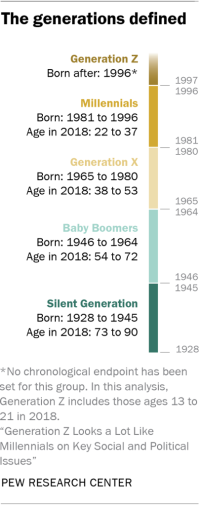
It’s too early to say with certainty how the views of this new generation will evolve. Most have yet to reach voting age, and their outlook could be altered considerably by changing national conditions, world events or technological innovations. Even so, two new Pew Research Center surveys, one of U.S. teens ages 13 to 17 and one of adults ages 18 and older, provide some compelling clues about where they may be headed and how their views could impact the nation’s political landscape.


Only about three-in-ten Gen Zers and Millennials (30% and 29%, respectively) approve of the way Donald Trump is handling his job as president. This compares with 38% of Gen Xers, 43% of Boomers and 54% of Silents. Similarly, while majorities in Gen Z and the Millennial generation say government should do more to solve problems, rather than that government is doing too many things better left to businesses and individuals, Gen Xers and Boomers are more evenly divided on this issue. For their part, most Silents would like to see a less activist government.

When it comes to views on race, the two younger generations are more likely than older generations to say that blacks are treated less fairly than whites in the United States today. And they are much more likely than their elders to approve of NFL players kneeling during the national anthem as a sign of protest.

The younger generations are also more accepting of some of the ways in which American society is changing. Majorities among Gen Z and the Millennial generation say increasing racial and ethnic diversity in the U.S. is a good thing for society, while older generations are less convinced of this. And they’re more likely to have a positive view of interracial and same-sex marriage than their older counterparts.

As a recent Pew Research Center report highlighted, Gen Z is the most racially and ethnically diverse generation we have seen, but this isn’t all that’s driving the attitudes of this generation when it comes to issues surrounding race and diversity. There are significant, if more modest, generational differences on these issues even among non-Hispanic whites.

From Texas Tribune: Bill filing for 2021 Texas session begins with legislation on abortion, police stops and redistricting

The 87th Legislative Session is, sort of, underway.

- Click here for the article.

The 87th Texas Legislature won’t gavel in until January, but state lawmakers on Monday got their first chance to file legislation for what’s expected to be a particularly tough 140-day stretch at the Capitol next year.

By mid-afternoon Monday, the first day to pre-file legislation, more than 530 bills had already been filed in the House and Senate. Thousands of bills are expected to be filed throughout the legislative session, though only a fraction of them will make it through both chambers and end up on Gov. Greg Abbott’s desk.

State leaders have already said they expect the upcoming session to be the toughest state lawmakers have seen in years. The state is forecasting billions of dollars in shortfalls to the state budget, which the coronavirus pandemic has fueled. On top of that, lawmakers are set to undergo the once-in-a-decade process of redrawing the state’s political maps.

House Redistricting Committee Chair Phil King, a Weatherford Republican, filed legislation Monday morning related to the composition of House districts and State Board of Education districts with House Bill 63 and 64, respectively. Later Monday, King filed a bill related to congressional districts.

With fights over voter access and ballot integrity dominating the election offices and courthouse across the state in recent months, lawmakers are also seeking to resolve some of the central issues around how Texans vote with a battery of bills filed in the early hours Monday. Before noon, nearly 30 pieces of elections-related legislation had already been proposed in both chambers.

Mail-in voting and voter registration emerged as two key focal points in bills filed by members of both parties. There was also legislation focused on countywide voting centers, voter identification, access for voters with disabilities, straight-ticket voting and designating any day an election is held statewide, including primaries, as a state holiday.

State Rep. Drew Springer, R-Muenster, filed proposals aimed at curbing the power of the governor's emergency powers, including one that would create an "Emergency Powers Board" to provide oversight during a declared disaster. The state's "Big Three" — the governor, lieutenant governor and speaker of the House — would sit on the board, as would the chairs of the House and Senate State Affairs Committees. Some Republicans have argued Abbott has overstepped his authority as the state has responded to the pandemic.

From Vox: Biden plans on swiftly rolling back Trump policies with a set of executive orders

 And we know all  about executive orders now.

- Click here for the article

President-elect Joe Biden is reportedly working on a group of executive orders that would reverse several controversial Trump administration policies once he takes office on January 20.

According to a Washington Post report, Biden plans to take immediate action on policies pertaining to climate change, immigration, and public health. On all three counts, the president-elect would effectively implement policies that are the opposites of President Donald Trump’s.

As the country continues to struggle with record daily Covid-19 cases amid the pandemic, Biden plans to swiftly reverse Trump’s withdrawal from the World Health Organization. The order would allow for greater pandemic cooperation and coordination with international partners, while also providing a check on China’s influence on the group.

Battling the pandemic will likely be the president-elect’s first priority, and he’s already forming a coronavirus task force, headed by former surgeon general Vivek Murthy; David Kessler, a former Food and Drug Administration commissioner; and Dr. Marcella Nunez-Smith, a professor of epidemiology and medicine at Yale University. The group is set to start meeting Monday.

Biden also plans to immediately rejoin the Paris climate accords, and to seek to push other countries into lowering their emissions.

From Roll Call: Biden’s transition moving ahead at full speed

4,000 new offices to be filled.

- Click here for the article.

Like everything else amid the pandemic, the transition effort — led by former Sen. Ted Kaufman, a longtime Biden adviser who literally wrote the law on presidential transitions — is doing more work remotely than it would under normal circumstances. The General Services Administration has allocated transition workspace at 1401 Constitution Avenue NW, the home of the Commerce Department.

"Like many organizations around the country, the Biden transition team will continue to do our work remotely," a transition spokesperson confirmed to CQ Roll Call in a statement last week. "While we have access to GSA space, the number of staff needed inside the office will be limited. Our team is following the direction of public health experts and medical professionals to develop a plan to keep our staff and their families safe."

That's a far cry from the approach of the current White House, where personnel on all levels from junior aides to Chief of Staff Mark Meadows have routinely disregarded the advice of public health experts, particularly when it comes to wearing protective masks. Meadows himself has tested positive for COVID-19, as first reported by Bloomberg News.

Some functions may require transition personnel to operate in in-person settings, including as part of what are known as "beachhead teams" that begin working at federal departments and agencies while politically appointed employees from the outgoing Trump administration are preparing to leave. But much of the federal workforce continues to operate remotely

From the Texas Tribune: After 2018 wake-up call, Texas Republicans were ready to fight back this year

Organization, organization, organization

- Click here for the article.

“I think they thoroughly underestimated the desire to fight and the sophistication of not just the candidates and the consulting class but also these groups who are committed to a conservative agenda,” said Matt Brownfield, a GOP strategist who worked on multiple races in the fight for the state House majority. “They just underestimated us tremendously.”

The Texas Democratic Party spent the cycle touting Texas as the “biggest battleground state,” and while the state attracted battleground-level attention and investment, Democrats ended up with few wins to show for it. President Donald Trump won the state by 6 percentage points, narrower than his 2016 margin but wider than many polls had suggested. U.S. Sen. John Cornyn, R-Texas, easily dispatched a late Democratic spending surge and won reelection by 10 points. After the Democratic Congressional Campaign Committee targeted 10 GOP-held U.S. House seats, Democrats were winning none of them as of Friday. And Democrats’ hopes of flipping the Texas House collapsed, with the balance of power largely unchanged heading into January.

On Tuesday afternoon, the state Democratic Party chair, Gilberto Hinojosa, issued a statement maintaining that the party called Texas the “biggest battleground, not the biggest blue state.”

“We have tough questions to ask ourselves,” Hinojosa said. “There are significant challenges before us, and new solutions are required.”

From the Texas Tribune: Analysis: In Texas, a seasonal shift away from election politics

 Back to governing.

- Click here for the article.

The Texas Legislature won’t convene until January, but Monday marks the beginning of that session. It’s the day lawmakers can officially file legislation for the coming session — an opening look at the issues legislators want to address or at least talk about.


Even as the presidential race, vote-counting and other election issues dominate the news and public attention, the Texas calendar is moving toward the state government the legislative candidates were elected to run.

The week after a general election in Texas is also the start of what’s called the “late train” — a fundraising period tucked between the election and the beginning of a campaign finance blackout period that starts Dec. 13 — one month before the beginning of the legislative session.

Elected state officials won’t be allowed to raise campaign money (with exceptions for special elections) until late June. Some want to replenish their campaign accounts. Some are waiting to see if contributors to their vanquished opponents come around, checkbooks at the ready, to kiss and make up with the victors. Some want to build the kind of cash balances that persuade potential challengers to shop for opportunities elsewhere.

The fundraising blackout is there to prevent the appearance of bribery, and also the most obvious opportunities for it. It’s unseemly — as the state Senate discovered 30 years ago — to hold a vote and then accept campaign checks on the floor of the Senate from one of the supporters of the very legislation that was under consideration at the time.

That was 1989, when the Legislature was in a special session on workers’ compensation laws. Lonnie “Bo” Pilgrim, proprietor of an East Texas poultry empire, gave nine senators checks for $10,000 during a break in their proceedings. Most of the recipients were embarrassed when the public found out and returned the checks. The memory stuck, making it into Pilgrim’s obituaries when he died in 2017.

Wednesday, November 4, 2020

National results

- From the New York Times

- From the Guardian.

From the Texas Tribune: Democrats' hopes of flipping Texas again fall short as Republicans dominate the state's 2020 elections

The map looks mostly the same. Cities votes Democrat, rural areas vote Republican.

- Click here for it.

Though the margins in the presidential race were narrower than they have been in years, Democrats underperformed the high expectations they had set for themselves, particularly in a hotly contested battle for dominance in the Texas House. And a number of potential pickups for Democrats in the U.S. House of Representatives seemed increasingly unlikely as the night wore on.

With his reelection still uncertain, Donald Trump carried Texas on Tuesday. The last Democratic presidential candidate to carry the state was Jimmy Carter in 1976.

Republican John Cornyn handily won reelection to his seat in the U.S. Senate, soaring past combat veteran MJ Hegar to notch a victory despite a late Democratic spending blitz on her behalf. Republicans held big leads in other statewide races for Railroad Commission, Texas Supreme Court and Court of Criminal Appeals.

And the contest some in-state operatives had focused on as Democrats’ best hope — the battle for a majority in the Texas House — appeared to end with a narrow victory for Republicans, leaving intact the party’s advantage in the chamber.

Election Results so far

- From the Texas Secretary of State.

Brazoria County - Elections.

- Brazoria County - Cumulative  Results.

- Harris County - Election Results.

Tuesday, November 3, 2020

From Community Impact Newspapers: Bellaire sidewalk charter election builds on longstanding divisions

For a look at a local issue on the ballot in Bellaire.

- Click here for the article.

Three amendments to Bellaire’s city charter are up for vote in November, each related to sidewalk construction and the notification process by the city to residents who would be affected by such construction. Residents can vote for any of the propositions.

Proposition A— Requires the city to provide six months of notice prior to a City Council action item to construct a sidewalk. The notice would include project schematics and other details, as well as a hydrological study of the proposed project by a third party.

Proposition B—The city may not construct a sidewalk on a residential block without 50% written approval of the property owners on that block no more than three months prior to construction.

Proposition C—The city may not construct a sidewalk unless it also eliminates the impact of the material used in the sidewalk construction on water discharge and runoff in the city.

From the Texas Tribune: Rural Texans have long helped Republicans. Will that hold true on Tuesday?

More on the competitiveness of the parties in Texas.

 - Click here for the story.

The story of Texas politics in 2020 is about the cities becoming bluer, the suburbs becoming more competitive and the Latino vote rising — but it is also about a rural firewall that has kept Republicans in power for so long. Rural areas of the state have historically been Republicans’ strongest line of defense in Texas as polls show suburbs — even in traditionally red areas — shifting toward Democrats. But with the state’s changing demographics and a noticeable surge of Democratic energy in deep Trump country, there’s an open question of whether Republicans can hold onto these districts with the same large margins they did in 2016.

Lt. Gov. Dan Patrick, who chairs Trump’s reelection campaign in Texas, called into a Lubbock radio show Thursday with an explicit appeal to rural Texans.

“The margins will depend on all of our great friends and our patriots in West Central and East Texas who say, ‘I don’t want the president just to win, I want him to stomp the Democrats here 75-25,’” Patrick told host Chad Hasty. “And the bigger rural Texas [votes] will determine the final margin he wins by — is it 4? Is it 6? Is it 8? Is it 3?”

In 2018, Cruz needed the state’s rural counties to fend off a blockbuster challenge by Democrat Beto O’Rourke. The former El Paso congressman defeated Cruz 51% to 48% in the non-rural counties, which Trump carried by 3 points in 2016. But Cruz held strong in the rural counties and carried them 75% to 24%, nearly identical to Trump’s margin in them two years earlier.

Monday, November 2, 2020

From the Texas Tribune: U.S. Supreme Court allows inmate to sue prison officers after he was forced to spend six days in unsanitary cells with human waste

 Federalism and the US Supreme Court.

- Scotusblog: Taylor v. Riojas.

- Click here for the story.

The U.S. Supreme Court ruled Monday that a Texas psychiatric prison inmate left for days in cells covered in either feces or sewage can sue six prison officers. That decision overturned an appeals court ruling that the officers had "qualified immunity," a legal doctrine that protects public officials from civil cases and only allows lawsuits where there are clear violations of constitutional rights.

The high court has previously refused to hear several qualified immunity cases. The doctrine has been used to stop civil cases against police and correctional officers. But in Monday's ruling, the justices called the facts in Trent Michael Taylor's case “particularly egregious” and said that any officer should have known that the conditions he was placed in “offended the Constitution.”

Taylor is suing six officers from the John T. Montford Psychiatric Facility Unit in Lubbock. Taylor alleged in the federal district court in Lubbock that he was naked when he was forced into a cell whose floor, windows, walls and ceiling were covered in feces. The faucet in the cell was also covered with feces and Taylor said he could not drink water. After three days, Taylor was transferred to a cell with a clogged drain overflowing with raw sewage. That cell had no bed or a toilet. Taylor claims he was told to urinate on the floor.

From The Texas Tribune: Here's how votes are counted in Texas

A look at county government in Texas.

- Click here for it.

There are more votes than ever to count in Texas this year: A record-breaking 9.7 million people cast ballots during Texas’ early voting period — 8.7 million of those were cast in person, and nearly 1 million sent through the mail. By the time Election Day comes and goes, experts predict that the total Texas vote count could reach 12 million.

The state’s 254 counties are responsible for tabulating the ballots, but they must follow a certain set of rules. Here’s how the process works in Texas:


Go  check it out.

From 538: Latest Polls

A good way top bridge towards next week's look at public opinion and polling - and figure out where we are numbers wise.

- Click here for them.

From 538: The 21 Ballot Measures We’re Watching This Election

Referenda and Initiatives from across the country.

Texas does not allow either statewide.

- Click here for it.

People who say that the U.S. is a republic and not a democracy apparently haven’t heard of ballot measures. Every year, some states1 allow citizens to bypass their elected representatives and weigh in directly on an issue — bringing policy to the forefront of the campaign in a way it often is not in candidate elections.

After all, it is through ballot measures that we’ve gotten laws that were either too bold or too partisan to pass legislatively, such as Colorado and Washington becoming the first states to legalize recreational marijuana, California restricting undocumented immigrants’ access to public education and health care and five red states expanding Medicaid.2

Friday, October 30, 2020

Changes in Texas' presidential voting patterns by county

- 2000.
- 2004.
- 2008.
- 2012.
- 2016.

2018 United States Senate election in Texas.

From the Texas Tribune: Collin County is the center of a political storm as the Texas suburbs become more competitive for Democrats

More on an ongoing theme. Cities in Texas have largely shifted to the Democratic party, the suburbs surrounding those cities seem to be next.

- Click here for it

Six years ago, Collin County was so solidly Republican that many of its representatives in Austin and Washington didn’t even draw Democratic opponents. Now three of them find themselves in their most competitive November races yet.

It is one sign of how quickly the political environment has shifted in the suburban county north of Dallas, which is now an emerging battleground important to understanding Texas in 2020. Unlike some suburban counties in 2018, Collin did not flip in statewide results — but a once-overwhelming GOP advantage continued to narrow and next week’s election could be the tipping point.

“It’s just changed,” said Sharon Hirsch, the Democrat challenging state Rep. Matt Shaheen, R-Plano. “It’s no surprise — it’s growing, it’s becoming more diverse, we have a highly educated population. They’re focused on basic issues like great schools and safe communities and health care. They’re not focused on the fringe-right issues, and that’s where our representation is right now, and I think it’s fixin’ to change.”

From Wikipedia: Statues affecting the size of the Supreme Court

 Remember that the Constitution says nothing about  this

- Judiciary Act of 1789

- Judiciary Act of 1801

- Judiciary Act of 1802

- Seventh Circuit Act of 1807

- Eighth and Ninth Circuits Act of 1837

- Tenth Circuit Act of 1863

- Judicial Circuits Act of 1866

- Judiciary Act of 1869

Some relevant Supreme Court cases in the October 2020 term

From Oyez:

- Brnovich v. Democratic National Committee. A case in which the Court will decide (1) whether Arizona’s policy of not counting provisional ballots cast in person on Election Day outside of the voter’s designated precinct violates Section 2 of the Voting Rights Act, and (2) whether Arizona’s law permitting only certain persons to handle another person’s completed early ballot violates Section 2 of the Voting Rights Act or the Fifteenth Amendment.

- Collins v Mnuchin. A case in which the Court will decide whether the Federal Housing Finance Agency’s (FHFA) structure violates the separation of powers; and (2) whether the courts must set aside a final agency action that FHFA took when it was unconstitutionally structured and strike down the statutory provisions that make FHFA independent.

- Department of Justice v. House Committee on the Judiciary A case in which the Court will decide whether an impeachment trial before a legislative body is a “judicial proceeding” under Rule 6(e)(3)(E)(i) of the Federal Rules of Criminal Procedure.

- Lange v. California. A case in which the Court will decide whether the exigent circumstances exception to the Fourth Amendment’s warrant requirement applies when police are pursuing a suspect whom they believe committed a misdemeanor.

- Trump v. Sierra Club. A case in which the Court will decide whether Section 8005 of the Department of Defense Appropriations Act authorizes President Trump to divert $2.5 billion in military funds to pay for the border wall.

- Wolf v. Innovation Law Lab. A case in which the Court will rule on the legality of the Trump administration’s “remain in Mexico” policy.

From ScotusBlog: Fulton v. City of Philadelphia, Pennsylvania

 Supreme Court hears a case regarding discrimination on religious grounds and free speech.

- Click here for it.

Whether free exercise plaintiffs can only succeed by proving a particular type of discrimination claim — namely that the government would allow the same conduct by someone who held different religious views — as two circuits have held, or whether courts must consider other evidence that a law is not neutral and generally applicable, as six circuits have held; (2) whether Employment Division v. Smith should be revisited; and (3) whether the government violates the First Amendment by conditioning a religious agency’s ability to participate in the foster care system on taking actions and making statements that directly contradict the agency’s religious beliefs.

From APNews: Supreme Court issues flurry of last-minute election orders

The chapter on the judiciary meets the chapter on elections.

- Click here for it.

North Carolina, yes. Pennsylvania, yes. Wisconsin, no. That’s how the Supreme Court has answered questions in recent days about an extended timeline for receiving and counting ballots in those states.

In each case, Democrats backed the extensions and Republicans opposed them. All three states have Democratic governors and legislatures controlled by the GOP.

At first blush, the difference in the outcomes at the Supreme Court seems odd because the high court typically takes up issues to harmonize the rules across the country. But elections are largely governed by states, and the rules differ from one state to the next.

There also is a difference in how the justices act based on whether they are ruling on a lawsuit that began in state or federal court.

Conservative justices who hold a majority on the Supreme Court object to what they see as intrusions by federal judges who order last-minute changes to state election rules, even in the middle of the coronavirus pandemic. The power to alter absentee ballot deadlines and other voting issues rests with state legislatures, not federal courts, according to the conservative justices.

The court also is divided, but so far has been willing to allow state courts interpreting their own state constitutions to play more of a role than their federal counterparts.

Last week, four conservative justices would have put on hold a Pennsylvania Supreme Court ruling allowing three additional days to receive and count mailed ballots. Three justices in Wednesday’s order about North Carolina’s absentee ballots would have blocked a six-day extension.

The justices did not finally resolve the legal issues involved, but they could do so after the election. A more thorough examination could come either in a post-election challenge that could determine the presidential winner if, for example, Pennsylvania proves critical to the national outcome, or in a less tense setting that might not affect the 2020 vote, but would apply in the future.

Thursday, October 29, 2020

From Oyez: 4 Key Segregation Cases

We'll use these to walk through terminology in the chapter on the judiciary. It'll help us prep for the upcoming chapter on civil rights.

- Plessy v Ferguson.

- Sweatt v Painter.

- Brown v Board 1.

- Brown v Board 2.

Wednesday, October 28, 2020

Tuesday, October 27, 2020

12 of the Boldest Executive Orders in U.S. History to Kick Off Your Presidents Day

 - Click here for the list.

U. S. Department of Homeland Security Public Org Chart

 - Click here for it.

For the agencies within the department: 

- Cybersecurity and Infrastructure Security Agency
- U.S. Customs & Border Protection
- U.S. Citizenship & Immigration Services
- U.S. Coast Guard
- U.S. Immigration & Customs Enforcement
- Federal Emergency Management Agency
- U.S. Secret Service
- Transportation Security Administration 

For background on the Department click here

Tom Pendergast and Harry Truman

The president responsible for the creation of the Defense Department and the person responsible for starting his career.

- Click here for it

The Organizational Development of the Joint Chiefs of Staff

 - Click here for it.

From Wikipedia: United States Department of Defense

Created after the National Security Act.

- Click here for the article.

After the end of World War II, President Harry Truman proposed the creation of a unified department of national defense. In a special message to Congress on 19 December 1945, the president cited both wasteful military spending and inter-departmental conflicts. Deliberations in Congress went on for months focusing heavily on the role of the military in society and the threat of granting too much military power to the executive.

On 26 July 1947, Truman signed the National Security Act of 1947, which set up a unified military command known as the "National Military Establishment", as well as creating the Central Intelligence Agency, the National Security Council, National Security Resources Board, United States Air Force (formerly the Army Air Forces) and the Joint Chiefs of Staff. The act placed the National Military Establishment under the control of a single secretary of defense. The National Military Establishment formally began operations on 18 September, the day after the Senate confirmed James V. Forrestal as the first secretary of defense. The National Military Establishment was renamed the "Department of Defense" on 10 August 1949 and absorbed the three cabinet-level military departments, in an amendment to the original 1947 law.

From US Courts.gov: Court Role and Structure

 A good inside look at the design of the national courts.

- Click here for it.

And for good measure: 

Wikipedia: The U.S. Court of Appeals for the 7th Circuit.  

Ideology on the Supreme Court

 A few items: 

Wikipedia: Ideological leanings of United States Supreme Court justices.

Scotusblog: Empirical SCOTUS: A comprehensive look at Judge Amy Coney Barrett.

Monday, October 26, 2020

The Congressional Budget Office

 For our perusal.

- Click here.

From Wikipedia: The United States Intelligence Community

Created by an executive order by Ronald Reagan.

- Click here for the entry.

The United States Intelligence Community (IC) is a group of separate United States government intelligence agencies and subordinate organizations, that work separately and together to conduct intelligence activities to support the foreign policy and national security of the United States. Member organizations of the IC include intelligence agencies, military intelligence, and civilian intelligence and analysis offices within federal executive departments. The IC is overseen by the Office of the Director of National Intelligence (ODNI), which itself is headed by the director of national intelligence (DNI), who reports to the president of the United States.

Among their varied responsibilities, the members of the community collect and produce foreign and domestic intelligence, contribute to military planning, and perform espionage. The IC was established by Executive Order 12333, signed on December 4, 1981, by U.S. president Ronald Reagan.

The Washington Post reported in 2010 that there were 1,271 government organizations and 1,931 private companies in 10,000 locations in the United States that were working on counterterrorism, homeland security, and intelligence, and that the intelligence community as a whole includes 854,000 people holding top-secret clearances. According to a 2008 study by the ODNI, private contractors make up 29% of the workforce in the U.S. intelligence community and account for 49% of their personnel budgets.

From Wikipedia: National Security Act of 1947

The start of the modern era of the military in the US.

- Click here for the entry

The National Security Act of 1947 was a law enacting major restructuring of the United States government's military and intelligence agencies following World War II. The majority of the provisions of the Act took effect on September 18, 1947, the day after the Senate confirmed James Forrestal as the first Secretary of Defense.

The Act merged the Department of War (renamed as the Department of the Army) and the Department of the Navy into the National Military Establishment (NME), headed by the Secretary of Defense. It also created the Department of the Air Force and the United States Air Force, which separated the Army Air Forces into its own service. It also protected the Marine Corps as an independent service, under the Department of the Navy.

Aside from the military reorganization, the act established the National Security Council and the Central Intelligence Agency, the U.S.'s first peacetime non-military intelligence agency.

From Lawfare: The Danger of Overstating the Impact of Information Operations

Just because foreign efforts exist to impact an election doesn't mean they're working.

- Click here for the article.

But if Russians are in fact mounting any information operations, shouldn’t the public be vigilant and raise the alarm anyway? Even if they are not the main game in town, they are still doing something that is illegal and against which we should defend, no?

The question has to be answered based on the objective of the disinformation campaign. If the objective is to get discrete false facts or frames communicated to target audiences, then yes, researchers and people in government should focus on it and there is no harm in emphasizing the threats of Russian disinformation. There have been excellent discrete studies of Russian propaganda aimed to achieve specific beliefs, such as the campaign to besmirch the White Helmets in Syria. These studies suggest that researchers certainly need to maintain an effort to monitor and identify, contain, and counter Russian information operations.

But most Russian information operations aren’t aimed at pushing concrete facts. It’s widely known that internally, in Russia itself and in its near periphery, the broad strategic thrust that Russian propaganda has focused mostly on is achieving disorientation, a state of “nothing is true and everything is possible,” as Peter Pomerantsev put it so well. It is that general disorientation, rather than a specific belief in a specific false fact or frame, that renders an opponent ungovernable. Beating the drums about disinformation campaigns aimed at this kind of disorientation is harmful, rather than helpful. If the objective of the campaign is to sow doubt and confusion, to make Americans believe that we have been infiltrated and that Russia is an all-powerful actor messing with our democracy, then overstating the importance of the campaign simply reinforces and executes the Russian plan.

To appear powerful and dangerous, all Russian actors need to do is make sure they are described as powerful and dangerous by credible sources in the United States. And for now, it seems that they are succeeding in doing just that. They have made a show of mounting information operations. And although there is no publicly available evidence that these operations have had any meaningful impact on voting or other behaviors and beliefs at a mass population level, their observed efforts have triggered extensive news reporting, published research and government readiness responses. Having triggered an autoimmune response, Russian actors can sit back to enjoy seeing well-intentioned and unwitting instruments report their campaigns widely and give them much more weight than they deserve.

From 538: Why Many Americans Don't Vote

For this week's written assignment.

- Click here for it.

In any given election, between 35 and 60 percent of eligible voters don’t cast a ballot. It’s not that hard to understand why. Our system doesn’t make it particularly easy to vote, and the decision to carve out a few hours to cast a ballot requires a sense of motivation that’s hard for some Americans to muster every two or four years — enthusiasm about the candidates, belief in the importance of voting itself, a sense that anything can change as the result of a single vote. “I guess I just don’t think that one person’s vote can swing an election,” said Jon Anderson, who won’t be voting for president this year because of moral objections to both candidates.

But who does — and doesn’t — vote is complex. Most Americans don’t fall neatly into any one category. Instead, as we found in our new poll with Ipsos, most are like Brown. They vote inconsistently, or at moments when they feel like their vote has a chance to make a difference, or when the stakes of not voting are just too high, which is how many Americans describe this upcoming election.

Of the 8,000-plus people we polled, we were able to match nearly 6,000 to their voting history. We analyzed the views of the respondents in that slightly smaller group, and found that they fell into three broad groups: 1) people who almost always vote; 2) people who sometimes vote; and 3) people who rarely or never vote. People who sometimes vote were a plurality of the group (44 percent), while 31 percent nearly always cast a ballot and just 25 percent almost never vote. And as the chart below shows, there weren’t huge differences between people who vote almost all the time and those who vote less consistently. Yes, those who voted more regularly were higher income, more educated, more likely to be white and more likely to identify with one of the two political parties, but those who only vote some of the time were also fairly highly educated and white, and not overwhelmingly young. There were much bigger differences between people who sometimes vote and those who almost never vote.

Sunday, October 25, 2020

From the United States Election Project: Voter Turnout National Turnout Rates, 1787-2018

 - Click here for it.

From the U.S. Senate: The Filibuster and Cloture

- Filibuster.

- Cloture.

From Roll Call: Senate cuts off debate on Barrett nomination, moves to final vote on Monday

For our look at Congress in 2305.

- Click here for the article.

A sharply divided Senate dispensed with a key procedural hurdle Sunday on the Supreme Court nomination of Amy Coney Barrett, as Republicans raced to a final confirmation vote Monday that will solidify the high court’s conservative tilt.

In a rare weekend floor vote mostly along party lines, 51-48, Republicans backed President Donald Trump’s pick of the reliably conservative federal appeals court judge to fill the vacancy left by the death last month of the liberal Justice Ruth Bader Ginsburg.

The only Republicans voting against the cloture motion were Susan Collins of Maine and Lisa Murkowski of Alaska. On Saturday, Murkowski said she would vote Sunday against cutting off debate on the motion, but would vote to confirm Barrett on Monday.

At the same time, Democratic senators decried a plan to have Vice President Mike Pence preside over Monday night’s vote for the Supreme Court nominee from his state, even though his chief of staff and other staffers in his office tested positive for COVID-19.

How hard is it to vote in your state?

The Cost-of-voting index

- Click here for it.

Oregon takes top honors for making it easy on voters in 2020—followed by Washington, Utah, Illinois and Maryland. Factors that help make voting convenient include online voter registration, early voting, mail-in voting, being able to register as late as Election Day and automatic voter registration of citizens who are eligible to vote.

“Notably, among the top states, Oregon, Utah and Washington all have permanent vote-by-mail processes,” Schraufnagel says. “Illinois is among the group of states that make absentee voting very easy, although it’s not the same as mail-in voting.”

On the flipside, Texas is the state with the most restrictive voting processes, followed by Georgia, Missouri, Mississippi and Tennessee. Texas maintains an in-person voter registration deadline 30 days prior to Election Day, has reduced the number of polling stations in some parts of the state by more than 50 percent and has the most restrictive pre-registration law in the country, according to the analysis.

Other factors that make voters jump through more hoops in some states include strict voter ID laws, cumbersome absentee voting processes and a lack of early voting options.

Cost of Voting in the American States: 2020.

From the Texas Tribune: Analysis: It's harder to vote in Texas than in any other state

Commentary: 

- Click here for the article.

Here’s how the researchers wrote up our state’s position on the list: “Texas maintains an in-person voter registration deadline 30 days prior to Election Day, has reduced the number of polling stations in some parts of the state by more than 50% and has the most restrictive pre-registration law in the country, according to the analysis.”

States at the top of the list — where it’s easiest to vote — have voting conveniences that aren’t available here, like online voter registration, automatic voter registration and allowing voters to register as late as Election Day. (The Texas deadline was Oct. 5.)

Some have universal mail-in voting, which the study considers a hallmark of a state where it’s easy to vote. In Texas, voting by mail is only available to people ages 65 and older, to eligible voters confined to jail, for voters who are out of their county of residence during voting, and for voters who cite a disability that prevents them from safely going to the polls.

And higher-rated states require only a signature for in-person voting, instead of tight voter photo identification laws like the one in Texas.

From the Texas Tribune: Order allowing Texas counties to have multiple mail-in ballot drop off sites is upheld, but appeal halts openings

More on the checks and balances.

- Click here for the article.

A state appeals court on Friday upheld a Travis County State district court order allowing Texas counties to have multiple drop-off locations for hand delivery of absentee ballots, undercutting Gov. Greg Abbott's recent directive limiting counties to one drop-off site.

But the intermediate court's decision will not yet lead to the reopening of ballot drop-off locations that were shut down in Harris and Travis counties after Abbott's order. Abbott and Texas Secretary of State Ruth Hughs immediately appealed the ruling to the Texas Supreme Court, which at least temporarily blocked the order from taking effect Saturday morning.

The lawsuit, filed in Travis County, is one of several state and federal court challenges to Abbott’s Oct. 1 order, which shut down three ballot drop-off locations in Travis County and 11 in Harris County and halted plans for more drop-offs in other counties. Last week, a federal appeals court upheld the Republican governor’s order under federal law, overturning a lower court’s ruling.

From the 1876 Texas Constitution

From the original version:

- Article 3.
- Article 4.
- Article 5.

From the current version:

- Article 3.
- Article 4.
- Article 5.

Friday, October 23, 2020

Thursday, October 22, 2020

U.S. Code. Title 18: CHAPTER 84

 - Click here - from August 1965.

From Wikipedia: Crimes Act of 1790

The first bill outlining crimes against the national government. These were to be prosecuted in the national courts.

- Click here for the entry

- Click here to see the current national penal code.

The Judiciary Act and the Jay Court

The Act that established the original federal court: click here.

The first court, under the first Chief Justice: click here.

From Square Up: The US Financial System and Alexander Hamilton

 A look at Hamilton's influence on the development of the American economy.

- Click here for it.

Wednesday, October 21, 2020

From the TSHA: Boss Rule

It was never prevalent in the state, but it did exist

- Click here for the entry

During the second half of the nineteenth century and the first part of the twentieth, boss rule became a prevalent pattern of political organization in the big cities of the United States. Typically, a clique of politicians dominated the political life of a city by manipulating the votes of large numbers of immigrants. The bosses resorted to bribery and coercion, but they also won the support of the hard-pressed newcomers by providing informal welfare services and limited opportunities for upward mobility. Businessmen as well often embraced the systems to secure special favors from city government. Some historians have even argued that the centralization of authority resulting from boss rule was an essential step in solving social problems growing out of rapid urban growth.

The concentration of political power in the hands of a few has not been uncommon in Texas cities during the twentieth century. In cities like Dallas and Houston, powerful business interests have prevailed. For example, the Citizens' Council and its sister organization, the Citizens' Charter Association, not only promoted the economic growth of Dallas but also, beginning in the mid-1930s, determined the character of city government. Corporate executives participating in these Dallas organizations recruited candidates for public office, arranged newspaper support, and provided generous financial backing. Their candidates usually carried the city elections. The corporate leaders also directly decided such basic social issues as the pace of racial integration in Dallas.

Despite the concentration of power and the limits on the political choices open to the public, however, this form of business government did not conform to the basic features of Texas boss rule. The truest and most notorious application of machine politics took root in South Texas during the closing decades of the nineteenth century and was still visible in some counties ninety years later. Stephen Powers and James B. Wells, Jr., oversaw the establishment of a Democratic political machine in Cameron County during the 1870s and 1880s. The ring retained control of Cameron County politics until 1920 and contributed to the formation of similar organizations in Hidalgo, Starr, and Duval counties.

From ACC: NOTICE ABOUT 2020 TAX RATES

For our look at the tax policies of local governments.

- Click here for it.

From Roll Call: Five more states voting this fall on legalizing marijuana

Policy diffusion, and state as laboratories of democracy: 

- Click here for the article.

Marijuana legalization advocates, afraid that efforts to win ballot initiatives would go up in smoke given the challenges of a pandemic, are fired up about chances in five states this fall.

The difficulty of safely getting signatures in person helped doom marijuana legalization efforts in some states, like Idaho and Missouri. But voters will decide next month whether to legalize recreational marijuana in four states, only one of which is reliably Democratic: Arizona, Montana, New Jersey and South Dakota. Mississippi will also consider a pair of ballot initiatives to legalize medical marijuana.

Despite COVID-19 risks, advocates managed to collect more than 661,000 signatures in four of those states in the 2020 election cycle to put the questions on the ballot. Some began before the pandemic hit, while advocates with later deadlines added protective steps like using individual plastic-wrapped pens.

In recent years, 11 states and the District of Columbia have legalized recreational marijuana for adults 21 years old or older, while 33 states plus the District have legalized medical marijuana for some patients.

If successful, as is likely in all the states this year except possibly Mississippi, the new legalization efforts could altogether bring in hundreds of millions in tax revenue, which could help blunt the impact of states’ plummeting revenue due to the economic collapse.

From the Texas Tribune: “They are hurting them”: Advocacy groups ask feds to investigate sexual assaults, gang violence in Texas youth lockups

 This story combines federalism, interest groups, executive agencies, and the public policy process.

- Click here for it.

Children in Texas’ youth lockups are suffering from widespread sexual assault and other constitutional violations, reform advocates wrote Wednesday in a complaint urging a federal investigation into the state’s five youth lockups.

Texas Appleseed and Disability Rights Texas, two justice and legal organizations, filed the complaint with the Civil Rights Division of the U.S. Department of Justice, citing “grievous violations of children’s constitutional rights” from the Texas Juvenile Justice Department.

The complaint is the latest criticism lodged by several people and entities — from reform advocates and the state legislature to Gov. Greg Abbott— in what’s been more than a decade of chronic understaffing, abuse and scandal within TJJD.

“The state facilities are not just failing the youth in them, they are hurting them,” said Brett Merfish, director of youth justice at Texas Appleseed. “Ongoing understaffing leads to an overall lack of safety.”

Still, the agency has undergone some major reforms in recent years. In 2007, after media reports highlighted physical and sexual abuse at state-run facilities, concerned judges stopped committing as many juveniles to state custody and the Legislature implemented several reforms to shift money from the state’s lockups and into local probation departments. As TJJD has encouraged more reliance on county facilities and reduced the number of state youth lockups from 12 in 2007 to five today, there has been a sustained drop in juveniles detained in state lockups.

The five youth lockups, which are in mostly rural areas far away from urban centers, had an average of 800 youths per day in 2019 — an average of 160 per facility — down from the 909 they had in 2018. Reform advocates and the TJJD have noted the need to further reduce the youth lockup population to under 100 per day.

“Efforts to reform the remaining facilities have never taken root,” the complaint says. TJJD did not immediately respond to requests for comment on the complaint Wednesday morning.

From the Texas Tribune: In Texas House fight, Democrats bet big on health care, while Republicans emphasize police support

 A look at campaign strategies.

- Click here for the article.

When Democrat Brandy Chambers read in The Dallas Morning News last month that her opponent, state Rep. Angie Chen Button, R-Richardson, now supports Medicaid expansion, Chambers could not believe it.

“Shocked would be a good word,” Chambers recalled in an interview.

Button and other Texas Republicans have long resisted expanding Medicaid, the state-federal health insurance program, even though Texas has the country’s highest uninsured rate. But Button said she now sees the need for expanding the program due to the coronavirus pandemic, which has left many Texans jobless — and without health insurance.

Button is not the only Republican lawmaker raising eyebrows about seemingly new policy positions now that the party’s majority in the Texas House is on the line. Another endangered incumbent, Rep. Jeff Leach, R-Plano, recently expressed regret for supporting the divisive “bathroom bill” that sought to limit public restroom access for transgender people and headlined the 2017 legislative year without ever becoming law.

That legislation, along with Medicaid expansion, is among a litany of issues that are cropping up in the final weeks of the Nov. 3 election that will decide the balance of power in the Legislature’s lower chamber. The stakes are high, with the battle unfolding ahead of the 2021 redistricting process during which lawmakers will draw new political boundaries for the state.

Tuesday, October 20, 2020

Two Key Budgeting Institutions

- The Office of Management and Budget.
- The Congressional Budget Office.

A look at the last two Congresses

 Both from Wikipedia.

- 115th Congress.
- 116th Congress.

From the U.S. House: The Legislative Process

 - Click here for it.

What is Section 230?

 It is a section in the Communications Decency Act, which is part of the Telecommunications Act of 1996, which 2305 students should remember from the chapter on the media.

- Click here for the Wikipedia on Section 230.

Section 230 generally provides immunity for website publishers from third-party content.

At its core, Section 230(c)(1) provides immunity from liability for providers and users of an "interactive computer service" who publish information provided by third-party users:

No provider or user of an interactive computer service shall be treated as the publisher or speaker of any information provided by another information content provider.

The statute in Section 230(c)(2) further provides "Good Samaritan" protection from civil liability for operators of interactive computer services in the removal or moderation of third-party material they deem obscene or offensive, even of constitutionally protected speech, as long as it is done in good faith.

Monday, October 19, 2020

From the U.S. Senate Committee on Commerce, Science, and Transportation: Does Section 230’s Sweeping Immunity Enable Big Tech Bad Behavior?

 An example of a congressional hearing. This on is set for 10/21

- Click here for the link.

From the Texas Tribune: Here's how many Texans have voted early in the 2020 general election in the state's biggest counties

Just keeping up to date: 

- Click here.

From ScotusBlog: Argument analysis: Justices spar over stare decisis, originalism, text and what counts as a Fourth Amendment “seizure”

This combines this week's subject matter with material we covered in Chapters 2 and 4: Constitutional interpretation and probable cause.

- Click here for the article.

In the oral argument of Torres v. Madrid on Wednesday, the justices tried out all the tools of constitutional interpretation as they worked through the meaning of the critical Fourth Amendment term, “seizure.” How they rule will answer one of the last remaining questions in this context: Is there a Fourth Amendment “seizure” when the police shoot a fleeing suspect who is injured by the bullets but does not stop?

Kelsi Corkran argued on behalf of Roxanne Torres, a New Mexico woman who was shot twice by state police before driving away from the scene. She had support from Rebecca Taibleson, who appeared as a “friend of the court” on behalf of the United States. Mark Standridge argued for the police officers, Janice Madrid and Richard Williamson. Torres claims in a civil rights lawsuit that the officers violated her Fourth Amendment right by committing an unreasonable seizure when they shot her. The officers’ defense is that the shooting did not constitute a seizure at all.

From ScotusBlog: Trump v. New York

 The case referred to in the previous post.

- Click here for the page.

Issues: (1) Whether a group of states and local governments have standing under Article III of the Constitution to challenge a July 21, 2020, memorandum by President Donald Trump instructing the secretary of commerce to include in his report on the 2020 census information enabling the president to exclude noncitizens from the base population number for purposes of apportioning seats in the House of Representatives; and (2) whether the memorandum is a permissible exercise of the president’s discretion under the provisions of law governing congressional apportionment.

From the Texas Tribune: Supreme Court will review Trump plan to exclude undocumented immigrants from calculations for congressional seats

For our look at checks and balances: 

- Click here for the article.

The Supreme Court announced Friday that it will review President Donald Trump’s attempt to exclude undocumented immigrants when calculating how congressional seats are apportioned among the states.

The unprecedented proposal could have the effect of shifting both political power and billions of dollars in federal funds away from urban states with large immigrant populations and toward rural and more Republican interests.

A three-judge panel in New York said Trump’s July 21 memorandum on the matter was “an unlawful exercise of the authority granted to” him by Congress. It blocked the Commerce Department and the Census Bureau from including information about the number of undocumented immigrants — it is unclear how those numbers would be generated — in their reports to the president after this year’s census is completed.

The justices put the case on a fast track and said they will hold a hearing Nov. 30. By then, it probably will be a nine-member court again, if Judge Amy Coney Barrett is confirmed, giving the court a 6-to-3 conservative majority. The administration says timing matters because it must present the plan to Congress in January.

It is unclear whether the matter would divide the court along ideological lines, but the issue is another mark of how the once-­a-decade census has been transformed from a largely bureaucratic exercise into the centerpiece of a partisan battle.

From Roll Call: Murkowski says she’ll use appropriations to block Alaskan mine

The appropriations process provides an alternative way to impact public policy. Here is an example: 

- Click here for the article.

Sen. Lisa Murkowski issued her strongest objection to date against the Pebble Mine project, a proposed mining site of copper, gold and molybdenum near the ecologically sensitive Bristol Bay, pledging to use the federal appropriations process to protect the region.

Speaking virtually at a convention of the Alaska Federation of Natives on Thursday, Murkowski, R-Alaska, chairwoman of the Senate Interior-Environment Appropriations Subcommittee, said she would use spending legislation to protect Bristol Bay, home to the world's biggest salmon run and one of its largest commercial fisheries. She is also chairwoman of the Energy and Natural Resources Committee.

"I simply think that this is the wrong mine in the wrong place," Murkowski said. "We need longer-term protections for the region that can also provide enduring value for Alaskans."

Murkowski submitted language in the fiscal 2020 Interior-Environment spending bill that directed the Army Corps of Engineers to conduct a more rigorous environmental assessment of the project's risks. "I plan to build on my appropriations language from last year to make sure that the Bristol bay region remains protected," she said Thursday.

Pebble Mine has stalled since 2014, when the Environmental Protection Agency blocked the project, citing risks to fish in the region. The project has come under scrutiny and political pressure in recent weeks.

Sunday, October 18, 2020

From Roll Call: US deficit hit a record $3.1 trillion last year

For our look at budgeting.

- Click here for the story.

The coronavirus relief spending blowout and recession pushed the federal deficit to a record-busting $3.1 trillion in fiscal 2020, three times the previous year’s budget shortfall, the Trump administration said Friday.

The previous year's deficit was $984 billion, by comparison. The administration projected a $1.1 trillion deficit for fiscal 2020 in February.

In a joint statement, Treasury Secretary Steven Mnuchin and Office of Management and Budget Director Russell Vought said government tax receipts totaled $3.42 trillion, $42 billion or 1 percent less than the previous year.

Meanwhile, spending catapulted to $6.55 trillion, $2.1 trillion or a 47 percent increase above fiscal 2019. The report attributed the surge in spending to four laws passed to provide pandemic relief and increased use of federal programs such as unemployment insurance.

Despite the surge of red ink, the officials said the economy “has begun an incredible comeback,” with 52 percent of the jobs lost during the pandemic recovered over the past five months. They pointed to the unemployment rate declining each month since its peak in April, falling to 7.9 percent in September.

Friday, October 16, 2020

From the Brennan Center: A Win Against Dark Money Eight Years in the Making

The fight over disclosure requirements continues.

- Click here for the article.

Good news is infrequent when you’re on the anticorruption beat. Notable recent incidents, for example, have included the sentencing of a former U.S. congressman’s wife for misuse of campaign funds and the resignation of a North Carolina state legislator who had pled guilty to tax evasion charges. However, in a rare positive development, the D.C. Circuit Court ruled last month that the Federal Elections Commission (FEC)’s disclosure rules on dark money were too weak.

In the case at hand, CREW v. FEC (which should not be confused with other cases, including a 2018 case of the same name), the plaintiffs were led by the Citizens for Responsibility and Ethics in Washington (CREW), a nonpartisan nonprofit organization whose mission is to hold government officials accountable to ethics rules, campaign finance laws, and the Constitution. Meanwhile, the defendant was the FEC, the agency responsible for administering federal campaign finance laws, including transparency rules. CREW sues the FEC often because the agency is known for failing to achieve its main objective — the enforcement of campaign finance laws. While many critics scream at the FEC, “you had one job!”, CREW actually does the hard work of litigation in order to prompt the agency toward action.

The case started eight years ago when CREW filed a complaint at the FEC against Crossroads GPS, a dark money group that had engaged in secret spending during the 2012 election cycle. When the FEC failed to take action, CREW then sued the FEC — and won their case in a federal district court in August 2018. The 2020 case involves an appeal of that lower court opinion.

From SENATOR SHELDON WHITEHOUSE: DARK MONEY AND U.S. COURTS: THE PROBLEM AND SOLUTIONS

 Published in the Harvard Journal of Legislation.

- Click here for it.

From the Introduction: 

The Founding Fathers had many threats in mind when they crafted a constitution for our young and fragile nation. Locke, Montesquieu, and other Enlightenment thinkers offered helpful political theory, but theory went only so far. Our Founders knew that patriotism could be overborne by selfish impulses and personal passions; that foreign governments and rapacious elites could exploit weak institutions; and that sharp differences divided the thirteen colonies. They planned for a lot of threats and dangers—but they did not plan for the corrupting power of corporations.

Today, corporations wield commanding power in our democracy. They do so directly, and through a network of trade associations, think tanks, front groups, and political organizations. That power too often is directed by corporate forces to dodge accountability for harms to the public; to subvert the free market to their advantage; and to protect their own political power by undermining democratic institutions.

This Article explores the expansion of that corporate power in our government, and its extension into a branch of government customarily viewed as insulated from special interest influence: the federal judiciary. I begin with a brief historical overview of corporate influence in America and a discussion of how that influence grew after the Supreme Court’s decision in Citizens United v. FEC. 1 I then turn to the fifty-year-long project of the corporate right to reshape both federal law and the federal bench; to the scheme’s tools, particularly anonymous “dark money” and the network of front groups behind which these interests hide; and to the long-fought scheme’s ultimate successes, culminating in the massive power grabs achieved in the Trump administration. The Article concludes with recommendations for legislation that would increase transparency at the Court. We must address the crisis of legitimacy the courts now face before captured courts become a national scandal.

More from Senator Whitehouse: 

- With Supreme Court Mired in Dark Money, Time for Large Dose of Transparency

What is Dark Money?

Recently topical due to the confirmation hearings.

- Here is the Wikipedia entry on it.

In the politics of the United States, dark money refers to political spending by nonprofit organizations — for example, 501(c)(4) (social welfare) 501(c)(5) (unions) and 501(c)(6) (trade association) groups — that are not required to disclose their donors. Such organizations can receive unlimited donations from corporations, individuals and unions. In this way, their donors can spend funds to influence elections, without voters knowing where the money came from. Dark money first entered politics with Buckley v. Valeo (1976) when the United States Supreme Court laid out Eight Magic Words that define the difference between electioneering and issue advocacy.

According to the Center for Responsive Politics (CRP), spending by organizations that do not disclose their donors has increased from less than $5.2 million in 2006 to well over $300 million in the 2012 presidential cycle and more than $174 million in the 2014 midterms." The New York Times editorial board has opined that the 2014 midterm elections were influenced by "the greatest wave of secret, special-interest money ever raised in a congressional election." CRP also noted that the 2010 landmark case, Citizens United v. FEC, marked the turning point when dark money contributions surged, stating "there are other groups now free to spend unrestricted funds advocating the election or defeat of candidates. These groups contend that they are not required to register with the FEC as any sort of PAC because their primary purpose is something other than electoral politics. This spending itself isn’t new. But the use of funds from a virtually unrestricted range of sources, including corporations, began with the most recent court rulings."