For our look at budgeting in 2305.
- Click here for it.
Showing posts with label CBO. Show all posts
Showing posts with label CBO. Show all posts
Tuesday, September 20, 2016
Tuesday, February 3, 2015
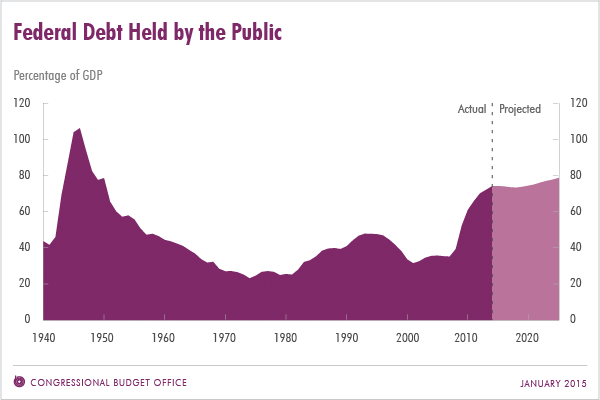
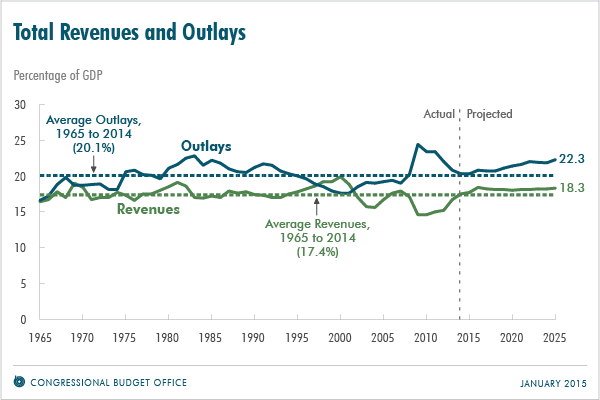
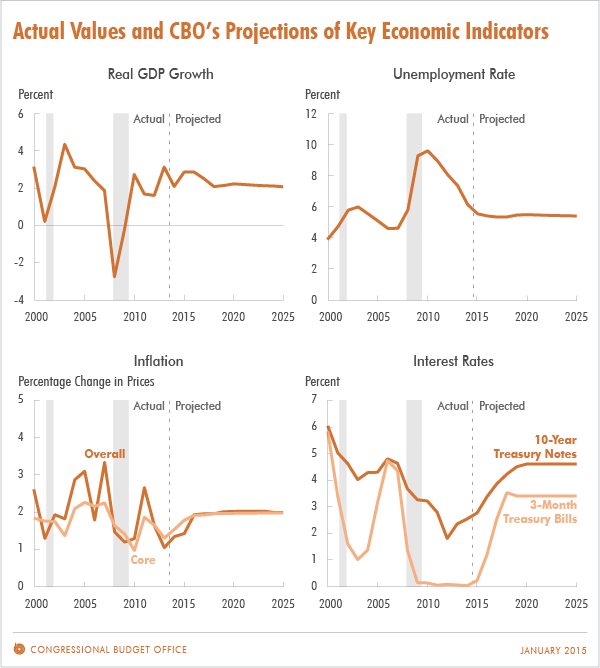
From the Congressional Budget Office: The Budget and Economic Outlook: 2015 to 2025
This was produced in preparation for consideration of the 2016 budget.
- Click here for it.
It provides data about recent economic performance as well as the level of outlays and revenue collection. Using economic forecasts it also - as is required by law - projects both ten years into the future. This provides guidelines for the future size of the deficit.
- Click here for the Wikipedia on the CBO.
- Click here for the CBO's website.
Here are some graphs from the report:

- Click here for it.
It provides data about recent economic performance as well as the level of outlays and revenue collection. Using economic forecasts it also - as is required by law - projects both ten years into the future. This provides guidelines for the future size of the deficit.
- Click here for the Wikipedia on the CBO.
- Click here for the CBO's website.
Here are some graphs from the report:


Wednesday, February 5, 2014
From the Congressional Budget Office: The Budget and Economic Outlook: 2014 to 2024
Prior to the presentation of the president's budget to Congress, the Congressional Budget Office is required to release a document projecting the budget 10 years into the future - which also requires that it estimate what the economy is likely to be like during that period of time.
Here is a link to the recently released document:
- The Budget and Economic Outlook: 2014 to 2024
Here the two key graphs in the report:


Here's what they have to say about projected revenues:
And here's what they have to say about projected spending:
The report contains some controversial predictions about the impact of the ACA on the number of jobs in the economy. It argues that a variety of responses to the law's requirements will lead to a reduction of over 2 million jobs by 2012. The White House and congressional Republicans are arguing over what this means for the laws merits.
- see this Washington Post story for greater detail.
Here is a link to the recently released document:
- The Budget and Economic Outlook: 2014 to 2024
Here the two key graphs in the report:
Here's what they have to say about projected revenues:
Federal revenues are expected to grow by about 9 percent this year, to $3.0 trillion, or 17.5 percent of GDP—just above their average percentage of the past 40 years (see the figure below). Revenues were well below that average in recent years, both because the income of individuals and corporations fell during the recession and because policymakers reduced some taxes. The expiration of various tax provisions and the improving economy underlie CBO’s projection that revenues will rise sharply this year. Those factors will increase revenues further in 2015, with CBO’s baseline showing another 9 percent rise. After 2015, revenues are projected to grow at about the same pace as output and to average 18.1 percent of GDP under the current-law assumptions of CBO’s baseline.
And here's what they have to say about projected spending:
Federal outlays are expected to increase by 2.6 percent this year, to $3.5 trillion, or 20.5 percent of GDP—their average percentage over the past 40 years. CBO projects that under current law, outlays will grow faster than the economy during the next decade and will equal 22.4 percent of GDP in 2024. With no changes in the applicable laws, spending for Social Security, Medicare (including offsetting receipts), Medicaid, the Children’s Health Insurance Program, and subsidies for health insurance purchased through exchanges will rise from 9.7 percent of GDP in 2014 to 11.7 percent in 2024, CBO estimates. Net interest payments by the federal government are also projected to grow rapidly, climbing from 1.3 percent of GDP in 2014 to 3.3 percent in 2024, mostly because of the return of interest rates to more typical levels. However, the rest of the government’s noninterest spending—for defense, benefit programs other than those mentioned above, and all other nondefense activities—is projected to drop from 9.4 percent of GDP this year to 7.3 percent in 2024 under current law.
The report contains some controversial predictions about the impact of the ACA on the number of jobs in the economy. It argues that a variety of responses to the law's requirements will lead to a reduction of over 2 million jobs by 2012. The White House and congressional Republicans are arguing over what this means for the laws merits.
- see this Washington Post story for greater detail.
Tuesday, September 24, 2013
Has austerity hampered economic growth?
Here is an argument that it has.
In recent recessions, government spending has increased. Not in the current recession. Here's one factoid. Government jobs have been cut, which keeps the unemployment rate high. In previous recessions they increased.

A CBO report argues that austerity has cut GDP growth by .8 percent.
In recent recessions, government spending has increased. Not in the current recession. Here's one factoid. Government jobs have been cut, which keeps the unemployment rate high. In previous recessions they increased.
A CBO report argues that austerity has cut GDP growth by .8 percent.
Friday, May 17, 2013
CBO's Updated Budget Projections: Fiscal Years 2013-1023
The Congressional Budget Office revises the estimates it made 4 months ago. The deficit is projected to stabilize as a percentage of GDP - in the next few years - around 21%. Wonkblog comments here.
Wednesday, February 6, 2013
CBO releases budget outlook
As required by law, the Congressional Budget Office released its budget outlook for the next 10 years. It's meant to provide a basis for the formation of each year's budget. It's just released it outlook for 2013-2023 - click here to access it. Commentary from Wonkblog here.
They offer some graphs that put the current budget in historical context:


They offer some graphs that put the current budget in historical context:
Monday, February 13, 2012
CBO Report: The Budget and Economic Outlook: Fiscal Years 2012 to 2022
As promised in today's 2302 classes: the CBO report on the Budget and Economic Outlook: Fiscal Years 2012 to 2022.
This kicks off Congress' part of the budgeting process.
This kicks off Congress' part of the budgeting process.
Tuesday, October 25, 2011
The Top 1% has Doubled it's Income Since 1979
From the NYT:
The top 1 percent of earners more than doubled their share of the nation’s income over the last three decades, the Congressional Budget Office said Tuesday, in a new report likely to figure prominently in the escalating political fight over how to revive the economy, create jobs and lower the federal debt.
In addition, the report said, government policy has become less redistributive since the late 1970s, doing less to reduce the concentration of income.
“The equalizing effect of federal taxes was smaller” in 2007 than in 1979, as “the composition of federal revenues shifted away from progressive income taxes to less-progressive payroll taxes,” the budget office said.
Also, it said, federal benefit payments are doing less to even out the distribution of income, as a growing share of benefits, like Social Security, goes to older Americans, regardless of their income.
The top 1 percent of earners more than doubled their share of the nation’s income over the last three decades, the Congressional Budget Office said Tuesday, in a new report likely to figure prominently in the escalating political fight over how to revive the economy, create jobs and lower the federal debt.
In addition, the report said, government policy has become less redistributive since the late 1970s, doing less to reduce the concentration of income.
“The equalizing effect of federal taxes was smaller” in 2007 than in 1979, as “the composition of federal revenues shifted away from progressive income taxes to less-progressive payroll taxes,” the budget office said.
Also, it said, federal benefit payments are doing less to even out the distribution of income, as a growing share of benefits, like Social Security, goes to older Americans, regardless of their income.
Sunday, August 28, 2011
Update on state of the budget, and the economy etc...
More of a series of links related to the state of the economy, jobs, the budget etc...
- Budget deficit to hit $1.3 trillion this year, congressional analysts report.
- Bernanke Blames Politics for Financial Upheaval.
- Budget deficit to hit $1.3 trillion this year, congressional analysts report.
- Bernanke Blames Politics for Financial Upheaval.
Saturday, August 27, 2011
Some random posts on the impact of the ARRA - the stimulus bill.
Just what the title says. I've been researching the impact of Obama's stimulus bill (and stimulus measures in general) and have run into various helpful sources, thought I'd share them if you'd like to dig into them also:
- Bush stimulus may have had only modest impact.
- How We Know the Stimulus Is Working.
- White House Report Claims Stimulus Success -- Despite 3.5 Million Job Losses.
- Obama says stimulus is responsible for 2 million jobs saved or created.
- Did the stimulus work? A review of the nine best studies on the subject.
- Wikipedia: Multiplier.
- Wikipedia: Fiscal Multiplier.
- Stimulating Spending with the Fiscal Multiplier.
- CBO Report.
Together these help focus on a question that ought to recur over this semester: What actual impact can government have on economic and social affairs? What role ought government have? It's one thing to wish for a specific outcome, its another to ensure this is likely to occur.
- Bush stimulus may have had only modest impact.
- How We Know the Stimulus Is Working.
- White House Report Claims Stimulus Success -- Despite 3.5 Million Job Losses.
- Obama says stimulus is responsible for 2 million jobs saved or created.
- Did the stimulus work? A review of the nine best studies on the subject.
- Wikipedia: Multiplier.
- Wikipedia: Fiscal Multiplier.
- Stimulating Spending with the Fiscal Multiplier.
- CBO Report.
Together these help focus on a question that ought to recur over this semester: What actual impact can government have on economic and social affairs? What role ought government have? It's one thing to wish for a specific outcome, its another to ensure this is likely to occur.
Saturday, July 16, 2011
Peter Orszag and the Debt Ceiling
Aside from providing some analysis about the consequences of default, and the likely prospects for increases in employment in the near future, the following story illustrates the close relationship - some say too close - between executive officials and private enterprise.
Until recently, Peter Orszag was the head of Obama's Office of Management and Budget - the White House's top adviser on budgetary matters - a position comparable to the Congressional Budget Office. Now he holds a high position at Citigroup, and is able to provide inside information about likely government activities. Nothing he is doing is that different from previous officials from various administrations.
From the Atlantic:
Former OMB director Peter Orszag left the Obama administration last year for Citigroup. But his opinions about what's going on in Washington are highly sought after by Citigroup clients. Part of his job is to advise institutional clients like hedge funds and mutual funds, which are growing nervous about the looming possibility of a debt default, like everybody else. Orszag recently gave such a briefing that left at least some in his audience convinced that the situation is less dire than Treasury is indicating.
FYI: Ezra Klein explains why default is bad for the economy. It will increase the amount of money that the federal government pays in interest on the money it borrows, which will in turn increase everyone else's interests as well. This will suppress spending.
Until recently, Peter Orszag was the head of Obama's Office of Management and Budget - the White House's top adviser on budgetary matters - a position comparable to the Congressional Budget Office. Now he holds a high position at Citigroup, and is able to provide inside information about likely government activities. Nothing he is doing is that different from previous officials from various administrations.
From the Atlantic:
Former OMB director Peter Orszag left the Obama administration last year for Citigroup. But his opinions about what's going on in Washington are highly sought after by Citigroup clients. Part of his job is to advise institutional clients like hedge funds and mutual funds, which are growing nervous about the looming possibility of a debt default, like everybody else. Orszag recently gave such a briefing that left at least some in his audience convinced that the situation is less dire than Treasury is indicating.
FYI: Ezra Klein explains why default is bad for the economy. It will increase the amount of money that the federal government pays in interest on the money it borrows, which will in turn increase everyone else's interests as well. This will suppress spending.
Tuesday, March 1, 2011
The Latest From the CBO
The CBO director gave a recent address about the outlook for the economy and the budget complete with slides I plan to steal for future lectures.
Tuesday, February 8, 2011
Wednesday, January 26, 2011
Friday, January 7, 2011
Health Care Repeal and the CBO
The House moved towards a mostly symbolic vote in favor of repealing health care. The real dispute seems to be about the costs of repeal and whether House Republicans want to accept -- which they don't -- the Congressional Budget Offices' analysis that repeal will increase the deficit.
Bruce Bartlett warns against undermining the CBO.
Bruce Bartlett warns against undermining the CBO.
Friday, May 14, 2010
Friday, January 29, 2010
Congressional Budget Office Report Not Good
The Congressional Budget Office has issued a report that predicts the economy will not turn around anytime soon.
William Galston spells out the obvious.
Wikipedia: Congressional Budget Office.
William Galston spells out the obvious.
Wikipedia: Congressional Budget Office.
Friday, March 20, 2009
Subscribe to:
Posts (Atom)