Showing posts with label generational politics. Show all posts

Sunday, September 25, 2016

From the New York Times: Will the Left Survive the Millennials?

An opinion piece.

For our look at ideology, free speech, and public opinion.

- Click here for the article.

When I was growing up in the ’60s and early ’70s, conservatives were the enforcers of conformity. It was the right that was suspicious, sniffing out Communists and scrutinizing public figures for signs of sedition.
Now the role of oppressor has passed to the left. In Australia, where I spoke, Section 18C of the Racial Discrimination Act makes it unlawful to do or say anything likely to “offend, insult, humiliate or intimidate,” providing alarming latitude in the restriction of free speech. It is Australia’s conservatives arguing for the amendment of this law.
As a lifelong Democratic voter, I’m dismayed by the radical left’s ever-growing list of dos and don’ts — by its impulse to control, to instill self-censorship as well as to promote real censorship, and to deploy sensitivity as an excuse to be brutally insensitive to any perceived enemy. There are many people who see these frenzies about cultural appropriation, trigger warnings, micro-aggressions and safe spaces as overtly crazy. The shrill tyranny of the left helps to push them toward Donald Trump.
Ironically, only fellow liberals will be cowed by terror of being branded a racist (a pejorative lobbed at me in recent days — one that, however groundless, tends to stick). But there’s still such a thing as a real bigot, and a real misogynist. In obsessing over micro-aggressions like the sin of uttering the commonplace Americanism “you guys” to mean “you all,” activists persecute fellow travelers who already care about equal rights.
Moreover, people who would hamper free speech always assume that they’re designing a world in which only their enemies will have to shut up. But free speech is fragile. Left-wing activists are just as dependent on permission to speak their minds as their detractors.
In an era of weaponized sensitivity, participation in public discourse is growing so perilous, so fraught with the danger of being caught out for using the wrong word or failing to uphold the latest orthodoxy in relation to disability, sexual orientation, economic class, race or ethnicity, that many are apt to bow out. Perhaps intimidating their elders into silence is the intention of the identity-politics cabal — and maybe my generation should retreat to our living rooms and let the young people tear one another apart over who seemed to imply that Asians are good at math.

Thursday, April 3, 2014

Tuesday, April 1, 2014

From the Pew Research Center: Shrinking Majority of Americans Support Death Penalty

This comes via the Dish.

- Click here for the report.

They issued a report showing declining support for the death penalty - as well as this chart showing fluctuations in support over time. A great question here is what accounts for the increased support beginning in the mid 1960s, which coincides with riots in major urban areas around the country.

What explains the continued shift downwards beginning in 1998?

death-penalty-1

There are few differences in opinion based on age, gender and education:

death-penalty-3

But there are based on race - which may explain the differences based on party ID:

death-penalty-2

Thursday, March 13, 2014

From the Dish: The Marriage Equality End Game

I just touched up slides for 2305's discussion later this semester of public opinion - which includes a look at the impact of peer groups like generational cohorts. Changes in public policy quite often are driven by changes in the opinions that each generation holds.

This helps explain shifts in attitudes about gay marriage (also - and more positively - called marriage equality). Grandma and grandpa do not change their opinions on the matter - they just grow old and die and their opinion die with them. These are replaced by their kids and grand kids - who will have the same fate.

There's an underlying cruelty to this.

Andrew Sullivan comments on this and offers this graphic that details the different attitudes within each generation, and why the shifts in attitudes are likely to be long lasting. Note the shifts among Republicans - that's the kicker.

- Click here for the post.

Pew Marriage

Thursday, May 30, 2013

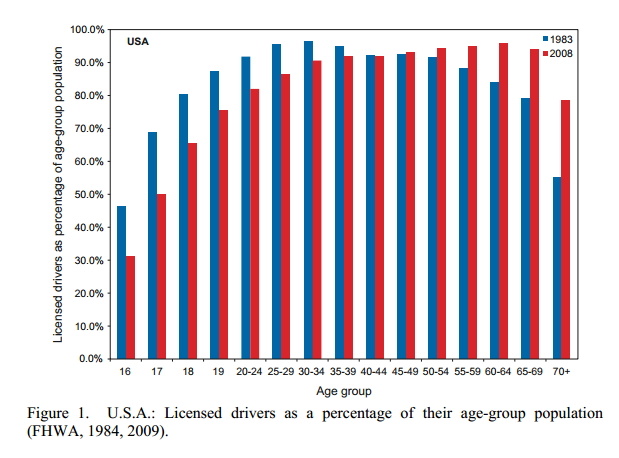
The young are driving less, the old are driving more

Andrew Sullivan has the story. American car culture may be waning. Walking and biking are more and more popular among the young. It might be worth considering what this means for traffic safety. Fewer younger drivers means fewer risk takers on the road, but having a larger number of elderly drivers may pose its own set of problems.

How might state and city ordinances respond to this shift? It would be worth checking on these data on a state by state basis. I have a hunch this does not apply to Texas.

dish_driverdata

Tuesday, January 17, 2012

Shifting attitudes about Martin Luther King

John Sides highlights a year old Gallup Poll that shows how attitudes about Martin Luther King have shifted over time. Note how the favorable and unfavorable numbers have shifted.


It's worth assessing why and what this tells us about public opinion. Like many public figures of the past - meaning they've been dead for some time - MLK is no longer a flesh and blood person, but is an icon. Personal animosity has long since subsided, so people no longer evaluate him based on feelings about an actual person, rather what that person stands for.

This shift happens of course not because people changed their minds about him, but because those who formed opinions of him while he was alive - and was a more controversial public figure - are themselves dead. Or if not, getting on in years. Many who form opinions now do so based on what they learn in history books, and the lessons it contains tend to be very positive. It's tough to come out strongly against someone who stood for civil rights and was killed doing so. This is an example of generational politics - something my 2301s hit when we discuss public opinion.

The same thing happens with all sorts of public figures - people like Washington and Lincoln were far more polarizing in their day than they are now. Its worth considering what future opinions about current polarizing figures (maybe W Bush and Obama) might be in the future once those who have personal grudges against them, or affinity towards them are no longer around to answer pollster's questions.  

Friday, September 23, 2011

The Great Recession Generation

Just like the Great Depression - the Great Recession is likely to have a significant impact on the generation that is coming of age right now. In 2301 we will discuss the concept of a political generation, the experiences of this group will impact politics and government throughout the 21st century.

-Recession changes the American way of life:

Lingering bad times may alter expectations and lifestyles for years to come, some demographers say.
"It's going to have a long-term impact and to say it's going to end is optimistic," says Cheryl Russell, former editor in chief of American Demographics, now editorial director of New Strategist Publications, publisher of reference tools. "I'm more pessimistic that this is the new normal.

- It Wasn't a Good Decade to be Young or in New York, Says the Census.

"Many young adults are essentially postponing adulthood and all of the family responsibilities and extra costs that go along with it," Mark Mather, analyst at the Population Reference Bureau, told the AP. Sure, without young people delaying those traditional markers of adulthood, we wouldn't have network sitcoms or trend pieces or Williamsburg (not to mention trend pieces involving network sitcoms set in Williamsburg). But twenty- and thirtysomethings are supposed to get to cling to immaturity by choice! It's depressing, and even more so when you consider it's only one early set of data connecting the economic impact of the downturn with the cultural impact — we're not done getting these numbers, and not all of the impact is going to be quantifiable.

Friday, April 9, 2010

Political Generations and the Future of the Democratic Party

For my 2301s as we continue to explore the sources of public opinion, some back and forth between the two authors about the impact a younger -- and possibly more libertarian -- cohort might have on the future of the Democratic Party.

- Liberaltarian Lessons from OKTrends?.
- Today's Social Liberal Is Tomorrow's Social Conservative.
- Liberaltarian Drift.
- Libertarian Electoral Fantasies.

Note the use of the term "liberaltarian" which is meant to distinguish younger, socially liberal members from the older folks.

Friday, February 26, 2010

Are Republicans Too Old?

Recent shifts in public opinion have benefited Republicans but this conservative writer worries that these shifts have been primarily among older Americans. Younger American support the Democratic Party more than they have in two or three decades. Does the future belong to them?

Saturday, September 19, 2009

Census Report: Incomes Rise only for the Old

This could lead to a seismic political shift:

The incomes of the young and middle-aged — especially men — have fallen off a cliff since 2000, leaving many age groups poorer than they were even in the 1970s, a USA TODAY analysis of new Census data found.

People 54 or younger are losing ground financially at an unprecedented rate in this recession, widening a gap between young and old that had been expanding for years.
While the young have lost ground, older people have grown more prosperous over the years and the decades. Older women have done best of all.

The dividing line between those getting richer or poorer: the year 1955. If you were born before that, you're part of a generation enjoying a four-decade run of historic income growth. Every generation after that is now sinking economically.

Household income for people in their peak earning years — between ages 45 and 54 — plunged $7,700 to $64,349 from 2000 through 2008, after adjusting for inflation. People in their 20s and 30s suffered similar drops. Older people enjoyed all the gains.

This coupled with the extra attention older Americans are paying to health care reform, sue to concerns it will harm them specifically, makes me wonder if age differences in political opinions are becoming more acute.

Sunday, September 13, 2009

Generation Gap on Health Care Reform

Here's something worth discussing in 2301 as we investigate political conflict. The dispute over health care reform has revealed a growing generational gap between older voters who are opposed to it -- and the Obama Presidency in general -- and younger voters who are not:

. . . Older Americans are more likely to oppose Mr. Obama’s initiative than any other age group. The White House views this dynamic as one of the biggest obstacles to tamping down public concerns about its approach and assembling a legislative coalition to get a bill passed in Congress.

Older voters were one of the few groups Mr. Obama did not win in the presidential election last year, leaving him and his party particularly reliant on younger voters, who do not show up at the polls as reliably as older people do. They have a dimmer view of his presidency than the rest of the nation.

And there is no reason to think that whatever tensions have been unearthed with this fight are going to end once it is resolved. Mr. Obama has signaled his intention to tackle the long-term financial problems of
Social Security, another issue the elderly play an outsize role in, and they tend to be resistant to change there, too.

Thursday, July 30, 2009

Are the 80s Over?

This video builds off a point I made below regarding generational shifts in attitudes. Have recent events -- the Great Recession especially -- led to a shift in attitudes about politics, government and society in general?

Sunday, March 15, 2009

The Homelanders

That's a potential name for the new generation of kids raised during the current economic recession. Another Silent Generation, according to the author.

File this under generational politics, the tendency of groups born around the same time, and exposed to the same experiences, to think alike.

Monday, May 19, 2008

The Entrepreneurial Age

That's what Michael Barone calls the next American frontier in today's Wall Street Journal. The upcoming generation--many of you--are primed to want to work for yourselves than work for an existing business. This is the latest stage of the never ending process by which America re-invents itself, which is the key to American success according to Mr. Barone:

The great new American frontiers proved to be those of business, science and technology. In the course of the 20th century, Americans invented more milestone technologies and inventions, created more wealth and leisure time, and reorganized their institutions more times than any country had ever done before – despite a massive economic depression and two world wars. It all reached a crescendo in the magical year of 1969, with the creation of the Internet, the invention of the microprocessor and, most of all, a man walking on the moon.

Along with genetic engineering, we are still busily spinning out the implications of these marvels. Yet it is becoming increasingly apparent that the cultural underpinnings of these activities have changed in some fundamental way.

We still have schools, but a growing number of our children are studying at home or attending private schools – and those in public schools are doing ever more amounts of their class work on the Internet.

We still have companies and corporations, but now they are virtualized, with online work teams handing off assignments to each other 24/7 around the world. Men and women go to work, but the office is increasingly likely to be in the den. In 2005, an Intel survey of its employees found that nearly 20% of its professionals had never met their boss face-to-face. Half of them never expected to. Last summer, when the Media X institute at Stanford extended that survey to IBM, Sun, HP, Microsoft and Cisco, the percentages turned out to be even greater.

Newspapers are dying, networks are dying, and if teenage boys playing GTA 4 and World of Warcraft have any say about it, so is television. More than 200 million people now belong to just two social networks: MySpace and Facebook. And there are more than 80 million videos on YouTube, all put there by the same individual initiative.

The most compelling statistic of all? Half of all new college graduates now believe that self-employment is more secure than a full-time job. Today, 80% of the colleges and universities in the U.S. now offer courses on entrepreneurship; 60% of Gen Y business owners consider themselves to be serial entrepreneurs, according to Inc. magazine. Tellingly, 18 to 24-year-olds are starting companies at a faster rate than 35 to 44-year-olds. And 70% of today's high schoolers intend to start their own companies, according to a Gallup poll.


It is telling that today's youth condition their goals and objectives on a landscape created by the previous generation. Perhaps that is the obligation each generation has to the next. So the question is whether a bustling internet economy beats a sinking dollar, exploding entitlements, and strained military.

Sunday, March 23, 2008

A New Generation Gap

That seems to be the key consequence of Obama's campaign, and especially of his speech on race (A More Perfect Union) last week in Philadelphia. He effectively tied his views--and I think the views of members of his age group--in with the larger story of the evolution of America, and the views of previous generations with the hostilities which evolved in the immediate aftermath of the 60s civil rights movement.

This editorial comes close to outlining the issue, but I'm convinced that most others will fight his views, not on their merits, but for the simple reason that they cannot understand what he is saying. It's classic generational politics and it has more to do with how events at one moment in time inevitably shape the generation that grows within them. When we discuss public opinion, we will cover the importance of generational change. It is a driving force in American politics. People do not change opinions, opinions dies off as the people who holds them dies off. Brutal isn't it?

Whether Obama wins or loses, he is shaping how the next generation discusses race. It's a sign of the future. The baby boomer commentators who are opposing Obama are partly reacting to their own mortality.

Monday, September 3, 2007

Time Marches On

Each year Beloit College releases a depressing document called the Mindset List. It is meant to help their faculty come to terms with incoming freshman. It will also prove useful for my 2302 classes when we discuss public opinion and the concept of "generational politics."

Many of you do not fit this demographic, but those of you who graduated high school last May were born in 1989 meaning that:

"They have been latchkey kids for most of their lives, students entering college this fall think nothing of arriving home with parents still at work, then e-mailing or texting their friends, instantly updating their autobiographies on "Facebook" or "MySpace," and listening to their iPods while doing their research on Wikipedia. They've grown up with Rush Limbaugh urging his fellow Dittoheads to excoriate liberals, with having been taught by an equal number of women and men in the classroom, and with women having been hired as police chiefs of major cities.

Food has always been a health concern. Consumer awareness about ingredients and fats has always been energized. They've never "rolled down" a car window, and to them Jack Nicholson is mainly known as the guy who played "The Joker."

As usual, they remind their elders how quickly time has passed. For them Pete Rose has never been in baseball. Abbie Hoffman's always been dead. Johnny Carson has never been live on TV, and Nelson Mandela has always been free.

As for the Berlin Wall, what's that?

Most of the students entering College this fall, members of the Class of 2011, were born in 1989. For them, Alvin Ailey, Andrei Sakharov, Huey Newton, Emperor Hirohito, Ted Bundy, Abbie Hoffman, and Don the Beachcomber have always been dead.


1. What Berlin wall?
2. Humvees, minus the artillery, have always been available to the public.
3. Rush Limbaugh and the "Dittoheads" have always been lambasting liberals.
4. They never "rolled down" a car window.
5. Michael Moore has always been angry and funny.
6. They may confuse the Keating Five with a rock group.
7. They have grown up with bottled water.
8. General Motors has always been working on an electric car.
9. Nelson Mandela has always been free and a force in South Africa.
10. Pete Rose has never played baseball.
11. Rap music has always been mainstream.
12. Religious leaders have always been telling politicians what to do, or else!
13. "Off the hook" has never had anything to do with a telephone.
14. Music has always been "unplugged."
15. Russia has always had a multi-party political system.
16. Women have always been police chiefs in major cities.
17. They were born the year Harvard Law Review Editor Barack Obama announced he might run for office some day.
18. The NBA season has always gone on and on and on and on.
19. Classmates could include Michelle Wie, Jordin Sparks, and Bart Simpson.
20. Half of them may have been members of the Baby-sitters Club.
21. Eastern Airlines has never "earned their wings" in their lifetime.
22. No one has ever been able to sit down comfortably to a meal of "liver with some fava beans and a nice Chianti."
23. Wal-Mart has always been a larger retailer than Sears and has always employed more workers than GM.
24. Being "lame" has to do with being dumb or inarticulate, not disabled.
25. Wolf Blitzer has always been serving up the news on CNN.
26. Katie Couric has always had screen cred.
27. Al Gore has always been running for president or thinking about it.
28. They never found a prize in a Coca-Cola "MagiCan."
29. They were too young to understand Judas Priest's subliminal messages.
30. When all else fails, the Prozac defense has always been a possibility.
31. Multigrain chips have always provided healthful junk food.
32. They grew up in Wayne's World.
33. U2 has always been more than a spy plane.
34. They were introduced to Jack Nicholson as "The Joker."
35. Stadiums, rock tours and sporting events have always had corporate names.
36. American rock groups have always appeared in Moscow.
37. Commercial product placements have been the norm in films and on TV.
38. On Parents' Day on campus, their folks could be mixing it up with Lisa Bonet and Lenny Kravitz with daughter Zöe, or Kathie Lee and Frank Gifford with son Cody.
39. Fox has always been a major network.
40. They drove their parents crazy with the Beavis and Butt-head laugh.
41. The "Blue Man Group" has always been everywhere.
42. Women's studies majors have always been offered on campus.
43. Being a latchkey kid has never been a big deal.
44. Thanks to MySpace and Facebook, autobiography can happen in real time.
45. They learned about JFK from Oliver Stone and Malcolm X from Spike Lee.
46. Most phone calls have never been private.
47. High definition television has always been available.
48. Microbreweries have always been ubiquitous.
49. Virtual reality has always been available when the real thing failed.
50. Smoking has never been allowed in public spaces in France.
51. China has always been more interested in making money than in reeducation.
52. Time has always worked with Warner.
53. Tiananmen Square is a 2008 Olympics venue, not the scene of a massacre.
54. The purchase of ivory has always been banned.
55. MTV has never featured music videos.
56. The space program has never really caught their attention except in disasters.
57. Jerry Springer has always been lowering the level of discourse on TV.
58. They get much more information from Jon Stewart and Stephen Colbert than from the newspaper.
59. They're always texting 1 n other.
60. They will encounter roughly equal numbers of female and male professors in the classroom.
61. They never saw Johnny Carson live on television.
62. They have no idea who Rusty Jones was or why he said "goodbye to rusty cars."
63. Avatars have nothing to do with Hindu deities.
64. Chavez has nothing to do with iceberg lettuce and everything to do with oil.
65. Illinois has been trying to ban smoking since the year they were born.
66. The World Wide Web has been an online tool since they were born.
67. Chronic fatigue syndrome has always been debilitating and controversial.
68. Burma has always been Myanmar.
69 Dilbert has always been ridiculing cubicle culture.
70. Food packaging has always included nutritional labeling.