Showing posts with label Texas Republicans. Show all posts

Tuesday, January 30, 2024

From Ballotpedia News: Texas Republican Party places 13 nonbinding advisory questions on the March primary ballot

This is one of the ways a political party figures out what future topics to focus on.

- Click here for the article


The Texas Republican Party has placed 13 nonbinding advisory questions on the March 5 primary ballot. The Texas Democratic Party does not plan on placing any questions on primary ballots this year. The last time they did was in 2020.

An advisory question is a type of ballot measure in which citizens vote on a non-binding question. The largest difference between an advisory vote and any other type of ballot measure is that the outcome of the ballot question will not result in a new, changed, or rejected law. Rather, the advisory question symbolically makes heard the general opinion of the voting population regarding the issue at hand.

The propositions address the following topics:
- Property taxes;
- The border and immigration;
- Foreign policy;
- Access to gold and silver for use as legal tender;
- Vaccine mandates;
- Closed primaries;
- Authority for the attorney general to prosecute election crimes;
- Right to choose any type of school for a child’s education and a voucher program;
- Proof of citizenship to register to vote; and
- Ban on Texas sale of land to citizens, governments, and entities from China, Iran, North Korea, and Russia.

The questions were adopted by the 64-member State Republican Executive Committee and published on Dec. 28.

The Texas Elections Code allows citizens to collect signatures for a petition to place a specific question before voters at the party’s general primary election. The required number of signatures is 5% of the total vote received by all candidates for governor in the party’s most recent primary election, which equates to 97,709 signatures for the 2024 ballot. The deadline to file the petition for the March 5, 2024, ballot was Dec. 10.

Tuesday, August 9, 2016

From the Texas Tribune: Trump Calls NAFTA a "Disaster." Texas Republicans Beg to Differ.

There's a split among Republicans on the agreement.

- Click here for the article.

Caught between the anti-globalist tirades of their presidential standard bearer and their state's close trade ties with Mexico, Texas congressional Republicans are straddling a tricky political line when it comes to talk of renegotiating the North American Free Trade Agreement.
Republican nominee Donald Trump called NAFTA a “disaster” and backed renegotiating the pact in a policy speech in Detroit on Monday. Barring a better deal, he said, the United States should withdraw from the 22-year-old agreement that lowered trade barriers between the United States, Mexico and Canada.
Texas grassroots conservatives also want to abandon the deal. The Republican Party of Texas' 2016 platform demands “immediate withdrawal from the North American Free Trade Agreement.”
But when The Texas Tribune reached out to each of the 27 Republican members of the Texas congressional delegation, not one joined in Trump's call for renegotiating the treaty. None agreed to be interviewed, three responded with written statements and the others either did not respond or declined to comment.
“NAFTA is responsible for increasing trade between Texas and Mexico by almost 110 percent since 2004,” Rep. Will Hurd, R-San Antonio, said in a statement.

Tuesday, August 2, 2016

From the New Yorker: THE NATHAN HECHT STORY: CONSERVATIVES CAPTURING COURTS

A look at the current Chief Justice of the Texas Supreme Court and the role he has played in using the courts to push the conservative agenda.

- Click here for the article.
Hecht’s brief moment as a major public figure thus illustrated one of the larger themes of recent American political history: the centrality of the United States Supreme Court to the conservative movement. But the story of the following eight years in Hecht’s judicial career suggests something nearly as important: the transformation of state supreme courts into engines of conservative change.
For much of American history, state courts were relatively sleepy outposts for lions of the local bar. But starting in the nineteen-eighties, state supreme courts (particularly in states where judges are elected rather than appointed) became political battlegrounds. This was especially true in Texas, where a young political consultant named Karl Rove ran the campaigns that turned the Texas Supreme Court from all-Democrat to all-Republican. When Hecht first won election to the Court, in 1988, Rove ran his campaign. Led by Hecht and other Rove clients, the Texas Court became a firm ally of local business interests, especially the insurance industry.

Monday, July 25, 2016

Cruz is in some hot water.

- After Cleveland Speech, Cruz Faces Isolation in Texas GOP.

After upending Donald Trump's Republican National Convention with his conspicuous non-endorsement of the presidential nominee, Cruz is confronting isolation and unease in his home-state GOP, which has largely been moving toward Trump even as he continues to withhold support.
"The isolation is increasingly rapid, and it seems to me only the most fervent Ted Cruz supporters are hanging on," said Carl Tepper, former president of the Texas Republican County Chairmen's Association and an at-large delegate from Lubbock.
More than 36 hours after Cruz left the stage in Cleveland amid thunderous boos, very few prominent Texas Republicans were rushing to his defense. In fact, more could be seen and heard bluntly voicing disagreement with the attitude Cruz took toward his party's presidential nominee.

"It was just painful. It was not what I would consider what we needed at a convention," state Sen. Charles Perry of Lubbock said in an interview Thursday on Lubbock radio.

- Trump Says He Plans to Launch Super PAC Against Ted Cruz.

Republican presidential nominee Donald Trump says he will probably create a super PAC with the aim of hobbling the political future of U.S. Sen. Ted Cruz, R-Texas.
Trump, a mercurial businessman whose promises have often been subject to deep skepticism, confirmed the plan in an interview set to air Sunday on NBC. He was asked about a report Friday that said he wants to set up a super PAC, which can raise and spend unlimited amounts of money, to go after Cruz and Ohio Gov. John Kasich, two former Republican primary opponents who have not endorsed him.

Thursday, July 21, 2016

From Vox: How Republicans went from the party of Lincoln to the party of Trump, in 13 maps

Highly recommended for both 2305 and 2306.

- Click here for it.

Here's one of the images: How Republicans gave up on reforming the South

Wednesday, July 20, 2016

From the Texas Tribune: Analysis: For Some Texas Republicans, Useful Distractions Back Home

More on the divisions between the state and national Republican parties.

- Click here for the article.

This year’s general election ballot doesn’t offer many shady spots to a Republican trying to escape the presidential campaign’s glare. But for those who want to stay out of that national conversation — the speaker of the Texas House, to name one — there are a handful of races at home that offer plausible excuses.
Joe Straus told the Texas delegates at the Republican convention in Cleveland that he’ll be busy this election cycle helping a half-dozen Republican incumbents who have real challenges in the general election.
It’s a dodge. A thin dodge.
There are only a handful of races up in the air in Texas, if by up in the air you mean “yeah, maybe.”
But Straus talked local in Cleveland when he was ducking reporters’ questions about whether he was endorsing Donald Trump. “I know there’s some tension over the presidential nomination, but not everything that happens at a nominating convention is about the top of the ticket," he said. “There are a whole lot of people here working where I am on down-ballot races.”
Straus did say he won’t be supporting Democrat Hillary Clinton, but didn’t say he would vote for Trump.
No matter how the presidential race goes in Texas, few of the candidates running down-ticket races have much to worry about. Officeholders left voters with district maps that take away voters' real choices over who serves in legislative or congressional office.

From the National Review: Trump leaves Texas Republicans morose and anxious.

Texas is not excited about their candidate, or what he might mean for the future of the party's coalition.

- Click here for the article.

“We are in trouble,” says Artemio “Temo” Muniz, chairman of the Texas chapter of the Federation of Hispanic Republicans. Muniz is the evidence for both sides of the immigration debate: He is the son of an illegal alien, a goat-herder from near San Luis Potosi and a beneficiary of the 1986 Reagan amnesty. He probably took a job or two that a native-born American might otherwise have taken, but he also created a lot of them, having started a mattress-manufacturing company that is now one of the largest home-furnishings businesses in the region, employing about 90 people. Muniz works for the family business and has just finished law school. When I ask about the lack of Hispanic participants in the convention, he says my observations are accurate. “The chairman says he wants a convention that looks like Texas, but we have a long way to go to get there.” (The Texas GOP leadership is not exactly covered up with Hispanic officers.) There are a number of problems facing Republicans looking to court Hispanic voters, starting with the fact that the target demographic is about 70 percent Mexican American while the Hispanic-outreach consultants are about 100 percent Cuban American. South Texas isn’t South Florida, but then South Florida isn’t South Florida anymore, either: Republicans lost the Cuban-American vote in the 2012 presidential race for the first time.

Tuesday, June 21, 2016

From the Texas Tribune: Platforms Reveal Common Ground Between Texas GOP, Democrats

For out look at political parties. A comparison of the party platforms of the Texas Republican and Democratic Party platforms.

- Click here for the article.

Though they disagree on nearly every major policy issue, from education funding to abortion to immigration, Texas Republicans and Democrats apparently have common ground on a few things, according to the platforms approved at recent state conventions.
Both state parties approve new platforms every two years, covering dozens of issues. Republicans put their platform together in May in Dallas. Democrats followed suit last week in San Antonio.
The platforms provide an opportunity for activists in both parties to outline the positions they expect their candidates and elected officials to hold, though there's always some that choose to ignore some of their party's positions.
While much of the two parties' platforms is irreconcilable, there are a handful of policy areas where Republicans and Democrats appear to come together.
- Medical Marijuana
- Toll Roads
- Trans-Pacific Partnership
- Campaign Finance
- Space Exploration

Click here for the respective platforms:

- Texas Democratic Party Platform.
- Texas Republican Party Platform.

Monday, April 25, 2016

From the Texas Tribune: Ted Cruz Shifts Policy Stances to Suit Fractured GOP

For our look at parties in the state of Texas, coupled with the ongoing campaign for the Republican presidential nomination.

- Click here for the article.

At the start of the presidential campaign,Ted Cruz told voters he would be the only “consistent conservative” in a crowded Republican field.
Then he confronted the modern GOP — a fractured party, in which each faction has a different definition of what “conservative” means.
To consistently please all of them, Cruz has had to be inconsistent with himself.
Time and again he has shifted, shaded or obfuscated his policy positions — piling on new ideas, which sometimes didn’t fit with the old.
Cruz, for instance, promised libertarians that he would show a strict respect for the Constitution’s checks and balances.
Then, the senator from Texas promised social conservatives that he would scrap one of those checks and balances, stripping lifetime tenure from Supreme Court justices.
He criticized Donald Trump’s plan for mass deportation of undocumented immigrants. Then he seemed to support it. He appeared skeptical of military intervention in Syria. Then he vowed to find out whether “sand can glow in the dark” there.
Cruz’s maneuvering has helped him build and maintain a base of support among the party’s activist class: If Trump fails to win the GOP nomination outright, Cruz could have enough backing among Republican delegates to win it after the first ballot at the party’s convention in Cleveland in July.
But while Cruz’s rightward shifts might have been politically smart during the primary season, they probably would create major challenges during the general election, putting Cruz far to the right of most voters.

Thursday, April 21, 2016

From TribTalk: With LGBT issues, Abbott must balance base and businesses

For our look at parties in Texas. State Republican parties are conflicted in their response to last year's gay marriage ruling. Business interests want to pull them in one direction, religious interests in another.

- Click here for the article.

The politics of the Texas GOP leadership’s immediate and no doubt well-planned responses to the court’s validation of same sex marriage echoed the responses by much of the southern wing of their party, and they provided a glimpse of things yet to come in Texas once national politics stabilize after the November elections. But these responses, and their underlying approach to the problem, are not without their share of difficulties.

The recent resistance of GOP-led state governments in Mississippi and North Carolina to local efforts to prevent discrimination against gay and lesbian residents has been met by a very public backlash from corporate actors in sectors ranging from professional sports leagues and banks to tech giants and manufacturers. Their repudiation has highlighted the increasingly familiar friction within the GOP between its socially conservative voting base and the business interests that in many cases play an outsized role in the party’s donor class.

The governors of these and other states have discovered that businesses looking to recruit and retain educated, cosmopolitan employees; to sell their products and services to the broadest possible base of customers, especially young ones; and to avoid pressure from gay and lesbian civil rights groups don’t want to be associated with policies perceived as being discriminatory against the LGBT community. Bigotry is bad for business. The Texas Association of Business has been a loud warning voice on this front, underlining the economic — rather than the ideological — nature of these concerns for many otherwise solidly Republican interests in the state.

This resistance notwithstanding, it is all but certain that the lieutenant governor, his allies and their fellow travelers in the Legislature will resume efforts to pass “religious protection” measures when the next legislative session cranks. These efforts will pose challenges to Republican leaders attempting to keep the disparate elements that make up their party within the GOP tent — especially Governor Abbott.

Wednesday, April 20, 2016

From the Texas Tribune: The Texas Secession Debate is Getting Kind of Real

For out look at state parties and how the rank and file can bring items up the leadership would rather not deal with.

- Click here for the article.

When Texas Republicans assemble for their state convention next month, it's possible they will debate whether the state should secede from the United States.
There's almost no chance Texas Republicans will actually vote in favor of seceding, mind you — not least because most of the party wants nothing to do with this — but the fact we're even mentioning secession and the Texas GOP convention in the same sentence suggests that the once-fringe movement has become a priority for at least some conservative grassroots Texans.
To be sure, that seems to be a relatively small group. The Texas secession movement says 22 out of the 270 county GOP conventions passed some kind of independence resolution this spring. A party official said he'd be "surprised" if that were the case, and the Houston Chronicle was able to confirm only 10 counties. But 10 is a lot more than the one county that passed an independence resolution in 2012.
Texas Republicans say these independence resolutions are just a handful of tens of thousands various resolutions to be considered at their convention. But it does seem like the secession movement is growing, or at least organizing, and may have become too big for party officials to ignore.

Thursday, April 14, 2016

From the Texas Tribune: Analysis: No Middle Ground in Race to Lead Texas GOP


There is a fight underway for control of the direction of the Republican Party in Texas.

- Click here for the article.

Houston’s Jared Woodfill is trying to win control of the Republican Party of Texas, challenging the current management and saying it has been too quiet in the face of legislative defeats in a state government dominated by Republican officeholders and appointees.

The contest between Tom Mechler of Amarillo, the party’s current chairman, and Woodfill, who once led the Harris County GOP, is a fight about purity, about which kinds of conservatives the Texas GOP represents and about what the party is supposed to be doing. They don’t run as combined tickets, but former state party Chairman Cathie Adams is running for vice chair in tandem with Woodfill while current vice chair Amy Clark is seeking re-election, along with Mechler.

The outcome of the elections, to be held at the GOP’s state convention in Dallas next month, probably isn’t going to change your life, but it’s interesting. Mechler wants the party to bring in more voters — he’s talking about minorities and millennials, among others — who have generally eluded the charms of the GOP. He doesn’t think it’s his job to tell the state’s Republican officeholders what to do.

“Every Republican should be comfortable within the party,” he says. “My vision is and will be that is that this party is welcoming and embracing all conservatives from all over the state of Texas.”

Woodfill is a bully-pulpit guy, a political figure whose effectiveness depends on everything from actual microphones on actual podiums to social media, news media and advertising.

He is appealing for the support of others who, like him, think the state political party should be whipping the Legislature to keep it in line with the GOP platform and the beliefs of Texans in its voting base.

His pitch against the current party leadership seems aimed more at the House than at anyone else. An example from the Facebook page promoting his candidacy: “Friends, we are engaged in a cultural war and our Republican Party of Texas leadership is running from the fight! One need only look at the 2015 legislative sessions to find evidence of the RPT surrendering our values.”

Woodfill focuses on a list of issues that met their demise, he contends, in the Texas House, including bills outlawing references to Sharia in courts, requiring Texas cities to enforce federal immigration laws, allowing the use or diversion of tax dollars for private school tuition, repealing in-state tuition for the children of undocumented immigrants/noncitizens who graduate from Texas high schools, and enacting new ethics legislation.

That plays into existing divisions among the Republicans in government, however they are characterized: establishment against insurgents, social conservatives against social moderates, chamber of commerce against grassroots.

Wednesday, March 2, 2016

From the Texas Tribune: Travis County GOP Apoplectic Over New Chairman

This is pretty fun - and coarse.

- Click here for the article.

For a cleaner version of events:

- Travis County Republican Party Split Over Controversial Chairman-Elect.

In the weeks leading up to election day, incumbent Travis County GOP Chairman James Dickey kept a close eye on his opponent’s Twitter feed, watching the steady stream of sexually explicit tweets that targeted everyone from Rick Perry to Barbara Bush. Dickey chose not to sound the alarm — and the man behind the tweets, Robert Morrow, won the election decisively Tuesday.
Now, members of the Travis County GOP are split about their feelings toward their divisive incoming chairman — some pledge mass mutiny, but others embrace him as an agent of change.
Morrow is no stranger to controversy. He’s openly wished several politicians would have heart attacks, says he believes members of the Bush family should be in jail and operates three Twitter accounts, one of which is exclusively dedicated to the theory that President Lyndon B. Johnson was behind the assassination of President John F. Kennedy.
Some members of the county GOP, including vice-chair Matt Mackowiak, said these beliefs and antics should disqualify Morrow from the chairmanship — hours after the election, Mackowiak said he viewed Morrow’s election as a “hostile takeover.”
“Mr. Morrow’s behavior would get most children spanked, for good reason,” said Jim Suydam, the precinct 450 chairman. “Mr. Morrow's language in the media, his statements on social media, his oddly proud misogyny — none of this is acceptable in a polite society.”
Those statements “render Morrow unfit” to represent the GOP, Suydam added.
But several other Travis County precinct chairs told The Texas Tribune they disagree with that assessment and believe Morrow will represent the GOP well in his new role. Still others said that because Morrow had been democratically elected, they had no grounds to dispute his legitimacy.
“I have no problems with Robert Morrow,” said Gonzalo Camacho, precinct 149 chairman, in an email to the Tribune. “What people do on their own time is their business, guaranteed by the US Constitution.”

Friday, January 29, 2016

For 2306 - this and that

- Jared Woodfill Starts Small in Bid to 'Take Back' Texas GOP. The internal struggle between the social conservatives and the "establishment" continues. Woodfill wants to become the chair of the Texas Republican Party, take out Texas Speaker Joe Straus along with other more moderate Republicans, and promote a more socially conservative agenda in the 85th session of the legislature. The article highlights which interest groups are also promoting these efforts. The article links to this previous story about how the current Texas GOP chair got his job.

- In Re-Election Bid, Straus Faces Familiar Tea Party Attacks. A bit more detail on the effort of the far right to unseat the merely right Straus: "the speaker’s opponents insist they’re snatching voters from Straus by demonstrating that his record is out of step with his own party and arguing he has few results to show after years of presiding over the House. They argue Straus is too cozy with House Democrats and point to the demise of GOP-backed initiatives, including legislation to expand school choice, a ban on so-called sanctuary cities and measures to further restrict abortion."

- Select Texas Senate tax committee meets in San Antonio. In November, Lt. Governor Dan Patrick appointed members to the Senate Select Committee on Property Tax Reform and Relief. The official announcement stated that it would "travel the state holding public hearings and look for ways to improve the property tax process as well as reduce the burden on property owners." Critic argue that it was just another attempt by the state to clamp down on local governments. The article discusses a recent hearing in San Antonio.

- Analysis: The Death of Taxes on Illegal Drugs in Texas. Here's an interesting story about the tough on crime days in Texas. It also discusses taxes, double jeopardy, the courts, checks and balances, and statutory code. Plus it has way cool images of tax stamps intended to be put on confiscated drugs. They are collectors items now apparently.

- Abbott lays into legislators, feds in first year review. In this televised interview, the governor - in part - discusses what he would like to see the next session of the Texas Legislature prioritize.

Sunday, December 6, 2015

Getting ready for the primary elections in Texas

Each party in Texas is gearing up for the March 1st primary election. Texas will be a part of a slate of states - including many southern states - that are attempting to collect their strength in order to influence the result of each race. Remember that these are party elections. A good number of internal party issues are settled in these elections. Currently the two major parties in the state are making preliminary decisions about how the primary elections will be conducted and what issues may or may not be on each party's ballot.

I won't ask nuanced question about these elections, but both 2305 and 2306 students should have a general familiarity with the concept of primary elections - and who runs them. Remember that states are given the responsibility of running elections in the United States. There really is no such thing as a national election in the US - national campaigns yes, elections no. The national government can oversee elections in order to determine if they are run in compliance with the equal protection clause, but little else.

Here are a few recent stories:

- Texas to have more prominent role in 2016 GOP presidential race.
- Texas GOP Votes Down Secession Proposal.
- Texas Democrats Approve 6 Ballot Referenda For Public Vote.
- Texas’ primary ballot begins to take shape.

For a broader look at the efforts of the presidential candidates to get on the ballots click on the following:

- The 2016 ballot wars begin: Each failure to appear on a ballot undermines a candidate’s credibility as a national figure.

Voting doesn’t begin for another two months but some presidential candidates have already failed their first big ballot test – actually getting on the ballot in all 50 states.
The business of getting a candidate’s name on the ballot is a costly and complex endeavor, a major drain of money and manpower that threatens to weed out the most underfunded campaigns and strain the others in what remains a historically unwieldy Republican field. Some states require thousands of signatures to qualify; others charge tens of thousands of dollars. Nationally, the price tag for ballot access can soar well past $1 million – more money than some campaigns have left in the bank.
“Right about now is the time when some desperation will set in,” said Ben Ginsberg, a veteran Republican political attorney who served as national counsel for Mitt Romney but is unaligned in 2016.

Monday, November 16, 2015

From the Texas Tribune: Analysis: A Test of the Two Republican Parties in Texas

A look at the internal dynamics of the current Republican Party in Texas.

- Click here for it

Candidate filing is underway and guess what, Captain Obvious? Almost everything that’s competitive in Texas races will come to a head in the March primary and not in the November general election.
That said, recent polling shows that not only are there strong factional differences between Tea Party and non-Tea Party Republicans, but also that the anti-establishment types are a sizable part of the Texas GOP.
The latest University of Texas/Texas Tribune Poll asked Texans which primary they’d be voting in; 50 percent said Republican and 35 percent said Democrat. It also asked how they would vote in a congressional race if there were candidates from the Republican, Democratic and Tea Parties. Once again, 35 percent chose the Democrats. The Republican number dropped to 22 percent, and the Tea Party got 17 percent. The percentage of “don’t know” responses rose, too.

Wednesday, October 28, 2015

From the Texas Tribune: Analysis: Republicans, Party of Two

For 2306's upcoming look at parties in Texas.

- Click here for the story.
Politics is about competition and deciding between different ideas, and when one party overwhelms the two-party system, it tends to develop into a two-faction party. It happened to Texas Democrats all those years ago, when the conservatives and liberals in that party warred in primaries and then crushed Republicans in general elections. And it’s a current fact of life in the Republican Party — a daily battle between traditional conservatives and those who believe those traditions are not conservative enough.
Straus exemplifies one side, Patrick the other.
And each, through his endorsement, is talking to his supporters. Straus’ folks want to see the chamber of commerce in the conversation, the establishment of the party, the sober and risk-averse kinds of moves that have always marked their part of the GOP. You know, people in suits.
The speaker, citing deep family and political relationships, was in the Bush camp as soon as this year's legislative session was over. “I have been a friend of his and his family for many, many years, and his record as governor of Florida proved that he could cut taxes, reduce government waste, and fix broken government programs there,” Straus told San Antonio’s WOAI Radio in June.
Patrick’s followers want to see some fire and brimstone in their politics, a willingness to throw out tired old ways of doing things and try new ideas. They’ve also displayed a bias for new names over old ones in politics, electing Patrick over three statewide officeholders in 2014’s election for lieutenant governor. He signaled his support for Cruz’s presidential run early on, and he gave the candidate his official blessing earlier this week. “He is the outsider in this race, but who understands the inside and how things work, and how to achieve victory in Washington,” Patrick said. “Other people can be outsiders, but we don't really know they'll follow up and do what they say.”

Sunday, December 7, 2014

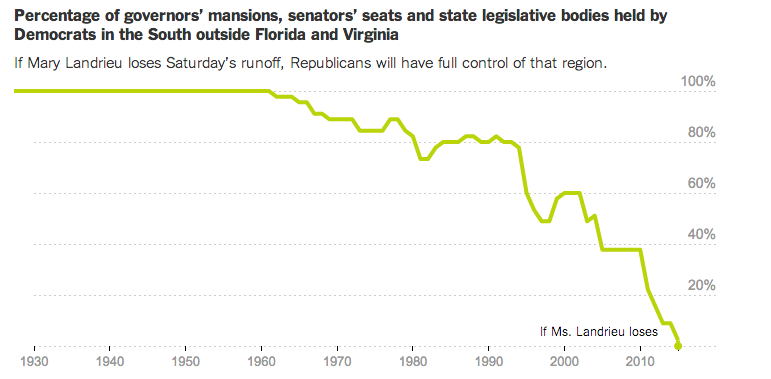
From the NYT: The Demise of the Southern Democrat Is Now Nearly Complete

With the defeat of Mary Landrieu there are no Democrat holds statewide office in any southern state outside of Florida and Virginia. The trend that started slowly when LBJ signed the Civil Rights Act of 1964 seems to now be complete. The Atlantic ran a recent article calling Landrieu The Last Southern Democrat.

- Click here for the article.

Here's the proof:


The article hits on themes we cover in both 2305 and 2306. What we seem to be seeing is white flight from the party.

Here's a taste:

The timing of the demise of the Southern Democrat is not coincidental. It reflects a complete cycle of generational replacement in the post-Jim Crow era. Old loyalties to the Democratic Party have died along with the generation of white Southerners who came of age during the era of the Solid South, before Brown v. Board of Education, before the Civil Rights Act.
Yet it also reflects the very specific conditions of 2014. Today’s national Democratic Party is as unpopular in the South today as it has ever been, in no small part because the party has embraced a more secular agenda that is not popular in the region.
“It’s a completely different party than it was 20 or 30 years ago,” said Merle Black, a professor of political science at Emory University. “When the Democratic Party and its candidates become more liberal on culture and religion, that’s not a party that’s advocating what these whites value or think.”
The party is also led by an unpopular president who has never appealed to the region’s white voters. President Obama won about 17 percent of white voters across the Deep South and Texas in 2012, based on an analysis of pre-election polls conducted by the Pew Research Center, census data and election results.

Thursday, November 13, 2014

From the National Journal: Why Texas Could Remain a Republican Stronghold for Another Generation

Talk about Texas turning blue might have been overblown.

Republicans have been trying to lure Latinos to identify with the party:

Governor-elect Greg Abbott won with 44 percent of the Latino vote, and Sen. John Cornyn won 48 percent, both improvements over the 38 percent Gov. Rick Perry earned when he was elected in 2011 for his third term.

Republican strategists in the state point out tha Abbott made 17 visits to the heavily Hispanic Rio Grande Valley during his campaign and ran months' worth of ads featuring his Latina wife and mother-in-law. His campaign ran his first Spanish-language spot during the World Cup game between Mexico and Brazil.

"The Latino voters cannot be taken for granted. The right candidate with the right message can make a difference," says Jorge Lima, the policy director for the LIBRE Institute, a nonprofit that promotes free-market principles in the Hispanic Community.

Another factor, Republicans say, that helped Abbott win Latino voters and undermined Democratic efforts in the state, was the candidate Abbott was running against. His Democratic opponent, Wendy Davis, had burst onto the national scene as a fierce defender of abortion rights. Latino voters, however, tend to be much more socially conservative than other Democratic constituencies. While reproductive rights might motivate millennials and single women voters, it's not an issue that drives Latinos to the polls for Democrats in droves.

"The results were partly a backlash against that blatant liberalism from the Davis campaign and from Battleground Texas," Texas-based Republican strategist Ray Sullivan says. "The message she delivered did not play with Hispanic Texans."


Thursday, June 19, 2014

And here's a link to the platform of the Republican Party of Texas

- Click here for it.

When Democrats produce theirs, I'll have an assignment where students can compare the two.