Showing posts with label the South. Show all posts

Monday, October 24, 2016

From the Gallup Vault (1941): Lining Up Against Poll Taxes

Southerns states with poll taxes wanted to keep them.

- Click here for the article.

In February 1941, Gallup found more than six in 10 Americans in favor of abolishing the poll taxes still prevalent in the American South. A majority of adults in the five southern states that had no poll tax at that time also wanted to abolish them. However, across the eight southern states where poll taxes were still in force -- Alabama, Arkansas, Georgia, Mississippi, South Carolina, Tennessee, Texas and Virginia -- the majority of residents wanted to keep them.

Poll taxes, which charged voters $1 to $2 ($7 to $15 today) to register to vote, emerged in the South after the Civil War as a way to prevent the poor, and particularly African Americans, from participating in elections. In combination with literacy tests, "whites-only Democratic Party primaries," and onerous rules about when and how to pay the poll tax, these laws resulted in a sharp drop-off in voter registration among the target groups.
Gallup's April 2, 1941, news release presented the unvarnished views of several southern poll respondents about the poll tax. A 76-year-old Arkansas farmer who favored abolishing the tax said, "You can't find a man in this whole country that voted for the poll tax in the first place -- it was just put on and run over the people." Another Arkansas farmer said, "It's gotten so rotten the way they purchase those poll taxes that the whole poll tax system ought to be done away with."
But respondents in favor of retaining the poll tax expressed very different perspectives. A 40-year-old farm wife in Mississippi plainly said, "Poll taxes help pay for the schools and keep the Negroes from voting." An insurance agent from Virginia expressed a more civic-minded view, saying, "We ought to keep the poll tax because when you pay a tax you're more interested in the results of an election." And then there was the "poor white farmer in the deep South" who said, "Better keep the poll tax because if we don't have it some people will just vote 'cause somebody gives 'em a bottle of whiskey or a dollar bill."

Thursday, July 21, 2016

From Vox: How Republicans went from the party of Lincoln to the party of Trump, in 13 maps

Highly recommended for both 2305 and 2306.

- Click here for it.

Here's one of the images: How Republicans gave up on reforming the South

Friday, November 20, 2015

From Vox: Woodrow Wilson was extremely racist — even by the standards of his time

This is a pretty effective hit job on Wilson, but I add it here mostly to illustrate a point we've gone over in class. That the Democratic Party - as we tend to forget - originated as the party of the South and was protective of first slavery and then segregation. Wilson was the first southerner elected to the White House after the end of the Civil War and re-segregated a number of federal agencies. Things would change when the next Democrat - FDR - was elected to the presidency, but this gives you an idea of how tight the relationship between the South and the Democratic Party was at that time, and how much it revolved around race.

- Click here for the article.
Easily the worst part of Wilson's record as president was his overseeing of the resegregation of multiple agencies of the federal government, which had been surprisingly integrated as a result of Reconstruction decades earlier. At an April 11, 1913, Cabinet meeting, Postmaster General Albert Burleson argued for segregating the Railway Mail Service. He took exception to the fact that workers shared glasses, towels, and washrooms. Wilson offered no objection to Burleson's plan for segregation, saying that he "wished the matter adjusted in a way to make the least friction."
Both Burleson and Treasury Secretary William McAdoo took Wilson's comments as authorization to segregate. The Department of Treasury and Post Office Department both introduced screened-off workspaces, separate lunchrooms, and separate bathrooms. In a1913 open letter to Wilson, W.E.B. DuBois — who had supported Wilson in the 1912 election before being disenchanted by his segregation policies — wrote of "one colored clerk who could not actually be segregated on account of the nature of his work [and who] consequently had a cage built around him to separate him from his white companions of many years." That's right: Black people who couldn't, logistically, be segregated were put in literal cages.
Outright dismissals were also common. Upon taking office, Wilson himself fired 15 out of 17 black supervisors in the federal service and replaced them with white people. After the Treasury and Post Office began segregating, many black workers were let go. The head of the Internal Revenue division in Georgia fired all his black employees, saying, "There are no government positions for Negroes in the South. A Negro's place in the corn field." To enable hiring discrimination going forward, in 1914 the federal government began requiring photographs on job applications.

Monday, October 5, 2015

From Politico: The Man Who Launched the GOP’s Civil War How a textile magnate turned the Party of Lincoln into the Party of Trump.

For our upcoming look at how the South went from being Democratic to Republican. I addition to racial issues, underlying hostility to labor unions by southern workers played a key role, as did the activities of a prominent political entrepreneur.

- Click here for the story.

Milliken’s name does not mean much to most anyone born after the Vietnam War, but he was the godfather to the first generation of modern conservatives. The owner of one of America’s largest private companies, a textile manufacturer he turned into a chemical-processing giant, Milliken used the profits from his staunchly antiunion mills to fund conservatism’s founding institutions, including the National Review and Heritage Foundation. Many of the facts we take for granted in politics today—that the GOP is a conservative party; that it counts on the solid support of white, male, working class voters in the South and West; and that big-money donors can pick and choose its candidates, even to the point of running themselves—were the fruits of his career.

Sunday, April 5, 2015

From the Economist: The present past: 150 years after the end of the civil war, the states that were once Confederate remain distinct

The British Magazine tries to figure out why politics in the South is so different than everywhere else.

The conclude that the answer is in the regions religiosity.

- Click here for the article.

Religion is a better explanation of southern exceptionalism. The civil war divided most of America’s Protestant sects, says Mark Noll of the University of Notre Dame. Both the Presbyterian and Methodist churches split into northern branches, which opposed slavery, and southern branches, which did not. Even after slavery ended, theological divisions persisted. In the north, which saw mass immigration from all over the world in the decades after the war, Protestant churches had to find some accommodation with Jews, Catholics and, eventually, non-believers.
In the South the share of those born outside America (which was low to begin with) actually fell after the civil war. New migrants moved west or north but rarely south. Because of this, southern churches could hold more traditional views without challenge. Those tented revival meetings that were such a feature of southern Protestantism were not intended to win converts so much as to purify and strengthen beliefs that were already there.
The Southern Baptist movement, which is strongly associated with the “values voters” who favour the Republicans, has its origins in support for slavery. Southern Baptists have long since updated their views on race, as the many black Southern Baptist pastors attest, but the movement’s social conservatism endures. And southerners are unusually observant: Utah is the only non-southern state where church attendance is as high as in Dixie.
When piety is grafted on to a small-government political philosophy—57% of southerners think the government does “too much” and only 37% think it should do more, according to Gallup—it explains much of why the South remains different. The link between the war and the appeal of the Reagan revolution is harder to make, but it is not implausible that antipathy towards the federal government may be connected to the loss of a quarter of all white male southerners aged 16 to 45, who were maimed or killed in a war against it.
If this is right, then there are two possible futures for what was once the Confederacy. The continuing in-migration of large numbers of northerners, including many African-Americans, may transform the rest of the South the way it has already transformed Virginia and Florida, which are both swing states these days. Or the South might continue to expand its cultural and religious reach westwards, as it has into Oklahoma, Arizona and New Mexico. Or both. Apologists for the old South like to point out that the last action of the war, a skirmish in Texas, resulted in a Confederate victory. It’s not over yet.

Sunday, March 8, 2015

How Texas became a western state

Apparently there was little question that Texas was a southern state up until about 100 years ago when business leaders wanted to distance the state from groups like the KKK.

Re branding the state as being full of freedom loving cowboys was more attractive than being seen as being full of racists who missed slavery and the plantation system.

Two related stories:

- Is Texas Southern, Western, or Truly a Lone Star?
“I don’t think anyone much questioned Texas’s essential Southernness until the twentieth century,” says Dr. Gregg Cantrell, Texas history chair at TCU, past president of the Texas State Historical Association, and a member of the Texas Institute of Letters. “And they started doing so as a way of distancing themselves from the late unpleasantness of the 1860’s and 1870’s. Defeat, military occupation, Jim Crow and lynching, and all of those unpleasant things that are very much a part of Texas history as a Southern state, were things that a lot of Texans would probably just as soon not talk about a lot.”
Nationally, Dixie was stigmatized as a backward, ignorant, and violent hotbed of the Ku Klux Klan and religious hypocrisy. Why remain linked to all that baggage? Why not, forward-looking Texans began to think, align with the West instead? Back then, and to a certain degree today, the West was seen as optimistic, the place of second chances, the land of the golden tomorrow, a stark contrast when compared to Dixie’s melancholy and tragic yesterdays. So Texas’s politicians, educators, and ad-men went to work, Cantrell says, and have since all but totally recast the very ideal of what it means to be a Texan.
“And so what do you do? You play up the frontier, you play up the Texas Revolution and the Alamo, you play up the (in reality not-very-glorious) ten years of the Texas Republic, and then you talk about the Indian Wars and the cattle drives, all culminating in Spindletop and the discovery of oil,” he says. “All of these things made Texas seem like anything but a Southern state.”

- How Fort Worth and Texas seceded from the South, or did we?


Read more here: http://www.star-telegram.com/opinion/opn-columns-blogs/bud-kennedy/article12946790.html#storylink=cpy


. . . take the slogan that remains on our front page: “Where the West Begins.”
That slogan was first added to founder Amon G. Carter’sStar-Telegram on Aug. 15, 1923.
That summer, the 1920s rebirth of the Ku Klux Klan had staged two robed and hooded parades in Fort Worth, one described as 25 blocks long.
Business leaders across Texas wanted desperately to promote the state to investors and customers from the North. But tens of thousands of white Texans wanted to revert to a racist, nativist “Invisible Empire” that used vigilante attacks to intimidate black Texans, immigrants and everyone except white Protestant prohibitionists.

Read more here: http://www.star-telegram.com/opinion/opn-columns-blogs/bud-kennedy/article12946790.html#storylink=cpy

Sunday, December 7, 2014

From the NYT: The Demise of the Southern Democrat Is Now Nearly Complete

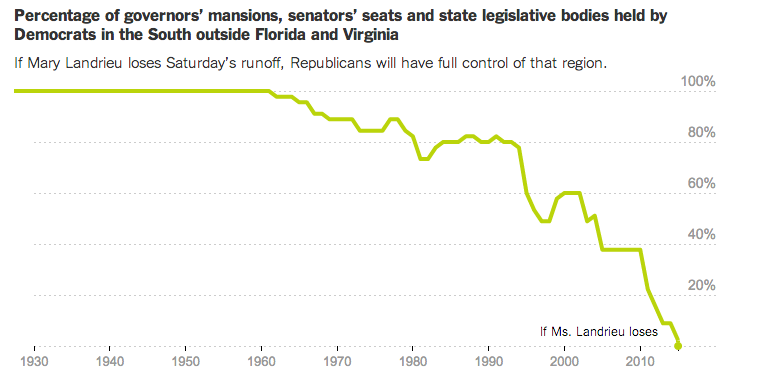
With the defeat of Mary Landrieu there are no Democrat holds statewide office in any southern state outside of Florida and Virginia. The trend that started slowly when LBJ signed the Civil Rights Act of 1964 seems to now be complete. The Atlantic ran a recent article calling Landrieu The Last Southern Democrat.

- Click here for the article.

Here's the proof:


The article hits on themes we cover in both 2305 and 2306. What we seem to be seeing is white flight from the party.

Here's a taste:

The timing of the demise of the Southern Democrat is not coincidental. It reflects a complete cycle of generational replacement in the post-Jim Crow era. Old loyalties to the Democratic Party have died along with the generation of white Southerners who came of age during the era of the Solid South, before Brown v. Board of Education, before the Civil Rights Act.
Yet it also reflects the very specific conditions of 2014. Today’s national Democratic Party is as unpopular in the South today as it has ever been, in no small part because the party has embraced a more secular agenda that is not popular in the region.
“It’s a completely different party than it was 20 or 30 years ago,” said Merle Black, a professor of political science at Emory University. “When the Democratic Party and its candidates become more liberal on culture and religion, that’s not a party that’s advocating what these whites value or think.”
The party is also led by an unpopular president who has never appealed to the region’s white voters. President Obama won about 17 percent of white voters across the Deep South and Texas in 2012, based on an analysis of pre-election polls conducted by the Pew Research Center, census data and election results.

Tuesday, January 28, 2014

From Frontline: How Texas became a "Red" State

We will discuss political organizations in Texas soon enough and try to outlining the process by which Texas shifted from a solid Democratic state to a relatively solid Republican one.

Click here for a Frontline feature on the story.

We'll go over some of this material soon.

This Wikipedia entry on the Solid South might be helpful also. While Texas isn't exactly a southern state, it tends to vote in sync with the other states in the south east. This helps explain the politics associated with that tendency.

Saturday, July 13, 2013

The 5 Republican Parties

One of the small handful of points I try to hammer on in class is that the two major parties in the US are best thought of as coalitions of factions that feel enough in common to fit under the same party category. Determining just what those factions are can be a bit of an art.

Here is Norm Ornstein's take on the current factions within the Republican Party and the impact each has on the governing process, as well as the future competitiveness of the party:

. . . I see at least five Republican parties out there, with a lot of overlap, but with enough distinct differences that the task is harder than usual. There is a House party, a Senate party, and a presidential party, of course. But there is also a Southern party and a non-Southern one. The two driving forces dominating today's GOP are the House party and the Southern one -- and they will not be moved or shaped by another presidential loss. If anything, they might double down on their worldviews and strategies.

He argues that the increased influence of the South on the party will help it retain power in the House, but make it less competitive in Senate and presidential elections in the near future:

The South has gone from being a trace element of the Republican Party in the 1950s and 1960s to becoming the solid base and largest element of today's GOP -- and its driving force on social and economic issues. And while some Southern Republicans such as Lindsey Graham remain fierce internationalists, the South, and the House, have become the epicenter of anti-defense and anti-diplomacy isolationism typified now by border Senator Rand Paul.

So here's the Republican dilemma: The House and Southern Republican parties are more concerned with ideological purity and tribal politics than they are with building a durable, competitive national party base to win presidential and Senate majorities. In most cases, they are in no danger of losing their House seats or their hegemony in their states. They will be resistant to changes in social policy that reflect broad national opinion; resistant to any policies or rhetoric, including but not limited to immigration, that would appeal to Hispanics, African-Americans, or Asian-Americans; and resistant to policies like Medicaid expansion or Head Start that would ameliorate the plight of the poor. They also will be more inclined to use voter-suppression methods to reduce the share of votes cast by those population groups than to find ways to appeal to them. I see little or nothing, including a potential loss in 2016, that will change this set of dynamics anytime soon.

Thursday, July 11, 2013

Is the South - state legislatures specifically - resegregating?

Here is an argument that is has.

The percentage of black legislators in positions of power in southern state legislatures is the lowest it has been since the passage of the Voting Rights Act. The ability to draw legislative districts has been a key instrument in accomplishing this.

Here's a take on the strategy:

Republicans in control of redistricting have two goals: the defeat of white Democrats, and the creation of safe districts for Republicans. They have achieved both of these goals by increasing the number of districts likely to elect an African-American. Black voters are gerrymandered out of districts represented by whites of both parties, making the Democratic incumbent weaker and the Republican incumbent stronger.

Take Mississippi. In the state’s 2012 redistricting, all of the decisively black legislative districts – where 60 percent or more of the voters are African-American – have been preserved, and four new majority-black districts have been created. This, in turn, has allowed Republicans to reduce the percentage of blacks in districts where Republican incumbents had close contests in Mississippi’s 2011 off-year elections.

While increasing the number of blacks elected to state legislatures, Republicans have been effectively implementing their long-range goal of decimating the number of white Democrats. Depending on local demographics, this has been achieved in two ways.

Where possible, Republican redistricting strategists have reduced the number of blacks in white Democratic legislative districts in order to render the incumbent vulnerable to Republican challenge. In other areas of the state, where it has not been not possible to “bleach” a district, Republicans have sharply increased the percentage of blacks to over 50 percent in order to encourage a successful black challenge to the white Democratic incumbent.

In private discussions, Republicans in the South talk explicitly about their goal of turning the Democratic Party into a black party, and in many Southern states they have succeeded. African-American legislators make up the majority of state House and Senate Democratic caucuses in most of the Southern states.

Wednesday, April 10, 2013

The most and least religious metropolitan areas

The Atlantic maps them out. The break down mirrors the cultural breakdown across state we discuss in 2306. Big surprise that no Texas cities were at the top of the list of religious areas. Mostly Utah and the Deep South. The west coast, New England and upper Midwest were least religious - along with Colorado. This almost looks like the electoral map of 2012.

Wednesday, February 20, 2013

Northernomics vs Southernomics

More from Michael Lind - who wrote the story about the distinctiveness of the South below. This is also a bit harsh on the South, but it fits themes we will discuss soon enough when we talk about the development of political parties and economic policymaking. His principal contribution for us is his description of the difference between northern and southern attitudes about how to develop economies, and the degree to which prosperity ought to be spread evenly throughout the population:
Northernomics is the high-road strategy of building a flourishing national economy by means of government-business cooperation and government investment in R&D, infrastructure and education. Although this program of Hamiltonianism (named after Washington’s first Treasury secretary, Alexander Hamilton) has been championed by maverick Southerners as prominent as George Washington, Henry Clay and Abraham Lincoln (born in Kentucky to a Southern family), the building of a modern, high-tech, high-wage economy has been supported chiefly by political parties based in New England and the Midwest, from the Federalists and the Whigs through the Lincoln Republicans and today’s Northern Democrats.

Southernomics is radically different. The purpose of the age-old economic development strategy of the Southern states has never been to allow them to compete with other states or countries on the basis of superior innovation or living standards. Instead, for generations Southern economic policymakers have sought to secure a lucrative second-tier role for the South in the national and world economies, as a supplier of commodities like cotton and oil and gas and a source of cheap labor for footloose corporations. This strategy of specializing in commodities and cheap labor is intended to enrich the Southern oligarchy. It doesn’t enrich the majority of Southerners, white, black or brown, but it is not intended to.


This also fits the story about political culture told in 2306 about the traditional culture in the South as opposed to the moral culture in the North.

Saturday, February 16, 2013

From Salon: The white South’s last defeat

This article might be a bit harsh to some, but I call attention to it because it tries to get to the heart of the differences between the South and the rest of the nation. This matters because the South has always been a distinct presence in American government and politics - and remains so to this day, though the author thinks things might be changing. The author if a native Texan and has written profusely on the relationship between the state and the nation.

It applies to both 2305 and 2306, the former because the southern representatives have become increasingly influential in the Republican Party and have made the party far more consistently conservative than it has been in the past. While this initially helped the national Republican Party win elections in the 1980s and 1990s - it may be making it less competitive now. In the effort to purify the party, conservatives have been driving out moderates - which lessens the size of the coalition. This has the obvious effect.

For 2306, it simply adds an additional point of view to what makes Texas - or at least that part of Texas that is southern (east of Houston and Dallas I'd say) - tick politically and culturally.

Some points from the article:

- The South is the only area of the country that has suffered severe defeats - the Civil War and the Civil Rights movement - and both were driven by the natioal government and included the use of federal troops to implement.

- While the US prided itself on being a "melting pot" the South never was - and only recently has become more diversified. Aside from the African - American population, the South was far more British and Scots-Irish in its background. This is less true now, so the South is now going through some of the internal conflicts that other states suffered back in the 1920s when waves of non-Anglo immigrants came to the US. The influx of diverse population is why the author argues the South is in the process of political change, but this will take time. Homogeneity still rules.

- As the white South declines in numbers, political techniques that allow the minority to place limits on the majority will become more and more common. The obstructionism we see in the US Congress, and between southern states and the US government are not only examples, but might be more common as diversity works its way slowly through southern society.

Thursday, January 17, 2013

We still haven't figured out what to do about the confederacy.

The Texas Tribune reports on the latest tussle over how to deal with Texas' confederate past. The Son's of Confederate states that the current plague insufficiently honors the Confederacy. It reads:
"Because this building was built with monies from the Confederate Pension fund it was, at that time, designated as a memorial to the Texans who served the Confederacy."
Not good enough for the group. Here's one of the many confederate monuments on the capitol grounds


We discussed controversies over the content of history and government curriculum in class this week, at least a bit. Covering Texas' past presents on an ongoing conflict in the state.

Click here for an interactive map of all Texas' confederate markers.

And here's a related story.

Wednesday, January 16, 2013

Where is Dixie exactly?

I stumbled across this map describing what is and is not "the South." It seems as good as any other.


The Uniqueness of the South


Here's a useful, brief analysis of the distinctions between the South and the rest of the US. Some of these points will apply to 2306 as dig into the cultural differences between Texas and the rest of the country. It also applies to 2305 since it touches on a recurrent theme in class - the emerging divisions within the Republican Party, especially those between southern Republicans and those from the rest of the nation.

Of course Texas is only partially southern, but the point applies. After having great influence on American politics for the past generation, is the allure of South fading? And is its cohesiveness marginalizing it from the rest of the nation?

Now the South is becoming isolated again. Every demographic and political trend that helped to reëlect Barack Obama runs counter to the region’s self-definition: the emergence of a younger, more diverse, more secular electorate, with a libertarian bias on social issues and immigration; the decline of the exurban life style, following the housing bust; the class politics, anathema to pro-business Southerners, that rose with the recession; the end of America’s protracted wars, with cuts in military spending bound to come. The Solid South speaks less and less for America and more and more for itself alone.

Solidity has always been the South’s strength, and its weakness. The same Southern lock that once held the Democratic Party now divides the Republican Party from the socially liberal, fiscally moderate tendencies of the rest of America. The Southern bloc in the House majority can still prevent the President from enjoying any major legislative achievements, but it has no chance of enacting an agenda, and it’s unlikely to produce a nationally popular figure.
This makes the South seem very static. that's a debatable point, but the general story the author tells is worth looking through.

Saturday, January 12, 2013

Texas: not even in the top ten

The Washington ranks the ten most interesting states, for politics. Texas did not make the cut. No surprise since we're a one party state, but its hard not to get my feelings hurt.

Their number one state is dominated by one party also, so I'm not sure what's up. Anyway, drum roll: the most interesting state politics can be found in South Carolina:

1. South Carolina (courtesy of AmandaSC):

“Andrew Jackson. John C. Calhoun. Civil War. Fort Sumter. Confederate Flag. Ben Tillman. Strom Thurmond. Lee Atwater. First in the South. McCain vs. Bush. Lindsey Graham. Fritz Hollings. Charleston. Stephen Colbert. Appalachian Trail. Andre Bauer. Mark Sanford. Jenny Sanford. Nikki Haley. Tim Scott. Jim DeMint. Alvin Greene.

“Clearly South Carolina is the most interesting and has been for years. Where else can a person like Alvin Greene be connected by ‘six degrees of separation’ from statesmen like Andrew Jackson and John C. Calhoun, all by using relevant political persons/hot issues of the past 30 years? That’s right: Nowhere.

“After all, the quote that has been true for the past 150 years, as stated by former congressman and anti-secessionist James Petigru in 1860: ‘South Carolina: Too small to be a republic, too large to be an insane asylum.’”


They might have a point.

Monday, September 24, 2012

The White Working Class and Obama

The Public Religion Research Institute clarifies reports suggesting that the white working class is opposed to Obama, its the Southern white working class primarily. See more here, here and here. This reflects the ongoing realignment of the South from Democrat to Republican over the past two generations.

Tuesday, March 13, 2012

Regarding Political Parties in the South

From the New Republic, an analysis of the Republican Party in the South - especially Alabama and Mississippi since they will be holding primaries there today. The author notes the racial divides between the two parties - the Republican Party is predominately white and the democratic Party is primalily minority - seem to transcend ideological differences.

Thursday, August 18, 2011

House Partisanship From 1879 - 2010

More striking graphical evidence of the increase in party polarization since the 1970s - and fluctuations over time. Notice the shift in Southern Democrats especially - that's the story.


See: Polarized America for more detail.