Showing posts with label Texas primary. Show all posts

Tuesday, January 30, 2024

From Ballotpedia News: Texas Republican Party places 13 nonbinding advisory questions on the March primary ballot

This is one of the ways a political party figures out what future topics to focus on.

- Click here for the article


The Texas Republican Party has placed 13 nonbinding advisory questions on the March 5 primary ballot. The Texas Democratic Party does not plan on placing any questions on primary ballots this year. The last time they did was in 2020.

An advisory question is a type of ballot measure in which citizens vote on a non-binding question. The largest difference between an advisory vote and any other type of ballot measure is that the outcome of the ballot question will not result in a new, changed, or rejected law. Rather, the advisory question symbolically makes heard the general opinion of the voting population regarding the issue at hand.

The propositions address the following topics:
- Property taxes;
- The border and immigration;
- Foreign policy;
- Access to gold and silver for use as legal tender;
- Vaccine mandates;
- Closed primaries;
- Authority for the attorney general to prosecute election crimes;
- Right to choose any type of school for a child’s education and a voucher program;
- Proof of citizenship to register to vote; and
- Ban on Texas sale of land to citizens, governments, and entities from China, Iran, North Korea, and Russia.

The questions were adopted by the 64-member State Republican Executive Committee and published on Dec. 28.

The Texas Elections Code allows citizens to collect signatures for a petition to place a specific question before voters at the party’s general primary election. The required number of signatures is 5% of the total vote received by all candidates for governor in the party’s most recent primary election, which equates to 97,709 signatures for the 2024 ballot. The deadline to file the petition for the March 5, 2024, ballot was Dec. 10.

Monday, July 18, 2016

2016 Texas Primary Election Results

For class discussion: Click here for the results from March.

- Click here for results from the Texas Secretary of States' office.

Thursday, February 25, 2016

Republican incumbents face primary challengers from their right

It's what primaries are all about. Texas isn't conservative enough for some people apparently.


Rep. Dan Flynn Faces Challenger From the Right.

In a race pitting an East Texas incumbent against an upstart challenger endorsed by conservative activists, a pair of unlikely issues has dominated the Republican primary fight for House District 2: toll roads and a controversy at the University of Texas at Austin. Bryan Slaton, a businessman and former Baptist minister, is hoping to unseat six-term incumbent state Rep. Dan Flynn of Canton, saying Flynn has stayed in office too long and has become less conservative over time.

Three House Committee Chairman from Texas Face Primary Challengers from the Right.

Three of Texas’ seven U.S. House committee chairman are facing primary challenges from the right wing of the Republican Party. Other Texas Republican House members are also facing serious challengers. The newly selected House Ways and Means chair, Rep. Kevin Brady (R-TX), Rules Committee chair Rep. Pete Sessions (R-TX)  and Science Space and Technology chair Rep. Lamar Smith (R-TX) all have primary opponents who are challenging their conservative credentials, The Hill reported.


Culberson faces challengers from the right. (behind a pay wall)

From the Texas Tribune: Analysis: The Winner-Take-Some Texas Primaries

- Click here for the article.

Every presidential candidate wants to win in Texas, but the state’s major parties will also be rewarding second- and even third-place finishers in this year’s primaries.

It’s not a winner-take-all state unless a winner proves to be extravagantly popular with Texas voters.

In all likelihood, the Republicans and the Democrats will be awarding delegates to the top candidates in proportion to the votes they receive. Winning just one vote in five might sound bad in the headlines, but it could add to the all-important delegate tallies that will ultimately determine the party nominees.

The two parties allocate their delegates differently, but with the same idea in mind: sending a delegation to the national conventions that reflects the voting for top candidates here.

Republicans

The Republicans have 2,472 national delegates, including 155 from Texas. It’ll take 1,237 to win.

The state GOP doles out delegates in two batches: 47 of them are awarded based on statewide results, and 108 are awarded based on the results in each of the state’s 36 congressional districts.

How many a candidate gets depends on how well the candidate does. Winning more than half of the state votes gets a candidate all of the 47 delegates at stake. If the top candidate has fewer than half of the votes, the delegates are assigned on a proportional basis, but there is a nuance there, too. If the lead candidate is the only one with more than 20 percent of the vote, that candidate splits delegates on a proportional basis with the second-place finisher. Nobody else gets any delegates. If more than one candidate gets 20 percent or more, each of them gets delegates on a proportional basis. And if no candidate gets more than 20 percent, all of the candidates win delegates based on each one’s proportion of the vote.

Democrats

The Democrats have 4,763 national delegates, meaning it will take 2,382 to win the nomination. Of that total, 252 will come from Texas. That number includes 30 “superdelegates” from Texas, a term that refers to unpledged delegates who are not bound to a particular candidate except by their own choice. The group includes members of Congress from Texas, Democratic National Committee members and other party nobles in Texas.

Of the 222 delegates without that “super” label, 145 come out of the state’s 31 state Senate districts. The number available from each district is based on average Democratic voter turnout in the most recent general elections for president and governor. It ranges from a high of 10 delegates in Austin’s
Senate District 14 to a low of two delegates in Senate District 31, which ranges from the Texas Panhandle down to the Permian Basin.

Candidates have to get at least 15 percent of the vote to get any delegates; those who meet that mark get delegates on a proportional basis.

The final 77 delegates are apportioned according to the statewide votes for the candidates. Again, anyone with at least 15 percent of the vote gets some delegates, and delegates are handed out proportionately to everyone above that mark.

Wednesday, February 17, 2016

From the Texas Tribune: Turnout for Texas Primaries Expected to Be Highest Since 2008

It'll still be very low compared to the general election though. This despite the fact that the primary election in Texas is the only one that really matters in the state due to gerrymandering and other factors.

- Click here for the article.
With the race for the Republican presidential nomination too close to call and U.S. Sen. Bernie Sanders of Vermont still waging an energetic campaign against Democratic frontrunner Hillary Clinton, election officials are bracing for exceptionally high turnout in this year's Texas primaries, where early voting begins today.
“I think Republican turnout is going to blow the doors off,” said Harris County Clerk Stan Stanart. “We’re planning on 100,000 more than we’ve ever done before.”
Both major parties are holding their primaries on March 1, and this year the Texas contests come unusually early in the presidential nomination process. Usually, far more states have primaries and caucuses scheduled before the Lone Star State, meaning that a prospective nominee is typically on the way toward wrapping things up by the time Texans weigh in, depressing turnout.
Presidential election years draw the most voters. Despite important federal, state and local races on the ballot during midterm elections, turnout typically suffers without a high-profile race for the White House at the top of the ballot. In elections of any kind, turnout tends to increase with the stakes: if candidates appear locked in a fierce battle, more people show up at the polls.

Be sure to check the bar graphs in the article for recent turnout numbers.

Monday, February 15, 2016

Texas Tribune: Analysis: A Field Guide to the 2016 Texas Primaries

Early voting starts Tuesday in Texas, and the races for the presidential nominations are not — in spite of all that noise they’re making — the only contests on the ballot. Here are the most competitive contests for state and federal seats on the state ballot. *
Ignore the asterisk above at your peril. In every election, there are a few candidates who think they are in dire trouble — or whose friends believe that. And there are always candidates who never know what hit them — and who don’t appear to be in any danger until their chances have been dashed. That’s the disclaimer; now to the primary races (and for reference, here’s a full list of who is on the Texas ballots).

From the Texas Tribune: Outspoken Candidates Could Revive Rancor on Education Board

- Click here for the article.

Save for some flare-ups in the past few years over what to put in social studies textbooks — and how to handle an error in one of them — the State Board of Education has seen more turbulent days.
The 15-member board in charge of crafting curriculum and textbooks for the state’s more than five million public schoolchildren spent years building a national reputation as the center of raucous quarrels over how — and whether — to teach young Texans about evolution, Islam and climate change.
Now, such charged exchanges are less common. Those who closely watch the board attribute the shift to the dispersion of a cadre of fervent right-wing conservatives, many of whom either retired or were voted out.
But the relative camaraderie could soon come to an end as two more moderate members step aside — and not just among the board’s Republican membership, where nearly all the notorious infighting has occurred.
Among the contenders in the races to replace Republican Thomas Ratliff of Mount Pleasant and Democrat Martha Dominguez of El Paso is a 68-year-old East Texas retiree who has said that President Obama used to be a prostitute and a 41-year-old self-described “MeXicana Empowerment Specialist” who says the board’s Democrats have sat silent for far too long.

Friday, January 29, 2016

For 2306 - this and that

- Jared Woodfill Starts Small in Bid to 'Take Back' Texas GOP. The internal struggle between the social conservatives and the "establishment" continues. Woodfill wants to become the chair of the Texas Republican Party, take out Texas Speaker Joe Straus along with other more moderate Republicans, and promote a more socially conservative agenda in the 85th session of the legislature. The article highlights which interest groups are also promoting these efforts. The article links to this previous story about how the current Texas GOP chair got his job.

- In Re-Election Bid, Straus Faces Familiar Tea Party Attacks. A bit more detail on the effort of the far right to unseat the merely right Straus: "the speaker’s opponents insist they’re snatching voters from Straus by demonstrating that his record is out of step with his own party and arguing he has few results to show after years of presiding over the House. They argue Straus is too cozy with House Democrats and point to the demise of GOP-backed initiatives, including legislation to expand school choice, a ban on so-called sanctuary cities and measures to further restrict abortion."

- Select Texas Senate tax committee meets in San Antonio. In November, Lt. Governor Dan Patrick appointed members to the Senate Select Committee on Property Tax Reform and Relief. The official announcement stated that it would "travel the state holding public hearings and look for ways to improve the property tax process as well as reduce the burden on property owners." Critic argue that it was just another attempt by the state to clamp down on local governments. The article discusses a recent hearing in San Antonio.

- Analysis: The Death of Taxes on Illegal Drugs in Texas. Here's an interesting story about the tough on crime days in Texas. It also discusses taxes, double jeopardy, the courts, checks and balances, and statutory code. Plus it has way cool images of tax stamps intended to be put on confiscated drugs. They are collectors items now apparently.

- Abbott lays into legislators, feds in first year review. In this televised interview, the governor - in part - discusses what he would like to see the next session of the Texas Legislature prioritize.

Friday, January 15, 2016

For 2306 - some random items

Some random items about Texas government:

- Ross Ramsey looks at down ballot races in the upcoming Texas Primary and wonders what will impact results in these low information races. People know little about presidential candidates, even less about state and local ones.

- The Texas Tribune reports that the Trump campaign lost one Texas state campaign director, but quickly got another. Here's Trump's press release announcing the change.

- A grand jury is investigating a land deal involving the Texas Attorney General. He's already being investigated for possible securities fraud.

- Ex-Governor Rick Perry has been hired to help a Florida dental insurance company obtain business through the state's Medicaid program. Reports show that the company had donated money to previous campaigns and one of the officers in the company had been appointed by Perry to head the Texas Health and Human Services Commission.

Sunday, October 18, 2015

Primary turnout in Texas since 1926

The number of people who have voted in primaries has changed little since then despite the fact that the population of the state has quintupled during the same period.

image

- The graph is pulled from TexasRedistricting.

The Texas Observer makes the following point:

The blue and red lines represent the number of votes in the Democratic and Republican primaries, respectively. The green line is Texas’ population, and black is the number of registered voters.
One reason people might be less inclined to vote in primary elections these days is that the general election would seem to matter more than it used to in the state. The Republican Party barely existed in 1926—that was year the GOP held its first statewide primary—and the general election was a rubber stamp that confirmed the results of the Democratic primary.
But for all practical purposes, Republicans have the same level of dominance in statewide offices that Democrats had in their period of one-party control. For the better part of two decades, the Republican primary has been the only election that really matters. Yet even within the GOP, primary turnout is remarkably low.

"Indeed, for all the talk of Texas being a “red state,” recent Republican primary turnout has been no better in aggregate numbers than Democratic turnout in the 1940s and 50s (and lower as a percentage of the population).
And in only 8 out of 27 Republican primaries since 1962 – the year Texas Republicans began having regular primaries – has the turnout exceeded turnout in the 1926 Democratic primary."
Much of what’s happened to the state Republican Party in recent years is down to the simple fact that the average Texan has become less likely to vote in the GOP primary. It’s a fundamentally undemocratic situation that gives power brokers and small interest groups enormous leverage on the whole state government. And it seems unlikely to change any time soon.

Wednesday, July 1, 2015

The Texas Two Step is no more: The National Democratic Party tells the Texas Democratic Party to change how it allocated delegates to presidential candidates

Another indication that each party is setting itself up for the 2016 presidential election

This story is for 2306 students as they look at the nature of elections in Texas.

The Texas Two Step is the term used to refer to the peculiar way that Texas Democratic Party selects its presidential delegates. Simply put, 2/3rds of the delegates are selected in the primary election while the remaining 1/3rd are selected in the precinct convention held when the polls closed. This process is discussed in the section on the temporary party organization.

For more detail:

- A guide to Texas' electoral two-step.
Texas Democratic primary and caucuses, 2008.

The unusual process allowed Obama to get more delegates from Texas than Hillary Clinton despite having lost the popular vote. Supporters of Clinton seemingly don't want to see that repeated in 2016.
Previous efforts to change the process had been unsuccessful. Here's a story about a failed attempt to do so in the 2010 Texas Democratic Convention:

Democrats Keep Controversial "Texas Two-Step"

For more detail on the current effort:

Saying goodbye to the Texas two-step.
- Texas Dems Dropping 'Two-Step' Presidential Primary.
- Texas Democrats ditching the “Texas 2-step;” no more primary caucus.

The Texas Republican Party simply uses the results of the popular election.

Monday, June 9, 2014

The 2014 Texas Republican Convention and the Temporary and Permanent Party Organizations

The Texas Republican Party held its 2104 convention this weekend in Forth Worth. Texas Democrats are set to hold theirs in Dallas June 27th and 28th.

Both 2305 and 2306 students will note that U.S. Constitution reserves to the states the power to pass laws about elections, and since political parties are the primary actors in elections, these laws impact how they form and operate. This means that each of the 50 states passes the laws that govern the activities of political parties. In 2306 we discuss this further when we cover the election code, and the part of the code that deal with political parties.

The reason that each party holds conventions each year - in a legal sense - is because the state election code says they must. Every two years. Of course you should keep in mind that the election code is based on laws passed by legislators who are members of political parties, so parties get to write their own rules, but let's not wander into that circular thicket.

When 2306 students read the section on the temporary and permanent party organizations they'll note that the state convention

The purpose of the state convention is to allow the grassroots within each party to have an impact on the way the state party is run, and the positions it holds. During presidential election years they also determine which delegates will represent which presidential candidates in the nation convention (which are only held during presidential elections). State conventions are where the activists and the professionals (let's call them the establishment) butt heads. We can also think of this as a war between the temporary and permanent party organizations.

Apparently there was a lot of head butting in Fort Worth.

The Tea Party wing of the Republican Party - people who are passionately committed to political participation - has developed an incredible degree of influence within the party. This is far beyond what their numbers suggest they ought to have, but they have it because when you and I are sleeping late - they are organizing.

Perhaps we should modify "government of the people, by the people, and for the people" to read "government of the participants, by the participants, and for the participants" because it is a far more accurate description of the reality of democratic politics. Things don't just happen for people, they happen because people work to get them.

The problem for the party establishment - especially in the Republican Party right now - the issues the Tea Party activists push for may jeopardize the party's future competitiveness. The Republican Party has done well for a while with the current electorate in the state, but as the electorate changes, the party must change in order to continue to do well. The temporary party organization - the people who reflect the needs of the grassroots - seem to be preventing them from making those changes.

I'll post - separately - links to stories that illustrate this tension.

Wednesday, March 19, 2014

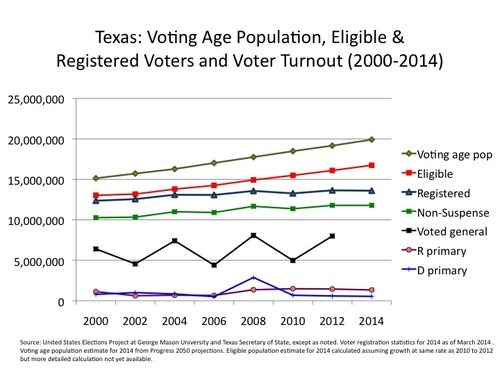
From Texas Redistricting: Texas’ civic engagement crisis in one chart

A supplement to the information contained in the previous post. The sees little to cheer for over this.

- Click here for the post.

image

Especially worrisome is the low number of people who vote in primary elections. They are the ones who determine who is on the ballot each November. The future of state politics is set by a very small group of people.

From the Texas Observer: Texas’ Undemocratic Party Primary System

Turnout in Texas primary elections continues to be abysmally low. The author points out that the highest turnout in Texas Primaries was in 1926.

- Click here for the article.

Here's a telling graphic. It contributes to the idea that democracy is not practiced much in the state.
Michael Li's voter participation chart


The blue and red lines represent the number of votes in the Democratic and Republican primaries, respectively. The green line is Texas’ population, and black is the number of registered voters.

One reason people might be less inclined to vote in primary elections these days is that the general election would seem to matter more than it used to in the state. The Republican Party barely existed in 1926—that was year the GOP held its first statewide primary—and the general election was a rubber stamp that confirmed the results of the Democratic primary.

But for all practical purposes, Republicans have the same level of dominance in statewide offices that Democrats had in their period of one-party control. For the better part of two decades, the Republican primary has been the only election that really matters. Yet even within the GOP, primary turnout is remarkably low.

. . . Much of what’s happened to the state Republican Party in recent years is down to the simple fact that the average Texan has become less likely to vote in the GOP primary. It’s a fundamentally undemocratic situation that gives power brokers and small interest groups enormous leverage on the whole state government. And it seems unlikely to change any time soon.

Tuesday, March 11, 2014

Will Tea Party success move the Republican Party so far to the right that Texas Democrats can become competitive statewide?

Normally the answer would be yes, but the following has doubts about whether this is the case - at least in the near term.

- Click here for the article.

In both 2305 and 2306 we discuss the electoral process and the impact that primary elections have on the nature of the candidates that end up on the general election ballot. Primary voters tend to be more ideologically extreme, and they ensure that the candidates that face the general electorate tilt either to the left or right.

Sometimes a party's primary voters tilt so far to one side that they become unacceptable to the general electorate. The other party - with a presumably less extreme candidate - becomes more attractive to the moderate voters who dominate general elections. They vote for the candidate of the other party. This assumes that what drives the electorate in the primary is not the same as what drives the electorate in the general election. While Tea Party candidates have proven too extreme for the general election in some states - Delaware, Missouri, Nevada among them - this isn't necessarily the case in Texas. At least we will be finding out this November.

Political consultants don't the increasingly rightward tilt of the Republican Party will make the Democratic Party more attractive to moderates in the state now - but it might in the future:
The rhetoric that appeals to the tea party movement — including “closing down” the border, barring abortion for rape victims, the open carrying of guns and impeaching President Barack Obama — is polarizing to many moderate and Hispanic voters.
But experts largely agree it’s still not enough to entice middle-ground voters to window-shop at the Democratic Party. At least not yet.
“The more Republicans wander further and further away from the concerns of most Texans — not talking about education or the places they live — the faster they will hasten the return of the Democrats,” said Harold Cook, a Democratic consultant.
Republican strategist Matt Mackowiak said that’s not going to happen in 2014. He agreed that if “the party moves so far right that it creates problems and voters don’t like the direction, yes, in two or four or six years, that will be reflected in how people vote,” Mackowiak said. “But I don’t see a short-term problem.”
In a traditionally competitive campaign, candidates move toward the left or right flank for the primary but tack toward the middle to win the general election. But for nearly two decades, Texas Republicans have had to worry only about the first round.
“All a candidate had to do to be elected to statewide office is avoid being the Democratic nominee,” Cook said.
Democrats haven’t won a statewide contest in 20 years. But last week’s primary brought out a type of conservatism that has given some moderate Republicans pause and given all Democrats hope, he said.
“The more right-wing folks Texas ends up electing, the faster the day will come when people will regret those elections,” Cook said.
But for now, the Democratic base is small in the state, Hispanic Texans don’t yet vote in proportion to their booming population numbers, and the Democrats lack the money and star power to pull enough voters to their side.

Monday, March 10, 2014

How did the Tea Party do in last week's primary?

Better than expected, though some observers have pointed out that Tea Party ideals have been a staple of Texas politics for some time. Even candidates that are argued to be centrist establishment types are very conservative and trumpet the same positions Tea Party backed candidates do.

A few items to run through:

From the NYT: Texas G.O.P. Beats Back Challengers From Right. The story suggests that any losses the Tea Party suffered happened because "establishment" candidates tacked far to the right to survive the challenge:

The success of several Republican incumbents Tuesday suggested to some that the influence of the Tea Party here had waned. But to others, it merely showed that the incumbents had managed to appease Tea Party conservatives by steering farther to the right. Still others said the Tea Party-supported candidates who were successful in ousting incumbents in the state Legislature, or forcing them into runoffs, were a sign of the movement’s continued strength in Texas.

From Slate: A Good Night for Texas Conservatives; a Bad Night for Grifters. The author points out that despite the fact that John Cornyn - our incumbent Senator beat back Tea Party opposition - others weren't so lucky.

From The American Prospect: Why Does the National Media Get Texas So Wrong? This repeats some points made in the previous article and points out the difficulty of determining what "the establishment" refers to in Texas. While the Tea Party may lack a unifying leader, and it does not have the force it had 4 years ago. It's still pretty strong.

From the BBC: Texas: Reports of Tea Party death have been exaggerated. The authors points out that Tea Party candidates did especially well at the local level, and that candidates have learned what it takes to appeal to Tea Party voters. The story also contains the following text that points out how primary elections encourage party polarization by allowing the more extreme primary voters to determine the candidates that appear on the general election ballot:

All of this has the Dallas Morning News's Tod Robberson, a self-proclaimed centrist, lamenting the state's primary system: 
In several races, we are going to wind up with an arch-conservative tea party type who wins the primary and will represent the GOP in the general election. And he or she will wind up vying against a hard-left Democrat. It'll be the worst choice to put before voters. But that will be the choice because those two candidates will have done the best job of appealing to the extremists and die-hards within their respective parties. The winner will go to Austin or Washington and probably will do an abysmal job. And then we'll repeat this same process in another two years, adding yet another batch of abysmal, extremist performers to the mix.

Here's a look at the state of the national Tea Party movement. Success in Texas does not lead to success nation-wide necessarily since Texas' political culture is very different from the national political culture.

From the Hill: Tea Party at five: Dawning or dimming? The national movement has not had the same impact that the movement in Texas has had. The recent vote on the debt ceiling is an example:

GOP leadership and establishment business groups have begun pushing back more forcefully against the movement. The fact that both McConnell and House Speaker John Boehner (R-Ohio) were willing to break with most of their party to help increase the debt ceiling without conditions shows their frustration with the base might have surpassed their fear of it. While there are dozens of Tea Party challengers to incumbent Republicans, only Sen. Thad Cochran (R-Miss.) and Rep. Mike Simpson (R-Idaho) appear to be facing a real threat.