For even more help, click on these for maps of the entire state of Texas:
- State Senate Districts (map)
- State House Districts (map)
- Congressional Districts (map)
Notice how small the districts get in our area - especially in Houston. This is due to population density. In a future lecture we will talk about the court cases which mandated that each district have an equal number of people in its borders.
For a look at this requirement, click on the link below:
- State and Federal Law Governing Redistricting in Texas.
Showing posts with label congressional districts. Show all posts
Showing posts with label congressional districts. Show all posts
Friday, June 6, 2014
Texas Legislative Council: DistrictViewer
For both 2305 and 2306:
This link takes you to District Viewer, an interactive map of legislative districts in the state of Texas, made available by the Texas Legislative Council.
You can use this to get familiar with the nature of the various legislative districts in the state. By clicking on the map, you can zoom in on the local area. If you also look at the top of the map, you'll see a small box with the word "plans" in it. Click on it and a box will open up where you will see the maps for congressional, state board of education, state house, and state senate districts.
2305 students are to focus on the congressional districts (these are the districts where members of the US Congress are elected from - US Senators represent the entire state, so no need to draw those districts). 2306 students are to choose either a state house or state senate district (these are where members of the Texas Legislature - either House or the Senate - are drawn from).
Here's a key point - something you'll be told later in the semester in each class. The U.S. Constitution reserves to each state the ability to drawn legislative districts - including that of the U.S. House of Representatives. So the districts you see are the result of political conflict that plays out every 10 years or so in the Texas Legislature following each census.
For more detail - click here on the Texas Legislative Council's Texas Redistricting page.
I'll post a few maps relevant to the assignment soon.
This link takes you to District Viewer, an interactive map of legislative districts in the state of Texas, made available by the Texas Legislative Council.
You can use this to get familiar with the nature of the various legislative districts in the state. By clicking on the map, you can zoom in on the local area. If you also look at the top of the map, you'll see a small box with the word "plans" in it. Click on it and a box will open up where you will see the maps for congressional, state board of education, state house, and state senate districts.
2305 students are to focus on the congressional districts (these are the districts where members of the US Congress are elected from - US Senators represent the entire state, so no need to draw those districts). 2306 students are to choose either a state house or state senate district (these are where members of the Texas Legislature - either House or the Senate - are drawn from).
Here's a key point - something you'll be told later in the semester in each class. The U.S. Constitution reserves to each state the ability to drawn legislative districts - including that of the U.S. House of Representatives. So the districts you see are the result of political conflict that plays out every 10 years or so in the Texas Legislature following each census.
For more detail - click here on the Texas Legislative Council's Texas Redistricting page.
I'll post a few maps relevant to the assignment soon.


Thursday, February 13, 2014
Alvin Community College straddles two congressional districts
In 2305 we are starting to look at Congress, and one way to approach it is to look at how ACC is represented in Congress. We all reside in a congressional district which - unless it is vacant - is occupied by a person who most likely is a member of one of the two major parties and is also on a standing committee or two. We are also represented by a couple members of the Senate.
So as we look at the behavior of members of Congress and the design of the institution, it might be best to do so by focusing on the people who represent this area.
For ACC, the creates a bit of a problem because the ACC campus is split. Most of it is in the 22nd Congressional district - represented by Pete Olson - bit a tiny piece in the south west part pf the property is in the 14th Congressional district - represented interestingly enough by ACC alumnus Randy Weber. This gives us two members of Congress to look at.
I'm still figuring out the best way to get the right image on the blog, but this link to District Viewer allows you to hone in on the local area: Click here to play around with it.
So as we look at the behavior of members of Congress and the design of the institution, it might be best to do so by focusing on the people who represent this area.
For ACC, the creates a bit of a problem because the ACC campus is split. Most of it is in the 22nd Congressional district - represented by Pete Olson - bit a tiny piece in the south west part pf the property is in the 14th Congressional district - represented interestingly enough by ACC alumnus Randy Weber. This gives us two members of Congress to look at.
I'm still figuring out the best way to get the right image on the blog, but this link to District Viewer allows you to hone in on the local area: Click here to play around with it.
Thursday, January 3, 2013
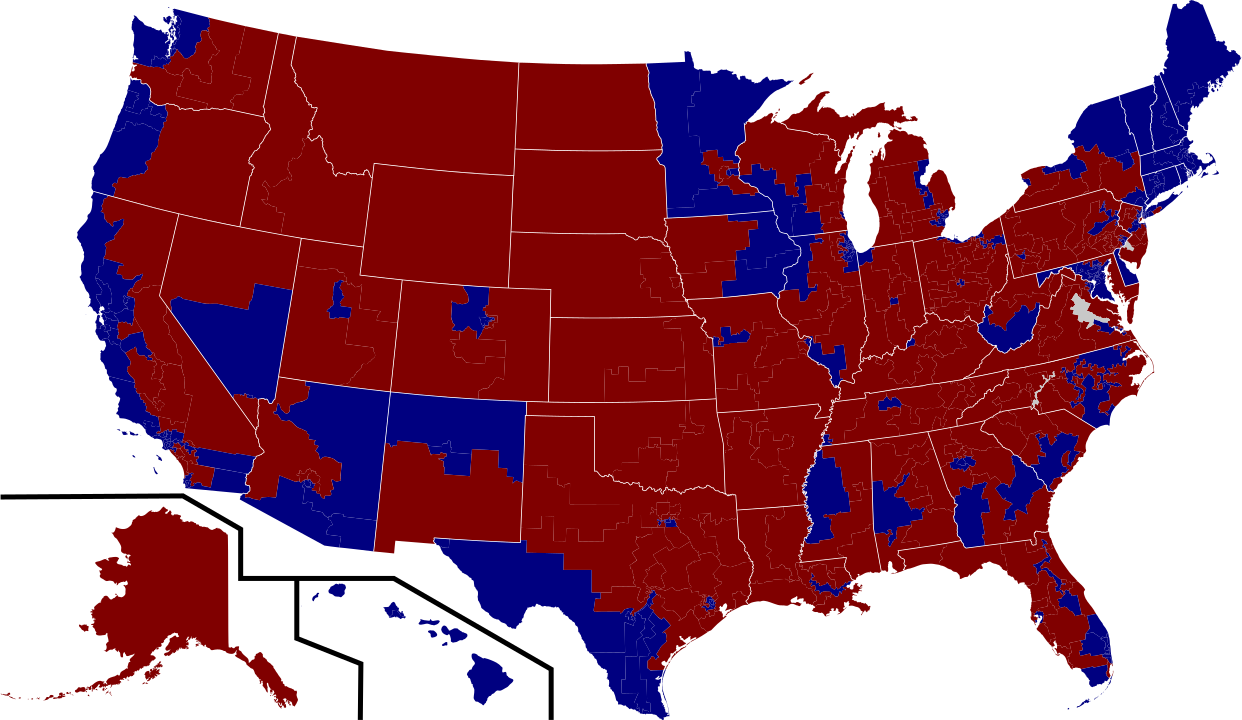
Red and Blue Districts and States in the 113th House
Here are the House districts. Remember that Democrats tend to be packed into the smaller districts, so this is deceptive.

Here's the partisan breakdown in the Senate

Blue means 2 Democrats
Red means 2 Republicans
Purple means one of each
Green means Independent
And what's up with Montana? Their one member of the House is a Republican, but both Senators are Democrats. The Dakotas too. Each elected a Republican to the house, but each has one Democrat in the Senate. Needs an explanation.
Here's the partisan breakdown in the Senate

Blue means 2 Democrats
Red means 2 Republicans
Purple means one of each
Green means Independent
And what's up with Montana? Their one member of the House is a Republican, but both Senators are Democrats. The Dakotas too. Each elected a Republican to the house, but each has one Democrat in the Senate. Needs an explanation.
Friday, March 11, 2011
Subscribe to:
Posts (Atom)