Thursday, January 10, 2013

Obama nominates his chief of staff to be the new Secretary of the Treasury

NYT has the story here, and here. More to follow, along with the many other appointments Obama has made recently.

We need to catch up on what all these changes mean. It is not unusual for presidents to have new faces in their second terms. The nature of Obama's selections have led some to suspect that he intends to make his mark on government this term. The first was about dealing with lingering crisis. His cabinet then was reflective of that. This time its different.

More on that soon.


Click here for info on Lew, and NYT's summary of Lew on key issues.

Yeah we do sorta think the world rotates around us

Land of the Focus, Home of the Vain

World class skate park breaks ground in North Houston

In its ongoing effort to be seen as a world class city, as well as an international destination, Houston - the Mayor's office anyway - has recently announced the development of the nation's largest - and the world's second largest, skate park. Here is a previous press release about the project. It'll join an already completed one near downtown.


Click here for more press releases from Houston's mayor. You'll notice that many are focused on the same theme. We are world class!

But do skateparks really benefit cities?

- The Tony Hawk Foundation says yes they do (big surprise).
- Suburban Rails agrees.
- As does Stand up for Skateparks.

There appears to be quite the advocacy network in the nation promoting skateparks. I was unaware. Nothing that I've seen yet points to an actual study with empirical proof that they increase the local economy, but they look pretty cool. They also gives kids things to do. Cities are probably interested in luring kids to the parks because if they don't skate there, they'll shread up downtown. This is probably subtle social control.

The concrete industry probably likes these things too.

Catching up with the 83rd Legislature

Here are links to a few stories about the goings on in Austin. All will apply to some aspect of GOVT 2306, so be on the lookout.

- The Texas Tribune reports that Lieutenant Governor David Dewhurst wants to retain the 2/3rds rule in the Senate, but that other Senators are not in favor of retaining it. The rule allows a minority within the Senate to block legislation they oppose:

The controversial rule prevents bills from being brought up for debate on the Senate floor unless two-thirds of senators consent. That rule has allowed a coalition of 11 of the Senate’s 31 members to block measures that have the support of more than half of the body. Although the rule has often helped Democrats block legislation, it has also worked in the favor of other groups of like-minded senators, such as those from rural districts.
Democrats will have at least 11 members out of the 31 in the Senate, so it gives them a bit of leverage in the chamber.

- Texas Watchdog argues that the state legislature in a "minefield of potential conflicts of interest." Legislators, who need to do something else in the almost 600 days they are not in session every two years, often have interests that they can assist with their ability to pass legislation. We might wish to consider if this is an inevitable consequence of the amateur legislature.

- The Texas Legislature likes to claim that it is not as dysfunctional of Congress, but the Dallas Morning News claims that lines are emerging quickly over what to do about the projected surplus. Should the programs cut in the last legislative session be restored? Or should taxes be cut further?

- The Dallas Morning News highlights 5 things to watch for in the upcoming session. 1 - Perry and Dewhurst will try to rebuild their reputations after a bad year. 2 - Water and transportation infrastructure needs to be addressed. Texas is not ready for projected growth. 3 - Public education has multiple issues including the backlash against testing and the cuts from the past session. 4 - A variety of hot-button issues including vouchers, drug testing, texting while driving bans and a statewide no-smoking ban. 5 - The latest round in pro-business efforts.

- The Lubbock Avalanche-Journal echoes the point.

- An editorial writer in Corpus Christi wonders if the legislature will look to the future or focus on the short term.

From the Washington Post: Before you talk about the deficit, take a look at these charts

A WP writer looks at what was and was not accomplished in the recent fiscal cliff deal, which is the first of what may turn out to be several separate deals on deficit reduction.

The fiscal cliff deal did much less to reduce the deficit than either political party had promised: It included $750 billion in deficit reduction, a far cry from the $1.8 trillion to $2.5 trillion deficit proposals that the White House and House Speaker John Boehner had put forward earlier in the debate. That’s prompted deficit hawks to insist that much more still needs to be done in the next phase of budget negotiations.

But the Jan. 1 fiscal cliff deal represented just one portion of the deficit reduction that’s been going on since 2011. The Center for American Progress calculates that President Obama and Congress have successfully enacted $2.4 trillion in deficit reduction since the beginning of fiscal year 2011, which began in September 2010.


About one-quarter of that comes from revenues (primarily the fiscal cliff deal) and almost two-thirds from spending cuts: In it’s research, CAP totals up $585 billion in discretionary cuts from the fiscal 2011 budgets passed under a GOP-controlled House and a lame-duck Democratic Congress and a GOP-controlled House. The debt-ceiling debate brought $860 billion in discretionary spending cuts through the Budget Control Act, which CAP calculates is a “10.6 percent reduction from inflation-adjusted 2010 spending levels.” Combined with the fiscal cliff deal and accounting for interest savings, that totals $2.4 trillion in deficit reduction over the past two years, CAP concludes.(Source: CAP)

Recent stuff from the Gallup Poll

The Gallup Poll never stops. Here are three recent items it sent out. The first shows that the number of people who answer "no religion" when it asks about religios preferences has increased 3% points since 2008.

Trend: What is your religious preference -- Protestant, Roman Catholic, Mormon, Jewish, Muslim, another religion, or no religion?
And support for the death penalty has varied over time, but we are now about where we were in 1936 in our support for it.
Trend: Are you in favor of the death penalty for a person convicted of murder?
And finally, there has been a 5% increase in the gap between those who identify or lean towards the Democratic Party.

Party Identification (Including Independent Leanings), Annual Averages, Gallup Polls, 1991-2012

Wednesday, January 9, 2013

The many faces of John Brennan

He does look like the kind of guy you want heading the CIA.


Here he's being a softy:

Mapping the power and influence of John Brennan and Chuck Hagel

Muckety is a website that maps out the relationships that exist among people in national politics. Its a great way to get used to the connections that allow poeple to get where they get.

Click here for the map surrounding Chuck Hagel and John Brennan.

While were; at it here's Jacob Lew and John Kerry.

My advice to you if you want to rise the ladder in whatever you do? Get connected. It aint what you know, its who you know. But you knew that.

The first bills of the 113th Congress

USA Today writes them up. They include gun control proposals, an effort to eliminate restrictions on the ability of non-profit organizations to endore or oppose political candidates, a repeal of the authorization to use force to respond to the 9/11 attacks, a request to return to the gold standard, and Michelle Bachmann's bill to repeal Obamacare (which has no co-sponsors despite a similar bill having over a hundred in the last Congress).

The opening days of a new Congress become the perfect time to announce positions because "there is not a whole lot of news to compete with" and the statement may actually get some attention, Kettl said. "It is a way to signal to people back home that 'I am working on things,' " and to highlight issues their representative is concerned about, even if the bills are destined to go nowhere, he said.

There is some symbolic value to be the first bill of the congressional session.
But according to Congressional rules, the first 20 bill numbers (H.R. 1 - 20) are reserved for bill that are proposed by Congressional leaders.

The first 10 are reserved for majority leadership to attach to their priority bills; the next 10 are for minority leadership. 

From Slate: A Lynching Map of the United States, 1900-1931

Click here for the story that accompanies this map

Lynching Map

Texas was #3 on the list following Georgia and Mississippi.

What is the difference between a lynching and a murder?

“There must be legal evidence that a person was killed. That person must have met death illegally. A group of three or more persons must have participated in the killing. The group must have acted under the pretext of service to justice, race or tradition.”
And lynching could result from relatively minor crimes:


One was charged with being accessory to burning a barn. One was accused to [sic] stealing cotton. A family of four, including two daughters, was slaughtered for clubbing an officer. Three were lynched for poisoning mules, and two for stealing hogs. Two were strung up for furnishing ammunition to a man who was resisting arrest.


This was from a description of lynchings for 1916. In four of these events the accused would later be proven innocent.

Day One of the 83rd Session

First Reading - in the Austin American-Statesman - will have daily summaries of what's happening in Austin everyday. I probably post links to these highlighting what I think is pertinent to the class.

Here's what stuck out to me today. We have remarkable continuity at the top of the executive and legislative branches. This will probably cancel out the impact of having a relative new ranks and file:

The Big Three

It may not be Yalta, or even Potsdam, but the Big Three, after breaking bread over breakfast this morning, will be holding a joint press conference at 9:30 at the Governor’s Press Conference Room.

The Big Three, of course, are Gov. Rick Perry, Lt. Gov. David Dewhurst and House Speaker Joe Straus, who have breakfast together every Wednesday the Legislature is in session. This morning they follow their breakfast routine by talking about the 83rd Legislative Session with reporters.


There are few if any states with this kind of continuity at the top. Perry, the longest-serving governor in the land, has been on the job since he succeeded George W. Bush, on his becoming president. Dewhurst has been lieutenant governor since 2003, and Straus is now embarking on his third term as speaker. Perry said the three talk all the time, and their staffs communicate with each other multiple times daily.

Brownie point opportunity if you get the reference to Yalta and Potsdam

Can Democrats Flip King and Christie?

I have no idea if this is possible, but the House Republican votes against relief for Hurricane Sandy - which were driven by the Tea Party (or southern) faction of the party, has caused two prominent national Republicans to be very critical of their party.

This reminds me of the criticism southern Democrats heaped upon the national Democratic Party beginning in the late 1940s when they started flirting with civil rights legislation. Ultimately they would flip over to the Republican Party - which became more amenable to them by reversing its positions on race issues as well - from being in favor to being opposed.

Are we seeing the reverse of this occurring now? If so, it would be part of a continuum. Southern Democrats flip to the Republican Party, but slowly take it over. Northeastern Republicans become more marginalized and begin feeling more isolated within the party. Recall that liberal Republicans (the Rockefeller Republicans) have already flipped. Might the moderates follow? I do not know if Peter King and Chris Christie qualify as moderates, but southern hostility to all aspects of federal power - save defense - are jeopardizing their constituents well-being.

If I'm a Democrat in New York or New Jersey (and especially if I'm Obama), I'm going to try to flip them. For King it means going from the majority to the minority, so there's little sense in that right now - unless he feels his very position in Congress is threatened. Christie might find himself more popular if he holds onto Republican support and then adds the Democrats.

Again, this is just a thought experiment - but party ID has been shifting considerable along regional lines. What happening here seems just another part of that shift. If it does happen, I can't see this being healthy for the Republican future. A party can't win if it is only the party of the South.

- Peter King: I'm 'over' the GOP.

The “go f— yourself” model of political polarization

Writers at the Washington Post use contemporary political science analysis to look at the impact outbursts from the leaders of one party (like recently between Boehner and Reid) to the other have on political polarization and, not a big surprise, they find a effect. John Sides at The Monkey Cage comments on it as well.

Some recent research suggests that when politicians engage in PDA – public displays of anathema – Americans’ attitudes toward the party they don’t identify with grow increasingly negative, contributing to mass polarization.

Political scientists for years have debated whether the American public is polarized along ideological lines. On one hand, some research portrays the vast majority of Americans as centrist on most issues. Other work has argued that Republican and Democratic voters’ policy views are far more divided.

But Shanto Iyengar, Gaurav Sood and Yphtach Lelkes suggest in a new article that “affective polarization” may better describe the divide between party identifiers. Instead of focusing on ideology and policy positions, Iyengar and his colleagues draw on a psychological concept called social identity theory.

They argue that simply identifying with a political party, as most Americans do, is enough to generate unfavorable attitudes toward the other side, or the “out-party.” (This idea should feel pretty familiar to Red Sox and Yankees fans.) And a variety of survey evidence shows that in recent decades Democratic identifiers have come to view Republicans increasingly negatively, and vice versa.

Differences between party identifiers transcends ideology and policy. They just don't like each other regardless of ideology or policy. As we continue hammering on a general theme - Is government broken? - it might be worth wondering whether government is fine as far as it goes. The real root of the problem may be personal animosity between party identifiers in the general population. That may translate into and cause political and governmental gridlock. Its a reasonable hypothesis.

Tuesday, January 8, 2013

9%

That's Congress' current approval rating according to Public Policy Polling


As least people like it more than Gonorrhea.

But Nickelbach - that's low ...

Richard Cramer, RIP

The NYT has an obituary of a journalist who produced one of the better account of a presidential campaign. His name was Richard Cramer, and the book is What it Takes: The Way to the White House.

Just in case you want a copy:

What It Takes: The Way to the White House

Supreme Court bait?

The Houston Chronicle reports on a conflict between a disabled woman and a local church.

From the story:

Harris County court has ruled that authorities at a Houston church discriminated against a disabled woman when they banned her from worship after she raised concerns about restroom accessibility.

Malaika Adan filed suit in 2010 against Beth Yeshua HaMashiach, a church of about 100 for Jewish and non-Jewish believers, after she was asked not to return to services temporarily after a conflict over the facility's restrooms, court documents show.

A summary judgment signed on Dec. 19 sided with Adan and said that she was banned from the church after she complained and tried to assert her rights as a person with a disability. The church was ordered to pay Adan, who uses a wheelchair, $1,000 in statutory damages and more than $52,000 in attorney's fees.

Adan's attorney, Joseph Berra, with the Texas Civil Rights Project, called the decision a "unique kind of win" because it shows churches are not above the law.

But is it? The Supreme Court has carved out all sorts of exemptions for church when it comes to federal law recently. In Hosanna-Tabor Evangelical Lutheran Church and School v. Equal Employment Opportunity Commission, they argued that the federal government could not force the church to rehire a woman fired for a disability.

I would not be surprised if we haven't heard the last of this dispute.   

An update on school funding

The Available School Fund is not always in the news, but the Texas Tribune highlights a recent controversy involving it, the School Land Board, Jerry Patterson and the Texas Legislature.

The School Land Board voted Tuesday to release $300 million into the Available School Fund for public schools.

The money will be released in two $150 million installments, one in February and the other on June. The funds had been caught in a standoff between the Legislature and the School Land Board, which operates out of the General Land Office and oversees the state’s public school land.

A constitutional amendment proposed in 2011 by state Rep. Rob Orr, R-Burleson, allowed the board to put a portion of earnings from investments on real estate assets into the Available School Fund, which along with property and sales taxes helps pay for public education.

Voters passed the amendment last November, but the little-watched School Land Board decided not to distribute the money in July. Land Commissioner Jerry Patterson, who sits on the three-member board, said it wanted to protect the funds for upcoming investment opportunities.

Members of the Legislature are a bit ticked at Patterson saying they expected the money to be spent, and seem to have reduced general revenue funding to education with the expectation that they would.

We'll file this away for now and dig into it when we look at pubic education in 2306 later this semester.

College Textbooks are a Scam

It's why I don't assign them. Here's proof:

Textbooks

Governor Perry wants the budget surplus to lead to tax cuts

No surprise here:

Gov. Rick Perry warned Texas lawmakers Tuesday not to start making grand plans for the multibillion-dollar budget surplus and the growing Rainy Day Fund.

Addressing the state Senate on the opening day of the 2013 legislative session, Perry said special interest groups already are eyeing the excess cash as “the equivalent of ringing the dinner bell.”

“In the face of that kind of pressure, we have to remember that Monday’s revenue estimate is not a chance to spend freely but an opportunity to rededicate ourselves to the very policies that made Texas economically strong,” the governor said. “It’s also a chance to put our fiscal house in order for years to come.”

Houston Senator John Whitmire criticized Perry's statement:

Perry's remarks ignore some pressing issues for the state . . .

"It's a good political speech, but the bottom line is we need to put more money into public education and deal with the dropout rate," he said, also saying, "There is not a state agency in this state that is being adequately funded."

Joe Straus reelected Texas House Speaker

From the Texas Tribune:

After the last of his challengers dropped out Tuesday, San Antonio Republican Joe Straus was elected to a third term as speaker of the Texas House.

That last challenger, Rep. David Simpson, R-Longview, never found enough support to threaten the incumbent. An earlier challenger, Rep. Bryan Hughes, R-Mineola, dropped out weeks ago as Simpson entered the race.

Simpson seems to be a gunner - not anxious to sit back and slowly work himself into a position of influence:

The seeds of Simpson’s challenge were planted two years ago. Simpson, in his freshman term, ignored experienced members who advised him to take a back seat and learn his way around, instead battling against legislation that would limit puppy mills and for legislation restricting security searches at airports. He lost both battles, but won a reputation for independence.
Simpson's career will be interesting to follow.

This is Straus' third time to be Texas House Speaker. Straus will now proceed to name committee chairs and members. He is able to do this after the vote - which means that this can turn into a weapon. No one wants to be on record as having oppose the Speaker.

He issued a statement after the vote listing what he sees as being the priorities for the session, he spends a great deal of attention to public education. He also mentions the drought and the need to focus on infrastructure repair.

Here's a snippet (the whole thing is worth a read):

Our rapid growth requires a steadfast commitment to the core responsibilities of government, such as a quality education, a reliable water supply, a healthy transportation system and an honest state budget. These are the priorities that you and I discussed around the state in recent months — the issues that voters expect us to address because they will play the largest role in determining our shared future.

Our priorities should begin where our future does — in public education. More than 5 million children are enrolled in our public schools, which is more than the total population of 29 states. More than 3 million of them are deemed economically disadvantaged, and almost 1 million of them speak limited English. The education of all our students will determine whether Texas is a land of prosperity or lost opportunities.

Be glad I'm not giving you this test

The New Republic digs up a copy of an 8th grade test from 1895.

Nothing on government, but here's the history portion:


U.S. History (Time, 45 minutes)

1. Give the epochs into which U.S. History is divided. 
2. Give an account of the discovery of America by Columbus. 
3. Relate the causes and results of the Revolutionary War. 
4. Show the territorial growth of the United States. 
5. Tell what you can of the history of Kansas. 
6. Describe three of the most prominent battles of the Rebellion. 
7. Who were the following: Morse, Whitney, Fulton, Bell, Lincoln, Penn, and Howe? 
8. Name events connected with the following dates: 1607, 1620, 1800, 1849, and 1865?


Rep. Weber's Committees

On January 3, 2012 Randy Weber sent out a press release announcing that we had been placed on the Science, Space, and Technology and Foreign Affairs committees.

"I am very excited to be on both committees,” said Congressman-Elect Randy Weber. “NASA is a neighbor to my district, while UTMB and a number of science and research-based entities reside within Congressional District 14. I will be a strong advocate for each of them on the Science, Space, and Technology Committee. The Foreign Affairs Committee will allow me the opportunity to champion our Nation and her able citizens, while learning more about the international issues impacting our borders.” Weber added, “I am looking forward to this opportunity to learn and grow on these committees and am grateful for the appointments given me.”


The decision on the Science, Space and Technology committee was made in mid December. Seven of the committees members in the 113th Congress will be from Texas, which gives the state some clout. Makes sense since the committee's jurisdiction includes the Johnson Space Center which is a major feature of the local economy. JSC is in the 14th District - so Weber's placement there makes perfect sense. No word right now on what subcommittees he will be on. A Texas Republican - Lamar Smith - will also chair the committee, taking over from another Texas Republican Ralph Hall.As if that is not enough - the ranking member - meaning the top Democrat - is also a Texan: Eddie Bernice Johnson.

From Texans on the Potomac:

The committee has strong impact on Texas and oversees NASA and research programs conducted in San Antonio at Southwest Research Institute, Texas Biomedical Research Institute, and the University of Texas Health Science Center.

“Clearly it’s an advantage,” said Louis DeSipio, professor of political science and Latino studies at the University of California Irvine. “What it will mean in practical terms is that when Congress gets around to allocating resources…Texas universities will be at an advantage. Larger Texas technology firms will be in a good position.”


FYI: Ralph Hall released a summary of the accomplishments of the committee during the 112th Congress.

Given the Houston area's position within internal markets - especially oil - Weber's appointment to the Foreign Affairs committee also makes sense. In addition, the committee allows for focus on border issues - illegal immigration and all that - which are important to his constituency.

The 14th District is a relatively safe one for Republicans. Now that he is an incumbent, there is little reason to think that he cannot hold onto this position as long as he likes. But being on these committees gives him enough opportunity to deal with the needs of constituents to be able to campaign effectively on that point. Republican leaders almost certainly took this into consideration when they made these appointments.

Some detail on Randy Weber - US House District 14 in Texas


http://www.georgejarkesy.com/wp-content/uploads/2012/10/14.12-Randy-Weber.jpeg

Our new Congressman

After representing the 29th district of the Texas House for a small handful of years Weber (ACC class of 1977) was elected to replace Ron Paul as representative of the 14th District of Texas in the US House. this was after the district was redrawn substantively. Paul supporters suspected this was done in part to push Paul out. Though Paul was a Republican, he was not a tight knit team player. He often went his own way on votes. The party was rumored to hope for a more reliable vote for the Republican House Conference.


Weber won a plurality of the vote (28%) against 8 other Republicans in the 2012 Primary and comfortable defeated Felicia Harris (63% - 37%) in the runoff. He then defeated Democrat Nick Lampson - along with a Libertarian and Green Party candidate - in the general election (53% - 44%).

For detail of the 2012 election click here.

And click here for his US House website.http://weber.house.gov/

The 83rd Session of the Texas Legislature convenes today

From the Texas Legislative Council: Dates of Interest for the 83rd session - note the related laws, constitutional sections and rules that establish the dates.


Tuesday, March 6, 2012
Primary election for legislative and other offices is held (This was delayed)
[Election Code, sec. 41.007]

Tuesday, May 22, 2012
Primary runoff election for legislative and other offices is held (This was also delayed)
[Election Code, sec. 41.007]

Tuesday, November 6, 2012
General election for legislative and other offices is held
[Election Code, Sec. 41.002]

Monday, November 12, 2012
Prefiling of legislation for the 83rd Legislature begins
[House Rule 8, Sec. 7, and Senate Rule 7.04(a)]

Session Begins

Tuesday, January 8, 2013 (1st day)
83rd Legislature convenes at noon
[Government Code, Sec. 301.001]

Friday, March 8, 2013 (60th day)
Deadline for filing bills and joint resolutions other than local bills,
emergency appropriations, and bills that have been declared an
emergency by the governor
[House Rule 8, Sec. 8; Senate Rules 7.07(b) and 10.01]

Monday, May 27, 2013 (140th day)
Last day of 83rd Regular Session; corrections only in house and senate
[Sec. 24(b), Art. III, Texas Constitution]

Session Ends

Sunday, June 16, 2013 (20th day following final adjournment)
Last day governor can sign or veto bills passed during the regular legislative session
[Sec. 14, Art. IV, Texas Constitution]

Monday, August 26, 2013 (91st day following final adjournment)
Date that bills without specific effective dates (that could not be effective
immediately) become law
[Sec. 39, Art. III, Texas Constitution]

Monday, January 7, 2013

ACC: part Randy Weber, part Pete Olson

A strange thing happened when congressional districts were redrawn in Texas. The Alvin Community College campus was put in two districts (I've yet to find a good map that contains the campus, but if you drill down into this map you can find it). The bulk of it is in the 22nd District, which is represented by Pete Olson while a small little corner in the southwest corner is in the 14th District, which is Represented by Randy Weber.

Previously ACC was fully in the 14th District and was represented by Ron Paul - when he wasn't running for president. Randy Weber represented ACC in the Texas House as the representative of the 29th district.

This gives us the opportunity to follow two different people - both Republican - that represent two different districts, one coastal, one suburban.

Wonkblog's graph of the day

Obama announces new Defense Secretary and CIA Director

No big surprise. Chuck Hagel for Defense; John Brennan for CIA.

Story in NYT - commentary and background to follow.

2014-2015 Biennial Revenue Estimate is unveiled

The Texas Comptroller has released the biennial revenue estimate on day before the start of the legislative session.

Access the report here.

Some highlights:

- Texas is projected to generate $96.2 billion in tax revenues from 2014-2015.

- An additional $8.8 billion will be collected in revenue for 2012- 2013 beyond what was originally anticipated

- $3.6 billion is expected to be generated from oil and natural gas revenues, which will then be deposited in the Economic Stabilization Fund - also known as the rainy day fund.

- Altogether this means that $101.4 billion in funds will available for general-purpose spending for the 2014-2015.

- The state will also receive $112 billion in federal receipts, which means that Texas will have $208 billion in revenue to spend in the 2014-2015 budget.

The legislature now has to put together a budget that is no greater than $101.2 billion. Reports suggest that republicans would like it to be much lower than that figure.

For media reports on the estimate click here and here.

Is Houston designed to encourage drunk driving?

Houston has more fatal crashes involving intoxication than most other cities in the US. Is there something about the cities design, including its reliance on automobiles, that makes guarantees this outcome? Cities like New York, Boston and Washington are all low on the list.

- The Geography of Drunk DrivingThe Geography of Drunk Driving

Texas School Districts lobby and lawyer up.

The Fort Worth Star Telegram reports that independent school districts in the state have organized prior to the 83rd session in order to push for a restoration of the $5.4 billion in finding lost in the previous session.

In related news, the lawsuit against those cuts continues. Schools argue that the cuts violated the mandate in the Texas Constitution that adequate provisions be made for public education in the state.

Detail about the lawsuits can be found here at the website of the Texas Association of School Boards.

Ross Ramsey argues that all spending decisions will be at a standstill until this issue is worked out.

From the Dallas Morning News: As Texas comptroller prepares to set budget limits, why was 2011 estimate so far off?

The Texas Comptroller - as required by the Texas Constitution - is expected to provide the biennial revenue estimate for 2014-2015. This will guide the members of the 83rd Session of the legislature as they put the state budget together. Expenditures cannot exceed the estimate, but the estimate is guaranteed to be off at leas some since its tough to project what the economy will be like in 2014 and 2015, which means that we will not know what tax revenues will be.

The Dallas Morning News points out that the previous estimate underestimated revenue by perhaps $12 billion.

A conservative blogger at the Houston Chronicle wants to see John Cornyn primaried

He's upset at Cornyn's vote for the fiscal cliff deal, and is toying with possibilities:

Look, I’ve been a supporter of Sen. Cornyn’s for a long time but that doesn’t mean I can’t criticize him, as I did with his support of the original TARP bill. And yes, he is a conservative and has done some good stuff for us during his time in Washington DC.

But at some point, you have to ask “why aren’t you voting conservative on fiscal issues?” And not accept a non-answer like the one above.

If someone does challenge him, they will face an uphill fight to be sure. Sen. Cornyn has deep roots, an extensive campaign organization, and the support of many party leaders. I think, as do most people, that Atty. Gen. Greg Abbott would easily beat him in a primary but I’m told that they are such good friends that Abbott will not challenge him. Which makes you wonder about Abbott but that is for another day.

Is this the race that State Sen. Dan Patrick will attempt? Before you dismiss him, remember, this is a Republican primary we’re talking about. What happens if Dan Branch takes a shot? Now that Lt. Gov. David Dewhurst has decided to embrace Tea Party groups and far right activists, will he forgo another run at Lt. Gov. and give the Senate another run? Stranger things have happened. Does George P. Bush have the spine to challenge him? Doubtful because they run in the same circles but if he sees an opening, does he take the chance? Who knows?

What I do know is that Sen. Cornyn’s vote on the fiscal cliff is out of touch with Republican primary voters in Texas. And that can’t be a good thing for him. Perhaps he is betting that Texas Republicans are going to move towards the center in the next 15 months
.

Sunday, January 6, 2013

Study Break


I hear that physical activity helps focus the mind.

Some advice, from me to you

How to Make Money From Facebook

This applies to school work as well.

House Republicans not giving up on repealing Obamacare

The Chronicle reports that while they understand the reality of Obama's re-election, they still intend to attack the law piece by piece. These will mostly be ceremonial votes, but they may resonate with public. Who knows?

From the Texas Tribune: 83rd Legislature Faces a New Set of Priorities

This session does not face the same crises that the 82nd session had to face, but issues loom. The Texas Tribune provides a reasonable look at what's on tap. So does the Dallas Morning News, which adds that just because something is a pressing problem does not guarantee that there's wiliingness to deal with it.

43 Freshman and 24 Sophmores will be in the 83rd Session

The Austin American Statesman contemplates the consequences of having so many green legislators, nearly half of the legislature has little or no experience in the institution. Many won their positons due to the continued influence of the Tea Party in the state.

Rice prof Mark Jones tries to put the newbies in context:

. . . the addition of a few more Democrats to the House minority, and the replacement of some veteran Republicans with more conservative folks like Stickland, will leave the House collectively in about the same spot it was ideologically in the last session. But the Republican caucus, where most of the action is, will be further to the right.

It is hard to know what vocabulary to apply to the two broad GOP camps. Jones uses the terms “movement conservative” and “establishment conservative.” While “establishment” might carry a musty air, the alternatives – “moderate,” “pragmatic,” “centrist,” – are now clearly, in the modern Republican lexicon, pejorative.

GOP members, Jones said, exist along a continuum. There are those who love the tea party, those who just like it, those who loathe it but fear its wrath, and those, like Villalba, who feel comfortable in politely maintaining their distance.

Stickland and his band consider themselves Davids who can defeat the Goliaths of better-funded opponents. But Jones said they will find that the moneyed Republican interests will tolerate their politics only to the extent that it doesn’t interfere with business, and then, those tea party members must contemplate the cost, in terms of their political future, of their ideas.

From MySA: It's not your father's Legislature any more

Gary Scharrer details how the 83rd Session of the Texas Legislature has changed. He points out how the changes in the past 25 years. The principle change has been the decrease of Anglo Democrats.

- In 1988 there were 83 Anglo Democrats, now there are 10.

- Only 3 of the 181 total members of the legislature are Hispanic Republicans.

- In 1988 56 Democrats were elected to represent rural areas, now there is only one.

- In 1988, 12 Anglo Democrats represented the Houston area, now only one does. John Whitmire.

Whitmire argues that the state has grown more urban, but the legislature is still dominated by agrarian interests. He anticipates that further increases in urban - and minority - population will lead to changes in state policies. Obama won 5 of the 6 largest counties in the state.

The reduction in Anglo Democrats was intentional. In an effort to make the Democratic Party weaker, Anglo Democrats were targeted for defeat, or weakened by redistricting. Doing so however may have solidified Hispanic support for the party however. Democrats are hoping that since demographics show the Latino population continues to grow, this suggests a bright future for the party. This assumes Republicans will not be able to increase its support among Latinos. That will be the party's challenge. 

Club for Growth set to primary Republicans who voted for the Sandy Relief Bill

An example of primarying in action.

The Club for Growth is one of the more powerful interest groups active today. Its expressed goal is to influence (control?) a majority of the Republican Conference in the House so they can then influence (control) what can and cannot pass the House.

The vote for the Sandy Relief Bill will be part of the score card they use to rank members of Congress according to their criteria. Those who score low may find themselves vulnerable in the upcoming 2014 Republican Primaries.

Some random links for background:
- What Kind of Politician Votes Against a Hurricane Relief Bill?
- Rep. Mo Brooks: Why I voted against Sandy relief bill.
- Did Congress Mishandle the Hurricane Sandy Relief Bill?
- Congress OKs $9.7B in Sandy relief, as conservatives question call for more aid.

Getting Primaried

I'm working on class material for campaigning and ran across a few items related to incumbents being "primaried" or threatened with being primaried. This - of course - is when an incumbent is threatened with a more ideologically pure primary challenger if they cast votes seen by certain interest groups as being too moderate. Since its an increasing tactic, I'm adding it to course content.

Students should add this to their vocabulary.

A few related items:

- Getting Primaried: The Changing Politics of Congressional Primary Challenges.
- Primarying Arlen Specter was very stupid.
- "Primarying" Barack Obama--Some Relevant History.

This is one of the many factors driving ideological polarization in Congress. We will be discussing this strategy regularly in class.

Saturday, January 5, 2013

Is the level of violent crime related to the level of lead in the environment?

There's evidence that a relationship exists between exposure to high levels of lead - it used to commonly be in paint and gas - and propensity to commit violent crime. The data correlate strongly.  

The lines are shifted a bit so they seem to overlap more than they normally would. The reasoning is likely that someone who was exposed to lead as a child would be more likely to commit violent crimes as an adult.

The question now is whether the relationship is spurious, and there is a different factor that drives the change - perhaps something that drives both independently. But researchers have isolated a molecule in lead that reduces IQ. Does that also increase the likelihood that someone will become a violent criminal? If so, that's your link.

Over the past few decades, laws have been passed limiting the amount of lead in the environment. Could these be taking effect? The prison population has been reduced recently, and there has a been a long term trend downward in the percent of people going to prison. A commentator calls this one of the major unreported public policy stories of the year.


Many factors are associated with this shift, but there's a definite shift in the tendency of younger males - the one's likely to commit violent crimes - to be sentenced to prison. Something seems to have shifted about 35 years ago - which was about the time leaded gasoline and lead paint were phased out.

Meet Compressorhead

They can track you down and kill you, do your job better than you for no pay, and now they can kick out the jams better than you too. Great, just great. Expect to see robot teacher in front of the class in a year. Try asking it to accept your late work.


All hail our robot overlords.


Just Curious: Is there a photograph available for the entire Texas Delegation to the 113th Congress? Democrats and Republicans in one picture?

I haven't found one. There's precedence in having one taken. Here's one of the 80th Texas delegation, which served from 1947-1949, and featured big ole Lyndon Johnson. Click here for the source and description.

medium image

They were all Southern Democrats (most - if not all - would be Republicans today. I'm not sure about LBJ.), so I suppose they could all stand to be in the same room with each other. Are they too politically polarized to take a picture like this now? Maybe one's been taken and I'm simply unaware, but I'd like to propose that one be taken. Might help break the ice between the members - assuming that anyone is interested in ice breaking of course.

How about starting a petition to get a picture of the Texas delegation together, in one room, smiling? Nutty idea?

New Congress; New Delegation

38 people will represent Texas in the 113th Congress. 2 in the Senate and 36 in the House - 11 of which represent at least part of the Greater Houston area. We will keep tabs on these folks, and here are a few links that will help us do so:

- Wikipedia: US Congressional delegations from Texas.
- GovTrack: Texas members and district maps.
- OpenSecrets: Texas Congressional Delegation.
- Texas Tribune Topics: Texas Congressional Delegation.
- Houston Chronicle: Texas Delegation.
- MySA: Texas Delegation.
- Ballotpedia: US Congressional delegations from Texas.

I'll add to the list as I find more resources. Send some along if you find some.

The Texas Women’s Health Program is launched

As a result of the conflict between the Texas Government (or at least the social conservatives within it) and Planned Parenthood, Texas has had to create its own mechanism for providing health care to poor women. Texas now prevents women who qualify for these services to get them from organizations that provide abortions. But doing so led the federal government to pull its funding for the programs - which was the bulk of it.

So Texas - if it is going to provide health care to poor women at all - has to do it alone.

To do so its launched the Texas Women’s Health Program this week. The question now is: can, or will, Texas provide this service at a level comparable to what it was able to provide in cooperation with the federal government. Texas tends to not like to provide services to the poor - at least through the state government. This will be worth monitoring.

- Here's the website to the Texas Women's Health Program. (It's pink!)
- And here's a link to the Texas Health and Human Commission's website, THHS runs the program.
- Here are statement's regarding the controversy from the governor's office.
- And here's a list of stories regarding the Women's Health Program from the Texas Tribune.

How did the Texas delegation to the US Congress vote on the fiscal cliff?

The Texas Tribune breaks it down. Four Republicans and all Democrats in the House voted for it. Both Senators voted for it as well. Since this vote was taken by the 112th Congress, this was the previous delegation, not the one just sworn in.

Politics trumps governing in Texas

The Texas Tribune gives a skeptical appraisal of what is about to begin next next when the 83rd Session of the Texas Legislature convenes.

The normal business of politics will be briefly interrupted by the temporary need for some governing to happen.

In civics textbooks, governing is the thing. Politics is in there, certainly, but the elections have a beginning and an end. The Legislature meets every two years for 140 days. A period of civic peace and prosperity follows for six or seven months. Birds sing. The sun shines. Children laugh and play. Late in the year, candidates file for March primaries. When that’s over, another period of relative calm would fall on Texas, ending around Labor Day, when candidates fire up their general election campaigns. The November elections would start the cycle all over again, regular as weather.

Back here in real life, the elections never stop. Neither does the electioneering. It’s a two-year political season, interrupted by five months of fierce legislating — a bit of which has as much to do with politics and elections as with governing the state.

The interruption started last month with the beginning of a ban on raising campaign contributions during a legislative session, and runs until June. Not only can elected state officials not raise money during a session, they can’t really campaign, and they must cross a parliamentary minefield, knowing that what happens between now and Memorial Day — the end of the session — could bite them in 2014, when the next elections take place.

Once the session starts next week and the politics of the speaker’s race ends, the politicos become lawmakers.

The Pollyannaish civics books are right, in part: the real consequences come during the governing part that starts next week. Everything else is just the fight to get into the building.

Friday, January 4, 2013

I'd like to think I'm not this bad

They Legitimately Expected Me to Study?

But then again...

Photoshopping Sheila Jackson Lee

Along with three other women, the area member of the House did no make it to the scheduled photograph of Democratic women taken earlier today, so they were all photoshopped in. Can't tell can you?

 Pelosi defends altered photo: At left, an Associated Press photo taken Thursday of House Minority Leader Nancy Pelosi posing with female House members on Capitol Hill, and at right, a screen grab from Pelosi's Flickr page of an altered photo. IMAGE
From visual.ly, a graphical depiction of the ideological history of the Supreme Court from 1937-2007:

The Ideological History of the US Supreme Court, 1937-2007 Infographic

"party trumps constituency"

I may be reading this summary of the study wrong, but it seems to imply that members of Congress - or at least candidates - are more responsive to their parties than to their constituents.

If so, that suggests that political parties have upset the entire purpose (as defined by the Constitution) of the House of Representatives.

Go see Lincoln

The Monkey Cage thinks its the best film ever about the House of Representatives.

But they do note that there's not much competition for that honor.

Digging into the Red State / Blue State Divide

It turns out that if you dig into the data - and break down voters by various categories - the standard red / blue distinction between states gets complicated. If broken down by income for example, things look like this (the blank states were not polled for this study):


And this is what things look like broken down by age. This one ought to concern Republicans. I only see two moderately red states in the 18-29 map.

Does gerrymandering cause party polarization in the US House?

Its a question we look at repeatedly in various sections in 2305 (primarily). The standard argument is that gerrymandered districts - which guarantee that a member of one of the two dominant parties will win the general election - are the primary cause of the increased polarization we've seen in the House recently. But this is a controversial point. Some pretty bright folks say that this is a simplification. For a look at this question by the folks who run The Money Cage click here, and here, and here. This Washington Post article also touches on the question.

But the argument persists, and here's the latest about it according to the Dish. An emerging idea is that polarization begins with natural ideological divisions within the nation, and these are cemented by gerrymandered districts.

Anyway, this was all really an excuse to post the following fancy graph:

Polarization_House

Angling to take out Boehner? Have they strengthened Democrats in the House?

Slideshow Image

I'm surprised these two didn't make a move. The guy on the left is #3 - Majority Whip Kevin McCarthy. The guy on the right is #2 - Majority Leader Eric Cantor. They've positioned themselves to the right of Boehner and seem poised to ride the conservative wing of the Republican Party upwards, but will this make the party weaker?

It's an ironic problem when a party is in the majority. It tends to splinter.

The Democratic Caucus on the other hand - at least according to this report - might be unusually unified. If Republicans split on a bill important to the leadership, they will need a few Democrats to pass it. But if Democrats can stay unified, they can prevent that from happening and extract concessions for their votes:

“The minority in the House has very few ways of getting things on the agenda,” Don Wolfensberger, director of the Congress Project at the Wilson Center, a former top staffer for the House Rules Committee and a CQ Roll Call contributing writer, said recently.

But Pelosi is beginning to maximize her leverage by keeping her troops unified, making Republicans find the votes for a majority in their own conference.

“There are few people as strategic as Nancy Pelosi. She has expressed to her colleagues and to others that if Democrats are going to be asked to support something, the number of Democrats who will be able to support something depends on the something they are being asked to support,” said Rep. Steve Israel of New York, chairman of the Democratic Congressional Campaign Committee.

“If you need Democrats, you need to tell us what’s in the deal, and if there is an appetite in the caucus, then the caucus will provide the votes. If there is no appetite in the caucus, then you can’t count on us for the votes. Nobody knows how to get to 218 more than Nancy Pelosi, and so she’s been applying herself to see how you get to 218 to get this solved in a way that is fair,”

House Rules for the 113th Congress

Along with electing a Speaker and swearing in new members, the House adopted the rules that will govern how things are done in the next two years. This is referred to as the rules package and was presented to the House as House Resolution 5 (it does not need a presidential signature since it isn't a bill).

The Constitution mandates that each chamber makes its own rules for how to do business, that's what this is.

Here's a link to the resolution.

It begins by stating this:

At the beginning of a Congress, the House must not only constitute itself, but must also approve rules. A newly elected House typically adopts the rules of the previous Congress with specific amendments. The proposed rules are offered in the form of a House resolution, which is considered under “general parliamentary law” which is interpreted to include the rules of the previous Congress (CRS RL 30725). 

And then proceeds with a summary of the how the rules of the 113th Congress are different from those of the 112th. Follow the link above to find the entire language of the resolution.

Since Republicans control the House, it contains provisions that reflect their goals and priorities. Example:

16.The Committee on Oversight and Government Reform is authorized to continue litigation to enforce a subpoena against the Attorney General regarding the “Fast and Furious” incidents.

For media coverage of the House Rules Package:

-
Huffington Post.

Looking down on the conspiracy


House Republicans who hoped to unseat Boehner as Speaker count the votes against him.

The NYT wonders why, since he has a vocal opposition to him already within his party, he wants the job. And there are lingering questions about whether he will be able to ensure the party works as a cohesive, unified forcer:

With his genial manner — and prodigious fund-raising efforts on behalf of fellow Republicans — Mr. Boehner has engendered considerable good will within his party. Though he lost the support of some of his fellow Republicans on Thursday, no one formally rose to challenge him.

“He’s personally well liked, and I think that’s important,” said Ross K. Baker, an expert in Congress at Rutgers University. “There haven’t been any coups mounted against Boehner, and I think that tells you something.”

But Mr. Boehner’s good-natured demeanor can sometimes work against him. As one House Democrat said, insisting on anonymity to avoid angering a leader, Republicans like him, but they do not fear him. The most difficult task for any speaker is to keep his party in line, a lesson that Mr. Boehner has learned the hard way.

“It’s a little bit like being the head caretaker of the cemetery,” said Representative Hal Rogers, the Kentucky Republican, describing the challenge Mr. Boehner faces. “There are a lot of people under you, but nobody listens.”

Thursday, January 3, 2013

Sleeper issues for 2013

The National Journal argues that tax and entitlement reform - along with gun control (possibly) - will dominate the 113th Congress, but there are 5 issues that might emerge:

Fossil-Fuel Exports
Europe Crisis
K-12 Education
Too Big To Fail
EPA's Climate Change Rules for Existing Polluters

Was there a failed coup against John Boehner?

Was there a last minute effort to unseat John Boehner as Speaker?

The Hill thinks so. The NYT makes the same point. It was unorganized, but real. Boehner has been upsetting conservative Republicans for some time, and his support for the fiscal cliff compromise seems to have pushed them over the edge.

A group of dissident Republicans failed on Thursday to push Rep. John Boehner (R-Ohio) to a second ballot in his election as Speaker and potentially replace him as leader of the House.

Twelve House Republicans broke from Boehner in a tense public roll-call vote, either by voting for someone else or deliberately not voting at all — five short of what would have been needed to force a second ballot.

There hasn't been a need for a second ballot in 90 years. Conservatives have been punished by Boehner and the Republican leadership by being removed from their preferred committees (remember that this is a key source of power for party leaders).

One of the 12 Republican defectors, Rep. Walter Jones (R-N.C.), said it was Rep. Justin Amash, a Michigan Republican just elected to his second term, who tried in recent days to organize what amounted to an attempted coup. Amash and Jones were among the four Republicans kicked off their committees by GOP leaders after the November elections.

At one point, both Jones and Amash said, the group had amassed enough Republicans to deny Boehner the gavel on the first ballot. Boehner ended up receiving 220 votes out of 426 votes cast on the floor, or 51.6 percent. The Speaker must receive a clear majority of votes cast, meaning he needed at least 214.

“We thought we had 20,” Jones said. “In fairness to those, two or three of those just decided they couldn’t go through with it.”

NPR details the vote process. It was long and drawn out, and uncertain to go Boehner's way at first.

You can see the gaveling of the 113th Congress here:


Pointless, irrelevant observation of the day

Let's Hope It's a Good One

Quote of the Day

Government, in my humble opinion, should be formed to secure and to enlarge the exercise of the natural rights of its members; and every government, which has not this in view, as its principal object, is not a government of the legitimate kind. - James Wilson.

This is drawn from a larger work - Of the Natural Rights of Individuals - which is a critique of some of the work of Edmund Burke. Wilson is argued by some to be even more important than James Madison to the eventual form of the Constitution. He would serve on the Supreme Court for almost a decade.

The quote goes beyond stating the a government is to secure the natural rights - which the Declaration of Independence - and says it should "enlarge" them as well.

Could be a good weekly written assignment: What does it mean to "enlarge the exercise of the natural rights?" Apply this to contemporary debates over the nature of natural rights.

- Click here for more from James Wilson.

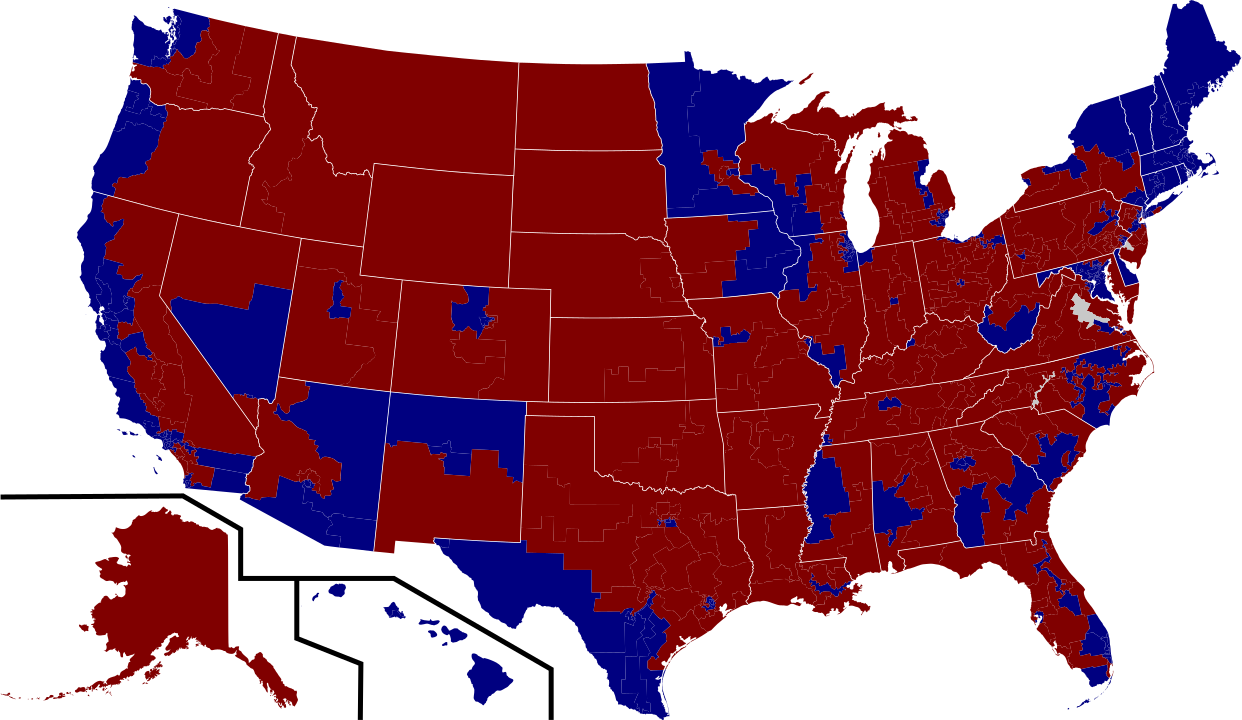
Red and Blue Districts and States in the 113th House

Here are the House districts. Remember that Democrats tend to be packed into the smaller districts, so this is deceptive.

File:113th US House.svg

Here's the partisan breakdown in the Senate

File:113th United States Congress Senators.svg

Blue means 2 Democrats
Red means 2 Republicans
Purple means one of each
Green means Independent

And what's up with Montana? Their one member of the House is a Republican, but both Senators are Democrats. The Dakotas too. Each elected a Republican to the house, but each has one Democrat in the Senate. Needs an explanation.

The 113th Congress is now in session

And it already has its own wikipedia page.

The House just re-elected John Boehner Speaker. Boehner was nominated by the Republican Conference, Nancy Pelosi was nominated by the Democratic Caucus. Since Republicans hold a majority of the seats, their nominee win.

Here's the vote result:

John Boehner: 220 votes
Nancy Pelosi: 192 votes
Eric Cantor: 3 votes
Jim Cooper and Allen West each received 2 votes (West is no longer a member)
1 vote each was received by
Justin Amash
John Dingell
Jim Jordan
Raul Labrador
John Lewis
Colin Powell (powel is not a member)
David Walker.
6 members did not cast a vote and 1 voted "present."

Tomorrow Congress meets in a joint session to count the electoral college vote. I wonder who will win?

What if George Washington decided to be a tyrant?

The newest version of the computer game Assassin's Creed is based on the premise the George Washington "succumbed to the allure of infinite power" and became a tyrant.

Image 1
A single-player campaign delivered through three episodes, the content tasks players will dethroning Washington and returning freedom to the colonies. Ubisoft had no qualms about altering history, according to executive producer Sebastien Puel.

“History is our playground, and [Assassin's Creed] teams have always loved playing with historical facts and their consequences as a way to better understand a time period,” Puel said in a statement. “While Assassin’s Creed III concentrates on history as it happens, we wanted to take some liberties with this DLC and tell you how things ‘could have happened.’”


Sweet. We should play it in class.

Revanchism

There was a nice vocabulary word in the previous story: Revanchism.

It's a political term. It describes a distinct political outlook and intent. From Dictionary.com:

"an advocate or supporter of a political policy of revanche, especially in order to seek vengeance for a previous military defeat."

Can Obama exploit divisions in the House Republican Party?

One of my favorite subjects is factions and the nature if divisions within American politics, and especially with American political parties. Very smart polisci guy John Judis has a piece in the New Republic that includes an analysis of the current divisions with the nation Republican Party - especially among Republicans in the House of Representatives. Remember that since House members are elected from relatively small districts, they are more likely to represent smaller, more ideologically clear constituents.

Judis argues that the compromises Obama made in the recent fiscal cliff deal - where certain issues like sequestration and dealing with the debt ceiling were postponed for two months - were designed to allow him to exploit these divisions when it comes time to negotiate. We will see whether his analysis is correct soon enough, but for now this seems to be a good way to understand the nature of House Republican Caucus. Remember that a party in Congress is only powerful if they are unified. Democrats made gains in the recent election and if a dozen or so Republicans vote with them on issues where they are unified - they win.

Here's Judis' full article, and here is his look at the three key divisions within the party in the House:

There are at least three different kinds of divisions that have become visible. First is between the Senate and the House. Senate Republicans, who are in a minority, have proven more amenable to compromise on fiscal issues. Unlike most Republican House members, many senators can’t count on being re-elected by solid Republicans majorities. McConnell himself comes from a state where Democrats still hold most of the state offices.  

Secondly, there is a regional division in the party between the deep South, which contains many of the diehard House Republicans, and the Republicans from the Northeast, industrial Midwest, and the Far West. In the House vote on the fiscal cliff, Republican House members from the deep South opposed it by 83 to 10, while Republicans from the Northeast favored it by 24 to one, and those from the Far West by 17 to eight. After the Republican leadership refused to bring a Sandy hurricane relief bill to the floor before the end of the session – effectively killing it –  New York Republican Peter King called on New York and New Jersey Republicans to withhold donations to the GOP. New Jersey Governor Chris Christe blew his top at the House Republicans.


Third, there is a division among Republican lobbies, political organizations and interest groups that surfaced in the wake of the election and once again this week. It’s not easy to define, but it runs between pro-business conservatives, on the one hand,  and the right-wing libertarians of the Tea Party and Club for Growth and their billionaire funders. Grover Norquist and Americans for Tax Reform gave their approval the Senate bill. The Chamber of Commerce grudgingly endorsed the final bill, and the National Federation of Independent Business said the tax provisions were acceptable. The Club for Growth, the Koch Brothers’ Americans for Prosperity, FreedomWorks (which itself has fallen under the sway of its most ideological elements), and the Tea Party Patriots opposed any compromise. 

These divisions don’t necessarily augur the kind of formal split that wrecked the Whig Party in the 1850s. Nor do they suggest widespread defection of Republicans into the Democratic Party as happened during the 1930s. There is still far too much distance between, say, McConnell and Democratic Majority Leader Harry Reid. But they do suggest that a process of erosion is under way that will weaken the Republicans’ ability to maintain a united front against Democratic initiatives. That could happen in the debates over the sequester and debt ceiling if Obama and the Democrats make the kind of public fuss that they did over fiscal cliff. 


This analysis applies only to Republicans in the US House. Texas Republicans are far more unified, so we will see little division among members of the Texas delegation - they are ideologically very similar. Same goes for the Texas House, though the nature of local issues makes divisions far more likely in the Texas Legislature, but - with some exceptions - for local policy reasons, not ideological ones. So this analysis does not apply to internal state politics.

For Data Freaks

Which includes me - the final (as of yet) 2012 US House Popular Vote totals. In a spreadsheet no less.

The vote in each district is totalled and broken down by party.

As pointed out earlier, Democrats actually got more votes (1,362,351) than Republicans, but Republicans maintained their lead. The reason is argued to be gerrymandering. Republican success in the 2010 election - when they were able to control a large number of state legislatures and dominate the redistricting process following the 2010 census paid dividends. And it will continue to do so through the decade.

One study argues that Democrats would have to outperform Republicans by 7 percentage points in order to take contrrol of the House. This will certainly not happen in 2014, when Republican turnout will - if history continues to be a guide - overwhelm that of Democrats.

Wednesday, January 2, 2013

From the Texas Tribune: Judge: Texas WHP Can Proceed Without Planned Parenthood

Here's the latest in an ongoing fight between Planned Parenthood and social conservatives in Texas, as well as the national government versus the state government:

A state district judge on Monday refused to grant a temporary restraining order allowing Planned Parenthood clinics to participate in the Texas Women's Health Program. The Jan. 1 launch of the program can proceed as planned, the judge ruled, until a trial challenging the state’s rule excluding Planned Parenthood is held on Jan. 11.

. . . In the 2011 legislative session, lawmakers passed a law requiring the Health and Human Services Commission, which ran the Women’s Health Program, to ban medical providers “affiliated” with abortion providers from participating in the program. The federal government told Texas that if the so-called Affiliate Ban Rule were implemented, it would stop providing federal matching funds of $9 for every $1 in state funds. In response, Gov. Rick Perry pledged to forgo the federal funding — roughly $30 million annually — and set up a state-funded version of the program called the Texas Women’s Health Program.

. . . Monday’s ruling is the latest in a series of court proceedings that have delayed and complicated the implementation of the Affiliate Ban Rule and the Texas Women’s Health Program. Planned Parenthood originally challenged the constitutionality of the Affiliate Ban Rule, arguing that it prohibited women from going to their provider of choice. But in October, a three-judge panel of the 5th Circuit Court of Appeals denied that claim and set the stage for the state to move forward with its plan to launch the successor program on Nov. 1.

A few days after that ruling, a Travis County district court judge issued a temporary restraining order requiring the state to continue the existing program until it could be determined whether state law made the Affiliate Ban Rule inoperative, because it caused the state to lose federal funding for the program. The state successfully appealed that injunction and, again, began moving forward on its plan to implement the Texas Women’s Health Program without Planned Parenthood providers.

But the state did not forgo its fight to continue receiving federal money to support the program. In December, the state attempted — but failed — to receive an injunction to stop the federal government from cutting off funding for the Women’s Health Program on Dec.31.

The fight is likely far from over. The twists and turns are worth following since it highlighst areas of conflict between governign institutions both within the state and between Texas and the national government.

Despite projected surplus, the Texas Legislature is unlikely to restore funding cut in the 82nd Legislature

The Chronicle reports that while the improving Texas economy has increased state revenue, there are efforts to ensure that the budget that was trimmed back two years ago stays trimmed:

. . . no one is betting on a spending spree.

Exactly how much money lawmakers will have at their disposal won't be known until Monday, when Comptroller Susan Combs releases a two-year revenue estimate. Republicans — who don't have the House supermajority they enjoyed in 2011, but will still be calling the shots — already want new restraints on how much lawmakers can spend.

Gov. Rick Perry and other top GOP leaders want to limit spending increases to a formula of population growth plus inflation. That would be less than the $77.9 billion cap set by the Legislative Budget Board, which is a 10 percent increase over current levels.

Democrats and others view such self-imposed restrictions as unnecessary. The Center for Public Policy Priorities, a progressive-leaning think tank in Austin, said the state has enough money on the table now to undo the steep cuts in 2011 and retain current services if the lawmakers were willing to exhaust the Rainy Day Fund that now has a balance of about $8.1 billion.

But there is little appetite to do so.

"That's a tough, tough challenge for the makeup of the new legislature," said Eva DeLuna Castro, a senior budget analyst for the CPPP. "And it's also not letting us undo all the other smoke and mirrors the legislative leadership has said is a priority."

Detail on poverty in the American States

Some reference material to build on in the future. Based on 2009 data, Texas ranks #46 in the percentage of its citizens that live under the poverty line. The poverty rate was 16.2% as opposed to the national rate of 12.6%.

A map of the American states based on poverty - the darker the state the higher the poverty rate. Click here for the original.


The Kaiser Foundation breaks the data down by race: White: Texas 12%, US 13%, Black: Texas 31%, US 35%, Hispanic: 34%, US 33%.

If you look at these numbers carefully you'll notice that Texas' rate in each category is lower than the national rate. The difference is in the racial and ethinc breakdown of the state as opposed to the nation as a whole.

The Annie E. Casey Foundation looks at childhood poverty. The national childhood poverty rate for 2011 was 23%, in Texas it was 27%.

Slightly different information can be found in the Department of Agriculture's Economic Research Service's website. For 2010, the Texas poverty rate was 17.9% and the childhood povertyrate was 25.7%.