For 2305 students and this week's written assignment. hat's going on here?
- Click here for the article.
Leaders of a deep-pocketed conservative group that spent millions in Texas last election cycle says the state is now at such risk of turning blue in 2020, it will consider helping moderate Republican incumbents once deemed potential targets for its primary efforts.
Despite floating the idea of funding a challenger to Texas Sen. John Cornyn the last time he was on the ballot in 2014, Club for Growth President David McIntosh told the Star-Telegram Friday his group is now concerned about the state’s political future, and would spend money on Cornyn’s behalf if the senator draws a difficult challenge from a Democrat.
“If we get a sense that Cornyn has a vulnerability, then we’ll come back to that and decide whether we should engage,” said McIntosh, whose group has already begun polling in Texas for 2020. “That would be Texas-specific,” he added of his group’s overall strategy for the Senate map this cycle. “Were mainly interested in three states where the Republican primary is key.”
The Club for Growth PAC and Club for Growth Action spent roughly $5 million in Texas in 2018, and considers the state fertile ground for its goal of electing conservative allies to Washington.
In the months following an election in which nine GOP members of Congress received less than 52 percent of the vote, however, it’s been huddling with Republicans of all stripes who are concerned about rapid Democratic gains.
Though the group can’t legally coordinate on strategy with campaigns or the state party, it now heads into the 2020 cycle in lock-step with the Republican Party of Texas, whose leaders it has huddled with in both D.C. and Austin.
“The November results were a reminder to everyone of what’s at stake if we focus too much of our attention inward and not toward the general election in November, so I certainly hope that everyone has gotten the message,” said James Dickey, chairman of the Republican Party of Texas.
“In any race we should be considering whether the potential benefit of a possible change is significantly outweighed by the potential risk of a much worse change,” said Dickey.
Friday, March 22, 2019
Thursday, March 21, 2019

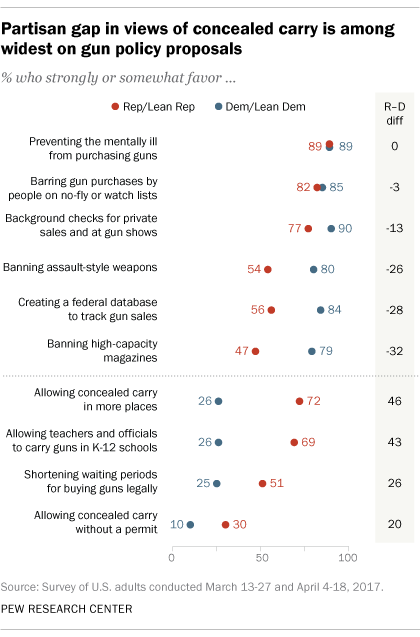
Vox: It took one mass shooting for New Zealand to ban assault weapons
A demonstration of what makes the American governing system different.
Keep in mind that more people live in the Houston metropolitan area than in New Zealand.
- Click here for the article.
The US political system also makes action on guns more difficult
Even if the US did have a president ready to enact stricter gun laws, there’s a good chance that such measures wouldn’t pass. That’s because of how the US political system is structured, with multiple checks in the system presenting several veto points to just about any legislation.
This isn’t hypothetical. After the Sandy Hook Elementary School shooting in 2012 (in which a gunman killed 20 children, six adults, and himself), President Barack Obama and Democrats pushed for Congress to enact stronger gun laws. The measure couldn’t even get through the Senate, because a minority of senators blocked the bill from getting through a filibuster.
Consider the basic structure of the US system (as explained by Schoolhouse Rock): For a bill to become a law at the federal level, it has to get through the US House and the Senate, and then the president has to sign off on it.
So before a bill becomes a law, it has to get majority approval from the House and Senate. The Senate is especially tricky because it’s inherently an unrepresentative body (with each state getting equal representation, regardless of population). The increasing use of the filibuster has created an even bigger hurdle in which most legislation needs to get 60 out of 100 votes, instead of a simple majority, to make it through the filibuster and pass. And then, of course, the president could veto the bill anyway, which Congress can only overcome with a two-thirds vote.
This creates multiple points throughout the process in which a bill can die. The only reliable way to overcome this is for a political party to control a majority of the House, 60 percent of the Senate (unless a majority votes to end the filibuster, which is technically possible, or lets a bill pass without it), and the White House. And the party can’t lose many, if any, votes along the way. That’s not easy in a highly polarized, divided country, especially with sensitive issues like gun control.
New Zealand does not face these barriers. In a parliamentary system, voters elect representatives, and then the representatives form a ruling coalition, either with their own political party or with like-minded political parties. This ruling coalition then chooses the prime minister. From that point, the party essentially controls the full agenda until the next election is called.
So in the US, a political movement needs to win the House, Senate, and White House to change the law. In New Zealand, a political movement needs to just win Parliament. (This is especially true in New Zealand, since it’s unicameral — meaning Parliament is only made up of one legislature.)
That means that all New Zealand really needs to do to change its gun laws is get the current leadership — particularly, Prime Minister Ardern and her coalition — on board. It’s a much simpler task than getting the support of House Speaker Nancy Pelosi (a Democrat), Senate Majority Leader Mitch McConnell (a Republican) and at least some Democrats in the Senate (to defeat a filibuster), and President Donald Trump (a Republican).
Parliaments don’t always have it easy. Political coalitions in parliamentary systems can splinter — just look at what’s happening in the UK with continuing battles over Brexit. But the parliamentary system does make it far easier for the ruling coalition to come together and pass its agenda when it wants.
We are now seeing this play out in New Zealand: It suffered a horrible mass shooting, the country’s prime minister within a day vowed to change the gun laws, and, less than a week later, New Zealand’s government is moving to enact those reforms.


Some recenty items from the Texas Tribune.
- State regulators: No 'immediate health concerns' from Deer Park terminal fire.
- Medical cannabis expansion has high support in the Texas Legislature. But Dan Patrick might stand in the way.
- On some big issues this year, Texas lawmakers are going against the polls.
- Laredo officials want to use border wall money to fund a riverfront project.
- Medical cannabis expansion has high support in the Texas Legislature. But Dan Patrick might stand in the way.
- On some big issues this year, Texas lawmakers are going against the polls.
- Laredo officials want to use border wall money to fund a riverfront project.

ANDREI IANCU v. ERIK BRUNETTI
More on the issue below:
- ScotusBlog: Iancu v. Brunetti.
- FUCT.
- Wikipedia: Lapham Act.
- Lexology: Iancu v. Brunetti: FUCT Trademark Battle Heads to the Supreme Court.
- ScotusBlog: Iancu v. Brunetti.
- FUCT.
- Wikipedia: Lapham Act.
- Lexology: Iancu v. Brunetti: FUCT Trademark Battle Heads to the Supreme Court.
From The Fashion Law: Supreme Court to Review Goverment Ban on Fuct & Other "Scandalous" Trademarks
Can the Patent Office trademark words that are scandalous and malicious?
- Click here for the article.
When Erik Brunetti first attempted to register the name of his famed streetwear-slash-skatewear brand – in 2011, the U.S. Patent and Trademark Office ("USPTO") had one word for him: no. As Mr. Brunetti would soon learn the hard way, the USPTO, as the arbitrator of federal trademark registrations in the United States, has the authority to bar the registration of names, logos and other trademarks that it deems to be "immoral" or "scandalous." In the eyes of the USPTO, “fuct" – the name of Mr. Brunetti’s brand – fit squarely within this territory.
. . . the Supreme Court agreed on Friday to review the Federal Circuit’s decision, after the USPTO’s formally requested that the Supreme Court take on the case. At issue, according to the petition filed on behalf of Andrei Iancu, the Under Secretary of Commerce for Intellectual Property and the Director of the USPTO in September, is whether the Lanham Act’s prohibition on the federal registration of “immoral” or “scandalous” marks is facially invalid (i.e., unconstitutional) under the Free Speech Clause of the First Amendment.
According to the USPTO’s petition, the lower court erred in siding with Brunetti. In the 73-page filing, the USPTO argues that the Lanham Act’s ban on the registration of scandalous marks does not run afoul of the First Amendment because it does not restrict what may be used as trademarks, only what may be registered. In other words, the USPTO may refuse to register a mark (in accordance with the Lanham Act ban) but even then, it does not prevent the trademark application filing party’s use of that mark.
In the U.S. (and other jurisdictions that award trademark rights to parties that are the first-to-use a specific trademark), rights are not gained by way of a registration with the USPTO but through actual and consistent use of the mark on commerce. This means that even if Brunetti (or any other party for that matter) does not register his mark with the USPTO, he still maintains common law (i.e., state law) trademark rights, which he can assert against parties that are using his mark without authorization.
The ban on the registration of “immoral” or “scandalous” marks “simply reflects Congress’s judgment that the federal government should not affirmatively promote the use of graphic sexual images and vulgar terms by granting them the benefits of registration,” U.S. Solicitor General Noel Francisco argued in the USPTO’s petition.
As for Brunetti, he is hardly staying silent. “The scandalous clause is not a content-neutral rule that rejects all profanity, excretory and sexual content,” he has asserted in connection with the Langham Act provision. “Instead, the government is selectively approving or refusing profanity, excretory and sexual content based upon the level of perceived offensiveness.”
Friday, March 8, 2019
From thr Texas Tribune: Former U.S. Rep. Ralph Hall dies
For our look at the transition from the Democratic to Republican Party in Texas.
- Click here for the article.
Hall was one of the last conservative Texas Democrats to switch over to the GOP and made history as the oldest member of the U.S. House.
He was a veteran of the Texas Senate, and East Texans elected him to the U.S. House in 1980 as a Democrat. He switched to the Republican party in 2004.
Hall served 17 terms in the U.S. House.
. . . Like most people in Texas politics, he was a Democrat early on. He served as a county judge from 1950-62, went to the Texas Senate in 1962 and served there for 10 years.
In 1980, East Texans elected him to Congress. Hall's district stretched from the Dallas suburbs deep into Northeast Texas — all the way to Texarkana — and was the seat once occupied by U.S. House Speaker Sam Rayburn. Rayburn was a close friend of Hall's mother. In the 1950s, a group of Republicans tried to recruit Hall to challenge Rayburn.
"If you do that, where are you going to get breakfast?" Hall's mother told him, according to a 2014 C-SPAN interview with the congressman. "You're not going run against Sam Rayburn."
While a member of the Democratic caucus, he voted often with Republicans. He stayed with the party long after many other high-profile Texans moved to the GOP, including John Connally and Rick Perry. In 2003, Hall voted "present" rather than support the Democrats' new leader, future Speaker Nancy Pelosi.
Hall finally made the jump in 2004 amid a GOP redraw of the state congressional map, and Republicans quickly named named him to a senior position on the U.S. House Energy and Commerce Committee. He would easily coast to re-election — until 2014.
Ratcliffe defeated Hall in a 2014 Republican primary. Most of the Texas Republican delegation realized the seriousness of the Ratcliffe threat at the time and rallied behind Hall. Even so, the longtime congressman lost that race.
"When I got up here, I was a Democrat. But I was a conservative Democrat," he said during the C-SPAN interview. "And I didn't really fit. Republicans didn't really want me, and the Democrats didn't like me."
Some recent polls from the Texas Tribune
- Analysis: In step with Texas voters on some things, and out of step on some others.
- Immigration and border security remain the top worries of Texas voters, UT/TT Poll finds.
- Guns are popular with Texans, and so are “red flag” laws, says UT/TT Poll.
- Texas voters deeply divided on voting, a border wall and diversity, says UT/TT Poll.
- Immigration and border security remain the top worries of Texas voters, UT/TT Poll finds.
- Guns are popular with Texans, and so are “red flag” laws, says UT/TT Poll.
- Texas voters deeply divided on voting, a border wall and diversity, says UT/TT Poll.
Thursday, March 7, 2019
From the NCSL: Marijuana Overview
More on policy diffusion.
- Click here for article.

- Click here for article.
States that Have Legalized Recreational Marijuana for Adults
From The Hill: What's socialism anyway?
There seems little consensus on this, and the polls reflect this confusion.
- Click here for the article.
Sanders and Ocasio-Cortez may know what they mean by socialism, I sincerely doubt most of the others throwing the label around have any real understanding of the term.
Eduard Bernstein, the preeminent theorist of democratic socialism, made the same point 120 years ago: “If we asked a number of people … to give a brief definition of socialism, most of them would be in some difficulty. … If we consult the literature of socialism itself, we will find very different accounts of the concept. … They will vary from … legal ideas (equality, justice) to … its identification with the class struggle … to the explanation that socialism means cooperative economics.”
Bernstein’s socialist program was so mainstream (i.e., not radical) that much of it was achieved in America long ago: universal suffrage, workers’ rights to form unions, an end to child labor for those under 14 and improved conditions for agricultural workers.
Bernstein explicitly rejected Marx and revolution, preferring evolution, and unlike some current American socialists, opposed “full state maintenance” of the unemployed, saying it was damaging the will to work of those voluntarily unemployed.
Soviet socialism was radically different, as are other visions of socialism. Saint-Simon’s socialism and Proudhon’s and Owens’s and Bakunin’s and Debs’s and Olof Palme’s socialisms were all quite different from each other.
But that’s exactly the point: There’s lots of disagreement, even among socialists, about what constitutes socialism.
So what are polls measuring when they ask about socialism?
From Slate: The U.S. Constitution Is Impossible to Amend
A mistake by the founders?
- Click here for the article.
The problem starts with Article 5 of the Constitution. It provides that an amendment can be proposed either by a two-thirds majority in both the House and the Senate or by a convention, called into being by Congress, after a request from two-thirds of the states. That’s version A and version B of step one. If an amendment makes it through either one, then comes step two: ratification by three-quarters of the states. In other words, an amendment requires a supermajority twice—the pig must pass through two pythons. By contrast, ordinary legislation requires the approval of a simple majority in each house.
The founders made the amendment process difficult because they wanted to lock in the political deals that made ratification of the Constitution possible. Moreover, they recognized that, for a government to function well, the ground rules should be stable. But they also understood that the people will need to change those ground rules as new challenges and problems surface with the passage of time. They didn’t mean for the dead hand of the past to block necessary progress.
But the founders blundered. They made passing an amendment too hard. In the 220-plus years since ratification of the Constitution, more than 11,000 amendments have been proposed, but only 27 have been enacted. The first 10 amendments were added immediately to appease critics of the Constitution during the ratification debates. The three critical post–Civil War amendments (13th, 14th, and 15th), which expanded individual rights, are also a special case because the Southern states were coerced into ratifying them. From 1870 to today, only 12 amendments have been enacted. And since 1971, only a single amendment has been ratified—a trivial change that prohibits Congress from giving itself a raise that takes effect before the following election—and that ratification took place 203 years after the proposed amendment was submitted to the states in 1789.
Still, how do we know that amendment is too hard rather than just hard enough? One reason is that the cumbersome national amendment process in the United States makes us an outlier. Most liberal democracies—including the nice, stable ones in Western Europe—amend their constitutions with great frequency. Germany amends its Basic Law almost once per year, and France a bit more than once every two years. Indeed, most states in the U.S. amend their constitutions every couple of years. Many have completely replaced their original founding documents. The procedures for amendment in states and most liberal democracies are much easier than they are for the U.S Constitution. For example, in Germany, an amendment requires a two-thirds majority in each House, and that’s it. In all these cases, no one complains about the lack of constitutional stability.
From Pitchfork: Chance, Killer Mike, Meek Mill File Legal Brief in Supreme Court Case on Rap Lyrics
For our look at
- Free Speech (limits)
- Criminal Law
- Amicus Briefs
- Interest Groups
- Click here for the article.
The Supreme Court is currently hearing the case of Jamal Knox v. Commonwealth of Pennsylvania. The case revolves around Knox, a rapper who was 19 when he was sentenced to 2-6 years in prison in 2014. He was charged with terroristic threats and witness intimidation, with prosecutors alleging his lyrics targeted specific police officers in Pittsburgh. The case has made its way to the Supreme Court, where Knox’s lawyers assert that his First Amendment rights are being violated.
Now, Run the Jewels’ Killer Mike and a group of other rappers—including Chance the Rapper, Meek Mill, 21 Savage, Yo Gotti, Styles P, and more—have filed an amicus curiae brief in the Supreme Court case in support of Knox, as The New York Times reports. The brief contains a “primer on rap music and hip-hop” as well as intricate breakdowns of the lyrics that were condemned as “terroristic threats.”
“In short, this is a work of poetry. It is told from the perspective of two invented characters in the style of rap music, which is (in)famous for its exaggerated, sometimes violent rhetoric, and which uses language in a variety of complex ways,” the brief reads. “It is not intended to be taken literally, something that a reasonable listener with even a casual knowledge of rap would understand.” Find the full brief here.
For More:
- Killer Mike, Chance the Rapper and others file Supreme Court brief to educate justices about rap music.
- Rapper jailed for song threatening police tries a free speech appeal — and loses.
The True Threat Doctrine
- Wikipedia.
A true threat is a threatening communication that can be prosecuted under the law. It is distinct from a threat that is made in jest. The U.S. Supreme Court has held that true threats are not protected under the U.S. Constitution based on three justifications: preventing fear, preventing the disruption that follows from that fear, and diminishing the likelihood that the threatened violence will occur.[1] There is some concern that even satirical speech could be regarded as a "true threat" due to concern over terrorism.[2]
The true threat doctrine was established in the 1969 Supreme Court case Watts v. United States.[3] In that case, an eighteen-year-old male was convicted in a Washington, D.C. District Court for violating a statute prohibiting persons from knowingly and willfully making threats to harm or kill the President of the United States.[3] The conviction was based on a statement made by Watts, in which he said, "[i]f they ever make me carry a rifle the first man I want to get in my sights is L.B.J."[3] Watts appealed, leading to the Supreme Court finding the statute constitutional on its face, but reversing the conviction of Watts.
In reviewing the lower court's analysis of the case, the Court noted that "a threat must be distinguished from what is constitutionally protected speech."[3] The Court recognized that "uninhibited, robust, and wideopen" political debate can at times be characterized by "vehement, caustic, and sometimes unpleasantly sharp attacks on government and public officials." In light of the context of Watts' statement - and the laughter that it received from the crowd - the Court found that it was more "a kind of very crude offensive method of stating a political opposition to the President" than a "true threat." [3] In so holding, the Court established that there is a "true threat" exception to protected speech, but also that the statement must be viewed in its context and distinguished from protected hyperbole. The opinion, however, stopped short of defining precisely what constituted a "true threat." [3]
For more:
- Freedom Forum Institute.
- True Threats and the Limits of First Amendment Protection.
- When Does the First Amendment Protect Threats?
Monday, March 4, 2019
From Bloomberg: Hold the Revolution: Roberts Keeps Joining High Court Liberals
Chief Justices tend to focus on the integrity of the court as an institution.
- Click here for the article.
Chief Justice John Roberts is showing a new willingness to side with the U.S. Supreme Court’s liberal wing after the divisive confirmation fight over Justice Brett Kavanaugh.
Roberts joined the liberals Wednesday in two rulings that left the conservatives in dissent. Most notably, he cast the deciding vote to order a new look at the mental competence of a death row inmate who says he can’t remember the crimes he committed.
The votes add to an unmistakable pattern, offering fresh indications that Roberts is in no hurry to oversee a conservative legal revolution. The chief justice has also joined 5-4 orders that blocked President Donald Trump from curbing bids for asylum at the Mexican border and stopped Louisiana from enforcing new abortion restrictions.
“Chief Justice Roberts’s voting pattern this year reflects a change,” said Josh Blackman, a professor at the South Texas College of Law in Houston.
It’s too early to say whether the votes mark the beginning of a lasting shift, or merely a pause on the court’s anticipated move to the right after Kavanaugh’s confirmation to succeed the retired Justice Anthony Kennedy. Since being appointed in 2005 by Republican President George W. Bush, Roberts, 64, has established himself as a solid conservative, though usually one inclined toward incremental change.
From 2005 through the end of the 2016-17 term, Roberts had provided the fifth vote for a liberal outcome in a case argued before the court only four times, according to Adam Feldman, creator of empiricalscotus.com, which tracks Supreme Court trends. The biggest was Roberts’s 2012 vote to uphold the Affordable Care Act, a decision that embittered conservatives who had supported his nomination.
From the Texas Tribune: Will Texas decriminalize marijuana this year? There is growing support.
Texas may join the national trend.
- Click here for the article.
. . . According to the Texas Department of Public Safety, roughly 379,000 Texans have been arrested for possessing 2 ounces or less of marijuana in the past five years. Those criminal charges are for being caught with small amounts of a drug that an estimated 128 million American adults have tried — and that 55 million U.S. residents regularly use, according to a 2017 poll.
Ten states and the District of Columbia have legalized small amounts of marijuana for personal use. Thirteen other states have made possessing small amounts a civil rather than a criminal infraction, according to the National Conference of State Legislatures. In Texas, possession of any amount of marijuana is illegal.
Still, there’s growing public support and bipartisan backing at the Capitol for lessening — or ditching — criminal penalties for what are currently low-level offenses. And some local court officials are already backing off of pursuing charges against some first-time offenders.
Lawmakers this year are pushing a bevy of bills that range from reducing the criminal penalties for those found with small amounts of marijuana to eliminating those criminal penalties altogether. But there remains some lingering political pushback from conservative hardliners and law enforcement groups who fear decriminalizing marijuana will increase crime rates and eventually lead to the legalization of other drugs.
. . . In Dallas County, newly-elected District Attorney John Creuzot said his office is currently declining prosecution for first-time marijuana possession offenders. He said he wants to free his prosecutors up to go after suspects who are accused of violent crimes or infractions that often portend to future violence.
“I don’t know of any research that shows having small amounts of marijuana has any bearing on community safety — certainly not violent crime,” Creuzot said.
Harris County prosecutors, meanwhile, offer a diversion program that gives residents caught with less than four ounces of marijuana the option to take a $130, four-hour class that focuses on decision making and risky behavior. If the class is taken within 90 days, participants will not have criminal charges pressed against them.
Since the program's implementation in March 2017, more than 7,000 people have gone that route as opposed to “the jailhouse or the courthouse,” said Dane Schiller, a spokesman for the Harris County District Attorney's Office.
“Thousands of people have not spent a night in jail, not been booked, fingerprinted, prosecuted and saddled with a record that could shadow them for the rest of their lives,” Schiller said.
From the Texas Tribune: GOP senator, oil industry clash over proposed eminent domain reforms
Oil and Gas versus agriculture, among other groups ...
- Click here for the article.
For years now, Texas Sen. Lois Kolkhorst has aimed to strengthen protections for Texans whose property may be seized by the governmental or private companies building roads, oil pipelines and other projects considered to be for the public good.
The first bill the Brenham Republican ever filed as a state senator in 2015 would have forced the entity seeking to condemn property to reimburse landowners for attorney and professional fees if they were caught making lowball offers for the targeted land; state law requires them to make a good faith offer, but many landowners complain that the initial offers often don’t jibe with the true value of their properties.
The bill never got a vote. In 2017, a similar measure by Kolkhorst passed the Senate but died in the House.
This year, she is trying again with Senate Bill 421, which includes a similar reimbursement provision but is largely limited to private, for-profit entities. The measure also would require condemnors to hold public hearings for more expansive projects and use "standard easement forms."
How Texas regulates eminent domain is more relevant than ever amid a historic oil-and-gas pipeline building spree — which has sparked a fervent backlash in the Texas Hill Country — and a continued push to build a high-speed train between Dallas and Houston. Federal land condemnations also are underway in the Rio Grande Valley to build some of the first sections of President Trump’s border wall.
The issue poses an awkward quandary for Republicans who say they support private property rights, but also assert that taking private land is often necessary for business and border security. Texas GOP officials consistently receive significant campaign contributions from the oil and gas industry, which relies on eminent domain to build pipelines and other infrastructure.
From the TSHA: WHITE PRIMARY
Some background on one of the two principle means used in Texas to limit minority voting.
- Click here for the article.
Following Reconstruction, white political leaders in Texas and other southern states sought to take the vote from black voters. As a disenfranchisement device, the poll tax discouraged poor whites as well as blacks from voting, while enabling blacks who paid the tax to vote. Party rules or state laws that barred blacks from the Democratic primary, however, could virtually disenfranchise all blacks (and only blacks) by keeping them out of the election that generally determined who would hold office in a Democratic-dominated state. When the Texas legislature passed a white primary law in 1923, it thrust Texans and the Texas white primary into the center of a struggle to have the United States Supreme Court declare all white primaries unconstitutional.
In the years immediately following Reconstruction no statewide primaries existed, and virtually all politically involved Texas blacks were Republicans. Especially in East Texas counties with black majorities, blacks often did participate in local politics. The first attempt to end local Republican rule where blacks had a decided majority was in Harrison County, where the so-called Citizen's Party, formed in 1878, managed to upset the county Republicans by stuffing ballot boxes and using intimidation. Similar efforts and occurrences took place in many other counties in the 1870s and 1880s, including Leon, Montgomery, Colorado, DeWitt, Fort Bend, Waller, Wharton, and other counties. When third-party movements, such as the People's party of the 1890s, appealed to black Texans as well as to some white Democrats, black voters also influenced state elections. Even some Democratic candidates sought black votes in response to the Populist challenge.
The Populists soon faded as a significant force, but white leaders began to search for ways of assuring white unity and hegemony. Governor James S. Hogg and state representative Alexander W. Terrell supported legislation to require and regulate primaries. They wished to counter vote fraud and believed that blacks should be excluded from Democratic primaries. Terrell's primary legislation was passed in 1903 and amended frequently thereafter. Some local party leaders adopted rules barring blacks from participating in the primary, but the law was not universally successful in disenfranchising blacks throughout Texas.
When more and more Anglo farmers moved into South Texas, conflict with established Mexican-American ranchers ensued as the two groups struggled for political and economic control of the region. The new farmers sought to eliminate Mexican Texans, who generally supported the old ranchers through the patron system, from the political process. In addition to using the formal and informal devices associated with the White Primary in the rest of Texas, organizations such as Dimmit County's White Man's Primary Association, established in 1914, disfranchised Mexican Americans in local elections and controlled the local labor supply.
From TribTalk: Texas should encourage the right to vote — and protect voters from intimidation
An opinion piece - one at odds with Texas history.
The author heads an advocacy group, The League of Women Voters of Texas.
- Click here for the article.
If you’ve never attended a naturalization ceremony, it’s an incredibly touching event to witness. To paint a picture: enthusiastic flag waving as patriotic new citizens and their proud families and friends are cheering, flowers are handed out and speeches are made. Everyone is smiling, shaking hands, taking photos and offering congratulations.
The League of Women Voters strives to embody its mission of empowering voters and defending democracy. Registering voters is core to our work as a nonpartisan organization, and some of the most rewarding voter registration events are naturalization ceremonies.
New citizens are excited and ready to celebrate their new citizenship by registering to vote. League volunteers stand by to help make the voter registration process easy and accessible, and sometimes register hundreds of new citizens. The feel of patriotic excitement is tangible. It is like a personal July 4 for so many newly naturalized citizens and a great reminder of what it feels like to be part of something greater than oneself.
Recently, state officials announced that a number of individuals voted in elections without the requisite citizenship, knowing the data was not yet reviewed or vetted.
There is not a problem of non-citizens registering and voting in Texas — there is a data problem. Even worse, government officials purposely took advantage of that known data problem to plant doubt about the integrity of the voting system.
The list of individuals in that bad data was made up of licensed drivers and state ID holders, most of whom likely obtained their citizenship after having obtained their state IDs and licenses. Calling this list as proof of “voter fraud,” was definitely inaccurate. This loosely thrown around terminology has a chilling effect on individuals who earnestly and lawfully follow the path to citizenship. This bullying of our newest citizens must stop.
The League regrets that we have to remind our state officials that naturalized citizens have a right to vote and to fully participate in our democracy. We have joined a lawsuit against the Texas Secretary of State and have asked the Senate Democratic caucus to block the nomination of David Whitley to be secretary of state. The League took these unusual actions because Whitley’s actions are not only not in the best interest of voting citizens but also a form of voter intimidation.
Naturalization ceremonies are family celebrations. But this celebratory event can quickly turn to fright and worry when those new citizens get letters from their county voter registrars, sent at the request of the Texas Secretary of State, attempting to invalidate their voter registrations. They included this sentence: “Your registration status is being investigated because there is reason to believe you may not be a United States citizen.” Very little instruction is provided around how individuals can cure the situation by partnering with their county official’s office. These are nothing more than intimidation letters, written in bureaucratic legalese.
The Secretary of State, as the chief election officer for Texas, should protect all citizens’ right to vote. Texans can have a secure and accurate voter registration list in two ways: first, by ensuring government officials prioritize data accuracy; and second, by modernizing to include a safe and secure electronic voter registration system like those currently available in 37 other states.
From the Texas Tribune: Broad Texas school safety bill proposes threat assessment teams, expanded emergency training
More from the legislature.
- Click here for the article.
Texas’ Senate education chairman on Monday unveiled a sweeping school safety measure that touches on strengthening school security, “hardening” school infrastructure and mental health counseling.
Senate Bill 11, filed by Sen. Larry Taylor, R-Friendswood, touches on a number of proposals Gov. Greg Abbott laid out in his 43-page school safety plan that followed the May shooting at Santa Fe High School that left 10 dead and 13 wounded.
Those proposals include beefing up mental health resources in schools by employing mental health professionals in Texas school districts; expanding emergency response training for district employees, including substitute teachers; and establishing threat assessment teams, which would help identify potentially dangerous students and determine the best ways to intervene before they become violent, to serve in Texas schools.
“Though nearly a year has passed since a shooting at Santa Fe High School took the lives of eight children and two teachers, it is critical that the Legislature keeps the topic of school safety at the forefront of our hearts and our conversations,” Taylor said in a news release. “It is my hope that the passage of this bill will help our schools prevent and prepare for similar events.” Taylor's news release said SB 11 would be heard by his committee on Tuesday.
More on the Texas Open Meetings Act
This is the subject of the post below
- texasopenmeetings.com.
- Freedom of Information Foundation of Texas.
- TML: TEXAS OPEN MEETINGS ACT LAWS MADE EASY.
- Texas Statutes: CHAPTER 551. OPEN MEETINGS - SUBCHAPTER A. GENERAL PROVISIONS
- Texas AG: Open Meetings Handbook.
- texasopenmeetings.com.
- Freedom of Information Foundation of Texas.
- TML: TEXAS OPEN MEETINGS ACT LAWS MADE EASY.
- Texas Statutes: CHAPTER 551. OPEN MEETINGS - SUBCHAPTER A. GENERAL PROVISIONS
- Texas AG: Open Meetings Handbook.
From the Texas Tribune: Texas' highest criminal court strikes down provision of Open Meetings Act as "unconstitutionally vague"
The more vague the law, the more arbitrary the prosecution of it
- Click here for the article.
In a major blow to the state’s government transparency laws, Texas’ highest criminal court has struck down a significant provision of the Texas Open Meetings Act, calling it “unconstitutionally vague.”
That law, which imposes basic requirements providing for public access to and information about governmental meetings, makes it a crime for public officials to “knowingly [conspire] to circumvent this chapter by meeting in numbers less than a quorum for the purpose of secret deliberations.” That provision aims to keep public officials from convening smaller meetings — without an official quorum present — to discuss public business outside the view of the taxpayers and the media.
Craig Doyal, the Montgomery County judge, was indicted under that statute for allegedly conducting “secret deliberations” — without a quorum of the commissioners court present — about a November 2015 county road bond. Doyal filed to have the charges dismissed, claiming the statute was unconstitutional. The case eventually made it to the Texas Court of Criminal Appeals, which handed him a victory Wednesday. Two judges on the nine-member, all-Republican court dissented.
“We do not doubt the legislature’s power to prevent government officials from using clever tactics to circumvent the purpose and effect of the Texas Open Meetings Act,” Presiding Judge Sharon Keller wrote for the majority. “But the statute before us wholly lacks any specificity, and any narrowing construction we could impose would be just a guess, an imposition of our own judicial views. This we decline to do.”
A few items covered last week
- Railroad commissioners voice doubts that Permian Basin flaring is more prevalent than reported.
- After Texas' second Supreme Court loss in a death penalty case, reform bill lands key GOP support.
- Texas still doesn't have a law on intellectual disability and the death penalty. Will that change this year?
- After state leaders’ unified rollout, 2.5 percent rollback rate on property tax bill looks unlikely to stick.
- Texas Republicans — and Beto — are more conservative than their national parties.
Americans Are Poorly Informed About Basic Constitutional Provisions
More on the irrational public.
- Click here for the article.
What does the First Amendment say?
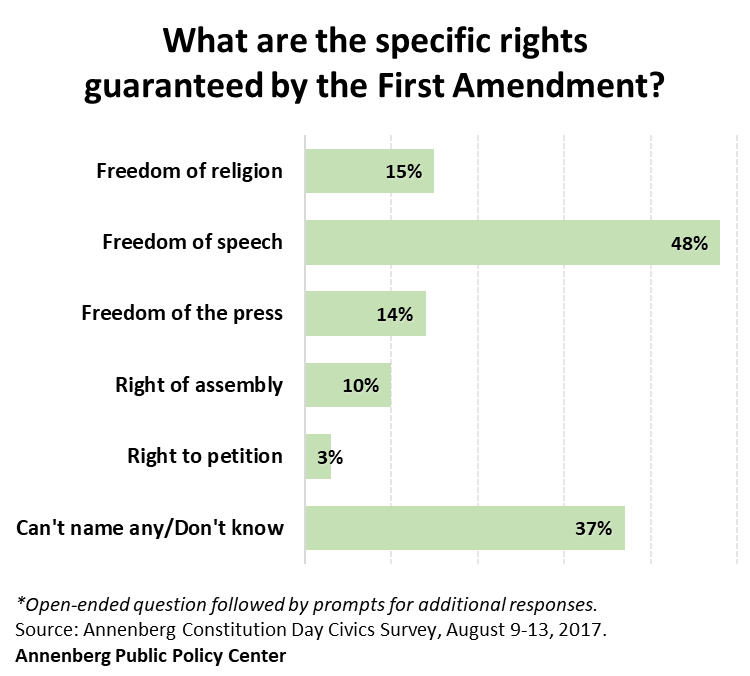
Nearly half of those surveyed (48 percent) say that freedom of speech is a right guaranteed by the First Amendment. But, unprompted, 37 percent could not name any First Amendment rights. And far fewer people could name the other First Amendment rights: 15 percent of respondents say freedom of religion; 14 percent say freedom of the press; 10 percent say the right of assembly; and only 3 percent say the right to petition the government.
The First Amendment reads:
Congress shall make no law respecting an establishment of religion, or prohibiting the free exercise thereof; or abridging the freedom of speech, or of the press; or the right of the people peaceably to assemble, and to petition the Government for a redress of grievances.
Contrary to the First Amendment, 39 percent of Americans support allowing Congress to stop the news media from reporting on any issue of national security without government approval. That was essentially unchanged from last year. But the survey, which followed a year of attacks on the news media, found less opposition to prior restraint (49 percent) than in 2016 (55 percent).

Many don’t know the branches of government
Only 26 percent of respondents can name the three branches of government (executive, judicial, and legislative), the same result as last year. In the presence of controls, people who identified themselves as conservatives were significantly more likely to name all three branches correctly than liberals and moderates. The 26 percent total was down significantly from APPC’s first survey on this question, in 2011, when 38 percent could name all three.
In the current survey, 33 percent could not name any of the three branches, the same as in 2011.
The phone survey, conducted for APPC by the research firm SSRS, has a margin of error of ±3.7 percent. For more on the methodology and questions click here.
- Click here for the article.
What does the First Amendment say?
Nearly half of those surveyed (48 percent) say that freedom of speech is a right guaranteed by the First Amendment. But, unprompted, 37 percent could not name any First Amendment rights. And far fewer people could name the other First Amendment rights: 15 percent of respondents say freedom of religion; 14 percent say freedom of the press; 10 percent say the right of assembly; and only 3 percent say the right to petition the government.
The First Amendment reads:
Congress shall make no law respecting an establishment of religion, or prohibiting the free exercise thereof; or abridging the freedom of speech, or of the press; or the right of the people peaceably to assemble, and to petition the Government for a redress of grievances.
Contrary to the First Amendment, 39 percent of Americans support allowing Congress to stop the news media from reporting on any issue of national security without government approval. That was essentially unchanged from last year. But the survey, which followed a year of attacks on the news media, found less opposition to prior restraint (49 percent) than in 2016 (55 percent).
Many don’t know the branches of government
Only 26 percent of respondents can name the three branches of government (executive, judicial, and legislative), the same result as last year. In the presence of controls, people who identified themselves as conservatives were significantly more likely to name all three branches correctly than liberals and moderates. The 26 percent total was down significantly from APPC’s first survey on this question, in 2011, when 38 percent could name all three.
In the current survey, 33 percent could not name any of the three branches, the same as in 2011.
The phone survey, conducted for APPC by the research firm SSRS, has a margin of error of ±3.7 percent. For more on the methodology and questions click here.
From Wikipedia: National Coalition for Men v. Selective Service System
A likely future Supreme Court case.
- Click here for the article.
In the United States, men between the ages of 18 and 25 and residing in the county with limited exception are required to sign up and maintain their registration in the Selective Service System, established by the Military Selective Service Act. Failure to register or maintain that can lead to fines and prison, and prevents one from several government benefits such as federally-backed student loans or employment in the federal sector. Women, not required to serve involuntarily, are not required to register. At the time it was established, the military did not allow women to serve in combat roles. The law was challenged on the basis of gender discrimination, leading to the 1981 Supreme Court case Rostker v. Goldberg. The Supreme Court ruled that the practice of requiring only men to register for the draft was constitutional on the basis that women were restricted from serving in combat roles.
Between 2013 and 2015, the Pentagon abolished their restrictions on women voluntarily serving in combat roles.[1] Based on these changes, the National Coalition for Men, a non-profit men's rights organization, filed a lawsuit against the Selective Service System in the United States District Court for the Central District of California on April 4, 2013, arguing that with the Pentagon's change in female participation in combat roles, the rationale behind Rostker no longer applied, and the male-only requirement of the Selective Service System was gender-discriminatory.[2] In 2016, the U.S. Court of Appeals for the Ninth Circuit reversed the district court's dismissal of the case and remanded the case back to the district court.[3] The case was later moved to the United States District Court for the Southern District of Texas in the 5th Circuit.[4]
In 2016 Congress created the National Commission on Military, National, and Public Service and tasked it with evaluating the Selective Service System and recommending whether women should be required to register for the draft, or potentially do away with the Selective Service System to avoid the gender inequality issue. On January 23, 2019, the Commission released an interim report, which suggests numerous options including eliminating the draft, a type of universal service requiring all Americans to participate in some type of military or public service, or increasing efforts to create a volunteer force.[5] The report is due by March 2020.[6]
From Slate: Federal Judge Cites RBG, Rules That Men-Only Draft Registration Is Unconstitutional
A great look at how Supreme Court justices can slowly build shifts in precedent.
- Click here for the article.
Nearly 23 years ago, Justice Ruth Bader Ginsburg issued a landmark decision invalidating the Virginia Military Institute’s exclusion of women as a violation of equal protection. The ruling in United States v. Virginia compelled the United States’ last all-male public university to accept women, who quickly proved themselves to be worthy cadets. But as every adult man in the U.S. knows, sex discrimination in military service remains: Upon their 18th birthday, American men must register for the selective service, while women are exempt. How, almost 23 years after the VMI decision, can this flagrant inequality persist?
On Friday, a federal judge in Texas provided an answer: It can’t. In a brief but emphatic decision, U.S. District Judge Gray H. Miller ruled that the Selective Service System may not constitutionally direct men to register as part of its draft requirements while excluding women. Miller’s decision closely tracks Ginsburg’s gradual development of the law toward ever-greater gender equality. While the outcome might seem startling, the logic is carefully anchored in precedent. It would be difficult if not impossible for the Supreme Court to reverse Miller’s ruling without simultaneously eroding decades of sex discrimination jurisprudence. Under any plausible interpretation of today’s equal protection principles, the men-only selective service has got to go.
As Miller acknowledged, the Supreme Court has evaluated the United States’ discriminatory draft process before, in 1981’s Rostker v. Goldberg. Back then, the court affirmed the constitutionality of the Selective Service System’s exclusion of women—but it did so for a very specific reason. The majority noted that the purpose of mandatory registration was to prepare combat troops in case of war. And in 1981, female troops were excluded from combat. Due to these “combat restrictions on women,” the court wrote, men and women “are simply not similarly situated for purposes of a draft or registration for a draft.” As a result, women’s exclusion from the draft raised no constitutional concerns.
It is hard to defend a men-only draft under this stringent rule.
Since then, however, the law has changed: In 2015, the Department of Defense opened all combat roles to women, permitting them to become Army Rangers, Green Berets, Navy SEALs—anything a man could be. While the Trump administration has attempted to undermine female troops’ right to serve in combat roles, it has not reversed this rule. The question, then, is whether Rotsker’s holding can still stand when the facts underpinning it have changed so dramatically.
To Miller, the answer is clearly no. Citing Ginsburg’s Virginia opinion, Miller explained that gender discrimination must be “substantially related” to “important governmental objectives” to pass constitutional muster. Moreover, its justification “must be genuine, not hypothesized or invented post hoc in response to litigation. And it must not rely on overbroad generalizations about the different talents, capacities, or preferences of males and females.”
It is hard to defend a men-only draft under this stringent rule; after all, women were formerly excluded from combat on the basis of tired stereotypes about the weakness of their sex. But Virginia did not purport to overrule Rotsker, which was decided 15 years earlier. Why, aside from the recent changes to combat roles, has this challenge arrived now, nearly 23 years after the VMI ruling?
The answer lies in another, more recent Ginsburg decision: 2017’s Sessions v. Morales-Santana. That case involved a discriminatory immigration law that made it easier for unwed mothers to pass along American citizenship to their children than unwed fathers. In striking down the law, Ginsburg further sharpened the test she laid out in Virginia. A gender classification, she held, may not be justified by past practices and beliefs. Instead, it “must substantially serve an important governmental interest today,” for the court has “recognized that new insights and societal understandings can reveal unjustified inequality … that once passed unnoticed and unchallenged.” This standard comes from Obergefell v. Hodges, which legalized same-sex marriage nationwide.
By importing Obergefell’s sweeping endorsement of forward-looking equality into sex discrimination cases with Morales-Santana, Ginsburg changed the game. She forced courts to look at the facts on the ground “today” to determine whether government-mandated gender inequality infringes on equal protection. And that’s exactly what Miller did, citing Ginsburg’s quote from Morales-Santana to clarify that even if a gender classification “served an important interest in the past,” shifting laws and social norms have rendered it unconstitutional now. Rotsker rested upon the fact that women could not serve in combat, and the draft was meant to prepare combat troops. In 2019, women can serve in combat. So it no longer makes sense to exclude them from the draft.
Thursday, February 28, 2019
From the Crystal Ball: The 2020 Electoral College: Our First Look
Were are within a year of the primaries.
- Click here for the article.
With an approval rating in the low-to-mid 40s — and, perhaps more importantly, a disapproval rating consistently over 50% — it would be easy to say that President Trump is an underdog for reelection.The president won only narrowly in 2016 and did so while losing the national popular vote, making his national coalition precarious. He has done little to appeal to people who did not vote for him, and a Democrat who can consolidate the votes of Trump disapprovers should be able to oust him unless the president can improve his approval numbers in a way he has demonstrably failed to do in the first half of his term.
At the same time, the president’s base-first strategy could again deliver him the White House, thanks in large part to his strength in the nation’s one remaining true swing region, the Midwest. He’s an incumbent, and incumbents are historically harder to defeat (although it may be that incumbency means less up and down the ticket in an era defined by party polarization). Still, Crystal Ball Senior Columnist Alan Abramowitz’s well-regarded presidential “Time for Change” model, which projects the two-party presidential vote, currently projects Trump with 51.4% of the vote based on the most recent measures of presidential approval and quarterly GDP growth (the model’s official projection is based off those figures in the summer of 2020). Arguably, the state of the economy is the most important factor: If perceptions of its strength remain decent, the president could win another term. If there is a recession, his odds likely drop precipitously. Meanwhile, it’s not a given that the Democratic nominee can consolidate the votes of Trump disapprovers, particularly if a third party candidate (Howard Schultz?) eats into the anti-Trump vote.
As it stands, the state of the economy next year remains unknowable, as does the identity of Trump’s challenger (Trump himself remains very likely to be the GOP nominee, although there’s always the possibility that someone else may ultimately be the candidate). So what’s there to say about the Electoral College right now?
From the Hill: Ohio city votes to give Lake Erie same legal rights as a person
A slight twist on the concept of civil rights.
- Click here for the article.
Voters in Toledo, Ohio, approved the Lake Erie Bill of Rights on Tuesday, granting the body of water the same legal rights as a human being.
The measure was approved during a special election and passed with 61 percent approval, according to the Sandusky Register.
Under the measure, residents are granted the right to take legal action on behalf of the lake when its right to "flourish and naturally evolve" has been violated.
Supporters of the measure say the law is the first of its kind in the U.S. and will guarantee the body of water protection from significant environmental harm.
Crystal Jankowski, an organizer with Toledoans for Safe Water, said it took years for the grass-roots group to establish the lake's bill of rights and get the measure on the ballot.
"It was definitely a long, hard struggle to get to this day, but all the hard work and countless volunteer hours by everyone in our local community group has paid off,” she told the Register.
“We started this more than two years ago and had to overcome election board decisions and protests in court just to get on the ballot,” she continued.
The legislation was met with its first lawsuit Wednesday morning, according to a local ABC station.
Drewes Farms in Custar, Ohio, reportedly filed a lawsuit challenging the voter-approved measure in U.S. District Court, claiming that the measure is unconstitutional and puts the farm at risk of liability if any fertilizer enters the lake’s watershed.
The push to obtain such rights for the lake comes on the heels of the 2014 Toledo water crisis, United Press International reported. Toxic algae blooms in the lake, which were caused by chemical fertilizer runoff from local farms, reportedly became so thick that drinking water from the lake was unsafe.
- Click here for the Lake Erie Bill of Rights.
From CNBC: Arguments over WWI cross showcase stark religious divide at Supreme Court, and possible split between Trump's two justices
Changes might be in store for the Lemon Test.
- Click here for the article.
A fiery debate at the U.S. Supreme Court on Wednesday showcased a stark divide among the justices over which monuments containing religious symbolism should be permitted stand on public ground.
The justices sparred over the meaning of a Latin cross erected in 1925 that looms large over a crowded Maryland intersection in the suburbs of the nation's capital. The cross, put up to memorialize men who died in the First World War, was envisioned by mothers of the fallen but is now maintained by a government agency.
Justice Ruth Bader Ginsburg, one of three Jewish justices, took a firm stance on the sectarian meaning of the cross, noting that people wear them "to show their devotion" to their religion. In response to arguments that the cross was tied to the World War I war dead, Ginsburg remarked that she herself had traveled to Flanders Fields.
"Are there not graves marked by Stars of David?" Ginsburg asked rhetorically.
Meanwhile, the two newest members on the bench, Justices Brett Kavanaugh and Neil Gorsuch seemed split in their thinking, with Gorsuch expressing skepticism about whether those opposing the cross even have standing and Kavanaugh asking tough questions of the cross' defenders.
The nation's top court has never established a clear and enduring test for when such displays violate the Constitution's Establishment Clause of the First Amendment, which stipulates that Congress may not pass a law "respecting an establishment of religion" and has been interpreted in different and at times conflicting forms.
From Scousblog: American Legion v. American Humanist Association
The case presents a challenge to the Lemon Test.
- Click here for the article.
Issues: (1) Whether a 93-year-old memorial to the fallen of World War I is unconstitutional merely because it is shaped like a cross; (2) whether the constitutionality of a passive display incorporating religious symbolism should be assessed under the tests articulated in Lemon v. Kurtzman, Van Orden v. Perry, Town of Greece v. Galloway or some other test; and (3) whether, if the test from Lemon v. Kurtzman applies, the expenditure of funds for the routine upkeep and maintenance of a cross-shaped war memorial, without more, amounts to an excessive entanglement with religion in violation of the First Amendment.
- Click here for coverage from Oyez.
Monday, February 25, 2019
From the Texas Tribune:Texas community colleges warn they may consider tuition hikes in the face of property tax reform
As discussed in class, a consequence of the ongoing weakness of groups representing the interests of community college students.
- Click here for the article.
The community colleges that educate about half the state’s higher education students are warning of possible tuition hikes if the Texas Legislature enacts its sweeping property tax proposal.
The high-priority legislation would slow the growth of property tax revenue, which makes up an average 40 percent of community colleges’ funding, according to an association that represents them. The share for state appropriations for the schools, meanwhile, has plummeted from 66 percent in the 1980s to near 23 percent today.
“Community colleges are alarmed,” said Brenda Hellyer, chancellor of San Jacinto College. While she understands the need for property tax reform, she said, “The concern is you've got two revenue sources — your state revenue source is pretty much capped. And now, if you put a very tight cap on your property taxes, what can you do other than increase tuition and fees or cut your services?”
Touted by Republican leaders as a needed check on spiraling property tax bills, the proposal would require taxing units to receive voter approval before raising property tax revenue 2.5 percent more than the previous year. It would apply to municipalities and special districts for hospitals and community colleges — and, depending on yet-to-be-filed legislation, to school districts, which levy the bulk of property taxes statewide. New developments don't count toward the 2.5-percent cap.
From the Texas Tribune: Houston judge tosses same-sex marriage benefits challenge, but plaintiffs pledge to appeal
This a case in the state, not national, courts.
- Click here for the article.
A Houston judge has thrown out the six-year-old lawsuit a pair of Houston taxpayers filed to keep the city from paying spousal benefits to the same-sex spouses of municipal employees. But the long-running legal saga is far from over, according to the side handed a loss this week.
The lawsuit dates to 2013, when the Rev. Jack Pidgeon and accountant Larry Hicks sued the city to end the policy. In 2015, after the U.S. Supreme Court handed down the landmark Obergefell ruling that opened up marriage rights to same-sex couples in all states, Pidgeon and Hicks continued to pursue the lawsuit, arguing that the decision did not extend to the right to city spousal benefits.
In June 2017, the Texas Supreme Court agreed, ruling unanimously that while same-sex marriage had been made legal, there is still room for state courts to explore the “reach and ramifications” of the landmark Obergefell ruling. The all-Republican high court sent the case back to a Houston trial court for further consideration.
Nearly two years later, Judge Sonya Heath threw out the case Monday, ruling for Houston in what the city has touted as a major win.
“This is a victory for equality, the law of our nation and human rights,” Houston Mayor Sylvester Turner said in a statement Thursday evening. “I thank our Legal Department for its diligent work defending common sense and fairness, and I’m glad we get to continue the policy established by the city 6 years ago.”
Still, that win won’t go unchallenged. Jared Woodfill, the lawyer who represents Pidgeon and Hicks, said Thursday night that his clients will appeal the ruling — and that he expects the case to land again before the Texas Supreme Court and that it could eventually be decided by the U.S. Supreme Court.
The case is one of the earliest headline rulings from a Houston judiciary that saw a major Republican rout in the 2018 elections. Heath, a Democrat, was elected as part of that sweep — a fact Woodfill highlighted, noting that under a Republican trial judge, his clients’ arguments had won more favor.
But other changes to the country’s judiciary may work to his clients' advantage, Woodfill suggested, referring to President Donald Trump's two appointees to the nation's highest court.
“Just like the trial court has changed in the interim, the U.S. Supreme Court has changed — now we have [Justice Neil] Gorsuch on the court, now we have [Justice Brett] Kavanaugh on the court,” he noted. “It’s going to be interesting.”
More on the Voter Citizenship Review
Altogether these provide a nice look at the interplay and conflict between the national, state, and local governments.
- Federal judge directs more counties to halt voter citizenship review efforts as lawsuits proceed.
- "This relationship is in tatters": How Texas' voter citizenship review frayed its relationship with local officials.
- Eight Texas counties agree to halt voter citizenship reviews while lawsuits proceed.
Sunday, February 24, 2019
This week's written assignments
For 2305: What is the Green New Deal anyway?
- Wikipedia.
- The Green New Deal, explained.
- Nine Key Questions About the Green New Deal.
For 2306: What's up here? Tell me how much of what we've covered in class so far is contained in this article.
- All 12 Senate Democrats oppose Texas Secretary of State David Whitley. That's more than enough to block his nomination.
The Blocker Bill!!!
It's SB 409: Relating to the creation, purpose, implementation, and funding of the County Park Beautification and Improvement Program.
- Click here for it.
- Detail form the Texas Tribune: Analysis: Skirting the rules in the Texas Senate — but doing it by the book
- Click here for it.
- Detail form the Texas Tribune: Analysis: Skirting the rules in the Texas Senate — but doing it by the book
From the Texas Secretary of State: Starting a Party and Nominating Candidates
In case you're curious.
- Click here for the page.
The page covers the following:
- Candidate Eligibility
- Procedures for Establishing a Minor Party
- Nomination by Convention Method
- Minimum of Precinct Participants Required
- Financial Disclosure Requirements
- Click here for the page.
The page covers the following:
- Candidate Eligibility
- Procedures for Establishing a Minor Party
- Nomination by Convention Method
- Minimum of Precinct Participants Required
- Financial Disclosure Requirements
Friday, February 22, 2019
For 2305 - Three stories from Vox
- Democrats welcome an increasingly diverse America; Republicans aren’t so sure.
Related items: polling, public opinion, party identification
- North Carolina elections board orders new House election after ballot tampering scandal.
Related items: state agencies, elections, campaigning, absentee ballots
- Judge issues gag order in Roger Stone case after Instagram post controversy.
Related items: the judiciary, judges, trials, free press, gag orders
Thursday, February 21, 2019
From the Texas Tribune: Texas police made more than $50 million in 2017 from seizing people’s property. Not everyone was guilty of a crime.
This relates to the previous post about Timbs v. Indiana.
- Click here for the article.
Under a process known as civil asset forfeiture, law enforcement can take cash and property they believe to be related to criminal activity, even if the person involved is never charged with a crime. Prosecutors then file suit against the property, and if successful, police may keep much of it for their own purposes.
Civil asset forfeiture is a tool supported by law enforcement leaders, who say it is necessary for fighting crime, but panned by both liberals and conservatives who see it as a violation of Americans’ civil liberties and sometimes refer to it as “policing for profit.” It’s a longstanding, nationwide practice that has regained steam under the Trump administration but faces constitutional challenges in court.
When police seize a person’s property, the onus falls on the owner to prove the property was “innocent,” or not linked to a crime. If a person doesn’t fight the seizure in court — which is what happens in the majority of cases — they lose their property automatically. Many cases involve property worth no more than a few thousand dollars, and attorneys’ fees can end up being more costly than the value of the property itself.
Last year alone, law enforcement agencies and prosecutors throughout Texas grew their coffers more than $50 million by seizing cash, cars, jewelry, clothing, art and other property they claimed were linked to a crime. That includes property seized under both criminal forfeiture — which requires someone to first be found guilty of a crime — and civil forfeiture, which allows the state to sue the property itself and doesn’t require a criminal charge. The Texas Attorney General’s Office, which tracks these figures, does not distinguish between the two.
Wednesday, February 20, 2019
The excessive fines clause has been incorporated to the states
About time.
The case in question is Timbs v Indiana.
- Commentary from ScotusBlog:
The Supreme Court today ruled that the Eighth Amendment’s ban on excessive fines applies to the states. The decision is a victory for an Indiana man whose luxury SUV was seized after he pleaded guilty to selling heroin. It is also a blow to state and local governments, for whom fines and forfeitures have become an important source of funds.
The case began back in 2015, when Tyson Timbs sold heroin to an undercover police officer. He pleaded guilty to drug charges and was sentenced to one year of home detention, living with his aunt, followed by five years on probation. The state court also ordered Timbs to forfeit his 2012 Land Rover, which he had purchased for approximately $42,000 with the proceeds of his father’s life insurance policy, on the theory that he had used the car to transport drugs.
Timbs challenged the forfeiture of his Land Rover as a violation of the Constitution’s ban on excessive fines, and a state trial court agreed. It reasoned that because the SUV was worth four times more than the maximum fine that the state could impose, requiring Timbs to forfeit it would be “grossly disproportional to the gravity” of Timbs’ crime.
An intermediate appeals court upheld that decision, but the Indiana Supreme Court reversed. It ruled that the U.S. Supreme Court has never specifically said that the Constitution’s ban on excessive fines – part of the Bill of Rights, which was originally interpreted as applying only to the federal government – applies to the states.
Timbs asked the Supreme Court to weigh in, and today the justices held that the Eighth Amendment’s ban on excessive fines does indeed apply to the states. In an opinion by Justice Ruth Bader Ginsburg, the court seemed to regard the basic question before it as an easy one. The justices explained that the “historical and logical case for concluding that” the ban on excessive fines applies to the states through the 14th Amendment – which bars states from depriving anyone “of life, liberty, or property, without due process of law” – is “overwhelming.”
Even Indiana, the court noted, did not seriously challenge whether the ban on excessive fines applies to the states. Instead, it argued that the ban applies only to payments imposed as punishment and does not apply to this case, which involves the forfeiture of property used to violate the law, a procedure that was not traditionally regarded as a fine. But because the state did not make that argument in the Indiana Supreme Court, the U.S. Supreme Court emphasized today, the court would not consider it. And it doesn’t matter whether the ban on excessive forfeitures of property was traditionally regarded as fundamental, the court explained; what matters is that the broader right to be protected from excessive fines has been regarded that way.
Justice Clarence Thomas agreed that the ban on excessive fines applies to the states, but he would have reached that result in a different way. Instead of relying on the due process clause of the 14th Amendment, Thomas would hold that the ban on excessive fines is “one of the ‘privileges or immunities of citizens of the United States’ protected by the Fourteenth Amendment.” Justice Neil Gorsuch echoed that thought in a separate opinion, but (unlike Thomas) he joined the court’s opinion, stressing that “nothing in the case turns on that question, and, regardless of the precise vehicle, there can be no serious doubt that the Fourteenth Amendment requires the States to respect the freedom from excessive fines enshrined in the Eighth Amendment.”
McKee v. Cosby
This is the case referred to in the post below. The Supreme Court denied the writ of certiorari, meaning they decided to not hear the appeal of McKee against Cosby. I'm not aware of denials of certiorari being accompanied by opinions justifying it, but I'm not a Supreme Court lawyer.
- Click here for the 1st Circuit court decision - the one that was not challenged by the Supreme Court.
- Click here for Thomas' opinion.
- Click here for Scotusblog's summary of the case.
Here is the issue presented in it: Whether a victim of sexual misconduct who merely publicly states that she was victimized (i.e., #metoo) has thrust herself to the forefront of a public debate in an attempt to influence the outcome, thereby becoming a limited-purpose public figure who loses her right to recover for defamation absent a showing of actual malice by clear and convincing evidence.
From the LA Times: Clarence Thomas agrees with Trump that libel laws should be eased
This would reverse NYT v Sullivan, but no one signed onto his opinion, which suggests the current rule on libel laws is safe.
This fits within our discussion of freedom of the press, libel, original intent, and concurring opinions.
- Click here for NYT v Sullivan.
- Click here for the article.
Justice Clarence Thomas filed a solo opinion Tuesday that should appeal to President Trump. He said the high court should make it easier for public figures to sue for libel.
Thomas said the court made a mistake in 1964 when it set a high barrier for public officials to sue the press for defaming them with a false story. That was later expanded to include famous individuals and people who inject themselves into big news stories.
In essence, public officials must show the publishers knew the report was false or otherwise displayed a “reckless disregard” for the truth.
Thomas argued that the framers of the Constitution did not intend such protection when they adopted the 1st Amendment, which forbids “abridging the freedom of speech or of the press.”
“We should not continue to reflexively apply this policy-driven approach to the Constitution,” he wrote in McKee vs. Cosby. At some time, “we should reconsider our jurisprudence in this area.”
Tuesday, February 19, 2019
The Full Text of the 25th Amendment
Since this is topical, its worth a review in class:
Section 1.
In case of the removal of the President from office or of his death or resignation, the Vice President shall become President.
Section 2.
Whenever there is a vacancy in the office of the Vice President, the President shall nominate a Vice President who shall take office upon confirmation by a majority vote of both Houses of Congress.
Section 3.
Whenever the President transmits to the President pro tempore of the Senate and the Speaker of the House of Representatives his written declaration that he is unable to discharge the powers and duties of his office, and until he transmits to them a written declaration to the contrary, such powers and duties shall be discharged by the Vice President as Acting President.
Section 4.
Whenever the Vice President and a majority of either the principal officers of the executive departments or of such other body as Congress may by law provide, transmit to the President pro tempore of the Senate and the Speaker of the House of Representatives their written declaration that the President is unable to discharge the powers and duties of his office, the Vice President shall immediately assume the powers and duties of the office as Acting President.
Thereafter, when the President transmits to the President pro tempore of the Senate and the Speaker of the House of Representatives his written declaration that no inability exists, he shall resume the powers and duties of his office unless the Vice President and a majority of either the principal officers of the executive department or of such other body as Congress may by law provide, transmit within four days to the President pro tempore of the Senate and the Speaker of the House of Representatives their written declaration that the President is unable to discharge the powers and duties of his office. Thereupon Congress shall decide the issue, assembling within forty-eight hours for that purpose if not in session. If the Congress, within twenty-one days after receipt of the latter written declaration, or, if Congress is not in session, within twenty-one days after Congress is required to assemble, determines by two-thirds vote of both Houses that the President is unable to discharge the powers and duties of his office, the Vice President shall continue to discharge the same as Acting President; otherwise, the President shall resume the powers and duties of his office.
Subscribe to:
Posts (Atom)