- Click here for it.
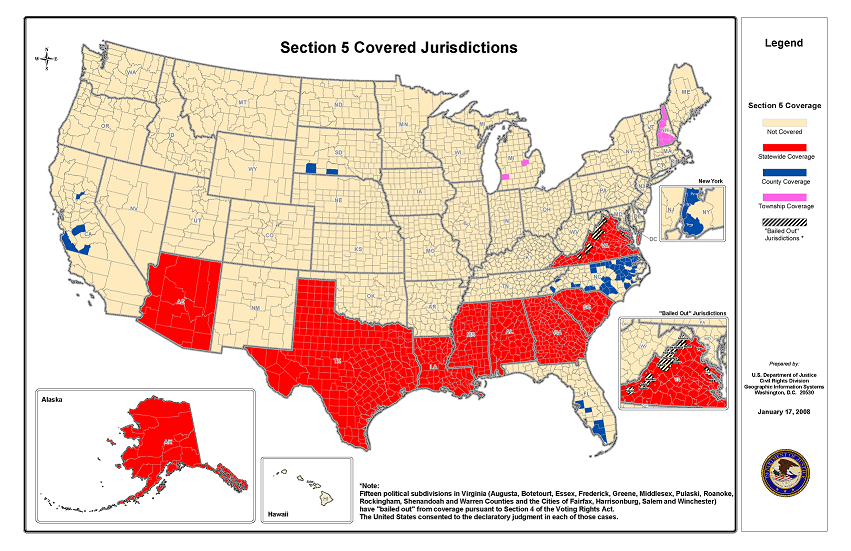
Here's what they have for restrictions in Texas:
Texas
New law enacted in 2019: Cut back use of mobile early voting sites.
New restriction in place since 2016 election: Photo ID required if a voter has one, but an alternative will be available for those who present a non-photo ID from a preset list and execute an affidavit claiming to have certain, enumerated reasonable impediments to obtaining photo ID. Reasonable impediment alternative is more restrictive than the alternative in place in 2016.
Click here to see the types of ID required under Texas’s law.
New restriction(s) in place for the first time in 2016: Photo ID required if a voter has one, but an alternative will be available for those who have a reasonable impediment to obtaining ID.
Restriction(s) in place for the first time in 2012: Curbed voter registration drives.
Background: In 2012, a federal court blocked the 2011 photo ID law under Section 5 of the Voting Rights Act. The state then implemented the requirement after the U.S. Supreme Court gutted Section 5 in 2013, and a photo ID was required to vote for the first time in a federal election in 2014.
In July 2016, the full Fifth Circuit Court of Appeals ruled that the strict photo ID law discriminates against minority voters, and therefore cannot be enforced against those who lack ID. In August 2016, a federal court approved an agreement that will allow voters with an obstacle to obtaining photo ID to cast a regular ballot in November 2016 after showing one of a much larger number of IDs and signing a declaration. In June 2017, in response to the litigation, Texas enacted a new voter ID law that is currently in place.
A Republican-controlled legislature passed the restriction on voter registration drives and the strict photo ID law in 2011, and both were signed by a GOP governor.
Wednesday, October 23, 2019
From Wikipedia: Wasted Vote
- Click here for the entry.
Efficiency gap
Wasted votes are the basis for computing the efficiency gap, a measure devised by University of Chicago law professor Nicholas Stephanopoulos and political scientist Eric McGhee in 2014. This statistic has been used to quantitatively assess the effect of gerrymandering, the assigning of voters to electoral districts in such a way as to increase the number of districts won by one political party at the expense of another. The heart of the computation is to add up, over all electoral districts, the wasted votes of each party's candidates. The efficiency gap is the difference between the two parties' wasted votes, divided by the total number of votes. Stephanopoulos and McGhee argued that in a non-partisan redistricting with two roughly equally popular parties, the efficiency gap would be zero, with an equal number of wasted votes from either party. If the gap exceeded 7%, then Stephanopoulos and McGhee argued that this could ensure the party with fewer wasted votes would be able to control the state for the duration of the validity of the district map.
Citing in part an efficiency gap of 11.69% to 13% in favor of the Republicans, a U.S. District Court ruling in Whitford v. Gill in 2016 ruled against the 2011 drawing of Wisconsin legislative districts. It was the first U.S. Federal court ruling to strike down a redistricting on the grounds of favoring a political party. In the 2012 election for the state legislature, Republican candidates had 48.6% of the two-party votes but won 61% of the 99 districts. The court found that the disparate treatment of Democratic and Republican voters violated the 1st and 14th amendments to the US Constitution. The State has challenged the District Court's ruling, and in June 2017, the Supreme Court has agreed to hear arguments in this case. The state is expected to challenge the validity of the efficiency gap measure.


From Jurist: Supreme Court rejects oil companies’ bid for stay in Baltimore climate change suit
Another lawsuit by a city against industry.
- Click here for the article.
The US Supreme Court declined to grant a stay to BP Plc and several other oil and gas companies Tuesday in a Baltimore lawsuit against the companies, solidifying a remand order issued by the US District Court for the District of Maryland.
The Mayor and City Council of Baltimore sued in state court last year against BP and 25 other oil companies for contributing to climate-related harm. BP removed to the federal district court, which granted Baltimore’s motion to remand to state court.
The oil companies asked the Supreme Court on October 1 for an emergency stay of the remand order until the US Fourth Circuit Court of Appeals weighed in on their appeal of the district court’s decision. This triggered the Federal Officer Removal statute, which allows federal agencies and officials to remove state cases to federal court. Baltimore officials asked the US Supreme Court to deny BP Plc and other oil and gas companies’ attempt to stay Friday.
The oil companies argued that irreparable harm would result from the costs of simultaneously litigating the case in federal and state courts. Baltimore counter-argued that expensive legal proceedings are unlikely given the cases are in early stages and would result in endless requests for review by the Supreme Court.
Justice Sam Alito recused himself from weighing in on this case.
From Roll Call: Supreme Court erases Michigan gerrymandering ruling
For our look at the courts, redistricting, gerrymanderings, etc ...
- Click here for the article.
The Supreme Court on Monday officially wiped out a lower court ruling from April that had struck down Michigan’s congressional map as giving an unconstitutional boost to Republicans.
The high court’s move was expected, since the justices decided in June that federal courts can’t rein in politicians who draw political maps to entrench a partisan advantage.
If it had stood, Michigan would have had to redraw state legislative and congressional districts ahead of the 2020 elections, and it could have set up a more favorable battlefield for House Democrats.
In April, a panel of three federal judges had invalidated portions of the state and congressional maps drawn by the GOP-controlled Legislature in 2011 as violating the rights of Democratic voters.
After the 2018 midterms, Michigan’s 14-district House delegation was evenly split between the two parties, 7-7. (Republicans have since dropped to six seats after Justin Amash became an independent in July.)
The League of Women Voters and some Democrats challenged the 1st, 4th, 5th, 7th, 8th, 9th, 10th, 11th and 12th districts, and the three-judge panel found that all nine of them were partisan gerrymanders “because they dilute the views of Democratic voters.”
But the ruling never went into effect. Republican members of Michigan’s congressional delegation and state lawmakers appealed to the Supreme Court, which put the ruling on hold as the justices decided two other cases about partisan gerrymandering in North Carolina and Maryland.
In June, the justices, in a 5-4 opinion, found the Constitution did not give federal courts the authority to strike down maps as partisan gerrymanders. Instead, the majority wrote, that was a political question and a task for Congress and the states.
- Wikipedia: Gill v Whitford.
- Wikipedia: Rucho v. Common Cause.
From ScotusBlog: Recent polls show confidence in Supreme Court, with caveats
For our look at polling, public opinion, and the Supreme Court.
- Click here for the article.
Public faith in government has fallen to historic lows. The Supreme Court, however, appears to have bucked the trend. A number of recent polls demonstrate broad public support for the job the justices are doing, though this approval appears influenced by party alignment.
Surveys of public opinion on the court were released this month by Gallup and the University of Pennsylvania’s Annenberg Public Policy Center, and Marquette Law School released another yesterday. Although the results depend to some degree on how the questions are framed, the polls share two central findings: The Supreme Court enjoys an appreciable level of public support, and this support is higher among political conservatives.
Annenberg found that 68 percent of the public trusts the court to act in the public’s best interest, while Gallup found that a more modest 54 percent approve of the job the court is doing. Of respondents to the Marquette survey, 80 percent possess at least “some” confidence in the Supreme Court, while nearly 40 percent rank their confidence level at “quite a lot” or “a great deal.” Marquette also found that, of the three branches of government, 57 percent find the Supreme Court most trustworthy, compared with 22 percent for Congress and 21 percent for the president.
This confidence is split by ideology. According to Marquette’s poll, 52 percent of “very conservative” respondents have high confidence in the court, compared to 31 percent of “very liberal” voters – 36 percent of those “very liberal” voters report low confidence. Gallup found a drastic shift in these relative levels of support under President Donald Trump, with conservative support for the court nearly tripling since 2016 and liberal support reduced by more than half.
From Newsweek: THESE CITIES AND COUNTIES ARE GOING AFTER BIG PHARMA IN THE OPIOID CRISIS
Dated 3/12/18
- Click here for the article.
Miami-Dade County announced this week that it was planning to take legal action against drug manufacturers and distributors for their role in the opioid crisis there—and joined a host of counties and cities across the country taking Big Pharma to court in the wake of one of the worst addiction crises in American history.
The county retained a law firm to investigate claims that drug manufacturers and distributors contributed to the opioid crisis and increased health care and policing costs for the community. The law firm, Podhurst Orseck, pointed to the nearly $1 billion in yearly costs to Florida hospitals for treatment of the crisis and Miami's 228 overdose deaths in the year 2016 alone in a release.
"Drug manufacturers and distributors are obligated by federal and state laws to properly monitor and control the supply and distribution of opioids," Miami-Dade Mayor Carlos A. Giménez said in a statement about the investigation. "Their collective failure to do so has flooded our communities with these highly addictive drugs and crippled the resources of our municipalities, which have had to bear the heavy costs."
The state of Florida has long struggled with the opioid crisis, and Governor Rick Scott in May declared a public health emergency in response. Miami-Dade, like many counties and cities, is alleging that drug companies used deceptive marketing that downplayed the dangers of opioids, and is pointing to the costs its community has incurred because of those drugs.
The local momentum builds upon recent federal action taken against the pharmaceutical industry. Attorney General Jeff Sessions announced on Tuesday that he would be filing a statement of interest in a lawsuit against some manufacturers, and announced a new task force that would investigate those companies and the claims against them.
For more:
- OPIOID MANUFACTURERS PAID MILLIONS TO GROUPS THAT LOBBIED FOR MORE OPIOID USAGE, SENATE INVESTIGATION CLAIMS.
For our upcoming look at the expansion of the national government (AKA cooperative federalism)
The First New Deal (1933–1934)
Emergency Banking Act
1933 Banking Act
Federal Emergency Relief Administration
Securities Act of 1933
National Recovery Administration
The Second New Deal (1935–1936)
Wagner Act
Works Progress Administration
Social Security Act
United States Housing Authority
Fair Labor Standards Act of 1938
Emergency Banking Act
1933 Banking Act
Federal Emergency Relief Administration
Securities Act of 1933
National Recovery Administration
The Second New Deal (1935–1936)
Wagner Act
Works Progress Administration
Social Security Act
United States Housing Authority
Fair Labor Standards Act of 1938
From the NIC: The History of Corrections in America
- Click here for it.
The United States government established the prison system in 1891. The Three Prison Act established funding for Leavenworth, McNeil Island and UPS Atlanta. It appears the first Federal prison was Leavenworth in Kansas. It started housing prisoners in 1906; however, prior to it opening federal prisoners were held at Fort Leavenworth military prison. Prisoners were used to build the facility.
Before the U.S. government passed the Three Prison Act, federal prisoners were held in state prisons. Today the Federal Bureau of Prisons houses inmates convicted of federal crimes. As of today the total number of inmates held in BOP operated facilities is 183,820 in 122 institutions, 27 residential reentry management offices and 11 privately managed facilities.
From NPR: Your Guide To The Massive (And Massively Complex) Opioid Litigation
A current example of a civil suit - county governments against corporations.
- Click here for the article.
Make no mistake: The legal fight over liability for the U.S. opioid crisis is only heating up.
An 11th-hour settlement Monday morning averted what would have been the first trial in a landmark federal case, one involving thousands of plaintiffs at nearly every level of government and defendants from every link in the chain of opioid drug production. But all the other lawsuits in the broader case remain on track for courtroom confrontations.
And with the costs of the crisis estimated at tens of billions of dollars and with more than 200,000 overdose deaths since the late 1990s, the stakes are immense — even for people who have never heard of this case. What happens with it will largely determine how much money cities and counties nationwide will have to fight the devastating effects of opioid abuse and when they'll get it.
From the Texas Tribune: Clerical concern prompts the Texas Court of Criminal Appeals to halt Ruben Gutierrez's execution
- Click here for the article.
Ruben Gutierrez has been fighting to stop his death by requesting DNA testing he claims could prove his innocence in the brutal killing of an elderly woman in Brownsville. But it was a clerical error that prompted the Texas Court of Criminal Appeals on Tuesday to halt his Oct. 30 execution.
The state’s highest criminal court issued a stay after Gutierrez’s attorneys argued his death warrant didn’t have the proper seal from the court when it was delivered to the sheriff and an attorney, invalidating it.
. . . A large focus of Gutierrez’s appeals has been on DNA testing. At the time of Harrison’s death, police preserved fingernail scrapings, a hair in her hand and blood stains, but DNA was never tested. Gutierrez has fought for a decade to get the evidence tested, claiming it can prove he was not Harrison’s killer. Cameron County prosecutors have argued that because there may have been multiple killers, tested evidence that didn't match him still wouldn’t mark him as innocent.
So far, the courts have rejected such testing. A new filing on the matter is pending at the Court of Criminal Appeals, but the court stopped Gutierrez’s execution on a technical question instead.
When the convicting court sets an execution date, Texas law states that the district clerk must issue an execution warrant “under the seal of the court” within 10 days to the county sheriff, who then delivers it to the Texas Department of Criminal Justice. The court must also send copies of the warrant to the attorneys in the case and the state’s Office of Capital and Forensic Writs, a state public defender office.
The warrant sent to the public defender office and the sheriff did not have the seal on it, and was sent 12 days after the execution was set, according to the court briefings. County prosecutors said it is wrong to stop Gutierrez’s execution for the clerical errors because the importance of the law is that notice is given fairly to all parties.
Dennis Bonnen Quits
- After a steady rise, Texas House Speaker Dennis Bonnen's fall came fast.
- Texas House Speaker Dennis Bonnen's downfall throws House majority fight into uncertainty.
- With a lame-duck speaker, Texas House confronts the work of the interim.
- Analysis: Dennis Bonnen gave Texas legislators a reason to distrust their leaders, too.
- Texas House Speaker Dennis Bonnen won't seek reelection after recording scandal.

River Pirates (Documentary)
Wikipedia: Cave in Rock, Illinois.
Wikipedia: Illinois, Territory.
Wikipedia: River Pirates.
Wikipedia: Flatboats.
Tuesday, October 22, 2019
From the House Committee on Oversight and Reform: Emoluments Clause
The committee has been holding a variety of hearings on accusations the the president has violated the clause repeatedly.
- Click here for the list of hearings.
President Trump is defying warnings from Republican and Democratic ethics experts and refusing to do what every previous president has done for decades — divest himself of his ownership interests, liquidate his business assets, and place them in a truly blind trust operated by an independent entity. As a result, Chairman Cummings is conducting oversight to protect against violations of the Emoluments Clause of the U.S. Constitution, which prohibits the President from obtaining any benefit of any kind from foreign governments or affiliated entities “without the consent of Congress.” Potential Emoluments Clause violations could include foreign government officials who buy up entire floors of hotel rooms, pay higher rents at Trump Tower, lower interest rates on loans, speed up permits for development projects, or take all kinds of other inappropriate actions to ingratiate themselves with the new Administration.
Monday, October 21, 2019
From the Texas Association of Counties: 2019 Legislative Analysis Report
- Click here for it.
Texas District & County Attorneys Association
Texas Association of County Auditors
County & District Clerks’ Association of Texas
County Judges & Commissioners Association of Texas
Justices of the Peace & Constables Association of Texas
Sheriffs’ Association of Texas
Tax Assessor-Collectors Association of Texas
County Treasurers’ Association of Texas

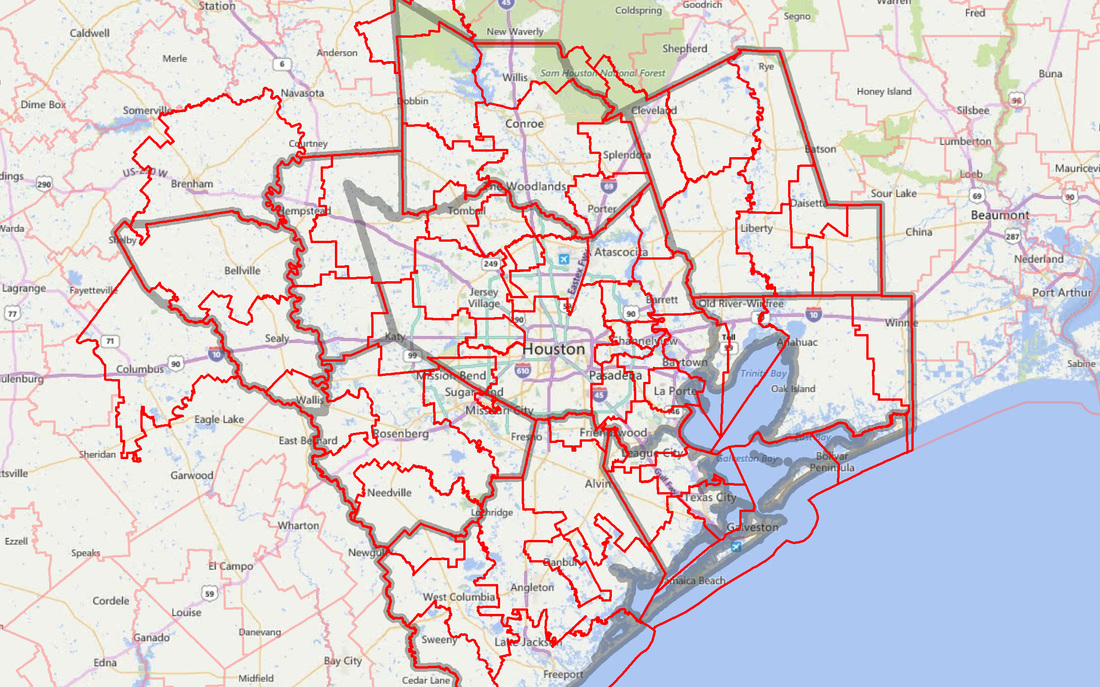
From Harris Votes: ABOUT THE COUNTY CLERK
- Click here for the source.
COUNTY CLERK’S FUNCTIONS AS ADMINISTRATOR OF ELECTIONS
As Chief Election Official of Harris County, the County Clerk has the responsibility of carrying out statutory electoral functions outlined by federal and state laws. Some of the County Clerk’s electoral functions include:
Provide training to all Presiding and Alternate Election Judges to ensure the proper execution of state and federal election law during each county/federal election;
Creating the ballot for county, state and federal elections in a manner provided by the state law.
Establishing the number of early voting locations in Harris County and schedule of voting hours (subject to approval by Commissioners Court);
Securing Election Day polling locations (subject to approval by Commissioners Court);
Securing the County’s election equipment and maintenance of equipment;
Accepting requests for ballots to be sent by mail and processing all returned ballots for tabulation;
Storing official campaign disclosure forms for local candidates;
Archiving official election results and voter histories for Harris County and reporting this information to the Secretary of State for district, statewide, and federal offices;
In short, the County Clerk is the administrator of elections and works with the Commissioners Court, the Tax Assessor Collector, the major political parties and other stakeholders to establish an elections infrastructure that facilitates access to the voting process to the citizenry of the third largest county in the United States.
Federal Criminal Law
DOJ: Federal Criminal Law.
U.S. Code Title 18—CRIMES AND CRIMINAL PROCEDURE
Clarifacts: FEDERAL CRIMES LIST.
Wikipedia: Federal crime in the United States.
Wikipedia: Criminal law of the United States.
U.S. Code Title 18—CRIMES AND CRIMINAL PROCEDURE
Clarifacts: FEDERAL CRIMES LIST.
Wikipedia: Federal crime in the United States.
Wikipedia: Criminal law of the United States.
From the Texas Tribune: Greg Abbott says TxDOT could remove homeless camps from Austin's highway underpasses
More on state / local conflict.
- Click here for the article.
Gov. Greg Abbott's office said Friday the Texas Department of Transportation could force homeless Austin residents out from under bridges and overpasses where some of them live or camp if recent changes to city ordinances don't result in less feces and fewer needles by Nov. 1.
Abbott plans to work with homeless shelters in Austin, according to a statement from a spokesman, who said they are currently working out details about when or how the camps will be cleared if such a plan is implemented.
The announcement comes less than a day after the Austin City Council changed its ordinances regarding camping, sitting and lying in public spaces. Camping is now banned on city sidewalks, near homeless shelters in and around downtown, and in high wildfire risk areas. Sitting and lying are no longer permitted within 15 feet of the entrance or exit to a business or residence.
“By reforming its homelessness policy, the city of Austin has taken a meaningful step to address the safety and health of Texans — including the homeless,” Abbott spokesman John Wittman said in a statement Friday afternoon. “The state will monitor how well the new policy actually reduces the skyrocketing complaints about attacks by the homeless and other public safety concerns. The state will also continue to monitor water quality for e-coli and other bacteria.”
The city's change will go into effect Oct. 27, four days before a deadline Abbott gave Austin officials to make a "consequential improvement" with what he called a homelessness crisis in the state's capital. That deadline and this week's changes follow the council's controversial decision earlier this year to relax some ordinances that critics said criminalized homelessness.
News of TxDOT's potential plans, which the Austin American-Statesman first reported, broke as Austin Mayor Steve Adler met with the media. Adler said he had not communicated with the governor, but that it had been suggested to him that Abbott would move people out of encampments under overpasses near state roads.
“I hope he doesn’t do that unless he has somewhere for those people to go,” Adler said, adding that he doesn't want people living under overpasses, but he doesn't want them moved into less public spaces like the woods, either.
Adler also said that he hopes the governor provides people experiencing homelessness with “a housing exit” should Abbott choose to move people into shelters.
From the New Yorker: Who Really Stands to Win from Universal Basic Income?
Some analysis about a popular topic among Democratic presidential candidates.
- Click here for the article.
In 1795, a group of magistrates gathered in the English village of Speenhamland to try to solve a social crisis brought on by the rising price of grain. The challenge was an increase in poverty, even among the employed. The social system at the time, which came to be known as Elizabethan Poor Law, divided indigent adults into three groups: those who could work, those who could not, and those—the “idle poor”—who seemed not to want to. The able and disabled received work or aid through local parishes. The idle poor were forced into labor or rounded up and beaten for being bums. As grain prices increased, the parishes became overwhelmed with supplicants. Terrorizing idle people turned into a vast, unmanageable task.
The magistrates at Speenhamland devised a way of offering families measured help. Household incomes were topped up to cover the cost of living. A man got enough to buy three gallon loaves a week (about eight and a half pounds of bread), plus a loaf and a half for every other member of his household. This meant that a couple with three children could bring home the equivalent of more than twenty-five pounds a week—a lot of bread. The plan let men receive a living wage by working for small payments or by not working at all.
Economics is at heart a narrative art, a frame across which data points are woven into stories about how the world should work. As the Speenhamland system took hold and spread across England, it turned into a parable of caution. The population nearly doubled. Thomas Malthus posited that the poverty subsidies allowed couples to rear families before their actual earnings allowed it. His contemporary David Ricardo complained that the Speenhamland model was a prosperity drain, inviting “imprudence, by offering it a portion of the wages of prudence and industry.” Karl Marx attacked the system years later, in “Das Kapital,” suggesting that it had kept labor wages low, while Karl Polanyi, the economic historian, cast Speenhamland as the original sin of industrial capitalism, making lower classes irrelevant to the labor market just as new production mechanisms were being built. When the Speenhamland system ended, in 1834, people were plunged into a labor machine in which they had no role or say. The commission that repealed the system replaced it with Dickensian workhouses—a corrective, at the opposite extreme, for a program that everyone agreed had failed.
In 1969, Richard Nixon was preparing a radical new poverty-alleviation program when an adviser sent him a memo of material about the Speenhamland experiment. The story freaked Nixon out in a way that only Nixon could be freaked out, and although his specific anxiety was allayed, related concerns lingered. According to Daniel P. Moynihan, another Nixon adviser, who, in 1973, published a book about the effort, Speenhamland was the beginning of a push that led the President’s program, the Family Assistance Plan, toward a work requirement—an element that he had not included until then.
Friday, October 18, 2019
Thursday, October 17, 2019
From Wikipedia: Jay Clayton
Some background on the current chair of the SEC.
- Click here for the full page.
From 1993 to 1995, Clayton clerked for Judge Marvin Katz of the District Court for the Eastern District of Pennsylvania.[7]
After being a summer associate at the firm in the summer of 1992, Clayton joined Sullivan & Cromwell full-time in October 1995 and became a partner in January 2001.[6] At Sullivan & Cromwell, Clayton was a member of the firm's management committee and co-managing partner of the firm's General Practice Group.[1][8] He specialized in mergers and acquisitions transactions and capital markets offerings[7] and represented prominent Wall Street firms, including Goldman Sachs.[9] He served as an adviser to numerous companies regarding issues related to the SEC, Federal Reserve, Department of Justice, and other agencies.[10]
He has also helped multiple corporations raise money through initial public offerings, including Alibaba Group,[11] Ally Financial, Och-Ziff Capital Management, Oaktree Capital Management, Blackhawk Network Holdings, and Moelis & Company.[7] During the financial crisis of 2007–2008, Clayton advised Bear Stearns in its fire sale to JPMorgan Chase in 2007, Barclays Capital in the purchase of Lehman Brothers' assets following their bankruptcy, and Goldman Sachs in connection with the investment by Berkshire Hathaway.[4]
Clayton disclosed to the U.S. Office of Government Ethics that his other corporate clients had included TeliaSonera AB, Ally Financial, Deutsche Bank, UBS, Volkswagen, SoftBank Group, The Weinstein Company, Pershing Square Capital Management, and Valeant Pharmaceuticals. Clayton's individual clients included Ocwen's former head William Erbey, Paul Tudor Jones, former Attorney General of Ireland Peter Southerland, CDW founder Michael Krasny and LinkedIn founder Reid Hoffman.[12]
Clayton earned $7.6 million in 2016 from his firm and has a family wealth of at least $50 million. A substantial portion of his holdings were in mutual funds of the Vanguard Group. His investments also included private funds managed by Apollo Global Management, Bain Capital, J.C. Flowers & Co., and Richard C. Perry but he divested these investments upon confirmation.[12]
From Wikipedia: Lockheed Martin
Lobbying
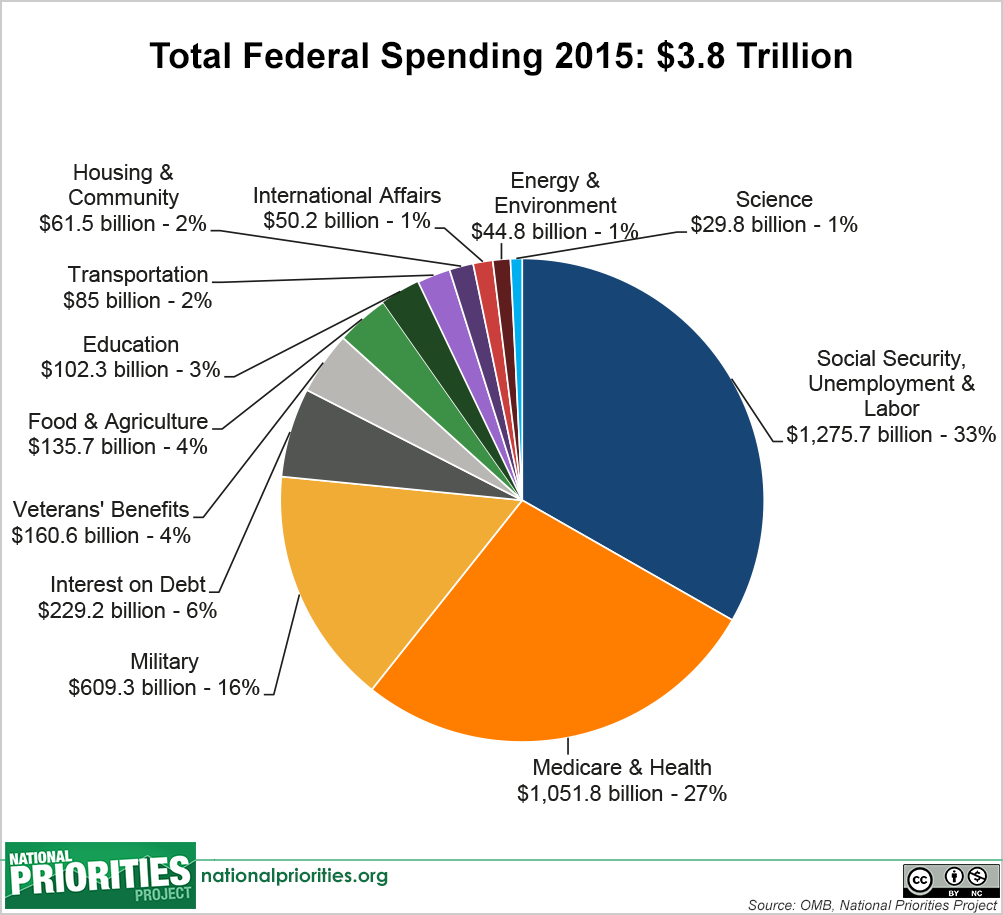
According to the magazine Politico, Lockheed Martin has "a political network that is already the envy of its competitors", and its contracts enjoy wide bipartisan support in the U.S. Congress thanks to it having "perfected the strategy of spreading jobs on weapons programs in key states and congressional districts".[94] The company's 2010 lobbying expenditure by the third quarter was $9.9 million (2009 total: $13.7 million).[95][96]
Through its political action committee (PAC), the company provides low levels of financial support to candidates who advocate national defense and relevant business issues.[97] It was the largest contributor to the House Armed Services Committee chairman, Republican Buck McKeon of California with over $50,000 donated in the election cycle as of January 2011. It also was the top donor to Sen. Daniel Inouye (D-HI), the chair of the Senate Appropriations Committee before his death in 2012.[77]
Lockheed Martin Employees Political Action Committee is one of the 50 largest in the country, according to FEC data. With contributions from 3,000 employees, it donates $500,000 a year to about 260 House and Senate candidates.[98]
Wednesday, October 16, 2019
From Open Secrets: Super PACs
For out look at campaign financing.
- Click here for the article.
Super PACs are a relatively new type of committee that arose following the July 2010 federal court decision in a case known as SpeechNow.org v. Federal Election Commission.
Technically known as independent expenditure-only committees, super PACs may raise unlimited sums of money from corporations, unions, associations and individuals, then spend unlimited sums to overtly advocate for or against political candidates. Unlike traditional PACs, super PACs are prohibited from donating money directly to political candidates, and their spending must not be coordinated with that of the candidates they benefit. Super PACs are required to report their donors to the Federal Election Commission on a monthly or semiannual basis – the super PAC's choice – in off-years, and monthly in the year of an election.
As of October 16, 2019, 1,563 groups organized as super PACs have reported total receipts of $177,298,278 and total independent expenditures of $11,684,880 in the 2020 cycle. See more on Outside Spending.
A few items from the Texas Tribune
- Primary fights few and far between as Texas Republicans focus on November 2020.
- Texas Attorney General Ken Paxton recuses himself from opinion, citing conflict of interest.
- Analysis: Michael Quinn Sullivan’s torment of Dennis Bonnen could end next week.
- Texas' $7 billion plan to remake Houston highways once again targets homes, businesses in communities of color.
- State Sen. Pat Fallon decides against primary challenge to Cornyn.
- As its U.S. House members of color depart, Texas GOP grapples with its lack of diversity.
Bletchley Park
An interesting story about the man who helped create traffic analysis, which would become the basis for how the internet and the cloud work today. Note the role the military plays in the development of this technology.
- Traffic Analysis.
- Gordon Welchman.
- MITRE Corporation.
From Vox: The Constitution’s ban on “cruel and unusual” punishment is in grave danger from the Supreme Court
More on how the current Supreme Court might change how due process rights in the Constitution are interpreted.
- Click here for the article.
There probably isn’t much doubt how Mathena v. Malvo, a case the Supreme Court will hear on Wednesday, will wind up being resolved.
The “Malvo” in this case is Lee Boyd Malvo, one half of the infamous pair of serial killers who terrorized the Washington, DC area with a sniper rampage in 2002. He was 17 at the time of the rampage, and he claims that the sentencing courts did not follow the proper process for condemning a juvenile offender to life without parole — though it’s doubtful that a majority of the Court will agree with him.
Several of the justices lived in the DC area during the three-week period when residents were scared to go outside for fear that they would be killed by Malvo and his partner, John Allen Muhammad. Malvo’s legal arguments rest on a fairly aggressive reading of a 2012 Supreme Court decision that split the Court 5-4. Notably, former Justice Anthony Kennedy cast the key fifth vote in that decision.
But even in the likely event that Malvo loses, it matters a great deal how Malvo loses. Malvo claims that he was sentenced in violation of the Eighth Amendment’s prohibition on “cruel and unusual punishments.” And the Supreme Court signaled just a few months ago that it wants to dramatically roll back the scope of that amendment.
Last April, in Bucklew v. Precythe, the Supreme Court signaled that it plans a wholesale rethinking of how it understands the Eighth Amendment. Malvo is the Court’s first Eighth Amendment case since Bucklew, so it could offer a window into just how deeply the Court’s Republican majority plans to cut into the shield against bizarre and excessive punishments.
Malvo could prove to be a fairly minor case, which simply states that the Court will not apply its 2012 decision in Miller v. Alabama — which held that “the Eighth Amendment forbids a sentencing scheme that mandates life in prison without possibility of parole for juvenile offenders” — in the specific way that Malvo seeks. In theory, the case could also end in a victory for Malvo, although that outcome seems unlikely.
Monday, October 14, 2019

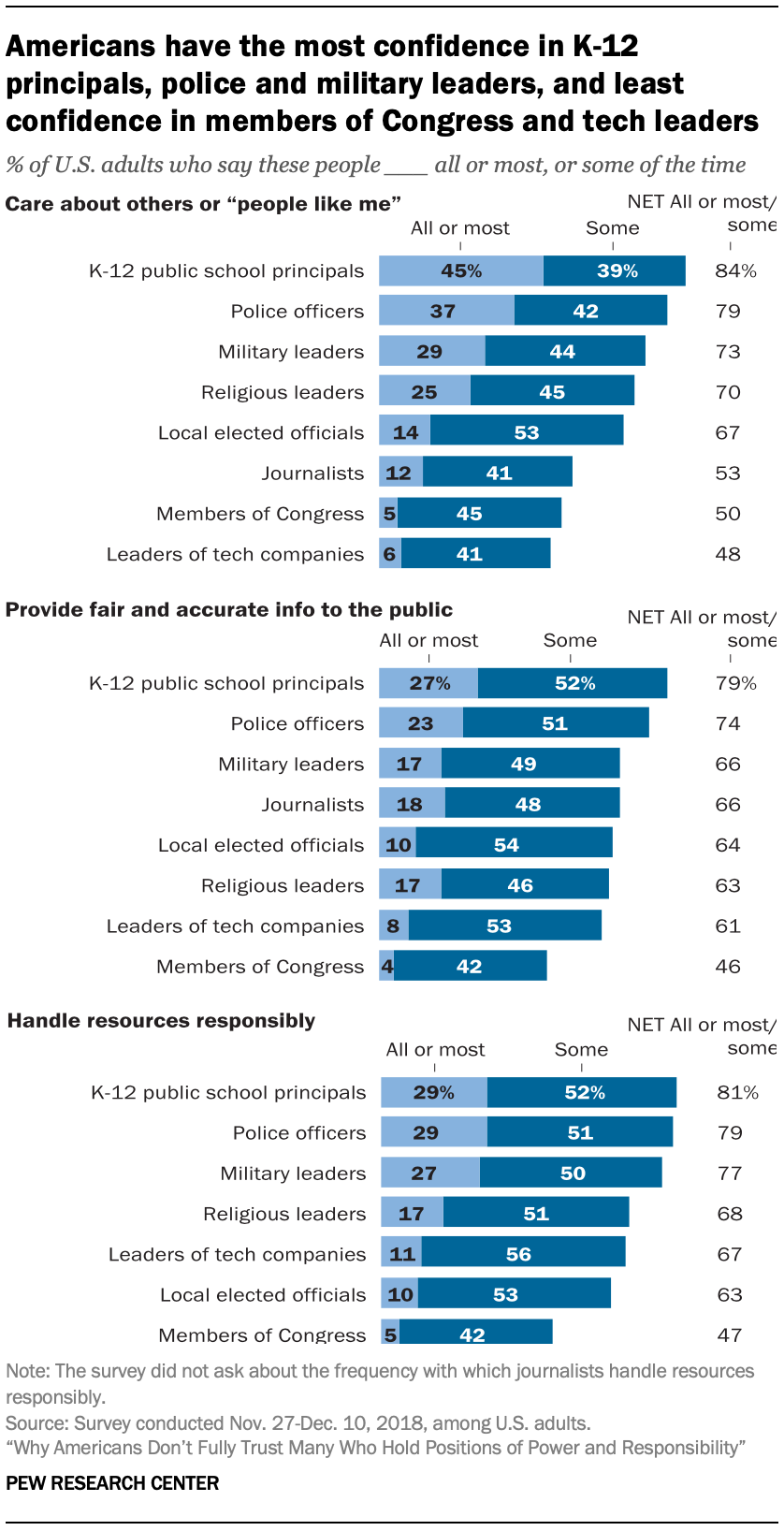
From the Pew Research Center: Why Americans Don’t Fully Trust Many Who Hold Positions of Power and Responsibility
For our look at both polling and governing institutions.
- Click here for the article.
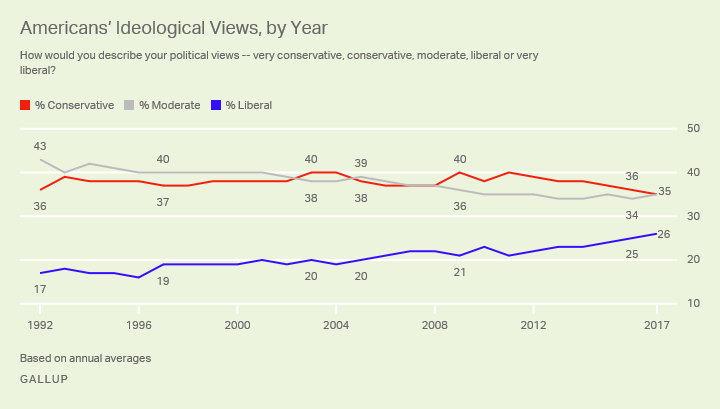
People invest their trust in institutions and those who have power for a variety of reasons. Researchers have found that people’s confidence in others and organizations can include their judgments about the competence, honesty and benevolence of the organizations or individuals they are assessing, as well as factors such as empathy, openness, integrity and accountability. These perceptions can be seen as building blocks of trust.
Taking account of those insights, a new Pew Research Center survey finds that people offer different judgments about these building blocks of trust when it comes to eight groups of people who hold positions of power and responsibility in America: members of Congress, local elected officials, K-12 public school principals, journalists, military leaders, police officers, leaders of technology companies and religious leaders.
- Click here for the article.
People invest their trust in institutions and those who have power for a variety of reasons. Researchers have found that people’s confidence in others and organizations can include their judgments about the competence, honesty and benevolence of the organizations or individuals they are assessing, as well as factors such as empathy, openness, integrity and accountability. These perceptions can be seen as building blocks of trust.
Taking account of those insights, a new Pew Research Center survey finds that people offer different judgments about these building blocks of trust when it comes to eight groups of people who hold positions of power and responsibility in America: members of Congress, local elected officials, K-12 public school principals, journalists, military leaders, police officers, leaders of technology companies and religious leaders.
From 538: What Happened When 2.2 Million People Were Automatically Registered To Vote
For our look at voter registration.
- Click here for the article.
As recently as 2015, automatic voter registration did not exist in the United States. Yet today, 16 states plus the District of Columbia have enacted (though in several cases, not yet implemented) some version of AVR. Almost overnight, it has become a core part of the agenda for those who want to make it easier for more people to vote. This year alone, AVR bills have been introduced in 39 states.1 Where they can’t convince the legislature, AVR advocates sometimes take their case to the people — Alaska, Michigan and Nevada have all enacted the policy via ballot measure. And someday, AVR could become a national mandate: It was a centerpiece of H.R. 1, the voting-rights bill passed earlier this year by the newly Democratically controlled U.S. House of Representatives.
AVR is meant to help people register to vote without needing to remember to do so — states just automatically register eligible citizens whenever they first interact with a government agency, usually the Department of Motor Vehicles, though some states include other agencies as well. Say you’re in California and you’re renewing your driver’s license. Unless you opt out, you’re going to be on a voter roll by the time you leave the DMV. AVR proponents say this can inject thousands of new voters into the electorate and help achieve near-universal voter registration.
That logic assumes, though, that being unregistered is the main thing that stops some people from voting. There’s another option: that unregistered people are mostly those who were never going to vote anyway. If that’s the case, turnout wouldn’t change much no matter how many more people got registered.
To find out whether states that automatically register voters saw an increase in electoral participation, FiveThirtyEight collected registration and turnout statistics from all eight jurisdictions that implemented AVR in time for the 2018 general election (Alaska, California, Colorado, the District of Columbia, Georgia, Oregon, Rhode Island and Vermont). To our knowledge, this is the first time this data has been made public for multiple states, and therefore the first opportunity to see how registration trends changed.
Our analysis shows that people who were registered through AVR do vote — but not necessarily at the same rate as those who register themselves.
From the Atlantic: A Step Toward Blowing Up the Presidential-Voting System
For our look at elections: ranked choice voting.
- Click here for the article.
The 2016 presidential election pitted the two most disliked candidates in the history of public polling against each other. In the race between Donald Trump and Hillary Clinton, millions of Americans found themselves forced to vote for a major-party nominee they plainly couldn’t stand or to risk electing the candidate they hated even more by casting their ballot for a third-party contender.
For the first time next November, a slice of the American electorate will have a way out of that lesser-of-two-evils scenario.
With a law set to take effect in 2020, Maine will become the first state to adopt ranked-choice voting for a presidential election—a method in which people list candidates by order of preference rather than bubbling in just one circle. Maine controls only four electoral votes and splits them in half by congressional district, but the change could have huge consequences if the national presidential race to 270 electoral votes is close.
In 2016, Clinton carried Maine by just three points, but she won just less than 48 percent of the vote in the state—a plurality but not a majority. If ranked-choice voting had been in place at the time, it’s possible the state could have gone to Trump. The format works like an instant runoff: If no candidate receives more than 50 percent of the first-choice votes, the candidate with the least support is eliminated. Whomever that person’s voters picked as their second choice is then added to the tallies, and the process repeats until one candidate reaches a majority.
Maine’s adoption of ranked-choice voting at the presidential level is the latest boon for an election-reform movement that has gained popularity across the country in recent years. Its proponents hail the method as a way to engage and empower more voters in a highly polarized political environment, while cutting costs in states and municipalities that currently hold runoff elections to ensure that winners secure a majority of the vote. The format played a big role in San Francisco’s high-profile mayoral race last year, and voters in New York City will decide in a ballot referendum this November whether to implement ranked-choice voting in future citywide elections.
Friday, October 11, 2019
From Mount Vernon: Fairfax Family
An early wealthy colonial family, Washington made connections with them as a kid.
- Click here for the article.
The Fairfax family of Fairfax County, Virginia, lived in a splendid brick mansion called Belvoir on the Potomac River four miles downstream from Mount Vernon. In his youth, George Washington developed lifelong friendships with several members of the Fairfax family and established social connections that would propel him to prominence as a young surveyor, soldier, and politician. George Washington fondly remembered his time with the Fairfaxes as "the happiest moments of my life."1
The Fairfaxes were descended from a prominent family based in Yorkshire, England, that had obtained a Scottish peerage from King Charles I in 1627. By 1719, Thomas Fairfax the sixth Baron of Cameron, inherited control of the vast Northern Neck Proprietary, a five million acre land grant between Virginia's Rappahannock and Potomac rivers. In 1734 he asked his cousin William Fairfax to act as his land agent in Virginia. By 1743, William and his family were comfortably settled into their new home on the Potomac. That same year Lawrence Washington married Colonel William Fairfax's eldest daughter Ann and the couple settled down at the newly re-named Mount Vernon, just across Dogue Creek from Belvoir.
Lawrence's younger brother George Washington became a part of the extended Fairfax family. He became a frequent foxhunting companion of Colonel Fairfax, who took an active interest in Washington's career. In 1748, Washington accompanied the Colonel's eldest son George William Fairfax on a surveying expedition across the Blue Ridge Mountains to Lord Fairfax's lands in the Shenandoah Valley.
From Wikipedia: Northern Neck Proprietary
A look at the struggle over landownership when the colonies transitioned into states.
- Click here for the entry.
The Northern Neck Proprietary — also called the Northern Neck land grant, Fairfax Proprietary, or Fairfax Grant — was a land grant first contrived by the exiled English King Charles II in 1649 and encompassing all the lands bounded by the Potomac and Rappahannock Rivers in colonial Virginia. This constituted up to 5,000,000 acres (20,000 km2) of Virginia's Northern Neck and a vast area northwest of it.
The grant became actual in 1660 when Charles was restored to the English throne. By 1719, these lands had been inherited by Thomas Fairfax, 6th Lord Fairfax of Cameron (1693-1781). By that time the question of the boundaries of the designated lands had also become highly contentious. It was decided in 1746 that a line between the sources of the North Branch of the Potomac and the Rappahannock River (the "Fairfax Line") would constitute the western limit of Lord Fairfax's lands.
The unsettled portions of his domain were finally confiscated during the American Revolution by the Virginia Act of 1779 and when he died in 1781 the Proprietary effectively ceased to exist. A portion of this estate, however, was later the subject of the landmark Supreme Court case Martin v. Hunter's Lessee (1816).
Survey of 330 Acres for Edward Hogan, George Washington, 1 November 1749
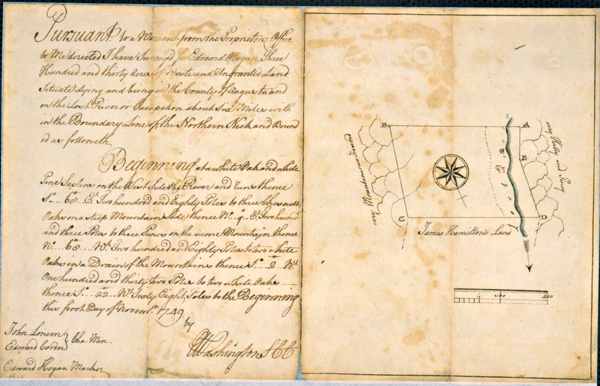
Washington's initial occupation.
From the Library of Virginia: Surveyors and Mapmakers
I'm on surveying kick
- Click here for the article.
From the founding of the colony, Virginia's surveyors and mapmakers charted westward expansion, internal development, and natural resources. Colonial surveyors were generally literate men who learned their craft from books on surveying or through experience. Among Virginia's early surveyors were John Henry (father of Patrick Henry), Peter Jefferson (father of Thomas Jefferson), and George Washington. Surveyors, especially those who were appointed as surveyors for a county, were key figures in colonial society. George Washington was not the only surveyor to use skill to increase his holdings of land, the basis of wealth and social status in colonial Virginia.
Virginians' pattern of settling land in advance of surveying was common to the southern colonies. A person interested in acquiring a land patent was not required to choose land contiguous to land already surveyed or land of a regular shape. Surveys by metes and bounds created tracts that reflected the owner's desire to choose the best land, no matter its location. The resulting surveys were irregularly shaped. Surveying on the frontier entailed considerable risk to the members of the surveying party as they tramped through unexplored swamps and forests and battled mosquitoes, disease, and snakes.
The Virginia Company of London appointed a surveyor general for Virginia in 1621, and the crown continued to appoint surveyors general after Virginia became a royal colony in 1624. From 1693 until the Revolutionary War, the College of William and Mary was responsible for the Office of the Surveyor General, which appointed official surveyors and received one-sixth of the fees that they collected. The new Commonwealth of Virginia established the Land Office on 22 June 1779, which continued the earlier practice of transferring title to land only after a survey had been executed.
Confusion arose in the case of the Northern Neck Proprietary, more than five million acres controlled by the Fairfax family from about 1685, which the colonial government was forced to recognize after 1660. The Proprietary recognized titles granted previously by the government but maintained a separate land office until 1781. Surveys became part of the legal documentation that determined the boundaries of the Proprietary. Thomas, sixth baron Fairfax, retained control of the Proprietary through the Revolutionary War because he was not recognized as a British loyalist. At his death in 1781, however, the Commonwealth of Virginia considered Fairfax's heirs as loyalists and claimed control over the Proprietary. Ownership of Northern Neck Proprietary was finally decided in favor of Virginia in 1816
From US Legal: Vagrancy Law and Legal Definition
Is it legal to be poor?
- Click here for the article.
In legal terminology, vagrancy refers to the offense of persons who are without visible means of support or domicile while able to work. State laws and municipal ordinances punishing vagrancy often also cover loitering, associating with reputed criminals, prostitution, and drunkenness. The punishment is usually a fine or several months in jail. Instead of arresting vagrants, local officials often attempt to induce them to move on. Vagrants are often transient persons who move from place to place and don't remain in any one place for a significant length of time. Lawmakers have claimed that these laws are necessary to preserve the public order, but critics claim that they are just a way for economically and politically powerful people to exert control over the lower classes. Recently, homeless people have gained some political clout through groups advocating on their behalf.
Vagrancy laws have come under constitutional attack, since being poor is not a crime under the Constitution. The statutory language was often held to be vague and overbroad, in violation of the due process requirements of the Fourteenth Amendment to the U.S. Constitution. A vagrancy law might be declared too vague if the definition of a vagrant is not detailed enough. Police had too much discretion to arrest people based upon appearance and suspicious characteristics. The fear was that the laws would be misused to make arbitrary arrests to harass unpopular groups or silence opposing political views. U.S. vagrancy laws generally punish the status of being poor and unemployed and not some overt act. In 1983, the U.S. Supreme Court struck down as too vague a loitering statute which punished people for failure to show credible identification upon police request. This case curbed police use of vagrancy and loitering statutes to harass the poor. However, other laws have been enacted, such as camping or sidewalk ordinances, which are often aimed at controlling homeless persons. The following are examples of local camping and sidewalk ordinances:
"Unlawful Camping. It shall be unlawful for any person to camp, occupy camp facilities or use camp paraphernalia in the following areas, except as otherwise provided:
Any street;
Any public parking lot or public area, improved or unimproved. "
"Those sidewalk activities proscribed within the specified zone include riding a bicycle, scooter, roller skates, or skateboard; unloading or loading a vehicle where safety does not necessitate obstructing the sidewalk; lying on the sidewalk or placing any object on the sidewalk, sitting on the public sidewalk or on any object on the sidewalk for more than one hour in any two-hour time period; placing or maintaining a bench without a license; leaving any belongings unattended; allowing dogs, guard cats, or pigs to go without a leash; allowing snakes outside of a cage; and not muzzling any animal with a “vicious propensity.”
From Wikipedia: Vagrancy Act 1824
An early look at poverty laws.
- Click here for it.
The Vagrancy Act 1824 (5 Geo. 4. c. 83) is an Act of Parliament of the United Kingdom that makes it an offence to sleep rough or beg. It remains in force in England and Wales, and anyone found to be sleeping in a public place or to be trying to beg for money can be arrested.
Contemporary critics, including William Wilberforce, condemned the Act for being a catch-all offence because it did not consider the circumstances as to why an individual might be placed in such a predicament.
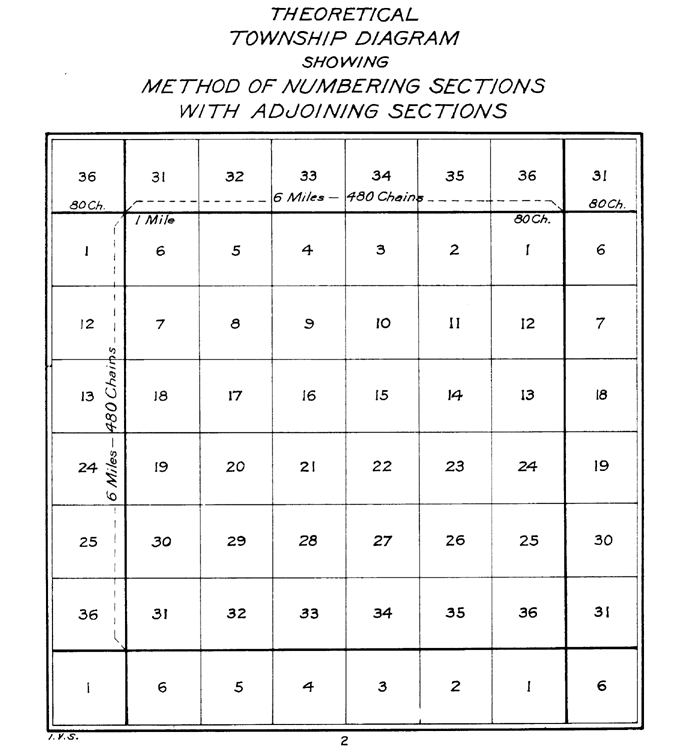
02 - Surveying the Land
- Land Ordinance of 1785.
- Public Land Survey System.
- 1812: General Land Office.
- 1849: Department of Interior.
- 1939: United States Grazing Service.
- 1946: Bureau of Land Management.
From 538: The Democratic Primary Looks Pretty Different In Each Of The Early States
Another look at primaries, and a reminder that these are run by the state parties.
- Click here for the article.
Earlier this week, I looked at national surveys to see what’s behind Sen. Elizabeth Warren’s rise in the polls, but now let’s zoom in on the early primary states — Iowa, New Hampshire, Nevada and South Carolina — to see what’s happening there.
This week we have a new Fox News poll of South Carolina that shows former Vice President Joe Biden still retains a formidable lead there at 41 percent (Warren was in second at 12 percent) despite Warren’s gains at the national level. In Iowa and New Hampshire, recent surveys more closely mirror the overall national picture — Warren has gained while Biden and Sen. Bernie Sanders have slipped. But there’s also evidence that someone like South Bend, Indiana, Mayor Pete Buttigieg may be underestimated in national polls.
To see what’s happened in the early states since August, I averaged all state-level polls taken between the second debate (July 30-31) and the third debate (Sept. 12) and compared that to an average of all state polls fielded since the third debate for the five candidates currently sitting at the top of the polls: Biden, Warren, Sanders, Buttigieg and Sen. Kamala Harris.
And in some states, there weren’t a ton of polls during these two time periods, but we did have at least two polls for each state before and after the third debate.
Primary Calendar
For our look at primary elections in both 2305 and 2306.
- Click here for it.
- Here's another source.
- Click here for it.
- Here's another source.
From Wikipedia: Witchcraft Act 1735
Something to be thankful for.
Perhaps we can discuss this in 2306 as we cover criminal justice.
- Click here for the entry.
The Witchcraft Act (9 Geo. II c. 5) was a law passed by the Parliament of the Kingdom of Great Britain in 1735 which made it a crime for a person to claim that any human being had magical powers or was guilty of practising witchcraft. With this, the law abolished the hunting and executions of witches in Great Britain. The maximum penalty set out by the Act was a year's imprisonment.
It thus marks the end point of the Witch trials in the Early Modern period for Great Britain and the beginning of the "modern legal history of witchcraft", repealing the earlier Witchcraft Acts which were based on a widespread belief in the genuine existence of magic and witchcraft.[1]
The law was reverting to the view of the medieval Church[2] that witchcraft and magic were illusory, treating as an offence not the supposed practice of witchcraft but the superstitious belief in its existence.[1] The Act reflected the general trend in Europe, where after a peak in the mid-17th century, and a series of late outbursts in the late 17th century, witch-trials quickly subsided after 1700. The last person executed for witchcraft in Great Britain was Janet Horne in 1727.
Thursday, October 10, 2019
The Texas Tribune: Texas ended temporary voting locations to curb abuse. Now rural and young voters are losing access.
A possible future Supreme Court case?
- Click here for the article.
. . . Florence’s one day of early voting was a casualty of a newly implemented Texas election law that lawmakers said they pushed to curb abuse in school bond elections. But the law was crafted broadly enough to upend a long-established practice of moving polling places during the early voting period to reach as many voters as possible near where they live, work or go to school. With a Nov. 5 constitutional election looming, the new law has left a trail of shuttered early voting polling places across the state, prompting unease among election officials about how far it'll go in limiting access to early voting in next year’s high-stakes election.
In Williamson County alone, the impact of the new law — one championed by Republican lawmakers — has reached the rural stretch of the Central Texas county and Southwestern University in Georgetown.
Campus officials used their turn at a one-day temporary polling place in 2018 to help turn out more than half of the university's nearly 1,500 students, according to Emily Sydnor, an assistant professor of political science who has spent her four years at Southwestern looking for ways to engage students in the electoral process.
She knows well the difference proximity can make, and she rattles of the numbers easily: There’s a 66% likelihood that someone will vote if their polling place is a hundredth of a mile away. The likelihood that someone without a car will vote drops to 42% if they have to walk two-thirds of a mile.
. . . This year’s wave of closures started with an effort to curb what critics call “rolling polling,” in which entities running elections may frequently rotate early voting sites to target specific voters.
For years, election officials across the state used temporary polling places to offer a day or two of early voting in places where it wasn’t practical or cost-efficient to maintain a site open for all of the early voting period. Some counties used the practice to reach smaller communities or to spend time at various college campuses within a county; others used mobile voting sites to bring a day of early voting to hospitals, government buildings that can’t host a permanent site, and senior living facilities where residents face mobility issues.
But that flexibility resulted in the “selective harvesting of targeted voters,” particularly in school bond elections where voting sites were set up in school facilities, state Rep. Greg Bonnen argued during this year’s legislative session. The Friendswood Republican offered House Bill 1888 as a solution that would do away with temporary voting sites by requiring polling places to remain open for all 12 days of early voting.
“The flexibility of polling locations was designed to accommodate more voters near their homes or workplaces, but some subdivisions of the state have abused this flexibility and targeted desirable voting populations at the exclusion of others,” Bonnen told the House Elections Committee as it considered his legislation in March.
Asked about the effect the bill would have on early voting, a lawyer with the secretary of state’s office told the committee it would “limit substantially” the use of temporary voting sites that were being used for legitimate purposes.
From Just Security: An Open Memo: Comparison of Clinton Impeachment, Nixon Impeachment and Trump Pre-Impeachment
For keeping up with what's up:
Note the role of presidential approval polls.
- Click here for the article.

Note the role of presidential approval polls.
- Click here for the article.
From Oyez: Citizens United v. Federal Election Commission
For next week in 2305
- Click here for it.
Question
1) Did the Supreme Court's decision in McConnell resolve all constitutional as-applied challenges to the BCRA when it upheld the disclosure requirements of the statute as constitutional?
2) Do the BCRA's disclosure requirements impose an unconstitutional burden when applied to electioneering requirements because they are protected "political speech" and not subject to regulation as "campaign speech"?
3) If a communication lacks a clear plea to vote for or against a particular candidate, is it subject to regulation under the BCRA?
4) Should a feature length documentary about a candidate for political office be treated like the advertisements at issue in McConnell and therefore be subject to regulation under the BCRA?
Conclusion
No. No. Yes. Yes. The Supreme Court overruled Austin v. Michigan Chamber of Commerce and portions of McConnell v. FEC. (In the prior cases, the Court had held that political speech may be banned based on the speaker's corporate identity.) By a 5-to-4 vote along ideological lines, the majority held that under the First Amendment corporate funding of independent political broadcasts in candidate elections cannot be limited. Justice Anthony M. Kennedy wrote for the majority joined by Chief Justice John G. Roberts and Justices Antonin G. Scalia, Samuel A. Alito, and Clarence Thomas. Justice John Paul Stevens dissented, joined by Justices Ruth Bader Ginsburg, Stephen G. Breyer, and Sonia Sotomayor. The majority maintained that political speech is indispensable to a democracy, which is no less true because the speech comes from a corporation. The majority also held that the BCRA's disclosure requirements as applied to The Movie were constitutional, reasoning that disclosure is justified by a "governmental interest" in providing the "electorate with information" about election-related spending resources. The Court also upheld the disclosure requirements for political advertising sponsors and it upheld the ban on direct contributions to candidates from corporations and unions.
In a separate concurring opinion, Chief Justice Roberts, joined by Justice Alito, emphasized the care with which the Court handles constitutional issues and its attempts to avoid constitutional issues when at all possible. Here, the Court had no narrower grounds upon which to rule, except to handle the First Amendment issues embodied within the case. Justice Scalia also wrote a separate concurring opinion, joined by Justices Alito and Thomas in part, criticizing Justice Stevens' understanding of the Framer's view towards corporations. Justice Stevens argued that corporations are not members of society and that there are compelling governmental interests to curb corporations' ability to spend money during local and national elections.
Wednesday, October 9, 2019
From Vox:A California city gave some residents $500 a month, no strings attached. Here’s how they spent it.
More on states and local governments as laboratories of democracy.
- Click here for the article.
What would a needy person do if you gave them $500 a month, no strings attached?
Stockton, California, is finding out. The city is eight months into an 18-month experiment with basic income, the idea that the government should give citizens a regular infusion of unconditional free cash. And it just released the first batch of data about how recipients are spending the money.
It turns out, they’re mostly spending it on food, clothes, and utility bills.
The data is provisional — the basic income experiment still has 10 months to go — and the number of participants is small: 125 people (out of an estimated 311,000 Stockton residents) who live at or below the median income line (around $46,000), nearly half of whom are working full- or part-time.
But it offers a counter to critics of basic income, who often claim that people getting free money will blow it on frivolous things or addictive substances, and that they won’t bother to find work. The evidence does not support that belief.
“In this country, we have an issue with associating people who are struggling economically and people of color with vices like drug use, alcohol use, gambling,” said Stockton Mayor Michael Tubbs. “I thought it was important to illustrate folks aren’t using this money for things like that. They are using it for literal necessities.”
In other words, Tubbs wants to destroy a myth — one that persists despite findings to the contrary — that people who become poor get that way because they’re bad at rational decision-making and self-control, and are thus intrinsically to blame for their situation. (If anything, evidence suggests it’s the other way around: Poverty itself hurts people’s decision-making abilities by imposing a terrible cognitive burden.)
From Urban.org: Segregated from the Start
More on civil rights.
- Click here for the article.
Children’s first learning experiences set the tone for the rest of their lives, in school and beyond. That’s why early childhood education (ECE)—which enrolls nearly half of infants and toddlers and three-quarters of preschoolers—has become a focus for public investment designed to promote educational equity and give children a strong start.
But little attention has been paid to the racial and ethnic composition of early childhood programs, even though the roots of racial and ethnic bias form during children’s earliest years. In addition to experiences in the home and in the community, early childhood education is a key place for addressing—or exacerbating—issues of diversity, equity, and inclusion.
Most research has focused on the benefits of integration in elementary and secondary schools, even though schools have become more segregated. But segregation in early childhood programs is even more pronounced than in K–12 classrooms, and that separation can lead to missed opportunities for contact and kinship during a critical point in child development.
Our analysis is the first that aims to characterize segregation across early childhood education in the US. To ensure the possibility of integration, we analyze only ECE programs that serve at least five children.
From the Texas Tribune: The 2019 Texas inauguration cost a record $5.3 million. Where are the receipts?
For our look at campaign contributions.
- Click here for the article.
Appointees of Gov. Greg Abbott and Lt. Gov Dan Patrick raised a record-setting $5.3 million for the 2019 inaugural festivities, two days’ worth of VIP events that included a ball with country crooner George Strait and a candlelight dinner with the state’s top elected officials.
They reported spending every dollar of it. But don’t ask for any receipts.
The Texas Tribune tried this summer to obtain expense records from multiple state agencies as well as the inaugural committee, a group of private donors appointed by Abbott and Patrick. They claim no such records exist.
“We have conducted a thorough search,” the group’s former executive director, Kim Snyder, who serves as Abbott’s campaign director, said in an email last month. “The 2019 Texas Inaugural Committee has no responsive records.”
The Tribune filed a lawsuit last month under open records laws, seeking to discover what happened to the $5.3 million raised through ticket sales and donations from top lobbying firms, corporations and banks, wealthy business people and trade groups. No taxpayer dollars were expended on the inaugural celebrations, according to the governor’s office.
Bill Aleshire, the attorney representing the Tribune, said the expenditure of money by governmental entities — whether they get it from taxpayers or deep-pocketed contributors — is one of the “core pieces of information the public is entitled to see.”
“The committee is a governmental body by law and is required to keep records,” Aleshire said. “They are not allowed to keep secret the expenditures by this public entity any more than any other public entity can keep that secret.”
The only accounting the committee, which is created by state law, has given the public came in its “final report” to the Texas Secretary of State's office. In a one-page list of cash receipts and disbursements, the report gives 11 broad categories of expenditures.
Tuesday, October 8, 2019
From Vox: How the LGBTQ rights cases before the Supreme Court affect all Americans
For our look at civil rights and the Supreme Court.
- Click here for the article.
The Supreme Court hears oral arguments on Tuesday in three cases that could decimate legal protections for LGBTQ workers in America.
The cases, Altitude Express Inc. v. Zarda, Bostock v. Clayton County, and R.G. & G.R. Harris Funeral Homes Inc. v. EEOC, are about whether employees can legally be fired for their sexual orientation or gender identity. Harris Funeral Homes involves Aimee Stephens, who was fired from her job because, she says, her boss disapproved of the fact that she is transgender. The employees in Zarda and Bostock are gay men who say they were fired because of their sexual orientation.
“For LGBTQ workers and for LGBTQ people in general,” the court’s decision in the cases “will be a declarative and transformative statement of our legal rights under federal law,” Chase Strangio, an attorney with the American Civil Liberties Union who will be arguing in the Harris Funeral Homes case on behalf of Stephens, told Vox. A decision against the workers could affect not just employment but housing, health care, and education as well and even contribute to the epidemic of violence against trans women of color.
Many feminist groups, including the National Women’s Law Center, have filed amicus briefs in support of Stephens and the other employees in the cases. But as Katelyn Burns reported at Vox last month, some anti-trans groups that purport to be feminist, including one called the Women’s Liberation Front, are siding with the employer in Harris Funeral Homes, arguing that giving anti-discrimination protections to trans women will harm cis women.
However, advocates for Stephens and the other employees say the opposite is true. The three cases before the court on Tuesday actually threaten the civil rights of everyone in America, regardless of gender identity or sexual orientation. If the court finds in favor of the employers, the advocates say, it wouldn’t just erase the protections that allow LGBTQ people to pursue careers and support their families — it would essentially destroy sex discrimination law as we know it.
Bostock v. Clayton County, Georgia
- ScotusBlog.
- Oyez.
- Symposium: Hiding elephants in mouseholes: The original meaning of “discrimination on the basis of sex”
- Title VII Civil Rights Act
- EEOC
- Oyez.
- Symposium: Hiding elephants in mouseholes: The original meaning of “discrimination on the basis of sex”
- Title VII Civil Rights Act
- EEOC

From the Texas Tribune: Analysis: Governments don’t fix problems they don’t recognize
For our look at agenda setting and "loud signals."
- Click here for the article.
Who will they take care of?
Is the homeless problem — as it’s seen by the government — a problem for the homeless people on the streets? Or is it a problem for the people who aren’t homeless, but have to step around homeless people, contend with homeless people, see homeless people every day?
Your mileage might differ depending on whether you’re talking about the state government or the folks at the city halls in places like Austin, Dallas, Houston, San Antonio and many of the state’s smaller cities.
The policies they write are responses to a problem, formulations concocted to set things right. And by its very nature, any policy reveals the problem it is supposed to solve. The authors of a policy address the problem they see — even if it’s not the problem others see.
In this case, policy might address the problem of homeless people — often unkempt, dirty, sometimes disturbing — on the streets where the rest of us encounter them daily. The “us” in that line is important, as it represents voters and the people most likely to command the attention of the policymakers. And they are complaining about a real problem; in a letter to Austin Mayor Steve Adler last week, Gov. Greg Abbott cited reports of “violence, used needles, and feces littering the streets of Austin and endangering Texas residents.”
Policy might be aimed at the underlying problem of why those homeless people are on the streets at all, and what might be done about that. Two obstacles come immediately to mind: Housing the homeless in any of the state’s big or medium-size cities would be expensive, first; second, the political rewards are smaller, as the people being helped aren’t the people who cast ballots and make political donations that benefit policymakers.
Monday, October 7, 2019
From the Texas Constitution, Article 3 - places where the state butts out of local business.
Sec. 56. PROHIBITED LOCAL AND SPECIAL LAWS. (a) The Legislature shall not, except as otherwise provided in this Constitution, pass any local or special law, authorizing:
(1) the creation, extension or impairing of liens;
(2) regulating the affairs of counties, cities, towns, wards or school districts;
(3) changing the names of persons or places;
(4) changing the venue in civil or criminal cases;
(5) authorizing the laying out, opening, altering or maintaining of roads, highways, streets or alleys;
(6) relating to ferries or bridges, or incorporating ferry or bridge companies, except for the erection of bridges crossing streams which form boundaries between this and any other State;
(7) vacating roads, town plats, streets or alleys;
(8) relating to cemeteries, grave-yards or public grounds not of the State;
(9) authorizing the adoption or legitimation of children;
(10) locating or changing county seats;
(11) incorporating cities, towns or villages, or changing their charters;
(12) for the opening and conducting of elections, or fixing or changing the places of voting;
(13) granting divorces;
(14) creating offices, or prescribing the powers and duties of officers, in counties, cities, towns, election or school districts;
(15) changing the law of descent or succession;
(16) regulating the practice or jurisdiction of, or changing the rules of evidence in any judicial proceeding or inquiry before courts, justices of the peace, sheriffs, commissioners, arbitrators or other tribunals, or providing or changing methods for the collection of debts, or the enforcing of judgments, or prescribing the effect of judicial sales of real estate;
(17) regulating the fees, or extending the powers and duties of aldermen, justices of the peace, magistrates or constables;
(18) regulating the management of public schools, the building or repairing of school houses, and the raising of money for such purposes;
(19) fixing the rate of interest;
(20) affecting the estates of minors, or persons under disability;
(21) remitting fines, penalties and forfeitures, and refunding moneys legally paid into the treasury;
(22) exempting property from taxation;
(23) regulating labor, trade, mining and manufacturing;
(24) declaring any named person of age;
(25) extending the time for the assessment or collection of taxes, or otherwise relieving any assessor or collector of taxes from the due performance of his official duties, or his securities from liability;
(26) giving effect to informal or invalid wills or deeds;
(27) summoning or empanelling grand or petit juries;
(28) for limitation of civil or criminal actions;
(29) for incorporating railroads or other works of internal improvements; or
(30) relieving or discharging any person or set of persons from the performance of any public duty or service imposed by general law.
(b) In addition to those laws described by Subsection (a) of this section in all other cases where a general law can be made applicable, no local or special law shall be enacted; provided, that nothing herein contained shall be construed to prohibit the Legislature from passing:
(1) special laws for the preservation of the game and fish of this State in certain localities; and
(2) fence laws applicable to any subdivision of this State or counties as may be needed to meet the wants of the people.
Subscribe to:
Posts (Atom)