Is it legal to be poor?
- Click here for the article.
In legal terminology, vagrancy refers to the offense of persons who are without visible means of support or domicile while able to work. State laws and municipal ordinances punishing vagrancy often also cover loitering, associating with reputed criminals, prostitution, and drunkenness. The punishment is usually a fine or several months in jail. Instead of arresting vagrants, local officials often attempt to induce them to move on. Vagrants are often transient persons who move from place to place and don't remain in any one place for a significant length of time. Lawmakers have claimed that these laws are necessary to preserve the public order, but critics claim that they are just a way for economically and politically powerful people to exert control over the lower classes. Recently, homeless people have gained some political clout through groups advocating on their behalf.
Vagrancy laws have come under constitutional attack, since being poor is not a crime under the Constitution. The statutory language was often held to be vague and overbroad, in violation of the due process requirements of the Fourteenth Amendment to the U.S. Constitution. A vagrancy law might be declared too vague if the definition of a vagrant is not detailed enough. Police had too much discretion to arrest people based upon appearance and suspicious characteristics. The fear was that the laws would be misused to make arbitrary arrests to harass unpopular groups or silence opposing political views. U.S. vagrancy laws generally punish the status of being poor and unemployed and not some overt act. In 1983, the U.S. Supreme Court struck down as too vague a loitering statute which punished people for failure to show credible identification upon police request. This case curbed police use of vagrancy and loitering statutes to harass the poor. However, other laws have been enacted, such as camping or sidewalk ordinances, which are often aimed at controlling homeless persons. The following are examples of local camping and sidewalk ordinances:
"Unlawful Camping. It shall be unlawful for any person to camp, occupy camp facilities or use camp paraphernalia in the following areas, except as otherwise provided:
Any street;
Any public parking lot or public area, improved or unimproved. "
"Those sidewalk activities proscribed within the specified zone include riding a bicycle, scooter, roller skates, or skateboard; unloading or loading a vehicle where safety does not necessitate obstructing the sidewalk; lying on the sidewalk or placing any object on the sidewalk, sitting on the public sidewalk or on any object on the sidewalk for more than one hour in any two-hour time period; placing or maintaining a bench without a license; leaving any belongings unattended; allowing dogs, guard cats, or pigs to go without a leash; allowing snakes outside of a cage; and not muzzling any animal with a “vicious propensity.”
Friday, October 11, 2019
From Wikipedia: Vagrancy Act 1824
An early look at poverty laws.
- Click here for it.
The Vagrancy Act 1824 (5 Geo. 4. c. 83) is an Act of Parliament of the United Kingdom that makes it an offence to sleep rough or beg. It remains in force in England and Wales, and anyone found to be sleeping in a public place or to be trying to beg for money can be arrested.
Contemporary critics, including William Wilberforce, condemned the Act for being a catch-all offence because it did not consider the circumstances as to why an individual might be placed in such a predicament.
- Click here for it.
The Vagrancy Act 1824 (5 Geo. 4. c. 83) is an Act of Parliament of the United Kingdom that makes it an offence to sleep rough or beg. It remains in force in England and Wales, and anyone found to be sleeping in a public place or to be trying to beg for money can be arrested.
Contemporary critics, including William Wilberforce, condemned the Act for being a catch-all offence because it did not consider the circumstances as to why an individual might be placed in such a predicament.


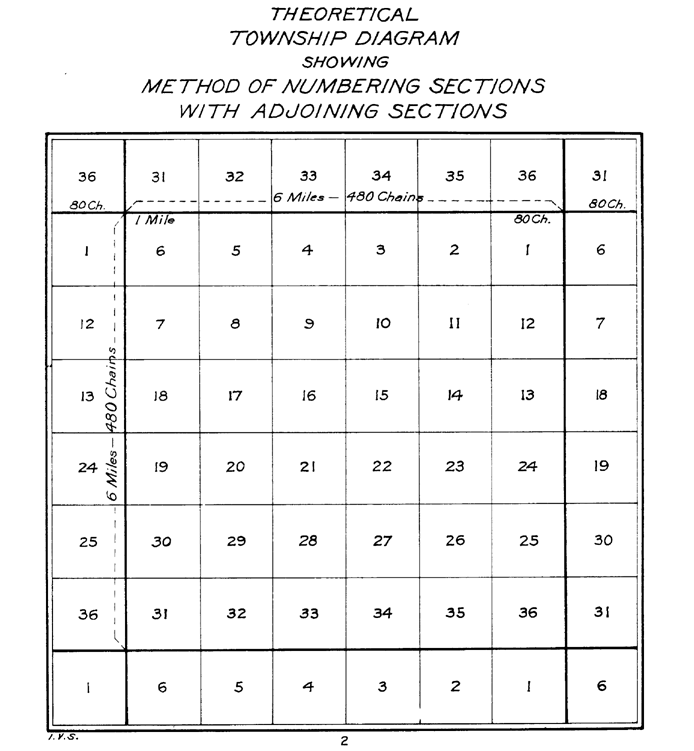
02 - Surveying the Land
- Land Ordinance of 1785.
- Public Land Survey System.
- 1812: General Land Office.
- 1849: Department of Interior.
- 1939: United States Grazing Service.
- 1946: Bureau of Land Management.
From 538: The Democratic Primary Looks Pretty Different In Each Of The Early States
Another look at primaries, and a reminder that these are run by the state parties.
- Click here for the article.
Earlier this week, I looked at national surveys to see what’s behind Sen. Elizabeth Warren’s rise in the polls, but now let’s zoom in on the early primary states — Iowa, New Hampshire, Nevada and South Carolina — to see what’s happening there.
This week we have a new Fox News poll of South Carolina that shows former Vice President Joe Biden still retains a formidable lead there at 41 percent (Warren was in second at 12 percent) despite Warren’s gains at the national level. In Iowa and New Hampshire, recent surveys more closely mirror the overall national picture — Warren has gained while Biden and Sen. Bernie Sanders have slipped. But there’s also evidence that someone like South Bend, Indiana, Mayor Pete Buttigieg may be underestimated in national polls.
To see what’s happened in the early states since August, I averaged all state-level polls taken between the second debate (July 30-31) and the third debate (Sept. 12) and compared that to an average of all state polls fielded since the third debate for the five candidates currently sitting at the top of the polls: Biden, Warren, Sanders, Buttigieg and Sen. Kamala Harris.
And in some states, there weren’t a ton of polls during these two time periods, but we did have at least two polls for each state before and after the third debate.
- Click here for the article.
Earlier this week, I looked at national surveys to see what’s behind Sen. Elizabeth Warren’s rise in the polls, but now let’s zoom in on the early primary states — Iowa, New Hampshire, Nevada and South Carolina — to see what’s happening there.
This week we have a new Fox News poll of South Carolina that shows former Vice President Joe Biden still retains a formidable lead there at 41 percent (Warren was in second at 12 percent) despite Warren’s gains at the national level. In Iowa and New Hampshire, recent surveys more closely mirror the overall national picture — Warren has gained while Biden and Sen. Bernie Sanders have slipped. But there’s also evidence that someone like South Bend, Indiana, Mayor Pete Buttigieg may be underestimated in national polls.
To see what’s happened in the early states since August, I averaged all state-level polls taken between the second debate (July 30-31) and the third debate (Sept. 12) and compared that to an average of all state polls fielded since the third debate for the five candidates currently sitting at the top of the polls: Biden, Warren, Sanders, Buttigieg and Sen. Kamala Harris.
And in some states, there weren’t a ton of polls during these two time periods, but we did have at least two polls for each state before and after the third debate.
Primary Calendar
For our look at primary elections in both 2305 and 2306.
- Click here for it.
- Here's another source.
- Click here for it.
- Here's another source.
From Wikipedia: Witchcraft Act 1735
Something to be thankful for.
Perhaps we can discuss this in 2306 as we cover criminal justice.
- Click here for the entry.
The Witchcraft Act (9 Geo. II c. 5) was a law passed by the Parliament of the Kingdom of Great Britain in 1735 which made it a crime for a person to claim that any human being had magical powers or was guilty of practising witchcraft. With this, the law abolished the hunting and executions of witches in Great Britain. The maximum penalty set out by the Act was a year's imprisonment.
It thus marks the end point of the Witch trials in the Early Modern period for Great Britain and the beginning of the "modern legal history of witchcraft", repealing the earlier Witchcraft Acts which were based on a widespread belief in the genuine existence of magic and witchcraft.[1]
The law was reverting to the view of the medieval Church[2] that witchcraft and magic were illusory, treating as an offence not the supposed practice of witchcraft but the superstitious belief in its existence.[1] The Act reflected the general trend in Europe, where after a peak in the mid-17th century, and a series of late outbursts in the late 17th century, witch-trials quickly subsided after 1700. The last person executed for witchcraft in Great Britain was Janet Horne in 1727.
Perhaps we can discuss this in 2306 as we cover criminal justice.
- Click here for the entry.
The Witchcraft Act (9 Geo. II c. 5) was a law passed by the Parliament of the Kingdom of Great Britain in 1735 which made it a crime for a person to claim that any human being had magical powers or was guilty of practising witchcraft. With this, the law abolished the hunting and executions of witches in Great Britain. The maximum penalty set out by the Act was a year's imprisonment.
It thus marks the end point of the Witch trials in the Early Modern period for Great Britain and the beginning of the "modern legal history of witchcraft", repealing the earlier Witchcraft Acts which were based on a widespread belief in the genuine existence of magic and witchcraft.[1]
The law was reverting to the view of the medieval Church[2] that witchcraft and magic were illusory, treating as an offence not the supposed practice of witchcraft but the superstitious belief in its existence.[1] The Act reflected the general trend in Europe, where after a peak in the mid-17th century, and a series of late outbursts in the late 17th century, witch-trials quickly subsided after 1700. The last person executed for witchcraft in Great Britain was Janet Horne in 1727.
Thursday, October 10, 2019
The Texas Tribune: Texas ended temporary voting locations to curb abuse. Now rural and young voters are losing access.
A possible future Supreme Court case?
- Click here for the article.
. . . Florence’s one day of early voting was a casualty of a newly implemented Texas election law that lawmakers said they pushed to curb abuse in school bond elections. But the law was crafted broadly enough to upend a long-established practice of moving polling places during the early voting period to reach as many voters as possible near where they live, work or go to school. With a Nov. 5 constitutional election looming, the new law has left a trail of shuttered early voting polling places across the state, prompting unease among election officials about how far it'll go in limiting access to early voting in next year’s high-stakes election.
In Williamson County alone, the impact of the new law — one championed by Republican lawmakers — has reached the rural stretch of the Central Texas county and Southwestern University in Georgetown.
Campus officials used their turn at a one-day temporary polling place in 2018 to help turn out more than half of the university's nearly 1,500 students, according to Emily Sydnor, an assistant professor of political science who has spent her four years at Southwestern looking for ways to engage students in the electoral process.
She knows well the difference proximity can make, and she rattles of the numbers easily: There’s a 66% likelihood that someone will vote if their polling place is a hundredth of a mile away. The likelihood that someone without a car will vote drops to 42% if they have to walk two-thirds of a mile.
. . . This year’s wave of closures started with an effort to curb what critics call “rolling polling,” in which entities running elections may frequently rotate early voting sites to target specific voters.
For years, election officials across the state used temporary polling places to offer a day or two of early voting in places where it wasn’t practical or cost-efficient to maintain a site open for all of the early voting period. Some counties used the practice to reach smaller communities or to spend time at various college campuses within a county; others used mobile voting sites to bring a day of early voting to hospitals, government buildings that can’t host a permanent site, and senior living facilities where residents face mobility issues.
But that flexibility resulted in the “selective harvesting of targeted voters,” particularly in school bond elections where voting sites were set up in school facilities, state Rep. Greg Bonnen argued during this year’s legislative session. The Friendswood Republican offered House Bill 1888 as a solution that would do away with temporary voting sites by requiring polling places to remain open for all 12 days of early voting.
“The flexibility of polling locations was designed to accommodate more voters near their homes or workplaces, but some subdivisions of the state have abused this flexibility and targeted desirable voting populations at the exclusion of others,” Bonnen told the House Elections Committee as it considered his legislation in March.
Asked about the effect the bill would have on early voting, a lawyer with the secretary of state’s office told the committee it would “limit substantially” the use of temporary voting sites that were being used for legitimate purposes.
- Click here for the article.
. . . Florence’s one day of early voting was a casualty of a newly implemented Texas election law that lawmakers said they pushed to curb abuse in school bond elections. But the law was crafted broadly enough to upend a long-established practice of moving polling places during the early voting period to reach as many voters as possible near where they live, work or go to school. With a Nov. 5 constitutional election looming, the new law has left a trail of shuttered early voting polling places across the state, prompting unease among election officials about how far it'll go in limiting access to early voting in next year’s high-stakes election.
In Williamson County alone, the impact of the new law — one championed by Republican lawmakers — has reached the rural stretch of the Central Texas county and Southwestern University in Georgetown.
Campus officials used their turn at a one-day temporary polling place in 2018 to help turn out more than half of the university's nearly 1,500 students, according to Emily Sydnor, an assistant professor of political science who has spent her four years at Southwestern looking for ways to engage students in the electoral process.
She knows well the difference proximity can make, and she rattles of the numbers easily: There’s a 66% likelihood that someone will vote if their polling place is a hundredth of a mile away. The likelihood that someone without a car will vote drops to 42% if they have to walk two-thirds of a mile.
. . . This year’s wave of closures started with an effort to curb what critics call “rolling polling,” in which entities running elections may frequently rotate early voting sites to target specific voters.
For years, election officials across the state used temporary polling places to offer a day or two of early voting in places where it wasn’t practical or cost-efficient to maintain a site open for all of the early voting period. Some counties used the practice to reach smaller communities or to spend time at various college campuses within a county; others used mobile voting sites to bring a day of early voting to hospitals, government buildings that can’t host a permanent site, and senior living facilities where residents face mobility issues.
But that flexibility resulted in the “selective harvesting of targeted voters,” particularly in school bond elections where voting sites were set up in school facilities, state Rep. Greg Bonnen argued during this year’s legislative session. The Friendswood Republican offered House Bill 1888 as a solution that would do away with temporary voting sites by requiring polling places to remain open for all 12 days of early voting.
“The flexibility of polling locations was designed to accommodate more voters near their homes or workplaces, but some subdivisions of the state have abused this flexibility and targeted desirable voting populations at the exclusion of others,” Bonnen told the House Elections Committee as it considered his legislation in March.
Asked about the effect the bill would have on early voting, a lawyer with the secretary of state’s office told the committee it would “limit substantially” the use of temporary voting sites that were being used for legitimate purposes.
From Just Security: An Open Memo: Comparison of Clinton Impeachment, Nixon Impeachment and Trump Pre-Impeachment
For keeping up with what's up:
Note the role of presidential approval polls.
- Click here for the article.

Note the role of presidential approval polls.
- Click here for the article.
From Oyez: Citizens United v. Federal Election Commission
For next week in 2305
- Click here for it.
Question
1) Did the Supreme Court's decision in McConnell resolve all constitutional as-applied challenges to the BCRA when it upheld the disclosure requirements of the statute as constitutional?
2) Do the BCRA's disclosure requirements impose an unconstitutional burden when applied to electioneering requirements because they are protected "political speech" and not subject to regulation as "campaign speech"?
3) If a communication lacks a clear plea to vote for or against a particular candidate, is it subject to regulation under the BCRA?
4) Should a feature length documentary about a candidate for political office be treated like the advertisements at issue in McConnell and therefore be subject to regulation under the BCRA?
Conclusion
No. No. Yes. Yes. The Supreme Court overruled Austin v. Michigan Chamber of Commerce and portions of McConnell v. FEC. (In the prior cases, the Court had held that political speech may be banned based on the speaker's corporate identity.) By a 5-to-4 vote along ideological lines, the majority held that under the First Amendment corporate funding of independent political broadcasts in candidate elections cannot be limited. Justice Anthony M. Kennedy wrote for the majority joined by Chief Justice John G. Roberts and Justices Antonin G. Scalia, Samuel A. Alito, and Clarence Thomas. Justice John Paul Stevens dissented, joined by Justices Ruth Bader Ginsburg, Stephen G. Breyer, and Sonia Sotomayor. The majority maintained that political speech is indispensable to a democracy, which is no less true because the speech comes from a corporation. The majority also held that the BCRA's disclosure requirements as applied to The Movie were constitutional, reasoning that disclosure is justified by a "governmental interest" in providing the "electorate with information" about election-related spending resources. The Court also upheld the disclosure requirements for political advertising sponsors and it upheld the ban on direct contributions to candidates from corporations and unions.
In a separate concurring opinion, Chief Justice Roberts, joined by Justice Alito, emphasized the care with which the Court handles constitutional issues and its attempts to avoid constitutional issues when at all possible. Here, the Court had no narrower grounds upon which to rule, except to handle the First Amendment issues embodied within the case. Justice Scalia also wrote a separate concurring opinion, joined by Justices Alito and Thomas in part, criticizing Justice Stevens' understanding of the Framer's view towards corporations. Justice Stevens argued that corporations are not members of society and that there are compelling governmental interests to curb corporations' ability to spend money during local and national elections.
- Click here for it.
Question
1) Did the Supreme Court's decision in McConnell resolve all constitutional as-applied challenges to the BCRA when it upheld the disclosure requirements of the statute as constitutional?
2) Do the BCRA's disclosure requirements impose an unconstitutional burden when applied to electioneering requirements because they are protected "political speech" and not subject to regulation as "campaign speech"?
3) If a communication lacks a clear plea to vote for or against a particular candidate, is it subject to regulation under the BCRA?
4) Should a feature length documentary about a candidate for political office be treated like the advertisements at issue in McConnell and therefore be subject to regulation under the BCRA?
Conclusion
No. No. Yes. Yes. The Supreme Court overruled Austin v. Michigan Chamber of Commerce and portions of McConnell v. FEC. (In the prior cases, the Court had held that political speech may be banned based on the speaker's corporate identity.) By a 5-to-4 vote along ideological lines, the majority held that under the First Amendment corporate funding of independent political broadcasts in candidate elections cannot be limited. Justice Anthony M. Kennedy wrote for the majority joined by Chief Justice John G. Roberts and Justices Antonin G. Scalia, Samuel A. Alito, and Clarence Thomas. Justice John Paul Stevens dissented, joined by Justices Ruth Bader Ginsburg, Stephen G. Breyer, and Sonia Sotomayor. The majority maintained that political speech is indispensable to a democracy, which is no less true because the speech comes from a corporation. The majority also held that the BCRA's disclosure requirements as applied to The Movie were constitutional, reasoning that disclosure is justified by a "governmental interest" in providing the "electorate with information" about election-related spending resources. The Court also upheld the disclosure requirements for political advertising sponsors and it upheld the ban on direct contributions to candidates from corporations and unions.
In a separate concurring opinion, Chief Justice Roberts, joined by Justice Alito, emphasized the care with which the Court handles constitutional issues and its attempts to avoid constitutional issues when at all possible. Here, the Court had no narrower grounds upon which to rule, except to handle the First Amendment issues embodied within the case. Justice Scalia also wrote a separate concurring opinion, joined by Justices Alito and Thomas in part, criticizing Justice Stevens' understanding of the Framer's view towards corporations. Justice Stevens argued that corporations are not members of society and that there are compelling governmental interests to curb corporations' ability to spend money during local and national elections.
Wednesday, October 9, 2019
From Vox:A California city gave some residents $500 a month, no strings attached. Here’s how they spent it.
More on states and local governments as laboratories of democracy.
- Click here for the article.
What would a needy person do if you gave them $500 a month, no strings attached?
Stockton, California, is finding out. The city is eight months into an 18-month experiment with basic income, the idea that the government should give citizens a regular infusion of unconditional free cash. And it just released the first batch of data about how recipients are spending the money.
It turns out, they’re mostly spending it on food, clothes, and utility bills.
The data is provisional — the basic income experiment still has 10 months to go — and the number of participants is small: 125 people (out of an estimated 311,000 Stockton residents) who live at or below the median income line (around $46,000), nearly half of whom are working full- or part-time.
But it offers a counter to critics of basic income, who often claim that people getting free money will blow it on frivolous things or addictive substances, and that they won’t bother to find work. The evidence does not support that belief.
“In this country, we have an issue with associating people who are struggling economically and people of color with vices like drug use, alcohol use, gambling,” said Stockton Mayor Michael Tubbs. “I thought it was important to illustrate folks aren’t using this money for things like that. They are using it for literal necessities.”
In other words, Tubbs wants to destroy a myth — one that persists despite findings to the contrary — that people who become poor get that way because they’re bad at rational decision-making and self-control, and are thus intrinsically to blame for their situation. (If anything, evidence suggests it’s the other way around: Poverty itself hurts people’s decision-making abilities by imposing a terrible cognitive burden.)
- Click here for the article.
What would a needy person do if you gave them $500 a month, no strings attached?
Stockton, California, is finding out. The city is eight months into an 18-month experiment with basic income, the idea that the government should give citizens a regular infusion of unconditional free cash. And it just released the first batch of data about how recipients are spending the money.
It turns out, they’re mostly spending it on food, clothes, and utility bills.
The data is provisional — the basic income experiment still has 10 months to go — and the number of participants is small: 125 people (out of an estimated 311,000 Stockton residents) who live at or below the median income line (around $46,000), nearly half of whom are working full- or part-time.
But it offers a counter to critics of basic income, who often claim that people getting free money will blow it on frivolous things or addictive substances, and that they won’t bother to find work. The evidence does not support that belief.
“In this country, we have an issue with associating people who are struggling economically and people of color with vices like drug use, alcohol use, gambling,” said Stockton Mayor Michael Tubbs. “I thought it was important to illustrate folks aren’t using this money for things like that. They are using it for literal necessities.”
In other words, Tubbs wants to destroy a myth — one that persists despite findings to the contrary — that people who become poor get that way because they’re bad at rational decision-making and self-control, and are thus intrinsically to blame for their situation. (If anything, evidence suggests it’s the other way around: Poverty itself hurts people’s decision-making abilities by imposing a terrible cognitive burden.)
From Urban.org: Segregated from the Start
More on civil rights.
- Click here for the article.
Children’s first learning experiences set the tone for the rest of their lives, in school and beyond. That’s why early childhood education (ECE)—which enrolls nearly half of infants and toddlers and three-quarters of preschoolers—has become a focus for public investment designed to promote educational equity and give children a strong start.
But little attention has been paid to the racial and ethnic composition of early childhood programs, even though the roots of racial and ethnic bias form during children’s earliest years. In addition to experiences in the home and in the community, early childhood education is a key place for addressing—or exacerbating—issues of diversity, equity, and inclusion.
Most research has focused on the benefits of integration in elementary and secondary schools, even though schools have become more segregated. But segregation in early childhood programs is even more pronounced than in K–12 classrooms, and that separation can lead to missed opportunities for contact and kinship during a critical point in child development.
Our analysis is the first that aims to characterize segregation across early childhood education in the US. To ensure the possibility of integration, we analyze only ECE programs that serve at least five children.
- Click here for the article.
Children’s first learning experiences set the tone for the rest of their lives, in school and beyond. That’s why early childhood education (ECE)—which enrolls nearly half of infants and toddlers and three-quarters of preschoolers—has become a focus for public investment designed to promote educational equity and give children a strong start.
But little attention has been paid to the racial and ethnic composition of early childhood programs, even though the roots of racial and ethnic bias form during children’s earliest years. In addition to experiences in the home and in the community, early childhood education is a key place for addressing—or exacerbating—issues of diversity, equity, and inclusion.
Most research has focused on the benefits of integration in elementary and secondary schools, even though schools have become more segregated. But segregation in early childhood programs is even more pronounced than in K–12 classrooms, and that separation can lead to missed opportunities for contact and kinship during a critical point in child development.
Our analysis is the first that aims to characterize segregation across early childhood education in the US. To ensure the possibility of integration, we analyze only ECE programs that serve at least five children.
From the Texas Tribune: The 2019 Texas inauguration cost a record $5.3 million. Where are the receipts?
For our look at campaign contributions.
- Click here for the article.
Appointees of Gov. Greg Abbott and Lt. Gov Dan Patrick raised a record-setting $5.3 million for the 2019 inaugural festivities, two days’ worth of VIP events that included a ball with country crooner George Strait and a candlelight dinner with the state’s top elected officials.
They reported spending every dollar of it. But don’t ask for any receipts.
The Texas Tribune tried this summer to obtain expense records from multiple state agencies as well as the inaugural committee, a group of private donors appointed by Abbott and Patrick. They claim no such records exist.
“We have conducted a thorough search,” the group’s former executive director, Kim Snyder, who serves as Abbott’s campaign director, said in an email last month. “The 2019 Texas Inaugural Committee has no responsive records.”
The Tribune filed a lawsuit last month under open records laws, seeking to discover what happened to the $5.3 million raised through ticket sales and donations from top lobbying firms, corporations and banks, wealthy business people and trade groups. No taxpayer dollars were expended on the inaugural celebrations, according to the governor’s office.
Bill Aleshire, the attorney representing the Tribune, said the expenditure of money by governmental entities — whether they get it from taxpayers or deep-pocketed contributors — is one of the “core pieces of information the public is entitled to see.”
“The committee is a governmental body by law and is required to keep records,” Aleshire said. “They are not allowed to keep secret the expenditures by this public entity any more than any other public entity can keep that secret.”
The only accounting the committee, which is created by state law, has given the public came in its “final report” to the Texas Secretary of State's office. In a one-page list of cash receipts and disbursements, the report gives 11 broad categories of expenditures.
- Click here for the article.
Appointees of Gov. Greg Abbott and Lt. Gov Dan Patrick raised a record-setting $5.3 million for the 2019 inaugural festivities, two days’ worth of VIP events that included a ball with country crooner George Strait and a candlelight dinner with the state’s top elected officials.
They reported spending every dollar of it. But don’t ask for any receipts.
The Texas Tribune tried this summer to obtain expense records from multiple state agencies as well as the inaugural committee, a group of private donors appointed by Abbott and Patrick. They claim no such records exist.
“We have conducted a thorough search,” the group’s former executive director, Kim Snyder, who serves as Abbott’s campaign director, said in an email last month. “The 2019 Texas Inaugural Committee has no responsive records.”
The Tribune filed a lawsuit last month under open records laws, seeking to discover what happened to the $5.3 million raised through ticket sales and donations from top lobbying firms, corporations and banks, wealthy business people and trade groups. No taxpayer dollars were expended on the inaugural celebrations, according to the governor’s office.
Bill Aleshire, the attorney representing the Tribune, said the expenditure of money by governmental entities — whether they get it from taxpayers or deep-pocketed contributors — is one of the “core pieces of information the public is entitled to see.”
“The committee is a governmental body by law and is required to keep records,” Aleshire said. “They are not allowed to keep secret the expenditures by this public entity any more than any other public entity can keep that secret.”
The only accounting the committee, which is created by state law, has given the public came in its “final report” to the Texas Secretary of State's office. In a one-page list of cash receipts and disbursements, the report gives 11 broad categories of expenditures.
Tuesday, October 8, 2019
From Vox: How the LGBTQ rights cases before the Supreme Court affect all Americans
For our look at civil rights and the Supreme Court.
- Click here for the article.
The Supreme Court hears oral arguments on Tuesday in three cases that could decimate legal protections for LGBTQ workers in America.
The cases, Altitude Express Inc. v. Zarda, Bostock v. Clayton County, and R.G. & G.R. Harris Funeral Homes Inc. v. EEOC, are about whether employees can legally be fired for their sexual orientation or gender identity. Harris Funeral Homes involves Aimee Stephens, who was fired from her job because, she says, her boss disapproved of the fact that she is transgender. The employees in Zarda and Bostock are gay men who say they were fired because of their sexual orientation.
“For LGBTQ workers and for LGBTQ people in general,” the court’s decision in the cases “will be a declarative and transformative statement of our legal rights under federal law,” Chase Strangio, an attorney with the American Civil Liberties Union who will be arguing in the Harris Funeral Homes case on behalf of Stephens, told Vox. A decision against the workers could affect not just employment but housing, health care, and education as well and even contribute to the epidemic of violence against trans women of color.
Many feminist groups, including the National Women’s Law Center, have filed amicus briefs in support of Stephens and the other employees in the cases. But as Katelyn Burns reported at Vox last month, some anti-trans groups that purport to be feminist, including one called the Women’s Liberation Front, are siding with the employer in Harris Funeral Homes, arguing that giving anti-discrimination protections to trans women will harm cis women.
However, advocates for Stephens and the other employees say the opposite is true. The three cases before the court on Tuesday actually threaten the civil rights of everyone in America, regardless of gender identity or sexual orientation. If the court finds in favor of the employers, the advocates say, it wouldn’t just erase the protections that allow LGBTQ people to pursue careers and support their families — it would essentially destroy sex discrimination law as we know it.
- Click here for the article.
The Supreme Court hears oral arguments on Tuesday in three cases that could decimate legal protections for LGBTQ workers in America.
The cases, Altitude Express Inc. v. Zarda, Bostock v. Clayton County, and R.G. & G.R. Harris Funeral Homes Inc. v. EEOC, are about whether employees can legally be fired for their sexual orientation or gender identity. Harris Funeral Homes involves Aimee Stephens, who was fired from her job because, she says, her boss disapproved of the fact that she is transgender. The employees in Zarda and Bostock are gay men who say they were fired because of their sexual orientation.
“For LGBTQ workers and for LGBTQ people in general,” the court’s decision in the cases “will be a declarative and transformative statement of our legal rights under federal law,” Chase Strangio, an attorney with the American Civil Liberties Union who will be arguing in the Harris Funeral Homes case on behalf of Stephens, told Vox. A decision against the workers could affect not just employment but housing, health care, and education as well and even contribute to the epidemic of violence against trans women of color.
Many feminist groups, including the National Women’s Law Center, have filed amicus briefs in support of Stephens and the other employees in the cases. But as Katelyn Burns reported at Vox last month, some anti-trans groups that purport to be feminist, including one called the Women’s Liberation Front, are siding with the employer in Harris Funeral Homes, arguing that giving anti-discrimination protections to trans women will harm cis women.
However, advocates for Stephens and the other employees say the opposite is true. The three cases before the court on Tuesday actually threaten the civil rights of everyone in America, regardless of gender identity or sexual orientation. If the court finds in favor of the employers, the advocates say, it wouldn’t just erase the protections that allow LGBTQ people to pursue careers and support their families — it would essentially destroy sex discrimination law as we know it.
Bostock v. Clayton County, Georgia
- ScotusBlog.
- Oyez.
- Symposium: Hiding elephants in mouseholes: The original meaning of “discrimination on the basis of sex”
- Title VII Civil Rights Act
- EEOC
- Oyez.
- Symposium: Hiding elephants in mouseholes: The original meaning of “discrimination on the basis of sex”
- Title VII Civil Rights Act
- EEOC

From the Texas Tribune: Analysis: Governments don’t fix problems they don’t recognize
For our look at agenda setting and "loud signals."
- Click here for the article.
Who will they take care of?
Is the homeless problem — as it’s seen by the government — a problem for the homeless people on the streets? Or is it a problem for the people who aren’t homeless, but have to step around homeless people, contend with homeless people, see homeless people every day?
Your mileage might differ depending on whether you’re talking about the state government or the folks at the city halls in places like Austin, Dallas, Houston, San Antonio and many of the state’s smaller cities.
The policies they write are responses to a problem, formulations concocted to set things right. And by its very nature, any policy reveals the problem it is supposed to solve. The authors of a policy address the problem they see — even if it’s not the problem others see.
In this case, policy might address the problem of homeless people — often unkempt, dirty, sometimes disturbing — on the streets where the rest of us encounter them daily. The “us” in that line is important, as it represents voters and the people most likely to command the attention of the policymakers. And they are complaining about a real problem; in a letter to Austin Mayor Steve Adler last week, Gov. Greg Abbott cited reports of “violence, used needles, and feces littering the streets of Austin and endangering Texas residents.”
Policy might be aimed at the underlying problem of why those homeless people are on the streets at all, and what might be done about that. Two obstacles come immediately to mind: Housing the homeless in any of the state’s big or medium-size cities would be expensive, first; second, the political rewards are smaller, as the people being helped aren’t the people who cast ballots and make political donations that benefit policymakers.
- Click here for the article.
Who will they take care of?
Is the homeless problem — as it’s seen by the government — a problem for the homeless people on the streets? Or is it a problem for the people who aren’t homeless, but have to step around homeless people, contend with homeless people, see homeless people every day?
Your mileage might differ depending on whether you’re talking about the state government or the folks at the city halls in places like Austin, Dallas, Houston, San Antonio and many of the state’s smaller cities.
The policies they write are responses to a problem, formulations concocted to set things right. And by its very nature, any policy reveals the problem it is supposed to solve. The authors of a policy address the problem they see — even if it’s not the problem others see.
In this case, policy might address the problem of homeless people — often unkempt, dirty, sometimes disturbing — on the streets where the rest of us encounter them daily. The “us” in that line is important, as it represents voters and the people most likely to command the attention of the policymakers. And they are complaining about a real problem; in a letter to Austin Mayor Steve Adler last week, Gov. Greg Abbott cited reports of “violence, used needles, and feces littering the streets of Austin and endangering Texas residents.”
Policy might be aimed at the underlying problem of why those homeless people are on the streets at all, and what might be done about that. Two obstacles come immediately to mind: Housing the homeless in any of the state’s big or medium-size cities would be expensive, first; second, the political rewards are smaller, as the people being helped aren’t the people who cast ballots and make political donations that benefit policymakers.
Monday, October 7, 2019
From the Texas Constitution, Article 3 - places where the state butts out of local business.
Sec. 56. PROHIBITED LOCAL AND SPECIAL LAWS. (a) The Legislature shall not, except as otherwise provided in this Constitution, pass any local or special law, authorizing:
(1) the creation, extension or impairing of liens;
(2) regulating the affairs of counties, cities, towns, wards or school districts;
(3) changing the names of persons or places;
(4) changing the venue in civil or criminal cases;
(5) authorizing the laying out, opening, altering or maintaining of roads, highways, streets or alleys;
(6) relating to ferries or bridges, or incorporating ferry or bridge companies, except for the erection of bridges crossing streams which form boundaries between this and any other State;
(7) vacating roads, town plats, streets or alleys;
(8) relating to cemeteries, grave-yards or public grounds not of the State;
(9) authorizing the adoption or legitimation of children;
(10) locating or changing county seats;
(11) incorporating cities, towns or villages, or changing their charters;
(12) for the opening and conducting of elections, or fixing or changing the places of voting;
(13) granting divorces;
(14) creating offices, or prescribing the powers and duties of officers, in counties, cities, towns, election or school districts;
(15) changing the law of descent or succession;
(16) regulating the practice or jurisdiction of, or changing the rules of evidence in any judicial proceeding or inquiry before courts, justices of the peace, sheriffs, commissioners, arbitrators or other tribunals, or providing or changing methods for the collection of debts, or the enforcing of judgments, or prescribing the effect of judicial sales of real estate;
(17) regulating the fees, or extending the powers and duties of aldermen, justices of the peace, magistrates or constables;
(18) regulating the management of public schools, the building or repairing of school houses, and the raising of money for such purposes;
(19) fixing the rate of interest;
(20) affecting the estates of minors, or persons under disability;
(21) remitting fines, penalties and forfeitures, and refunding moneys legally paid into the treasury;
(22) exempting property from taxation;
(23) regulating labor, trade, mining and manufacturing;
(24) declaring any named person of age;
(25) extending the time for the assessment or collection of taxes, or otherwise relieving any assessor or collector of taxes from the due performance of his official duties, or his securities from liability;
(26) giving effect to informal or invalid wills or deeds;
(27) summoning or empanelling grand or petit juries;
(28) for limitation of civil or criminal actions;
(29) for incorporating railroads or other works of internal improvements; or
(30) relieving or discharging any person or set of persons from the performance of any public duty or service imposed by general law.
(b) In addition to those laws described by Subsection (a) of this section in all other cases where a general law can be made applicable, no local or special law shall be enacted; provided, that nothing herein contained shall be construed to prohibit the Legislature from passing:
(1) special laws for the preservation of the game and fish of this State in certain localities; and
(2) fence laws applicable to any subdivision of this State or counties as may be needed to meet the wants of the people.
(1) the creation, extension or impairing of liens;
(2) regulating the affairs of counties, cities, towns, wards or school districts;
(3) changing the names of persons or places;
(4) changing the venue in civil or criminal cases;
(5) authorizing the laying out, opening, altering or maintaining of roads, highways, streets or alleys;
(6) relating to ferries or bridges, or incorporating ferry or bridge companies, except for the erection of bridges crossing streams which form boundaries between this and any other State;
(7) vacating roads, town plats, streets or alleys;
(8) relating to cemeteries, grave-yards or public grounds not of the State;
(9) authorizing the adoption or legitimation of children;
(10) locating or changing county seats;
(11) incorporating cities, towns or villages, or changing their charters;
(12) for the opening and conducting of elections, or fixing or changing the places of voting;
(13) granting divorces;
(14) creating offices, or prescribing the powers and duties of officers, in counties, cities, towns, election or school districts;
(15) changing the law of descent or succession;
(16) regulating the practice or jurisdiction of, or changing the rules of evidence in any judicial proceeding or inquiry before courts, justices of the peace, sheriffs, commissioners, arbitrators or other tribunals, or providing or changing methods for the collection of debts, or the enforcing of judgments, or prescribing the effect of judicial sales of real estate;
(17) regulating the fees, or extending the powers and duties of aldermen, justices of the peace, magistrates or constables;
(18) regulating the management of public schools, the building or repairing of school houses, and the raising of money for such purposes;
(19) fixing the rate of interest;
(20) affecting the estates of minors, or persons under disability;
(21) remitting fines, penalties and forfeitures, and refunding moneys legally paid into the treasury;
(22) exempting property from taxation;
(23) regulating labor, trade, mining and manufacturing;
(24) declaring any named person of age;
(25) extending the time for the assessment or collection of taxes, or otherwise relieving any assessor or collector of taxes from the due performance of his official duties, or his securities from liability;
(26) giving effect to informal or invalid wills or deeds;
(27) summoning or empanelling grand or petit juries;
(28) for limitation of civil or criminal actions;
(29) for incorporating railroads or other works of internal improvements; or
(30) relieving or discharging any person or set of persons from the performance of any public duty or service imposed by general law.
(b) In addition to those laws described by Subsection (a) of this section in all other cases where a general law can be made applicable, no local or special law shall be enacted; provided, that nothing herein contained shall be construed to prohibit the Legislature from passing:
(1) special laws for the preservation of the game and fish of this State in certain localities; and
(2) fence laws applicable to any subdivision of this State or counties as may be needed to meet the wants of the people.
Thursday, October 3, 2019
From Lawfare: The Constitution Says ‘Bribery’ Is Impeachable. What Does That Mean?
- Click here for the article.
. . . Article II, Section 4, says the president “shall be removed from Office on Impeachment for, and Conviction of, Treason, Bribery, or other high Crimes and Misdemeanors.” In contrast to the prescriptive definition of “treason” in Article III, Section 3, the term “bribery” is not defined there or elsewhere in the constitutional text. Some of Trump’s defenders have taken advantage of that silence by attempting to apply the standard in the modern federal criminal bribery statute, arguing that impeachment for bribery is off the table unless there is a quid pro quo. They claim that Trump’s conduct falls short of that standard because he did not explicitly link the withheld aid to the requested investigation of a political rival.
In fact, Trump’s conduct almost certainly satisfies the modern statutory standard for bribery. As Randall Eliason has explained, a quid pro quo “need not be stated in express terms; corrupt actors are seldom so clumsy, and the law may not be evaded through winks and nods.” We have little doubt that a prosecutor would be able to establish a quid pro quo based on what was said on the call and the surrounding facts and context. (As an aside, Trump’s conduct also likely qualifies as extortion. As James Lindgren has explained at length, historically there has been a substantial overlap between the concepts of extortion and bribery, and around the time of the Founding, the terms were often used to describe the same conduct.)
But even if Trump’s actions do not satisfy the modern criminal standard for bribery, the argument from Trump’s defenders is misplaced—because the federal statute isn’t the relevant statement of the law in the context of impeachment.
The Founders had no intent of tying the constitutional definition of bribery to federal criminal statutory law. On the most basic level, no federal criminal code existed at the time that the Constitution was drafted. Beyond that, the Framers had no reason to believe that Congress would enact federal criminal statutes in the future. As Laurence Tribe and Joshua Matz explain in their comprehensive book on impeachment, “To End a Presidency,” criminal law was understood to be the province of the states, and there was very little federal criminal law at all until the mid-20th century. To the extent there was federal criminal law, it followed the common law model. That is why the concept of high crimes and misdemeanors can’t be limited by federal statutes. The same goes for bribery—as there was no general federal bribery statute at all until 1853.
As Zephyr Teachout describes in her study “Corruption in America,” the statutory definition of bribery—and its interpretation by courts—has evolved dramatically over the course of the nation’s history, from a broad conception in the early days of the Republic to today’s more narrow definition, which requires a clear quid pro quo and a very specific “official act.” Indeed, the idea of an explicit quid pro quo as a necessary element of a bribe is a recent development, borrowed from contract law in the later half of the 20th century.
. . . Article II, Section 4, says the president “shall be removed from Office on Impeachment for, and Conviction of, Treason, Bribery, or other high Crimes and Misdemeanors.” In contrast to the prescriptive definition of “treason” in Article III, Section 3, the term “bribery” is not defined there or elsewhere in the constitutional text. Some of Trump’s defenders have taken advantage of that silence by attempting to apply the standard in the modern federal criminal bribery statute, arguing that impeachment for bribery is off the table unless there is a quid pro quo. They claim that Trump’s conduct falls short of that standard because he did not explicitly link the withheld aid to the requested investigation of a political rival.
In fact, Trump’s conduct almost certainly satisfies the modern statutory standard for bribery. As Randall Eliason has explained, a quid pro quo “need not be stated in express terms; corrupt actors are seldom so clumsy, and the law may not be evaded through winks and nods.” We have little doubt that a prosecutor would be able to establish a quid pro quo based on what was said on the call and the surrounding facts and context. (As an aside, Trump’s conduct also likely qualifies as extortion. As James Lindgren has explained at length, historically there has been a substantial overlap between the concepts of extortion and bribery, and around the time of the Founding, the terms were often used to describe the same conduct.)
But even if Trump’s actions do not satisfy the modern criminal standard for bribery, the argument from Trump’s defenders is misplaced—because the federal statute isn’t the relevant statement of the law in the context of impeachment.
The Founders had no intent of tying the constitutional definition of bribery to federal criminal statutory law. On the most basic level, no federal criminal code existed at the time that the Constitution was drafted. Beyond that, the Framers had no reason to believe that Congress would enact federal criminal statutes in the future. As Laurence Tribe and Joshua Matz explain in their comprehensive book on impeachment, “To End a Presidency,” criminal law was understood to be the province of the states, and there was very little federal criminal law at all until the mid-20th century. To the extent there was federal criminal law, it followed the common law model. That is why the concept of high crimes and misdemeanors can’t be limited by federal statutes. The same goes for bribery—as there was no general federal bribery statute at all until 1853.
As Zephyr Teachout describes in her study “Corruption in America,” the statutory definition of bribery—and its interpretation by courts—has evolved dramatically over the course of the nation’s history, from a broad conception in the early days of the Republic to today’s more narrow definition, which requires a clear quid pro quo and a very specific “official act.” Indeed, the idea of an explicit quid pro quo as a necessary element of a bribe is a recent development, borrowed from contract law in the later half of the 20th century.
Wednesday, October 2, 2019
From Vox: Cities are considering safe injection sites. A federal judge just said they’re legal.
For our look at federalism, and the idea that states and cities can serve as laboratories of democracy.
- Click here for the article.
Several American cities are rallying around a new response to the opioid epidemic: safe spaces for using heroin.
The concept has gained traction in New York City, Philadelphia, San Francisco, and other cities across the US. The thinking is to allow supervised drug consumption sites where people can use drugs with sterile injection equipment and the supervision of trained staff, who are ready with the opioid overdose antidote naloxone if anything goes wrong. The sites may also link people to addiction treatment on request.
The idea: While in an ideal world, no one would use dangerous and potentially deadly drugs, many people do. So it’s better to give these people a space where they can use drugs with some sort of supervision. It’s a harm reduction approach.
The US Department of Justice, under President Donald Trump, has become a vocal opponent of supervised consumption sites (also known as safe injection sites, medically supervised consumption sites, and many other names). This year, the Justice Department sued Safehouse, the nonprofit spearheading a safe injection site in Philadelphia, to stop it.
On Wednesday, a federal judge ruled that Philadelphia’s safe injection site did not violate federal law. The federal government argued that the site would violate the federal law by promoting illegal activity, citing the federal “crackhouse statute” that targets properties where drugs are used. Safehouse argued its goal is, in fact, to help people who use drugs and over time get them to reduce risky behaviors and perhaps get into addiction treatment.
US District Judge Gerald McHugh agreed with Safehouse. “The ultimate goal of Safehouse’s proposed operation is to reduce drug use, not facilitate it,” he wrote in his opinion.
The move means Safehouse can, barring appeals, move forward with its plan. It also signals to other cities that their proposals for safe injection sites may be on sturdy legal ground too.
- Click here for the article.
Several American cities are rallying around a new response to the opioid epidemic: safe spaces for using heroin.
The concept has gained traction in New York City, Philadelphia, San Francisco, and other cities across the US. The thinking is to allow supervised drug consumption sites where people can use drugs with sterile injection equipment and the supervision of trained staff, who are ready with the opioid overdose antidote naloxone if anything goes wrong. The sites may also link people to addiction treatment on request.
The idea: While in an ideal world, no one would use dangerous and potentially deadly drugs, many people do. So it’s better to give these people a space where they can use drugs with some sort of supervision. It’s a harm reduction approach.
The US Department of Justice, under President Donald Trump, has become a vocal opponent of supervised consumption sites (also known as safe injection sites, medically supervised consumption sites, and many other names). This year, the Justice Department sued Safehouse, the nonprofit spearheading a safe injection site in Philadelphia, to stop it.
On Wednesday, a federal judge ruled that Philadelphia’s safe injection site did not violate federal law. The federal government argued that the site would violate the federal law by promoting illegal activity, citing the federal “crackhouse statute” that targets properties where drugs are used. Safehouse argued its goal is, in fact, to help people who use drugs and over time get them to reduce risky behaviors and perhaps get into addiction treatment.
US District Judge Gerald McHugh agreed with Safehouse. “The ultimate goal of Safehouse’s proposed operation is to reduce drug use, not facilitate it,” he wrote in his opinion.
The move means Safehouse can, barring appeals, move forward with its plan. It also signals to other cities that their proposals for safe injection sites may be on sturdy legal ground too.
From Vox: The Harvard admissions case that could end affirmative action, explained
For our look at the equal protection clause, strict scrutiny, test cases, de facto discrimination, civil trials, and civil rights - at the very least.
- Click here for the article.
On Tuesday, Federal District Court Judge Allison Burroughs ruled that Harvard’s race-conscious admissions process is fair, and that it doesn’t discriminate against Asian-American applicants.
On the surface, the ruling is a huge win for affirmative action, as it upholds the university’s practice of considering a person’s race in the application process to create a more diverse student body. But the plaintiffs — an anonymous group of Asian Americans who were rejected from Harvard — have argued that Harvard caps the number of spots available to Asian students like them. Interestingly, the organization representing them is led by a white man. So yeah, it’s complicated.
The plaintiffs are planning to appeal the case, and if it ends up in front of the US Supreme Court, conservative justices like Neil Gorsuch and Brett Kavanaugh might end up outlawing affirmative action altogether.
- Click here for the article.
On Tuesday, Federal District Court Judge Allison Burroughs ruled that Harvard’s race-conscious admissions process is fair, and that it doesn’t discriminate against Asian-American applicants.
On the surface, the ruling is a huge win for affirmative action, as it upholds the university’s practice of considering a person’s race in the application process to create a more diverse student body. But the plaintiffs — an anonymous group of Asian Americans who were rejected from Harvard — have argued that Harvard caps the number of spots available to Asian students like them. Interestingly, the organization representing them is led by a white man. So yeah, it’s complicated.
The plaintiffs are planning to appeal the case, and if it ends up in front of the US Supreme Court, conservative justices like Neil Gorsuch and Brett Kavanaugh might end up outlawing affirmative action altogether.
Links today
- An Originalist Defense of Social Security.
- What Would the Founding Fathers Make of Originalism? Not much.
- From Oyez: National Labor Relations Board v. Jones & Laughlin Steel Corporation.
- The Original Meaning of the Equal Protection Clause.
- Established Churches in Early America.
- Immigrant Legal Resource Center: Public Charge.
- What Would the Founding Fathers Make of Originalism? Not much.
- From Oyez: National Labor Relations Board v. Jones & Laughlin Steel Corporation.
- The Original Meaning of the Equal Protection Clause.
- Established Churches in Early America.
- Immigrant Legal Resource Center: Public Charge.
- Texas Tribune: Fearing deportation, immigrants are dropping Medicaid over misinformation about Trump's new policy.
- Texas Tribune: Turnout among young Texas voters exploded in 2018. Groups want to make it even bigger in 2020.
- Wikipedia: Medicaid History.
- USCIS: Public Charge Provisions of Immigration Law: A Brief Historical Background.
- Texas Tribune: Gov. Greg Abbott selects former appeals court judge Jane Bland for Texas Supreme Court - Bland lost her Houston appeals court seat in the November 2018 election.
- Texas Tribune: Texas vs. the Feds — A Look at the Lawsuits - Since President Obama took office in 2009, the state of Texas has sued his administration at least 48 times. Here's a look at each of those cases.
- https://www.theverge.com/2019/10/1/20756701/mark-zuckerberg-facebook-leak-audio-ftc-antitrust-elizabeth-warren-tiktok-comments
- https://www.theverge.com/2019/7/24/20707013/ftc-facebook-settlement-data-cambridge-analytica-penalty-privacy-punishment-5-billion
https://en.wikipedia.org/wiki/Economic,_social_and_cultural_rights
- Texas Tribune: Gov. Greg Abbott selects former appeals court judge Jane Bland for Texas Supreme Court - Bland lost her Houston appeals court seat in the November 2018 election.
- Texas Tribune: Texas vs. the Feds — A Look at the Lawsuits - Since President Obama took office in 2009, the state of Texas has sued his administration at least 48 times. Here's a look at each of those cases.
- https://www.theverge.com/2019/10/1/20756701/mark-zuckerberg-facebook-leak-audio-ftc-antitrust-elizabeth-warren-tiktok-comments
- https://www.theverge.com/2019/7/24/20707013/ftc-facebook-settlement-data-cambridge-analytica-penalty-privacy-punishment-5-billion
https://en.wikipedia.org/wiki/Economic,_social_and_cultural_rights
Tuesday, October 1, 2019
From Lawfare: Does Giuliani’s Work in Ukraine Violate the Appointments Clause?
Interesting question
- Click here for the article.
President Trump’s personal lawyer—former New York City Mayor Rudy Giuliani—appears to have played a pivotal role in orchestrating the president’s designs with respect to Ukraine. Assuming the part of an unofficial diplomat, Giuliani reportedly met with a Ukrainian prosecutor and with a senior aide to Ukrainian President Volodymyr Zelensky in order to press for an investigation of former Vice President Joe Biden. In doing so, Giuliani appears to have sidelined the national security officials who manage U.S.-Ukraine relations, expressing views that do not reflect U.S. policy. Giuliani also may have facilitated the premature recall of U.S. Ambassador Marie Yovanovitch from her post in Kyiv. And while he kept Trump apprised of his activities, Giuliani apparently left other officials guessing about his agenda and the source of his authority.
Among many other legal issues, these developments raise a question about the Appointments Clause: Was it lawful for the president to dispatch an envoy to interface with a foreign government on his behalf, without first seeking the Senate’s advice and consent?
Some might suspect that the president’s reliance on Giuliani was unlawful. After all, the Constitution requires Senate confirmation for a broad range of diplomatic appointments—not only “Ambassadors” but also “other public Ministers.” Giuliani was not an ambassador, but if he was a “public Minister” in his role, then the unilateral manner in which Trump selected him would violate the requirement of Senate advice and consent.
- Click here for the article.
President Trump’s personal lawyer—former New York City Mayor Rudy Giuliani—appears to have played a pivotal role in orchestrating the president’s designs with respect to Ukraine. Assuming the part of an unofficial diplomat, Giuliani reportedly met with a Ukrainian prosecutor and with a senior aide to Ukrainian President Volodymyr Zelensky in order to press for an investigation of former Vice President Joe Biden. In doing so, Giuliani appears to have sidelined the national security officials who manage U.S.-Ukraine relations, expressing views that do not reflect U.S. policy. Giuliani also may have facilitated the premature recall of U.S. Ambassador Marie Yovanovitch from her post in Kyiv. And while he kept Trump apprised of his activities, Giuliani apparently left other officials guessing about his agenda and the source of his authority.
Among many other legal issues, these developments raise a question about the Appointments Clause: Was it lawful for the president to dispatch an envoy to interface with a foreign government on his behalf, without first seeking the Senate’s advice and consent?
Some might suspect that the president’s reliance on Giuliani was unlawful. After all, the Constitution requires Senate confirmation for a broad range of diplomatic appointments—not only “Ambassadors” but also “other public Ministers.” Giuliani was not an ambassador, but if he was a “public Minister” in his role, then the unilateral manner in which Trump selected him would violate the requirement of Senate advice and consent.
From the Texas Tribune: What is Texas' Castle Doctrine and what does it mean in the Amber Guyger case?
An odd take on the Castle Doctrine, which is covered in 2306's chapter on criminal justice in Texas.
- Click here for the article.
On Monday, State District Court Judge Tammy Kemp allowed jurors to consider what's called the "Castle Doctrine" in the murder trial of former Dallas police officer Amber Guyger, who shot and killed 26-year-old unarmed Botham Jean in his apartment after mistaking it for her own.
Jean lived one floor above Guyger and worked at the accounting firm PricewaterhouseCoopers. Guyger, who was fired after the 2018 shooting, had just completed a nearly 14-hour work shift.
Closing arguments were heard on Monday. The jury is expected to resume deliberations Tuesday.
What is the Castle Doctrine?
The Castle Doctrine is a term used to refer to Senate Bill 378, passed in 2007, that says if you’re in your “castle” — home, car or business — any deadly force used is presumed to be reasonable.
The jury has to interpret any force used as reasonable unless the state proves it otherwise beyond a reasonable doubt, said Pete Schulte, a Dallas-based lawyer.
According to Schulte and Fort Worth law firm Barnett Howard & Williams, a person can claim self-defense if:
- They believed someone was on their property illegally.
- They reasonably believed the deadly force was immediately necessary.
- They did not provoke the person against which the deadly force was used.
- They weren’t engaged in criminal activity (other than a minor traffic offense) at the time the deadly force was used.
- Click here for the article.
On Monday, State District Court Judge Tammy Kemp allowed jurors to consider what's called the "Castle Doctrine" in the murder trial of former Dallas police officer Amber Guyger, who shot and killed 26-year-old unarmed Botham Jean in his apartment after mistaking it for her own.
Jean lived one floor above Guyger and worked at the accounting firm PricewaterhouseCoopers. Guyger, who was fired after the 2018 shooting, had just completed a nearly 14-hour work shift.
Closing arguments were heard on Monday. The jury is expected to resume deliberations Tuesday.
What is the Castle Doctrine?
The Castle Doctrine is a term used to refer to Senate Bill 378, passed in 2007, that says if you’re in your “castle” — home, car or business — any deadly force used is presumed to be reasonable.
The jury has to interpret any force used as reasonable unless the state proves it otherwise beyond a reasonable doubt, said Pete Schulte, a Dallas-based lawyer.
According to Schulte and Fort Worth law firm Barnett Howard & Williams, a person can claim self-defense if:
- They believed someone was on their property illegally.
- They reasonably believed the deadly force was immediately necessary.
- They did not provoke the person against which the deadly force was used.
- They weren’t engaged in criminal activity (other than a minor traffic offense) at the time the deadly force was used.
From 1922: LABOR LAWS THAT HAVE BEEN DECLARED UNCONSTITUTIONAL
A report from the Bureau of Labor Statistics prior the Supreme Court's decision to allow the national government to pass labor laws under the commerce clause.
- Click here for the study.
- Click here for the study.
From Vox: Elon Musk broke US labor laws on Twitter - An administrative judge says Tesla tried to sabotage efforts to unionize factory workers in California.
More on the implied powers.
- Click here for the article.
Elon Musk’s tweets have gotten him into trouble.
A California judge ruled Friday that the Tesla CEO and other company executives have been illegally sabotaging employee efforts to form a union.
The administrative judge, Amita Tracy, pointed to 12 company actions that violated US labor laws. That includes letting security guards harass workers who were passing out union pamphlets in the parking lot, banning employees from wearing pro-union T-shirts and buttons, repeatedly interrogating union organizers, and eventually firing one of them.
Then there is the matter of Musk’s tweets. The judge said several anti-union messages he posted on Twitter in May 2018 were illegal too.|
These are known as unfair labor practices. And what is the financial penalty for this? There isn’t one.
That’s because the law that governs collective bargaining doesn’t let judges fine companies that break the law. Basically, Tesla just has to stop sabotaging union efforts and hire back the fired employee, plus pay him lost wages. Musk has to also read a notice to his employees saying that they have a right to unionize and that the company will not interfere with that. (Tesla has not yet responded to Vox’s request for comment.)
If Tesla doesn’t comply, the National Labor Relations Board, an independent federal agency that enforces collective bargaining laws, would have to petition a federal appeals court to enforce the order.
So this is more like a slap on the wrist.
Still, it’s a big victory for workers who build Tesla’s luxury electric cars. Since 2016, a group of them have been trying to form a labor union at the company’s factory in Fremont, California, which employs about 12,000 people. The organizers had complained about high injury rates and low wages and wanted to join the United Auto Workers union, which represents workers at GM, Ford, and Fiat Chrysler. Right now, Tesla is the only large US automaker without a unionized workforce.
- Wikipedia: U.S. Labor Law.
- Click here for the article.
Elon Musk’s tweets have gotten him into trouble.
A California judge ruled Friday that the Tesla CEO and other company executives have been illegally sabotaging employee efforts to form a union.
The administrative judge, Amita Tracy, pointed to 12 company actions that violated US labor laws. That includes letting security guards harass workers who were passing out union pamphlets in the parking lot, banning employees from wearing pro-union T-shirts and buttons, repeatedly interrogating union organizers, and eventually firing one of them.
Then there is the matter of Musk’s tweets. The judge said several anti-union messages he posted on Twitter in May 2018 were illegal too.|
These are known as unfair labor practices. And what is the financial penalty for this? There isn’t one.
That’s because the law that governs collective bargaining doesn’t let judges fine companies that break the law. Basically, Tesla just has to stop sabotaging union efforts and hire back the fired employee, plus pay him lost wages. Musk has to also read a notice to his employees saying that they have a right to unionize and that the company will not interfere with that. (Tesla has not yet responded to Vox’s request for comment.)
If Tesla doesn’t comply, the National Labor Relations Board, an independent federal agency that enforces collective bargaining laws, would have to petition a federal appeals court to enforce the order.
So this is more like a slap on the wrist.
Still, it’s a big victory for workers who build Tesla’s luxury electric cars. Since 2016, a group of them have been trying to form a labor union at the company’s factory in Fremont, California, which employs about 12,000 people. The organizers had complained about high injury rates and low wages and wanted to join the United Auto Workers union, which represents workers at GM, Ford, and Fiat Chrysler. Right now, Tesla is the only large US automaker without a unionized workforce.
- Wikipedia: U.S. Labor Law.
From Vox: Jeff Bezos says Amazon is writing its own facial recognition laws to pitch to lawmakers
A good look at how interest groups - in this case a corporation - can influence legislation. They can write it thtmselves.
- Click here for the article.
Amazon CEO Jeff Bezos says his company is developing a set of laws to regulate facial recognition technology that it plans to share with federal lawmakers.
In February, the company, which has faced escalating scrutiny over its controversial facial recognition tech, called Amazon Rekognition, published guidelines it said it hoped lawmakers would consider enacting. Now Amazon is taking another step, Bezos told reporters in a surprise appearance following Amazon’s annual Alexa gadget event in Seattle on Wednesday.
“Our public policy team is actually working on facial recognition regulations; it makes a lot of sense to regulate that,” Bezos said in response to a reporter’s question.
The idea is that Amazon will write its own draft of what it thinks federal legislation should look like, and it will then pitch lawmakers to adopt as much of it as possible.
“It’s a perfect example of something that has really positive uses, so you don’t want to put the brakes on it,” Bezos added. “But, at the same time, there’s also potential for abuses of that kind of technology, so you do want regulations. It’s a classic dual-use kind of technology.”
He did not provide details on what’s in the proposed legislation.
Bezos’s revelation comes a few months after Andy Jassy, CEO of Amazon Web Services, which sells the Rekognition software, told Recode’s Code Conference audience that he hoped federal regulation happened soon.
Amazon’s Rekognition software lets its customers match photos and videos of people’s faces with databases of other face photos, such as those of criminals, in real time. (Amazon has marketed the tech to both corporations and law enforcement agencies.)
- Click here for the article.
Amazon CEO Jeff Bezos says his company is developing a set of laws to regulate facial recognition technology that it plans to share with federal lawmakers.
In February, the company, which has faced escalating scrutiny over its controversial facial recognition tech, called Amazon Rekognition, published guidelines it said it hoped lawmakers would consider enacting. Now Amazon is taking another step, Bezos told reporters in a surprise appearance following Amazon’s annual Alexa gadget event in Seattle on Wednesday.
“Our public policy team is actually working on facial recognition regulations; it makes a lot of sense to regulate that,” Bezos said in response to a reporter’s question.
The idea is that Amazon will write its own draft of what it thinks federal legislation should look like, and it will then pitch lawmakers to adopt as much of it as possible.
“It’s a perfect example of something that has really positive uses, so you don’t want to put the brakes on it,” Bezos added. “But, at the same time, there’s also potential for abuses of that kind of technology, so you do want regulations. It’s a classic dual-use kind of technology.”
He did not provide details on what’s in the proposed legislation.
Bezos’s revelation comes a few months after Andy Jassy, CEO of Amazon Web Services, which sells the Rekognition software, told Recode’s Code Conference audience that he hoped federal regulation happened soon.
Amazon’s Rekognition software lets its customers match photos and videos of people’s faces with databases of other face photos, such as those of criminals, in real time. (Amazon has marketed the tech to both corporations and law enforcement agencies.)
A few sites recent.y visited
- From Vox: Jeff Bezos says Amazon is writing its own facial recognition laws to pitch to lawmakers.
- Wikipedia: Freedom suit.
- Definition: arbitrary.
- Colonial Period: Punishment.
- The Loyalists Rebuttal to the Declaration of Independence.
- Wikipedia: Freedom suit.
- Definition: arbitrary.
- Colonial Period: Punishment.
- The Loyalists Rebuttal to the Declaration of Independence.
What are high crimes and misdemeanors anyway?
A good way to study the difference between the originalist and pragmatist perspective on interpreting the US Constitution, especially in light of the push to impeach Trump.
- Claremont Institute: HIGH CRIMES AND MISDEMEANORS.
- Constitutional Rights Foundation: High Crimes and Misdemeanors.
- Impeachment: What did the Founders mean by “High Misdemeanors?”
- Claremont Institute: HIGH CRIMES AND MISDEMEANORS.
- Constitutional Rights Foundation: High Crimes and Misdemeanors.
- Impeachment: What did the Founders mean by “High Misdemeanors?”
From Wikipedia: United States congressional delegations from Texas
This should help provide background for the story below.
- Click here for the page.
The districts at issue are:
- 10
- 21
- 22
- 23
- 24
- 31
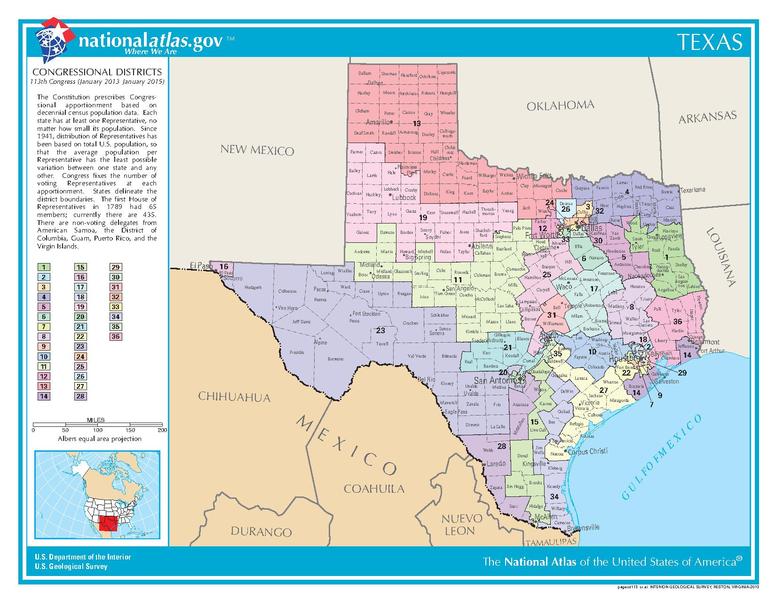
- Click here for the page.
The districts at issue are:
- 10
- 21
- 22
- 23
- 24
- 31
From Roll Call: Democratic polls show competitive House races in Texas
An emerging theme in various media sources.
- Click here for the article.
A handful of Republican-held House seats in the Texas suburbs represent fertile ground for competitive races in 2020, according to recent Democratic polling.
The surveys in six GOP districts, shared first with CQ Roll Call, are a sign that Democratic outside groups are willing to spend resources in the Lone Star State, where party leaders believe they can make gains next year. The polls were commissioned by House Majority Forward, the nonprofit arm of House Majority PAC, a super PAC tied to the chamber’s Democratic leadership.
Three of the districts surveyed have GOP incumbents running for reelection, including Reps. Michael McCaul in the 10th District, Chip Roy in the 21st and John Carter in the 31st. Polls were also conducted in three open-seat races in the 22nd, 23rd and 24th districts. Republicans won all six seats in 2018, all by margins of 5 points or less.
The surveys, conducted by Public Policy Polling, tested a generic Democrat against a generic Republican in each of the districts.
Respondents backed a generic Republican candidate over a Democratic one in four of the six races. In the 10th, 21st and 22nd districts, 49 percent supported a GOP candidate, compared to 46, 44 and 45 percent respectively for a Democrat. Fifty-one percent backed a Republican in the 31st District, compared to 44 percent for a Democrat.
For 2305 students, this fits with the chapters on public opinion, the media, parties, interest groups, elections, and Congress.
Relevant terminology:
- polling
- party leaders
- House Majority Forward
- House Majority PAC
- super PAC
- incumbents
- open seats
- Public Policy Polling
- generic candidates
- margin of error
- demographics
- suburbs
- DCCC
- job approval
- Click here for the article.
A handful of Republican-held House seats in the Texas suburbs represent fertile ground for competitive races in 2020, according to recent Democratic polling.
The surveys in six GOP districts, shared first with CQ Roll Call, are a sign that Democratic outside groups are willing to spend resources in the Lone Star State, where party leaders believe they can make gains next year. The polls were commissioned by House Majority Forward, the nonprofit arm of House Majority PAC, a super PAC tied to the chamber’s Democratic leadership.
Three of the districts surveyed have GOP incumbents running for reelection, including Reps. Michael McCaul in the 10th District, Chip Roy in the 21st and John Carter in the 31st. Polls were also conducted in three open-seat races in the 22nd, 23rd and 24th districts. Republicans won all six seats in 2018, all by margins of 5 points or less.
The surveys, conducted by Public Policy Polling, tested a generic Democrat against a generic Republican in each of the districts.
Respondents backed a generic Republican candidate over a Democratic one in four of the six races. In the 10th, 21st and 22nd districts, 49 percent supported a GOP candidate, compared to 46, 44 and 45 percent respectively for a Democrat. Fifty-one percent backed a Republican in the 31st District, compared to 44 percent for a Democrat.
For 2305 students, this fits with the chapters on public opinion, the media, parties, interest groups, elections, and Congress.
Relevant terminology:
- polling
- party leaders
- House Majority Forward
- House Majority PAC
- super PAC
- incumbents
- open seats
- Public Policy Polling
- generic candidates
- margin of error
- demographics
- suburbs
- DCCC
- job approval
Thursday, September 26, 2019
Wednesday, September 25, 2019
From Lawfare: How Companies Can Help Make Police Facial Recognition Systems More Transparent
For 2305, the next big issue in search and seizures.
- Click here for the article.
As facial recognition becomes an increasingly common law enforcement tool, the risks it can pose are becoming increasingly clear. Recently, police in Hong Kong are weaponizing the technology to identify protesters, who are using everything from face masks to laser pointers to try to avoid government retaliation for taking to the streets.
It may seem implausible that police in America would use facial recognition to identify and target protesters—but this has actually already happened. Several years ago, Baltimore police used a social media monitoring company, Geofeedia, to scan social media photos of people at a constitutionally protected protest of the death of Freddie Gray in police custody. Police used this information to find out if any protesters had outstanding warrants, and, according to the Baltimore Sun, arrested them “directly from the crowd.” Social media companies responded to this news by cutting off Geofeedia’s ability to scrape their photo data.
To the best of the public’s knowledge, law enforcement agencies have not tried to harness social media and online photo databases for facial recognition since the Geofeedia incident. But both technology companies and civil liberties advocates need to prepare for this possibility. Major companies that maintain personal photos through photo storing and sharing services—such as Facebook, Google, Apple, Amazon, Dropbox and Yahoo—should consider adding information on facial recognition to their annual transparency reports detailing many of their interactions with the government, including how the companies responded to government demands to turn over content.
Companies should also alert the public if the government issues orders to access these photo databases to conduct facial recognition scans. Given many companies’ proactive attitudes toward increasing transparency about government surveillance demands, publishing information on facial recognition would meaningfully expand their work to protect and better inform users.
The rapidly growing use of facial recognition makes it all the more important for companies to take such a step now: Already, at least one in four police departments possesses the capability to use facial recognition surveillance, and the FBI conducts an average of 4,000 facial recognition searches every month.
- Geofeedia.
- Click here for the article.
As facial recognition becomes an increasingly common law enforcement tool, the risks it can pose are becoming increasingly clear. Recently, police in Hong Kong are weaponizing the technology to identify protesters, who are using everything from face masks to laser pointers to try to avoid government retaliation for taking to the streets.
It may seem implausible that police in America would use facial recognition to identify and target protesters—but this has actually already happened. Several years ago, Baltimore police used a social media monitoring company, Geofeedia, to scan social media photos of people at a constitutionally protected protest of the death of Freddie Gray in police custody. Police used this information to find out if any protesters had outstanding warrants, and, according to the Baltimore Sun, arrested them “directly from the crowd.” Social media companies responded to this news by cutting off Geofeedia’s ability to scrape their photo data.
To the best of the public’s knowledge, law enforcement agencies have not tried to harness social media and online photo databases for facial recognition since the Geofeedia incident. But both technology companies and civil liberties advocates need to prepare for this possibility. Major companies that maintain personal photos through photo storing and sharing services—such as Facebook, Google, Apple, Amazon, Dropbox and Yahoo—should consider adding information on facial recognition to their annual transparency reports detailing many of their interactions with the government, including how the companies responded to government demands to turn over content.
Companies should also alert the public if the government issues orders to access these photo databases to conduct facial recognition scans. Given many companies’ proactive attitudes toward increasing transparency about government surveillance demands, publishing information on facial recognition would meaningfully expand their work to protect and better inform users.
The rapidly growing use of facial recognition makes it all the more important for companies to take such a step now: Already, at least one in four police departments possesses the capability to use facial recognition surveillance, and the FBI conducts an average of 4,000 facial recognition searches every month.
- Geofeedia.
From Lawfare: The Impeachable Offense
"Other high Crimes and Misdemeanors"
This is the third, catchall phrase in the formula designating impeachable offenses. The reader will hardly need to be told that it must generate, and has generated, great difficulties of interpretation. Some definite things can be said about its extent, but we will be left with an area of considerable vagueness. Let us take the definite things first.
It would be well to start with the one and only discussion of the phrase at the 1787 Constitutional Convention. The day was September 8, 1787, just nine days before the Constitution was signed and transmitted for the adherence of the states. The impeachment provision, as reported out by the last of the convention committees (except the final one charged only with polishing the style of the Constitution), listed "treason and bribery" as the only grounds for impeachment and removal. The colloquy we need to look at was brief, taking perhaps five minutes:
This is the third, catchall phrase in the formula designating impeachable offenses. The reader will hardly need to be told that it must generate, and has generated, great difficulties of interpretation. Some definite things can be said about its extent, but we will be left with an area of considerable vagueness. Let us take the definite things first.
It would be well to start with the one and only discussion of the phrase at the 1787 Constitutional Convention. The day was September 8, 1787, just nine days before the Constitution was signed and transmitted for the adherence of the states. The impeachment provision, as reported out by the last of the convention committees (except the final one charged only with polishing the style of the Constitution), listed "treason and bribery" as the only grounds for impeachment and removal. The colloquy we need to look at was brief, taking perhaps five minutes:
The clause referring to the Senate, the trial of impeachments agst. the President, for Treason & bribery, was taken up.
Col. Mason. Why is the provision restrained to Treason & bribery only? Treason as defined in the Constitution will not reach many great and dangerous offences. Hastings is not guilty of Treason. Attempts to subvert the Constitution may not be Treason as above defined— As bills of attainder which have saved the British Constitution are forbidden, it is the more necessary to extend: the power of impeachments. He movd. to add after "bribery" "or maladministration". Mr. Gerry seconded him—
Mr Madison So vague a term will be equivalent to a tenure during pleasure of the Senate.
Mr Govr Morris, it will not be put in force & can do no harm— An election of every four years will prevent maladministration.
Col. Mason withdrew "maladministration" & substitutes "other high crimes & misdemeanors"
On the question thus altered
From the Texas Tribune: New Texas prison program aims to help women leave the system with jobs waiting for them
For 2306, a look at the evolving nature of criminal justice in Texas.
- Click here for the article.
More than 12,000 women were incarcerated in Texas prison facilities as of August 2018, and nearly 11,000 were released from state custody in the preceding year, according to TDCJ. Texas has a relatively low recidivism rate compared with other states, with about 20% of those leaving state prisons being reincarcerated within three years. That number is 15% for women. (More than 40% are rearrested within the same time frame.)
But the increasing number of women in a male-dominated prison system has raised criticism over a lack of opportunities at women’s prisons. This year, state lawmakers passed multiple bills to improve gender-specific services, including a measure requiring the agency to adopt more educational, vocational and reentry programs geared toward women.
With the creation of STRIVE, an acronym for Strength Through Restoration, Independence, Vision and Empowerment, prison officials said they chose women they determined would have a higher risk of ending up back in prison without additional support. It’s free for the women, and officials said the agency hired a couple of new employees, though it’s mostly run with existing staff and equipment. As the program grows — the agency aims to double it by the end of the year — officials said women in state prisons will be eligible if they aren’t in high-security custody or other treatment programs.
- Click here for the article.
More than 12,000 women were incarcerated in Texas prison facilities as of August 2018, and nearly 11,000 were released from state custody in the preceding year, according to TDCJ. Texas has a relatively low recidivism rate compared with other states, with about 20% of those leaving state prisons being reincarcerated within three years. That number is 15% for women. (More than 40% are rearrested within the same time frame.)
But the increasing number of women in a male-dominated prison system has raised criticism over a lack of opportunities at women’s prisons. This year, state lawmakers passed multiple bills to improve gender-specific services, including a measure requiring the agency to adopt more educational, vocational and reentry programs geared toward women.
With the creation of STRIVE, an acronym for Strength Through Restoration, Independence, Vision and Empowerment, prison officials said they chose women they determined would have a higher risk of ending up back in prison without additional support. It’s free for the women, and officials said the agency hired a couple of new employees, though it’s mostly run with existing staff and equipment. As the program grows — the agency aims to double it by the end of the year — officials said women in state prisons will be eligible if they aren’t in high-security custody or other treatment programs.
From Texas Monthly: Is John Cornyn Vulnerable? For many years, taking on the senior Texas senator seemed like a fool’s errand. But in 2020, Cornyn looks less than invincible.
For both 2305 and 2306.
- Click here for the article.
. . . to most people—including many Texas Democrats—Cornyn’s run for reelection in 2020 seemed like just another sure thing, one last ride before the 67-year-old hung up his spurs and started raking it in as a lobbyist or a rainmaker for some big-deal law firm. Cornyn is certainly still the favorite at this point in the race, but in the last few months, his invincibility has come to look, well, less sure. In fact, a few things have happened that might be responsible for turning fat-cat Republicans into fraidy-cat Republicans.
The first shock came with Beto O’Rourke’s surprisingly narrow loss to Cruz in 2016. And then the polls started rolling in. In February, a Quinnipiac poll showed that voters actually liked Cruz better than Cornyn—51 to 43 percent. This September, another Quinnipiac survey showed that 23 percent of Texas voters said they would definitely consider voting for Cornyn, while 35 percent said they definitely would not. Thirty percent were leaning toward supporting him, while 13 percent were still undecided. You could almost hear the huhs among ambitious Democrats.
Unlike Cruz, Cornyn has a squishy base. Cornyn started out as a Bush Republican, but as time passed and politics changed, he tacked right and then further right like virtually all Texas Republicans. But perhaps Cornyn wasn’t convincing enough as he shifted: Despite his Trumpian voting record, he’s drawn a tea party opponent in the primary. State senator Pat Fallon, of Prosper, is hitting Cornyn in the same way some of the Democratic presidential candidates are attacking front-runner Joe Biden: “What would happen in Texas if we can finally have a candidate—a new one—that energized the right?” Fallon said in a speech on September 9, before announcing he was exploring a run. “That gave everybody in this room something to believe in.”
Fallon is probably not much of a threat, but Cornyn’s fealty to President Trump, which probably looked like a good idea early on, might create other problems for Half of all Texans are not fans of the president, according to most polling. If you are a Republican, maybe you are okay with the border wall, but perhaps those family separations make it hard to sleep at night. Maybe you’re worried about labor shortages that Trump’s anti-immigration policies could create in your business. And what about the trade policies that threaten to cut into profits generated in ports from Laredo to Houston?
- Click here for the article.
. . . to most people—including many Texas Democrats—Cornyn’s run for reelection in 2020 seemed like just another sure thing, one last ride before the 67-year-old hung up his spurs and started raking it in as a lobbyist or a rainmaker for some big-deal law firm. Cornyn is certainly still the favorite at this point in the race, but in the last few months, his invincibility has come to look, well, less sure. In fact, a few things have happened that might be responsible for turning fat-cat Republicans into fraidy-cat Republicans.
The first shock came with Beto O’Rourke’s surprisingly narrow loss to Cruz in 2016. And then the polls started rolling in. In February, a Quinnipiac poll showed that voters actually liked Cruz better than Cornyn—51 to 43 percent. This September, another Quinnipiac survey showed that 23 percent of Texas voters said they would definitely consider voting for Cornyn, while 35 percent said they definitely would not. Thirty percent were leaning toward supporting him, while 13 percent were still undecided. You could almost hear the huhs among ambitious Democrats.
Unlike Cruz, Cornyn has a squishy base. Cornyn started out as a Bush Republican, but as time passed and politics changed, he tacked right and then further right like virtually all Texas Republicans. But perhaps Cornyn wasn’t convincing enough as he shifted: Despite his Trumpian voting record, he’s drawn a tea party opponent in the primary. State senator Pat Fallon, of Prosper, is hitting Cornyn in the same way some of the Democratic presidential candidates are attacking front-runner Joe Biden: “What would happen in Texas if we can finally have a candidate—a new one—that energized the right?” Fallon said in a speech on September 9, before announcing he was exploring a run. “That gave everybody in this room something to believe in.”
Fallon is probably not much of a threat, but Cornyn’s fealty to President Trump, which probably looked like a good idea early on, might create other problems for Half of all Texans are not fans of the president, according to most polling. If you are a Republican, maybe you are okay with the border wall, but perhaps those family separations make it hard to sleep at night. Maybe you’re worried about labor shortages that Trump’s anti-immigration policies could create in your business. And what about the trade policies that threaten to cut into profits generated in ports from Laredo to Houston?
From Wikipedia: September 2019 Israeli legislative election
A look at an election run by proportional representation.
- Click here for it.
Snap legislative elections were held in Israel on 17 September 2019 to elect the 120 members of the twenty-second Knesset. Following the previous elections in April, incumbent Prime Minister Benjamin Netanyahu failed to form a governing coalition, the first such failure in Israeli history.[1] On 30 May, the Knesset voted to dissolve itself and trigger new elections, in order to prevent Blue and White party leader Benny Gantz from being appointed Prime Minister-designate.[2] This election was the first time that the Knesset voted to dissolve itself before a government had been formed.
For more: Knesset.
- Click here for it.
Snap legislative elections were held in Israel on 17 September 2019 to elect the 120 members of the twenty-second Knesset. Following the previous elections in April, incumbent Prime Minister Benjamin Netanyahu failed to form a governing coalition, the first such failure in Israeli history.[1] On 30 May, the Knesset voted to dissolve itself and trigger new elections, in order to prevent Blue and White party leader Benny Gantz from being appointed Prime Minister-designate.[2] This election was the first time that the Knesset voted to dissolve itself before a government had been formed.
For more: Knesset.
From Vox: The sudden Democratic shift in favor of impeaching Trump, explained
Things are about to get interesting.
- Click here for the article.
All of a sudden, President Donald Trump’s impeachment is looking likelier than ever.
Grappling with the latest revelations that Trump tried to pressure the president of Ukraine to investigate Joe Biden’s family, more and more House Democrats are concluding that Trump abused his powers of office — and that it’s time, at long last, for an unambiguous impeachment inquiry.
Their number includes Speaker Nancy Pelosi, who announced Tuesday afternoon that “the House of Representatives is moving forward with an official impeachment inquiry.”
See also: Impeaching the president, explained.
- Click here for the article.
All of a sudden, President Donald Trump’s impeachment is looking likelier than ever.
Grappling with the latest revelations that Trump tried to pressure the president of Ukraine to investigate Joe Biden’s family, more and more House Democrats are concluding that Trump abused his powers of office — and that it’s time, at long last, for an unambiguous impeachment inquiry.
Their number includes Speaker Nancy Pelosi, who announced Tuesday afternoon that “the House of Representatives is moving forward with an official impeachment inquiry.”
See also: Impeaching the president, explained.
From the Austin American Statesman: State ethics agency rebukes Travis County judge
For 2306.
- Click here for the article.
County Court-at-Law Judge John Lipscombe’s actions, which included draping black fabric over his courtroom doors, “cast public discredit on the judiciary” and was inconsistent with the proper performance of his duties, the State Commission on Judicial Conduct concluded.
“Judge Lipscombe’s decision to publicly protest Justice Kavanaugh’s confirmation in this manner was influenced by partisan interests” in violation of the state’s ethics code for judges, according to a public admonition that was signed Aug. 8 and made public Thursday.
The agency, which investigates complaints against judges at all levels, said news stories about the one-day closing of Court-at-Law No. 3 resulted in five complaints.
A message left Thursday afternoon at Lipscombe’s court was not returned.
According to the public admonition, the agency’s lowest level of rebuke behind a reprimand and a warning, Lipscombe said he became concerned after watching the contentious confirmation process for Kavanaugh.
“I became more and more disgusted and concerned for the future of the Supreme Court ... not because he comes from a political party different from mine, but because of his character and conduct,” Lipscombe told the Commission on Judicial Conduct, according to the admonition.
Lipscombe, a Democratic judge since 2011, said he believed Kavanaugh’s conduct during his confirmation hearing, when he angrily sparred with Democrats on the Senate Judiciary Committee, besmirched the Supreme Court’s reputation.
“I had a personal obligation to show my disapproval and demonstrate my utmost respect for the judiciary,” Lipscombe said, according to the commission.
On Oct. 8, 2018, two days after Kavanaugh was confirmed, Lipscombe said he closed his court, which had 107 matters on its docket with 69 defendants scheduled to appear, and contacted the president of the Austin Criminal Defense Lawyers Association to ask for word of the closing to be spread among attorneys.
- Click here for the article.
A state ethics agency has rebuked a Travis County judge who closed his courtroom last year to protest the U.S. Senate confirmation of Brett Kavanaugh, President Donald Trump’s nominee to the U.S. Supreme Court.
County Court-at-Law Judge John Lipscombe’s actions, which included draping black fabric over his courtroom doors, “cast public discredit on the judiciary” and was inconsistent with the proper performance of his duties, the State Commission on Judicial Conduct concluded.
“Judge Lipscombe’s decision to publicly protest Justice Kavanaugh’s confirmation in this manner was influenced by partisan interests” in violation of the state’s ethics code for judges, according to a public admonition that was signed Aug. 8 and made public Thursday.
The agency, which investigates complaints against judges at all levels, said news stories about the one-day closing of Court-at-Law No. 3 resulted in five complaints.
A message left Thursday afternoon at Lipscombe’s court was not returned.
According to the public admonition, the agency’s lowest level of rebuke behind a reprimand and a warning, Lipscombe said he became concerned after watching the contentious confirmation process for Kavanaugh.
“I became more and more disgusted and concerned for the future of the Supreme Court ... not because he comes from a political party different from mine, but because of his character and conduct,” Lipscombe told the Commission on Judicial Conduct, according to the admonition.
Lipscombe, a Democratic judge since 2011, said he believed Kavanaugh’s conduct during his confirmation hearing, when he angrily sparred with Democrats on the Senate Judiciary Committee, besmirched the Supreme Court’s reputation.
“I had a personal obligation to show my disapproval and demonstrate my utmost respect for the judiciary,” Lipscombe said, according to the commission.
On Oct. 8, 2018, two days after Kavanaugh was confirmed, Lipscombe said he closed his court, which had 107 matters on its docket with 69 defendants scheduled to appear, and contacted the president of the Austin Criminal Defense Lawyers Association to ask for word of the closing to be spread among attorneys.
Great Stink
A fun - if a bit gross - look at the development of London's sewage system. An underappreciated part of local government.
Monday, September 23, 2019
Thursday, September 19, 2019
Viewed in class today
- Definition: zeal.
- Definition: impulse.
- Separate Car Act.
- Plessy v Ferguson.
- Presidential election results.
- Scott v Sanford.
- police power.
- Fisher v UT.
- Loving v Virginia.
- Craig v Boren.
- Dyer Anti-Lynching Bill.
- Guadalupe-Blanco River Authority
- Pure Food and Drug Act.
- Controlled Substances Act.
- Definition: impulse.
- Separate Car Act.
- Plessy v Ferguson.
- Presidential election results.
- Scott v Sanford.
- police power.
- Fisher v UT.
- Loving v Virginia.
- Craig v Boren.
- Dyer Anti-Lynching Bill.
- Guadalupe-Blanco River Authority
- Pure Food and Drug Act.
- Controlled Substances Act.
From 538: Just How Many Swing Voters Are There?
For our upcoming look at voting.
- Click here for the article.
It’s a long time until the 2020 general election, but there’s a good chance it will be competitive. After all, we live in a politically polarized era where most presidential elections are decided by relatively narrow margins (since 1988, in the single digits). Which means if the margins are as slim as they were in 2016, the race could come down to swing voters, or voters that tend to switch their support between the two major parties from year to year.
So we were curious: Just how many swing voters are there? A number of researchers have tried to tackle this question, and it turns out, there’s a pretty big range of answers.
That’s because defining who is and isn’t a swing voter isn’t easy, as it’s a small group. But estimates I previously made based on a couple of data sets suggest that there were around 10 million voters who shifted from voting for one major party in 2012 to the other in 2016, which accounted for roughly 7 percent of all votes cast. In the grand scheme of things, that’s not a lot of people, but these voters probably did play a role in helping President Trump get elected because around three-quarters of those voters swung toward him rather than Hillary Clinton.
- Click here for the article.
It’s a long time until the 2020 general election, but there’s a good chance it will be competitive. After all, we live in a politically polarized era where most presidential elections are decided by relatively narrow margins (since 1988, in the single digits). Which means if the margins are as slim as they were in 2016, the race could come down to swing voters, or voters that tend to switch their support between the two major parties from year to year.
So we were curious: Just how many swing voters are there? A number of researchers have tried to tackle this question, and it turns out, there’s a pretty big range of answers.
That’s because defining who is and isn’t a swing voter isn’t easy, as it’s a small group. But estimates I previously made based on a couple of data sets suggest that there were around 10 million voters who shifted from voting for one major party in 2012 to the other in 2016, which accounted for roughly 7 percent of all votes cast. In the grand scheme of things, that’s not a lot of people, but these voters probably did play a role in helping President Trump get elected because around three-quarters of those voters swung toward him rather than Hillary Clinton.
From 538: How To Win An Election
FYI
- Click here for the article.

The article compiles polling info about things most people agree with:
98 percent believe adults should watch swimmers rather than reading or talking on the phone. (American Red Cross Water Safety Poll, 2013)
99 percent think it’s wrong for employees to steal expensive equipment from their workplace. (NBC News Poll, 1995)
95 percent think it’s wrong to pay someone to do a term paper for you. (NBC News Poll, 1995)
98 percent would like to see a decline in hunger in the world. (Harris Survey, 1983)
97 percent would like to see a decline in terrorism and violence. (Harris Survey, 1983)
98% would like to see an end to high unemployment. (Harris Survey, 1982)
95 percent would like to see an end to all wars. (Harris Survey, 1981)
95 percent would like to see a decline in prejudice. (Harris Survey, 1977)
95 percent don’t believe Magic 8 Balls can predict the future. (Shell Poll, 1998)
96 percent think the Olympics are a great sports competition. (Atlanta Journal-Constitution Poll, 1996)
- Click here for the article.
The article compiles polling info about things most people agree with:
98 percent believe adults should watch swimmers rather than reading or talking on the phone. (American Red Cross Water Safety Poll, 2013)
99 percent think it’s wrong for employees to steal expensive equipment from their workplace. (NBC News Poll, 1995)
95 percent think it’s wrong to pay someone to do a term paper for you. (NBC News Poll, 1995)
98 percent would like to see a decline in hunger in the world. (Harris Survey, 1983)
97 percent would like to see a decline in terrorism and violence. (Harris Survey, 1983)
98% would like to see an end to high unemployment. (Harris Survey, 1982)
95 percent would like to see an end to all wars. (Harris Survey, 1981)
95 percent would like to see a decline in prejudice. (Harris Survey, 1977)
95 percent don’t believe Magic 8 Balls can predict the future. (Shell Poll, 1998)
96 percent think the Olympics are a great sports competition. (Atlanta Journal-Constitution Poll, 1996)
From Wikipedia: Wilderness Road
Prior to the Natchez Trace ...
- Click here for the article.
The Wilderness Road served as a great path of commerce for the early settlers in Kentucky, as well as for coffles of slaves being transported through Tennessee to the new plantations in Mississippi and Louisiana. Horses, cattle, sheep and hogs herded in the other direction found waiting markets in the Carolinas, Maryland and Virginia. Hogs in groups of 500 or more were driven down the Road to market. Beef in Eastern markets had become a main source of income for farmers in Kentucky.[21]
A postal road was opened in 1792 from Bean Station, Tennessee through Cumberland Gap to Danville, Kentucky. This was due largely to the efforts of Governor Isaac Shelby of Kentucky. This connection of Kentucky to the East was a great advantage. Frontier settlers considered the postal riders heroes and waited eagerly for their arrival for news from settlements along the trails as well as getting their mail and newspapers

- Click here for the article.
The Wilderness Road served as a great path of commerce for the early settlers in Kentucky, as well as for coffles of slaves being transported through Tennessee to the new plantations in Mississippi and Louisiana. Horses, cattle, sheep and hogs herded in the other direction found waiting markets in the Carolinas, Maryland and Virginia. Hogs in groups of 500 or more were driven down the Road to market. Beef in Eastern markets had become a main source of income for farmers in Kentucky.[21]
A postal road was opened in 1792 from Bean Station, Tennessee through Cumberland Gap to Danville, Kentucky. This was due largely to the efforts of Governor Isaac Shelby of Kentucky. This connection of Kentucky to the East was a great advantage. Frontier settlers considered the postal riders heroes and waited eagerly for their arrival for news from settlements along the trails as well as getting their mail and newspapers
From Wikipedia: Natchez Trace
More on early roads in the US.
- Click here for the article.
Even before the 1803 Louisiana Purchase, President Thomas Jefferson wanted to connect the distant Mississippi frontier to other settled areas of the United States. To foster communication with what was then called the Southwest, he directed construction of a postal road to be built between Daniel Boone's Wilderness Road (the southern branch of the road ended at Nashville) and the Mississippi River.
The U.S. signed treaties with the Chickasaw and Choctaw tribes to maintain peace, as European Americans entered the area in greater numbers. In 1801 the United States Army began trail blazing along the Trace, performing major work to prepare it as a thoroughfare. The work was first done by soldiers reassigned from Tennessee and later by civilian contractors. To emphasize American sovereignty in the area, Jefferson called it the "Columbian Highway." The people who used it, however, dubbed the road as "The Devil's Backbone" due to its remoteness, rough conditions, and the frequently encountered highwaymen found along the new road.
By 1809, the trail was fully navigable by wagon, with the northward journey taking two to three weeks. Critical to the success of the Trace as a trade route was the development of inns and trading posts, referred to at the time as "stands."
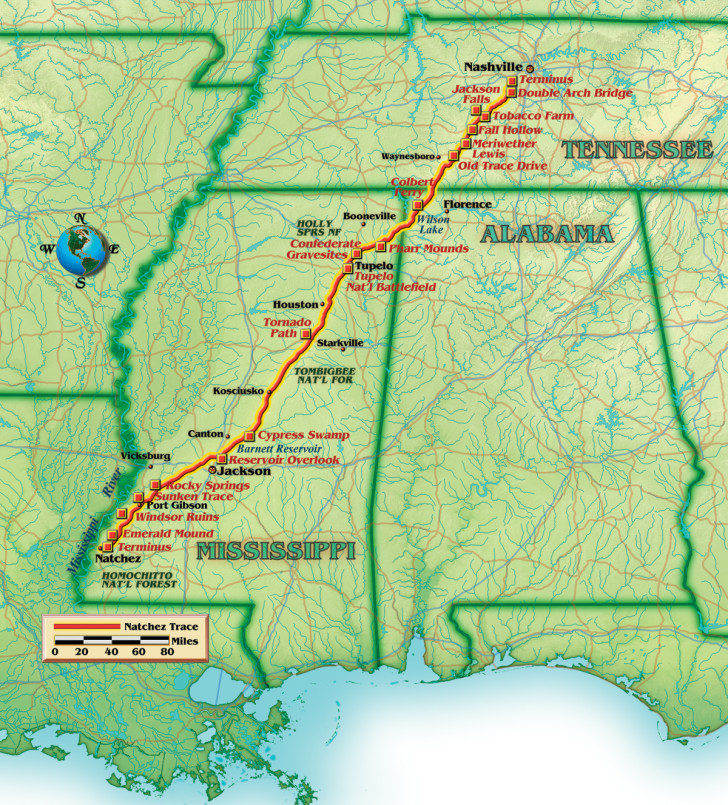
- Click here for the article.
Even before the 1803 Louisiana Purchase, President Thomas Jefferson wanted to connect the distant Mississippi frontier to other settled areas of the United States. To foster communication with what was then called the Southwest, he directed construction of a postal road to be built between Daniel Boone's Wilderness Road (the southern branch of the road ended at Nashville) and the Mississippi River.
The U.S. signed treaties with the Chickasaw and Choctaw tribes to maintain peace, as European Americans entered the area in greater numbers. In 1801 the United States Army began trail blazing along the Trace, performing major work to prepare it as a thoroughfare. The work was first done by soldiers reassigned from Tennessee and later by civilian contractors. To emphasize American sovereignty in the area, Jefferson called it the "Columbian Highway." The people who used it, however, dubbed the road as "The Devil's Backbone" due to its remoteness, rough conditions, and the frequently encountered highwaymen found along the new road.
By 1809, the trail was fully navigable by wagon, with the northward journey taking two to three weeks. Critical to the success of the Trace as a trade route was the development of inns and trading posts, referred to at the time as "stands."
Tuesday, September 17, 2019
Monday, September 16, 2019


Texas Tribune: Federal judge orders Galveston County to have defense lawyers at bail-setting hearings
For our look at federalism, due process, equal protection, etc....
- Click here for the article.
Add Galveston to the list of Texas counties that have been court ordered to change their bail practices.
A federal district judge on Wednesday issued a temporary injunction in a 2018 lawsuit where attorneys for inmates have called Galveston County’s money bail system discriminatory against poor criminal defendants. The court’s order doesn’t target the entire pretrial system — which has largely changed since the suit was filed after federal rulings against Harris County. But it requires poor arrestees to have a lawyer at their first court appearance, where their bail is set to determine the monetary or other conditions under which an arrestee can be released from jail before trial.
The ACLU of Texas, which represents Galveston County inmates in the lawsuit, said in a statement after the order that it was the first court in the country to conclude that the Sixth Amendment, which guarantees a right to counsel, requires defense attorneys to be provided at initial bail-setting hearings.
“It’s a matter of basic fairness that you should get a lawyer before a judge decides whether to lock you in jail,” said Trisha Trigilio, senior staff attorney for the ACLU of Texas. “Unsurprisingly, without lawyers to advocate for their release, many people wind up in jail who shouldn’t be there. And even a short time in jail can have devastating repercussions on someone’s life.”
- Click here for the article.
Add Galveston to the list of Texas counties that have been court ordered to change their bail practices.
A federal district judge on Wednesday issued a temporary injunction in a 2018 lawsuit where attorneys for inmates have called Galveston County’s money bail system discriminatory against poor criminal defendants. The court’s order doesn’t target the entire pretrial system — which has largely changed since the suit was filed after federal rulings against Harris County. But it requires poor arrestees to have a lawyer at their first court appearance, where their bail is set to determine the monetary or other conditions under which an arrestee can be released from jail before trial.
The ACLU of Texas, which represents Galveston County inmates in the lawsuit, said in a statement after the order that it was the first court in the country to conclude that the Sixth Amendment, which guarantees a right to counsel, requires defense attorneys to be provided at initial bail-setting hearings.
“It’s a matter of basic fairness that you should get a lawyer before a judge decides whether to lock you in jail,” said Trisha Trigilio, senior staff attorney for the ACLU of Texas. “Unsurprisingly, without lawyers to advocate for their release, many people wind up in jail who shouldn’t be there. And even a short time in jail can have devastating repercussions on someone’s life.”
From the Texas Tribune: Texas wasn’t a battleground state until young people made it one
For 2305 and 2306
- Click here for the article.
When I was born in 1996, George W. Bush was already a year into his first term as governor of Texas. In my lifetime, Texas politics has been entirely dominated by conservative giants who governed with unchecked power, while progressives seemed to lose more and more ground. I have never known a Texas that sounded more like Ann Richards and Barbara Jordan than it did like Fox News and Karl Rove.
Few national campaigns, funders or candidates bothered to show up here, underscoring their preconceived notion that Texas was never in play to begin with. As a result, the infrastructure necessary to register and turn out voters has consistently lagged behind heavily courted states like Iowa, New Hampshire and Virginia.
But for the first time in decades, Texas politics are changing.
The Democratic Party’s decision to host this week’s presidential debate in Houston is the latest indicator of what so many of us have been saying for years: Texas is the largest battleground state in the country. But the part too often glossed over is that the Lone Star State is only in play because of young voters.
In Texas, 43% of us are under the age of 30, and 63% are people of color. Our state is getting younger and more diverse every day and in 2018, those young folks showed up to flex their electoral power. Youth turnout tripled in Texas between 2014 and 2018, a surge that helped flip 12 seats in the Texas House of Representatives, two in the Senate, and brought Democrat Beto O’Rourke within striking distance of Republican U.S. Sen. Ted Cruz. When young people showed up to vote, the conversation about Texas started to change.
But showing up has never been inevitable. Texas has some of the strictest voting laws in the country, laws that disproportionately block access to the ballot box for young people and people of color. That’s why groups like MOVE Texas, Texas Rising, JOLT Action and Battleground Texas invest so heavily in civic education, voter registration and voter turnout programs that empower young Texans vote — many for the first time. But we are not just turning folks out to vote for one election; we are creating a habit of civic participation that will create life-long voters and fundamentally change who decides elections in this state.
- Click here for the article.
When I was born in 1996, George W. Bush was already a year into his first term as governor of Texas. In my lifetime, Texas politics has been entirely dominated by conservative giants who governed with unchecked power, while progressives seemed to lose more and more ground. I have never known a Texas that sounded more like Ann Richards and Barbara Jordan than it did like Fox News and Karl Rove.
Few national campaigns, funders or candidates bothered to show up here, underscoring their preconceived notion that Texas was never in play to begin with. As a result, the infrastructure necessary to register and turn out voters has consistently lagged behind heavily courted states like Iowa, New Hampshire and Virginia.
But for the first time in decades, Texas politics are changing.
The Democratic Party’s decision to host this week’s presidential debate in Houston is the latest indicator of what so many of us have been saying for years: Texas is the largest battleground state in the country. But the part too often glossed over is that the Lone Star State is only in play because of young voters.
In Texas, 43% of us are under the age of 30, and 63% are people of color. Our state is getting younger and more diverse every day and in 2018, those young folks showed up to flex their electoral power. Youth turnout tripled in Texas between 2014 and 2018, a surge that helped flip 12 seats in the Texas House of Representatives, two in the Senate, and brought Democrat Beto O’Rourke within striking distance of Republican U.S. Sen. Ted Cruz. When young people showed up to vote, the conversation about Texas started to change.
But showing up has never been inevitable. Texas has some of the strictest voting laws in the country, laws that disproportionately block access to the ballot box for young people and people of color. That’s why groups like MOVE Texas, Texas Rising, JOLT Action and Battleground Texas invest so heavily in civic education, voter registration and voter turnout programs that empower young Texans vote — many for the first time. But we are not just turning folks out to vote for one election; we are creating a habit of civic participation that will create life-long voters and fundamentally change who decides elections in this state.
From the Houston Chronicle: Effort to lift age for buying tobacco to 21 faces court challenge
age discrimination?
- Click here for the article.
San Antonio is one more than 280 cities and counties across the nation that have raised the minimum age to purchase tobacco products to 21. At least five states have similar laws.
The San Antonio City Council, in a 9-2 vote, passed the ordinance in January. It went into effect Oct. 1, but the city gave retailers a three-month grace period to comply. The city will begin enforcing the law next week, when inspectors and underage decoys will conduct begin random visits to stores to ensure they are complying.
Stores that violate the ordinance face fines of up to $500, while young adults caught purchasing, using or possessing tobacco face no penalties.
That disparate treatment is the basis of the challenge brought by convenience store owners, who argue the ordinance unfairly singles them out. The lawsuit, brought by the trade groups Association of Convenience Store Retailers, South Texas Merchants Association Cooperative and Texas Food and Fuel Association, asks the court to declare the ordinance “unconstitutional and void” because their “members were deprived equal protection” under federal and state laws.
“Without any enforcement provision for the (purchase, use and possession) of tobacco products by persons aged 18 to 20, (the ordinance) is clearly biased against one class for the benefit of another,” the lawsuit said.
Among those who oppose the ordinance is Anwar Tahir, owner of an independent West Side convenience store and president of the Association of Convenience Store Retailers in San Antonio. Tahir projects his store would lose as much as 4 percent of its profit because of the law.
“This is an unequal thing. They are penalizing the retailer only,” Tahir said. “It’s unfair. You cannot penalize one party and on the consumer side there is no law enforcement. We are saving their life, but we are not enforcing the law on them.”
- Click here for the article.
San Antonio is one more than 280 cities and counties across the nation that have raised the minimum age to purchase tobacco products to 21. At least five states have similar laws.
The San Antonio City Council, in a 9-2 vote, passed the ordinance in January. It went into effect Oct. 1, but the city gave retailers a three-month grace period to comply. The city will begin enforcing the law next week, when inspectors and underage decoys will conduct begin random visits to stores to ensure they are complying.
Stores that violate the ordinance face fines of up to $500, while young adults caught purchasing, using or possessing tobacco face no penalties.
That disparate treatment is the basis of the challenge brought by convenience store owners, who argue the ordinance unfairly singles them out. The lawsuit, brought by the trade groups Association of Convenience Store Retailers, South Texas Merchants Association Cooperative and Texas Food and Fuel Association, asks the court to declare the ordinance “unconstitutional and void” because their “members were deprived equal protection” under federal and state laws.
“Without any enforcement provision for the (purchase, use and possession) of tobacco products by persons aged 18 to 20, (the ordinance) is clearly biased against one class for the benefit of another,” the lawsuit said.
Among those who oppose the ordinance is Anwar Tahir, owner of an independent West Side convenience store and president of the Association of Convenience Store Retailers in San Antonio. Tahir projects his store would lose as much as 4 percent of its profit because of the law.
“This is an unequal thing. They are penalizing the retailer only,” Tahir said. “It’s unfair. You cannot penalize one party and on the consumer side there is no law enforcement. We are saving their life, but we are not enforcing the law on them.”
Viewed in class today
- Judge temporarily blocks plans to drain four Texas lakes and accompanying dams.
- Hear how this Texas school district found itself at risk of returning to a segregated past.
- Analysis: Texas redistricting is hard enough when politicians trust the mapmakers.
- Griswold v. Connecticut.
- Lemon v. Kurtzman.
- Title VII of the Civil Rights Act of 1964.
- Texas just raised the smoking age to 21. Who is exempt and what are the penalties?
- Abbot says he has sued the Obama administration 25 times.
- Hear how this Texas school district found itself at risk of returning to a segregated past.
- Analysis: Texas redistricting is hard enough when politicians trust the mapmakers.
- Griswold v. Connecticut.
- Lemon v. Kurtzman.
- Title VII of the Civil Rights Act of 1964.
- Texas just raised the smoking age to 21. Who is exempt and what are the penalties?
- Abbot says he has sued the Obama administration 25 times.
Friday, September 13, 2019
Thomas Nast
More on the media personalities that highlighted the five points - specifically the political corruption that underlay it.
- Wikipedia.

- more on Tammany Hall here.
- Wikipedia.
- more on Tammany Hall here.
How the Other Half Lives
An example of the media - especially the increased use of cameras - as an agenda setter. This book highlighted living conditions in the five points.
- Wikipedia
- Jacob Riis.

- Wikipedia
- Jacob Riis.
From Wikipedia: Conscription in the United States
This stems from the discussion of the draft riots in the video in the five points area below.
- Click here for it.
The constitutionality of the draft was the subject of Arver v US. As mentioned in 2305, the draft is an implied, not enumerated power.
- Click here for it.
The constitutionality of the draft was the subject of Arver v US. As mentioned in 2305, the draft is an implied, not enumerated power.
Subscribe to:
Posts (Atom)