The address of the Danbury Baptists Association in the state of Connecticut, assembled October 7, 1801.
To Thomas Jefferson, Esq., President of the United States of America.
Sir,
Among the many million in America and Europe who rejoice in your election to office; we embrace the first opportunity which we have enjoyed in our collective capacity, since your inauguration, to express our great satisfaction, in your appointment to the chief magistracy in the United States: And though our mode of expression may be less courtly and pompous than what many others clothe their addresses with, we beg you, sir, to believe that none are more sincere.
Our sentiments are uniformly on the side of religious liberty‐‐that religion is at all times and places a matter between God and individuals‐‐that no man ought to suffer in name, person, or effects on account of his religious opinions‐‐that the legitimate power of civil government extends no further than to punish the man who works ill to his neighbors; But, sir, our constitution of government is not specific. Our ancient charter together with the law made coincident therewith, were adopted as the basis of our government, at the time of our revolution; and such had been our laws and usages, and such still are; that religion is considered as the first object of legislation; and therefore what religious privileges we enjoy (as a minor part of the state) we enjoy as favors granted, and not as inalienable rights; and these favors we receive at the expense of such degrading acknowledgements as are inconsistent with the rights of freemen. It is not to be wondered at therefore; if those who seek after power and gain under the pretense of government and religion should reproach their fellow men‐‐should reproach their order magistrate, as a enemy of religion, law, and good order, because he will not, dare not, assume the prerogatives of Jehovah and make laws to govern the kingdom of Christ.
Sir, we are sensible that the president of the United States is not the national legislator, and also sensible that the national government cannot destroy the laws of each state; but our hopes are strong that the sentiments of our beloved president, which have had such genial effect already, like the radiant beams of the sun, will shine and prevail through all these states and all the world, till hierarchy and tyranny be destroyed from the earth. Sir, when we reflect on your past services, and see a glow of philanthropy and good will shining forth in a course of more than thirty years we have reason to believe that Americaʹs God has raised you up to fill the chair of state out of that goodwill which he bears to the millions which you preside over. May God strengthen you for your arduous task which providence and the voice of the people have called you to sustain and support you enjoy administration against all the predetermined opposition of those who wish to raise to wealth and importance on the poverty and subjection of the people.
And may the Lord preserve you safe from every evil and bring you at last to his heavenly kingdom through Jesus Christ our Glorious Mediator.
Signed in behalf of the association, Nehemiah Dodge
Ephraim Robbins
Stephen S. Nelson
_________________________
Thomas Jefferson’s Letter to the Danbury Baptist Association
To messers. Nehemiah Dodge, Ephraim Robbins, & Stephen S. Nelson, a committee of the Danbury Baptist association in the state of Connecticut.
Gentlemen
The affectionate sentiments of esteem and approbation which you are so good as to express towards me, on behalf of the Danbury Baptist association, give me the highest satisfaction. My duties dictate a faithful and zealous pursuit of the interests of my constituents, & in proportion as they are persuaded of my fidelity to those duties, the discharge of them becomes more and more pleasing.
Believing with you that religion is a matter which lies solely between Man & his God, that he owes account to none other for his faith or his worship, that the legitimate powers of government reach actions only, & not opinions, I contemplate with sovereign reverence that act of the whole American people which declared that their legislature should ʺmake no law respecting an establishment of religion, or prohibiting the free exercise thereof,ʺ thus building a wall of separation between Church & State. Adhering to this expression of the supreme will of the nation in behalf of the rights of conscience, I shall see with sincere satisfaction the progress of those sentiments which tend to restore to man all his natural rights, convinced he has no natural right in opposition to his social duties.
I reciprocate your kind prayers for the protection & blessing of the common father and creator of man, and tender you for yourselves & your religious association, assurances of my high respect & esteem.
Th Jefferson
Jan. 1. 1802
Tuesday, November 17, 2020
From Roll Call: House Democrats’ leadership races reflect coming generational change
Political generations in Congress.
- Click here for the story.
With Assistant Speaker Ben Ray Luján running for the open Senate seat in New Mexico, three lawmakers — Tony Cárdenas of California, David Cicilline of Rhode Island and Katherine M. Clark of Massachusetts — are vying to replace him as the fourth-ranking House Democrat.
The top three leaders who have led the caucus for nearly two decades, Speaker Nancy Pelosi, 80, House Majority Leader Steny H. Hoyer, 81, and Majority Whip James E. Clyburn, 80, are expected to stay in those positions, according to several Democratic lawmakers and aides CQ Roll Call spoke with for this report.
The team forming below them represents the generational change many rank-and-file Democrats have long sought. All of the candidates running were first elected to the House in the past decade.
Pelosi has promised she wouldn’t serve as speaker beyond 2022, so whoever becomes assistant speaker is likely a potential candidate to replace her. Democratic Caucus Chairman Hakeem Jeffries, 50, first elected in 2012, is seeking reelection to the No. 5 leadership post unchallenged and is another potential speaker hopeful.


From Roll Call: 5 things to watch in House Democrats’ leadership elections
The 117th Congress takes shape.
- Click here for the story.
House Democrats this week will elect most of their leadership team for the 117th Congress, making choices in contested races that will determine the ideological, racial and gender balance of caucus decision-makers.
This week’s elections include three contested races: assistant speaker, caucus vice chair and caucus leadership representative, a position reserved for members who’ve served five terms or less.
Monday, November 16, 2020
From The Hill: Questions swirl at Pentagon after wave of departures
How might the military respond to recent presidential actions?
- Click here for the article.
Is it a coup, a push to withdraw from Afghanistan or just some petty score settling?
The shakeup has led Trump’s critics to sound the alarm, with Democratic lawmakers and others fearful of what the Pentagon’s new leadership will try to push through in Trump’s remaining two months in office.
But others say the Pentagon’s vast bureaucracy and the military chain-of-command make any radical changes in less than 70 days difficult.
“All this speculation about, ‘Is Trump going to do something with the Insurrection Act, is he going to invade some country?’ No,” said Mark Cancian, a former defense official now at the Center for Strategic and International Studies.
While “it’s not impossible that he would try some precipitous withdrawal from Afghanistan,” Cancian said, the military “could slow roll him” on anything he directs.
In a speech on Veterans Day, Chairman of the Joint Chiefs of the Staff Gen. Mark Milley touted the apolitical nature of the military. It’s a message he’s delivered frequently in recent months, but one that received renewed attention amid the upheaval.
“We are unique among militaries,” Milley said at a ceremony marking the opening of the National Museum of the United States Army. “We do not take an oath to a king or a queen, a tyrant or a dictator. We do not take an oath to an individual. No, we do not take an oath to a country, a tribe or religion. We take an oath to the Constitution.
From Wikipedia: Freedom Suits
Quite enterprise before the Dred Scott case.
- Click here for the article.
Freedom suits were lawsuits in the Thirteen Colonies and the United States filed by enslaved people against slaveholders to assert claims to freedom, often based on descent from a free maternal ancestor, or time held as a resident in a free state or territory.
While some cases were tried during the colonial period, the majority of petitions for freedom were heard during the antebellum period in the border or the Southern United States. After the American Revolution, most northern states abolished slavery and were considered "free." The United States Congress prohibited slavery in some newly established territories, and some new states were admitted to the union as free states. The rise in travel and migration of masters with slaves between free and slave states resulted in conditions that gave rise to slaves suing for freedom. Many free states had residency limits for masters who brought slaves into their territory; after that time, the slave would be considered free. Some slaves sued for wrongful enslavement after being held in a free state.
Other grounds for suit were that the person was freeborn and illegally held in slavery, or that the person was illegally held because of being descended from a freeborn woman in the maternal line. The principle of partus sequitur ventrem, first incorporated into English colonial slavery law by a 1662 statute in Virginia, established that children's status was that of the mother. It was adopted into law by other English colonies, and the states of the United States.
In Saint Louis, Missouri records of nearly 300 petition cases have been found that were filed between 1807 and 1860, and in Washington, D.C. nearly 500 petition cases were filed in the same period. A large portion of cases, as much as one-third, either never went to trial or were settled out of court. In the early nineteenth century in St. Louis and in Washington, D.C., nearly half of the attorneys at the bar may have acted as counsel for slave petitions.
Sunday, November 15, 2020
From Wikipedia: Harris County
Might as well right?
- Click here for the entry.
From its history:
In 1824, the land empresario, Stephen F. Austin convened at the house of William Scott for the purpose of conveying titles for Mexican headrights. He was joined by the land commissioner, Baron von Bastrop, and Austin's secretary, Samuel May Williams. About thirty families gained legal titles to land in what would later be known as Harris County. A few immigrants settled on Buffalo Bayou in these early years, including Moses Callahan, Ezekial Thomas, and the Vince brothers.
Nicolas Clopper arrived in the Galveston Bay area from Ohio in the 1820s. He attempted to develop Buffalo Bayou as a trading conduit for the Brazos River valley. He acquired land at Morgan's Point in 1826. John Richardson Harris (1790–1829), for whom the county was later named, arrived in 1824. Harris had moved his family to Sainte Genevieve, Missouri Territory, where they had been residing until the early 1820s.
Harris was granted a league of land (about 4,428 acres) at Buffalo Bayou. He platted the town of Harrisburg in 1826, while he established a trading post and a grist mill there. He ran boats transporting goods between New Orleans and Harrisburg until his death in the fall of 1829.
The First Congress of the Republic of Texas established Harrisburg County on December 22, 1836. The original county boundaries included Galveston Island, but were redrawn to its current configuration in May 1838.
From the Texas Tribune: Judge rules acting Homeland Security secretary appointment unlawful, which could have implications for DACA
More checking and balancing
- Click here for it.
A federal judge in New York has ruled that acting Homeland Security secretary Chad Wolf lacked the authority to limit the work permits of hundreds of thousands of undocumented immigrants who came to the United States as children because his appointment to the top position in the department did not appear to be lawful.
U.S. District Judge Nicholas G. Garaufis — one of the first judges to block President Trump from phasing out the work permits the government issues via the Deferred Action for Childhood Arrivals program, or DACA — said in an unusual Saturday ruling that the “plain text” of the department’s order of succession showed that Wolf’s ascension to acting secretary did not follow established law and was part of several hastily crafted administration moves designed to get people into the top DHS position outside of standard procedures.
As a result, Garaufis said, Wolf’s memo in July limiting the validity of the DACA permits from two years to one year “was not an exercise of legal authority.”
Garaufis’s ruling adds to the complex legal battles surrounding the Obama-era DACA program, which was designed to give those who arrived into the United States as minors a way to stay in the country. More than 640,000 immigrants known as “dreamers” currently rely on the program to live and work in the United States.
The Pro-Slavery Movement
Before abolition picked up steam, proponents of slavery sought to advance support.
- Wikipedia: Slavery as a positive good in the United States.
- John Calhoun's Speech: Slavery a Positive Good.
- Wikipedia: Nullifier Party.
- Wikipedia: Nullification.
Friday, November 13, 2020
The House Select Committee on the Modernization of Congress
Congress gets modified from time to time, including - possibly - now.
- Click here for the committee.
- Their final report.
- From the CRS: House Select Committee on theModernization of Congress:Structure and Procedures.
- From Roll Call: ‘Fix Congress Committee’ launches framework for earmark revival.
From CNN: 2020 Exit Polls
Something's changed between 22016 and 2020, some didn't ... much.
- Click here for the article.
From the Texas Tribune: Analysis: Texans in many border counties voted for Donald Trump — and then for Democrats
Split ticket voting among Latinos in Texas.
- Click here for the article.
All but one of the Republicans running statewide campaigns in Texas this year beat their opponents by 8 to 11 percentage points. The one? President Donald Trump, who beat Joe Biden by 5.8 percentage points.
Statewide, Texas Republicans outperformed the leader of their ticket.
In several places along the Texas border, the opposite happened. Much has been written about Trump’s strong performance in the persistently blue counties on the Texas-Mexico border. His border supporters were numerous and enthusiastic. The New York Times sent reporters to Zapata County, which flipped from its customary spot on the Democratic side of the aisle to a seat on the Republican side. The Wall Street Journal went to Starr, where Trump improved dramatically on historical Republican results.
But it’s not like those blue counties switched sides altogether. Voters there supported Trump — in most cases that meant he still lost, but by less than in his first race in 2016 — but then many of them went back to voting more or less like they usually do.
Start with Zapata County. Chrysta Castañeda, a Democrat running for a seat on the Texas Railroad Commission, beat Republican Jim Wright in Zapata by 531 votes. (Wright won statewide, by almost 10 percentage points.) At the same time, Trump was beating Biden in Zapata County by 212 votes.
Castañeda wasn’t the odd duck on that county’s ballots. Trump was. While he was winning, the same Republican candidates who outperformed him statewide were often losing. U.S. Sen. John Cornyn landed 363 votes behind MJ Hegar. Nathan Hecht, the chief justice of the Texas Supreme Court, lost to Democrat Amy Clark Meachum in Zapata by 512 votes. The chief got 53% of the statewide vote, but in Zapata County, he only got 41%.
It’s both interesting and not that consequential. Only 3,279 people voted in Zapata County. Many of the border counties are rural, and a change in a relatively small number of votes can produce outsized percentage shifts.
Even so, this election marked a significant and unusual change of direction. If Trump had performed like the rest o
If the Republican ticket, the border votes wouldn’t be a topic of conversation. And in some ways, the numbers point to a result that’s more complicated than a county moving from one party to the other.
Several of these counties only did it for the president.
Thursday, November 12, 2020
From Wikipedia: List of American Indian Wars
Before the United States could engage world affairs, it had to control the land that would become the 50 states. This took a little time.
- Click here for the entry.
From Wikipedia: Great White Fleet
Theodore Roosevelt introduces the world the U.S. Navy.
- Click here for the entry.
The Great White Fleet was the popular nickname for the group of United States Navy battleships which completed a journey around the globe from 16 December 1907 to 22 February 1909 by order of United States President Theodore Roosevelt. Its mission was to make friendly courtesy visits to numerous countries while displaying new U.S. naval power to the world.
Wednesday, November 11, 2020
From Harvard Business Review: How John F. Kennedy Changed Decision Making for Us All
How to avoid groupthink.
- Click here for the article.
Eighteen months earlier, he’d made arguably the worst decision he ever made, to support an ill-conceived covert operation to unseat Fidel Castro, known today as the Bay of Pigs fiasco. Yale psychologist Irving Janis used the debacle to coin the term “groupthink,” which refers to a psychological drive for consensus at any cost that suppresses dissent and appraisal of alternatives. Historian Arthur Schlesinger, who took part in that decision process, later wrote that “our meetings were taking place in a curious atmosphere of assumed consensus, [and] not one spoke against it.”
And yet, as I write in more detail in Collaboration, after the Bay of Pigs Kennedy brilliantly retooled his group decision-making process. He ordered a review (keep in mind that not even the military was doing formal after-action reviews at the time) and subsequently instituted four changes to how his top team would make critical decisions:
- Each participant should function as a “skeptical generalist,” focusing on the problem as a whole rather than approaching it from his or her department’s standpoint.
- To stimulate freewheeling discussions, the group should use informal settings, with no formal agenda and protocol, so as to avoid the status-laden meetings in the White House.
- The team should be broken into sub-groups that would work on alternatives and then reconvene.
- The team should sometimes meet without Kennedy present, so as to avoid people simply following his views.
The whole idea was to solicit diverse viewpoints, stimulate debate, explore options, probe assumptions, and let the best plan win on its merits.
Then, on the morning of October 15, 1962, President Kennedy and his team learn that the Soviets are placing nuclear-armed missiles in Cuba—missiles that a few minutes after being fired would kill eighty million Americans.
That very morning, top military brass insist on an immediate and massive military strike to take out the missiles. But this time, instead of debating only the one plan, they follow the new approach, which calls for exploring options. So someone suggests an alternative—a naval blockade to force the Soviets to remove the missiles.
As the new process unfolds, Kennedy instructs his brother to lead a thorough deliberation of the two alternatives. The group of more than a dozen men meets in an unassuming office at the Sate Department and shuttles secretly back and forth to the White House (hence the ride with ten men stuffed into the car that evening). Frank discussions ensue. “There was no rank, and in fact we did not even have a chairman…the conversations were completely uninhibited,” Robert Kennedy would later recall.
As time passes, they deploy another new approach: they divide into sub-groups, with one developing a position paper arguing for the military strike, the other for the blockade. They then swap papers, dissecting and criticizing one another. In this way, the groups are able to probe decisions and surface pros and cons. Two days later, the group presents the fully developed alternatives to President Kennedy, who chooses to pursue the blockade. The blockade is successful, and prevents a nuclear confrontation with the Soviet Union.
From the Texas Tribune: Texas GOP Chair says party will not "support or accept" Republican Rep. Dade Phelan as next House speaker
The new state party chair inserts himself in legislative politics. Which they generally don't do.
- Click here for the story.
In an email to supporters, West took issue with the fact that Democrats had backed Phelan even though Republicans retained a majority in the 150-member lower chamber after Election Day.
Phelan said last week he had support from a "supermajority of the Republican caucus" and a "broad coalition of support" from Democrats. That support, should it hold until January when the Legislature convenes, would mean Phelan has more than enough votes needed to become the next speaker when House members elect a leader as one of the chamber's first orders of business.
. . . Phelan filed paperwork to run for speaker after a group of GOP members gathered and picked the lawmaker as their preferred candidate. Phelan announced he had the support needed to win the race days later at a news conference at the Texas Capitol and hours after Republicans easily fended off a well-funded challenge from Democrats to flip control of the House. A group of Republicans did not immediately sign onto Phelan's list of supporters, though that seemed to change by the next day when state Rep. Geanie Morrison, R-Victoria, said she was dropping out of the race and backing Phelan.
The House GOP Caucus is still slated to meet in December, per its bylaws, to select a speaker candidate within the group and then vote as a bloc on the floor, though there is no enforcement mechanism. Phelan is expected to be the group's preferred candidate.
West also argued that Phelan would appoint Democrats to chair House committees "who will undermine [and] kill our legislative priorities, as happened in the 87th Texas legislative session." Bonnen, who is retiring after a political scandal last summer, received criticism from other Republicans for tapping Democrats to chair high-profile committees, such as the House Homeland Security and Public Safety Committee.
Who is Mark Esper?
He's the recently fired Secretary of Defense.
And he's another example of the revolving door.
- Click here for his Wikipedia entry.
Mark Thomas Esper is a U.S. politician and businessman who served as the 27th United States secretary of defense from July 2019 to November 2020. He was a defense contractor lobbyist before joining the Donald Trump administration.
In 2017, he joined the Trump administration as the 23rd United States secretary of the Army. Esper assumed the office of acting Secretary of Defense in 2019 and was confirmed as 27th secretary of defense by the United States Senate with a vote of 90–8 shortly afterwards.
Timeline:
1986: Graduated West Point - infantry officer during Gulf War
1995: Master's Degree from Harvard
1996 - 1998: Chief of Staff at Heritage Foundation
1998 - 2002: Staffer in Senate committees on Foreign Relations and Government Affairs
2002 - 2004: W Bush Administration Deputy Assistant of Defense for negotiations policy
2004 - 2006: Senate: director for security affairs under Bill Frist
2006 - 2007: Executive Vice President at Aerospace Industries Association
2007 - 2008: National Policy Director for Senator Fred Thomson's presidential campaign
2008 - 2010: Executive Vice President for Global Intellectual Property Center
2008 - 2010: Voce President for Europe and Eurasia at the U.S. Chamber of Commerce
2010 - 2017: Vice President of Government Relations at Raytheon
2010 - 2017: Vice President of Government Relations at Raytheon
2017 - 2019: Secretary of the Army
2019 - 2020: Secretary of Defense
The dude gets around
2019 - 2020: Secretary of Defense
The dude gets around
What is the General Services Administration?
They've been in the news since the president has refused to let them cooperate with the Biden transition.
- Click here for the Wikipedia entry.
GSA employs about 12,000 federal workers and has an annual operating budget of roughly $20.9 billion. GSA oversees $66 billion of procurement annually. It contributes to the management of about $500 billion in U.S. federal property, divided chiefly among 8,700 owned and leased buildings and a 215,000 vehicle motor pool. Among the real estate assets managed by GSA are the Ronald Reagan Building and International Trade Center in Washington, D.C. – the largest U.S. federal building after the Pentagon – and the Hart-Dole-Inouye Federal Center (which had previously been the Battle Creek Sanitarium run by John Harvey Kellogg).
GSA's business lines include the Federal Acquisition Service (FAS) and the Public Buildings Service (PBS), as well as several Staff Offices including the Office of Government-wide Policy, the Office of Small Business Utilization, and the Office of Mission Assurance. As part of FAS, GSA's Technology Transformation Services (TTS) helps federal agencies improve delivery of information and services to the public. Key initiatives include the Presidential Innovation Fellows program, 18F (includes login.gov and cloud.gov), FedRAMP, the USAGov platform (USA.gov, GobiernoUSA.gov), Data.gov, and Challenge.gov, the U.S. Web Design System, and I.T. Modernization Centers of Excellence.
Here's a look at the career of its current chief, Emily W. Murphy.
Note the focus on small business:
After graduating from Smith College, Murphy moved to Washington, D.C., where she began her career at the Republican National Committee. She worked for the RNC from October 1995 to January 1997, where she served as Assistant to the Director of Administration. She then worked as a staff member for Jim Talent while he served as Chair of the House Committee on Small Business from January 1997 to July 1998, before leaving to pursue a law degree.
Murphy previously served as counsel at the United States House Committee on Armed Services, where she specialized in acquisition policy and reform. She has also held roles at the Small Business Administration and at the GSA, where she served as the agency's first Chief Acquisition Officer. Murphy served under three chairmen of the United States House Committee on Small Business. Her private sector experience includes five years in executive positions at a technology startup company engaged in federal contracting and three years as a government contracts attorney with two D.C. law firms.
From Roll Call: McConnell, Schumer to remain Senate leaders
The 117th Senate looks a lot like the 116th Senate.
- Click here for the article.
Republican Mitch McConnell of Kentucky and Democrat Charles E. Schumer of New York were reelected Tuesday to lead their parties in the Senate during the next Congress.
The leadership elections, which occurred behind closed doors Tuesday morning, were held even though it’s still unclear which party will hold the Senate majority.
Races called in last week’s election have the chamber currently deadlocked at 48-48, and control could depend on a double runoff in Georgia for seats held by GOP Sens. Kelly Loeffler and David Perdue. Republican incumbents Dan Sullivan of Alaska and Thom Tillis of North Carolina are leading in the two other uncalled races.
Tuesday, November 10, 2020
What is a Low-Income Housing Tax Credit?
Its mentioned in the story below.
- The Wikipedia entry:
The Low-Income Housing Tax Credit (LIHTC - often pronounced "lie-tech", Housing Credit) is a dollar-for-dollar tax credit in the United States for affordable housing investments. It was created under the Tax Reform Act of 1986 (TRA86) and gives incentives for the utilization of private equity in the development of affordable housing aimed at low-income Americans. LIHTC accounts for the majority (approximately 90%) of all affordable rental housing created in the United States today.[1] As the maximum rent that can be charged is based upon the Area Median Income ("AMI"), LIHTC housing remains unaffordable to many low-income (<30% AMI) renters. The credits are also commonly called Section 42 credits in reference to the applicable section of the Internal Revenue Code. The tax credits are more attractive than tax deductions as the credits provide a dollar-for-dollar reduction in a taxpayer's federal income tax, whereas a tax deduction only provides a reduction in taxable income. The "passive loss rules" and similar tax changes made by TRA86 greatly reduced the value of tax credits and deductions to individual taxpayers. Less than 10% of current credit expenditures are claimed by individual investors.
From the Texas Tribune: A controversial rule limiting housing options for homeless Texans with criminal records was softened, but it still worries advocates
On homeless / criminal / justice policy in the state.
- Click here for the article.
The Texas Department of Housing and Community Affairs is slightly backing off a controversial plan that would make it harder for homeless Texans with particular criminal histories to live in tax-subsidized housing units meant to help them secure permanent homes. At a meeting Thursday, agency officials said they would drop a proposal blocking people with convictions for nonviolent felonies and class A misdemeanors from living in new developments financed with what are called Low-Income Housing Tax Credits.
But the agency still plans to ban prospective tenants who have committed some violent felonies and some drug-related offenses for three to seven years after their convictions. That remaining planned prohibition has some homeless organizations saying the proposed rule will still make it hard to get homeless people into "supportive housing" developments.
Supportive housing projects are funded through Low-Income Housing Tax Credits, which give developers tax benefits in exchange for building homes that are leased at below-market rates. Once they're built, developers and local providers coordinate to connect tenants that were previously homeless with support services like mental health or substance use programs. Either the developer or external agencies provide these services in order to help tenants get back on their feet.
From the Texas Tribune: What to expect as Texas heads to the U.S. Supreme Court in bid to overturn the Affordable Care Act
Let's think about this in terms of health policy.
- Click here for the article.
Texas, leading a coalition of Republican states, heads to the U.S. Supreme Court on Tuesday morning to argue that the Affordable Care Act is unconstitutional and should be struck down in its entirety.
What’s at stake?
Health insurance and popular benefits for millions of Americans, including some 1 million in Texas who have subsidized health insurance plans under the law. The sprawling health law touches nearly every facet of the American health care system — from popular protections for individuals with preexisting conditions to no-cost benefits for certain health services to allowing young adults to stay on their parents’ insurance through age 26. Experts say it’s almost impossible to imagine the chaos that would come from ending the law without a replacement, particularly during the worsening coronavirus pandemic. Texas already has the nation’s highest uninsured rate.
Gov. Greg Abbott said years ago that if the Affordable Care Act were to fall, Texas would be ready with a replacement, but no plan has materialized. It would be difficult for the state to cover the gaps without congressional action, given its limited regulatory authority over the insurance market.
What are the legal arguments?
Texas argues that the entire fate of the act turns on one key provision, the individual mandate. Once a penalty you had to pay for not purchasing insurance, the mandate was set to $0 by Congress in a 2017 tax cut. Texas argues that since the mandate is $0, it cannot be interpreted as a tax, and thus must fall as unconstitutional.
The state’s legal team goes a step further than that — and here’s where it loses some legal scholars. Texas claims that if the individual mandate must fall as unconstitutional, the entirety of the sprawling health law has to go with it. That question of “severability” is at the core of the case.
A number of legal scholars don’t buy that, and a conservative federal appellate court, the 5th U.S. Circuit Court of Appeals, said much the same when it heard the case a few years ago. In its December 2019 ruling, the court said the individual mandate was unconstitutional, but that it needed to hear more arguments about why the rest of the law had to fall with it.
Monday, November 9, 2020
From the Pew Research Center: Generation Z Looks a Lot Like Millennials on Key Social and Political Issues
For our look at Public Opinion
- Click here for it.
It’s too early to say with certainty how the views of this new generation will evolve. Most have yet to reach voting age, and their outlook could be altered considerably by changing national conditions, world events or technological innovations. Even so, two new Pew Research Center surveys, one of U.S. teens ages 13 to 17 and one of adults ages 18 and older, provide some compelling clues about where they may be headed and how their views could impact the nation’s political landscape.
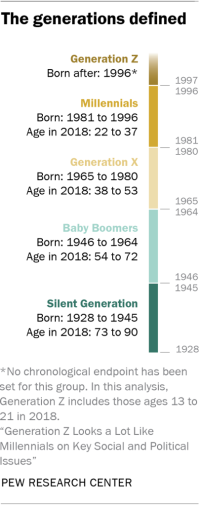
Only about three-in-ten Gen Zers and Millennials (30% and 29%, respectively) approve of the way Donald Trump is handling his job as president. This compares with 38% of Gen Xers, 43% of Boomers and 54% of Silents. Similarly, while majorities in Gen Z and the Millennial generation say government should do more to solve problems, rather than that government is doing too many things better left to businesses and individuals, Gen Xers and Boomers are more evenly divided on this issue. For their part, most Silents would like to see a less activist government.
When it comes to views on race, the two younger generations are more likely than older generations to say that blacks are treated less fairly than whites in the United States today. And they are much more likely than their elders to approve of NFL players kneeling during the national anthem as a sign of protest.
The younger generations are also more accepting of some of the ways in which American society is changing. Majorities among Gen Z and the Millennial generation say increasing racial and ethnic diversity in the U.S. is a good thing for society, while older generations are less convinced of this. And they’re more likely to have a positive view of interracial and same-sex marriage than their older counterparts.
As a recent Pew Research Center report highlighted, Gen Z is the most racially and ethnically diverse generation we have seen, but this isn’t all that’s driving the attitudes of this generation when it comes to issues surrounding race and diversity. There are significant, if more modest, generational differences on these issues even among non-Hispanic whites.
From Texas Tribune: Bill filing for 2021 Texas session begins with legislation on abortion, police stops and redistricting
The 87th Legislative Session is, sort of, underway.
- Click here for the article.
The 87th Texas Legislature won’t gavel in until January, but state lawmakers on Monday got their first chance to file legislation for what’s expected to be a particularly tough 140-day stretch at the Capitol next year.
By mid-afternoon Monday, the first day to pre-file legislation, more than 530 bills had already been filed in the House and Senate. Thousands of bills are expected to be filed throughout the legislative session, though only a fraction of them will make it through both chambers and end up on Gov. Greg Abbott’s desk.
State leaders have already said they expect the upcoming session to be the toughest state lawmakers have seen in years. The state is forecasting billions of dollars in shortfalls to the state budget, which the coronavirus pandemic has fueled. On top of that, lawmakers are set to undergo the once-in-a-decade process of redrawing the state’s political maps.
House Redistricting Committee Chair Phil King, a Weatherford Republican, filed legislation Monday morning related to the composition of House districts and State Board of Education districts with House Bill 63 and 64, respectively. Later Monday, King filed a bill related to congressional districts.
With fights over voter access and ballot integrity dominating the election offices and courthouse across the state in recent months, lawmakers are also seeking to resolve some of the central issues around how Texans vote with a battery of bills filed in the early hours Monday. Before noon, nearly 30 pieces of elections-related legislation had already been proposed in both chambers.
Mail-in voting and voter registration emerged as two key focal points in bills filed by members of both parties. There was also legislation focused on countywide voting centers, voter identification, access for voters with disabilities, straight-ticket voting and designating any day an election is held statewide, including primaries, as a state holiday.
State Rep. Drew Springer, R-Muenster, filed proposals aimed at curbing the power of the governor's emergency powers, including one that would create an "Emergency Powers Board" to provide oversight during a declared disaster. The state's "Big Three" — the governor, lieutenant governor and speaker of the House — would sit on the board, as would the chairs of the House and Senate State Affairs Committees. Some Republicans have argued Abbott has overstepped his authority as the state has responded to the pandemic.
From Vox: Biden plans on swiftly rolling back Trump policies with a set of executive orders
And we know all about executive orders now.
- Click here for the article.
According to a Washington Post report, Biden plans to take immediate action on policies pertaining to climate change, immigration, and public health. On all three counts, the president-elect would effectively implement policies that are the opposites of President Donald Trump’s.
As the country continues to struggle with record daily Covid-19 cases amid the pandemic, Biden plans to swiftly reverse Trump’s withdrawal from the World Health Organization. The order would allow for greater pandemic cooperation and coordination with international partners, while also providing a check on China’s influence on the group.
Battling the pandemic will likely be the president-elect’s first priority, and he’s already forming a coronavirus task force, headed by former surgeon general Vivek Murthy; David Kessler, a former Food and Drug Administration commissioner; and Dr. Marcella Nunez-Smith, a professor of epidemiology and medicine at Yale University. The group is set to start meeting Monday.
Biden also plans to immediately rejoin the Paris climate accords, and to seek to push other countries into lowering their emissions.
From Roll Call: Biden’s transition moving ahead at full speed
4,000 new offices to be filled.
- Click here for the article.
Like everything else amid the pandemic, the transition effort — led by former Sen. Ted Kaufman, a longtime Biden adviser who literally wrote the law on presidential transitions — is doing more work remotely than it would under normal circumstances. The General Services Administration has allocated transition workspace at 1401 Constitution Avenue NW, the home of the Commerce Department.
"Like many organizations around the country, the Biden transition team will continue to do our work remotely," a transition spokesperson confirmed to CQ Roll Call in a statement last week. "While we have access to GSA space, the number of staff needed inside the office will be limited. Our team is following the direction of public health experts and medical professionals to develop a plan to keep our staff and their families safe."
That's a far cry from the approach of the current White House, where personnel on all levels from junior aides to Chief of Staff Mark Meadows have routinely disregarded the advice of public health experts, particularly when it comes to wearing protective masks. Meadows himself has tested positive for COVID-19, as first reported by Bloomberg News.
Some functions may require transition personnel to operate in in-person settings, including as part of what are known as "beachhead teams" that begin working at federal departments and agencies while politically appointed employees from the outgoing Trump administration are preparing to leave. But much of the federal workforce continues to operate remotely
From the Texas Tribune: After 2018 wake-up call, Texas Republicans were ready to fight back this year
Organization, organization, organization
- Click here for the article.
The Texas Democratic Party spent the cycle touting Texas as the “biggest battleground state,” and while the state attracted battleground-level attention and investment, Democrats ended up with few wins to show for it. President Donald Trump won the state by 6 percentage points, narrower than his 2016 margin but wider than many polls had suggested. U.S. Sen. John Cornyn, R-Texas, easily dispatched a late Democratic spending surge and won reelection by 10 points. After the Democratic Congressional Campaign Committee targeted 10 GOP-held U.S. House seats, Democrats were winning none of them as of Friday. And Democrats’ hopes of flipping the Texas House collapsed, with the balance of power largely unchanged heading into January.
On Tuesday afternoon, the state Democratic Party chair, Gilberto Hinojosa, issued a statement maintaining that the party called Texas the “biggest battleground, not the biggest blue state.”
“We have tough questions to ask ourselves,” Hinojosa said. “There are significant challenges before us, and new solutions are required.”
From the Texas Tribune: Analysis: In Texas, a seasonal shift away from election politics
Back to governing.
- Click here for the article.
The Texas Legislature won’t convene until January, but Monday marks the beginning of that session. It’s the day lawmakers can officially file legislation for the coming session — an opening look at the issues legislators want to address or at least talk about.
Even as the presidential race, vote-counting and other election issues dominate the news and public attention, the Texas calendar is moving toward the state government the legislative candidates were elected to run.
The week after a general election in Texas is also the start of what’s called the “late train” — a fundraising period tucked between the election and the beginning of a campaign finance blackout period that starts Dec. 13 — one month before the beginning of the legislative session.
Elected state officials won’t be allowed to raise campaign money (with exceptions for special elections) until late June. Some want to replenish their campaign accounts. Some are waiting to see if contributors to their vanquished opponents come around, checkbooks at the ready, to kiss and make up with the victors. Some want to build the kind of cash balances that persuade potential challengers to shop for opportunities elsewhere.
The fundraising blackout is there to prevent the appearance of bribery, and also the most obvious opportunities for it. It’s unseemly — as the state Senate discovered 30 years ago — to hold a vote and then accept campaign checks on the floor of the Senate from one of the supporters of the very legislation that was under consideration at the time.
That was 1989, when the Legislature was in a special session on workers’ compensation laws. Lonnie “Bo” Pilgrim, proprietor of an East Texas poultry empire, gave nine senators checks for $10,000 during a break in their proceedings. Most of the recipients were embarrassed when the public found out and returned the checks. The memory stuck, making it into Pilgrim’s obituaries when he died in 2017.
Sunday, November 8, 2020
About those polls
From the Atlantic: The Polling Crisis Is a Catastrophe for American Democracy.
From Politico: The polling industry blows it again.
From Politico: The polling industry blows it again.
Thursday, November 5, 2020
Some links for today
- Texas Tribune.
- Ballotpedia: Who can file election-related lawsuits?
- ScotusBlog: Justices will consider constitutionality of ACA’s individual mandate again.
- Ballotpedia: State Ballot Measures.
Wednesday, November 4, 2020
From the Texas Tribune: Democrats' hopes of flipping Texas again fall short as Republicans dominate the state's 2020 elections
The map looks mostly the same. Cities votes Democrat, rural areas vote Republican.
- Click here for it.
Though the margins in the presidential race were narrower than they have been in years, Democrats underperformed the high expectations they had set for themselves, particularly in a hotly contested battle for dominance in the Texas House. And a number of potential pickups for Democrats in the U.S. House of Representatives seemed increasingly unlikely as the night wore on.
Republican John Cornyn handily won reelection to his seat in the U.S. Senate, soaring past combat veteran MJ Hegar to notch a victory despite a late Democratic spending blitz on her behalf. Republicans held big leads in other statewide races for Railroad Commission, Texas Supreme Court and Court of Criminal Appeals.
And the contest some in-state operatives had focused on as Democrats’ best hope — the battle for a majority in the Texas House — appeared to end with a narrow victory for Republicans, leaving intact the party’s advantage in the chamber.
Tuesday, November 3, 2020
From Community Impact Newspapers: Bellaire sidewalk charter election builds on longstanding divisions
For a look at a local issue on the ballot in Bellaire.
- Click here for the article.
Three amendments to Bellaire’s city charter are up for vote in November, each related to sidewalk construction and the notification process by the city to residents who would be affected by such construction. Residents can vote for any of the propositions.
Proposition A— Requires the city to provide six months of notice prior to a City Council action item to construct a sidewalk. The notice would include project schematics and other details, as well as a hydrological study of the proposed project by a third party.
Proposition B—The city may not construct a sidewalk on a residential block without 50% written approval of the property owners on that block no more than three months prior to construction.
Proposition C—The city may not construct a sidewalk unless it also eliminates the impact of the material used in the sidewalk construction on water discharge and runoff in the city.
From the Texas Tribune: Rural Texans have long helped Republicans. Will that hold true on Tuesday?
More on the competitiveness of the parties in Texas.
- Click here for the story.
The story of Texas politics in 2020 is about the cities becoming bluer, the suburbs becoming more competitive and the Latino vote rising — but it is also about a rural firewall that has kept Republicans in power for so long. Rural areas of the state have historically been Republicans’ strongest line of defense in Texas as polls show suburbs — even in traditionally red areas — shifting toward Democrats. But with the state’s changing demographics and a noticeable surge of Democratic energy in deep Trump country, there’s an open question of whether Republicans can hold onto these districts with the same large margins they did in 2016.
“The margins will depend on all of our great friends and our patriots in West Central and East Texas who say, ‘I don’t want the president just to win, I want him to stomp the Democrats here 75-25,’” Patrick told host Chad Hasty. “And the bigger rural Texas [votes] will determine the final margin he wins by — is it 4? Is it 6? Is it 8? Is it 3?”
In 2018, Cruz needed the state’s rural counties to fend off a blockbuster challenge by Democrat Beto O’Rourke. The former El Paso congressman defeated Cruz 51% to 48% in the non-rural counties, which Trump carried by 3 points in 2016. But Cruz held strong in the rural counties and carried them 75% to 24%, nearly identical to Trump’s margin in them two years earlier.
Monday, November 2, 2020
From the Texas Tribune: U.S. Supreme Court allows inmate to sue prison officers after he was forced to spend six days in unsanitary cells with human waste
Federalism and the US Supreme Court.
- Scotusblog: Taylor v. Riojas.
- Click here for the story.
The U.S. Supreme Court ruled Monday that a Texas psychiatric prison inmate left for days in cells covered in either feces or sewage can sue six prison officers. That decision overturned an appeals court ruling that the officers had "qualified immunity," a legal doctrine that protects public officials from civil cases and only allows lawsuits where there are clear violations of constitutional rights.
Taylor is suing six officers from the John T. Montford Psychiatric Facility Unit in Lubbock. Taylor alleged in the federal district court in Lubbock that he was naked when he was forced into a cell whose floor, windows, walls and ceiling were covered in feces. The faucet in the cell was also covered with feces and Taylor said he could not drink water. After three days, Taylor was transferred to a cell with a clogged drain overflowing with raw sewage. That cell had no bed or a toilet. Taylor claims he was told to urinate on the floor.
From The Texas Tribune: Here's how votes are counted in Texas
A look at county government in Texas.
- Click here for it.
The state’s 254 counties are responsible for tabulating the ballots, but they must follow a certain set of rules. Here’s how the process works in Texas:
Go check it out.
From 538: Latest Polls
A good way top bridge towards next week's look at public opinion and polling - and figure out where we are numbers wise.
- Click here for them.
From 538: The 21 Ballot Measures We’re Watching This Election
Referenda and Initiatives from across the country.
Texas does not allow either statewide.
- Click here for it.
People who say that the U.S. is a republic and not a democracy apparently haven’t heard of ballot measures. Every year, some states1 allow citizens to bypass their elected representatives and weigh in directly on an issue — bringing policy to the forefront of the campaign in a way it often is not in candidate elections.
Sunday, November 1, 2020
Sample Ballots - Fall 2020 General Election
ACC: Brazoria County Precinct 16.
HCC Alief - Hayes: Harris County Precinct 559
HCC Acres Homes: Harris County Precinct
ACC - Turner: Brazoria County Precinct 13.
ACC - Dawson: Brazoria County Precinct 54.
- Sample Ballot for all of Harris County.
- Voter precincts for Brazoria County.
- Voter precincts for Harris County.
Friday, October 30, 2020
From the Texas Tribune: Collin County is the center of a political storm as the Texas suburbs become more competitive for Democrats
More on an ongoing theme. Cities in Texas have largely shifted to the Democratic party, the suburbs surrounding those cities seem to be next.
- Click here for it.
It is one sign of how quickly the political environment has shifted in the suburban county north of Dallas, which is now an emerging battleground important to understanding Texas in 2020. Unlike some suburban counties in 2018, Collin did not flip in statewide results — but a once-overwhelming GOP advantage continued to narrow and next week’s election could be the tipping point.
“It’s just changed,” said Sharon Hirsch, the Democrat challenging state Rep. Matt Shaheen, R-Plano. “It’s no surprise — it’s growing, it’s becoming more diverse, we have a highly educated population. They’re focused on basic issues like great schools and safe communities and health care. They’re not focused on the fringe-right issues, and that’s where our representation is right now, and I think it’s fixin’ to change.”
From Wikipedia: Statues affecting the size of the Supreme Court
Remember that the Constitution says nothing about this
- Judiciary Act of 1789- Judiciary Act of 1801
- Judiciary Act of 1802
- Seventh Circuit Act of 1807
- Eighth and Ninth Circuits Act of 1837
- Tenth Circuit Act of 1863
- Judicial Circuits Act of 1866
- Judiciary Act of 1869
Some relevant Supreme Court cases in the October 2020 term
From Oyez:
- Brnovich v. Democratic National Committee. A case in which the Court will decide (1) whether Arizona’s policy of not counting provisional ballots cast in person on Election Day outside of the voter’s designated precinct violates Section 2 of the Voting Rights Act, and (2) whether Arizona’s law permitting only certain persons to handle another person’s completed early ballot violates Section 2 of the Voting Rights Act or the Fifteenth Amendment.
- Collins v Mnuchin. A case in which the Court will decide whether the Federal Housing Finance Agency’s (FHFA) structure violates the separation of powers; and (2) whether the courts must set aside a final agency action that FHFA took when it was unconstitutionally structured and strike down the statutory provisions that make FHFA independent.
- Department of Justice v. House Committee on the Judiciary A case in which the Court will decide whether an impeachment trial before a legislative body is a “judicial proceeding” under Rule 6(e)(3)(E)(i) of the Federal Rules of Criminal Procedure.
- Lange v. California. A case in which the Court will decide whether the exigent circumstances exception to the Fourth Amendment’s warrant requirement applies when police are pursuing a suspect whom they believe committed a misdemeanor.
- Trump v. Sierra Club. A case in which the Court will decide whether Section 8005 of the Department of Defense Appropriations Act authorizes President Trump to divert $2.5 billion in military funds to pay for the border wall.
- Wolf v. Innovation Law Lab. A case in which the Court will rule on the legality of the Trump administration’s “remain in Mexico” policy.
From ScotusBlog: Fulton v. City of Philadelphia, Pennsylvania
Supreme Court hears a case regarding discrimination on religious grounds and free speech.
- Click here for it.
Whether free exercise plaintiffs can only succeed by proving a particular type of discrimination claim — namely that the government would allow the same conduct by someone who held different religious views — as two circuits have held, or whether courts must consider other evidence that a law is not neutral and generally applicable, as six circuits have held; (2) whether Employment Division v. Smith should be revisited; and (3) whether the government violates the First Amendment by conditioning a religious agency’s ability to participate in the foster care system on taking actions and making statements that directly contradict the agency’s religious beliefs.
From APNews: Supreme Court issues flurry of last-minute election orders
The chapter on the judiciary meets the chapter on elections.
- Click here for it.
North Carolina, yes. Pennsylvania, yes. Wisconsin, no. That’s how the Supreme Court has answered questions in recent days about an extended timeline for receiving and counting ballots in those states.
At first blush, the difference in the outcomes at the Supreme Court seems odd because the high court typically takes up issues to harmonize the rules across the country. But elections are largely governed by states, and the rules differ from one state to the next.
There also is a difference in how the justices act based on whether they are ruling on a lawsuit that began in state or federal court.
Conservative justices who hold a majority on the Supreme Court object to what they see as intrusions by federal judges who order last-minute changes to state election rules, even in the middle of the coronavirus pandemic. The power to alter absentee ballot deadlines and other voting issues rests with state legislatures, not federal courts, according to the conservative justices.
The court also is divided, but so far has been willing to allow state courts interpreting their own state constitutions to play more of a role than their federal counterparts.
Last week, four conservative justices would have put on hold a Pennsylvania Supreme Court ruling allowing three additional days to receive and count mailed ballots. Three justices in Wednesday’s order about North Carolina’s absentee ballots would have blocked a six-day extension.
The justices did not finally resolve the legal issues involved, but they could do so after the election. A more thorough examination could come either in a post-election challenge that could determine the presidential winner if, for example, Pennsylvania proves critical to the national outcome, or in a less tense setting that might not affect the 2020 vote, but would apply in the future.
Thursday, October 29, 2020
From Oyez: 4 Key Segregation Cases
We'll use these to walk through terminology in the chapter on the judiciary. It'll help us prep for the upcoming chapter on civil rights.
- Plessy v Ferguson.
- Sweatt v Painter.
- Brown v Board 1.
- Brown v Board 2.
Wednesday, October 28, 2020
Tuesday, October 27, 2020
U. S. Department of Homeland Security Public Org Chart
- Click here for it.
For the agencies within the department:
- Cybersecurity and
Infrastructure Security
Agency
- U.S. Customs & Border
Protection
- U.S. Citizenship &
Immigration Services
- U.S. Coast Guard
- U.S. Immigration & Customs Enforcement
- Federal Emergency Management Agency
- U.S. Secret Service
- Transportation Security Administration
For background on the Department click here.
Tom Pendergast and Harry Truman
The president responsible for the creation of the Defense Department and the person responsible for starting his career.
- Click here for it
From Wikipedia: United States Department of Defense
Created after the National Security Act.
- Click here for the article.
After the end of World War II, President Harry Truman proposed the creation of a unified department of national defense. In a special message to Congress on 19 December 1945, the president cited both wasteful military spending and inter-departmental conflicts. Deliberations in Congress went on for months focusing heavily on the role of the military in society and the threat of granting too much military power to the executive.
From US Courts.gov: Court Role and Structure
A good inside look at the design of the national courts.
- Click here for it.
And for good measure:
Wikipedia: The U.S. Court of Appeals for the 7th Circuit.
Ideology on the Supreme Court
A few items:
Wikipedia: Ideological leanings of United States Supreme Court justices.
Scotusblog: Empirical SCOTUS: A comprehensive look at Judge Amy Coney Barrett.
Monday, October 26, 2020
From Wikipedia: The United States Intelligence Community
Created by an executive order by Ronald Reagan.
- Click here for the entry.
The United States Intelligence Community (IC) is a group of separate United States government intelligence agencies and subordinate organizations, that work separately and together to conduct intelligence activities to support the foreign policy and national security of the United States. Member organizations of the IC include intelligence agencies, military intelligence, and civilian intelligence and analysis offices within federal executive departments. The IC is overseen by the Office of the Director of National Intelligence (ODNI), which itself is headed by the director of national intelligence (DNI), who reports to the president of the United States.
The Washington Post reported in 2010 that there were 1,271 government organizations and 1,931 private companies in 10,000 locations in the United States that were working on counterterrorism, homeland security, and intelligence, and that the intelligence community as a whole includes 854,000 people holding top-secret clearances. According to a 2008 study by the ODNI, private contractors make up 29% of the workforce in the U.S. intelligence community and account for 49% of their personnel budgets.
From Wikipedia: National Security Act of 1947
The start of the modern era of the military in the US.
- Click here for the entry.
The National Security Act of 1947 was a law enacting major restructuring of the United States government's military and intelligence agencies following World War II. The majority of the provisions of the Act took effect on September 18, 1947, the day after the Senate confirmed James Forrestal as the first Secretary of Defense.
The Act merged the Department of War (renamed as the Department of the Army) and the Department of the Navy into the National Military Establishment (NME), headed by the Secretary of Defense. It also created the Department of the Air Force and the United States Air Force, which separated the Army Air Forces into its own service. It also protected the Marine Corps as an independent service, under the Department of the Navy.
Aside from the military reorganization, the act established the National Security Council and the Central Intelligence Agency, the U.S.'s first peacetime non-military intelligence agency.
From Lawfare: The Danger of Overstating the Impact of Information Operations
Just because foreign efforts exist to impact an election doesn't mean they're working.
- Click here for the article.
But if Russians are in fact mounting any information operations, shouldn’t the public be vigilant and raise the alarm anyway? Even if they are not the main game in town, they are still doing something that is illegal and against which we should defend, no?
The question has to be answered based on the objective of the disinformation campaign. If the objective is to get discrete false facts or frames communicated to target audiences, then yes, researchers and people in government should focus on it and there is no harm in emphasizing the threats of Russian disinformation. There have been excellent discrete studies of Russian propaganda aimed to achieve specific beliefs, such as the campaign to besmirch the White Helmets in Syria. These studies suggest that researchers certainly need to maintain an effort to monitor and identify, contain, and counter Russian information operations.
But most Russian information operations aren’t aimed at pushing concrete facts. It’s widely known that internally, in Russia itself and in its near periphery, the broad strategic thrust that Russian propaganda has focused mostly on is achieving disorientation, a state of “nothing is true and everything is possible,” as Peter Pomerantsev put it so well. It is that general disorientation, rather than a specific belief in a specific false fact or frame, that renders an opponent ungovernable. Beating the drums about disinformation campaigns aimed at this kind of disorientation is harmful, rather than helpful. If the objective of the campaign is to sow doubt and confusion, to make Americans believe that we have been infiltrated and that Russia is an all-powerful actor messing with our democracy, then overstating the importance of the campaign simply reinforces and executes the Russian plan.
To appear powerful and dangerous, all Russian actors need to do is make sure they are described as powerful and dangerous by credible sources in the United States. And for now, it seems that they are succeeding in doing just that. They have made a show of mounting information operations. And although there is no publicly available evidence that these operations have had any meaningful impact on voting or other behaviors and beliefs at a mass population level, their observed efforts have triggered extensive news reporting, published research and government readiness responses. Having triggered an autoimmune response, Russian actors can sit back to enjoy seeing well-intentioned and unwitting instruments report their campaigns widely and give them much more weight than they deserve.
From 538: Why Many Americans Don't Vote
For this week's written assignment.
- Click here for it.
In any given election, between 35 and 60 percent of eligible voters don’t cast a ballot. It’s not that hard to understand why. Our system doesn’t make it particularly easy to vote, and the decision to carve out a few hours to cast a ballot requires a sense of motivation that’s hard for some Americans to muster every two or four years — enthusiasm about the candidates, belief in the importance of voting itself, a sense that anything can change as the result of a single vote. “I guess I just don’t think that one person’s vote can swing an election,” said Jon Anderson, who won’t be voting for president this year because of moral objections to both candidates.
But who does — and doesn’t — vote is complex. Most Americans don’t fall neatly into any one category. Instead, as we found in our new poll with Ipsos, most are like Brown. They vote inconsistently, or at moments when they feel like their vote has a chance to make a difference, or when the stakes of not voting are just too high, which is how many Americans describe this upcoming election.
Of the 8,000-plus people we polled, we were able to match nearly 6,000 to their voting history. We analyzed the views of the respondents in that slightly smaller group, and found that they fell into three broad groups: 1) people who almost always vote; 2) people who sometimes vote; and 3) people who rarely or never vote. People who sometimes vote were a plurality of the group (44 percent), while 31 percent nearly always cast a ballot and just 25 percent almost never vote. And as the chart below shows, there weren’t huge differences between people who vote almost all the time and those who vote less consistently. Yes, those who voted more regularly were higher income, more educated, more likely to be white and more likely to identify with one of the two political parties, but those who only vote some of the time were also fairly highly educated and white, and not overwhelmingly young. There were much bigger differences between people who sometimes vote and those who almost never vote.
Subscribe to:
Posts (Atom)