Showing posts with label Federal Reserve. Show all posts

Wednesday, December 16, 2015

Why did the Fed raise the Federal Funds Rate?

It appears they believe the economy has recovered to the point where it is warranted. There is political debate about whether this is correct, but the Fed issued a statements explaining their reasoning. There appears to be a concern that the current trajectory of the economy might lead to inflation - over 2% - down the road. The increase is an early adjustment to ensure that does not occur.

- Click here for the statement.

Information received since the Federal Open Market Committee met in October suggests that economic activity has been expanding at a moderate pace. Household spending and business fixed investment have been increasing at solid rates in recent months, and the housing sector has improved further; however, net exports have been soft. A range of recent labor market indicators, including ongoing job gains and declining unemployment, shows further improvement and confirms that underutilization of labor resources has diminished appreciably since early this year. Inflation has continued to run below the Committee's 2 percent longer-run objective, partly reflecting declines in energy prices and in prices of non-energy imports. Market-based measures of inflation compensation remain low; some survey-based measures of longer-term inflation expectations have edged down.
Consistent with its statutory mandate, the Committee seeks to foster maximum employment and price stability. The Committee currently expects that, with gradual adjustments in the stance of monetary policy, economic activity will continue to expand at a moderate pace and labor market indicators will continue to strengthen. Overall, taking into account domestic and international developments, the Committee sees the risks to the outlook for both economic activity and the labor market as balanced. Inflation is expected to rise to 2 percent over the medium term as the transitory effects of declines in energy and import prices dissipate and the labor market strengthens further. The Committee continues to monitor inflation developments closely.
The Committee judges that there has been considerable improvement in labor market conditions this year, and it is reasonably confident that inflation will rise, over the medium term, to its 2 percent objective. Given the economic outlook, and recognizing the time it takes for policy actions to affect future economic outcomes, the Committee decided to raise the target range for the federal funds rate to 1/4 to 1/2 percent. The stance of monetary policy remains accommodative after this increase, thereby supporting further improvement in labor market conditions and a return to 2 percent inflation.

For commentary:

- CNBC: FED RAISES RATES BY 25 BASIS POINTS, FIRST SINCE 2006.
- Market Watch: OK, the Fed’s raised interest rates — now what?
- Nerd Wallet: Federal Funds Rate: What Rising Interest Rates Mean for You.
- Wall Street Journal: Fed Plans to Signal Gradual, Cautious Path on Rate Hikes.

The Federal Reserve increases the Federal Funds Rate

2305 students will be looking at the executive branch and at economic policy making - especially monetary policy - over the course of the semester. This story regarding the Fed touches on both. Let's look at some basic facts before digging into why the Fed did what it did. In a sense, this marks the end of the policies related to addressing the problems stemming from the Great Recession.


Three background questions

So, what is the Federal Funds Rate?

The interest rate at which a depository institution lends funds maintained at the Federal Reserve to another depository institution overnight. The federal funds rate is generally only applicable to the most creditworthy institutions when they borrow and lend overnight funds to each other. The federal funds rate is one of the most influential interest rates in the U.S. economy, since it affects monetary and financial conditions, which in turn have a bearing on key aspects of the broad economy including employment, growth and inflation. The Federal Open Market Committee (FOMC), which is the Federal Reserve’s primary monetary policymaking body, telegraphs its desired target for the federal funds rate through open market operations. Also known as the “fed funds rate".

While we are at it, what is the Federal Reserve?

The central bank of the United States. The Fed, as it is commonly called, regulates the U.S. monetary and financial system. The Federal Reserve System is composed of a central governmental agency in Washington, D.C. (the Board of Governors) and twelve regional Federal Reserve Banks in major cities throughout the United States.

So what does the Federal Reserve Do?

Current functions of the Federal Reserve System include:

- To address the problem of banking panics
- To serve as the central bank for the United States
- To strike a balance between private interests of banks and the centralized responsibility of government
- To supervise and regulate banking institutions
- To protect the credit rights of consumers
- To manage the nation's money supply through monetary policy to achieve the sometimes-conflicting goals of
- - maximum employment
- - stable prices, including prevention of either inflation or deflation
- - moderate long-term interest rates
- To maintain the stability of the financial system and contain systemic risk in financial markets
- To provide financial services to depository institutions, the U.S. government, and foreign official institutions, including playing a major role in operating the nation's payments system
- To facilitate the exchange of payments among regions
- To respond to local liquidity needs
- To strengthen U.S. standing in the world economy

Thursday, November 12, 2015

From the Fiscal Times: Looks Like Congress Can’t Stand the Idea of an Independent Federal Reserve

The Federal Reserve is designed to be insulated from the political branches so that it makes its decisions according to economic, not political, factors. Nevertheless members of Congress - as should be expected from any group of ambitious people - want to control it.

Here's a look at what is driving this desire. The new chair of the Ways and Means Committee - area rep Kevin Brady - is at the center of these efforts.

- Click here for the article.

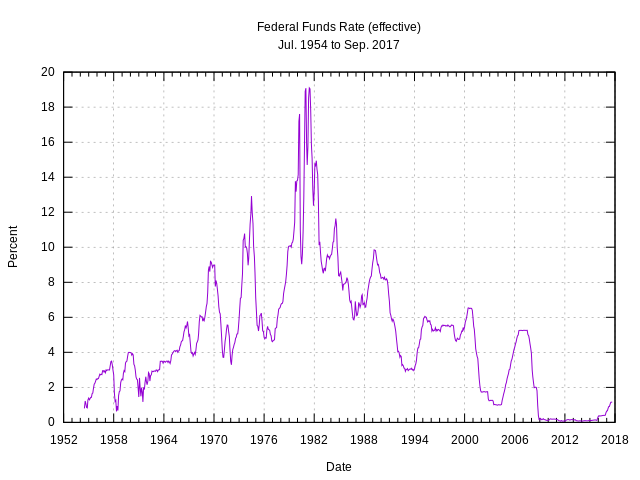
From FRED: the Federal Funds Rate over the past 60 years

Will the Fed increase interest rates? If so, what will the effect be?

We've discussing economic policy in 2305, which involves a look at fiscal and monetary policy.

A key aspect of monetary policy involves the Fed's ability to influence interest rates. Since 2008 the Federal Funds Rate has been at 0% in order to stimulate the economy by making it cheaper to borrow money in order to boost the economy. We are a consumer based economy so that's how things roll.

For background:
- Wikipedia: Federal Funds Rate.
- Investopedia: Discount Rate.

But low interest rates have a tendency - historically - to overheat the economy, which leads to inflation, which leads to another crash. Pressure has built on the Fed to nip this in the bud by raising the federal funds rate, but it has resisted because doing so prematurely raising the rates can also weaken the economy and lead to a crash.

There's your dilemma - and what the Fed has to weigh as they make their decision.

Here's commentary from smarter people than me:

-  NYT: When Will the Fed Raise Rates?
- The Fiscal Times: 10 Ways the Fed’s Looming Rate Hike Touches You.

- Here's a bit from Quartz's analysis:

Americans are borrowing big again. The Federal Reserve’s credit numbers showed American consumers borrowed at an all-time record of $28.9 billion in September, besting the previous high-water mark set in November 2001. The surge wasn’t driven by mortgage lending, but by an ongoing rise in non-revolving credit—essentially car and student loans, which surged by more than $22 billion. Revolving debt—mainly credit-card debt—also increased, by $6.7 billion.


Tuesday, November 10, 2015

From the New York Times: When Will the Fed Raise Rates?

For our look at monetary policy.

- Click here for the article.
One of these days, the Federal Reserve tells us, it will decide to raise interest rates.
The announcement will be akin to a doctor’s decision that a patient is well enough to be gradually taken off medication. The thinking inside the Fed is that the economy is finally healthy enough that borrowing costs should return to more “normal” levels to help keep future inflation from accelerating too much.
But it is a moment with challenges. It could send markets into a tizzy (if past experience is any guide), lead to a slower economic recovery and make it harder for workers to press for higher wages. For savers, it could signal higher returns, but those borrowing to buy a house or a car may soon have to pay more.
Nearly seven years ago the Fed put its benchmark interest rate close to zero as a way to bolster the economy. And for months now, officials have said they might raise rates by the end of 2015.

It’s a “liftoff” – to use the Fed’s own term – that’s getting the kind of attention that space aficionados once lavished on NASA rockets. Fed officials left rates unchanged after meeting in October, but when they do make their announcement, it will have lasting consequences.
The last time the Fed raised interest rates, in June 2006, Facebook was mainly for college students and had one-tenth the users of Myspace.

Monday, November 9, 2015

From Federal Reserve Education.org: Monetary Policy Basics

For this week in 2305 as we begin to look at economic policy:

- Here's a link to the page.

Some highlights: 

What is monetary policy? The term "monetary policy" refers to what the Federal Reserve, the nation's central bank, does to influence the amount of money and credit in the U.S. economy. What happens to money and credit affects interest rates (the cost of credit) and the performance of the U.S. economy.

What is inflation and how does it affect the economy? Inflation is a sustained increase in the general level of prices, which is equivalent to a decline in the value or purchasing power of money. If the supply of money and credit increases too rapidly over time, the result could be inflation.
What are the goals of monetary policy? The goals of monetary policy are to promote maximum employment, stable prices and moderate long-term interest rates. By implementing effective monetary policy, the Fed can maintain stable prices, thereby supporting conditions for long-term economic growth and maximum employment.
What are the tools of monetary policy? The Federal Reserve’s three instruments of monetary policy are open market operations, the discount rate and reserve requirements.
Open market operations involve the buying and selling of government securities. The term “open market” means that the Fed doesn’t decide on its own which securities dealers it will do business with on a particular day. Rather, the choice emerges from an “open market” in which the various securities dealers that the Fed does business with – the primary dealers – compete on the basis of price. Open market operations are flexible, and thus, the most frequently used tool of monetary policy.
The discount rate is the interest rate charged by Federal Reserve Banks to depository institutions on short-term loans.
Reserve requirements are the portions of deposits that banks must maintain either in their vaults or on deposit at a Federal Reserve Bank.

Thursday, September 19, 2013

What is the Fed doing to pump up the economy and why?

More from Wonkblog:
The Fed is doing two things right now to stimulate the economy. One is holding their interest rates pretty much at 0%. The other is buying $85 billion in housing and treasury bonds each month in order to try and pump money into the economy.
At some point, the Fed intends to begin backing off these policies. But they only want to do it once the economy is strong enough, and even then, they want to do it slowly, so the economy has time to adjust.
To put it differently, rather than cut off their support, they want to "taper" it.
We will discuss both the Federal Reserve and monetary policy on 2305 in a few weeks. Monetary policy refers to - according to Wikipedia -
". . . the process by which the monetary authority of a country controls the supply of money, often targeting a rate of interest for the purpose of promoting economic growth and stability. The official goals usually include relatively stable prices and low unemployment.
Here's a secondary definition:
Monetary policy is the process by which the government, central bank, or monetary authority of a country controls (i) the supply of money, (ii) availability of money, and (iii) cost of money or rate of interest to attain a set of objectives oriented towards the growth and stability of the economy.
The setting of interest rates is a standard part of the fed's toolkit, the purchasing of bonds is not. The purchasing of the bonds has a fancy name: quantitative easing. It means:

. . . an unconventional monetary policy used by central banks to stimulate the national economy when standard monetary policy has become ineffective. A central bank implements quantitative easing by buying specified amounts of financial assets from commercial banks and other private institutions, thus increasing the monetary base. This is distinguished from the more usual policy of buying or selling government bonds in order to keep market interest rates at a specified target value.
The big news this week is that the Fed decided not to cut back on the amount of bonds it is purchasing - that is what "the taper" refers to.

Why? Here's one answer: Because Congress is horrible.

Which fits a theme in 2305 so far - 2306 too, sort of. One of the major differences between the design of the legislative and executive branches in the US Constitution is that Congress' design lends itself to stalemate and dysfunction. This is due to its democratic nature, which is why Congress has done an awful job handling the economy.

The executive has more of an autocratic design, and many of its agencies - the Federal Reserve included - are designed to be able to act swiftly to address problems they have been designated to address. For that reason the Federal Reserve has been in a much better position to grow the economy than Congress. Its the nature of the beast.

From Wonkblog: Nine questions about the Federal Reserve you were too embarrassed to ask

This is a very good primer for an upcoming discussion in 2305 about economic policy, as well as the nature of bureaucratic power.

It includes very simple answers to very simple question about the Federal Reserve, its duties, the job of the chairman and what its been up to recently.

Wednesday, May 22, 2013

From the Fiscal Times: Bernanke to Congress: I’m Not the Problem. You Are.

For our continued look at congressional oversight - in this case one not involving the IRS. And this has the added twist of contributing to our discussion of congressional dysfunction.

Federal Reserve Chair Ben Bernanke testified before the Joint Economic Committee today and very subtly blamed Congress for the continuing sluggishness in the economy.

He told the committee that the ability of the Fed to use monetary policy to stimulate the economy is negated by Congressional fiscal policy:

Fiscal policy “has become significantly more restrictive,” he said. “In particular, the expiration of the payroll tax cut, the enactment of tax increases, the effects of the budget caps on discretionary spending, the onset of the sequestration, and the declines in defense spending for overseas military operations are expected, collectively, to exert a substantial drag on the economy this year.”


One of the members of the area congressional delegation - Kevin Brady - is chair of the committee and he among a few others are concerned about the long term debt problem given the degree of spending that occurred after the recent financial crisis. Bernanke argued that focus on debt is premature and is leading to policies that continue to limit economic growth.
Bernanke defended the Fed’s policies and argued that the problem isn’t that the Fed is doing too much but that fiscal policymakers are doing too little. “Mr. Chairman, first of all, the slowness of the recovery can be explained by a number of important headwinds, including the aftereffects of the financial crisis, developments in Europe, the problems with the housing market and, very importantly, the fact that fiscal policy for the last few years has actually been a significant headwind to recovery rather than a supporting tailwind,” Bernanke said. “So I would submit that without monetary policy’s aggressive actions, this recovery would be much weaker than it has been, and indeed if you compare our recovery to that of Europe and other advanced industrial economies, it looks relatively good.”

Bernanke also made clear that he wasn’t looking to downplay the significance of the long-term budget issues. “I fully realize the importance of budgetary responsibility, but I would argue that it’s not responsible to focus all of the restraint on the very near term and do nothing about the long term, which is where most of the problem exists,” Bernanke said in response to questioning from Democratic Minnesota Sen. Amy Klobuchar. “I do think that we would all be better off, with no loss to fiscal sustainability or market confidence, if we had somewhat less restraint in the very near term – this year and next year, say – and more aggressive action to address these very real long-term issues, which threaten within a decade or so to begin to put our fiscal budget on an unsustainable path.”

What is a joint committee? "Committees including membership from both houses of Congress. Joint committees are usually established with narrow jurisdictions and normally lack authority to report legislation. Chairmanship usually alternates between the House and Senate members from Congress to Congress."

For information about the Joint Economic Committee click here. "The Joint Economic Committee (JEC) is one of four standing joint committees of the U.S. Congress. The committee was established as a part of the Employment Act of 1946, which deemed the committee responsible for reporting the current economic condition of the United States and for making suggestions for improvement to the economy. The JEC is chaired by Representative Kevin Brady of Texas."

Video of the hearing can be found here.

Thursday, March 7, 2013

What The Shining has in common with the Wilson Administration and the early Federal Reserve Board


So I shut things down last might when the Shining came on TV and watched it from the beginning with the family. I had talked my boys into muttering "redrum" at school from time to time to freak their teacher out, so they were familiar with the movie and I figured this was as good a time as any to watch their first real horror movie.

If you've seen the movie you know what its all about and that it ends with a zoom-in shot of a photograph from a very fancy party at a swanky hotel taken in 1921. The kicker is that the Jack Nicholson character is in the photograph even though the movie was set around the late 1970s.

Very eerie.

Anyway, my boys and I were looking at some You Tubes that described how the movie was made and stumbled across one that described the original photograph that Nicholson's image was airbrushed into. The narrator discovered that the photograph included members of Woodrow Wilson's Administration and of the recently created Federal Reserve Board. I thought this was an interesting coincidence considering what I teach.

Here's a bio of one of the guys he mentions

- Benjamin Strong, Jr.

Wednesday, December 12, 2012

The Federal Reserve to Hold Interest Rates Down Until the Unemployment Rate Goes below 6.5%

Story in the NYT and Washington Post.

This marks a significant shift for the Fed. It will no longer focus strictly on inflation. It will also now take unemployment into account. This was part of its original mandate.

Monday, September 17, 2012

Interview with Paul Volcker

Volcker was chair of the Federal Reserve from 1979 - 1987 and is credited with bringing down high rates of inflation during that time.

In this Daily Beast interview he discusses the transformation of the banking sector and the increased difficulty of regulating the financial sector in a dynamic environment.

A choice bit: :

- I am struck by the number of not just friends but other observers who share the belief that there has been a real change in the mental approach of people in markets. They used to be more customer-oriented, with some sense of fiduciary responsibility that’s been very much reduced into an impersonal, “you’re a counterparty, you’re not a customer” caveat emptor.

That attitude lies behind a lot of these difficulties and has been spurred by enormous changes in compensation practices that have tempted people to cut corners. I’m afraid that the temptation now becomes greater—that if I can, as they say, cut some corners, maybe I’ll get some of this magic dust myself in proportions that seemed unimaginable a few years ago
.

Friday, September 14, 2012

Some random links regarding QE3

For various points of view about the feds recent decision (see post below):

- Wonkbook: Everything you need to know about the Fed's big move.
- The Dish: Bernanke Goes Big, Bernanke Goes Big, Ctd.

QE3 announced

Federal Reserve Chair Ben Bernacke announced that the Fed will begin a third round of "quantitative easing." This means that they will purchase bonds (mortgage bonds specifically) in the open market in order to keep interest rates low - the theory being that doing so boosts the economy by making it cheaper for people to borrow money.

They also announced a change in priorities. Among the goals of the Fed is to maintain stable inflation rates and help attain maximum employment. These goals can conflict, so a choice generally has to be made, and usually the Fed has looked primarily at maintaining law interest rates. In their announcement they suggested that they will now begin to also look at the unemployment rate and try to reduce it.

From the NYT:

The Federal Reserve opened a new chapter Thursday in its efforts to stimulate the economy, saying that it intends to buy large quantities of mortgage bonds, and potentially other assets, until the job market improves substantially.

This is the first time that the Fed has tied the duration of an aid program to its economic objectives. And, in announcing the change, the central bank made clear that its primary reason was not a deterioration in its economic outlook, but a determination to respond more forcefully — in effect, an acknowledgment that its incremental approach until now had been flawed.

The concern about unemployment also reflects a significant shift in the priorities of the nation’s central bank, which has long focused on inflation. Inflation is now running below the Fed’s 2 percent annual target. But with the unemployment rate above 8 percent, the Fed’s policy-making committee suggested Thursday that it might tolerate a period of somewhat higher inflation, promising to maintain stimulus efforts “for a considerable time after the economic recovery strengthens.”

Click here for:

- The press release announcing the decision.
- Story from Bloomberg.
- Quantitative Easing and Bank Lending.
- QE1: financial crisis timeline.
- QE2 was a bust.

Saturday, September 1, 2012

From the NYT: Fed Chairman Makes Case, in Strong Terms, for New Action

For a future discussion of monetary policy, mostly in Govt 2305 and 2302. While the Congress has stalemated, the Federal Reserve still has the ability to impact the economy:

The Federal Reserve chairman, Ben S. Bernanke, delivered a detailed and forceful argument on Friday for new steps to stimulate the economy, reinforcing earlier indications that the Fed is on the verge of action.

Calling the persistently high rate of unemployment a “grave concern,” language that several experts described as unusually strong, Mr. Bernanke made clear that a recent run of tepid rather than terrible economic data had not altered the Fed’s will to act, because the pace of growth remained too slow to reduce the number of people who lack jobs.


Bernacke did so despite opposition from Congressional Republicans:

. . . Mr. Bernanke appeared to defy political pressure from Republicans to refrain from new measures. Mitt Romney, the Republican presidential nominee, has said such action would be counterproductive, and has pledged to replace Mr. Bernanke at the earliest opportunity.

“Policies from Congress, not more short-term stimulus from the Fed, are the ingredients necessary for restoring growth in the American economy,” Senator Bob Corker, Republican of Tennessee, said in a statement after Mr. Bernanke’s speech.

On the other hand, Democrats welcomed Mr. Bernanke’s remarks. There is little prospect that Fed action will lift the economy before the election, but party officials fear the opposite possibility — that inaction could undermine economic confidence — and so they greeted the speech with relief.

Senator Charles E. Schumer, Democrat of New York, said Mr. Bernanke “should not let any political backlash deter him from following through and doing the right thing.”


We will spend time in upcoming classes looking at the specific steps he proposes, but for now its useful to note the differences in these two branches. The legislative branch is geared towards inaction, while the executive branch is designed to act.

Thursday, July 12, 2012

The June Jobs Report

This is a few days late.

- The news release from the Department of Labor.
- Related story in the NYT.
- A compilation of reactions from Andrew Sullivan.

Since this is election season, there's no guarantee that Congress will do anything to remedy this - but the Federal Reserve - unaffected by elections - can.

Ezra Klein:

The question now is whether these numbers will change our economic policy. In Congress, the answer is almost certainly not. So, much as the data makes an overwhelming case for, say, hiring hundreds of thousands of workers to rebuild the nation’s infrastructure, or passing a large employer-side payroll tax cut to goose hiring, there’s little chance House Republicans will greenlight either policy response.

But with Congress largely on the sidelines, inflation low, and the labor market recovering, there’s a stronger and stronger case for the Federal Reserve to step in more aggressively. “The big question is whether this is a weak enough report to get the Fed to move,” writes economist Justin Wolfers. “I think it is, and they will
.”

Wednesday, June 20, 2012

Fed to extend Operation Twist

From the Washington Post:

The Federal Reserve on Wednesday renewed a program designed to provide a push to economic growth amid a warning that hiring is slowing.

The Fed said it would extend “Operation Twist,” a program that seeks to reduce long-term interest rates, through the end of the year. The decision was a sign that the Fed is not pulling back from its years-long campaign to support the U.S. economy.

In its policymaking statement, the Fed said “growth in employment has slowed in recent months” and made clear it is “prepared to take further action” in the future.

The Fed “anticipates that the unemployment rate will decline only slowly toward levels that it judges to be consistent with its dual mandate,” the statement said. “Furthermore, strains in global financial markets continue to pose significant downside risks to the economic outlook.”

- Definition: Operation Twist

Tuesday, June 19, 2012

The Fed unlikley to act on the economy when it meets this week.

The story is in the Fiscal Times. Last week - in 2302 - we discussed monetary policy and the role of the Fed in regulating the macro economy. We especially noted that since it is an executive institution that already has a mandate to act by Congress, it is free from the political constraints common in Congress. That doesn't mean it will always act however.

Here's proof:

Even though the jobless rate is far above that mark, don’t expect any bold new steps this week. Here are the three main reasons why the Fed won’t act:

1. The Slow-Boil Euro Crisis
2. Growth has Slowed, not Stopped
3. The Fiscal Cliff Ahead.


We should discuss in class. This adds to our query about whether government can actually work.

Tuesday, June 12, 2012

Federal Reserve Study Reveals that U.S. Wealth Fell 38.8% in 2007-2010 on Housing

The information comes from a report issued by the Federal Reserve. Bloomberg outlines it here. This complicates recovery since less wealth means less purchasing power and less demand for goods and services.