Showing posts with label Texas elections. Show all posts

Saturday, September 14, 2024

What is a swing state?

A little help for the GOVT 2306 essay.

- From Wikipedia: 

In American politics, a swing state (also known as battleground state, toss-up state, or purple state) is any state that could reasonably be won by either the Democratic or Republican candidate in a statewide election, most often referring to presidential elections, by a swing in votes. These states are usually targeted by both major-party campaigns, especially in competitive elections. Meanwhile, the states that regularly lean to a single party are known as "safe states" (or more specifically as "red states" and "blue states" depending on the partisan leaning), as it is generally assumed that one candidate has a base of support from which a sufficient share of the electorate can be drawn without significant investment or effort by the campaign.


What are the swing states in 2024? 

- From the NYT: Tracking the Swing States for Harris and Trump.

- - Pennsylvania
- - Georgia
- - North Carolina
- - Michigan
- - Arizona
- - Wisconsin
- - Nevada


How competitive will Texas be? 

- From Wikipedia: 2024 United States presidential election in Texas.

Texas is generally considered to be a red state, not having voted Democratic in a presidential election since Southerner Jimmy Carter won it in 1976 and with Republicans holding all statewide offices since 1999. Texas' location in the American South and largely in the greater Bible Belt has given the GOP the upper hand in the state in recent decades. Texas is considered by some to be potentially competitive, as the state has not backed a Republican for President by double digits since it favored Mitt Romney in 2012, which can be largely credited to the fast-growing Texas Triangle trending leftwards in some recent elections.

For More: 

- From Axios: As Harris invigorates Dems, Texas appears out of play.

- From KXAN: 2024 election: Exploring claim Texas is ‘sleeper battleground state’

- From KXAN: These are the reddest and bluest counties in Texas, based on recent election results.


Tuesday, March 7, 2017

From the Texas Tribune: Analysis: A political fishing guide for the 2018 elections in Texas

For our look at elections in Texas.

- Click here for the article.

Election numbers recently released by the Texas Legislative Council point to some soft spots in this red state’s political underbelly — places where Republicans hold office now but where Democrats at the top of the ticket have recently done well.

Specifically, they are the districts where Republicans won federal or state legislative races in 2016 while the same voters electing them were choosing Democrat Hillary Clinton over Republican Donald Trump.

Trump won Texas, but not by as much as Republicans normally do.

The non-prediction here is that every single one of these officeholders might win re-election next time they’re on the ballot.

On the other hand, a political fishing guide, in this instance, would tell you that these are districts Democrats should examine if they’re trying to win seats in the congressional delegation or in the Texas Senate or House.

The November results are more a commentary on the voters themselves — and on the Republican candidate who became president — than on the Texas candidates. These aren’t districts where everything was nominal except for the Texans. They’re districts where — for Republicans — something wasn’t working according to plan.

Wednesday, October 19, 2016

From the Austin American Statesman: Why only 1 Texas congressional race is competitive

Texas does gerrymandering right.

And despite all this talk of kicking the bums out, it seems we are completely happy with the bum we have.

- Click here for the article.

Texas has 36 congressional districts, second only to California, but only one seat appears to be competitive heading into early voting next week — District 23, a vast West Texas seat that has switched between Republican and Democratic hands in each of the last three elections.
Elsewhere, 23 Republicans and 10 Democrats are likely to win re-election, by dint of gerrymandering and the power of incumbency. Only two Texas districts are open seats — District 15, a predominantly Hispanic and Democratic-leaning district in South Texas, and District 19, a largely rural and heavily Republican district in parts of West Texas and the Panhandle where no Democrat is on the ballot.
In Central Texas, all six members of Congress who represent a slice of Austin are sitting on large war chests but running light campaigns. Each Austin incumbent had more than $200,000 on hand as of Sept. 30, with Democrat Lloyd Doggett topping the list with more than $3 million on hand. No challenger in those races has more than $30,000, and many have no money on hand.
“We know for a fact incumbency is powerful,” said Chad Long, an associate professor of political science at St. Edward’s University. “It’s the single most powerful predictor of congressional elections, even more than the money. If you have an incumbent in the election, you pretty much know who’s going to win.”
According to Long, a district is considered competitive when the winning candidate garners no more than 55 percent of the vote. Under this definition, only two of the six U.S. House members representing the Austin area have ever experienced a competitive race — Doggett and Republican Michael McCaul.

Tuesday, October 18, 2016

From the Austin American-Statesman: Why only 1 Texas congressional race is competitive

Texas does gerrymandering right.

And despite all the talk of throwing the bums out - we keep them in. All the other guys are bum,s apparently, our's is perfectly fine.

- Click here for the article.

Texas has 36 congressional districts, second only to California, but only one seat appears to be competitive heading into early voting next week — District 23, a vast West Texas seat that has switched between Republican and Democratic hands in each of the last three elections.
Elsewhere, 23 Republicans and 10 Democrats are likely to win re-election, by dint of gerrymandering and the power of incumbency. Only two Texas districts are open seats — District 15, a predominantly Hispanic and Democratic-leaning district in South Texas, and District 19, a largely rural and heavily Republican district in parts of West Texas and the Panhandle where no Democrat is on the ballot.
In Central Texas, all six members of Congress who represent a slice of Austin are sitting on large war chests but running light campaigns. Each Austin incumbent had more than $200,000 on hand as of Sept. 30, with Democrat Lloyd Doggett topping the list with more than $3 million on hand. No challenger in those races has more than $30,000, and many have no money on hand.

“We know for a fact incumbency is powerful,” said Chad Long, an associate professor of political science at St. Edward’s University. “It’s the single most powerful predictor of congressional elections, even more than the money. If you have an incumbent in the election, you pretty much know who’s going to win.”

- Click here for the 2016 Texas Primary results.
- Click here for the general election races.

Monday, August 29, 2016

From Ballotpedia: 2016 ballot measures

A look at the 153 ballot initiatives that are up for a vote in 35 states this November. None in Texas - we do not have them statewide, though they can happen on the local level. The dominant issues are marijuana, gun control, health care and minimum wage.

- Click here for the article.

Texas does regularly place constitutional proposals on the ballot. Some laws passed by the legislature can only take effect if the Texas Constitution is amended. As we will see in class, it often is.

- Click here for Ballotpedia's list of Texas ballot measures.

Tuesday, August 2, 2016

From the Texas Tribune: Analysis: See How Texans Turn Out, Vote in Presidential Elections

There's a reason Republican candidates dominate statewide office.

- Click here for the article.


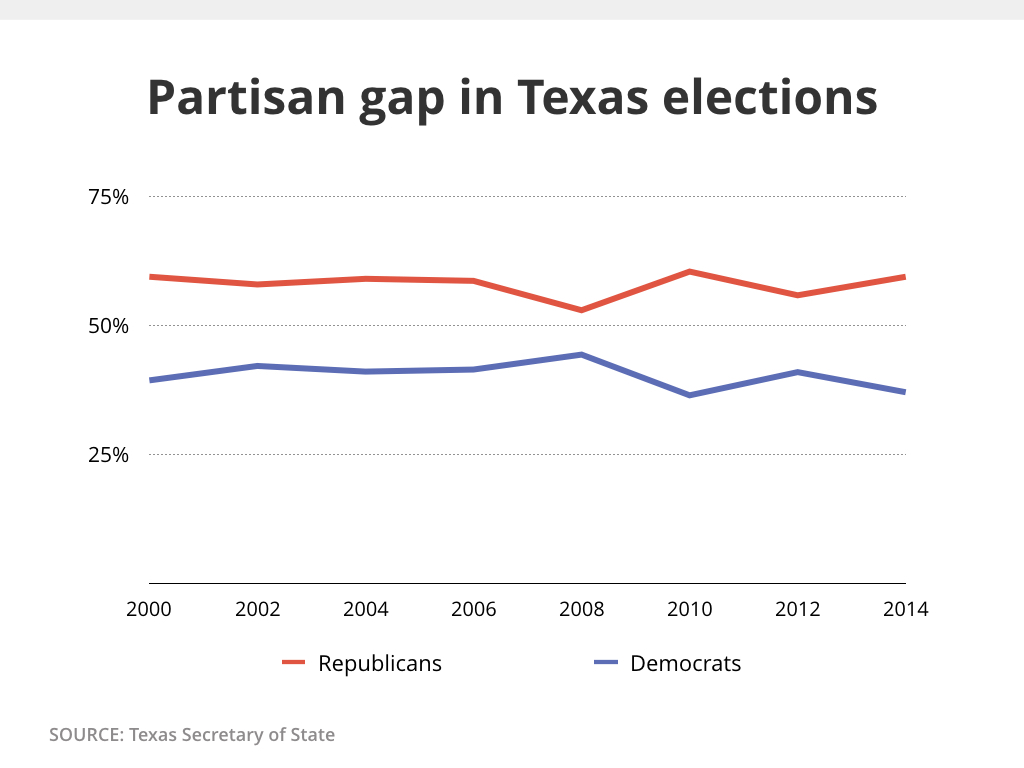
Republicans have had the upper hand in Texas elections for the past two decades, winning every statewide election starting in 1996. Since 2000, the size of that advantage has changed from year to year; in the latest two presidential elections, it shrank, expanding again in the interim years when Texas elects its governors and most other statewide officeholders.
The numbers here represent the averages for Republicans and Democrats in statewide elections where both major parties had candidates. Races that featured a Republican and one or two third-party candidates were not included since this is a measure of the strength of the major parties.
The average margin for this period was the smallest in 2008, when the average statewide candidates were separated by 8.6 percentage points, and the largest in 2010, when they were 23.9 percentage points apart.
The general elections will be competitive again when the lines cross, which they haven’t done since 1994.

Thursday, April 21, 2016

From the Economist: Texas's voter-ID law - So, is it suppressing voters?

This is a year and a half old, but the evidence at the time was mixed.

- Click here for the article.

So, is Texas's voter-ID law deterring voters? The answer, so far, is hardly clear. Let's look at the early-voting period, which ended on October 31st: 19.11% of the registered voters in Texas’s 15 most populous counties weighed in, either in person or by mail. During this same period in 2010—the last non-presidential election year—the figure was 20.76%. Though the state has seen a steep rise in registered voters in recent years, the total number of early votes cast had ticked down, from 1,731,589 in 2010, to 1,715,731 this year.

Texas is known for its low turnout rate. Gerrymandered districts ensure few of the legislative races are competitive, and polls suggest that Republicans will once again win all the major races this year by whopping margins. Yet the decline in early voters is notable, as the state’s elections are busier and more exciting than usual this year. After more than a decade with Rick Perry at the helm, the state is getting a new governor; all of the top jobs in state government, in fact, are changing hands. And despite more than two decades of disarray, the Democrats started the cycle in a fighting mood. With Wendy Davis, a Fort Worth state senator, they have a high-profile candidate at the top of the ticket, and a number of impressive other candidates. In 2010 the party didn’t even have a candidate for comptroller; this year they chanced upon one
with a sterling record from the private sector. National Democrats have also made a splashy effort to rally the troops via an initiative called Battleground Texas, which reportedly raised about $6.6m so far this year. Yet Texas voters are apparently failing to respond to all of this hubbub.

Perhaps this means the state's new law is suppressing turnout. Several details seem to confirm this possibility. For starters, the figures from Texas are consistent with patterns evident in other states.
As Nate Silver wrote in 2012, laws requiring photo ID “seem to decrease turnout by about 2 percent as a share of the registered voter population.” It is also intriguing that while fewer Texans voted early in person this year, there has been a spike in the number voting by mail, which allows people to evade the photo-ID regulation as long as they can prove they are either disabled, aged 65 or older, travelling or confined in jail.

For more:

- Everything You’ve Ever Wanted to Know About Voter ID Laws.
- Measuring the Effects of Voter Identification Laws.
- Voters Turned Away Because of Texas Photo ID Law.

From Politifact: Voter fraud occurs in Texas, though convictions and guilty pleas are rare

The organization claims that it is wrong to say that voter fraud does not occur - for consideration in 2306 when we look at voting in the state.

- Click here for the article.

. . . Trimble’s sources mostly referred to voter fraud -- deception committed by individual voters, such as voting more than once, impersonating a voter or voting despite ineligibility -- rather than overall election fraud, which encompasses actions by others, such as election officials or campaign workers, who break election laws in ways that could include intimidating voters, publishing misinformation about polling places or possessing ballots not their own.

We dipped into that distinction in an April 2012 fact-check that rated as
Half True a claim from Abbott that he had secured 50 convictions for election fraud. Abbott’s basis was his office’s records on 2002-12 prosecutions for alleged election code violations.

For this fact-check, we asked Abbott’s office for an updated list. County district attorneys and the Texas secretary of state’s elections division usually refer allegations of election code violations to the attorney general. We also called the secretary’s office and several district attorney offices around the state, but found no specific information about how many violations were reported or prosecuted.

Abbott spokeswoman Lauren Bean emailed us records showing that from August 2002 through September 2012, the office received
616 allegations of election-code violations and recorded 78 election-code prosecutions.

By our count, 46 of the prosecutions ended with a conviction, guilty plea, no-contest plea or guilty plea as part of deferred adjudication. Of those, 18 cases appeared to involve fraud committed by individual voters: 12 cases with ineligible voters, five cases of voter impersonation and one case of voting more than once.

So, by our reading of the attorney general’s records, 18 instances of voter fraud have been confirmed in Texas since 2002.

Wednesday, March 30, 2016

From Ballotpedia: Laws governing direct democracy in Texas

Texas does not allow the general population many opportunities to directly impact legislation. Here's a look at what is allowed.

- Click here for it.

Texas citizens have statewide access to just one of the six common forms of direct democracy--they can ratify or reject constitutional amendments to the Texas Constitution placed on the ballot by the Texas State Legislature.

Here is the full list:

- the legislatively referred constitutional amendment,
- the legislatively referred state statute,
- the initiated state statute (direct or indirect),
- the initiated constitutional amendment,
- the veto referendum (sometimes called the citizen referendum or the statute referendum),
- the statute affirmation (available only in Nevada), and
- the statewide recall.


Sunday, March 6, 2016

From the Texas Tribune: Republican Presidential Race Fueled Record Primary Turnout

26.1% turnout in Harris County
27.8% turnout in Brazoria County.

- Click here for the article.

Voting turnout in Texas surged on Tuesday with a record high number of Republican voters making it to the polls for the party's primary, thanks to a volatile presidential party contest and the state's earlier position in the nation's primaries.
"It's unprecedented," said Tom Mechler, Texas GOP chairman. "It's definitely historical."
Melcher attributed the record-breaking turnout to Texas' place on the primary schedule plus the fact that this was only the second time in Texas history that there was a GOP primary in all 254 counties.

"The reason that this has happened is that Texans believe they are going to have a say," he said.

More than 2.8 million Republican ballots were cast in Texas, approximately double the 2012 Republican primary total of 1.4 million. In the Democratic primary, more than 1.4 million were cast, besting the 2012 totals but falling far short of the nearly 2.9 million Democratic ballots cast in the 2008 primary, when the contest between Barack Obama and Hillary Clinton drew strong interest.
The combined turnout for both primaries this year is comparable to the 4.2 million primary ballots cast in 2008, according to unofficial totals.

Monday, February 22, 2016

From the Texas Tribune: Analysis: A Field Guide to the 2016 Texas Primaries

Here's something to set us up for next week;s election - the one that really matters in the state.

- Click here for the article.
Early voting starts [last] Tuesday in Texas, and the races for the presidential nominations are not — in spite of all that noise they’re making — the only contests on the ballot. Here are the most competitive contests for state and federal seats on the state ballot. *
Ignore the asterisk above at your peril. In every election, there are a few candidates who think they are in dire trouble — or whose friends believe that. And there are always candidates who never know what hit them — and who don’t appear to be in any danger until their chances have been dashed. That’s the disclaimer; now to the primary races (and for reference, here’s a full list of who is on the Texas ballots).

Catching up with the primary race for Texas Supreme Court

Both from the Texas Tribune:

- Three Supreme Court Justices Face Challenges.
In all three state Supreme Court seats up for election this year, Republican incumbents face primary challengers on March 1 — but that's where the similarities end. Medical malpractice litigation dominates one race. A second pits two men named Green against each other. And the third features a two-time loser trying again to reach the state's highest civil court.
Supreme Court justices are elected at large. No Democrat has won a seat on the court since 1992, so the GOP primary effectively picks the winners. Here's the rundown:

You'll have to click on the article for the rundown.

- Analysis: In Supreme Court Primary Race, a Question of Judgment.
Something unusual turned up in the arguments over which Green — Paul or Rick — should be the Republican Party’s nominee for a seat on the Texas Supreme Court.
Their primary isn’t just about confusion over their names, but about their judgment. And their disagreement over a much-remarked 2015 ruling by the high court reveals a lot about what each would do after donning the judicial robes.

- Analysis: Could Surname Be Key in Republican Supreme Court Race?

What’s the deal with Texas Republican primary voters and candidates with Hispanic names?
This question comes around every two years — usually as part of an election autopsy exploring why a particular candidate lost.
The question describes risk more than it describes certainty: Sometimes, it does not apply at all; sometimes, the difference in names seems to be the only reason for an election to come out the way it did.
It’s a risk for Texas Supreme Court Justice Eva Guzman, who finds herself in a Republican primary against Joe Pool Jr. of Dallas, who has unsuccessfully tried to get on the court two times before this year.

For all the candidates for the Texas Supreme Court - as well as the rest - click here.

Monday, February 1, 2016

For more on state election law . . .

We spend more time with these later in the semester, but they are applicable today for two reasons. First, the presidential campaign begins today since the Iowa Caucus will be held later. Iowa runs the thing however it chooses to - this is true for all states ad their methods for presidential selection. Second, in both 2305 and 2306 we are reviewing the U.S. Constitution. In each we'll look at the role states are given in running elections.

- TSHA: Election Laws.
- Texas Election Code.
- NCSL: Election Laws and Procedures Overview.

For local stuff - since we will hit this soon:

- Alvin Code of Ordinances: Elections.
- Houston Municipal Code: Elections.

Sunday, January 31, 2016

From the Texas Almanac: Voter Participation in Texas

I can't find a good way to copy and paste this document, but it deserves to be the subject of an entire lecture - and will be for ACC 2306 students later this semester.

It walks through basic facts associated with voter participation in Texas including turnout and changes in suffrage. It has some surprising facts. For example, until 1954 members of the American armed forces could not vote in Texas.

- Click here for it.

Sunday, December 6, 2015

Getting ready for the primary elections in Texas

Each party in Texas is gearing up for the March 1st primary election. Texas will be a part of a slate of states - including many southern states - that are attempting to collect their strength in order to influence the result of each race. Remember that these are party elections. A good number of internal party issues are settled in these elections. Currently the two major parties in the state are making preliminary decisions about how the primary elections will be conducted and what issues may or may not be on each party's ballot.

I won't ask nuanced question about these elections, but both 2305 and 2306 students should have a general familiarity with the concept of primary elections - and who runs them. Remember that states are given the responsibility of running elections in the United States. There really is no such thing as a national election in the US - national campaigns yes, elections no. The national government can oversee elections in order to determine if they are run in compliance with the equal protection clause, but little else.

Here are a few recent stories:

- Texas to have more prominent role in 2016 GOP presidential race.
- Texas GOP Votes Down Secession Proposal.
- Texas Democrats Approve 6 Ballot Referenda For Public Vote.
- Texas’ primary ballot begins to take shape.

For a broader look at the efforts of the presidential candidates to get on the ballots click on the following:

- The 2016 ballot wars begin: Each failure to appear on a ballot undermines a candidate’s credibility as a national figure.

Voting doesn’t begin for another two months but some presidential candidates have already failed their first big ballot test – actually getting on the ballot in all 50 states.
The business of getting a candidate’s name on the ballot is a costly and complex endeavor, a major drain of money and manpower that threatens to weed out the most underfunded campaigns and strain the others in what remains a historically unwieldy Republican field. Some states require thousands of signatures to qualify; others charge tens of thousands of dollars. Nationally, the price tag for ballot access can soar well past $1 million – more money than some campaigns have left in the bank.
“Right about now is the time when some desperation will set in,” said Ben Ginsberg, a veteran Republican political attorney who served as national counsel for Mitt Romney but is unaligned in 2016.

Saturday, November 7, 2015

From the San Antonio Express-News: U.S. Court panel says redistricting maps will stay the same for 2016 election

Texas' house maps - drawn in 2013 - are being challenged in the federal courts. Minority groups argue that the districts are drawn to diminish their voting strength, which would be a violation of the 14th Amendment's equal protection clause. The paper reports that the panel of judges that are reviewing the accusation will allow the 2016 elections to be competed on the basis of those districts. This does not mean that they will not ultimately rule that the districts are unconstitutional.

- Click here for the story.
A three-judge panel in San Antonio on Friday rejected a motion to temporarily block a set of redistricting maps passed by the Legislature in 2013 for Congress and the Texas House. Litigation on the maps remains pending, as civil rights groups claim they discriminate against minorities. The three-judge panel said it has not reached a final decision and that the current boundaries are being “used on an interim basis only.”
However, the court made clear it has no intention to tweak the maps before the upcoming March primaries — a move that will avoid a repeat of 2012 when redistricting map litigation threw the election cycle into disarray and caused the primaries to be delayed from March to May. The ruling eases fears of Texas getting bumped from the "Super Tuesday" slate of March primaries. “The 2016 elections will proceed as scheduled, without interruption or delay,” the court wrote.

Roll Call reports that similar accusations are being made for the maps in five other states:

- 5 Congressional Maps That Redistricting Could Change for 2016.

Governing Magazine points out how these disputes will impact the 2016 election nationally. Two states - at least - already have to redraw their districts:

- How the Never-Ending Battle of Redistricting Will Impact 2016.

Sunday, October 18, 2015

From the Texas Secretary of State: Turnout and Voter Registration Figures (1970-current)

For the official turnout figures in Texas, click here.

Here are the most recent turnout figures - percent of turnout to voting age population. The figures are statewide.

- 2014 General Election: 24.99%
- 2014 Republican Primary Runoff: 3.98%
- 2014 Democratic Primary Runoff: 1.48%
- 2014 Republican Primary: 7.18%
- 2014 Democratic Primary: 2.96%
- 2013 Constitutional Election: 6.14%
- 2012 General Election: 43.73%

The Texas Almanac has figures dating back to 1872. Click here for it.

Click on these for random commentary on turnout in the state.

- Texas has the worst voter turnout in the country.
- Analysis: 2016 Could See Voter Turnout Spike in Texas.
- Democratic consultant says Texas had nation's 'worst voter participation' in November 2014.
- Texas seen last in voting.
- Turnout Down in Texas, and Democrats Claim a Reason: Voter ID Law.

Monday, October 12, 2015

From the Texas Tribune: Analysis: A Change in Political Winds Every Two Years

The author points to one of the key reasons why elections turnout as they do. It's not public opinion or the quality of the candidates, its who turns out to vote.

- Click here for the article.

Texas has two electorates. One votes in presidential election years, and the other votes in gubernatorial election years. They are not the same.
The turnouts are different, and so are the results. Turnouts drop when governors are the most-talked-about races on the ballot. And the state’s Republican voters are more dominant in those years.
In the last two presidential elections, the average Republican on the statewide ballot — the races for president and statewide offices — got 54.4 percent. In the last two gubernatorial election years — 2010 and 2014 — the average Republican running statewide got 59.9 percent. The averages for Democrats in those elections are the flip: They do better in presidential years, getting 42.6 percent, and worse in gubernatorial years: 36.7 percent.

Monday, November 10, 2014

Explaining the reduction in voters in Texas

Was it due to Voter ID? From the Texas Tribune:

Texas turnout, already the worst in the country, dropped. The state’s population is larger than it was in 2010. More than 14 million Texans registered to vote, according to the secretary of state — up from 13.3 million in 2010. Turnout that year was 37.5 percent. Turnout this year (the numbers are unofficial) was 33.6 percent.

The people who did not show up appear to be Democrats. The Republican numbers were up in the governor’s race, while the Democratic numbers were way down.

At a post-election discussion last week, Gilberto Hinojosa, chairman of the Texas Democratic Party, suggested the voter ID law might be to blame for the decline, implying that Democrats are more numerous among non-voters than Republicans. His opposite on the Republican side — Steve Munisteri — guffawed at that, instead crediting his own party’s turnout efforts, the state’s recent voting history and the national trend against Democrats.

Munisteri skeptically answered a question about whether Texans should be allowed to register and vote on the same day. He fears that would introduce an opportunity for fraud — the same concern cited by proponents of the voter ID law. Actual cases of the type of in-person voter fraud targeted by that law are scarce. And it will take some time to know whether the new law was to blame for the decline in voter turnout.