Showing posts with label 2016 election. Show all posts

Sunday, February 5, 2017

From the Harvard Business Review: What So Many People Don’t Get About the U.S. Working Class

Further analysis of the 2016 election.

- Click here for the article.
For months, the only thing that’s surprised me about Donald Trump is my friends’ astonishment at his success. What’s driving it is the class culture gap.

One little-known element of that gap is that the white working class (WWC) resents professionals but admires the rich. Class migrants (white-collar professionals born to blue-collar families) report that “professional people were generally suspect” and that managers are college kids “who don’t know shit about how to do anything but are full of ideas about how I have to do my job,” said Alfred Lubrano in
Limbo. Barbara Ehrenreich recalled in 1990 that her blue-collar dad “could not say the word doctor without the virtual prefix quack. Lawyers were shysters…and professors were without exception phonies.” Annette Lareau found tremendous resentment against teachers, who were perceived as condescending and unhelpful.

Michèle Lamont, in
The Dignity of Working Men, also found resentment of professionals — but not of the rich. “[I] can’t knock anyone for succeeding,” a laborer told her. “There’s a lot of people out there who are wealthy and I’m sure they worked darned hard for every cent they have,” chimed in a receiving clerk. Why the difference? For one thing, most blue-collar workers have little direct contact with the rich outside of Lifestyles of the Rich and Famous. But professionals order them around every day. The dream is not to become upper-middle-class, with its different food, family, and friendship patterns; the dream is to live in your own class milieu, where you feel comfortable — just with more money. “The main thing is to be independent and give your own orders and not have to take them from anybody else,” a machine operator told Lamont. Owning one’s own business — that’s the goal. That’s another part of Trump’s appeal.

Hillary Clinton, by contrast, epitomizes the dorky arrogance and smugness of the professional elite. The dorkiness: the pantsuits. The arrogance: the email server. The smugness: the basket of deplorables. Worse, her mere presence rubs it in that even women from her class can treat working-class men with disrespect. Look at how she condescends to Trump as unfit to hold the office of the presidency and dismisses his supporters as racist, sexist, homophobic, or xenophobic.

Trump’s blunt talk taps into another blue-collar value: straight talk. “Directness is a working-class norm,” notes Lubrano. As one blue-collar guy told him, “If you have a problem with me, come talk to me. If you have a way you want something done, come talk to me. I don’t like people who play these two-faced games.” Straight talk is seen as requiring manly courage, not being “a total wuss and a wimp,” an electronics technician told Lamont. Of course Trump appeals. Clinton’s clunky admission that
she talks one way in public and another in private? Further proof she’s a two-faced phony.

Friday, January 6, 2017

From the Director of National Intelligence: Background to “Assessing Russian Activities and Intentions in Recent US Elections”: The Analytic Process and Cyber Incident Attribution

As far as I am aware, this is the most comprehensive detail of the facts related to the accusation that Russia interfered with the recent election.

- Click here for it.

The Washington Post outlines the report.

- Click here for U.S. intelligence agencies: Putin ordered intervention in presidential election.

Russia carried out a comprehensive cyber campaign to upend the U.S. presidential election, an operation that was ordered by Russian President Vladi­mir Putin and “aspired to help” elect Donald Trump by discrediting his Democratic rival, Hillary Clinton, U.S. intelligence agencies concluded in a report released Friday.
The report depicts Russian interference as unprecedented in scale, saying that Moscow’s assault represented “a significant escalation in directness, level of activity, and scope of effort” beyond previous election-related espionage.
The campaign was ordered by Putin himself and initially sought primarily to undermine public faith is the U.S. democratic process, “denigrate Secretary Clinton” and harm her electoral prospects. But as the campaign proceeded, Russia “developed a clear preference for President-elect Trump” and repeatedly sought to elevate him by “discrediting Secretary Clinton and publicly contrasting her unfavorably to him.”
The document represents an extraordinarily direct and detailed account of a longstanding United States' adversary’s multi-pronged intervention in a fundamental pillar of American democracy.

Thursday, January 5, 2017

From the Washington Post: State pollsters, pummeled by 2016, analyze what went wrong

According to the author, the national polls nailed the popular vote for president. The results were within 1% of the final poll numbers. The error was in state polls, especially the ones that mattered: Wisconsin, Michigan, Ohio, and Pennsylvania.

The article explains what happened.

- Click here for it.

. . . when the national popular vote was certified, the major national pollsters were nearly redeemed. The final Washington Post/ABC News tracking poll put Clinton three points ahead of Trump. She won the popular vote by 2.1 percentage points, about the same as Jimmy Carter's 1976 margin over Gerald Ford. No national pollster was as badly burned by 2016 as by 2012, when those projecting a tie between President Obama and Republican challenger Mitt Romney had to explain a clear Obama majority.
It was a different story in the states, where a half-dozen pollsters, seen as rock-solid for their command of the local numbers, saw a Clinton win that never materialized. In Ohio, which seemed to have slipped away from Clinton in the summer, the Columbus Dispatch's unique mail poll — praised by Silver as the country's most accurate — seemed to find late movement her way. Its final numbers, released on the Sunday before the election, found Clinton and Trump deadlocked. Two days later, Trump triumphed in Ohio by eight points, the biggest Republican victory in the state since 1988.
“I realized that our poll, which showed Clinton leading by one point the weekend before the election, was going to be 'wrong' as I was monitoring results from across Ohio showing her underperforming in urban counties and Trump rolling up extraordinary margins in more rural areas,” said Darrel Rowland, the Dispatch reporter who runs the poll. “Our presidential poll has never been that far off in my memory nor that of my predecessor, who started at the Dispatch in the early 1970s.”
In Michigan, which went red for the first time in 28 years, the final EPIC/MRA poll found Clinton clinging to a four-point lead over Trump. Unlike in Wisconsin, neither Trump's nor Clinton's campaign responded like the state was deadlocked. Nonetheless, that poll — and all but one Michigan poll conducted in 2016 — pointed to a Clinton victory that never happened.
Like Marquette Law's poll, the EPIC/MRA survey had concluded after a few bad Clinton news cycles but before the campaign's final days. “We had an 11-point lead after the debates, it dropped down to seven after WikiLeaks, then after the [FBI Director James B.] Comey letter it dropped down to four points,” said Bernie Porn, the poll's director. “The only thing I wish we'd done is take one more poll the weekend before the election. I assumed, based on the numbers we found, that Clinton would win unless she wasn't able to turn out enough blacks in Detroit and Flint. And that was what happened.”
In Pennsylvania, two reliable state pollsters — Susquehanna and Morning Call/Muhlenberg College — released final numbers that suggested Clinton was going to repeat recent Democratic history, with a narrow win. The latter poll, which suggested Clinton was ahead by six points — outside the margin of error — also surmised a seven-point Democratic registration advantage. On Election Day, said Muhlenberg College pollster Chris Borick, the advantage was only three points.

Here's a summary of the points made:

  • Key error: not picking up Clinton underperformance in urban areas and Trump over performance in rural areas. 
  • Polls did not pick up late breaking voters in favor of Trump.
  • Robocalls were more effective in measuring the silent Trump voter
  • Cuts to local papers minimized the number of polls that could be taken, a late movement towards Trump was not measured.
  • A better job needs to be done explaining what polls are actually saying. Some of what went wrong was less the fault of pollsters, than in the interpretation of the results.

For more: How to recover from the polling disaster of 2016? Look beyond polls.

Wednesday, December 21, 2016

From 538: ‘Shy’ Voters Probably Aren’t Why The Polls Missed Trump

I'll compile a list of articles highlighting what went wrong - and right - in the polls leading up to the 2016 presidential election. One prevailing theory was that some Trump voters did not want to tell a human on the telephone - a pollster - that they intended to vote for him.

The following analysis finds little support for that argument. Below is his first point - there was no evidence that his vote totals were higher in places where he was unpopular.

- Click here for the article.
. . . the “shy Trump” theory relies on the notion of social desirability bias — the idea that people are reluctant to reveal unpopular opinions. So if the theory is right, we would have expected to see Trump outperform his polls the most in places where he is least popular — and where the stigma against admitting support for Trump would presumably be greatest. (That stigma wouldn’t carry over to the voting booth itself, however, so it would suppress Trump’s polling numbers but not his actual results.) But actual election results indicate that the opposite happened: Trump outperformed his polls by the greatest margin in red states, where he was quite popular. The two states that had the largest polling error for Trump were Tennessee and South Dakota, where Trump won more than 60 percent of the vote. Meanwhile, Trump underperformed his polls in states where the stigma against him would seem to be strongest: deep-blue states like California, Hawaii, Massachusetts, New York and Washington.2We don’t have polling data for areas smaller than states, so it is possible that Trump outperformed his polls in the blue pockets of red states or underperformed them in red pockets of blue states. But there is no evidence to suggest that this happened. Overall, as my colleague Carl Bialik and I (as well as Andrew Gelman) have pointed out, there’s a very strong correlation between how Republican a state is and how much better Trump did than polling averages indicated he would.

The author offers the following graphic to support the point above. It also shows that states are increasingly polarized according to political party. What this means for the governability of the nation is worth discussing.

enten-shytrump-1

Saturday, November 19, 2016

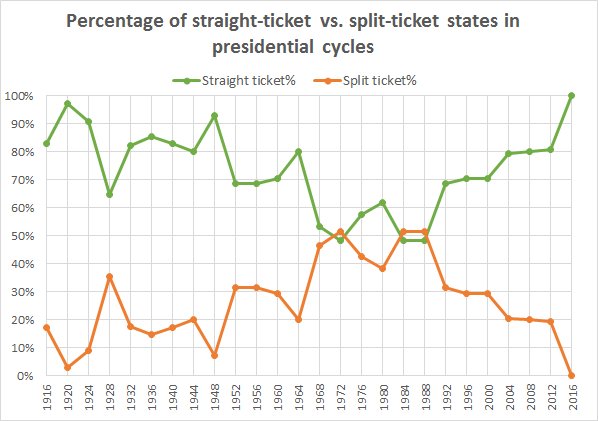
From Vox: Ticket splitting is dead. National parties are now everything.

I'm not sure if this is good or bad, but it is what it is.

The polarization of the U.S. continues.

- Click here for the article.


Every single state that elected a Republican senator this November voted for Donald Trump — and every single state that elected a Democratic senator voted for Hillary Clinton.

That’s a first in American history — at least going back to 1913, when the Constitution began mandating the direct popular election of senators. And it’s a dramatic reversal from much of the middle of the 20th century, when voters frequently backed senators of one party while also supporting the opposing party’s presidential nominee — a phenomenon known as “ticket splitting.”

The finding confirms a long-running trend: that ticket splitting is now virtually dead. The key culprit appears to be political polarization: Whereas the parties in the 1960s and 1970s were similar enough that a candidate’s local popularity could make a great deal of difference to a state’s voters, the Republican and Democratic caucuses are now so divided on the issues that it makes little sense to, say, back Hillary Clinton but oppose Democratic Missouri Senate candidate Jason Kander.

In an interview, the Center for Politics’ Geoffrey Skelley adds that the vote share of the parties’ presidential candidates and Senate candidate were also extraordinarily closely tied together this year (a 90 percent correlation). In other words, basically no Senate candidates did much better or much worse than their party’s nominee.


- Click here for more.

Wednesday, November 16, 2016

From the Harvard Business Review: What So Many People Don’t Get About the U.S. Working Clas

Since last week's election, renewed attention has been paid to this group.

- Click here for the article.
. . . the white working class (WWC) resents professionals but admires the rich. Class migrants (white-collar professionals born to blue-collar families) report that “professional people were generally suspect” and that managers are college kids “who don’t know shit about how to do anything but are full of ideas about how I have to do my job,” said Alfred Lubrano in Limbo. Barbara Ehrenreich recalled in 1990 that her blue-collar dad “could not say the word doctor without the virtual prefix quack. Lawyers were shysters…and professors were without exception phonies.” Annette Lareau found tremendous resentment against teachers, who were perceived as condescending and unhelpful.
Michèle Lamont, in The Dignity of Working Men, also found resentment of professionals — but not of the rich. “[I] can’t knock anyone for succeeding,” a laborer told her. “There’s a lot of people out there who are wealthy and I’m sure they worked darned hard for every cent they have,” chimed in a receiving clerk. Why the difference? For one thing, most blue-collar workers have little direct contact with the rich outside of Lifestyles of the Rich and Famous. But professionals order them around every day. The dream is not to become upper-middle-class, with its different food, family, and friendship patterns; the dream is to live in your own class milieu, where you feel comfortable — just with more money. “The main thing is to be independent and give your own orders and not have to take them from anybody else,” a machine operator told Lamont. Owning one’s own business — that’s the goal. That’s another part of Trump’s appeal.
Hillary Clinton, by contrast, epitomizes the dorky arrogance and smugness of the professional elite. The dorkiness: the pantsuits. The arrogance: the email server. The smugness: the basket of deplorables. Worse, her mere presence rubs it in that even women from her class can treat working-class men with disrespect. Look at how she condescends to Trump as unfit to hold the office of the presidency and dismisses his supporters as racist, sexist, homophobic, or xenophobic.
Trump’s blunt talk taps into another blue-collar value: straight talk. “Directness is a working-class norm,” notes Lubrano. As one blue-collar guy told him, “If you have a problem with me, come talk to me. If you have a way you want something done, come talk to me. I don’t like people who play these two-faced games.” Straight talk is seen as requiring manly courage, not being “a total wuss and a wimp,” an electronics technician told Lamont. Of course Trump appeals. Clinton’s clunky admission that she talks one way in public and another in private? Further proof she’s a two-faced phony.
Manly dignity is a big deal for working-class men, and they’re not feeling that they have it.

Tuesday, November 15, 2016

From Foreign Policy: The Two-Hundred-Year Era of ‘Left’ and ‘Right’ Is Over

Another argument that identity politics is an increasingly powerful driving force in global - not just American - politics.

- Click here for the article.

U.S. democracy may be government of the people, by the people, for the people. But who are “We the people”?
In the United States, every couple of years, one finds out. Elections reveal how the identity of the people — the sovereign person — has changed in body, will, and soul. As with human beings, certain moments in the life of the sovereign being are revealing of its true personality. Donald Trump’s victory was one such moment.
Before the primaries, it was possible to dismiss the electoral relevance of white working-class America, and those left behind by globalization more broadly, and many did: Look no further than the desiccated Washington-consensus platitudes regurgitated by Hillary Clinton and most of the Republican primary candidates.
Despite Trump and Bernie Sanders’s unexpected success in the primary campaigns, before Nov. 8, denial — most often heard in the form of a “surely Hillary can’t lose to Trump” plea — remained rife. But truth, whether electoral or existential, cannot be repressed forever. Now that the American sovereign being has made its biennial apparition for all to see, nobody can deny the fundamental changes in its personality.
Of course, this new political reality is not confined to the United States. We saw it with Brexit, we see it in populist movements across Europe, and we will see it again in the French and German elections next year.
Brexit and Trump were not anomalies, accidents of political history that can be explained away to maintain the integrity of the inherited notion that “normal” politics involves competition between a center-left party and a center-right party. Rather, in my view, they are symptomatic of a paradigm shift in the configuration of Western political life, one which has only just started.
Consider the familiar political category of left and right, which since 1945 has provided the basic organizing category of political differentiation in Western democracies across the vast majority of issues. Although the language of left and right dates to the French Revolution, the category started to take substantial political meaning in the late 19th century, and was forged over the following decades on the anvil of intense political fights over industrialization in the West, and all the changes in economic, social, and political relations that came in its wake.
The crucial point is that left and right are symbiotic, because they represent both sides of the argument over the problem of industrialization, over which there are good arguments to be made on either side. It is the interaction of these arguments set up by the mediation of the left-right categorization that produced sensible compromises across a whole range of issues.
Thus, the near-universal acceptance of the left and right categorization as a basic political normality after 1945 allowed for a long period of relative domestic stability in the West. Political argument between center-left and center-right parties was ordinarily contained to questions of distributive justice, that is, the allocation of goods within an established political framework.
2016 tells us that this world is now gone. Civil arguments about distributive justice seem quaint, as identity politics — the demon that the post-1945 world sought to contain — once again rears its ugly head.

Monday, November 14, 2016

From the Houston Press: What You Can Expect to See Under Kim Ogg as Harris County District Attorney

A look at what to expect from one of the few bright spots for Democrats last week

- Click here for the article.

After defeating Republican incumbent Devon Anderson at the polls, Democrat Kim Ogg is taking over the Harris County District Attorney's Office in a contentious time for criminal justice in Houston, in Texas, and frankly, in the United States. She will become the gatekeeper with the power to decide who belongs in the overcrowded Harris County Jail, the third-largest in the country, and will wield the power to rewrite policies that either strengthen or weaken punishment for those charged with low-level, nonviolent crimes.
And Ogg will take over just as a perfect storm brews for criminal justice reform here in Harris County, at every corner of the system. She takes over as the county, its misdemeanor judges and bail hearing officers face a lawsuit for allegedly failing to consider poor people's ability to pay bail, as the Constitution requires. She takes over as the county makes use of a prestigious $2 million grant to enact reforms intended to equalize the system for racial minorities, for the mentally ill and for the poor. And she takes over as the nationwide war on drugs continues to recede from prominence.
Ogg has repeatedly promised her supporters, throughout the campaign and during her victory speech, that "it’s a new day of justice in Harris County." It's a romantic notion, sure — but what does that actually look like in practice?

From the Texas Tribune: Analysis: The blue dots in Texas’ red political sea

More on Democratic gains at the local level.

- Click here for the article.
Tuesday’s election results offer further evidence that Texas mirrors America, with urban voters strongly favoring Democrats, while rural and many suburban voters favor Republicans.
Republican Donald Trump beat Democrat Hillary Clinton in 227 of the state’s 254 counties, racking up an advantage of 1,697,593 votes.
His biggest vote yield came in Montgomery County, one of several suburban counties — like Collin, Denton and Parker — that turned in reliably high Republican votes. Tarrant was the most populous county in his column, turning in a pile of Republican votes in spite of Clinton’s victory in Fort Worth, its biggest city.
Trump also won many of the state’s mid-size cities and nearly all of its rural areas.
Clinton beat Trump in 27 counties by a total of 883,819 votes. That was enough to cut his overall margin in half, but not nearly enough to pull off a Texas upset.
Her wins came in some of the state’s biggest counties — Harris, Dallas, Bexar, Travis, El Paso, Hidalgo and Fort Bend. He won the vast majority of rural Texas, but not everything: Clinton took a few relatively unpopulated counties like Kenedy and Culberson.
Trump’s overall margin was smaller than Mitt Romney’s 2012 win in Texas. In fact, the Republican at the top of this year’s ticket got a smaller percentage of the overall vote in Texas than any of the eight Republicans running statewide here, a group that included candidates for the Railroad Commission and the state’s two highest courts. Conversely, Clinton got a higher percentage of the vote than any of the Democrats running statewide.
A win is a win is a win, and this year belonged to the Republicans. Their streaks are intact: They’ve won the last 10 presidential elections in Texas and every statewide race in every election since 1994. But one takeaway from this year’s contests is that Democrats reduced the normal Republican margins and their scattered blue spots on the Texas map — the state’s biggest cities — turned in stronger Democratic performances than they have in the past.

From the NYT: Trump’s Supreme Court List: Ivy League? Out. The Heartland? In.

All current members are from Harvard, Yale or Columbia. That seems likely to change.

- Click here for the article.
If the list has a main theme, it is that there are plenty of good judges who went to law school at places like Notre Dame, Marquette, the University of Georgia and the University of Miami.
About half of Mr. Trump’s candidates sit on state supreme courts, and almost all those who sit on federal appeals courts do so in the heartland. (The exception is Judge Margaret A. Ryan of the United States Court of Appeals for the Armed Forces, in Washington.)
The résumés of the justices currently on the Supreme Court, by contrast, reflect a legal profession that is deeply hierarchical, obsessed with credentials and dominated by lawyers on the two coasts. Mr. Trump’s list, like his campaign, is a revolt against the elites.
At the same time, Mr. Trump’s candidates are, unsurprisingly, committed judicial conservatives. Mr. Trump credited two leading conservative policy groups — the Heritage Foundation and the Federalist Society — with helping to draw up his list.
“You had an awful lot of conservatives during the campaign who were incredibly skeptical, to put it mildly, about Donald Trump,” said John G. Malcolm, a Heritage Foundation official who suggested a number of names that appeared on the list. “But they certainly cared a lot about the Scalia vacancy and the direction of the court. And that list was a very, very sober list, and it was greatly reassuring.”
The list is a good reflection of Mr. Trump’s dual priorities, said William M. Jay, a lawyer with the firm of Goodwin Procter and a former law clerk to Justice Scalia.
“It was consistent with the message he was trying to send: that he was not going to be naming establishment choices but that the establishment might well be happy with the people he chose from Alabama and Iowa and places like that,” Mr. Jay said.
The top priority for conservatives, Mr. Malcolm said, was to avoid another disappointment like Justice David H. Souter, who was appointed by President George Bush in 1990 but whose voting record on the Supreme Court turned out to be decidedly liberal.

From the Pew Research Center: A Divided and Pessimistic Electorate

More evidence that Trump and Clinton supporters live in two different worlds, and see the problems facing the nation in two different ways.

- Click here for the article.

Beyond their disagreements over specific policy issues, voters who supported President-elect Donald Trump and Hillary Clinton also differed over the seriousness of a wide array of problems facing the nation, from immigration and crime to inequality and racism.
And while voters generally said little progress has been made over the last eight years across major areas, Trump backers said things had gotten worse across the board, while Clinton supporters saw more improvement, especially on the economy.
The national online survey was conducted in the two weeks leading up to the presidential election (from October 25 through the morning of November 8) among 3,788 registered voters who reported they had already voted or planned to vote. The survey was conducted on Pew Research Center’s nationally representative American Trends Panel.

Sunday, November 13, 2016

From Salon: How did we get here? Largely by way of Bill Clinton, Barack Obama and the big GOP victories of 1994 and 2010

The author puts the 2016 election in some historical context - going back to 1992 when Democratic presidents started playing to the political middle. He argues the results - including Democratic embrace of free trade, which it had opposed - re positioned the party in a "neo-liberal" direction creating the opportunity for the Republican Party to get the support of the disaffected blue collar whites that seem to be the reason for Trumps victory.

- What is neo-liberalism?

Neoliberalism is a policy model of social studies and economics that transfers control of economic factors to the private sector from the public sector. It takes from the basic principles of neoclassical economics, suggesting that governments must limit subsidies, make reforms to tax law in order to expand the tax base, reduce deficit spending, limit protectionism, and open markets up to trade. It also seeks to abolish fixed exchange rates, back deregulation, permit private property, and privatize businesses run by the state.

Liberalism, in economics, refers to a freeing of the economy by eliminating regulations and barriers that restrict what actors can do. Neoliberal policies aim for a laissez-faire approach to economic development.

- Click here for the article.

Let’s begin by rewinding to 1992. After 12 long years of Ronald Reagan and George H.W. Bush, Bill Clinton was elected president with Democrats in charge of both houses of Congress. Trifectas like that had once been commonplace. Throughout most of American history, it was more common to have them than to have divided government. But from 1968 up until Clinton’s 1992 election, only Jimmy Carter’s four years in office had seen a unified government. So Clinton’s trifecta was a big deal, and he was ambitious to get things done. Unfortunately, one of those things was NAFTA.

In fairness, Clinton didn’t dream up NAFTA. Ronald Reagan did. He didn’t negotiate or sign it. Bush did. But he did get it passed through Congress, twisting scores of Democrats’ arms as a symbol of his “pragmatism” in moving the Democrats back to the so-called center. (It’s worth recalling that billionaire H. Ross Perot, who ran for president as a pragmatic centrist independent, opposed NAFTA as one of his central campaign planks.)

The irony here was twofold: First, in the real world, Democrats clearly occupied the political center during the Reagan-Bush years, dominating the House as well as a majority of state legislative bodies and retaking the Senate in 1986. What’s more, NAFTA was deeply unpopular with the Democratic base and their representatives. In the House roll call vote, Democrats opposed the treaty, 156 to 102, while Republicans overwhelmingly supported it, 132 to 43.

Saturday, November 12, 2016

From 538: Voter Turnout Fell, Especially In States That Clinton Won

We noticed this in class this week.

- Click here for the article.

Early voting surged. Election Day voting plummeted. The net result: A smaller share of eligible voters cast ballots in 2016 than in either of the previous two presidential elections.

The raw number of votes rose: About
1.4 million more Americans voted in this year’s election than in 2012, a total which itself was down from 2008. But the electorate was growing in the meantime: About 57 percent of eligible voters cast ballots this year, down from 58.6 percent in 2012 and 61.6 percent in 2008, which was the highest mark in 40 years. Turnout still remained well above levels for most presidential election years from 1972 to 2000.

bialk-turnout-2


We still don't really know how many people voted though:

These numbers are preliminary estimates subject to change as our decentralized electoral system continues counting votes. There is no official national turnout figure, and the best available estimates — from Michael McDonald, associate professor at the University of Florida, who gathers data at the U.S. Elections Project; and from FiveThirtyEight contributor David Wasserman, who is gathering national vote counts — suggest that more than 4 million votes remain uncounted, more than half of them in California.3Wasserman is collecting presidential votes that have been counted so far; McDonald is using available data to estimate the total number of people who voted. As a result, McDonald’s count is higher. Though a small proportion of the gap between their counts is also due to McDonald counting ballots without a vote for president. McDonald might also be understating the number of California votes still uncounted. He didn’t respond to a request for comment. As a result, figures in this story may not line up with vote-count data published by media organizations. Many news organizations after the election claimed that 46.9 percent of people didn’t vote. But that figure, which may have originated from this tweet, was based on dividing vote totals as of Wednesday morning by all eligible voters.


Thursday, November 10, 2016

From Scientific American: Explaining Donald Trump's Shock Election Win Five factors behind America’s staggering decision

Here's what they isolate:

- Click here for the article.

1. SILENT TRUMP VOTE 
2. CELEBRITY BEAT ORGANIZATION 
3. POPULIST REVOLT AGAINST IMMIGRATION AND TRADE
4. OUTSIDERS AGAINST INSIDERS
5. AMERICA, THE DIVIDED

From the Pew Research Center: Behind Trump’s victory: Divisions by race, gender, education

Expect lot's of analysis in the coming days.

Here's a look at the divides that revealed themselves in Tuesday's election in comparison to previous elections.

- Click here for the article.

And some nice helpful graphs:


Let's compare 2016 with previous elections.

For use in class: David Leip's political atlas.

Neither Trump not Clinton received as many votes as the winner in 2012, 2008 or 2004.

- Click here for voter turnout rates.

Here's an analysis claiming that Clinton lost because Democrats did not show up to vote.

I made a chart showing the popular vote turnout in 2008, 2012 and 2016. Hillary didn't lose because the Republicans grew their base; she lost because the Democrats didn't come out to vote. [OC]

From Vox: Few predicted Trump had a good shot of winning. But political science models did.

Not everyone got the election wrong. Forecasts based on fundamentals were more accurate than those based on polls - which were actually accurate, as we'll see in other posts. 

- Click here for the article.

Why did so few people see Donald Trump’s win coming?
The polls got it wrong. The major election forecasting models got it wrong (though FiveThirtyEight’s Nate Silver deserved credit for being significantly less certain about it). The political professionals got it wrong. The pundits got it oh, so very wrong indeed.
Oddly enough, though, there were signs pointing to the fact that Trump had a better chance than people were giving him, and they were lurking in plain sight.
They were in well-known political science research on “fundamental-based” factors that has long been used to explain presidential elections.
In fact, of the major political science models that try to explain presidential elections, three predicted Trump would win and three others predicted only a very narrow Clinton victory.

Wednesday, November 9, 2016

From Vox: Trump won. But so did marijuana legalization, gun control, and minimum wage increases.

An odd result since these are all liberal proposals.

- Click here for the story.

By all accounts, the biggest races on Election Day were a total disaster for Democrats. Donald Trump won. Republicans kept Congress, holding back a Democratic attempt to retake the Senate. And down the ballot, the results weren’t much better for the party: Democrats overall lost governors’ races, although the results were more mixed in state legislatures.
But not all is doom and gloom. While Democrats lost big, liberals won some of the big initiatives that were on statewide ballots. It wasn’t a total sweep — several states, for example, affirmed the death penalty — but there were gains on some issues, including marijuana legalization, minimum wage, and gun control.
The full results paint a much more mixed picture than the top-ballot results suggest: The Democratic Party got clobbered, but some of the major policies Democrats support also won big.

From the Houston Press: Gonzalez Unseats Hickman to Become Harris County Sheriff

State and national races aside, Democrats did well in Harrow County

- Click here for the article.


Democratic challenger Ed Gonzalez defeated incumbent Harris County Sheriff Ron Hickman by nearly 64,000 votes Tuesday. Hickman conceded to Gonzalez shortly after 10 p.m., with roughly 81 percent of the votes counted.
Since Hickman's appointment by the Harris County Commissioners Court in May 2015, his administration had been plagued by continuing problems at the Harris County Jail — poor conditions that Hickman blamed largely on his predecessor, Adrian Garcia. (Garcia stepped down to run for mayor).
In a September interview with Houston Public Media, Gonzalez, a former Houston Police Department homicide detective and three-time city councilman, called Hickman's administration "stagnant" and "almost going backwards."
Gonzalez told the radio station “There’s three things that we’re addressing in law enforcement that do not have a law enforcement response, and that’s mental illness, poverty, and addiction. We’ve got to find community-based solutions to that."
Hickman's campaign had centered largely on the fact that Gonzalez was no longer a licensed peace officer, while stressing the incumbent's law enforcement bona fides. This earned him endorsements by the Houston Police Officers Union, the Harris County Deputies Organization and the Mexican-American Sheriffs Organization. (Perhaps even more importantly, he had the blessing of Gallery Furniture founder Jim "Mattress Mac" McIngvale).
But Gonzalez was endorsed by the Houston Chronicle, saying that the former homicide detective and three-term city councilman "built a record as a policymaker dedicated to diverting people from our jail — one of the major challenges facing the sheriff's office."

For background on problems with the Harris County jail:

- Jailhouse jeopardy: Guards often brutalize and neglect inmates in Harris County Jail, records show.