Showing posts with label Trump presidency. Show all posts

Thursday, March 30, 2017

From the NYT: ‘We Must Fight Them’: Trump Goes After Conservatives of Freedom Caucus

Trump has a new enemy.

An example of the relatively new concept of primarying.

- Click here for the article.

President Trump declared war on the conservatives of the House Freedom Caucus on Thursday, suggesting Republicans should “fight them” in the 2018 midterm elections if they do not back his agenda.

“The Freedom Caucus will hurt the entire Republican agenda if they don’t get on the team, & fast,” Mr. Trump said Thursday morning on Twitter, escalating a fight that began when the conservatives from the caucus
blocked his Affordable Care Act repeal last Friday.

“We must fight them, & Dems, in 2018!” Mr. Trump wrote, apparently making good on suggestions that he would support Republican challengers to lawmakers in his own party who oppose him, a stance advocated by his chief strategist,
Stephen K. Bannon.

Friday’s loss on health care rekindled a long-running civil war between the party’s establishment, represented by Speaker Paul D. Ryan, who drafted the original bill, and anti-establishment conservatives in the caucus, who thought it preserved too many elements of the Obama-era program.


For more:

House conservatives call Trump an ungrateful bully after threat to unseat them in 2018.
- Trump can’t stop the Freedom Caucus. He has GOP gerrymandering to blame.

Tuesday, March 28, 2017

From the Washington POst: Attorney General Jeff Sessions repeats Trump threat that ‘sanctuary cities’ could lose Justice Department grants

An example of coercive federalism?

- Click here for the article

Attorney General Jeff Sessions on Monday threatened to strip some “sanctuary cities” of coveted Justice Department grants for state and local law enforcement, saying those places that did not comply with a particular federal law on immigration would not be eligible for money.

“I urge our nation’s states and cities to consider carefully the harm they are doing to their citizens by refusing to enforce our immigration laws, and to rethink these policies,” Sessions said from the White House. “Such policies make their cities and states less safe, and put them at risk of losing valuable federal dollars.”

Sessions’s announcement follows President Trump’s executive order in January that gave the attorney general the authority to sanction any city that doesn’t readily hand over undocumented immigrants for deportation.

This effort to punish cities where local leaders refuse to hand over undocumented immigrants for deportation is the latest effort by the Trump administration to crack down on illegal immigration.

Sessions said the Justice Department will take steps to “claw back any funds awarded to a jurisdiction” that violates federal law. The Justice Department will award more than $4.1 billion in grants to state and local jurisdictions this fiscal year.

Monday, March 27, 2017

The Washington Post: White House installs political aides at Cabinet agencies to be Trump’s eyes and ears

For 2305

- Click here for the article.

The political appointee charged with keeping watch over Environmental Protection Agency Administrator Scott Pruitt and his aides has offered unsolicited advice so often that after just four weeks on the job, Pruitt has shut him out of many staff meetings, according to two senior administration officials.
At the Pentagon, they’re privately calling the former Marine officer and fighter pilot who’s supposed to keep his eye on Defense Secretary Jim Mattis “the commissar,” according to a high-ranking defense official with knowledge of the situation. It’s a reference to Soviet-era Communist Party officials who were assigned to military units to ensure their commanders remained loyal.
Most members of President Trump’s Cabinet do not yet have leadership teams in place or even nominees for top deputies. But they do have an influential coterie of senior aides installed by the White House who are charged — above all — with monitoring the secretaries’ loyalty, according to eight officials in and outside the administration.
This shadow government of political appointees with the title of senior White House adviser is embedded at every Cabinet agency, with offices in or just outside the secretary’s suite. The White House has installed at least 16 of the advisers at departments including Energy and Health and Human Services and at some smaller agencies such as NASA, according to records first obtained by ProPublica through a Freedom of Information Act request.
These aides report not to the secretary, but to the Office of Cabinet Affairs, which is overseen by Rick Dearborn, a White House deputy chief of staff, according to administration officials. A top Dearborn aide, John Mashburn, leads a weekly conference call with the advisers, who are in constant contact with the White House.

From The Monkey Cage: President Trump couldn’t pass Obamacare repeal. This is why.

For 2305.

President Trump is coming to terms with the limits of presidential power.

- Click here for the article.

The decision to pull the American Health Care Act (AHCA) from the House floor on Friday is a telling reminder of the limits of presidential power when it comes to leading the legislature. Our separated system makes it hard for presidents to translate their preferences into policy, even on priority matters. As Lyndon Johnson put it, complaining about the Kennedy staff’s inability to get bills moving: “You can’t start yelling ‘frog’ at everybody and expect ‘em to jump!”
A quick review of political science literature on presidential success in Congress gives us several lenses through which to view Friday’s happenings. One consistent finding is that presidential personality — and the schmoozing of legislators, etc. — matters mostly “at the margins,” as George Edwards put it. In a close vote, those margins surely might matter. But systematic factors were also at play:

Read on for detail.

Wednesday, March 8, 2017

From 538: The Eight Power Centers Of The Trump Administration

A nice look at the battles within the Trump Administration.

It also provides a great overview of the various groups that exist within each party - in this case the Republican Party

- Click here for the article.

Whenever a new administration starts, top aides to the president battle for authority and power, and the Washington press corps pushes for scoops on the “palace intrigue.” Those senior aides try to get reporters to write profiles that pump up the aides’ influence, while the reporters hope a favorable profile results in a grateful aide leaking them information in the future.
Usually, no part of this process matters to anyone outside of Washington. In 2009, President Barack Obama named a combination of ex-Bill Clinton aides, senior Democratic staffers on Capitol Hill, veteran Washington figures and a few of his longtime allies from Chicago politics to key jobs in the White House and in the Cabinet. The people in top jobs may have been slightly different than if Hillary Clinton had been elected president but not by much. Obama, like Hillary Clinton, was a center-left Democrat from the party’s congressional wing, campaigned as such and picked a team to govern that reflected the prevailing ideology in his party.
But now, White House staffers, cabinet secretaries and other advisers matter. Bigly. President Trump didn’t come from any existing wing of the Republican Party. He didn’t run as a tea party-type like Ted Cruz or in the center-right style of George W. and Jeb Bush. There is no nationalist, Trump-style faction of the Republican Party in Congress that can be plucked to fill out an entire administration.
. . . Indeed, Trump’s administration has at least eight major factions, which has become clear based on statements and decisions by his advisers since the November election but also confirmed by interviews with veteran Washington figures who are dealing with his team. And to understand what is happening and will happen in this administration, it is crucial to understand these power centers, which are cooperating but also competing with one another.

Here's the breakdown:

- The Bannon Wing
- The Pence Wing
- The McCain Wing
- The Friends and Family Wing
- The Party Wing
- The Wall Street Wing
- The Bureaucrats
- Other important figures

Tuesday, March 7, 2017

From the Washington Post: Supreme Court sends Virginia transgender case back to lower court

More policy change due to the change in the White House.

- Click here for the article.

The Supreme Court on Monday vacated a lower court’s ruling in favor of a Virginia transgender student after the Trump administration withdrew the federal government’s guidance to public schools about the controversial bathroom policy.
The justices were scheduled to hear the case later this month. But after the federal government’s position changed, the court said the U.S. Court of Appeals for the 4th Circuit should reconsider the dispute between the Gloucester County school board and 17-year-old Gavin Grimm.
The 4th Circuit had relied on the federal government’s guidance that school should let transgender students use the bathroom that corresponds with the student’s gender identity.
The Trump administration withdrew that guidance, which was issued by the Obama administration.
Both the school board and Grimm’s attorneys had asked the Supreme Court to let the case proceed, saying it presented a reading of the civil rights law Title IX that the court ultimately will have to settle.

Grimm, whose birth gender was female, has become a celebrated figure in the transgender-rights community because of his lawsuit, with profiles in national media. His case was thought to be an important milestone on the issue.
While the Obama administration said anti-discrimination laws required allowing transgender students to use the bathroom of their choice, the Trump administration said it needs more time to study the issue and put forward its own view of the law.

For more:

- NYT: Supreme Court Won’t Hear Major Case on Transgender Rights.
- ScotusBlog: Justices send transgender bathroom case back to lower courts, no action on same-sex marriage cake case.

ScotusBlog has a full record of the case here: Gloucester County School Board v. G.G.

Wednesday, February 22, 2017

From the National Law Journal: Order to Reveal Detainee Names May Grow List of Plaintiffs Challenging Travel Ban

More checking and balancing of the Trump Administration from the courts.

- Click here for the article.

A Brooklyn judge's ruling for the Trump administration to produce a list of travelers who were detained under a controversial travel ban it issued in January may help plaintiffs' attorneys in the New York case challenging the ban to grow their clients' ranks.
Eastern District Judge Carol Bagley Amon ruled on Tuesday that the government has until 5 p.m. on Thursday to submit the names of all those held by U.S. Customs and Border Protection agents under the Trump administration's executive order from 9:37 p.m. on Jan. 28, when Eastern District Judge Ann Donnelly issued a ruling to stay deportations, to 11:59 p.m. on Jan. 29.
In a news release, Healy Ko, a law student intern for Yale Law School's Worker and Immigrant Rights Advocacy Clinic, said Amon's order was an "important step in the fight to repair the damage done" by the executive order.
"We are aware of reports that CBP officers deliberately ignored the court's order in the hours after the decision came down, and are confident that the court's decision will help to identify individuals that were unlawfully removed and provide them a chance to return to the United States," Ko said.
In addition to counsel from Yale Law, the plaintiffs are also represented by the National Immigration Law Center, the International Refugee Assistance Project, the American Civil Liberties Union, the New York Civil Liberties Union, and Kilpatrick Townsend & Stockton.
The Justice Department did not immediately reply to a request for comment.
Amon's order partially granted a motion to compel filed by the plaintiffs, who include doctors, refugees and students affected by the order. The plaintiffs have also moved for class certification, but there has been no ruling on the motion.
The plaintiffs' motion to compel also contained a proposed order for the government to return any individuals who were removed from the United States as part of the order.

- Click here for the Judge Amon's Wikipedia page.

Monday, February 20, 2017

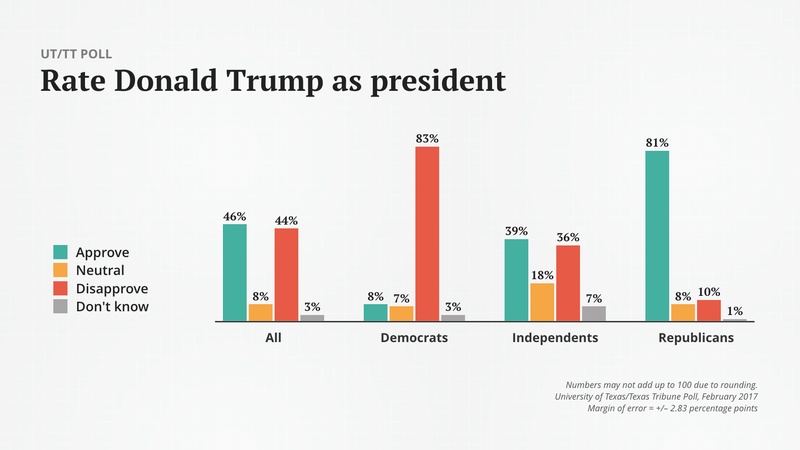
Texas Republicans like President Trump

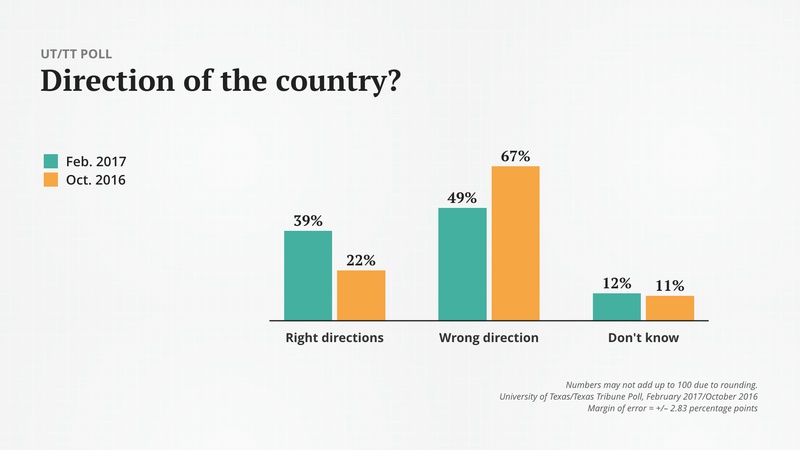
And they suddenly like the direction the country is headed.

Big surprise. Both stories are from the Texas Tribune.

- UT/TT Poll: A new president, popular with Texas Republicans.


- UT/TT Poll: A change in party control prompts a change in Texans’ moods.

From Mother Jones: Trump Expected to Sign Executive Orders Hitting the EPA

I'm posting this because it contains the following quote:
"I read the constitution of the United States, and the word 'environmental protection' does not appear there."


- Click here for the article.

Scott Pruitt will almost certainly be the next head of the Environmental Protection Agency. The Oklahoma attorney general's nomination is expected to sail through the Senate—possibly as soon as Friday—despite Democrats' protests that he is unfit to lead an agency that he has repeatedly sued. The administration has already imposed a freeze on the EPA's social media, halted its rulemaking, and reportedly mandated that all agency research be reviewed by a political appointee before being released to the public. But next week, once Pruitt is sworn in, the real frenzy will begin.
According to Reuters, President Donald Trump plans to sign between two and five environmental executive orders aimed at the EPA and possibly the State Department. The White House is reportedly planning to hold an event at the EPA headquarters, similar to the administration's rollout of its widely condemned travel ban after Defense Secretary James Mattis took office. While we don't know what, exactly, next week's orders will say, Trump is expected to restrict the agency's regulatory oversight. Based on one administration official's bluster, the actions could "suck the air" out of the room.
Trump may have hinted at the forthcoming orders in his unwieldy press conference on Thursday. "Some very big things are going to be announced next week," he said. (He didn't make clear whether or not he was referring to the EPA.)
Former President Barack Obama's array of climate regulations, including the Clean Power Plan limiting power plant emissions, are certainly high on conservative activists' hit list. So, too, is the landmark Paris climate deal, in which Obama agreed to dramatically cut domestic carbon emissions and provide aide to other countries for clean energy projects and climate adaptation. The EPA's rule that defines its jurisdiction over wetlands and streams is also a prime target. As attorney general, Pruitt launched lawsuits against a number of these regulations.
"What I would like to see are executive orders on implementing all of President Trump's main campaign promises on environment and energy, including withdrawing from the Paris climate treaty," said Myron Ebell, who headed Trump's EPA transition and recently returned to the Competitive Enterprise Institute, in an email to Mother Jones.

Sunday, February 19, 2017

From the Pew Research Center: A basic question when reading a poll: Does it include or exclude nonvoters?

In some 2305 sections we've been discussing polling. Here's an important reminder of what can throw polls off.

- Click here for the article.

The early days of a new presidential administration produce not just a blizzard of news but a blizzard of numbers. Pollsters of all stripes race to get and report Americans’ first impressions of their new president. But, frustratingly, those reports don’t always match up as precisely as the Type A among us might wish.
Take the past three weeks of polling on President Donald Trump. Depending on the poll, Trump’s approval rating between Feb. 5 and 13 could have been as high as 53% or as low as 39%. So which was it?
There are a number of possible reasons for polls arriving at different estimates – from the mode used to collect data to how people are selected for a survey – but here we’ll tackle one of the most basic: Did the poll include or exclude the 45% of adult Americans who didn’t cast a vote last November?

Wednesday, February 15, 2017

Limiting Trump

Here are four out of a number of articles detailing how aspects of the governing system - both internal and external - are limiting efforts of the Trump Administration to quickly implement its goals.

I've mentioned in class that inertia is built into the constitutional system, here's proof.

1 - Lawfare: Bannon in Washington: A Report on the Incompetence of Evil.

Steve Bannon has proved himself to be so monumentally incompetent that I am fairly certain the Republic is safer than I could have believed three weeks ago, at least from Bannon’s flailing efforts to maximize whatever supposed contradictions he believes he has identified.
Bannon isn’t an arch-villain. And he’s not the guy who’s going to destroy American democracy. Instead, as I’ll explain, he’s just an internet troll.
Bannon’s ineptitude has become clear in the context of his role at the center of the refugee order’s botched writing and rollout—strangely, the same context out of which emerged the portrait of him as the sinister, all-knowing eminence grise. To paraphrase Benjamin Wittes, the executive order was both deeply malevolent and profoundly incompetent.
. . . it’s very hard to dismantle major democratic institutions without a certain degree of capability. The establishment of authoritarianism takes both effort and cunning. And I’m much less worried than I was that these folks have the kind of cunning and focus it would take to take down the American experiment.
And for that I say, thanks, Steve Bannon.

2 - Lawfare: The Real Constitutional Danger.

The real story in the last week, and indeed of the Trump presidency, is (as predicted) how well our constitutional checks and balances are working in reaction to an unorthodox, norm-breaking, law-indifferent President. It is increasingly clear that the main danger in a Trump presidency is not that it will be too strong, but that it will be too weak.

In November I argued that “the permanent bureaucracy, including inspectors general and government lawyers; the press; civil society; Congress; and courts … will operate in much more robust fashion to check President Trump than they did to check President Obama,” and that “Trump’s seeming indifference to the rule of law and his pledges to act unlawfully will cause the checking institutions to judge all of his actions with much greater scrutiny and skepticism.” That is precisely what has happened.

3 - Washington Post: In the early weeks of the new administration, the humbling of a president.


For Trump, nothing has proved as easy as it might have looked on the campaign trail, despite the flurry of executive orders and actions that flowed from his desk in the first days after the inauguration. He has signaled a radically different direction for the country, but only that. Senior policy adviser Stephen Miller’s claim that Trump has accomplished more in a few weeks than most presidents do in their entire administrations should be seen as the fanciful boast that it is. The record is only beginning to be written.
The powers of the president are vast, but they are not unlimited. Trump has come face to face with the checks and balances built into the Constitution and with the difficulty of commanding a huge bureaucracy of federal workers who value their role as public servants. He has seen anew the power of a free press to dig and report and hold those in power accountable. He has felt the power and sting of leaks from inside the government. There’s nothing new about any of this. It has been true for past presidents. Trump is learning the lesson painfully.

4 - The New Republic: Donald Trump Is on the Ropes.

Trump’s obsession with the leakers, and those who are eager to publish these leaks, is consistent with his longtime political strategy of demonizing the press and professional bureaucrats. The leaking issue allows him to pair these two alleged foes as a united enemy—a characterization his base will no doubt devour—and also allows him to have his cake and eat it, too: He can bemoan the “illegally given” information on the one hand, and then claim it’s all “fake news” anyway. Further, this obsession is also consistent with his propensity for conspiracy theories. The very anonymity of leakers makes it easy to portray them as shadowy conspirators plotting against him.
This isn’t just a matter of rhetoric, though. It’s also a reflection of Trump’s approach to governing. He’s being undermined by leakers because he doesn’t know how government works, is isolated and alienated from the professional bureaucracy, and has been slow in appointing his own people to key spots. The result is an utterly chaotic, confused administration—and where there’s chaos and confusion in government, there are usually leaks, too.

Monday, February 6, 2017

From the Washington Post: Former top diplomats, tech giants blast immigration order as court showdown looms

More pushback against the president's immigration order.

- Click here for the article.
Fresh challenges to President Trump’s court-frozen immigration order took shape Monday with two former secretaries of state claiming the White House was undermining national security and nearly 100 Silicon Valley tech companies arguing it will keep the best minds from coming to America.

The powerful new voices were added with another legal showdown coming as early as Monday. The suspension of the order, meanwhile, has allowed those previously banned more time to try to reach the United States.

. . . A decision Sunday by the U.S. Court of Appeals for the 9th Circuit preserved a lower judge’s order to temporarily halt the ban — and based on a schedule the court outlined, the stop will remain in place at least until sometime on Monday. The Justice Department said it would not elevate the dispute to the Supreme Court before that.

. . . Hours earlier, a host of technology giants — including Apple, Facebook, Google, Microsoft, Netflix, Twitter, Uber — were part of a “friend of the court” legal brief by
97 companies opposing the Trump administration’s immigration order.

The brief claimed the order was a “significant departure” from U.S. immigration policies and “makes it more difficult and expensive for U.S. companies to recruit, hire, and retain some of the world’s best employees.
. . . Vice President Pence said Sunday on NBC’s “Meet The Press” that White House officials felt that Trump was “operating within his authority as president, both under the Constitution and under clear statutory law.” Legal analysts have said the president has broad authority to set immigration policy, although civil liberties advocates have countered that the order essentially amounts to a discriminatory ban on Muslims that has no real national security purpose.

“We’re very confident that we’re going to prevail,” Pence said. “We’ll accomplish the stay and will win the case on the merits. But again, the focus here is on the safety and security of the American people.”


Sunday, February 5, 2017

From the Washington Post: Judge halts deportations as refugee ban causes worldwide furor

More resistance to recent immigration moves by the Trump Administration - a current example of checks and balances.

- Click here for the article.
A federal judge in New York blocked deportations nationwide late Saturday of those detained on entry to the United States after an executive order from President Trump targeted citizens from seven predominantly Muslim countries.

Judge Ann Donnelly of the U.S. District Court in Brooklyn granted a request from the American Civil Liberties Union to stop the deportations after determining that the risk of injury to those detained by being returned to their home countries necessitated the decision.

Minutes after the judge’s ruling in New York, another came in Alexandria when U.S. District Judge Leonie Brinkema issued a temporary restraining order to block for seven days the removal of any green-card holders being detained at Dulles International Airport. Brinkema’s action also ordered that lawyers have access to those held there because of the ban.

Several hours after the judicial rulings, the Department of Homeland Security said it would continue to implement Trump’s executive order. In a statement released early Sunday, the agency said “less than one percent” of international air travelers arriving Saturday in the U.S. were “inconvenienced” by the executive order.

“President Trump’s Executive Orders remain in place — prohibited travel will remain prohibited, and the U.S. government retains its right to revoke visas at any time if required for national security or public safety,” the statement said. “No foreign national in a foreign land, without ties to the United States, has any unfettered right to demand entry into the United States or to demand immigration benefits in the United States.”

From the Washington Post: Retired Gen. John F. Kelly confirmed as secretary of homeland security

This is also a bit late.

- Click here for the article.
The Senate confirmed John F. Kelly as secretary of homeland security on Friday, putting the blunt-spoken retired Marine general in charge of securing the nation’s borders, including construction of the controversial southwest border wall that was a centerpiece of President Trump’s campaign.

Senators approved Kelly’s nomination to run the Department of Homeland Security, a sprawling entity of more than 240,000 employees who do everything from protecting the president to safeguarding the nation’s electrical grid.

Kelly, who retired in February as chief of the U.S. Southern Command, is part of
the first wave of Cabinet secretaries who will begin to implement the expansive plans of the nation’s 45th president. 
DHS will be at the forefront of some of the most highly charged parts of that agenda, including the wall, which would be designed to keep out illegal immigrants. Kelly appeared to play down the wall’s importance at his recent confirmation hearing, telling a Senate committee that “a physical barrier in and of itself will not do the job’’ and that technology such as drones and sensors are also needed to secure the border.

For more on the DHS:

- Wikipedia: Department of Homeland Security.

From the Washington Post: Retired Gen. James Mattis is confirmed as defense secretary, breaking with decades of precedent

I'm a bit late on this post, but here's a look at out new Defense Secretary.

- Click here for the article.

Retired Marine Gen. James N. Mattis was confirmed and sworn in as President Trump’s defense secretary Friday, breaking with decades of precedent as a recently retired general became the Pentagon’s top civilian leader.

Mattis, 66, was approved with a 98-1 vote after the presidential inauguration and then sworn in by Vice President Pence. The new Pentagon chief released a statement to U.S. troops afterward that credited not only them, but intelligence personnel as “sentinels and guardians of our nation” — rhetoric that is in line with Mattis’s past statements, but stands in contrast to the way Trump has criticized the value of U.S. intelligence in recent weeks.

. . . Many lawmakers and long-time foreign policy observers hope Mattis can be a moderating voice of experience in an administration that has notably few senior officials with national security experience in Washington. He will lead the Defense Department’s 1.9 million active-duty service members and reservists and oversee a budget of more than $580 billion as Trump prepares to expand the military.

Mattis becomes the first senior military officer to serve as defense secretary since President Truman nominated Army Gen. George C. Marshall for the job in 1950, as the U.S. military struggled in the Korean War. Mattis retired in spring 2013 as the chief of U.S. Central Command after a career in which he became one of the most influential officers of his generation and commanded troops in Iraq and Afghanistan.

For more on the defense department:

- Wikipedia: Department of Defense.

From the American Assiciation for the Advancement of Science: AAAS Responds to Moves to Halt EPA and USDA Public Communications

We'll be looking at the efforts different groups are using to push back against the initiatives of the Trump administration. The AAAS is an advocacy group.

- Click here for the article.
Holt responded Tuesday to moves by the Trump administration to bar employees at the Environmental Protection Agency and the Department of Agriculture from communicating with the media or engaging on social media.

“We are concerned about reports that federal agencies – including the Department of Agriculture and the Environmental Protection Agency – have issued directives to staff that may silence the voices of scientific researchers and others working for the federal government,” said Holt in a statement.

Holt held out hope that the measures are temporary and being taken as the agencies await Senate confirmation of President Donald Trump’s nominees for the two departments. “Our hope is that this is a temporary measure put into place until the new government agency heads are confirmed by the Senate,” Holt said.

But Holt sounded concern about potential ethical and policy implications of such moves.

“Many federal agencies have existing scientific integrity policies that prohibit political interference in the public dissemination of scientific findings,” added Holt. “As the AAAS Council stated in 2006: Censorship, intimidation, or other restriction on the freedom of scientists employed or funded by governmental organizations to communicate their unclassified scientific findings and assessments not only to each other but also to policymakers and to the public is inimical to the advance of science and its appropriate application in the policy domain."

For more on the agencies referred to above:

- Wikipedia: EPA.
- Wikipedia: Department of Agriculture.

More for the AAAS: First 100 Days.

Thursday, February 2, 2017

From the Washington Post: Trump’s intervention into policing, voting and immigration sets up showdown with America’s largest cities

For out look at federalism.

- Click here for the article.

In an executive order signed Wednesday, Trump directed the Department of Homeland Security to find ways to defund cities and jurisdictions out of step with his immigration priorities. That action — which could cost sanctuary cities including Washington, New York and Los Angeles millions of dollars — is the latest in a series of moves where Trump has appeared willing to step on state-level or municipal prerogatives.

In the scuffle, U.S. mayors have emerged as key players in the resistance to Trump’s agenda.

“Cities know how important local control is, because we are in touch with the people we represent most closely. This is a president who’s been clear that he wants to centralize as much authority as he can in himself,” Minneapolis Mayor Betsy Hodges said Wednesday. “That is dangerous for our democracy, I believe, and he is using the levers of our democracy to centralize his authority.”

At the center of the sanctuary city debate is a disagreement over whether local police officers should be required to help immigration officials enforce federal immigration laws. Many liberal mayors, including Los Angeles Mayor Eric Garcetti and New York City’s Bill De Blasio, have argued that requiring local police departments to assist immigration agents with deportations could sow distrust among immigrant populations. It could also discourage undocumented victims or witnesses from coming forward to report crimes.

“This is a federalism issue,” said Jorge Elorza (D), the mayor of Providence, R.I., who is the son of immigrants. “The idea of local control is deeply embedded in American history, and what we have now is a very aggressive attempt by the federal government to commandeer our local police departments to become immigration agents.”

He vowed “massive and aggressive lawsuits,” a resistance echoed by several local leaders.

Kevin de Leon, the Democratic president pro tempore of the California state Senate, said the state legislature is prepared to “explore all of our legal options” to fight the order.

“Singling out states and cities with punitive threats and withholding federal resources as today’s order on sanctuary cities does is unconstitutional,” de Leon said. “It’s not the job of our local and county and state law enforcement to turn the cogs on President Trump’s deportation machine.”

Friday, January 27, 2017

From the National Constitution Center: Podcast: Has President Trump violated the Emoluments Clause?

In a couple weeks I'll ask 2305 students about the emoluments clause of the Constitution.

Here's a head start on it.

- Click here for the podcast.

On January 23, the nonprofit legal watchdog group CREW filed a lawsuit alleging that President Donald Trump is violating the Foreign Emoluments Clause in Article 1, Section 9, which states: “[N]o Person holding any Office of Profit or Trust under them, shall, without the Consent of the Congress, accept of any present, Emolument, Office, or Title, of any kind whatever, from any King, Prince, or foreign State.”
CREW points out that foreign governments are doing business at Trump hotels and other buildings in the United States, and that the Trump organization is conducting business abroad.
There are also questions about the Domestic Emoluments Clause in Article II, Section 1, which states that “The President shall, at stated Times, receive for his Services, a Compensation … and he shall not receive … any other Emolument from the United States, or any of them.”
Joining We the People to discuss are two experts in constitutional law who are actively writing and thinking on these issues.

Wednesday, January 25, 2017

From the Washington Post: Trump to sign executive orders enabling construction of proposed border wall and targeting sanctuary cities

Today's executive actions.

These appear to be actual orders, not memorandums.

- Click here for the article.

President Trump plans to sign executive orders Wednesday enabling construction of his proposed wall on the U.S.-Mexico border and targeting cities where local leaders refuse to hand over illegal immigrants for deportation, according to White House officials familiar with the decisions.
The actions, part of a multi-day focus on immigration, are among an array of sweeping and immediate changes to the nation’s immigration system under consideration by the new president. The moves represent Trump’s first effort to deliver on perhaps the signature issue that drove his presidential campaign: his belief that illegal immigration is out of control and threatening the country’s safety and security.
Trump’s immigration blitz this week is widely seen inside the White House as a victory for the self-described populist wing of his inner circle — which includes chief strategist Stephen K. Bannon, attorney general nominee Jeff Sessions and top policy adviser Stephen Miller.

But discussions were ongoing Tuesday about just how far to go on some policies, in particular the Deferred Action for Childhood Arrivals program, known as DACA. The 2012 initiative has given temporary protection from deportation to hundreds of thousands of people who arrived in the United States as children. Trump vowed during the campaign to reverse it.
It was not yet clear late Tuesday whether DACA would be addressed as part of Trump’s immigration actions, according to a White House official, because of differing views among Trump’s advisers and associates about the timing, scope and political benefits of ending the program or suspending it for new entries.