Showing posts with label Party Identification. Show all posts

Sunday, September 1, 2024

How party identification influences opinion formation

Study the chart below. It shows facts associated with crime - murder rates in large cities - and data showing how people perceive those cities: Are they safe? 

Note the two furthest to the right - people who identify as Democrats and Republicans don't seem to be seeing the same thing. 

Why?


Thursday, January 25, 2024

Democrats and Republicans don't seem to live in the same world

At least they don't see things the same way. Here is an example: 


Why? 

- Polarization, Democracy, and Political Violence in the United States: What the Research Says.

1 - American voters are less ideologically polarized than they think they are, and that misperception is greatest for the most politically engaged people.

2 - American politicians are highly ideologically polarized. In other words, they believe in and vote for different sets of policies, with little overlap. This trend has grown in a steady, unpunctuated manner for decades.

3 - Even though Americans are not as ideologically polarized as they believe themselves to be, they are emotionally polarized (known as “affective polarization”). In other words, they do not like members of the other party.

4 - Affective polarization is unlikely to be causing democratic backsliding or political violence on its own. The problem is not polarized emotions alone but how those feelings interact with voting systems, candidate incentives, and personal relationships.

5 - Similarly, affective polarization is not causing political violence directly. It is probably contributing to an environment that allows politicians and opinion leaders to increase violence targeted at politicians, election officials, women, and many types of minorities.

- From the Pew Research Center: A Deep Dive Into Party Affiliation.

Democrats hold advantages in party identification among blacks, Asians, Hispanics, well-educated adults and Millennials. Republicans have leads among whites – particularly white men, those with less education and evangelical Protestants – as well as members of the Silent Generation.

Saturday, November 19, 2016

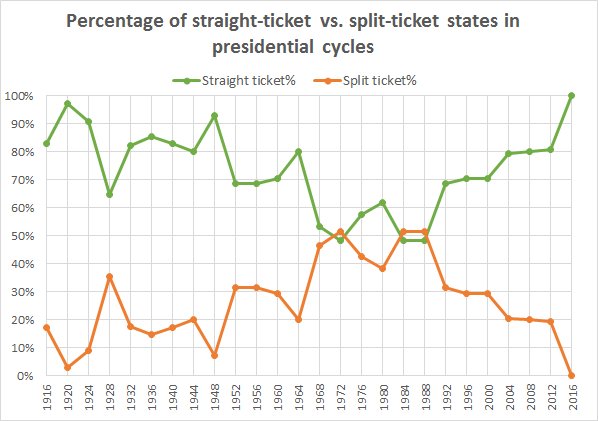
From Vox: Ticket splitting is dead. National parties are now everything.

I'm not sure if this is good or bad, but it is what it is.

The polarization of the U.S. continues.

- Click here for the article.


Every single state that elected a Republican senator this November voted for Donald Trump — and every single state that elected a Democratic senator voted for Hillary Clinton.

That’s a first in American history — at least going back to 1913, when the Constitution began mandating the direct popular election of senators. And it’s a dramatic reversal from much of the middle of the 20th century, when voters frequently backed senators of one party while also supporting the opposing party’s presidential nominee — a phenomenon known as “ticket splitting.”

The finding confirms a long-running trend: that ticket splitting is now virtually dead. The key culprit appears to be political polarization: Whereas the parties in the 1960s and 1970s were similar enough that a candidate’s local popularity could make a great deal of difference to a state’s voters, the Republican and Democratic caucuses are now so divided on the issues that it makes little sense to, say, back Hillary Clinton but oppose Democratic Missouri Senate candidate Jason Kander.

In an interview, the Center for Politics’ Geoffrey Skelley adds that the vote share of the parties’ presidential candidates and Senate candidate were also extraordinarily closely tied together this year (a 90 percent correlation). In other words, basically no Senate candidates did much better or much worse than their party’s nominee.


- Click here for more.

Wednesday, October 19, 2016

From the Pew Research Center: The Parties on the Eve of the 2016 Election: Two Coalitions, Moving Further Apart

More on the shifts in party identification that seem to be underway this electoral cycle, but in greater detail.

Also some detail on what's driving party polarization.

- Click here for the report.

Ahead of the presidential election, the demographic profiles of the Republican and Democratic parties are strikingly different. On key characteristics – especially race and ethnicity and religious affiliation – the two parties look less alike today than at any point over the last quarter-century.
The fundamental demographic changes taking place in the country – an aging population, growing racial and ethnic diversity and rising levels of education – have reshaped both party coalitions. But these changes, coupled with patterns of partisan affiliation among demographic groups, have influenced the composition of the two parties in different ways. The Democratic Party is becoming less white, less religious and better-educated at a faster rate than the country as a whole, while aging at a slower rate. Within the GOP the pattern is the reverse: Republican voters are becoming more diverse, better-educated and less religious at a slower rate than the country generally, while the age profile of the GOP is growing older more quickly than that of the country.

Monday, October 17, 2016

From the Pew Research Center: In Presidential Contest, Voters Say ‘Basic Facts,’ Not Just Policies, Are in Dispute

More evidence of political polarization - as well as selection bias.

- Click here for the article.

Some graphics pulled from the article:


From the Washington Post: And now, some legitimately good news for Republicans

Trump's low numbers may not have the down ballot effect some have predicted.

- Click here for the article.

The nightmare scenario for Republicans has long been that Donald Trump would crash and burn, and drag every other Republican on the ballot down with him.
The first part of that could very well be happening. The second half? Perhaps not.
Of the four high-quality mainstream media polls conducted since that "Access Hollywood" video emerged, Trump has trailed by 11 points, 9 points, 7 points and 4 points. And even that last, closest poll, from The Washington Post and ABC News on Sunday, includes some big red flags for Trump.
But those same polls don't suggest doom and gloom for downballot Republicans just yet. And in fact, there's real reason for GOP optimism that Trump won't ruin their year completely.
For one, the so-called generic ballot -- i.e., whether people prefer a generic Democrat for Congress or a generic Republican -- still only favors Democrats by a small margin: 3 points in both the Post-ABC poll and NBC News-Wall Street Journal poll, among likely voters. That same Democratic edge on the generic ballot is actually down from 6 points in last week's NBC-WSJ poll.
Put plainly, these generic ballots are unremarkable and don't suggest a big Democratic wave ahead.
Part of the reason Trump's woes might not have filtered downballot could be that a strong majority of people don't really associate Republicans with their party's presidential nominee. And many people also appear to dislike Clinton enough that they like the idea of a Congress that could keep her in check.
The Post-ABC poll includes a question about whether people think Trump represents the "core values" of the Republican Party, and a strong majority of likely voters say he doesn't -- 57 percent overall.

For a timeline of generic poll results, click here.

Thursday, October 6, 2016

From Bloomberg: Education Level Emerges as Sharp Dividing Line in Clinton-Trump Race

This is the third article making the same basic claim about an emerging dividing line among Republican identifiers - and the electorate in general.

- Click here for the article.

There are many demographic fault lines emerging in this year’s presidential campaign, but few are deeper than the division among likely voters based on educational attainment.
Those with the least number of years of education are far more likely to support Donald Trump, while those who have had the most schooling are much more likely to back Hillary Clinton, according to a Bloomberg Politics national pollreleased this week.
“The presence or absence of a college degree is more predictive of the vote in this election than we’ve seen in past elections,” said pollster J. Ann Selzer, who oversees many political surveys for Bloomberg Politics.

Another trend may also be developing in the campaign that could pose a threat to Clinton: apathy among potential voters under age 35.
Both of these subplots were revealed in the new poll, with educational level offering the starkest contrast.
Clinton wins the college-educated segment by 25 percentage points, 59 percent to 34 percent. Trump’s edge among those without a college education is 10 points, 52 percent to 42 percent.
Trump’s lead is 4-to-1 among white men with less than a college degree, 76 percent to 19 percent. Clinton’s advantage with college-educated women is 64 percent to 31 percent.
That’s vastly different from what was recorded in the 2012 presidential election, when exit polling showed 47 percent of voters were college graduates. In that contest, President Barack Obama only narrowly beat Republican challenger Mitt Romney among college graduates, 50 percent to 48 percent.
It’s also different from the two presidential contests before that. In 2008, Obama won among both those who did and did not graduate college by almost identical margins over Senator John McCain of Arizona (53 percent to 45 percent, and 53 percent to 46 percent).
In 2004, President George W. Bush beat then-Senator John Kerry of Massachusetts among those with no college degree, 53 percent to 47 percent. Among those with college degrees, the two men tied at 49 percent.

From 538: Trump’s Doing Worse Than Romney Did Among White Voters

More support for the argument that college educated white voters are realigning from the Republican to Democratic Party just as those without a college degree have been headed in the opposite direction.

The only question is whether this shift will last more than one electoral cycle.

- Click here for the article.

Donald Trump’s strategy in this campaign has been fairly clear from the beginning: Drive up Republican support among white voters in order to compensate for the GOP’s shrinking share among the growing nonwhite portion of the electorate. And Trump has succeeded in over performing among a certain slice of white voters, those without a college degree. But overall, the strategy isn’t working. Trump has a smaller lead among white voters than Mitt Romney did in 2012, and Trump’s margin seems to be falling from where it was when the general election began.
. . . Perhaps, it would be better news for Trump if he were at least trending in the right direction with white voters. But he’s moved backward compared with polls back in May and early June. Back then, Trump led Clinton by 17 percentage points, on average, among white voters. In other words, the longer white voters have had a chance to listen to Trump’s message, the more they have been put off by it as a group.
To be more specific, Trump is trading one type of white voter for another. Even as he piles up support among white men without a college degree, he’s on track for a record poor performance for a Republican among white voterswith a degree. And right now, that tradeoff is a net negative for Trump, compared with Romney. If a ton of new white voters without a degree flooded into the electorate, that could change the math for Trump. But such a surge doesn’t look like it’s in the offing.

Sunday, September 18, 2016

From the Pew Research Center: The Parties on the Eve of the 2016 Election: Two Coalitions, Moving Further Apart

This helps explain much of the animosity in contemporary politics.

- Click here for the article.

Ahead of the presidential election, the demographic profiles of the Republican and Democratic parties are strikingly different. On key characteristics – especially race and ethnicity and religious affiliation – the two parties look less alike today than at any point over the last quarter-century.
The fundamental demographic changes taking place in the country – an aging population, growing racial and ethnic diversity and rising levels of education – have reshaped both party coalitions. But these changes, coupled with patterns of partisan affiliation among demographic groups, have influenced the composition of the two parties in different ways. The Democratic Party is becoming less white, less religious and better-educated at a faster rate than the country as a whole, while aging at a slower rate. Within the GOP the pattern is the reverse: Republican voters are becoming more diverse, better-educated and less religious at a slower rate than the country generally, while the age profile of the GOP is growing older more quickly than that of the country.


Tuesday, June 21, 2016

Tuesday, April 5, 2016

From the NYT: American Anger: It’s Not the Economy. It’s the Other Party.

Mutual animosity seems to be fueling much of the polarization driving the parties apart, and increasing the level of anger in society.

- Click here for the article.

Americans are angry. That’s the sentiment that many believe is driving the 2016 election. They are angry because the rich are getting richer, the average guy is struggling and the government in Washington hasn’t done anything to stop the trend.
But it may not be that simple.
Data on the nation’s economic recovery, people’s reactions to current economic conditions and their overall sense of satisfaction with life do not suggest Americans are angry. In fact, historical measures indicate people are about as happy and satisfied with the economy and with their lives as they were in 1983, when Ronald Reagan told us it was “morning again in America.”
So why does it feel more like a 1 a.m. bar brawl?
The answer may have more to do with political parties than economics, or at least with the interaction of the two. Today’s voters have sorted themselves and polarized into partisan groups that look very different than they did in the late 1980s. And members of each side like the other side less than before. Americans aren’t annoyed only by the economy; they’re annoyed with one another.

Sunday, December 6, 2015

Regarding Party Coalitions

2305 students should be prepared for a small number of questions on the various groups that are part of the Democratic and Republican national coalitions. Aside from what's available on class material, this should help:

- A Deep Dive Into Party Affiliation.

Democrats hold advantages in party identification among blacks, Asians, Hispanics, well-educated adults and Millennials. Republicans have leads among whites – particularly white men, those with less education and evangelical Protestants – as well as members of the Silent Generation.
A new analysis of long-term trends in party affiliation among the public provides a detailed portrait of where the parties stand among various groups in the population. It draws on more than 25,000 interviews conducted by the Pew Research Center in 2014, which allows examination of partisan affiliation across even relatively small racial, ethnic, educational and income subgroups. (Explore detailed tables for 2014 here.)


Wednesday, September 30, 2015

From the Economist: Regicidal Republicans - The party faithful are keen to decapitate politicians with experience of politics

The author tries to put his finger on what's motivating the Republican base (or the Tea Party wing anyway) to take out their leaders. The insurrection against Boehner - and current one against Senate Majority Leader Mitch McConnell - are the latest examples.

This is the latest on an emerging theme - the "experts" have no idea what's going on right now.

- Click here for the article.

The concluding paragraph:

Republican primary voters are not in a revolutionary mood, then, but a regicidal one. They think their rulers are corrupt, inept and mendacious, if not actually treasonous. But they are at the same time ready to swoon before new rulers promising to fix America in an instant. The key credential required to earn that trust is a lack of experience. Will those outsiders disappoint their followers in their turn, triggering a still deeper loss of public trust? Probably. This is going to be a bumpy year.

Wednesday, May 28, 2014

The left and right might converge over increasing the minimum wage

Most stories about ideology in the United States point out where the differences lie, but there are areas where the far right and the far left converge.

A Washington Post writer covers a recent conference where conservatives joined liberals in arguing that in increase in the minimum wage would benefit the economy. Whether this gains traction in Congress is unclear. One of the arguments made is that higher wages leads to less demand for social services. The government may well be subsidizing businesses, allowing them to pay low wages with these programs.

One conservative even argued that increased wages might be good for the Republican Party's competitiveness. The wealthier people are, the more likely they are to pay income taxes, and the more likely they are to adopt fiscally conservative positions, which might make them consider voting Republican.

- Click here for the article.

Democrats have made the argument that an increase is morally right and that the only thing standing in the way is corporate greed. That may be so, but it hasn’t won them enough Republican support to get the increase through Congress. But what if Democrats were to make a free-market argument that a higher minimum wage would shrink the federal government and reduce the welfare state?
That’s the argument Ron Unz made to Nader’s gathering. Unz, a wealthy businessman known for his 1994 Republican primary challenge to California Gov. Pete Wilson and his fight against bilingual education, has serious conservative credentials, most recently as publisher of the American Conservative magazine. But now he’s leading a ballot measure in California to raise the minimum wage to $12 an hour.
“The government spends over $250 billion a year in social welfare programs aimed at the working poor,” he said, addressing the group via Skype. “If we simply made the working poor much less poor by raising their wages to a much more reasonable level, a lot of that money would be saved, probably in the range of $40 to $50 billion a year.” The $250 billion spent on welfare for the working poor, Unz said, amounts to a “massive subsidy for businesses” that are paying less than a living wage and “forcing taxpayers to make up the difference.”
But what about the Congressional Budget Office study this year predicting that increasing the minimum wage to $10.10 would cost 500,000 workers their jobs? Actually, Unz argued, the study found that 98 percent of minimum-wage workers would benefit from a wage increase, while only 2 percent would lose their jobs. Further, he said, the higher minimum wage would mean a reduction in Mitt Romney’s “47 percent” — those who, Romney said, won’t consider voting Republican because they don’t pay income taxes — as these new taxpayers become “open to a traditional Republican conservative economic message.”

Monday, March 24, 2014

From the Gallup Poll: Record-High 42% of Americans Identify as Independents

Subtitle: Republican identification lowest in at least 25 years

- Click here for the post.

This builds off the post below - something to think about as we start talking about political parties and party id.

Forty-two percent of Americans, on average, identified as political independents in 2013, the highest Gallup has measured since it began conducting interviews by telephone 25 years ago. Meanwhile, Republican identification fell to 25%, the lowest over that time span. At 31%, Democratic identification is unchanged from the last four years but down from 36% in 2008.

. . .Americans' increasing shift to independent status has come more at the expense of the Republican Party than the Democratic Party. Republican identification peaked at 34% in 2004, the year George W. Bush won a second term in office. Since then, it has fallen nine percentage points, with most of that decline coming during Bush's troubled second term. When he left office, Republican identification was down to 28%. It has declined or stagnated since then, improving only slightly to 29% in 2010, the year Republicans "shellacked" Democrats in the midterm elections.

Not since 1983, when Gallup was still conducting interviews face to face, has a lower percentage of Americans, 24%, identified as Republicans than is the case now. That year, President Ronald Reagan remained unpopular as the economy struggled to emerge from recession. By the following year, amid an improving economy and re-election for the increasingly popular incumbent president, Republican identification jumped to 30%, a level generally maintained until 2007.


Party Identification, Yearly Averages, 1988-2013

From the Gallup Poll: U.S. Whites More Solidly Republican in Recent Years

Subtitle: Party preferences more polarized by race and ethnicity under Obama

- Click here for the post.

Another factor leading to polarized parties:


Whites and nonwhites have long shown differing political party preferences, with nonwhites widely favoring the Democratic Party and whites typically favoring the Republican Party by at least a small margin. In recent years, however, the margins in favor of the Republican Party among whites have been some of the largest.
. . . The trend lines in white and nonwhite party preferences often move in the same direction, but with a sizable gap maintained between them. For example, both racial groups drifted in a more Republican direction from 2001-2003, after the 9/11 terrorist attacks. Whites and nonwhites became increasingly Democratic in the last years of the Bush presidency, with whites as likely to favor the Democratic Party as the Republican Party from 2006-2008. Since 2009, whites and nonwhites have trended more Republican.

In recent years, party preferences have been more polarized than was the case in the 1990s and most of the 2000s. For example, in 2010, nonwhites' net party identification and leanings showed a 49-point Democratic advantage, and whites were 12 percentage points more Republican than Democratic. The resulting 61-point racial and ethnic gap in party preferences is the largest Gallup has measured in the last 20 years. Since 2008, the racial gaps in party preferences have been 55 points or higher each year; prior to 2008, the gaps reached as high as 55 points only in 1997 and 2000.

Democratic Advantage in Party Affiliation, Whites vs. Nonwhites, 1995-2013

Tuesday, February 25, 2014

From the Atlantic: The War on Reason

Andrew Sullivan called attention to this article - written by a cognitive scientist -  that attempts to get to the root of our ability to reason. Remember that our collective capacity to reason was part of John Locke's theory about why human choose to leave the state of nature and what allows us to provide - or deny - consent to what governments do.

It's a long article, but the last few paragraphs are especially important for our subject matter this semester since it touches on the factors that influence the decisions we make. Notable the influence that our identification with political parties has on what policies we favor and oppose.

- Click here for the article.

We’re at our worst when it comes to politics. This helps explain why recent attacks on rationality have captured the imagination of the scientific community and the public at large. Politics forces us to confront those who disagree with us, and we’re not naturally inclined to see those on the other side of an issue as rational beings. Why, for instance, do so many Republicans think Obama’s health-care plan violates the Constitution? Writing in The New Yorker in June 2012, Ezra Klein used the research of Haidt and others to argue that Republicans despise the plan on political, not rational, grounds. Initially, he notes, they objected to what the Democrats had to offer out of a kind of tribal sense of loyalty. Only once they had established that position did they turn to reason to try to justify their views.

But notice that Klein doesn’t reach for a social-psychology journal when articulating why he and his Democratic allies are so confident that Obamacare is constitutional. He’s not inclined to understand his own perspective as the product of reflexive loyalty to the ideology of his own group. This lack of interest in the source of one’s views is typical. Because most academics are politically left of center, they generally use their theories of irrationality to explain the beliefs of the politically right of center. They like to explore how psychological biases shape the decisions people make to support Republicans, reject affirmative-action policies, and disapprove of homosexuality. But they don’t spend much time investigating how such biases might shape their own decisions to support Democrats, endorse affirmative action, and approve of gay marriage.

None of this is to say that Klein is mistaken. Irrational processes do exist, and they can ground political and moral decisions; sometimes the right explanation is groupthink or cognitive dissonance or prejudice. Irrationality is unlikely to be perfectly proportioned across political parties, and it’s possible, as the journalist Chris Mooney and others have suggested, that the part of the population that chose Obama in the most recent presidential election is more reasonable than the almost equal part that chose Romney.

But even if this were so, it would tell us little about the human condition. Most of us know nothing about constitutional law, so it’s hardly surprising that we take sides in the Obamacare debate the way we root for the Red Sox or the Yankees. Loyalty to the team is what matters. A set of experiments run by the Stanford psychologist Geoffrey Cohen illustrates this principle perfectly. Subjects were told about a proposed welfare program, which was described as being endorsed by either Republicans or Democrats, and were asked whether they approved of it. Some subjects were told about an extremely generous program, others about an extremely stingy program, but this made little difference. What mattered was party: Democrats approved of the Democratic program, and Republicans, the Republican program. When asked to justify their decision, however, participants insisted that party considerations were irrelevant; they felt they were responding to the program’s objective merits. This appears to be the norm. The Brown psychologist Steven Sloman and his colleagues have found that when people are called upon to justify their political positions, even those that they feel strongly about, many are unable to point to specifics. For instance, many people who claim to believe deeply in cap and trade or a flat tax have little idea what these policies actually mean.

So, yes, if you want to see people at their worst, press them on the details of those complex political issues that correspond to political identity and that cleave the country almost perfectly in half. But if this sort of irrational dogmatism reflected how our minds generally work, we wouldn’t even make it out of bed each morning. Such scattered and selected instances of irrationality shouldn’t cloud our view of the rational foundations of our everyday life. That would be like saying the most interesting thing about medicine isn’t the discovery of antibiotics and anesthesia, or the construction of large-scale programs for the distribution of health care, but the fact that people sometimes forget to take their pills.

Friday, November 22, 2013

Is Obama and the Democrats losing the Millennials?

If Obamacare never gets fixed, it might just sour the single best relationship the Democratic Party has: its love affair with the young.
To understand why, it’s important to understand the basic paradox of millennial politics. Millennials are the product of what Chris Hayes has called “the fail decade.” Because they came of age watching a Republican president fail massively in Iraq,Hurricane Katrina, and the financial crisis, millennials are predisposed to favor Democrats. Because they’ve entered adulthood in miserable economic times, they’re more likely than their elders to feel that capitalism itself has failed, which predisposes them to favor government intervention in the economy. A November 2011 Pew studyfound that young Americans were more than 20 points more likely than the middle-aged, and a whopping 30 points more likely than the elderly, to favor a bigger, more expensive government over a cheaper, smaller one.
But the same failures that have made young Americans eager for government help also have left them dubious that government can provide it. When a 2009 Center for American Progress study compared millennials to previous generations of young people, it found them significantly less likely to trust government to “do what is right most of the time.” A 2009 National Bureau of Economic Research paper suggests that this paradox is typical of people who enter adulthood during rough economic times. “Recession-stricken individuals on the one hand ask for larger involvement by the state in redistribution,” observed authors Paola Giuliano and Antonio Spilimbergo, “but at the same time are more skeptical of the state institutions’ ability to intervene effectively.”

During Obama’s first term, this contradiction only grew. According to pollsters, young Americans were far more supportive of Obamacare than their elders. But between 2010 and 2013, their faith in government continued to fall.

Until a month ago, it seemed possible that when health-care reform took effect, and young Americans began to feel its positive results, the gap might close. Now it seems likely to widen further. I doubt that means young people will shift toward the GOP in significant numbers anytime soon. Among millennials, the Republican Party’s brand remains horrendous, and almost everything the party has done since Mitt Romney’s loss has made it worse. More fundamentally, few millennials embrace the right’s basic contention that a larger welfare state threatens their freedom and that an unregulated free market will solve their economic woes.
Instead of re-aligning young people, the Obamacare debacle is more likely to de-align them.

If I'm following the argument correctly, the author is implying that young voters will be increasingly likely to tune out of politics, dealign from either of the two parties, which renders them even less powerful than they already are.

Wednesday, November 6, 2013

Gallup: In U.S., Voter Registration Lags Among Hispanics and Asians

This confirms some points we made in 2305 earlier today about ethnic disparity in registration and voting.

U.S. Hispanics and Asians are much less likely to be registered to vote than whites or blacks. Whereas more than eight in 10 blacks and whites are registered, and therefore able to vote in elections, 60% of Asians and barely half of Hispanics are currently able to participate in the electoral process.

Self-Reported Voter Registration by Racial and Ethnic Subgroup, July-September 2013


The relevance of greater Hispanic and Asian participation in the political process is clear. Both Hispanics and Asians have decidedly Democratic political leanings. Notably, Hispanics and Asians who are registered to vote are even more Democratic than those who are not registered.

Party Affiliation Among Hispanics and Asians, by Voter Registration Status, July-September 2013