A terrific resource
- Click here for it.
Showing posts with label ideology. Show all posts
Showing posts with label ideology. Show all posts
Thursday, May 30, 2024
From the Pew Research Center: Political ideology among adults in Texas


Sunday, November 5, 2023
Left Wing Populism and Right Wing Populism
What is left and right wing?
- Left–right political spectrum.
- Left-wing politics.
- Left-wing populism.
- ECPS: Left-Wing Populism.
- Right-wing politics.
- Right-wing populism.
- ECPS: Right-Wing Populism.
Tuesday, November 15, 2016
From Foreign Policy: The Two-Hundred-Year Era of ‘Left’ and ‘Right’ Is Over
Another argument that identity politics is an increasingly powerful driving force in global - not just American - politics.
- Click here for the article.
- Click here for the article.
U.S. democracy may be government of the people, by the people, for the people. But who are “We the people”?
In the United States, every couple of years, one finds out. Elections reveal how the identity of the people — the sovereign person — has changed in body, will, and soul. As with human beings, certain moments in the life of the sovereign being are revealing of its true personality. Donald Trump’s victory was one such moment.
Before the primaries, it was possible to dismiss the electoral relevance of white working-class America, and those left behind by globalization more broadly, and many did: Look no further than the desiccated Washington-consensus platitudes regurgitated by Hillary Clinton and most of the Republican primary candidates.
Despite Trump and Bernie Sanders’s unexpected success in the primary campaigns, before Nov. 8, denial — most often heard in the form of a “surely Hillary can’t lose to Trump” plea — remained rife. But truth, whether electoral or existential, cannot be repressed forever. Now that the American sovereign being has made its biennial apparition for all to see, nobody can deny the fundamental changes in its personality.
Of course, this new political reality is not confined to the United States. We saw it with Brexit, we see it in populist movements across Europe, and we will see it again in the French and German elections next year.
Brexit and Trump were not anomalies, accidents of political history that can be explained away to maintain the integrity of the inherited notion that “normal” politics involves competition between a center-left party and a center-right party. Rather, in my view, they are symptomatic of a paradigm shift in the configuration of Western political life, one which has only just started.
Consider the familiar political category of left and right, which since 1945 has provided the basic organizing category of political differentiation in Western democracies across the vast majority of issues. Although the language of left and right dates to the French Revolution, the category started to take substantial political meaning in the late 19th century, and was forged over the following decades on the anvil of intense political fights over industrialization in the West, and all the changes in economic, social, and political relations that came in its wake.
The crucial point is that left and right are symbiotic, because they represent both sides of the argument over the problem of industrialization, over which there are good arguments to be made on either side. It is the interaction of these arguments set up by the mediation of the left-right categorization that produced sensible compromises across a whole range of issues.
Thus, the near-universal acceptance of the left and right categorization as a basic political normality after 1945 allowed for a long period of relative domestic stability in the West. Political argument between center-left and center-right parties was ordinarily contained to questions of distributive justice, that is, the allocation of goods within an established political framework.
2016 tells us that this world is now gone. Civil arguments about distributive justice seem quaint, as identity politics — the demon that the post-1945 world sought to contain — once again rears its ugly head.
Saturday, August 27, 2016
From the New York Times: Liberal, Moderate or Conservative? See How Facebook Labels You
We're pretty easy to figure out it seems.
- Click here for the article.
- Click here for the article.
You may think you are discreet about your political views. But Facebook, the world’s largest social media network, has come up with its own determination of your political leanings, based on your activity on the site.
And now, it is easy to find out how Facebook has categorized you — as very liberal or very conservative, or somewhere in between.
Try this (it works best on your desktop computer):
Go to facebook.com/ads/preferences on your browser. (You may have to log in to Facebook first.)
That will bring you to a page with your ad preferences. Under the “Interests” header, click the “Lifestyle and Culture” tab. Then look for a box titled “US Politics.” In parentheses, it will describe how Facebook has categorized you, such as liberal, moderate or conservative. (If the “US Politics” box does not show up, click the “See more” button under the grid of boxes.)
Facebook makes a deduction about your political views based on the pages that you like — or on your political preference, if you stated one, on your profile page. If you like the page for Hillary Clinton, Facebook might categorize you as a liberal.
Even if you do not like any candidates’ pages, if most of the people who like the same pages that you do — such as Ben and Jerry’s ice cream — identify as liberal, then Facebook might classify you as one, too.
Sunday, March 20, 2016
Authoritarian Populism
That's term the authors of the Monkey Cage use to describe the Trump phenomenon. They think it is a growing trend.
- It’s not just Trump. Authoritarian populism is rising across the West. Here’s why.
- It’s not just Trump. Authoritarian populism is rising across the West. Here’s why.
Populist authoritarianism can best be explained as a cultural backlash in Western societies against long-term, ongoing social change.
Over recent decades, the World Values Survey shows that Western societies have been getting gradually more liberal on many social issues, especially among the younger generation and well-educated middle class. That includes egalitarian attitudes toward sex roles, tolerance of fluid gender identities and LGBT rights, support for same-sex marriage, tolerance of diversity, and more secular values, as well as what political scientists call emancipative values, engagement in directly assertive forms ofdemocratic participation, and cosmopolitan support for agencies of global governance.
This long-term generational shift threatens many traditionalists’ cultural values. Less educated and older citizens fear becoming marginalized and left behind within their own countries.
Thursday, March 17, 2016
What impact might Merrick Garland have on the Supreme Court?
This is the subject of the written assignment I'll be giving students as they come back from spring break. Garland's appointment is probably the big news item of the break. If confirmed, he will have a significant impact on the court given who he is replacing, so I'd like students to speculate on the nature of this impact.
2305 students are asked to think about the impact on the court generally, 2306 students are asked to think about what impact it will have on cases involving the state of Texas.
Here are a handful of - hopefully helpful - links:
- Garland Would Influence SCOTUS Encryption, Privacy Cases.
- The Supreme Court’s New Era.
- Is Merrick Garland more conservative than Antonin Scalia on criminal justice issues?
- Is Merrick Garland A Liberal? The Supreme Court Prospect's Political Leanings Could Make Him A Safe Bet.
- Merrick Garland could be an unpredictable vote on high court.
- Merrick Garland raises prospect of a centrist Supreme Court.
These are just a start.
2305 students are asked to think about the impact on the court generally, 2306 students are asked to think about what impact it will have on cases involving the state of Texas.
Here are a handful of - hopefully helpful - links:
- Garland Would Influence SCOTUS Encryption, Privacy Cases.
- The Supreme Court’s New Era.
- Is Merrick Garland more conservative than Antonin Scalia on criminal justice issues?
- Is Merrick Garland A Liberal? The Supreme Court Prospect's Political Leanings Could Make Him A Safe Bet.
- Merrick Garland could be an unpredictable vote on high court.
- Merrick Garland raises prospect of a centrist Supreme Court.
These are just a start.
Tuesday, March 8, 2016
From the Washington Post: It’s already looking like a different Supreme Court
Scalia's death is having an impact.
- Click here for the article.
- Click here for the article.
During Wednesday’s hearing on Texas’s abortion restrictions, it was the court’s four liberals who filled the space that Scalia left.
They dominated the session the way Scalia used to do when he cared passionately about a subject. Justices Sonia Sotomayor and Ruth Bader Ginsburg all but commandeered the proceeding, ignoring Chief Justice John G. Roberts Jr.’s efforts to bring the interrogation to an end.
[Liberal justices unite in arguments over Texas abortion restrictions]
That was a change in style, and there’s more to say about it. But there were also indications that without Scalia to shore up the court’s conservative wing, a shift in the court’s jurisprudence is underway as well.
Dow Chemical, for instance, announced that it would settle a nearly $1 billion antitrust judgment instead of pursuing its plans to take the fight to the high court.
“Growing political uncertainties due to recent events with the Supreme Court and increased likelihood for unfavorable outcomes for business involved in class-action suits have changed Dow’s risk assessment of the situation,” the company said.
[Dow Chemical settles suit because of Supreme Court uncertainty]
Those changed circumstances were apparent in another of the court’s decisions last week.
A month after granting an apparently unprecedented stay to temporarily freeze the Obama administration’s signature regulation on climate change, the court denied a similar request to block a different air-pollution rule.
Roberts rejected a request from Michigan and other Republican-led states to stay the Mercury and Air Toxic Standards rule. The regulation was adopted by the Environmental Protection Agency three years ago to tighten restrictions on a class of harmful pollutants that are byproducts of burning coal.
Wednesday, March 2, 2016
Party propositions on yesterday's ballots
I'm not sure how this did yet - I'll add that soon. In addition to determining who will be the candidates for the general elections, primary elections offer voters the opportunity to determine what their preferred party stands for that election cycle. A good look at the differences between the major parties.
Republican propositions
Republican propositions
Proposition 1: Texas should replace the property tax system with an alternative other than an income tax and require voter approval to increase the overall tax burden.
Proposition 2: Texas cities and counties should be required to comply with federal immigration laws or be penalized by loss of state funds.
Proposition 3: Texas should prohibit governmental entities from collecting dues for labor unions through deductions from public employee paychecks.
Proposition 4: Texas and its citizens should strongly assert 10th Amendment Rights guaranteed by the US Constitution which states "The powers not delegated to the United States by the Constitution, nor prohibited by it to the States, are reserved to the States respectively, or to the people."
Democratic propositions
Referenda 1: Should the Texas Legislature and the United States Congress pass an economic security and prosperity plan for families that includes higher incomes by raising the state minimum wage to a livable wage, passing the Paycheck Fairness Act to ensure equal pay for equal work, guaranteeing paid family leave to care for a child or ill loved one, fully funding public neighborhood schools, and making a debt-free community college education a reality for hardworking students?
Referenda 2: Should the Texas Legislature and the United States Congress pass criminal justice reform legislation that ensures equal justice throughout our society without respect to race, socioeconomic status, geographic location, or other factors unrelated to behavior, ensuring as well common sense policies to protect the rights of law enforcement officers, the community, and defendants in the criminal justice system?
Referenda 3: Should the Texas Legislature and the United States Congress encourage the transition to renewable, non-polluting energy as a means to slow down climate change and its impact on the planet?
Referenda 4: Should the United States Congress pass the new Voting Rights Advancement Act to protect all American voters?
Referenda 5: Should the Texas Legislature allow each public institution of higher education (not only private universities) to opt out of the ability to carry guns on campus?
Referenda 6: Should the United States Congress pass a just and fair comprehensive immigration reform solution that includes an earned path to citizenship for law-abiding immigrants and their children, keeps families together, protects DREAMers, and provides workforce solutions for businesses?
Wednesday, February 24, 2016
From 538: Ted Cruz’s General Election Strategy Is Wishful Thinking
There are multiple reasons I like this story. The graph below breaking voter turnout into ideological categories might be the best.
- Click here for the article.

- Click here for the article.
Tuesday, February 16, 2016
From Scotusblog: How the politics of the next nomination will play out
Here's a look at the interests behind and motivating the individual who have the power to check and balance each other.
- Click here from the article.
- Click here from the article.
This post substantially revises and supersedes my earlier one on how the political parties will likely approach the Scalia vacancy, in which I had concluded that Ninth Circuit Judge Paul Watford was the most likely nominee. On reflection, I think that Attorney General Loretta Lynch is more likely. I also think that the Republicans will eventually permit the nomination to proceed on the merits and reject it on party lines.
In thinking about how to respond to the vacancy on the Supreme Court, the administration has two priorities. First, fill the Scalia seat by getting a nominee confirmed. The stakes could not be higher: the appointment could flip the Supreme Court’s ideological balance for decades. Second, gain as much political benefit as possible and exact as heavy a political toll as possible on Republicans, particularly in the presidential election. Precisely because of the seat’s importance, this is the rare time that a material number of voters may seriously think about the Court in deciding whether to vote at all and who to vote for.
Those priorities reinforce each other. The Republican Senate leadership has staked out the position that no nomination by President Obama will move forward. Because Republicans hold the Senate majority, they have the power to refuse to hold confirmation hearings before the Judiciary Committee and/or a floor vote on the nominee. So, any effort to replace Scalia is dead on arrival unless the political dynamic in the country forces Republicans to change their minds and allow the nomination to proceed.
Not surprisingly, Republican priorities are the exact opposite. Fundamental conservative legal victories over the past two decades hang directly in the balance. To take just one example, Ted Cruz is exactly right to say that a more liberal replacement for Justice Scalia is very likely to overturn the Supreme Court’s recent recognition of a Second Amendment right to possess firearms or at least render it a nullity as a practical matter. There are dozens of other examples. Conversely, a Republican appointee would not only preserve those victories but continue the Court’s steady move to the right.
Monday, February 15, 2016
From On The Issues: Antonin Scalia
In case you want detail on what makes him conservative on the issues, if not on legal reasoning.
- Click here for it.
- Click here for it.
More on ideology on the Supreme Court
For more fancy looking graphs:
- The Ideological History of the Supreme Court, 1937-2007.
- Ideological leanings of U.S. Supreme Court justices.
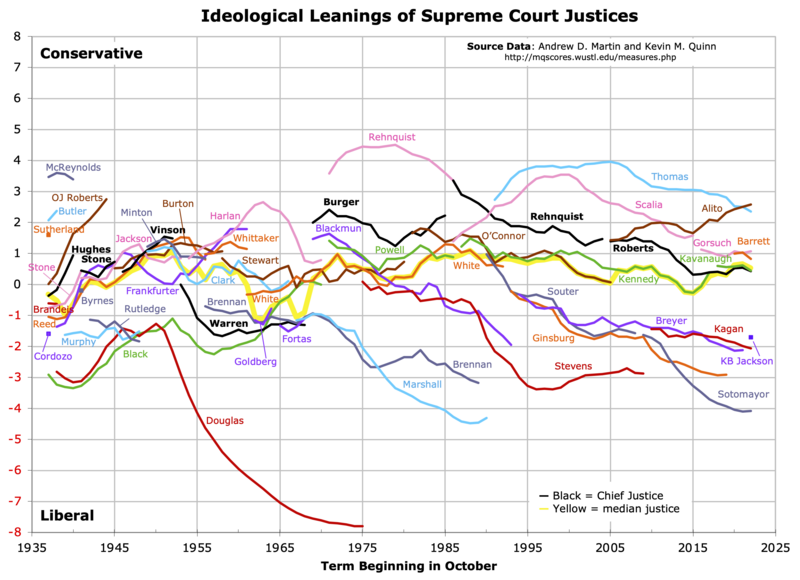
For a scholarly look at how ideology is measured on the courts:
- Measuring Ideology on the Courts.
- The Ideological History of the Supreme Court, 1937-2007.
- Ideological leanings of U.S. Supreme Court justices.
For a scholarly look at how ideology is measured on the courts:
- Measuring Ideology on the Courts.
From 538: Scalia Was Almost Never The Most Conservative Justice On The Supreme Court
Clarence Thomas has always been more conservative than Scalia, and in the past three sessions, so has Samuel Alito.
- Click here for the article.

Other commentators argue that Scalia's conservative scores were compromised by his support of limits on unreasonable search and seizures. Neither Thomas not Alito seem that concerned about it. I have no idea what changed in 2000 to send Scalia in a more liberal direction. 538 argues that justices tend to get more liberal as they get older. Maybe that has something to do with it.
For a closer look at the scores used to measure ideology among Supreme Court justices, click here.
- Click here for the article.
Other commentators argue that Scalia's conservative scores were compromised by his support of limits on unreasonable search and seizures. Neither Thomas not Alito seem that concerned about it. I have no idea what changed in 2000 to send Scalia in a more liberal direction. 538 argues that justices tend to get more liberal as they get older. Maybe that has something to do with it.
For a closer look at the scores used to measure ideology among Supreme Court justices, click here.
Thursday, February 4, 2016
Monday, December 28, 2015
Is Bernie Sanders a Socialist?
Same issue with Sanders - he's been identified as a Democratic Socialist (which is a modified version of a socialist) but what does that mean and is that true? As with libertarianism - among other ideologies - it can be on the test, so be sure to prep.
- Bernie Sanders — socialist or democratic socialist?
- Bernie Sanders — socialist or democratic socialist?
Sanders himself eschewed the term "socialist" early in his career, but both his and the public’s attitudes towards the word have since evolved. A 2011 report by the Pew Center shows that while most Americans still view the word negatively, 49 percent of 18- to 29-year-olds reacted positively to socialism (compared with 46 percent who viewed capitalism positively).
Experts told us that that’s because the word itself has evolved, "untethered from its original meaning," said Samuel Goldman, who studies the history and philosophy of political thought at George Washington University. The millennials and Gen-Xers who are more open to socialism aren’t associating it with a state-controlled economy. Rather than Soviet-style governing, they think of and admire Nordic models of living.
- Bernie’s Strange Brew of Nationalism and Socialism.
Aside from Grandma Stalin there, there’s not a lot of overtly Soviet iconography on display around the Bernieverse, but the word “socialism” is on a great many lips. Not Bernie’s lips, for heaven’s sake: The guy’s running for president. But Tara Monson, a young mother who has come out to the UAW hall to support her candidate, is pretty straightforward about her issues: “Socialism,” she says. “My husband’s been trying to get me to move to a socialist country for years — but now, maybe, we’ll get it here.” The socialist country she has in mind is Norway, which of course isn’t a socialist country at all: It’s an oil emirate.
- Calling Himself a Socialist Was One of Bernie Sanders’ Smartest Moves.
- 14 things Bernie Sanders has said about socialism.
Bernie Sanders famously likes to refer to himself a “democratic socialist.” Not content to label his views as merely liberal or progressive, the presidential candidate reaches all the way for the S-word, which has been basically verboten in post–World War II American national politics. This has led to some debate over what, exactly, a "democratic socialist" actually is, and whether one can accurately or usefully call the man any kind of socialist at all, given that his views actually line up quite well with those of many fairly mainstream members of the American left. The discussion has even sucked in the prime minister of Denmark, which Sanders has held up as a possible model for the United States. (Denmark, the prime minister would like us to know, is “far from a socialist planned economy.”)
Socialist has never been a complimentary term in American political discourse, but it has reached a particularly high level of toxicity during the past six years of President Barack Obama’s administration. While the president and his defenders have spent a great deal of time parrying that attack, Bernie Sanders is using the socialist label to his advantage, packing venues around the country and establishing himself as Hillary Rodham Clinton’s leading challenger for the 2016 Democratic presidential nomination.
Sanders, 73, has been preaching socialism for nearly half a century, and he cites Eugene Debs, the five-time presidential candidate of the Socialist Party of America, as his hero. But he hasn’t always embraced the label.
Sunday, December 27, 2015
Is Rand Paul a Libertarian?
The consensus of these articles is that he is not - and even if he is, the libertarian movement is at best a minor force in the Republican Party.
Be prepared for questions about ideology next week, including what a libertarian is. Those of you writing about the differences between Republican candidates might find these useful.
- The collapse of Rand Paul and the libertarian moment that never was.
- Rand Paul Is Not A Libertarian.
- The strange death of GOP libertarianism: Rand Paul’s collapse and the fading of a political moment.
- IS RAND PAUL A TRUE LIBERTARIAN? NO, HE’S A POLITICIAN.
- Is Rand Paul struggling because he isn't libertarian enough?
Be prepared for questions about ideology next week, including what a libertarian is. Those of you writing about the differences between Republican candidates might find these useful.
- The collapse of Rand Paul and the libertarian moment that never was.
The collapse of the Rand Paul campaign speaks volumes. In a 15-person field, Paul is the only candidate who looks even remotely libertarian (social tolerance, foreign policy restraint, and limited government). He started the campaign with decent name recognition, a seat in the United States Senate, lavish media attention, a serious will to win, and a battle-tested, national political operation inherited from his father, Ron. If there were any significant support for Libertarian ideas in the GOP—any at all—Rand Paul would be near the top of an otherwise crowded, fragmented field that is fighting over every non-libertarian voter in the party. Yet he’s polling at a mere 1 percent among Republican voters nationwide and has a higher unfavorability rating than anyone else in the GOP race.
- Rand Paul Is Not A Libertarian.
Libertarians, in general, are fiscally conservative but socially liberal, with a non-interventionist approach to foreign policy. His father, Ron Paul is a “libertarian cult figure” who had tremendous appeal to young Republicans. Rand Paul is clearly marketing himself as the heir apparent to those supporters — the one candidate with a chance of expanding the Republican base. But is Rand Paul a libertarian? He certainly likes to talk like a libertarian. Let’s take a look at where he stands on the issues.
- The strange death of GOP libertarianism: Rand Paul’s collapse and the fading of a political moment.
In a recent article, Jerry Taylor, president of the Niskanen Center, Washington’s newest libertarian think-tank, discusses the collapsing presidential campaign of Kentucky Sen. Rand Paul and what it means for the larger libertarian movement in the United States. As I pointed out last month, Taylor concludes that the sudden rise of Donald Trump, who may just be the least libertarian of all GOP front-runners, is not a good sign for the libertarian movement, which not too long ago seemed poised to take over a large segment of the Republican Party. Today, this optimism had been shattered.
- IS RAND PAUL A TRUE LIBERTARIAN? NO, HE’S A POLITICIAN.
. . . it seems to me that many people are hitching their wagons to Paul without really looking at his record. While I can appreciate Senator Paul’s filibuster regarding the use of drones abroad and his opposition to the USA Patriot Act and the Freedom Act, he’s hardly the pinnacle of the classical liberal ideal. He’s still a politician.
Let me repeat that. He’s a politician. Look at Paul’s voting record. Far from breaking away from partisan politics, Paul votes align with the Republican Party some 84 percent of the time. This includes affirmative votes for the annual National Defense Authorization Acts.
- Is Rand Paul struggling because he isn't libertarian enough?
This has been the week of articles painting a dismal portrait of Rand Paul's presidential campaign. Hispolling has slipped since the last time I wrote about this topic and his fundraising numbers, including super PACs, have been a major letdown. Disappointed libertarians are starting to speak out about these struggles, somelamenting that Paul hasn't been libertarian enough while others note that he hasn'trecaptured the excitement of his father Ron Paul's Republican presidential campaigns.
Wednesday, December 16, 2015

Some help figuring out ideological divisions within each party
For GOVT 2305 students, here are a few websites that should help you isolate where each candidate is positioned ideologically. Remember that I want you to look at divisions within either party since that is what's at issue right now. I want you to develop your own specific take on the topic, but think about honing on the divisions that might matter most in determining which candidates receive their party's nomination. Differences between the parties will matter more during the general election, but we are far away from that.
This site might be especially useful to you:
- CrowdPAC: 2016 Presidential Candidates.
Here's more:
- On the Issues.
- NYT: Hillary Clinton and the 2016 Democrats: Mostly Liberal, Together.
- 538: Is Jeb Bush Too Liberal To Win The Republican Nomination In 2016?
- YouGov: On ideology, Democrats clustered but Republicans far apart.
- Pew Research Center: Contrasting Partisan Perspectives on Campaign 2016.
- Washington Post: Who is the most conservative Republican candidate for president?
- Huffington Post: Every 2016 Presidential Candidate From Most Liberal to Most Conservative in 2 Charts.
This site might be especially useful to you:
- CrowdPAC: 2016 Presidential Candidates.
Here's more:
- On the Issues.
- NYT: Hillary Clinton and the 2016 Democrats: Mostly Liberal, Together.
- 538: Is Jeb Bush Too Liberal To Win The Republican Nomination In 2016?
- YouGov: On ideology, Democrats clustered but Republicans far apart.
- Pew Research Center: Contrasting Partisan Perspectives on Campaign 2016.
- Washington Post: Who is the most conservative Republican candidate for president?
- Huffington Post: Every 2016 Presidential Candidate From Most Liberal to Most Conservative in 2 Charts.
Monday, December 14, 2015
Speaking of Donald Trump: Is he a fascist?
Well, we don't really know unless we know what a fascist is. The section on ideology attempts to define a variety of ideological terms, including "fascism." Apparently there's a dispute about whether Trump qualifies. The term can simply be used as a put-down, but that doesn't use the term in a rational, meaningful way.
Here are a handful of thoughts on the subject, most seem to support the claim:
- Donald Trump Is a Fascist: This isn’t a partisan attack. It is the political label that best describes what the GOP front-runner has become.
- Donald Trump is an actual fascist: What his surging popularity says about the GOP base.
- Donald Trump's alarming skid toward outright fascism.
I found the following especially useful - and it seems to suggestion that despite his rhetoric, Trump falls short of outright fascism - at least the type we can trace to Mussolini and Hitler. These were the guys who developed and perfected the concept.
- I asked 5 fascism experts whether Donald Trump is a fascist. Here's what they said.
The article points out the following key traits of fascism, areas where Trump falls short.
1. Fascism requires the rejection of democracy.
2. Fascism emphasizes violence for its own sake.
3. Fascism is anti-individualist — and Donald Trump is an arch-individualist.
4. Fascism doesn't really have much to do with economics
So there.
Here are a handful of thoughts on the subject, most seem to support the claim:
- Donald Trump Is a Fascist: This isn’t a partisan attack. It is the political label that best describes what the GOP front-runner has become.
- Donald Trump is an actual fascist: What his surging popularity says about the GOP base.
- Donald Trump's alarming skid toward outright fascism.
I found the following especially useful - and it seems to suggestion that despite his rhetoric, Trump falls short of outright fascism - at least the type we can trace to Mussolini and Hitler. These were the guys who developed and perfected the concept.
- I asked 5 fascism experts whether Donald Trump is a fascist. Here's what they said.
The article points out the following key traits of fascism, areas where Trump falls short.
1. Fascism requires the rejection of democracy.
2. Fascism emphasizes violence for its own sake.
3. Fascism is anti-individualist — and Donald Trump is an arch-individualist.
4. Fascism doesn't really have much to do with economics
So there.
Friday, December 4, 2015
Regarding the concept of "standing"
I asked 2305 students to think about the concept of standing since there might be - might be - a question about it on the test. Simply put, it's what allows you to sue someone - and what allows the courts to hear your case. You have been directly impacted by a law or executive action.
- Here's the relevant Wikipedia entry on the subject.
Legal observers have noticed that the current Supreme Court - the Roberts Court - has been tightening up the concept of standing, making it more difficult for people to prove harm and thereby taking cases to the court.
- Here's the latest along those lines.
It's written with an ideological agenda, the author argues that conservative justices have been trying to make it more difficult for people too use the courts to address grievances. So in addition to filling you in on the concept of standing, this also touches on ideology.
Here's a test of his argument:
- Here's the relevant Wikipedia entry on the subject.
Legal observers have noticed that the current Supreme Court - the Roberts Court - has been tightening up the concept of standing, making it more difficult for people to prove harm and thereby taking cases to the court.
- Here's the latest along those lines.
It's written with an ideological agenda, the author argues that conservative justices have been trying to make it more difficult for people too use the courts to address grievances. So in addition to filling you in on the concept of standing, this also touches on ideology.
Here's a test of his argument:
Like many conservative judges, Roberts has sought to make it more difficult for people to get the standing to sue in federal court. In 2007, for example, Roberts joined anopinion that held that taxpayers did not have the standing to challenge expenditures by the executive branch that go to religious institutions.
Conservative justices on the supreme court have also narrowed standing in environmental cases. In a 1992 opinion written by Justice Scalia, the court deniedstanding to citizens bringing a lawsuit based on the Endangered Species Act. Vigilant citizens were denied the ability to compel enforcement of the statute in the face of executive inaction.
Subscribe to:
Posts (Atom)