Showing posts with label Republicans. Show all posts

Thursday, September 22, 2016

From Vox: A conservative intellectual explains why the GOP has fallen to Donald Trump

More evidence of the impact Trump is having on the Republican Party.

- Click here for the article.

Samuel Goldman is one of America’s most thoughtful conservatives. A professor of political theory at George Washington University and the executive director of its Loeb Institute for Religious Freedom, he spends his days pondering the ideas that define American politics.
Recently, Goldman has come to an uncomfortable conclusion: The conservative movement has failed. Its traditional package of ideas — free market economics, social conservatism, and an interventionist foreign policy — has long dominated the Republican Party but has clearly failed to win over enough actual voters to secure the White House.
“The great message of Trump is that there really are not that many movement conservatives,” Goldman told me during a sit-down near his office. “Since conservative politicians and policies have stopped delivering peace and prosperity, I think it’s more or less inevitable that voters have become dissatisfied.”
Moreover, he argued, the GOP and conservative movement has embraced a vision of America — Sarah Palin’s “Real America,” more or less — that can’t appeal to anybody but white Christians. A (somewhat controversial) census projection suggests that the US will be a majority minority country in the next 30 years — an unfriendly environment, to say the least, for the GOP.
“If you project yourself as a white Christian provincial party, you're not going to get very many votes among people who are none of those things,” Goldman says. “That's what's happened over the last 10 or 15 years.”

Thursday, July 21, 2016

From Vox: How Republicans went from the party of Lincoln to the party of Trump, in 13 maps

Highly recommended for both 2305 and 2306.

- Click here for it.

Here's one of the images: How Republicans gave up on reforming the South

Sunday, July 17, 2016

From Politico: 'Never (Again) Trump' sets sights on 2020 - Grass-roots conservatives and party leadership are finding a common cause: Limiting Republican primaries to registered Republican voters.

This seems to call for a change to Texas' open primary rules.

- Click here for the article.

Conservatives, still reeling over the looming nomination of Donald Trump, are pushing new Republican primary rules that might have prevented the mogul’s victory in the first place: shutting out independents and Democrats from helping to pick the GOP nominee.
Trump romped in “open primaries” where non-Republicans voted by the thousands and may have influenced the outcome — especially in early states that set the tone of the entire race. Trump’s most successful rival, Ted Cruz, thrived in states with closed primaries where only Republicans were permitted to participate.
Now, Cruz’s allies — hundreds of supportive convention delegates that he helped elect — hope to use the national convention in Cleveland to shove states toward closing their open primaries. And if they’re successful, it will not only go a long way toward warding off a Trump-like candidacy, it will tilt the primary toward conservative candidates in 2020 and beyond.
The advocates are finding a sympathetic ear at the very top of the party. Republican National Committee Chairman Reince Priebus has long supported closed primaries, but has never had a constituency to back him on it. "I believe that only Republicans should vote in Republican primaries," he said Friday at a Politico Playbook breakfast event, though he added that he respects the right of states to set their own primary rules.

The Empire Strikes Back!

A few items on the Texas Delegation to the Republican Convention


Every four years, prominent Texans show up in large numbers to the Republican National Convention.
But this year in Cleveland, with some Texas Republicans openly refusing to endorse their party's presumptive nominee, Donald Trump, the Texas footprint may be noticeably smaller.
To be sure, plenty of Texas Republicans plan on attending the convention, which starts Monday, including two recent presidential candidates — former Gov. Rick Perry and U.S. Sen. Ted Cruz, who is expected to be one of the convention speakers.

Also planning to attend: Lt. Gov. Dan Patrick, U.S. Sen. John Cornyn, Attorney General Ken Paxton, Texas House Speaker Joe Straus and most of the U.S. House committee chairmen from Texas.

 WFAA: Texas delegates to lead rebellion at RNC to deny Trump nomination.

A rebellion is underway in the Bexar County Republican party, led by some San Antonio delegates headed to the Republican National Convention, who want to deny Donald Trump the GOP presidential nomination.
The anti-Trump, last-minute effort is considered a long shot by many since Trump has 1,542 delegates of the 1,237 needed to clinch the GOP nomination. Those delegates will be officially awarded to the billionaire businessman at the July 18-21 Republican National Convention in Cleveland, Ohio.
Rogue GOP delegates, including Grant Moody of San Antonio, are calling for a rule change before the convention delegates start voting. They're asking the national party for a "conscience clause," that would free the delegates to vote for any Republican.
“There is a high duty and responsibility for the delegates,” Moody said. “My hope is we will choose a nominee who can beat Hillary Clinton in November because I don’t think he can.”
Moody said that he not only fears losing the White House to Democrats, but also control of the Senate. Additionally, he doesn’t believe Trump is fit to be president.

My Statesman: Herman: Who is sponsoring the Texas delegation at the GOP convention?

Welcome to the GOP convention’s Texas delegation, brought to you in part by folks who bring you cars (foreign and domestic), chemicals, cable TV, beer, dental insurance and a movie. Corporate sponsorship at political conventions is a tradition, yet another conduit for big-hearted corporations to show their appreciation for our hard-working party officials and their partying devotees.
This year, however, is a bit different. Not enamored with Donald Trump, some corporations that sponsored the 2012 GOP convention have opted out this year. And that comes amid increased need for cash because Congress in 2014 yanked the plug on what would have been about $19 million each party would have received for the 2016 conventions.
The Texas GOP delineated “various sponsorship opportunities” for its delegation. Such generosity knows no legal bounds.
“Please note that the Republican Party of Texas is able to accept unlimited corporate, PAC or personal funds for our national convention expenses,” would-be sponsors were assured.

TribTalk: Trump's in charge, but he shouldn't take it for granted.

Ted Cruz's suspension of his presidential campaign in early May changed the dynamics of the Texas GOP convention held in Dallas two weeks later. While the vast majority of delegates to the state convention remained Cruz supporters, there was a notable shift in attitude toward presumptive presidential nominee Donald Trump.
When Cruz still remained in the race as an active candidate, Cruz forces in Texas were poised to make sure that all of the Texas delegates to the upcoming Republican national convention in Cleveland were Cruz loyalists, even though Trump was entitled to nearly one-third of the delegates under convention rules. While Trump delegates from Texas would have been obligated to vote for Trump on the first two ballots, they would be free to vote however they chose to on any disputes that arose at the national convention relating to the platform, rules or credentials. Had Cruz stayed in the race, the Texas delegates for Trump effectively would have been "Trump in name only."
That didn't happen. Once it became clear that Cruz no longer was actively running for president, the mood shifted at the Dallas GOP convention. The delegate selection process for the national convention followed a more typical pattern of picking statewide elected officials, party regulars and grassroots activists to represent the Texas GOP in Cleveland. While the majority of delegates remain Cruz supporters — and some of those delegates remain part of the "never Trump" movement — the vast majority of the delegates seem ready to move on from that fight and do what is necessary to defeat Hillary Clinton, the presumptive Democratic nominee, in November.
That effort to unite the party was particularly helped by the convention speech of Lt. Gov. Dan Patrick, who encouraged the delegates to get behind Trump. The Trump campaign also made a shrewd decision to bring Sen. Jeff Sessions from Alabama as a surrogate speaker. Sessions, who is very popular with Texas conservatives, gave a substantive speech that was well received by those delegates still in attendance on the last day of the convention.

Friday, July 15, 2016

From Vox: The convention coup attempt against Trump, explained

For our look at national parties, conventions, and the 2016 presidential election.

- Click here for the article.
Original story: It’s been a really tough few months for the GOP’s #NeverTrump movement. Donald Trump won a clear majority of delegates who are bound by party rules to back his nomination at the convention — seemingly ensuring that he’ll be the Republican presidential nominee. Game over, right?

Yet the most fervent anti-Trump campaigners have long held on to one slim reed of hope that there’s still a way to stop him. Namely, it’s theoretically possible for those convention delegates to vote to change the party’s rules and "unbind" themselves, so they can vote for whomever they want. And if they manage to do that, they could just ... well, nominate somebody else.
So in recent weeks, a small group of delegates and a slightly larger group of outside operatives and commentators have been publicly pushing for this to happen, under the slogan "Free the Delegates" (or, if you prefer, "Dump Trump").
They’ll make their case to their fellow delegates on Thursday and Friday of this week, when the convention’s rules committee meets in Cleveland.

Update (9:55 pm Eastern): As expected, the proposal to unbind the delegates was overwhelmingly defeated by the convention rules committee. And the Free the Delegates supporters also seem to have fallen short of the threshold they needed to force a vote on their proposal by the full convention. One of the last obstacles to Trump's nomination is now gone.

For more on the subject:

- Can Trump’s opponents manipulate the convention rules and defeat him? Here’s the problem.

Sunday, April 10, 2016

From Quorum Report: Former RPT Chairman Munisteri hired by RNC to help prepare for a possible contested convention

It's looking increasingly like the Republican Party will have a contested convention and they are laying the groundwork necessary to make it happen. Presumably defeating Donald Trump will be a key goal of the convention's leadership:

- Click here for the story.
RNC Chairman Priebus: "As we lay the groundwork for a fair and transparent Convention, ensuring our delegates are fully informed and prepared is one of our highest priorities.”

The Republican National Committee has announced the launch of what the party is calling the "Grassroots Assistance Project.” The point of the project is to "welcome, educate, and engage delegates to the 2016 Republican National Convention."
Former Republican Party of Texas Chairman Steve Munisteri, who was succeeded by Chairman Tom Mechler after stepping down, will help with the project alongside former Oklahoma GOP Chairman Matt Pinnell and others.
“We are dedicated to making sure everyone has a full and proper understanding of the convention process and the Grassroots Assistance Project is another step in making that happen,” said RNC Chair Reince Priebus. “As we lay the groundwork for a fair and transparent Convention, ensuring our delegates are fully informed and prepared is one of our highest priorities.”
The party also launched this website to help delegates and others understand the convention process.

For info on the participants so far:

- Steve Munisteri.
- Reince Priebus.
- Tom Mechler.

Also:

- RNC Launches Grassroots Assistance Project.
- Your Guide to the Republican National Convention.


Tuesday, April 5, 2016

From Ballotpedia: Rule 40 (b) and its impact on the 2016 Republican National Convention

Rule 40 was adopted by the national Republican Party leadership in 2012 as a way to minimize the ability of outsider candidates - namely Ron Paul - to be considered for the nomination, and to allow the party to quickly select any rally around a candidate. Candidates had to have a majority of the delegates form at least eight separate states in order to be considered for the nomination.

But now that rule will prevent candidates other than Trump to be considered for the nomination, which means opponents of Trump will need to change it prior to the convention.

- Click here for the entry.

What impact could Rule 40(b) have on the 2016 Republican National Convention?
At the Republican National Convention in July 2016, the Rules Committee of the Republican Party will craft a set of rules for the convention. The committee will have the option to replace Rule 40(b), remove it, adopt with it modifications, or adopt it unchanged before the nominating ballot is officially set in stone. Rule 40(b) is, in fact, part of what are called "Temporary Rules," which, according to Rule 42, "constitute the Standing Rules" for the convention at which they were adopted and the "temporary rules" for the next convention. [5] As Curly Haugland, a member of the Rules Committee from North Dakota, explained to Politico in March 2016, “rules aren’t fixed until the convention.”[9] The two possible scenarios that could unfold in Cleveland are discussed in more detail below:
Scenario 1: The Rules Committee adopts the 2012 version of Rule 40(b) unchanged, thereby requiring a candidate for the Republican nomination to demonstrate the support of a majority of delegates in no less than eight individual states in order to have his name on the nominating ballot at the convention. If this is the scenario that unfolds in Cleveland, it is possible that no candidate except for Donald Trump will be eligible to be considered for the Republication nomination for president, because Rule 16.2(a) requires bound delegates to support the eligibility of the candidate to whom they are bound. As of March 24, 2016, Trump had won the majority of bound delegates in more than eight states in primary election contests and caucuses.
Scenario 2: The Rules Committee replaces or modifies Rule 40(b). The committee could lower the threshold or it could raise it. It could also replace “majority” with “plurality.” Or—a third option—it could remove the rule altogether. In March 2016, Ben Ginsberg, a former RNC lawyer who helped write Rule 40(b) in Tampa, noted that changes to the rule were certainly possible at the 2016 convention. He told MSNBC, "each convention has to pass for itself the number of states that put a candidate's name in nomination.” In regards to the state threshold, he noted, “The 2016 convention can make that number one, eight, 18, 28 or 58, if it wishes.”[9] The Rules Committee, then, could remove or modify the rule to make it easier for other candidates to have their names placed on the ballot. On the other hand, the committee could also make it even more difficult.

Sunday, April 3, 2016

From the NYT: How Votes For Trump Could Become Delegates for Someone Else

An inside look at how the Republican Party assigns its delegates, and a possible look at the storm that might well hit this summer when the convention is held.

- Click here for the article.

A related article walks through the latest hot commodity, the GOP delegate.

- Click here for As Floor Fight Looms, G.O.P. Convention Delegates Become a Hot Commodity.

The chairman of the Republican Party in American Samoa, Utu Abe Malae, began feeling the pressure almost immediately: phone calls, commitment forms, anything the presidential campaigns could do, say or send to nail down his support as a delegate.
Ken Callahan, a district chairman for the North DakotaRepublican Party, is perpetually fielding calls not just from the campaigns, but also from neighbors and friends who, excited by the process that is starting to unfold, are interested in becoming delegates themselves. “I receive, I would say, 10 to 15 calls a day,” he said, “and it doesn’t stop on weekends, either.”
And Holland Redfield, a Republican delegate and former lawmaker in the Virgin Islands, had a special call-in guest on his radio program the other day: Gov. John Kasich of Ohio, who promised more than just lip service to the islands if he became president. After years of being treated like second-class citizens by mainland politicians, Mr. Redfield said, “we are in the catbird seat. There’s going to be some hard bargaining.”
Suddenly, they matter: For the first time in 40 years, the delegates to the Republican National Convention could be more than just a rubber stamp on their party’s nomination process.
The out-and-out wooing has not yet begun. But it seems only a matter of time before campaigns start using all the trappings of prestige, power and who-knows-what-else they are able to muster.

Thursday, February 25, 2016

From the Atlantic: Will U.S. Conservatives Mount a Third-Party Challenge If Trump Is the Nominee?

Trump's nomination is looking more and more likely. This might be the final way conservatives can stop him. Would thins hand the White House to the Democratic nominee?

- Click here for the article.
Last summer, Donald Trump scared movement conservatives and establishment Republicans—not because they thought that he would actually win the Republican nomination, but because they feared that, in defeat, he would refuse to support the Republican nominee. Back then, it was easy to imagine a general election pitting a Bush against a Clinton—and a third-party bid by an eccentric billionaire throwing the election to Hillary, just as Ross Perot’s bid arguably tipped the 1992 election to Bill.
Trump ultimately assuaged those fears, pledging last September to support the winner of the Republican primary process whether it turned out to be him or one of his rivals. Today, that bet seems smart. Trump appears most likelyto be the victor, having won three primaries while maintaining leads in nearly all of the rest. Still, I wonder if it occurred to Trump at the time that the movement conservatives and Republicans who pressed him to forswear a third-party bid made no commitment of their own to support him if he won the nomination. Would conservatives dare to greet a Trump victory with their own third-party challenge?

Thursday, February 4, 2016

Who controls the Republican Party?

An occasional question. Here's the latest I've found on it. The two major political parties in the United States are highly decentralized. Finding their center - or who is in charge of either at any moment in time - is very difficult. And the power center is often in flux. The author argues that the current Republican Party is controlled by media personalities, specifically talk radio hosts and Fox News.

- Ted Cruz and Donald Trump: Signs of conservative media's grip on GOP.
Over the course of the last three decades, these media personalities have surpassed party officials and even elected representatives in their influence, ascending to exalted status atop Republican leadership. Yet, they prioritize goals seemingly at odds with good governance, and often, even the party's sole purpose for existence.

Talking heads wresting control of the GOP from the traditional party power brokers benefits neither the party, nor the nation. Political parties, after all, exist to win elections. By surrendering issue control to entertainers on the fringe of contemporary thought, however, the Republican Party has limited its ability to reach the 42% of Americans who according to Gallup, regard themselves as independents in a national, general election.
. . . On the rare occasions when Republican elites have attempted to reassert control, they've been pounded into submission by the titans of talk and their allies in Congress. One example came last summer when House Oversight and Government Reform Chairman Jason Chaffetz (R-Utah) stripped Rep. Mark Meadows (R-North Carolina) of his subcommittee chairmanship as punishment for crossing the Republican leadership on a key procedural vote -- which violated a cardinal rule of party loyalty in the House.

When choosing sides between the maintenance of party order and discipline or support for a charter member of the House Freedom Caucus who was among the leaders who forced a government shutdown in 2013, one talk icon didn't hesitate.
While chatting with a Meadows' sympathizer, Ohio GOP Rep. Jim Jordan, a disgusted Laura Ingraham slammed the leadership for its shabby treatment of leaders like Jordan and Meadows.
"This is what the mafia does," Ingraham said. "You know, I'm sorry, but this is a political mafia up on Capitol Hill. That's the way I see it. I don't see this as a Republican Party that represents people like me."
Later in the show, Ingraham hosted Meadows, who she praised: "Mark Meadows, Republican (of) North Carolina who stood up for common sense and pragmatism in trade and was punished for it."
She shamed Chaffetz, exclaiming "there's a point where you just have to say, you know I voted the right way in your mind on trade, sir, but I will not do this. I won't be party to what you're doing to these good men. That's what he should have said."
Less than a week later, Chaffetz reversed course and restored Meadows to his position, signifying the toothlessness of the elected Republican leadership.

Monday, November 23, 2015

This is awesome

From 538:

- The Perfect Republican Stump Speech.

We asked former Republican speechwriter Barton Swaim to write a ​totally pandering stump speech for an imaginary GOP presidential candidate — one who ​espouses only positions that a majority of Republicans agree with. ​Here’s the speech he wrote, including notes to explain his phrasing, behind-the-scenes pro tips on appealing to Republican voters and the data he used to decide which positions to take.

Wednesday, September 30, 2015

From the Economist: Regicidal Republicans - The party faithful are keen to decapitate politicians with experience of politics

The author tries to put his finger on what's motivating the Republican base (or the Tea Party wing anyway) to take out their leaders. The insurrection against Boehner - and current one against Senate Majority Leader Mitch McConnell - are the latest examples.

This is the latest on an emerging theme - the "experts" have no idea what's going on right now.

- Click here for the article.

The concluding paragraph:

Republican primary voters are not in a revolutionary mood, then, but a regicidal one. They think their rulers are corrupt, inept and mendacious, if not actually treasonous. But they are at the same time ready to swoon before new rulers promising to fix America in an instant. The key credential required to earn that trust is a lack of experience. Will those outsiders disappoint their followers in their turn, triggering a still deeper loss of public trust? Probably. This is going to be a bumpy year.

Friday, August 7, 2015

Commentary on the first Republican Debate

A few thoughts about what did and did not happen last night.

Lot's of disagreement over how Trump did.

- The Hill: Trump dominates rowdy debate.

Donald Trump dominated the first Republican primary debate Thursday with a performance that was pugnacious, volatile and, as ever, controversial. Trump showed that he could take a punch, facing a number of tough questions from Fox News moderators that cited his business history, penchant for outlandish comments and erstwhile support for liberal positions. The businessman suffered just a few truly uncomfortable moments and avoided the kind of catastrophe some of his detractors had predicted. “The answers were good, obviously, because everyone thinks I won,” Trump told the reporters who gathered around him in the “spin room” shortly after leaving the stage.

- The Hill: GOP debate’s winners, losers.

Winners; Trump, Kasich, Rubio, ChristieMixed: Huckabee, CruzLosers: Bush, Walker, Paul, Carson

- Brookings: Trump disappoints as candidates spar in lively GOP debate.

Although it is hard to know the limits of what Trump’s supporters are willing to tolerate, my hunch is that the debate damaged his prospects. When challenged about numerous statements that seemed on their face to be demeaning to women, he had no effective response. His defense of bankruptcy declarations by several of his corporations was cynical and self-interested. If his debate strategy was to modulate his tone and convey more gravitas than usual, he failed to stick to it.

- Fiscal Times: Trump’s Debate Performance Should Kill His Candidacy…but Won’t.

Donald Trump delivered a performance at the first debate between the leading candidates for the Republican presidential nomination that ought to kill his barely two-month-old campaign. The real estate mogul and former reality television star was boorish and defensive when he was challenged on his past behavior, and when asked to explain his policy positions he was vague to the point of absurdity. Of course, vindictive behavior, intemperate outbursts and total lack of specificity on policy matters has pretty much been the story of Trump’s entire campaign so far, and he’s leading the Republican field by a wide margin. So it’s not really clear what his showing in Cleveland last night will do to his standing in the polls.

- Fiscal Times: Fiorina Trumps Six Other GOP Candidates in the ‘Happy Hour’ Debate.

Fiorina was sharp coming out of the box, and she quickly pooh-poohed a Fox News moderator’s question about her poor showing in the polls. “I would begin by reminding people that at this point in previous presidential elections, Jimmy Carter couldn’t win, Ronald Reagan couldn’t win, Bill Clinton couldn’t win and neither could have Barack Obama.

There's lot's more out there - mostly along these lines as I can see. Happy surfing.


Tuesday, July 14, 2015

From the National Journal: A PARTY DIVIDED The Republican establishment always rallies behind one candidate. But not this time. Results from an exclusive survey of RNC leaders.

GOVT 2305 11 week students might find this useful for addressing this week's written assignment asking who is in charge of the major parties - either one, your choice.

This focuses on the Republican Party and the process the Republican National Committee - and what is also loosely referred to as the Republican establishment - is going through to determine which of the announced candidates they will likely rally behind. Usually this is done early in the process. The large number of candidates this time makes it less likely they will be able to do so.

Remember that one doesn't have to have the backing of the "official" party in order to announce a run for the presidency. Ronald Reagan didn't. The candidate just needs a reliable source of funding and enough support from primary voters.

- Click here for the article.
These findings, and dozens of conversations with senior party officials, demonstrate a deep-rooted disagreement within the GOP's governing body that hasn't been visible in decades. A few outliers aside, RNC members overwhelmingly supported Mitt Romney in the 2012 primary. Several even formally advised his White House campaigns. The opinions of RNC members, which were collected anonymously to allow for candor, are instructive because they come from those individuals who literally write the GOP's rules and collectively embody a party establishment that prioritizes order and electability.
They are part of Republican tradition that has since 1980 promoted a "next-in-line" approach. From Ronald Reagan (lost the previous primary to Gerald Ford) to George H.W. Bush (Reagan's VP after losing the 1980 primary) to Bob Dole (lost to Bush) to George W. Bush (the former president's son) to John McCain (lost to Bush) to Romney (lost to McCain), the GOP has a definitive recent history of elevating those who have paid dues or are products of the D.C. Republican machine—or both.
That candidate was supposed to be Jeb Bush in 2016. A son and brother of the two most recent Republican presidents, Bush is armed with a dynasty-driven political network, an attendant behemoth fundraising operation, and restrained rhetoric aimed at appealing to the broadest possible cross-section of voters. Yet Bush clearly has not distinguished himself amid a talented field of Republicans, several of whom, including Walker and Rubio, are competing for those right-of-center supporters while simultaneously courting conservatives.

Thursday, April 2, 2015

From Politico: Here Are the Real Republican Primaries

The author coins a few terms - prior to state primaries where delegates to the national conventions are selected - Republican candidates have to navigate the following. These are "the real 2016 contests." 

- Click here for the article.

The Laura Ingraham Primary: There are other top radio talkers, but few are more effective in their crusades than Laura Ingraham, the lawyer and best-selling author. She’s both unrelenting and effective, and she has proven unusually influential with a fervent fan base numbering in the millions.
The Memoir Primary: As a general rule, nobody reads political memoirs anymore—not even their authors. But on those few occasions when a political book is well-crafted and does sell well, it can be a telling sign of genuine grass-roots enthusiasm.

The Ben Carson Primary: Book sales aside, every Republican knows—even Ben Carson knows—that despite his remarkable performance in recent polls, the only scenario in which the accomplished neurosurgeon is the GOP nominee begins with: “All the other candidates are in a plane that disappears over the Bermuda Triangle.”

Tuesday, November 11, 2014

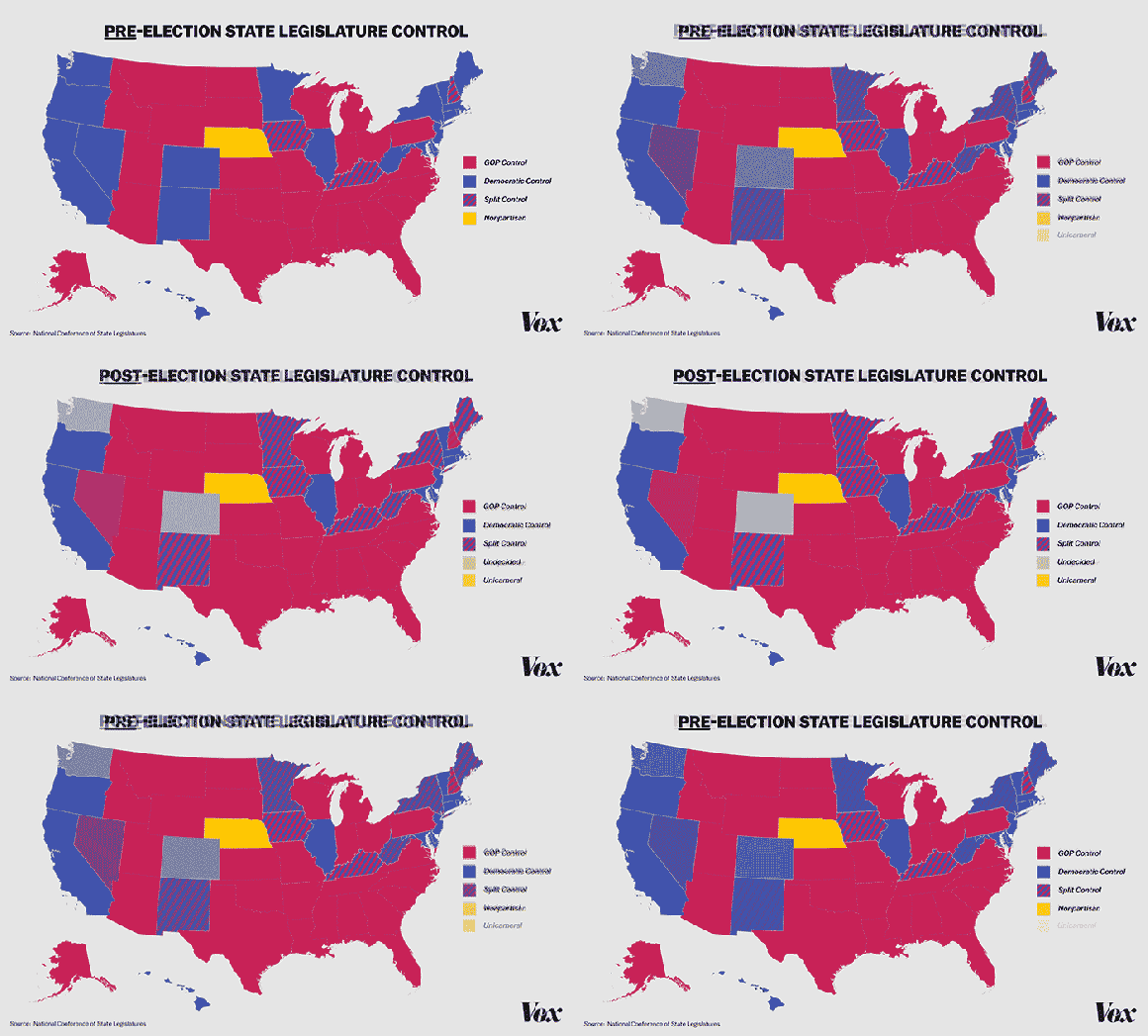
Republicans dominate state races

As well as Republicans did in national races - they did better in state wide races. They now control more state legislatures and governorships than at any time in the past century.

Republicans now have historic majorities in state legislatures. That's a really big deal.
- The process for doing so has been underway for a long time and could provide advantages to the party for decades.

A National Strategy Funds State Political Monopolies.
- The financial effort to fund these races has been underway for several years.

Red Shift in States Creates Conservative Opportunities.
- Future candidates for nation office may be groomed at the state level.

state governments

Wednesday, May 28, 2014

The left and right might converge over increasing the minimum wage

Most stories about ideology in the United States point out where the differences lie, but there are areas where the far right and the far left converge.

A Washington Post writer covers a recent conference where conservatives joined liberals in arguing that in increase in the minimum wage would benefit the economy. Whether this gains traction in Congress is unclear. One of the arguments made is that higher wages leads to less demand for social services. The government may well be subsidizing businesses, allowing them to pay low wages with these programs.

One conservative even argued that increased wages might be good for the Republican Party's competitiveness. The wealthier people are, the more likely they are to pay income taxes, and the more likely they are to adopt fiscally conservative positions, which might make them consider voting Republican.

- Click here for the article.

Democrats have made the argument that an increase is morally right and that the only thing standing in the way is corporate greed. That may be so, but it hasn’t won them enough Republican support to get the increase through Congress. But what if Democrats were to make a free-market argument that a higher minimum wage would shrink the federal government and reduce the welfare state?
That’s the argument Ron Unz made to Nader’s gathering. Unz, a wealthy businessman known for his 1994 Republican primary challenge to California Gov. Pete Wilson and his fight against bilingual education, has serious conservative credentials, most recently as publisher of the American Conservative magazine. But now he’s leading a ballot measure in California to raise the minimum wage to $12 an hour.
“The government spends over $250 billion a year in social welfare programs aimed at the working poor,” he said, addressing the group via Skype. “If we simply made the working poor much less poor by raising their wages to a much more reasonable level, a lot of that money would be saved, probably in the range of $40 to $50 billion a year.” The $250 billion spent on welfare for the working poor, Unz said, amounts to a “massive subsidy for businesses” that are paying less than a living wage and “forcing taxpayers to make up the difference.”
But what about the Congressional Budget Office study this year predicting that increasing the minimum wage to $10.10 would cost 500,000 workers their jobs? Actually, Unz argued, the study found that 98 percent of minimum-wage workers would benefit from a wage increase, while only 2 percent would lose their jobs. Further, he said, the higher minimum wage would mean a reduction in Mitt Romney’s “47 percent” — those who, Romney said, won’t consider voting Republican because they don’t pay income taxes — as these new taxpayers become “open to a traditional Republican conservative economic message.”

Tuesday, February 11, 2014

The Republican Party establishment tries to undermine Tea Party candidates in state primaries

For our upcoming look at elections, especially primary elections since they are on their way very soon.

The national Republican Party is convinced that its inability to win back the Senate in 2010 or 2012 - and possible the presidency in 2012 - was due to extremist candidates winning primary elections, but then losing the general elections. Extremism works when a small group of like minded voters dominate the election, as happens in primary elections, but not when moderates show up, as happens in general elections.

The party is trying to defeat candidates it judges to be extreme at the primary level by throwing money behind moderates who prioritize fiscal and economic issues over social and moral ones.

The danger for the party is that if they alienate the Tea Party, they could lose their support. They wont be voting for Democrats, but they might just sit the election out. Even if they do decide to vote, they may not supply the energy necessary for victory.

It'll be a tough needle to thread.

Here's detail in the NYT:

The Republican Party establishment, chastened by the realization that a string of unpredictable and unseasoned candidates cost them seats in Congress two elections in a row, is trying to head off potential political hazards wherever it can this year.

In House and Senate races across the country, many of the traditional and influential centers of power within the party are taking sides in primaries, overwhelming challengers on the right with television ads and, in some cases, retaliating against those who are helping the insurgents. In Mr. Black’s case, one by one, powerful Republicans started backing his rival, Barbara J. Comstock, a member of the State House of Delegates. First Mitt Romney endorsed her. Then came Citizens United and the president of Americans for Prosperity, the group financed by the wealthy Koch brothers.

A few day after he announced his candidacy, Mr. Black dropped out. “It was pretty evident that she had all the machinery,” he said in an interview.

One of the biggest challenges for Republican leaders in the 2014 midterm elections will be how to hang on to the Tea Party support that has been so instrumental to the party’s growth, while winning back voters alienated by hard-right candidates. These conflicting goals were evident last week as Speaker John A. Boehner of Ohio shelved plans to tackle immigration reform in the House, bowing to pressure from conservatives.

“We’re not picking a fight with the basis for the Tea Party,” said Scott Reed, the senior political strategist for the U.S. Chamber of Commerce, who noted that most Republicans were sympathetic to the free-market, small-government philosophy that inspired the movement. “But some have hijacked the Tea Party model and taken it to an extreme level.”