Showing posts with label two party system. Show all posts

Tuesday, October 25, 2016

From 538: What Went Wrong For Gary Johnson

Winner-take-all elections are brutal for minor parties.

- Click here for the article.

Johnson’s decline isn’t shocking. Third-party candidates usually lose steamthe closer we get to the election. But Johnson is faltering even against that standard. Based on his polling in late August, FiveThirtyEight’s polls-plus model, which accounts for the drop-off third-party candidates usually experience, projected Johnson to get around 7 percent of the vote. The same model has him down to just 5.6 percent now.
What went wrong? You could point to Johnson’s missing the debates. He has lost about 1.5 percentage points from his national poll numbers since late September (when the first debate took place). However, he may have already been on a downward trajectory before the debates took place; on Sept. 25, the day before the first debate, he had 7.3 percent, on average, in national polls, compared with 9 percent a month before. So, it’s quite possible Johnson’s numbers would have continued to dip even if he appeared on the debate stage. Johnson, of course, has committed some policy-related gaffes— not knowing basic facts about the Syrian War or being able to name a foreign leader he admires — that suggest perhaps the debates would have been rough on him.
Another plausible explanation is that Johnson was simply a “protest” choice. Perhaps many voters who said they were going to vote for him weren’t really interested in Johnson specifically but were merely voicing frustration with Donald Trump and Hillary Clinton instead. There’s evidence for this. In August, when Johnson was flying high, a majority of voters had no opinion of him. In addition, many younger voters who as a group voted heavily for Sen. Bernie Sanders in the Democratic primary said they were going to vote for Johnson, even though Johnson and Sanders have very different ideologies. That seemed at least a little unsustainable. Indeed, as the campaign has taken shape and Sanders stumps for Clinton, Johnson’s numbers seem to be falling with young voters as Clinton’s rise.

Monday, October 10, 2016

From 538: The Ross Perot Myth

The conventional wisdom is that Ross Perot pulled enough votes From HW Bush in 1992 to tip the election to Bill Clinton.

Here's a counter argument.

- Click here for the video.

Sunday, July 10, 2016

From The Texas Tribune: Analysis: In Texas, the Loyal Opposition is Dysfunctional

The lack of a functioning two party system in the state seems to be a recipe for corruption.

We discuss Texas' tendency towards one party rule in GOVT 2306. 

- Click here for the article.

Republicans who’ve been behaving themselves might be wigging out about the escapades of some of their top statewide officials, but they’re not talking about it.
And the Democrats, who ought to be having a hoedown right now, can’t seem to find anyone with sufficient gravitas to make the opposition’s voters hesitate.
The presidential race is different from the state races because it’s competitive. National politics remains hypersensitive to slights and gaffes; Texas politics — especially in general elections — seems numb to those things.
Elsewhere, there’s a Hillary Clinton for every Trump, and the slightest error can put a national figure on the broiler. In Texas, where the partisan competition is almost imaginary, a conservative officeholder can get into all kinds of political trouble without threat from the other party.
Pushback is useful even when it falls short. Trump wasn’t exactly toppled when U.S. Rep.Filemon Vela, D-Brownsville, told him to "take your border wall and shove it up your ass." But it bought people a moment to sort out their thoughts about Trump’s big fence.
That’s something. It’s what checks and balances are meant to do — to freeze things, if only for a second, for a reconsideration of whether an idea or action is really a good idea.
Talking about the troubles of confederates is so repellant to people in the civics business that they prefer ignorance over having to express their own views.
This is not a Republican malady; it’s politics.

Democratic officeholders in the 1980s were pretty damned quiet when Speaker Billy Clayton and Attorney General Jim Mattox were indicted. Both were eventually acquitted, too. Clayton won another term as speaker. Mattox won another term as the state’s top lawyer. Sometimes, these things pass.
The Texas Democratic Party’s convention lands at a moment when the state’s Republicans are feverishly manufacturing topics for the opposition party to talk about.
In that interim period between full Democratic control of Texas and the full Republican control we have now, there was an opposition party making noise at every turn. Ask Democrat Garry Mauro, who as land commissioner was accused of running Bill Clinton’s Texas campaign out of his state offices, or Kay Bailey Hutchison, who was accused of handling too much of what should have been done in her campaign through her office of state treasurer.
Mauro was never indicted. Hutchison was acquitted. But both were scorched by opponents in the other party throughout their ordeals. Mauro, whose party was waning, went on to lose a lopsided 1998 governor’s race against George W. Bush. Hutchison, whose party was waxing, won a special election and then three full terms in the U.S. Senate.
It’s not that the bellowing from their political enemies did them in — it’s that it constrained their behavior. You keep your mitts off the cookie jar when the folks are watching, but what if they’re not around?
Right now, for Republican Texas officeholders, the folks are not around.

Monday, June 20, 2016

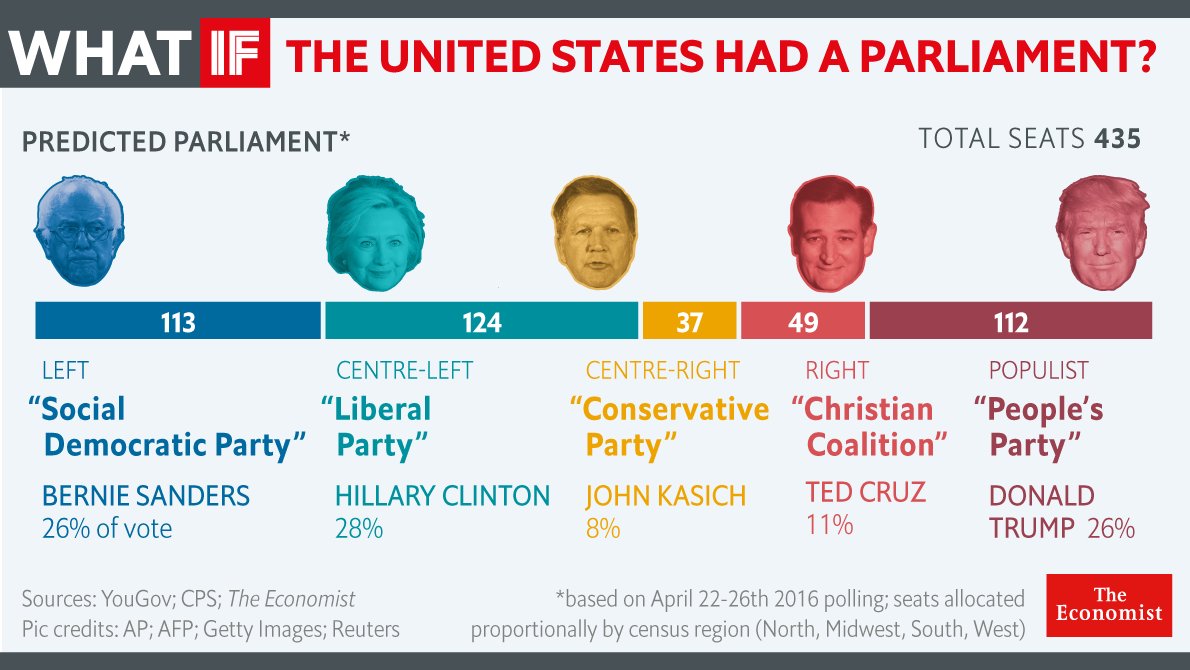
From the Economist: America's primaries are over; how would they have turned out under a parliamentary system?

Embedded image

Or rather - what if we had proportional representation instead of winner take all elections?

Hot Air has great commentary:

- Click here for it.

I think they’ve got the nomenclature right for Trump’s, Clinton’s, and Sanders’s movements, but no self-respecting conservative is going to cede that label to John farking Kasich and his merry band of centrists. Call that party the Republicans (or the Tories, in honor of the squishy British version of conservatism) and let the group to their right be the Conservatives. Also, while Cruz might emerge as Conservative leader, it’s unlikely that an also-ran like Kasich would head the Republicans. Kasich made the cut here only because he refused to take a hint and drop out in April despite having no chance of winning the nomination. He’s a placeholder. But that raises the question: Who would lead the Republicans? One enjoyable dilemma created by a formal Republican/Conservative split would be watching center-right pols try to calculate which party would be better for their careers and, consequently, which of their principles they should abandon. Should Marco Rubio join the Conservative Party and battle Cruz for the leadership? Or, fearing he can’t win, should he go all-in on amnesty, social liberalism, etc, and rebrand as a center-right Republican?
If the vote turned out this way, Hillary would obviously be a strong favorite to emerge as prime minister. She and Bernie would probably form a coalition, giving her a 54 percent majority in parliament, but Sanders would have leverage. His party plus Trump’s could create a different majority coalition; he’d warn Hillary that if she doesn’t promise to do things his way on trade, for instance, he’ll bolt and he and Trump will make a deal for one of them to run the government. That’s sort of what Bernie’s doing right now in holding out on endorsing Hillary, but once she’s safely elected president she can choose to keep her promise or not and won’t have to worry about consequences until 2020. In a parliamentary system, her job would depend day-to-day on keeping that promise. No matter how you slice and dice these numbers, though, the Conservatives and the Republicans end up as nonfactors. Cruz and the Republican leader would be at the mercy of the ruling coalition. That feels like a fitting takeaway from 2016.

Thursday, February 25, 2016

From the Atlantic: Will U.S. Conservatives Mount a Third-Party Challenge If Trump Is the Nominee?

Trump's nomination is looking more and more likely. This might be the final way conservatives can stop him. Would thins hand the White House to the Democratic nominee?

- Click here for the article.
Last summer, Donald Trump scared movement conservatives and establishment Republicans—not because they thought that he would actually win the Republican nomination, but because they feared that, in defeat, he would refuse to support the Republican nominee. Back then, it was easy to imagine a general election pitting a Bush against a Clinton—and a third-party bid by an eccentric billionaire throwing the election to Hillary, just as Ross Perot’s bid arguably tipped the 1992 election to Bill.
Trump ultimately assuaged those fears, pledging last September to support the winner of the Republican primary process whether it turned out to be him or one of his rivals. Today, that bet seems smart. Trump appears most likelyto be the victor, having won three primaries while maintaining leads in nearly all of the rest. Still, I wonder if it occurred to Trump at the time that the movement conservatives and Republicans who pressed him to forswear a third-party bid made no commitment of their own to support him if he won the nomination. Would conservatives dare to greet a Trump victory with their own third-party challenge?

Tuesday, December 22, 2015

In the news today ....

- Texas Speaker Joe Straus has two Tea Party affiliated challengers to his seat in the upcoming primary election. Straus represents the 121st district in the Texas House. Tea Party opponents , who think Straus is too liberal, have failed to defeat him in two previous primary challenges. They think he might be more vulnerable if he has to face two challengers since he might not win a majority and could defeated in a run-off with low turnout: See Straus faces two-candidate challenge from the far right in Republican primary.

- I still need to post items detailing the recent spending bill. It contains a variety of items (riders) related to non-spending issues including rules loosening campaign spending rules. Some allowing greater use of what is called dark money - dark because its source can;t be traced. This a road we've been heading down for decades: See: White House surrenders on 'dark money' regulation.

- Dark money is also becoming more influential in state races. States vary in their policies regarding transparency - Texas requires little. Most of the additional money spent on campaigns since the Citizens United decision removed many caps on expenditures has been through channels that do not require disclosure. Much of this spending on state races comes from groups located in other states, but the precise source is difficult to determine, and there are sufficient loopholes in place to continue to make them secret. See: 'Dark money' grows in politics even as states try to stop it.

- Texas Lieutenant Governor Dan Patrick is continuing to shape the state panels by appointing people with more conservative bona-fides. This includes the Sunset Commission and the Legislative Budget Board. Among the recent appointees of the latter is area state senator Larry Taylor. See: Dan Patrick shows, through new panel picks, that he wants a more conservative Texas Senate.

- A common theme regarding the early race for the Republican nomination has been what impact Trump will have on the party and whether a division might emerge within it that leads to a third party run. Most previous analyses have looked at the possibility the Trump runs as a third party candidate is he looses the nomination. Here's a look at the possibility that a traditional Republican runs as a third party candidate if Trump wins the nomination. See: Will the GOP Mount a Third-Party Challenge to Trump?

- Is Trump's campaign organization playing with fire? Lot's of Trump's activities are being performed by people that work in many of his businesses, which creates problems since these are to be treated as campaign expenses, meaning that they are to be reported as such. Trump appears to be testing the limits of campaign funding law. See: Trump’s reliance on business questioned.

Friday, August 7, 2015

What happens if Trump runs as an independent?

It's tough to predict the future, but it's very likely that he would split the Republican vote and make it easier for a Democrat to win in 2016.

Its a story we tell in 2305 when we discuss the consequences of the use of winner take all elections in the US and their tendency to lead to the formation of two large political parties. Efforts to support third party - or independent candidates can tip the scales in unusual ways. It's an odd consequence of a party getting a bit too big and when the factions within the party become hostile to one another.

Support can be thrown to someone running outside the party, or a party member may choose to run independently. It happens from time to time. The is is covered in class notes, but examples include:

Ralph Nader in 2000
Ross Perot in 1992 and 1996
John Anderson in 1980
George Wallace in 1968

And on through history. The problem with this can be that supporters of the outsider might end up with their least preferred option in office. Nader voters helped elect W. Bush. Perot voters helped elect Clinton.

Might we see a repeat in 2016 if Trump runs as an independent?

Some thoughts from the smart set:

- Politico: Defiant Donald Trump refuses to rule out third-party run.
- Business Insider: 5 things to consider as Donald Trump dangles a third-party run for president.
- RCP: Why Republicans Shouldn't Fear a Third-Party Trump.

Tuesday, April 7, 2015

From the New Republic: Rand Paul Will Break Libertarian Hearts, Just Like Reagan Did

In our discussion of the winner take all system, we've been talking about the compromise that libertarians and others have to make between the urge to be pure that the desire to have an actual practical impact on politics.

This article walks through the tension that libertarians have with the Republican Party.

- Click here for it.

For Senator Rand Paul, winning the Republican presidential nomination will involve a delicate balancing act of keeping faith with his libertarian roots while also appealing to the broader conservative base of the party. On issues like the war on drugs and government surveillance, Paul has articulated strongly anti-statist positions that are rarely heard from either party. Yet to be a plausible Republican presidential candidate, Paul, to the disappointment of many of his more orthodox libertarian followers, is increasingly sounding like a typical conservative, especially on foreign policy.
Paul’s conundrum shouldn’t surprise us: Libertarians have always been an uneasy fit within the broader Republican coalition. Libertarians claim to have roots in classical liberalism of the early modern era, but only emerged as a salient and self-conscious political movement in the 1930s, as a reaction to the expansion of the welfare state initiated by Franklin Roosevelt’s New Deal. That didn’t make libertarians comfortable Republicans, though. As purist counter-revolutionaries who wanted to roll back FDR’s achievements, libertarians all too often found Republicans to be cowardly and unreliable allies.

Monday, December 8, 2014

Israel's ruling coalition comes apart, the legislature dissolves and elections are set for next March

We mentioned in both 2305 and 2306 that the winner take all elections common in the United States, are not used in most other nations. Proportional representation is far more common. I use Israel as an example mostly because the website of the Knesset does a great job showing how votes are translated into seats, and how this method leads to multiparty systems as opposed to the two party system we have in the Unites States.

- Click here for their explanation of how they do business.

As it turns out, Israel will be having elections soon. So to get an idea about how elections and parties work in a different country, click on these:

- Israel’s ruling coalitions coming apart sooner.
- Israeli Knesset dissolves, sets date for elections.
- Israeli Knesset to Dissolve Itself for Early Elections on 17 March.

Monday, November 18, 2013

From The American Prospect: Fifty Shades of Purple

Recently in 2305 we discussed the two party system and its decentralized nature. We toyed with the possibility that since each party has a presence in each of the fifty states, it might be best to say that the United States has a 100 party system (50 states x 2 parties in each - in case you didn't figure this out yourself). Each state party has a degree of autonomy and can determine for itself what it stands for - usually this is determined by which groups are especially powerful in the state, and what issue positions help win elections.

But even though each party has a presence in each state, they are not competitive in each. Republicans dominate some states (like Texas) while Democrats dominate others (like California). There are only a handful of states where there is a close balance between the two - Florida and Ohio for example.

This author from the American Prospect thinks this is a problem and that democracy would be better served if each party was competitive in each of the fifty states. The roots of government dysfunction might be found in this lack of competition:

The real winner, if the parties started competing for votes across the map, wouldn’t be Republicans or Democrats; it would be small-d democracy. Voter turnout would surely rise. When only one party is courting them, voters disconnect. In 2012 battleground states, where both parties poured resources into voter outreach and engagement, turnout was high. In Ohio, 65 percent of the voting-eligible population cast a ballot; in Virginia, 66 percent did; and in Colorado, a whopping 70 percent turned out. But one-party states like Texas (50 percent) and California (55 percent) were both below the national average.
Voters can’t hold elected officials accountable if their party affiliation virtually assures their re-election. A weak opposition party can’t serve as an effective watchdog on those in power, either. Politicians in unchallenged parties also tend to move to ideological extremes. When general elections are largely decided in party primaries, as they are in Illinois and Texas, small numbers of highly motivated voters can carry the day; that’s how the Tea Party took over the Republican Party in states like Texas. It’s what elected Ted Cruz and what emboldened him to orchestrate an unpopular government shutdown without having to worry about his own political future. In the strange world that noncompetitive politics has wrought, Cruz is doing precisely what Republican primary voters back home elected him to do.
Neither party, of course, will pursue a 50-state strategy because it thinks such a plan is good for democracy. But we’re at a juncture when both believe they can benefit from talking to voters they’ve long ignored. If the parties embraced 50-state strategies, rather than putting most of their resources into a handful of battlegrounds like Ohio and Florida, who would gain the most by 2020 or 2030? It’s impossible to say. Democrats would win over a lot of people simply by giving them a reason to vote. Republicans might acquire even more converts by revising their message to appeal to Latinos and other voters who have written them off. One thing’s for sure, though: American politics would be a lot healthier.

Saturday, July 13, 2013

The 5 Republican Parties

One of the small handful of points I try to hammer on in class is that the two major parties in the US are best thought of as coalitions of factions that feel enough in common to fit under the same party category. Determining just what those factions are can be a bit of an art.

Here is Norm Ornstein's take on the current factions within the Republican Party and the impact each has on the governing process, as well as the future competitiveness of the party:

. . . I see at least five Republican parties out there, with a lot of overlap, but with enough distinct differences that the task is harder than usual. There is a House party, a Senate party, and a presidential party, of course. But there is also a Southern party and a non-Southern one. The two driving forces dominating today's GOP are the House party and the Southern one -- and they will not be moved or shaped by another presidential loss. If anything, they might double down on their worldviews and strategies.

He argues that the increased influence of the South on the party will help it retain power in the House, but make it less competitive in Senate and presidential elections in the near future:

The South has gone from being a trace element of the Republican Party in the 1950s and 1960s to becoming the solid base and largest element of today's GOP -- and its driving force on social and economic issues. And while some Southern Republicans such as Lindsey Graham remain fierce internationalists, the South, and the House, have become the epicenter of anti-defense and anti-diplomacy isolationism typified now by border Senator Rand Paul.

So here's the Republican dilemma: The House and Southern Republican parties are more concerned with ideological purity and tribal politics than they are with building a durable, competitive national party base to win presidential and Senate majorities. In most cases, they are in no danger of losing their House seats or their hegemony in their states. They will be resistant to changes in social policy that reflect broad national opinion; resistant to any policies or rhetoric, including but not limited to immigration, that would appeal to Hispanics, African-Americans, or Asian-Americans; and resistant to policies like Medicaid expansion or Head Start that would ameliorate the plight of the poor. They also will be more inclined to use voter-suppression methods to reduce the share of votes cast by those population groups than to find ways to appeal to them. I see little or nothing, including a potential loss in 2016, that will change this set of dynamics anytime soon.

Thursday, February 14, 2013

From the National Journal: Republican Leaders Worry Their Party Could Divide in Two

There's concern in Washington that Rand Paul might make an independent run for the presidency and split the Republican Party in half and lead to further realignments that might impact the Democrats as well, especially if Hillary Clinton does not run.

A leading Democratic consultant released a memo detailing the chances of a third party candidate: The State of the Union.

Both reads are based on the idea that each of the two major parties - despite their dominance of the political process - are weak and vulnerable. Might we soon witness a seismic shift in the nature of the party system?

Saturday, October 20, 2012

From Forbes: Will You Waste Your Vote? Why?

Here's a link to a reasonable article in Forbes which hits a point we will discuss next week in class (my 2305's are about to discuss elections and parties in the the US).

Why waste your vote for Romney and Obama if there is a candidate from a smaller party that better fits your specific preferences? Why throw your vote away?

What the author fails to note is that not voting for the "lesser of two evils" can swing elections more fully against one's interests. Votes for Nader in 2000 helped elect George W. Bush. More on this in class. It will help clarify how electoral rules in the US have guaranteed us a two party system.

Sunday, October 23, 2011

Third Parties Don't Work

A relevant story - for this week's 2301 16 week students - from Jonathan Bernstein about the impact of third parties on elections.

Walmart Moms - Written Assignment for 16 Week 2301 Students

My 16 week 2301 students will be studying elections this week. As we will note, electoral rules - the winner take all system specifically - favors the development of two large political parties, and thought there is a degree of stability in the membership of each (at least in the short to mid term) certain groups can fluctuate between the two and prove to be factor that determines who wins a given election. Often these groups are given catchy names: "soccer moms" and "NASCAR dads" are two recent examples.

This year it seems to be the "Walmart moms."

Here are a few stories that describe this demographic group, explain what motivates them and how they might impact the election in 2012. I want you to read through them - and please do your own research as well - and tell me whether you think that this group may well end up determining who wins in 2012.

- Watch Out for Walmart Moms.
- Meet the New Swing Voters: Walmart Moms.
- Insight: Wal-Mart moms - The election pollsters' new favorites.

- Walmart Moms: Not giving up on Obama yet.
- Wikipedia: Swing Vote.

Sunday, January 23, 2011

Texas' Three Party System

From BurkaBlog:

The way that things are shaping up in the House is that there not two but three “parties” of near-equal strength. There are the mainstream Republicans, the Tea Party Republicans, and the Democrats. On hot-button issues like border security, Voter ID, and the sonogram bill, the two Republican factions will join to overwhelm the Democrats. Straus will be moving these bills through the House and his supporters will be voting for them in self-preservation. The fight is going to come over education, and the Republican caucus could split wide open over issues like getting rid of Pre-K, closing neighborhood schools, and doing away with the 22:1 student-teacher ratio.

The issues that mainstream Republicans are going to hate to deal with are those that that bring them into potential conflict with influential people in their districts–superintendents, hospital administrators, junior college presidents, university regents, all of whose institutions are dependent upon the state for their funding. Mainstream Republicans are going to be caught between Tea Party conservatives and their traditional constituencies of parents and professionals. In order to prevail, the mainstream conservatives have nowhere to look for help except the Democrats. They sure aren’t going to get any help from the Conservative Coalition, which has already demonstrated its disinterest in public education, starting with Pre-K. We are months away from this outcome, and maybe a couple of special sessions too, but when you have three factions in a legislative body, sooner or later one of them is going to cut a deal with another one, and the least strange bedfellows are mainstream Republicans and Democrats.

Sunday, November 14, 2010

One and Done by Design?

Again from Slatest, this time a story from the Washington Post, should Obama declare that he will not run for reelection and instead focus on the economy:

For the good of the country, Barack Obama should declare himself a one-term president , argue Carter- and Clinton-era presidential advisers Patrick Caddell and Douglas Schoen in the Washington Post. That act of political suppuku would disarm Republicans, the pair assert, allowing them to support Obama without worrying about bolstering his re-election bid. "Quite simply, given our political divisions and economic problems, governing and campaigning have become incompatible," the pair write. "If he is to bring Democrats and Republicans together, the president cannot be seen as an advocate of a particular party." The proposals met with a skeptical response from both sides of the aisle, with liberal bloggers dismissing the pair as "pretend Democrats" and conservatives questioning the proposal's practicality. "The symbolism of Obama's withdrawal from the race to focus on fiscal solvency would, admittedly, be huge in communicating the gravity of the challenge," writes one conservative blogger . "But that doesn't mean Congress would act on it."
- The Opinion Piece itself.
- Pretend Democrats ...
- Hot Air.

Saturday, October 9, 2010

Will the Electorate Continue to Swing After 2010?

We've discussed the volatility of the electorate and how the constitutional design is meant to minimize its impact on public policy. The last several electoral cycles have shifted drastically from favoring one party to the other. Here's an argument that this shift might continue after November's elections:

One of the more remarkable things about the likely big win Republicans are headed for next month is that they're doing it without having improved their appeal to the center at all since the 2008 election.

Barack Obama defeated John McCain 60-39 with self described moderates, according to the national exit poll. Our last national generic ballot poll found Democrats ahead 58-28, showing no improvement whatsoever


It's a similar story in some of the closest Senate races. Obama only won moderates 51-46 in West Virginia. Joe Manchin has a 29 point advantage over John Raese with them. In Colorado Obama won them 63-35...Michael Bennet leads Ken Buck by a pretty identical 56-32. In Nevada his advantage was 64-33...and Harry Reid led Sharron Angle 64-28 with them on our last poll.


The fact that Republicans are winning this election without showing much appeal to moderates is another reminder that the main reason for the pending GOP onslaught is the disengagement of Democratic voters. Conservatives will make up a much larger portion of the electorate this year than they did in 2008 and that's put Republicans in a position to make big gains without even having to develop a message that's appealing to the center.

That's the reason why this year's Republican resurgence may prove to be short lived and why much of what the party gains this year could be lost again in 2012. The formula they're using for victory this year- fire up the base, forget the moderates- may work for a midterm election but it's not likely to be particularly sustainable in a Presidential year. If Republicans want the 2012 election cycle to be as enjoyable for them as the 2010 cycle has been they have a lot of work to do to broaden their base.
I've also suggested that if Republicans win Congress, and the economy continues to be sluggish (as most economists suggest) they will bear part of the blame for it and their messages will likely not resonate as much as they are now. Plus, Republican success now will mobilize Democrats in 2012. Thsi story makes the point that moderates (the center) serves as balast in the American political system and tends to shift away from whichever party is in power, especially when that party starts implementing policies that stray too far to either ideological extreme.