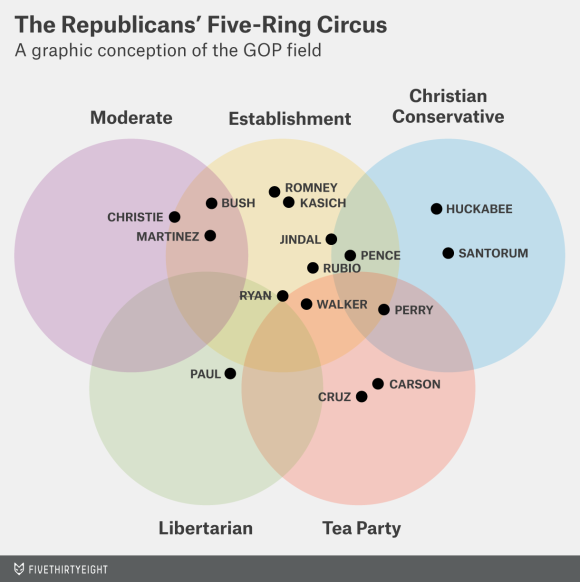
There are many ways to measure it. This is just one of them.

There are many ways to measure it. This is just one of them.


For years, pundits have predicted that the Republican Party is breaking apart. But it took Donald Trump to make it happen.
The Republican Party is like a gigantic Antarctic ice shelf with fissures we’ve watched develop for years. Those cracks were evident in 2010, when the Tea Party emerged, and in 2014, when GOP primary voters rejected establishment favorites, including the sitting House Republican Leader, Eric Cantor.
The obvious legacy of the 2016 election is a split between pro- and anti-Trump forces, but this division has a twist rarely seen in American political history: The party’s voters and its elites are not only separate constituencies, but ones whose interests and beliefs are incompatible. The two groups are starting from different places and ending up perhaps even further apart.As the fractures grew, the party held together—for the past eight years, opposition to President Barack Obama was more or less enough to ice over major intraparty differences. But in the glaring sun of Donald Trump, those dividing lines are no longer survivable: The party has melted down and cracked apart, and its various components are drifting away.
In the past, party splits have frequently been unclear, messy and short-lived. When the Democratic Party splintered over civil rights in 1948, the faction of the party that didn’t like President Harry S. Truman or the platform walked out and formed its own
“Dixiecrat” ticket. In 1952, some of those Democrats who didn’t like Adlai Stevenson endorsed Dwight D. Eisenhower. And Theodore Roosevelt ran on his own Bull Moose ticket in 1912 after losing the Republican nomination to incumbent President William Howard Taft. In the end, those divides either healed over in some way, or they happened so quickly that the Band-Aid was ripped off, the pain ended and the parties could get to work building new electoral coalitions.
By contrast, this year’s Republican unwinding is hesitant and halting—and it’s not clear at all where it will end. Trump’s nomination and, at this point, presumptive loss is probably just the beginning. Nationally, there is much more infighting yet to come. At this point, the possibly alarming news for Republicans is that what defines the GOP breakup isn’t its severity or depth: It’s the great degree to which it’s still incomplete.
If Donald Trump loses the election next week, “there will be a lot of blood left on the floor between November and the 2020 primaries,” predicts GOP consultant John Weaver, who advised John Kasich’s campaign.
For all the attention on the fights between Trump and a faction of Republicans who have refused to support him, most GOP elected officials have so far taken the path of least resistance. They’ve supported their party’s nominee, even if they’re not thrilled about him.
These Republicans — from Paul Ryan, Mitch McConnell, and Reince Priebus to Marco Rubio, Ted Cruz, Tom Cotton, and many others — have calculated that since Trump was the nominee chosen by Republican voters, and the only person standing in between Hillary Clinton and the presidency, they should stand by him.
Should Trump lose on Election Day, though, many Republicans will want to say "I told you so" and turn the page on the Trump experiment, returning to a more generic Republicanism that they see as a better vote-getter and a more substantively defensible ideology. And to discredit Trumpism, they’ll make the case that Trump is to blame for his defeat — that he blew what should have been a winnable election for Republicans.
Many of Trump’s most passionate supporters won’t see it that way at all, though. They’re being primed to see a candidate betrayed by an out-of-touch establishment that is compromised by its social and economic ties to a cosmopolitan elite. So if Trump loses, his backers will try to turn grassroots disappointment at his defeat into grassroots rage against Republicans who were insufficiently supportive, thus leveraging their own way into power. (If he wins, the party will face a whole different set of issues.)
Polls show the presidential race in Texas is closer than it's been in decades. Some even show the two candidates within the margin of error.
Does Hillary Clinton actually stand a chance in Texas? It's unlikely, but it could be closer than at any time in the past 20 years. The reason for how competitive the race looks lies in two demographic groups — Republican-leaning suburban women offended by Trump's comments about women, and Latinos, who are fired up to vote against him.
Non-college-educated whites are moving toward Donald Trump. Non-whites and college-educated whites are swinging Hillary Clinton.
The 2016 election is poised to be among the most polarized elections ever, not only along gender and generational lines, but especially along lines of race and educational attainment.
In August, Nate Cohn of The New York Times put it well when he wrote: “The simple way to think about Mr. Trump’s strength is in terms of education among white voters. He hopes to do much better than Mitt Romney did in 2012 among white voters without a degree so that he can make up the margin of Mr. Romney’s four-point defeat and overcome the additional losses he’s likely to absorb among well-educated voters and Hispanic voters.”
There’s evidence that Trump is underperforming Romney among Asiansand African-Americans, not just Latinos and college-educated whites. Clinton, on the other hand, has been underperforming President Obama among non-college-educated whites.
To get a handle on how these shifts could affect the electoral landscape, we modeled how many of Romney’s votes came from college-educated whites and minorities and how many of Obama’s votes came from non-college-educated whites in each state, county and congressional district. The difference between these two vote totals, shown in the map above, can tell us where Clinton and Trump have the most potential to build on 2012.
Then we went a step further: How would the 2016 map look if one out of every five whites without a college degree who voted for Obama in 2012 defected to Trump and if one out of every five non-whites and college-educated whites who voted for Romney in 2012 switched to Clinton?
The Democratic Party of Bill Clinton relied on voters who were unfriendly—even hostile—to racial liberalism. And it moved accordingly. Bolstered by the economy as well as these cultural moves, Clinton would claim the center of American politics, winning an easy re-election and eventually ending his term as one of the most popular presidents in recent memory, despite scandal and an impeachment attempt.
But that was then. Today, those voters—among them millions of working-class white men—are lost to the Democratic Party, in a shift that began under George W. Bush but accelerated under the presidency of Barack Obama. Democrats today win a smaller share of white voters—and the white workers in particular—than ever before. The home for those voters is in the GOP, under Trump, who turned a substantial majority with working-class whites into an overwhelming one, enough to win Ohio and Iowa and possibly other Midwestern states. But there’s been a backlash to this backlash. Trump’s success with working-class whites has come at the expense of the Republican Party’s historic advantage with college-educated and professional whites, who now favor Hillary Clinton. Increasingly, the Democratic electorate is shorn of those voters who are skeptical of racial and cultural liberalism or who vote on that skepticism.
Hillary demonstrated her distance from racists just as her husband used Sister Souljah to demonstrate his independence from black interests.
Bill Clinton distanced himself from anything that smacked of identity politics or traditional liberalism. Hillary Clinton has not. This speaks to a larger reality in American politics. Racism—either virulent or implicit—is the enemy of progressive political coalitions. It’s either an obstacle to building those coalitions in the first place, or it’s a part of the process that unravels them. White departure from the Democratic Party cost it the Oval Office for nearly 20 years, and the effort to win those whites back yielded a disappointing and myopic centrism. But now those whites aren’t as central to Democratic presidential fortunes, and it has given many in the party the space they need to move in a more liberal direction. And looking at the tenor of Democratic policy debates over the past year—debates over how the welfare state should expand, not if it should—they have. Which is to say that the great upside of this shift is for the blacks, Latinos, and young people who form a critical part of the Democratic Party’s national electorate. Their demands for criminal justice reform, immigration reform, and broader economic reform—as channeled through the primary campaign of Bernie Sanders—aren’t a deal-breaker for national Democratic politicians.
Samuel Goldman is one of America’s most thoughtful conservatives. A professor of political theory at George Washington University and the executive director of its Loeb Institute for Religious Freedom, he spends his days pondering the ideas that define American politics.
Recently, Goldman has come to an uncomfortable conclusion: The conservative movement has failed. Its traditional package of ideas — free market economics, social conservatism, and an interventionist foreign policy — has long dominated the Republican Party but has clearly failed to win over enough actual voters to secure the White House.
“The great message of Trump is that there really are not that many movement conservatives,” Goldman told me during a sit-down near his office. “Since conservative politicians and policies have stopped delivering peace and prosperity, I think it’s more or less inevitable that voters have become dissatisfied.”
Moreover, he argued, the GOP and conservative movement has embraced a vision of America — Sarah Palin’s “Real America,” more or less — that can’t appeal to anybody but white Christians. A (somewhat controversial) census projection suggests that the US will be a majority minority country in the next 30 years — an unfriendly environment, to say the least, for the GOP.
“If you project yourself as a white Christian provincial party, you're not going to get very many votes among people who are none of those things,” Goldman says. “That's what's happened over the last 10 or 15 years.”
Ahead of the presidential election, the demographic profiles of the Republican and Democratic parties are strikingly different. On key characteristics – especially race and ethnicity and religious affiliation – the two parties look less alike today than at any point over the last quarter-century.
The fundamental demographic changes taking place in the country – an aging population, growing racial and ethnic diversity and rising levels of education – have reshaped both party coalitions. But these changes, coupled with patterns of partisan affiliation among demographic groups, have influenced the composition of the two parties in different ways. The Democratic Party is becoming less white, less religious and better-educated at a faster rate than the country as a whole, while aging at a slower rate. Within the GOP the pattern is the reverse: Republican voters are becoming more diverse, better-educated and less religious at a slower rate than the country generally, while the age profile of the GOP is growing older more quickly than that of the country.


Not so long ago, many observers worried that Americans had lost interest in politics. In his famous book Bowling Alone, published in 2000, the social scientist Robert Putnam bemoaned the collapse in American political participation during the second half of the 20th century. Putnam suggested that this trend would continue as the World War II generation gave way to disengaged Gen Xers.
But even as Putnam’s book went into paperback, that notion was falling behind the times. In the 1996 presidential election, voter turnout had tumbled to the lowest level since the 1920s, less than 52 percent. Turnout rose slightly in November 2000. Then, suddenly: overdrive. In the presidential elections of 2004 and 2008, voter turnout spiked to levels not seen since before the voting age was lowered to 18, and in 2012 it dipped only a little. Voters were excited by a hailstorm of divisive events: the dot-com bust, the Bush-versus-Gore recount, the 9/11 terrorist attacks, the Iraq War, the financial crisis, the bailouts and stimulus, and the Affordable Care Act.
Putnam was right that Americans were turning away from traditional sources of information. But that was because they were turning to new ones: first cable news channels and partisan political documentaries; then blogs and news aggregators like the Drudge Report and The Huffington Post; after that, and most decisively, social media.
Politics was becoming more central to Americans’ identities in the 21st century than it ever was in the 20th. Would you be upset if your child married a supporter of a different party from your own? In 1960, only 5 percent of Americans said yes. In 2010, a third of Democrats and half of Republicans did. Political identity has become so central because it has come to overlap with so many other aspects of identity: race, religion, lifestyle. In 1960, I wouldn’t have learned much about your politics if you told me that you hunted. Today, that hobby strongly suggests Republican loyalty. Unmarried? In 1960, that indicated little. Today, it predicts that you’re a Democrat, especially if you’re also a woman.
Meanwhile, the dividing line that used to be the most crucial of them all—class—has increasingly become a division within the parties, not between them. Since 1984, nearly every Democratic presidential-primary race has ended as a contest between a “wine track” candidate who appealed to professionals (Gary Hart, Michael Dukakis, Paul Tsongas, Bill Bradley, and Barack Obama) and a “beer track” candidate who mobilized the remains of the old industrial working class (Walter Mondale, Dick Gephardt, Bill Clinton, Al Gore, and Hillary Clinton). The Republicans have their equivalent in the battles between “Wall Street” and “Main Street” candidates. Until this decade, however, both parties—and especially the historically more cohesive Republicans—managed to keep sufficient class peace to preserve party unity.
Not anymore, at least not for the Republicans.
Democrats hold advantages in party identification among blacks, Asians, Hispanics, well-educated adults and Millennials. Republicans have leads among whites – particularly white men, those with less education and evangelical Protestants – as well as members of the Silent Generation.
A new analysis of long-term trends in party affiliation among the public provides a detailed portrait of where the parties stand among various groups in the population. It draws on more than 25,000 interviews conducted by the Pew Research Center in 2014, which allows examination of partisan affiliation across even relatively small racial, ethnic, educational and income subgroups. (Explore detailed tables for 2014 here.)

When it’s time to vote, Republicans usually choose an “establishment” candidate to lead their party: George H.W. Bush in 1988, Bob Dole in 1996, George W. Bush in 2000, John McCain in 2008, and Mitt Romney in 2012.
Part of that is the strength of the people who raise money and push for specific policies, but part of it is the strength of establishment picks. These candidates fit a profile. They stand at the center of their parties with ties to the three “legs” of the modern GOP: social conservatives, national security conservatives, and anti-tax conservatives. They’re not always strong with every group, but they are—or they become—acceptable through the course of the primary. They may not hold moderate positions, but they sound moderate and appeal to ordinary American voters.
That candidate, or a version of that candidate, exists in the 2016 Republican primary. It’s Jeb Bush, it’s Sen. Marco Rubio, it’s Gov. John Kasich—it’s even Gov. Chris Christie. But they aren’t the leaders of the race. They aren’t even close. The leader is Donald Trump, a real estate mogul turned reality TV star turned nativist agitator.
American parties routinely go through periods of ascendancy, decline, and deadlock. From 1896 to 1930, the Republican Party reigned supreme; from 1932 to 1968, the New Deal Democrats dominated; following a period of deadlock, the Reagan Republicans held sway during the 1980s. After the parties exchanged the White House, Democrats appeared to take command of American politics in 2008. In that election, Obama and the Democrats won not only the White House but also large majorities in the Senate and House, plus a decided edge in governor's mansions and state legislatures.
At the time, some commentators, including me, hailed the onset of an enduring Democratic majority. And the arguments in defense of this view did seem to be backed by persuasive evidence. Obama and the Democrats appeared to have captured the youngest generation of voters, whereas Republicans were relying disproportionately on an aging coalition. The electorate's growing ethnic diversity also seemed likely to help the Democrats going forward.
These advantages remain partially in place for Democrats today, but they are being severely undermined by two trends that have emerged in the past few elections—one surprising, the other less so. The less surprising trend is that Democrats have continued to hemorrhage support among white working-class voters—a group that generally works in blue-collar and lower-income service jobs and that is roughly identifiable in exit polls as those whites who have not graduated from a four-year college. These voters, and particularly those well above the poverty line, began to shift toward the GOP decades ago, but in recent years that shift has become progressively more pronounced.
The more surprising trend is that Republicans are gaining dramatically among a group that had tilted toward Democrats in 2006 and 2008: Call them middle-class Americans. These are voters who generally work in what economist Stephen Rose has called "the office economy." In exit polling, they can roughly be identified as those who have college—but not postgraduate—degrees and those whose household incomes are between $50,000 and $100,000. (Obviously, the overlap here is imperfect, but there is a broad congruence between these polling categories.)
The defection of these voters—who, unlike the white working class, are a growing part of the electorate—is genuinely bad news for Democrats, and very good news indeed for Republicans. The question, of course, is whether it is going to continue. It's tough to say for sure, but I think there is a case to be made that it will.
Governor-elect Greg Abbott won with 44 percent of the Latino vote, and Sen. John Cornyn won 48 percent, both improvements over the 38 percent Gov. Rick Perry earned when he was elected in 2011 for his third term.
Republican strategists in the state point out tha Abbott made 17 visits to the heavily Hispanic Rio Grande Valley during his campaign and ran months' worth of ads featuring his Latina wife and mother-in-law. His campaign ran his first Spanish-language spot during the World Cup game between Mexico and Brazil.
"The Latino voters cannot be taken for granted. The right candidate with the right message can make a difference," says Jorge Lima, the policy director for the LIBRE Institute, a nonprofit that promotes free-market principles in the Hispanic Community.
Another factor, Republicans say, that helped Abbott win Latino voters and undermined Democratic efforts in the state, was the candidate Abbott was running against. His Democratic opponent, Wendy Davis, had burst onto the national scene as a fierce defender of abortion rights. Latino voters, however, tend to be much more socially conservative than other Democratic constituencies. While reproductive rights might motivate millennials and single women voters, it's not an issue that drives Latinos to the polls for Democrats in droves.
"The results were partly a backlash against that blatant liberalism from the Davis campaign and from Battleground Texas," Texas-based Republican strategist Ray Sullivan says. "The message she delivered did not play with Hispanic Texans."
Establishment Republicans, who had vowed to thwart the Tea Party, succeeded in electing new lawmakers who are, for the most part, less rebellious. And when the new Congress convenes in January, the Republican leaders who will take the reins will be mainly in the mold of conservatives who have tried to keep the Tea Party in check.
But they have not crushed the movement’s spirit.
As Republicans on Capitol Hill transition from being the opposition party to being one that has to show it can govern, a powerful tension is emerging: how to move forward with an agenda that challenges the president without self-destructing.
Some conservatives believe that the threat of another shutdown is their strongest leverage to demand concessions on the health care law and to stop the president from carrying out immigration reform through executive order. Yet their leadership has dismissed the idea as a suicide mission that could squander the recent gains.
In the wake of the GOP's approval of a platform that includes a hardline stance on immigration, Attorney General Greg Abbott finds himself at the top of the ticket for a party whose members are deeply divided over the subject and under fire from opponents who say the Republicans' position is offensive to Hispanic Texans.
And it all comes during an election cycle in which Hispanic Texans are seen as an especially critical voting bloc that Abbott has worked to woo.
"It effectively puts him in an awkward position," said Mark P. Jones, a political scientist at Rice University, because the attorney general does not want to risk alienating Hispanic voters or contradicting the official party stance.
Last week, the Republican party adopted a political platform that no longer endorses a provisional visa program for immigrants and calls for ending in-state tuition for undocumented immigrants and for prohibiting “sanctuary cities” that do not enforce immigration laws.
Abbott has largely been silent on the issue. Representatives for the Abbott campaign did not respond to requests for comment for this story, and they have not responded to previous inquiries about his position on the immigration plank of the platform.
This author is doubtful that the coalition that elected President Obama has enough to keep itself together - apart from the personality of Hillary Clinton. But if she does not run, the coalition will fragment. No single issue binds the party together, so without the force of Hillary's personality matters for the party's electoral success.
This author offers a counterpoint. The lack of a single issue that binds all factions within the Democratic Party together is a strength, not a weakness. Democrats have outperformed Republicans in most recent elections (in number of votes cast anyway): by being “sprawling” and “heterogeneous,” and doesn't depend on a particular nominee to do this.
The author argues that key issues - banking reform and inequality - unify the party and that those that divide it - K-12 education - aren't topical national issues. They resonate more at the state and local level. The major divisive issue in 2008 was the Iraq War, and that has faded into the distance. The fact that each party dislikes the other so much is bad for the nation but good for party cohesion. The author states that Clinton leads the pack because of Democratic unity, not the other way around.
If Obamacare never gets fixed, it might just sour the single best relationship the Democratic Party has: its love affair with the young.
To understand why, it’s important to understand the basic paradox of millennial politics. Millennials are the product of what Chris Hayes has called “the fail decade.” Because they came of age watching a Republican president fail massively in Iraq,Hurricane Katrina, and the financial crisis, millennials are predisposed to favor Democrats. Because they’ve entered adulthood in miserable economic times, they’re more likely than their elders to feel that capitalism itself has failed, which predisposes them to favor government intervention in the economy. A November 2011 Pew studyfound that young Americans were more than 20 points more likely than the middle-aged, and a whopping 30 points more likely than the elderly, to favor a bigger, more expensive government over a cheaper, smaller one.
But the same failures that have made young Americans eager for government help also have left them dubious that government can provide it. When a 2009 Center for American Progress study compared millennials to previous generations of young people, it found them significantly less likely to trust government to “do what is right most of the time.” A 2009 National Bureau of Economic Research paper suggests that this paradox is typical of people who enter adulthood during rough economic times. “Recession-stricken individuals on the one hand ask for larger involvement by the state in redistribution,” observed authors Paola Giuliano and Antonio Spilimbergo, “but at the same time are more skeptical of the state institutions’ ability to intervene effectively.”
During Obama’s first term, this contradiction only grew. According to pollsters, young Americans were far more supportive of Obamacare than their elders. But between 2010 and 2013, their faith in government continued to fall.
Until a month ago, it seemed possible that when health-care reform took effect, and young Americans began to feel its positive results, the gap might close. Now it seems likely to widen further. I doubt that means young people will shift toward the GOP in significant numbers anytime soon. Among millennials, the Republican Party’s brand remains horrendous, and almost everything the party has done since Mitt Romney’s loss has made it worse. More fundamentally, few millennials embrace the right’s basic contention that a larger welfare state threatens their freedom and that an unregulated free market will solve their economic woes.
Instead of re-aligning young people, the Obamacare debacle is more likely to de-align them.