Showing posts with label realignment. Show all posts

Wednesday, January 25, 2017

From the Saturday Evening Post: The Civil Rights Act vs. States’ Rights

A look at the tension between the two.

- Click here for the article.

Goldwater recognized that the Civil Rights Act would split the liberal and conservative wings of the Democratic Party. For years, the Democrats had been able to hold these two warring factions together, but as the liberal wing began supporting the growing civil rights movement, many white, conservative Democrats began withdrawing their support of the party their families had supported for generations.
The day would come, Goldwater predicted in a 1963 Post article, “The G.O.P. Invades the South,” when the region would vote solidly Republican. He noted that Republican candidates were already winning elections in Florida, North Carolina, and Georgia. The South would shift its party allegiance, he said, because of “a profound evolution of political thinking and acting.”
It had nothing to do, he asserted, with white voters being angry with liberal Democrats’ support of integration. Southerners were leaving the party, he said, because they believed in “state’s rights,” and limiting the role of the federal government. They viewed the Civil Rights Act as an intrusion that, Goldwater argued, would eventually lead to “the creation of a police state.”
Civil rights were important, Goldwater believed, but they were “resolved more safely and soundly on the state or local level.”
But the local level, as Anthony Lewis wrote, was precisely where the problem lay. (“Goldwater Is Wrong On Civil Right” September 26, 1964) The law in southern states and towns was vigorously enforcing racist policies, using intimidation and violence to deprive African Americans of their rights.
The U.S. Government had tried Goldwater’s approach for nearly a century, Lewis argued. When states were left on their own to handle race relations, “the result was massive inequality, injustice, and cruelty that shocked the conscience of this nation…The law has been cynically manipulated to maintain white supremacy, in defiance of the most elementary rights of a citizen.”
Federal intervention was necessary, he said, to prevent state officials from enforcing racist politics

Thursday, January 5, 2017

On this day in History: Truman delivers his Fair Deal speech

The year is 1949. Much of what is passed by Congress with the backing of LBJ in the 1960s as the Great Society is introduced in this speech. It also starts setting in motion the shift in the ideological basis of the Democratic Party that would eventually lead to the the realignment of the South - including Texas - towards the Republican Party.

- Click here for the article.

On this day in 1949, President Harry S. Truman announces, in his State of the Union address, that every American has a right to expect from our government a fair deal.
In a reference to Franklin Roosevelt’s New Deal policies, Truman announced his plans for domestic policy reforms including national health insurance, public housing, civil rights legislation and federal aid to education. He advocated an increase in the minimum wage, federal assistance to farmers and an extension of Social Security, as well as urging the immediate implementation of anti-discrimination policies in employment. Truman argued for an ambitious liberal agenda based on policies first articulated by his predecessor, Franklin D. Roosevelt. However, the nation’s politics had shifted rightward in the years following World War II and inflation, economic conversion from wartime to peacetime industries and growing anti-communist sentiment provided major obstacles to Truman’s plan. To a growing contingency of conservatives and Southern Democrats in Congress, the Fair Deal smacked of socialism.
After his landslide re-election in 1948, Truman managed to convince Congress to pass several of his liberal reforms. It almost doubled the minimum wage—from 40 cents to 75 cents an hour—and established the Housing Act, which provided 800,000 new houses for the poor. Though Congress approved Truman’s extension of Social Security benefits, it rejected the idea of national health care, avoided passing any new civil rights legislation and failed to aggressively tackle concerns over fair labor practices.
Beginning in 1950, foreign affairs, particularly the Korean War and the Cold War, increasingly distracted Truman from domestic issues.

For more:

- Annual Message to the Congress on the State of the Union. January 5, 1949.
- Fair Deal.
- Conservative Coalition.
- Universal Health Care.
- Fair Employment Practice Committee.
- Labor Management Relations Act of 1947.
- Modern Liberalism in the United States.

Thursday, October 13, 2016

Is Texas becoming bluer?

Maybe.

- Conservative Texas Justice Terry Jennings Bucks GOP to Become Democrat.

It was just after presiding over a same-sex wedding, in January, that the formerly Republican Justice Terry Jennings, of the Texas First Court of Appeals, started thinking more seriously about changing his party affiliation.
Jennings had been considering becoming a Democrat for years as he grew increasingly dissatisfied with the way the Republican Party had trended toward the fringes, turning “moderate” into a dirty word, he said. And as his children, two daughters in college and a son in high school, continued to ask their dad why he still identified as a Republican, Jennings said the question continued to grow harder to answer.
When others commented to him that deciding to preside over a same-sex wedding was a decision many other Republican judges may not have made, “that's when I started thinking, Well maybe I'm not in the right party then,” Jennings told the Houston Press in an interview Monday.
The change-over makes him the only Democrat among the nine justices on the First Court of Appeals. Democrats make up just 12 of 73 jurists on the state's 14 courts of appeal.

A couple prominent Republicans have left the conservative think thank the Texas Public Policy Foundation and joined the liberal Center for Public Policy Priorities.

- Here's the announcement from the CPPP.

Quorum Report offers this quote:

Retiring Rep. Keffer said “the Texas Public Policy Foundation is so off the rails. I wanted to be part of a legitimate think tank.”


From 538: Where Do Clinton And Trump Have The Most Upside?

Yet more on a theme that seems to grow over the course of the campaign:
Non-college-educated whites are moving toward Donald Trump. Non-whites and college-educated whites are swinging Hillary Clinton.

Plus the follow up question: are we finally witnessing the realignment in the parties that has been anticipated for several election cycles?

- Click here for the article / study.


The 2016 election is poised to be among the most polarized elections ever, not only along gender and generational lines, but especially along lines of race and educational attainment.
In August, Nate Cohn of The New York Times put it well when he wrote: “The simple way to think about Mr. Trump’s strength is in terms of education among white voters. He hopes to do much better than Mitt Romney did in 2012 among white voters without a degree so that he can make up the margin of Mr. Romney’s four-point defeat and overcome the additional losses he’s likely to absorb among well-educated voters and Hispanic voters.”
There’s evidence that Trump is underperforming Romney among Asiansand African-Americans, not just Latinos and college-educated whites. Clinton, on the other hand, has been underperforming President Obama among non-college-educated whites.
To get a handle on how these shifts could affect the electoral landscape, we modeled how many of Romney’s votes came from college-educated whites and minorities and how many of Obama’s votes came from non-college-educated whites in each state, county and congressional district. The difference between these two vote totals, shown in the map above, can tell us where Clinton and Trump have the most potential to build on 2012.
Then we went a step further: How would the 2016 map look if one out of every five whites without a college degree who voted for Obama in 2012 defected to Trump and if one out of every five non-whites and college-educated whites who voted for Romney in 2012 switched to Clinton?

Thursday, October 6, 2016

From Bloomberg: Education Level Emerges as Sharp Dividing Line in Clinton-Trump Race

This is the third article making the same basic claim about an emerging dividing line among Republican identifiers - and the electorate in general.

- Click here for the article.

There are many demographic fault lines emerging in this year’s presidential campaign, but few are deeper than the division among likely voters based on educational attainment.
Those with the least number of years of education are far more likely to support Donald Trump, while those who have had the most schooling are much more likely to back Hillary Clinton, according to a Bloomberg Politics national pollreleased this week.
“The presence or absence of a college degree is more predictive of the vote in this election than we’ve seen in past elections,” said pollster J. Ann Selzer, who oversees many political surveys for Bloomberg Politics.

Another trend may also be developing in the campaign that could pose a threat to Clinton: apathy among potential voters under age 35.
Both of these subplots were revealed in the new poll, with educational level offering the starkest contrast.
Clinton wins the college-educated segment by 25 percentage points, 59 percent to 34 percent. Trump’s edge among those without a college education is 10 points, 52 percent to 42 percent.
Trump’s lead is 4-to-1 among white men with less than a college degree, 76 percent to 19 percent. Clinton’s advantage with college-educated women is 64 percent to 31 percent.
That’s vastly different from what was recorded in the 2012 presidential election, when exit polling showed 47 percent of voters were college graduates. In that contest, President Barack Obama only narrowly beat Republican challenger Mitt Romney among college graduates, 50 percent to 48 percent.
It’s also different from the two presidential contests before that. In 2008, Obama won among both those who did and did not graduate college by almost identical margins over Senator John McCain of Arizona (53 percent to 45 percent, and 53 percent to 46 percent).
In 2004, President George W. Bush beat then-Senator John Kerry of Massachusetts among those with no college degree, 53 percent to 47 percent. Among those with college degrees, the two men tied at 49 percent.

From 538: Trump’s Doing Worse Than Romney Did Among White Voters

More support for the argument that college educated white voters are realigning from the Republican to Democratic Party just as those without a college degree have been headed in the opposite direction.

The only question is whether this shift will last more than one electoral cycle.

- Click here for the article.

Donald Trump’s strategy in this campaign has been fairly clear from the beginning: Drive up Republican support among white voters in order to compensate for the GOP’s shrinking share among the growing nonwhite portion of the electorate. And Trump has succeeded in over performing among a certain slice of white voters, those without a college degree. But overall, the strategy isn’t working. Trump has a smaller lead among white voters than Mitt Romney did in 2012, and Trump’s margin seems to be falling from where it was when the general election began.
. . . Perhaps, it would be better news for Trump if he were at least trending in the right direction with white voters. But he’s moved backward compared with polls back in May and early June. Back then, Trump led Clinton by 17 percentage points, on average, among white voters. In other words, the longer white voters have had a chance to listen to Trump’s message, the more they have been put off by it as a group.
To be more specific, Trump is trading one type of white voter for another. Even as he piles up support among white men without a college degree, he’s on track for a record poor performance for a Republican among white voterswith a degree. And right now, that tradeoff is a net negative for Trump, compared with Romney. If a ton of new white voters without a degree flooded into the electorate, that could change the math for Trump. But such a surge doesn’t look like it’s in the offing.

Thursday, July 21, 2016

From Vox: How Republicans went from the party of Lincoln to the party of Trump, in 13 maps

Highly recommended for both 2305 and 2306.

- Click here for it.

Here's one of the images: How Republicans gave up on reforming the South

Wednesday, March 2, 2016

Vox: Donald Trump's candidacy is going to realign the political parties

A few writers think this might happen.

- Click here for the article.

. . . here's my prediction: Over the next decade or so, the Republicans will split between their growing nationalist-populist wing and their business establishment wing, a split that the nationalist-populist wing will eventually win. The Democrats will face a similar split between the increasingly pro-corporate but socially liberally Clinton wing and a more economically progressive Sanders wing, a split that the Clinton wing will eventually win.
Eventually, the Democrats will become the party of urban cosmopolitan business liberalism, and the Republicans will become the party of suburban and rural nationalist populism (similar to what my colleague Michael Lind has predicted).
But this will take a while. And during the transition period, both parties will diversify to the point where they can again work within the uniquely compromise-dependent America system of separated institutions sharing power. As the parties weaken as coherent entities, the political system will become more fluid and dynamic, with more shifting coalitions and more opportunity for dealmaking, and less clear partisanship. For a while, American politics actually could be great again.

Here's more on the subject:

- The Trump Realignment: If Rubio's attacks on the Donald aren't successful, will neoconservatives leave the GOP for Hillary Clinton?

- The Great GOP Realignment: Ted Cruz and Donald Trump may herald an historic working-class Republican revolt against the party establishment.

Monday, February 29, 2016

From Vox: Don’t Assume Conservatives Will Rally Behind Trump

It's been a while since we have had a party realignment. Here's an argument that we have one coming up.

- Click here for the article.

If a Trump nomination happens, it will imply that the Republican Party has been weakened and is perhaps evenon the brink of failure, unable to coordinate on a plan to stop Trump despite the existential threat he poses to it. 
Major partisan realignments do happen in America — on average about once every 40 years. The last one, which involved the unwinding of the New Deal coalition between Northern and Southern Democrats, is variously dated as having occurred in 1968, 1972 and 1980. There are also a lot of false alarms, elections described as realignments that turn out not to be. This time, we really might be in the midst of one. It’s almost impossible to reconcile this year’s Republican nomination contest with anyone’s notion of “politics as usual.”
If a realignment is underway, then it poses a big empirical challenge. Presidential elections already suffer from the problem of small sample sizes — one reason a lot of people, certainly including us, shouldn’t have been so dismissive of Trump’s chances early on. Elections held in the midst of political realignments are even rarer, however. The rules of the old regime — the American political party system circa 1980 through 2012 — might not apply in the new one. And yet, it’s those elections that inform both the conventional wisdom and statistical models of American political behavior.
This doesn’t necessarily mean we’ll be completely in the dark. For one thing, the polls — although there’s reason to be concerned about their condition in the long-term — have been reasonably accurate so far in the primaries. And some of the old rules will still apply. It’s probably fair to guess that Pennsylvania and Ohio will vote similarly, for example.
Still, one should be careful about one’s assumptions. For instance, the assumption that the parties will rally behind their respective nominees may or may not be reliable. True, recent elections have had very little voting across party lines: 93 percent of Republicans who voted in 2012 supported Romney, for example, despite complaints from the base that he was insufficiently conservative. And in November 2008, some 89 percent of Democrats who voted supported Barack Obama after his long battle with Hillary Clinton.

Sunday, December 7, 2014

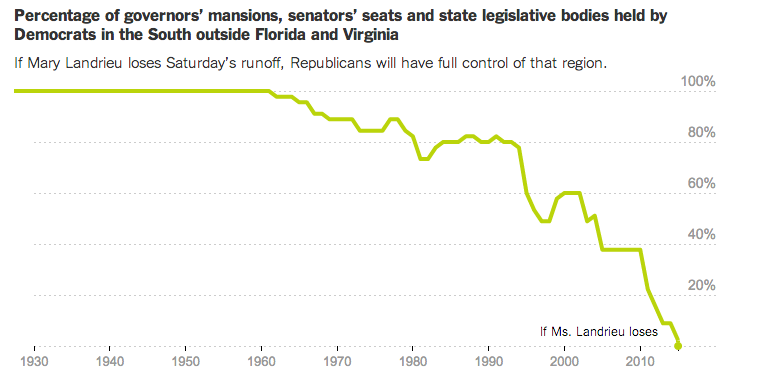
From the NYT: The Demise of the Southern Democrat Is Now Nearly Complete

With the defeat of Mary Landrieu there are no Democrat holds statewide office in any southern state outside of Florida and Virginia. The trend that started slowly when LBJ signed the Civil Rights Act of 1964 seems to now be complete. The Atlantic ran a recent article calling Landrieu The Last Southern Democrat.

- Click here for the article.

Here's the proof:


The article hits on themes we cover in both 2305 and 2306. What we seem to be seeing is white flight from the party.

Here's a taste:

The timing of the demise of the Southern Democrat is not coincidental. It reflects a complete cycle of generational replacement in the post-Jim Crow era. Old loyalties to the Democratic Party have died along with the generation of white Southerners who came of age during the era of the Solid South, before Brown v. Board of Education, before the Civil Rights Act.
Yet it also reflects the very specific conditions of 2014. Today’s national Democratic Party is as unpopular in the South today as it has ever been, in no small part because the party has embraced a more secular agenda that is not popular in the region.
“It’s a completely different party than it was 20 or 30 years ago,” said Merle Black, a professor of political science at Emory University. “When the Democratic Party and its candidates become more liberal on culture and religion, that’s not a party that’s advocating what these whites value or think.”
The party is also led by an unpopular president who has never appealed to the region’s white voters. President Obama won about 17 percent of white voters across the Deep South and Texas in 2012, based on an analysis of pre-election polls conducted by the Pew Research Center, census data and election results.

Tuesday, January 28, 2014

From Frontline: How Texas became a "Red" State

We will discuss political organizations in Texas soon enough and try to outlining the process by which Texas shifted from a solid Democratic state to a relatively solid Republican one.

Click here for a Frontline feature on the story.

We'll go over some of this material soon.

This Wikipedia entry on the Solid South might be helpful also. While Texas isn't exactly a southern state, it tends to vote in sync with the other states in the south east. This helps explain the politics associated with that tendency.

Wednesday, November 7, 2012

Are we witnessing a partisan realignment?

We finished discussing parties in most classes last week, and and concluded with a look at party eras - those periods of time where a specific relationship between political parties - and political forces in general - are somewhat stable. They tend to last 30-40 years, and we haven't seen one in a while, possibly since 1968.

Given that Obama not only won reelection last night, but was the first Democratic president since FDR to win consecutive elections with a majority, there's talk that we might be undergoing a long delayed shift in politics.

The Reagan Coalition, which has dominated politics since 1980 might be running out of steam, and could be replaced with a multi racial, coalition that might keep Democrats in power for some time.

Andrew Sullivan has a list of the various takes on this theme from various commentators. These includes advice - mostly unsolicited - about what Republicans need to consider doing in order to stay competitive. A consensus seems to be emerging that the Republican Party is old and white, and that wont help them much as the nation continues on the road to being majority minority.

Monday, September 24, 2012

The White Working Class and Obama

The Public Religion Research Institute clarifies reports suggesting that the white working class is opposed to Obama, its the Southern white working class primarily. See more here, here and here. This reflects the ongoing realignment of the South from Democrat to Republican over the past two generations.

Thursday, November 3, 2011

Before the Walmart Moms there was the Silent Majority

I strongly suggest that 2301 students read through this. It describes how Richard Nixon identified a group that had traditionally voted Democratic - but seemed up for grabs in the 1972 election - and how to mobilize them. His effort led to the realignment that continues to define the current party era. The Republican and Democratic parties look the way they do today as a consequence of this electoral strategy.

- the Southern Strategy.

Thursday, January 27, 2011

Partisanship Trends by State

From The Monkey Cage, data showing how different states over the past 50-60 years have shifted partisan alliances.

Monday, November 24, 2008

Less a Coalition than a Clubhouse

Sorry to keep hammering on this theme, but it is pervasive in the press:

As George W. Bush's presidency winds down, the Republican Party's greatest problem is that it doesn't appear to be reaching much of anybody who isn't already watching Fox News. Bush leaves behind a party that looks less like a coalition than a clubhouse.

The consistent thread linking the 2006 and 2008 elections was the narrowing of the playing field for Republicans even as Democrats extended their reach into places once considered reliably "red."


...McCain cratered in such places as Philadelphia's upscale, socially moderate suburbs, which he lost by almost 200,000 votes, double Bush's already daunting deficit last time. Until Republicans restore their ability to speak to voters in the Philadelphia suburbs and to their counterparts outside Detroit and Denver or Columbus and Orlando, rousing the faithful on Fox isn't likely to halt the Democratic advance.

On a lighter note -- one hopes, here is one person's about how the Republican Party can rebound:

The future of the Grand Old Party needs to be dangerously youthful, devastatingly attractive and outrageously fun.

...With the economy in the pits, the young, the restless and unapologetically handsome should use their looks, vigor and Internet knowledge to wrest away elective office from joyless bureaucrats who gallingly repackaged the soiled utopian promises of their overly replayed Woodstock days as "hope" and "change."

...The suburban Mall Rats will be the first Obamacons to come back to the fold when they realize that trickle-up socialism limits their lifestyle options. So let's stop first at Abercrombie and Fitch. See those shirtless models in the storefront tossing footballs in the air? There's a better use of their time and efforts. Tanned, coiffed and seriously cut, these young studs could be tossing free-trade legislation
across the halls of the Cannon House Office Building faster than you can Twitter "The Bella Twins."

For the sake of the Republic's future lets hope the GOP is smarter than this.

Saturday, November 22, 2008

And Still More About Republicans

More commentary on the Republican realignment that wasn't and the essential components of the Obama Coalition. At the moment it seems that white college educated professionals have realigned from the Republican to Democratic Party. By joining the ranks of the young, black, Latino and secular, they helped Obama win the most impressive victory by a Democrat since 1964's Johnson landslide.

The author tells us:

Perhaps the most revealing post-election data on that question came from within the defeated McCain campaign. In an interview with Roger Simon of Politico, the Republican candidate's speechwriter and friend, Mark Salter, disclosed that in the campaign's own internal polling data, 60 percent of Americans regarded Obama as "liberal." The campaign thought that would be enough to defeat him, which is why it hammered on the "left-wing" themes.

Baiting the liberals didn't work this year. Disgusted with the Republican right, voters wanted something different and weren't afraid to look leftward. That is what "realignment" means.


At one time, the mere mention of the word "liberal" was enough to tar a candidate and make him or her unelectable. No more. This may be due to generational effects. Younger voters aren't turned off by liberalism. The strategy still works in Texas though, and may well for some time.

Wednesday, November 12, 2008

A Realignment?

I tend to think these claims are overblown, but here are pieces which together suggest that the Reagan Coalition has been substituted with an Obama Coalition.

Here is a sober piece from the National Journal, and something a bit more hysterical from P.J. O'Rourke.

From the former:

Barack Obama on Tuesday won the most decisive Democratic presidential victory in a generation largely by tapping into growing elements of American society: young people, Hispanics and other minorities, and white upper-middle-class professionals. That coalition of the ascendant -- combined with unprecedented margins among African-Americans -- powered Obama to a commanding victory over Republican John McCain, even though Obama achieved only modest and intermittent gains with the working-class white voters who provided the foundation of the Democratic coalition from Franklin D. Roosevelt's election in 1932 to Humphrey's defeat 36 years later.

"Obama is reimagining a Democratic coalition for the 21st century," says Simon Rosenberg, president of NDN, a Democratic group that studies electoral trends and tactics. "Democrats [are]... surging with all the ascending and growing parts of the electorate. He is building a coalition that Democrats could ride for 30 or 40 years, the way they rode the FDR coalition of the 1930s."


As witht he piece below, the author points out the problems that the Republican party is having in appealing to the cosmopolitan centers of the country as social concervatives become stronger in the party and help determine what positions it takes on hot button issues.

Tuesday, May 20, 2008

The Force Behind the 1968 Realignment

The New Yorker has an amazing article outlining the trajectory of contemporary conservatism and it contains two stories outlining how Richard Nixon, with the help of Pat Buchanan, helped engineer the unravelling of the New Deal Coalition and the realignment of some of its members to the GOP. Here are two bits, expect more to come.

“From Day One, Nixon and I talked about creating a new majority,” Buchanan told me recently, sitting in the library of his Greek-revival house in McLean, Virginia, on a secluded lane bordering the fenced grounds of the Central Intelligence Agency. “What we talked about, basically, was shearing off huge segments of F.D.R.’s New Deal coalition, which L.B.J. had held together: Northern Catholic ethnics and Southern Protestant conservatives—what we called the Daley-Rizzo Democrats in the North and, frankly, the Wallace Democrats in the South.” Buchanan grew up in Washington, D.C., among the first group—men like his father, an accountant and a father of nine, who had supported Roosevelt but also revered Joseph McCarthy. The Southerners were the kind of men whom Nixon whipped into a frenzy one night in the fall of 1966, at the Wade Hampton Hotel, in Columbia, South Carolina. Nixon, who was then a partner in a New York law firm, had travelled there with Buchanan on behalf of Republican congressional candidates. Buchanan recalls that the room was full of sweat, cigar smoke, and rage; the rhetoric, which was about patriotism and law and order, “burned the paint off the walls.” As they left the hotel, Nixon said, “This is the future of this Party, right here in the South.”

and:

Nixon was coldly mixing and pouring volatile passions. Although he was careful to renounce the extreme fringe of Birchites and racists, his means to power eventually became the end. Buchanan gave me a copy of a seven-page confidential memorandum—“A little raw for today,” he warned—that he had written for Nixon in 1971, under the heading “Dividing the Democrats.” Drawn up with an acute understanding of the fragilities and fault lines in “the Old Roosevelt Coalition,” it recommended that the White House “exacerbate the ideological division” between the Old and New Left by praising Democrats who supported any of Nixon’s policies; highlight “the elitism and quasi-anti-Americanism of the National Democratic Party”; nominate for the Supreme Court a Southern strict constructionist who would divide Democrats regionally; use abortion and parochial-school aid to deepen the split between Catholics and social liberals; elicit white working-class support with tax relief and denunciations of welfare. Finally, the memo recommended exploiting racial tensions among Democrats. “Bumper stickers calling for black Presidential and especially Vice-Presidential candidates should be spread out in the ghettoes of the country,” Buchanan wrote. “We should do what is within our power to have a black nominated for Number Two, at least at the Democratic National Convention.” Such gambits, he added, could “cut the Democratic Party and country in half; my view is that we would have far the larger half.”