Showing posts with label candidates. Show all posts

Monday, November 20, 2023

From the Washington Post: Fight against strip club set Speaker Mike Johnson on his moral crusade

I've fielded a few questions about how and why people get involved in politics.

Here's one story:

- Click here for the article. 

Mike Johnson was an eager young lawyer, four years out of law school, when he stayed up until 5 a.m. one night poring over the details of a controversy roiling his hometown: the opening of a new strip club.

By the morning, he was so worked up about the issue, he said, that he appeared later that day at a Shreveport City Council meeting to implore city leaders to block the Deja Vu club from moving in downtown.

“I have done an exhaustive legal research on this matter, probably more than anyone,” he told municipal lawmakers in April 2002, according to minutes of the meeting. He argued that the arrival of another “sexually oriented business,” or “SOB” as he called it, would spread sexually transmitted diseases and other social ills.

Johnson’s pitch failed, and the club opened early the following year. But the dispute over Deja Vu proved to be a turning point for him. It marked the end of his short-lived career as a general practice lawyer and the beginning of his single-minded focus on the culture wars. The shift put him on the path to elected office, first in the Louisiana legislature and then in Congress, and ultimately last month to the House speakership.

- 
House Speaker Mike Johnson used faith in campaign against gay rights.

__________

For more:

What is the culture war?

A culture war is a cultural conflict between different social groups struggle to impose their own virtues, beliefs, and practices over society. The notion of "war" is a metaphor for how to how social groups holding entrenched values and ideologies build adversarial narratives around "hot button" topics on which there is general societal disagreement and polarization over politics, public policy or consumption issues. Culture wars often delve around wedge issues, often based on values, morality, and lifestyle which often lead to political cleavage.

Thursday, August 4, 2016

From Vox: Can panicked Republicans rid themselves of Trump? Here are 7 options.

A look at campaign strategy, as well as the unique and troubled relationship that exists between Trump and the Republican Party establishment.

- Click here for the article.

Here are the options:

1) Kick Trump off the ticket and find another candidate2) Convince Trump to drop out (or hope he drops out on his own)3) Officially disavow Trump4) Un-endorse Trump5) Quietly shift to down-ballot races6) Hope Trump will start behaving himself7) Learn to stop worrying and love the Trump

Thursday, November 19, 2015

From the Texas Tribune: Presidential Candidates Start to File for Texas Primary

And it begins, officially. Since Texas is a red state, the time between now and the March 1st primary will be the most exciting part of the presidential election for us.

- Click here for the story.

After months of talking up Texas' clout in the 2016 presidential race, the White House hopefuls are beginning to take their first formal step toward competing in the state's March 1 primary: getting on the ballot. The period to do so began Saturday and runs through Dec. 14.

As of 5 p.m. Wednesday, three Republican candidates had filed, according to the state GOP: former Florida Gov. Jeb Bush, retired neurosurgeon Ben Carson and billionaire Donald Trump. The campaign of Texas' favorite son, U.S. Sen. Ted Cruz, expects to get him on the ballot in the coming weeks.

Lucky for them, it's not too hard to compete in the Lone Star State. The Republican Party of Texas requires candidates to pay a $5,000 fee or gather 300 signatures from registered voters in each of 15 of Texas' 36 congressional districts. That's a much lower bar to clear than some other states. The filing fee for Republicans in South Carolina, for instance, is $40,000.

On the Democratic side, the process is even easier. Hopefuls have to pony up just $2,500 or produce 500 signatures to get on the Texas ballot.

For more:

- Texas Republican Party elections page.
- Do you want to run for office as a Democrat?
- Filing to run for office as a Green Party member.
- Libertarian links to candidate forms.

Monday, November 16, 2015

Would you like to run for office next year?

If so you - and you want to run as a Democrat or Republican - you have one month to file to be on the ballot.

If you want more info click on these, both from the office of the Texas Secretary of State:

- Important 2016 Election Dates.
- Important Dates for the Party Conventions, Primary Elections and General Election.

Friday, September 25, 2015

From Vox: Political scientists think "the party" will stop Trump. They shouldn't be so sure.

The author takes on the "party decides" theory of candidate selection.

- Click here for the article.

So far the normal rules do not apply - at least on the Republican side - but maybe among Democrats also.

Friday, August 7, 2015

Where are the Republican and Democratic Candidates on the Issues?

If there was more time this semester I'd ask 2305 students to find out where the Republican and Democratic Candidates are in agreement (with each other - not with the other party) and where they differ.

I'll be sure to ask it for fall students.

Sources for info:

- ISIDEWITH.com.
- OnTheIssues.org.
- insidegov.com.

Monday, July 6, 2015

A for real academic article: Etch-a-Sketching: Testing the Post-Primary Moderation Hypothesis

The previous post links to it.

- Click here to check it out.

Its commonly assumed that candidates for the presidency - and by extension any office that involves a primary - have to moderate their stances on issues in order to win general elections. The rule of thumb is that candidates campaign to either extreme in order to win their party's nomination. This id because party identifiers dominate the primaries, but they are only a minority of voters in the general election. Extreme position do not help in general elections, so moderation is necessary.

But is this in fact true?

The author finds evidence that it is.

Here's his conclusion:

This research project moves American political research forward in two major ways. First, the research provides the first systematic evidence for the academic and popular intuition behind a substantial moderation in candidate messages after the primary campaign. By employing text analytic tools, this research gains leverage on a question that evaded empirical measurement for decades. Second, and perhaps more excitingly, this approach opens a new and fruitful area for future study. It remains an open question how well voters may, or may not, perceive subtle rhetorical differences. As with any campaign message, the fact that candidates seem to carefully craft their ideological moderation may not mean that the strategy has much of an effect on voters.


Tuesday, November 11, 2014

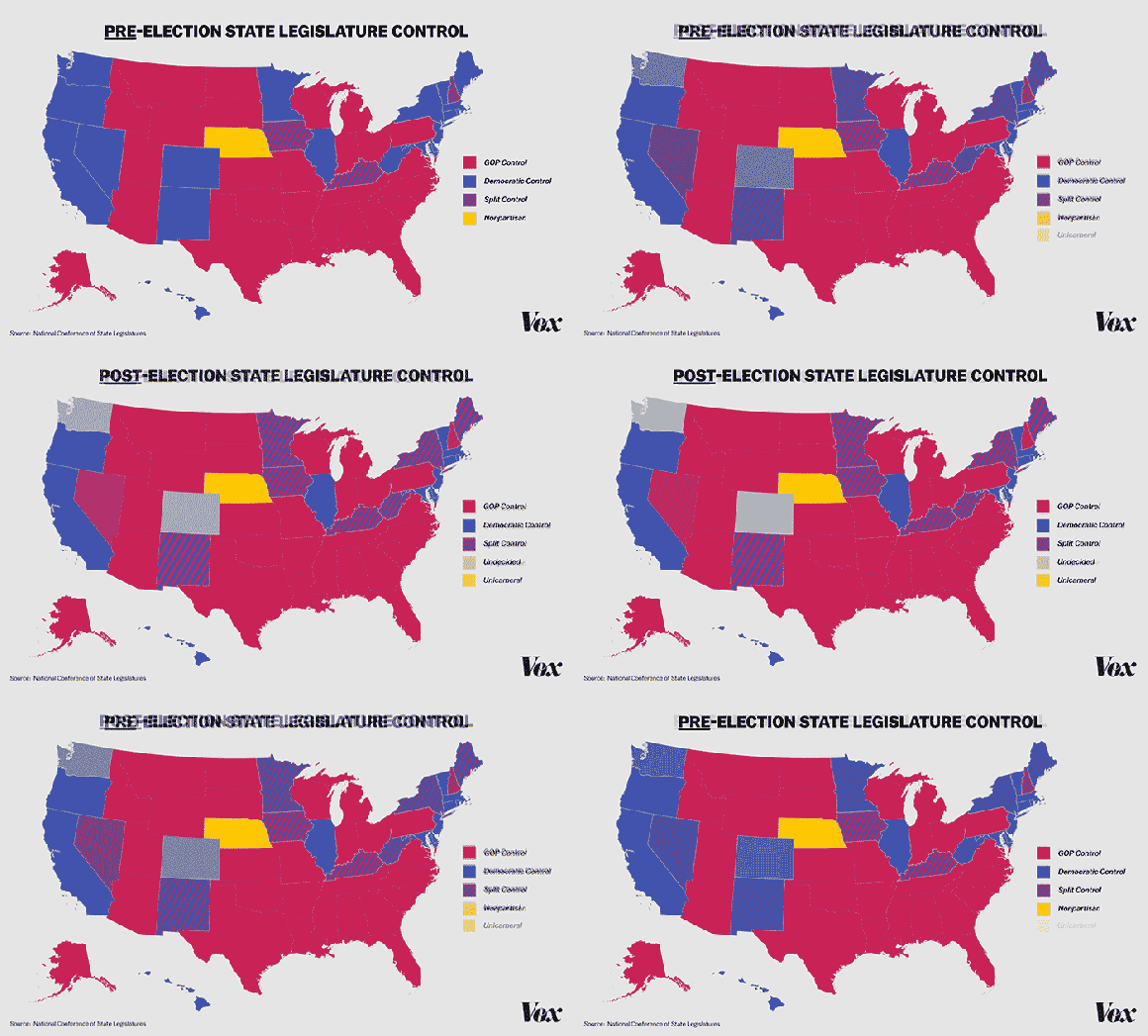
Republicans dominate state races

As well as Republicans did in national races - they did better in state wide races. They now control more state legislatures and governorships than at any time in the past century.

Republicans now have historic majorities in state legislatures. That's a really big deal.
- The process for doing so has been underway for a long time and could provide advantages to the party for decades.

A National Strategy Funds State Political Monopolies.
- The financial effort to fund these races has been underway for several years.

Red Shift in States Creates Conservative Opportunities.
- Future candidates for nation office may be groomed at the state level.

state governments

Thursday, March 13, 2014

From the Texas Tribune: Analysis: A Kink in the Democrats' Chain

One of the weaknesses of political parties in general - and the Texas Democratic Party specifically - is the inability to control who runs on their ticket. Each individual candidate determines if they want to run and on which ticket. If you get enough votes you win - even if the party prefer that you didn't.

The list of embarrassing candidates for each major party is pretty long.

I'd hardly consider Kinky Friedman to be an embarrassment - but the Democratic Party does not want him running as a Democrat for Agriculture Commissioner. Problem is - he could win the general. This creates the obvious dilemma.

- Click here for the article.

On the other side of the field, Republicans are trying to decide between two former state representatives who are in a runoff for agriculture commissioner and were each tossed out of office by the voters in their home districts.
Either Sid Miller of Stephenville or Tommy Merritt of Longview would arguably be the weakest link in the GOP’s chain of statewide candidates — the best place for the Democrats to strike. 
And the most famous name on the Democratic ballot, at the moment, belongs to the mustachioed, black-hatted singer and comedian from Medina, Texas.
The odds are against Friedman, but they were were also against Rick Perry in 1990, when he won the same job against Jim Hightower.

For any Democrat in Texas to win a statewide race this year, something out of the ordinary will have to happen. The ordinary result for the last 20 years has been a Republican victory. The closer races, for the most part, have been toward the bottom of the list of statewide races on the ballot. Democrats nearer the top came close in 1998, but since then, Republican candidates do better at the top than at the bottom.
Even there, a finish above 45 percent is rare. And the money is at the top of the ballot.
The governor’s race will probably dominate the state’s political news between now and November. It’s where the money will be, too, which means it is where the noisiest ad campaigns will originate.
The race for agriculture commissioner is far down the list, both in terms of voter interest and the interest of people who write checks to political campaigns. It is the backwater of state politics, which makes it a great place for a candidate who is well known and doesn’t need the help of the financial people to get the attention of voters.

Sunday, February 16, 2014

State Party Organization Links

I have two to add to my list.

The previous story mentions the Association of State Democratic Chairs.

- Click here for the link.

Here's the mission statement:

The Association of State Democratic Chairs’ mission is to help build strong state parties in order to elect Democrats from the State House to the White House. To accomplish this goal, the ASDC focuses exclusively on the current and future needs of State Democratic Parties. It acts as a service organization dedicated to supporting and educating its members, State Party executive directors and staff.


For a similar organization for Republicans, here's the Republican State Leadership Committee.

- Click here for the link.

And here's it mission statement:

The Republican State Leadership Committee (RSLC) is the largest caucus of Republican state leaders in the country and is the only national organization whose mission is electing Republicans to the office of attorney general, lieutenant governor, secretary of state and legislator. The RSLC concentrates on recruiting outstanding candidates and providing them with research, financial support, and assistance in message development and delivery.

Tuesday, November 19, 2013

From the New Yorker: On the Face of It: The Psychology of Electability

We just finished talking about how personal characteristics can influence voters. When we cover the media, we will see the impact that television has had on how candidates are evaluated.

Looks matter.

Here's a more exhaustive look at these factors:


In 2003, the Princeton psychologist Alexander Todorov began to suspect that, except for those people who have hard-core political beliefs, the reasons we vote for particular candidates could have less to do with politics and more to do with basic cognitive processes—in particular, perception. When people are asked about their ideal leader, one of the single most important characteristics that they say they look for is competence—how qualified and capable a candidate is. Todorov wondered whether that judgment was made on the basis of intuitive responses to basic facial features rather than on any deep, rational calculus. It would make sense: in the past, extensive research has shown just how quickly we form impressions of people’s character traits, even before we’ve had a conversation with them. That impression then colors whatever else we learn about them, from their hobbies to, presumably, their political abilities. In other words, when we think that we are making rational political judgments, we could be, in fact, judging someone at least partly based on a fleeting impression of his or her face.

Starting that fall, and through the following spring, Todorov showed pairs of portraits to roughly a thousand people, and asked them to rate the competence of each person. Unbeknownst to the test subjects, they were looking at candidates for the House and Senate in 2000, 2002, and 2004. In study after study, participants’ responses to the question of whether someone looked competent predicted actual election outcomes at a rate much higher than chance—from sixty-six to seventy-three per cent of the time. Even looking at the faces for as little as one second, Todorov found, yielded the exact same result: a snap judgment that generally identified the winners and losers. Todorov concluded that when we make what we think of as well-reasoned voting decisions, we are actually driven in part by our initial, instinctive reactions to candidates.


Tuesday, September 3, 2013

State and Local Elections - 2013

Things are pretty quiet overall on the states and local level here (tough to compete with Syria) but local issues will become more prominent as the 2013 elections start to loom.

Click here for the Texas Secretary of State's page on important 2013 election dates.

It gives us an idea about what to look forward to. Houston has elections coming up, so there's a good course of content for us. We will also follow news about potential candidates for the primary elections scheduled this coming March.

Ballorpedia has a page on Texas' 2013 elections also.

Wednesday, September 26, 2012

From the Texas Tribune: GOP Candidates Walk Fine Line Between Primary, General

The following story hit on a point we will concentrate on more fully as we begin to discuss elections soon. In order to win primary elections, candidates have to earn the votes of party identifiers - which means they have to take relatively extreme ideological positions. But these positions can make them uncompetitive in the general election, where more moderate and independent voters are likely to turn out. So candidates have to moderate their tone accordingly if they want to win, but this might make them unpopular to the party base.

Its a delicate dance, the story points out that it is increasingly common in Texas elections:

In the primaries, Republican candidates in particular answer to their party’s purists and, in the general election, to everybody who votes.

The state’s political maps put most candidates in safe zones, where Republicans do not have to worry about moderate or liberal voters, and Democrats do not have to worry about moderates and conservatives. The rest have to get out of their primaries without committing to anything that will endanger them in November.

They have to walk a line, sticking with conservative colleagues on legislative votes, but doing it without imperiling their re-elections.

Members of Congress are familiar with that terrain, but on the scale that has partisanship on one end and local issues on the other, Texas legislative races used to skew toward the local.


Thursday, July 28, 2011

Weber for Congress? And what exactly is an Exploratory Committee?

Now that Ron Paul has announced that he will not run for Congress in 2012, our state representative Randy Weber - who has built some name recognition by running for and serving in the legislature for the past three sessions - is taking "the necessary steps to form an Exploratory Committee for US Congress to gauge his support for a race."

- What is an exploratory committee?
- The Atlantic.
- Huffington Post.
- Perry doesn't need one.

Wednesday, March 16, 2011

Palin's Base Shrinks But Intensifies - The Daily Dish | By Andrew Sullivan

Palin's Base Shrinks But Intensifies - The Daily Dish By Andrew Sullivan

Sullivan highlights poll results that show that Palin's overall support within the Republican Party is diminshing, but those who support her do so strongly (Huckabee's supporters are similarly enthusiastic). He suggests, appropriately, that this makes her very strong in the primaries, though low overall numbers may make her uncompettive in a general election. Obama runs very strongly against her head to head.

For 2301s this is an important point. Primary elections - which are conducted by each party - are different affairs than general elections. Turnout is lower and tends to be composed mostly of hard core party identifiers who are often extreme in their ideological beliefs. Palin has been shown to be very popular among this crowd, but no so among the moderates who sit out primaries but do so in the general election. This tells us something about the power struggle within parties. Party leaders may attempt to influence which candidates are likely to get the party nomination, but the decision is ultimately up to the party base. It is not unusual for the passionate base to select a candidate unapealing to the calmer middle.

- Palin's Favorability Declines; Negatives Exceed her Rivals'
- Poll: Palin's numbers slide among Republicans

Saturday, May 22, 2010

Rand Paul and the Demise of the Local Press

Josh Green has an interesting theory why Rand Paul, who did not talk about the Civil Rights Act of 1964 on the campaign trail at all, was suddenly tripped up by questions about it on the Rachel Maddow show.

Due to the recent demise of newspapers, especially on the local level, Senate candidates are no longer forced to face tough questioning on the local or state level. Paul was able to sail through by only offering stump speeches and never had an aggressive reporter pestering him about positions on issues he does not wish to talk about. He was therefore unprepared for Maddow.

Considering that part of the job of the press is to give us information about political candidates, its worth speculating about what this means for the amount of information we get about lower level candidates in general. This episode will probably also encourage political candidates to simply not talk to reporters. This is a lesson many politicians learn. Sarah Palin certainly did.