Showing posts with label budgeting. Show all posts

Sunday, July 10, 2016

The latest on budgeting in Texas

All from the Texas Tribune:

- Oil Patch Schools Facing Budget Nightmare.
In December 2014, the week Pam Seipp became interim superintendent of Runge schools, the tiny South Texas district held a symbolic groundbreaking for schools and sports facilities to be paid for by a $22 million bond that local voters overwhelmingly approved just as oil prices began to slip.
Seipp’s main responsibility since then?

“The bearer of bad news,” she says.
Four months into the job, she had to inform the board of trustees that local property values were expected to drop by more than half from the previous year because of a major slowdown in oil and gas drilling, and that the $6 million savings account the 300-student district had built up during the recent boom would quickly evaporate. She delivered a similar message this year with property values expected to plummet another 42 percent amid the lingering low oil prices that have brought drilling in the state — and across the U.S. — to a near halt.
The district is now operating on a deficit budget and moving to restructure its bond because it can’t afford payments.

“It’s not been a good experience for me,” Seipp said. “I can hardly wait ‘til they get a permanent person here.”
Runge is a worst-case example of the budgetary difficulties facing school districts in oil producing regions across the state, where a drilling frenzy raged for nearly a decade until oil prices tanked.

- State Leaders Ask Agencies to Cut Budgets by 4 Percent.

Texas' top elected officials are asking state agencies to scale back their budget requests by 4 percent, seeking to further rein in state spending for the 2018-2019 cycle.
In a letter dated Thursday, Gov. Greg Abbott, Lt. Gov. Dan Patrick and House Speaker Joe Straus said agencies should propose the 4 percent reduction as a "starting point for budget deliberations."

"Limited government, pro-growth economic policies and sound financial planning are the key budget principles responsible for Texas' economic success," the three wrote. "It is imperative that every state agency engage in a thorough review of each program and budget strategy and determine the value of each dollar spent."
The letter hints at some priorities for lawmakers heading into next session, making several exceptions to the 4 percent cut. They include funds for public schools, border security, Child Protective Services and mental health resources. The exemptions also include public-employee pensions, Medicaid and dollars needed to meet debt service requirements for bond authorizations. Agencies are also being asked to submit information about zero-based budgeting, a practice in which all expenses must be justified in a new cycle. Patrick and state Sen. Jane Nelson, a Flower Mound Republican who chairs the Finance Committee, have been proponents of zero-based budgeting.

Overall, the letter makes a plea for holding back the growth of state government as Texas continues to deal with a downturn in the oil and gas industry.

- Analysis: No Political Benefit if Voters Can't Feel Tax Relief.

If a state officeholder of any political persuasion promises to cut your property taxes, demand proof.
They made their most recent attempt during last year’s legislative session with a constitutional amendment increasing the homestead exemption. Their hope was that school property tax bills would drop.
Voters approved the amendment in November, giving the average homeowner a $126 tax break.
Hey, if you can’t make it rain, make it sprinkle.
Lawmakers tried the rain thing back in 2006, rewriting property and franchise and other tax laws to bring relief to taxpayers.
State Sen. Paul Bettencourt, a Republican who was Harris County’s tax assessor-collector at the time, watched the benefit get swallowed by “appraisal creep” — the steady increase of property values in a booming state.
This is the problem for Texas lawmakers. They want to get a leash on property taxes statewide, even though there is no state property tax. It requires them to restrain local governments. The local governments, with plenty of evidence, point to expensive state government mandates that drive up their costs.
Your governments, taken together, operate as a circular finger-pointing squad.

Thursday, February 11, 2016

From the NYT: Obama’s Last Budget, and Last Budget Battle With Congress


President Obama on Tuesday sent his final annual budget proposal to a hostile Republican-led Congress, rejecting the lame-duck label to declare that his plan “is about looking forward,” with new initiatives that include $19 billion for a broad cybersecurity plan.
The budget for the 2017 fiscal year, which starts Oct. 1, would top $4 trillion, although just over one-quarter of that is the so-called discretionary spending for domestic and military programs that the president and Congress dicker over each year. The rest is for mandatory spending, chiefly interest on the federal debt and theSocial Security, Medicareand Medicaid benefits that are expanding automatically as the population ages.

The deficit would increase in this fiscal year to $616 billion from $438 billion last year, the budget projects, in part because of tax cuts that Mr. Obama and Congress agreed in December to make permanent. That would make this year’s shortfall equal to 3.3 percent of the economy’s output, or gross domestic product, up from 2.5 percent and exceeding the 3 percent threshold that economists consider sustainable for a growing economy.
Mr. Obama’s proposed 10-year savings — some spending cuts, but primarily almost $3 trillion in higher taxes from wealthy individuals and some businesses, including a $10-a-barrel fee on crude oil — would push deficits down again for a couple years and offset costs of the president’s proposed initiatives.
Then deficits would begin increasing again with the retirement and health costs of aging Americans. The administration says annual deficits would remain below 3 percent of the gross domestic product through the decade to 2026. The accumulated debt held by the public would grow from $14 trillion currently to $21.3 trillion in that time, but measured against a growing economy, the debt would be stable at about 75 percent of gross domestic product.

Tuesday, December 22, 2015

From the Council on Foreign Relations: Trends in U.S. Military Spending

This is simply offered to augment the section on budgeting - as well as foreign policy. I stumbled across it and it helps address issues associated with military spending, so I offer it as a general resource.

- Click here for the article.

Some handy charts from the article:


U.S. Military Spending, $ Billions

U.S. Military Spending, % of World

U.S. National Defense Spending

Tuesday, October 13, 2015

State Budget Solutions

We wont be looking in depth at budgeting issues across the nation - but you might have some interest in it. State Budget Solutions is a non profit that runs a - seemingly - useful website which I'd recommend looking through.

- Click here for it.

I'm trying to figure out who it is affiliated with - other than an outfit called Federalism in Action - so I can't determine if it has a political agenda as of yet. Generally when groups use the word "federalism" in their title they are opposed to federal action in public policy and prefer states and local governments to assert control.

Make of it what you will.

Saturday, March 21, 2015

The "Doc Fix"

The previous post concluded with a mention of the "doc fix."

You might wonder just what that is. The best I can define it, is that it is the yearly process designed to go around limits that were placed on the growth of spending on Medicare passed in the Balanced Budget Act of 1997. Since much of the increase in spending - at that point - was based on increased spending on health the act limited increases to the size of gross domestic product. This includes reimbursements to doctors and hospitals, both of which are strong interest groups and do not want to see reductions in those reimbursements.

The fancy name for this is the Medicare Sustainable Growth Rate.

- Click here for the Wikipedia on the subject.

The Medicare Sustainable Growth Rate (SGR) is a method currently used by theCenters for Medicare and Medicaid Services (CMS) in the United States to control spending by Medicare on physician services. Enacted by the Balanced Budget Act of 1997 to amend Section 1848(f) of the Social Security Act, the SGR replaced theMedicare Volume Performance Standard (MVPS), which was the previous method that CMS used in an attempt to control costs. Generally, this is a method to ensure that the yearly increase in the expense per Medicare beneficiary does not exceed the growth in GDP. Every year, the CMS sends a report to the Medicare Payment Advisory Commission, which advises the U.S. Congress on the previous year's total expenditures and the target expenditures. The report also includes a conversion factor that will change the payments for physician services for the next year in order to match the target SGR. If the expenditures for the previous year exceeded the target expenditures, then the conversion factor will decrease payments for the next year. If the expenditures were less than expected, the conversion factor would increase the payments to physicians for the next year. On March 1 of each year, the physician fee schedule is updated accordingly. The implementation of the physician fee schedule update to meet the target SGR can be suspended or adjusted by Congress, as has been done regularly in the past (a doc fix). Physician groups, including the American Medical Association and the American Osteopathic Association, lobby for a permanent reform to the SGR so that physician payment rates are not subject to annual cuts (a permanent doc fix).

Note that the updates have to be done in early March - which explains why its topical.

From Modern HealthCare

- House, Senate leaders unveil permanent 'doc fix' bills.

Congressional leaders Thursday announced a bipartisan, bicameral deal to permanently repeal Medicare's loathed sustainable growth-rate formula for paying doctors. Bills containing terms of the deal were introduced in both chambers of Congress.

Unclear for now, though, is the fate of the Children's Health Insurance Programand the exact details of how it will be financed.
The legislation, if enacted, would end one of Washington's longest-running fiscal battles and bring welcome stability to payments for doctors who treat Medicare patients. Congress has passed 17 consecutive short-term fixes dating back more than a decade. A vote is anticipated next week. Doctors would face a 21.2% cut in payments on April 1 if no legislative fix is enacted.

“As a doctor, I know firsthand just how destructive the SGR formula has been to America's seniors and their providers,” said. Rep. Michael Burgess (R-Texas), the chief sponsor of the House legislation, in a statement. “Finally, after unparalleled progress in recent years, both sides of the aisle have begun to understand that the long-term solvency of our Medicare system depends on taking this fight head-on together.”

The “doc fix” deal was negotiated by House Speaker John Boehner and Minority Leader Nancy Pelosi in recent weeks behind closed doors. But key committee members have signed on. Sponsors of the legislation included Rep. Paul Ryan (R-Wis.), chair of the House Ways and Means Committee and Sen. Orrin Hatch (R-Utah), chair of the Senate Finance Committee.

Monday, February 2, 2015

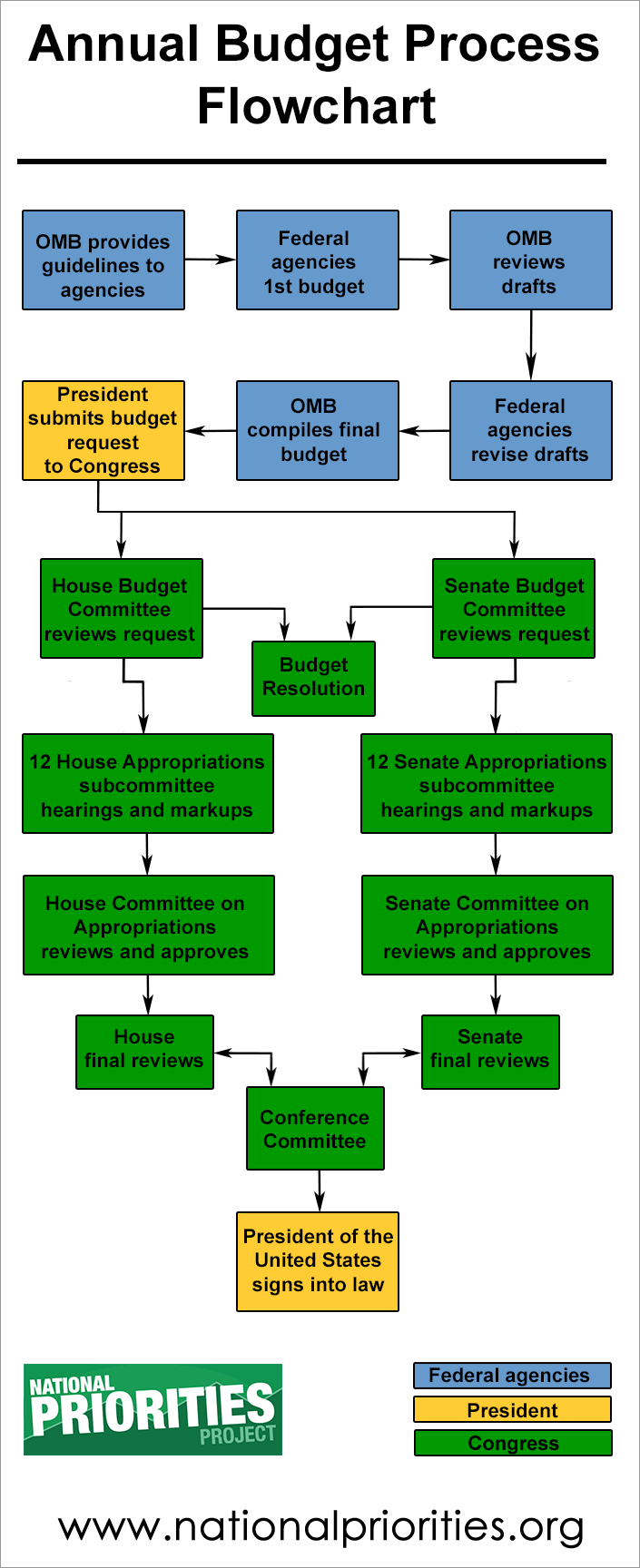
The United States' budgeting process

To put our look at the recently released 2016 federal budget in context - here's a flowchart of the process.


And for more detail and description:

- Wikipedia: United States budget process.
- House Budget Committee: Budget Process.
- CBPP: Policy Basics: Introduction to the Federal Budget Process.

Tuesday, February 18, 2014

From Politico: The Word That Changed the Debt Ceiling Debate

This applies to the bill making process, budgeting and public opinion. The author points out that Democrats were able to spin public opinion in their favor in the recent debate over the debt ceiling by using the word "default" to describe the proposal to not increase it.

This is a common tactic - define a policy or proposal in terms favorable to one's preferred outcome. Republicans have generally bee more successful doing so than Democrats, for example calling the estate tax a death tax. Democrats seem to have learned the lesson.

- Click here for the article.
When Treasury Secretary Jack Lew recently gave notice that the federal government would once again hit the debt ceiling in February, the response from congressional Republicans—who twice took the nation to the brink of default—was decidedly muted.
The official line? “We believe that defaulting on our debt is the wrong thing,” says House Speaker John Boehner (R-Ohio). “We don’t want to do that.” On Tuesday, the House duly voted to raise the debt limit without conditions, sending the action over to the Senate.
This move represents a 180-degree turn from the previous strategy of trying to extract concessions from Democrats by threatening to send the country into economic chaos.

Why such a stark softening of the party line? Republicans’ retreat from the debt-limit battlefield, which they entered so boldly in the spring of 2011 and again last year, began with a shift in the Democrats’ rhetorical strategy. A simple turn of phrase turned the tables on the GOP.
The short history of debt-limit brinksmanship offers a useful lesson in the power of a word to reframe a national debate and drive public opinion in a new direction.
When Republicans first played the debt-limit card in 2011 to force budget concessions from Democrats, the GOP held the rhetorical upper hand. The dialogue was framed in terms of the policy question at hand: Should the national debt limit be raised, so that the Treasury could borrow more money to pay outstanding bills?

. . . Democrats undermined their own position by talking too much about raising the debt limit—and not talking about the consequences of sending the country into default. As seen in the word frequency chart above, the word “default” didn’t even show up in the debate during the first round of this fight in 2011.
We shared this linguistic analysis with top Democrats and recommended a simple, but critical, change in their message: Stop talking about the “debt limit.” Start the conversation with the word “default.”
It was a straightforward switch in vocabulary—but it started a whole new conversation. When high-profile messengers in the Obama administration and Congress started talking about the danger of “default,” the prominence of that idea quickly increased in news coverage. Commentators began discussing it more, and the theme was amplified in social media.
Democrats also dialed up the emotional resonance of the message by saying that a default could cause an economic “catastrophe.” Emotion works with cognition in the brain to help us with attention, retention and motivation. A message must create an emotional reaction for people to notice it, much less remember it.
Within weeks of Democrats adopting this new tack, the polls began to shift. A Pew survey in July 2011 showed the percentage of respondents concerned about default had increased by seven points—while opposition to raising the debt limit had decreased by one.

Wednesday, February 5, 2014

From the Congressional Budget Office: The Budget and Economic Outlook: 2014 to 2024

Prior to the presentation of the president's budget to Congress, the Congressional Budget Office is required to release a document projecting the budget 10 years into the future - which also requires that it estimate what the economy is likely to be like during that period of time.

Here is a link to the recently released document:

- The Budget and Economic Outlook: 2014 to 2024


Here the two key graphs in the report:


Here's what they have to say about projected revenues:


Federal revenues are expected to grow by about 9 percent this year, to $3.0 trillion, or 17.5 percent of GDP—just above their average percentage of the past 40 years (see the figure below). Revenues were well below that average in recent years, both because the income of individuals and corporations fell during the recession and because policymakers reduced some taxes. The expiration of various tax provisions and the improving economy underlie CBO’s projection that revenues will rise sharply this year. Those factors will increase revenues further in 2015, with CBO’s baseline showing another 9 percent rise. After 2015, revenues are projected to grow at about the same pace as output and to average 18.1 percent of GDP under the current-law assumptions of CBO’s baseline.

And here's what they have to say about projected spending:

Federal outlays are expected to increase by 2.6 percent this year, to $3.5 trillion, or 20.5 percent of GDP—their average percentage over the past 40 years. CBO projects that under current law, outlays will grow faster than the economy during the next decade and will equal 22.4 percent of GDP in 2024. With no changes in the applicable laws, spending for Social Security, Medicare (including offsetting receipts), Medicaid, the Children’s Health Insurance Program, and subsidies for health insurance purchased through exchanges will rise from 9.7 percent of GDP in 2014 to 11.7 percent in 2024, CBO estimates. Net interest payments by the federal government are also projected to grow rapidly, climbing from 1.3 percent of GDP in 2014 to 3.3 percent in 2024, mostly because of the return of interest rates to more typical levels. However, the rest of the government’s noninterest spending—for defense, benefit programs other than those mentioned above, and all other nondefense activities—is projected to drop from 9.4 percent of GDP this year to 7.3 percent in 2024 under current law.

The report contains some controversial predictions about the impact of the ACA on the number of jobs in the economy. It argues that a variety of responses to the law's requirements will lead to a reduction of over 2 million jobs by 2012. The White House and congressional Republicans are arguing over what this means for the laws merits.

- see this Washington Post story for greater detail.

Wednesday, September 25, 2013

Tuesday, September 24, 2013

Has austerity hampered economic growth?

Here is an argument that it has.

In recent recessions, government spending has increased. Not in the current recession. Here's one factoid. Government jobs have been cut, which keeps the unemployment rate high. In previous recessions they increased.


A CBO report argues that austerity has cut GDP growth by .8 percent.

Friday, September 20, 2013

What is a continuing resolution?

The NYT provides an overview of the politics associated with the continuing resolution just passed by the US House. The one that also cuts funding for ObamaCare.

But first - what is a continuing resolution (also referred to as continuing appropriations) and why do they matter?

Here's a definition from the US Senate website:
continuing resolution/continuing appropriations - Legislation in the form of a joint resolution enacted by Congress, when the new fiscal year is about to begin or has begun, to provide budget authority for Federal agencies and programs to continue in operation until the regular appropriations acts are enacted.
It all comes down to the budgetary process in the US, and that fact that the Constitution stipulates that money cannot be drawn from the Treasury unless it has been appropriated by law - the is the Appropriations Clause.

Both the House and Senate have Appropriations Committees that oversee this process.

Aside from that - as we will soon see - there is nothing in the Constitution about a budgetary process. One only began to be established in the early years of 20th Century when efforts were made - driven by progressives - to professionalize the governing process. This includes the establishment of Budget Committees in the House and Senate. They are in charge of determining how Congress wants funding to be directed - sort of - because some funding is mandatory. This is referred to as the authorization process of the budgetary process. We will cover this soon enough.

- Here's the Wikipedia on the US budget process.

But none of this really matters here. What matter is the appropriations process and the fact that we are near the end of the fiscal year. What is that? Again, from the Senate:
fiscal year - The fiscal year is the accounting period for the federal government which begins on October 1 and ends on September 30. The fiscal year is designated by the calendar year in which it ends; for example, fiscal year 2013 begins on October 1, 2012 and ends on September 30, 2013. Congress passes appropriations legislation to fund the government for every fiscal year.
- Click here for a CRS report on the process.
- And here for another CRS report - a bit more thorough.

We are coming up on the end of the 2012-2013 fiscal year. That's what the media really refers to when it says that the US government is about to run out of money. In theory, the new fiscal year 2013-2014 cannot begin, or at least money for that period cannot be drawn from the Treasury, unless appropriations bills are passed. These are to provide funding through the next fiscal year.

As we will see when we discuss the budget, this seldom really happens. Conflicts over spending usually result in these bills not being passed in time. So how does the US government get the money it is required to spend due to existing law?

From the continuing resolutions. These are bills that provide short term funding for government when the appropriations bills are not passed. So what the House passed was such a bill, but with a condition - that funding for Obamacare be terminated - which won't happen of course.

We'll follow this over the next couple of weeks. Since war does not appear to be likely with Syria - this is the most exciting stuff we have going on.

Thursday, September 19, 2013

From the NYT: The Money Behind the Shutdown Crisis

The NYT editorializes on one of the causes of dysfunction in Congress - the fact that conservative interest groups increasingly target Republican member of Congress who are not conservative enough, and who have shown a willingness to make compromises.

Representative Aaron Schock is a conservative Republican from Illinois, but not conservative enough for the hard-right activist group Club for Growth, which is seeking someone to run against him in next year’s primary.
His crime? In 2011, he voted to increase the debt ceiling, and, in 2012, he voted for a stopgap spending bill that prevented a government shutdown. In neither case did he demand the defunding of health care reform.
Club for Growth and other extremist groups consider a record like his an unforgivable failure, and they are raising and spending millions to make sure that no Republicans will take similar positions in the next few weeks when the fiscal year ends and the debt limit expires.
If you’re wondering why so many House Republicans seem to believe they can force President Obama to accept a “defunding” of the health care reform law by threatening a government shutdown or a default, it’s because these groups have promised to inflict political pain on any Republican official who doesn’t go along.

When we discuss elections in future classes, we will look at arguments that the primary election process has evolved into a mechanism for rewarding extremism and punishing moderation. This editorial provides evidence.

Wednesday, September 18, 2013

What is a government shutdown?

Now that Syria is off the radar screen - for now - attention is turning to a more predictable crisis: the looming government shut down.

This comes at a convenient time because we will be discussing the budgeting process very soon.

You may need a primer on this, so here's the obligatory Wikipedia entry on government shutdown, CNN has a guide to it, and the Washington Post lists 5 reasons why its likely to happen.

Simply put its a negotiating tactic that can be used by one side that wants to force concessions from another by refusing to allow for any spending at all if the concession is not met. It can be effectively the end of the budgetary cycle - when a new budget has to passed and money appropriated to fund governmental projects - or when the budget ceiling is about to be hit.

Both of those are looming right now. Tea Party Republicans are using this scenario to try to force Democrats to defund ObamaCare. If not - no spending so the government shuts down.

We will go over the budget process and the political issues associated with the shutdown in the coming weeks. in the meantime here are freaky slides showing the process.

Sunday, April 14, 2013

US Gross Domestic Product - 2012

For this week's look at the US economy and the budget:
According to the Bureau of Labor Statistics. the US GDP at the end of 2012 was just under $16 trillion - $15.864 trillion.

If you need a refresher on what the GDP is click here. Some of the figure we will be looking at regarding the budget are set in percentages of GDP. It might be helpful to know what that figure is.

For more detail:

- Trading Economics.
- Google Data.
- US economy climbs off the mat.

Monday, April 8, 2013

From the Washington Post: Why do people hate deficits?

A counter-intuitive read. We don't like deficits, but do we really know enough to say why? And are they really as cataclysmic as we think?

Thursday, March 21, 2013

Medical cost are rising because we have more old people.

Other than that, medical costs are pretty steady. Graphic from Wonkblog:

http://www.washingtonpost.com/blogs/wonkblog/files/2013/03/medicare-excess-growth.jpg?wpisrc=nl_wonk

The story the chart is pulled from can be found here. Here's the basic point the study makes:

The latest CBO report, which takes into account three consecutive years of dramatically slower health care cost increases, should serve as a warning (and a reminder) that it is misleading to say the problem with the federal budget “is just a health care problem.”
If one only looks at the two CBO updates over the last six months, projected 10-year Medicare spending has been revised downward by $306 billion. Projected Medicaid spending has been revised downward by $273 billion (not counting revised estimates of lower Medicaid enrollment due to the Supreme Court’s ruling on Medicaid expansion in the Affordable Care Act (ACA)).
Yet even under that “better case scenario,” federal outlays for health care will soon be greater than outlays for Social Security -- placing it at the top of all federal budgetary commitments. Over the 10-year budget window, health care spending will experience growth of 1.2 percent of GDP, second fastest only to net interest.
The reason is simply that the “health care problem” actually reflects the large increase in the number of people who will become eligible for Medicare due to the retirement of the baby-boom generation. Over the next 10 years, 18 million new beneficiaries are expected to sign up for Medicare.
Nearly three-quarters of the spending increases in Medicare over the next two decades can be attributed to aging alone. And, as I will explain, the remaining increase in costs due to health care inflation will be very difficult to avoid because even that amount of projected growth is lower than anyone realistically believes we can sustainably achieve. Thus, the major problem in Medicare really is one of an aging population. In this case, the Medicare problem is no different than the Social Security problem.

Continuing Resolution passes US House and Senate

When 2305's start looking at the budget, we will discuss what "the budget" is and what it isn't. It is a statement declaring what revenues and outlays are to be over a given period of time, but it is not a binding document. The budgets I asked 2305s to discuss in this week's assignment are better considered as being political - not fiscal - instruments. The Constitution says nothing about budgets or a budgetary process, only that funds cannot be drawn from the treasury if an appropriations bill has been passed to authorize it. But the recent dysfunction in Congress has even made that problematic, and more recently the US government has been funded by a series of short term funding measures called continuing resolutions.

Here's Wikipedia's definition of a continuing resolution: A continuing resolution is a type of appropriations legislation used by the United States Congress to fund government agencies if a formal appropriations bill has not been signed into law by the end of the Congressional fiscal year. The legislation takes the form of a joint resolution, and provides funding for existing federal programs at current, reduced, or expanded levels.

If the resolution is not passed - assuming that the appropriations bills have not passed either - they money cannot be drawn from the treasury to fund government agencies and they have to shut down. At least those that perform non-vital programs do.

We will cover this more fully later, but I bring it up now because the US House and Senate have passed continuing resolutions in order to avoid a shutdown - which tends to be unpopular.

Here are the stories that provide detail:

- Congress moves one step closer to avoiding a government shutdown.
- House to approve bill to keep government running.
- House approves resolution to keep government running; bill heads to White House.

This guarantees funding until September 30th, when further funding can be subject to hostage taking again.

Wednesday, March 6, 2013

Cut spending, but not spending on what I like

This is one of those stories that gets rewritten every time spending cuts are topical.

The general idea of slicing government spending is popular, with majorities of Republicans, independents and Democrats all saying they support an across-the-board five percent reduction in federal outlays. (This poll asked only about cuts started with the so-called sequester, not about taxes, or any possible budget deal.)

. . . The large support for cutting government spending stands in stark contrast deep public opposition to decreasing spending on particular programs. In February the Pew Research Center surveyed Americans on 19 areas of federal spending, and there was majority support for decreasing spending in precisely zero of them. (See also Huffpost Pollster’s write-up of the cuts paradox.)
In short: the American public likes the idea of cutting federal spending; what they don’t like are actual cuts in federal spending.

That paradox makes it very difficult for elected officials to navigate the issue of whether — and what — to cut. It also explains why we should have seen the sequester as politically inevitable right from the start. Without any clear signal from the public of how, specifically, it wants the cuts to happen, politicians did the easy thing: They let an across-the-board cut go into effect without having to vote (read: explain) on it.

One person's pork is another person's job. This has always made federal spending cuts difficult to enact. Constituencies develop around different spending projects which aim to preserve programs.

But here's a question: Why doesn't this logic work in Texas - or why does it work only selectively? The legislature was able ti cut $5 billion in public education in the 82nd session (pending the ongoing lawsuit), but supporters of the cuts were able to survive electorally. Why? Perhaps it comes down to the nature of the political factions in the state as opposed to national factions. This would make a good research project.