Showing posts with label Federal Register. Show all posts

Wednesday, January 13, 2016

From Politico: Obama pushing thousands of new regulations in Year 8 The calendar says there are 13 months left to Barack Obama's presidency. But when it comes to exercising executive power, it's more like five.

A look at how a president can exercise political power when Congress is held by the opposition party and the nation is distracted by a campaign. This is a good look at how the executive branch works.

- Click here for the story.
Nearly 4,000 regulations are squirming their way through the federal bureaucracy in the last year of Barack Obama’s presidency — many costing industry more than $100 million — in a mad dash by the White House to push through government actions affecting everything from furnaces to gun sales to Guantánamo.
That means a full court press at the Occupational Safety and Health Administration (OSHA) to reduce exposure limits for silica, a chemical used widely in construction and fracking that can cause cancer when inhaled; at the Bureau of Alcohol, Tobacco, Firearms and Explosives, to require more small-scale gun sellers to perform background checks; and at the Food and Drug Administration, to make food manufacturers disclose on product labels how much sugar they add to cranberry juice.
Much of this work will be carried out in the coming months by career bureaucrats working in the bowels of federal agencies, but the cumulative effect adds up to something larger: A final-year sprint by a president intent on using executive power to improve the lives of American workers and consumers — in many instances over loud objections from the businesses that will have to pay for it.
The work must be done swiftly in most cases because any regulation finalized after May
17 or thereabouts risks being blocked by Congress.

. . . The mid-May deadline isn’t statutory or in any way official, but neither is it arbitrary. It arises from the Congressional Review Act, a 1996 law that gives Congress 60 legislative days to veto, by a special swift procedure, any regulation it dislikes before the rule takes effect.

The president may veto Congress’s veto, as Obama did the one time he faced this situation. But if the 60-day period extends past the inauguration of a new president, and if that president is of the opposing party — a President Donald Trump, say, or Ted Cruz or Marco Rubio — any resolution of disapproval against his predecessor will surely go unchallenged.

Wednesday, February 5, 2014

A Unilateral President?

After a State of the Union Address where he promised to use whatever means were at his disposal to implement his policies, a handful of commentators have asked whether Obama has gone to far in asserting executive power.

Other have tried to put it in perspective - throwing water on the idea that he's behaving lawlessly.

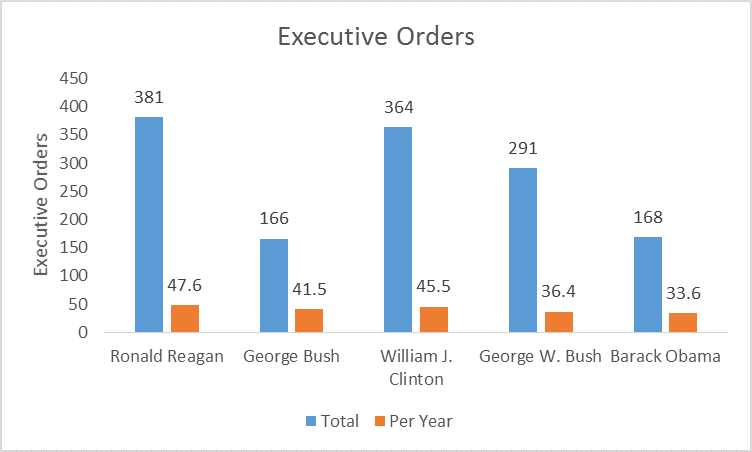
He's issued fewer executive orders than other recent presidents:

executive orders

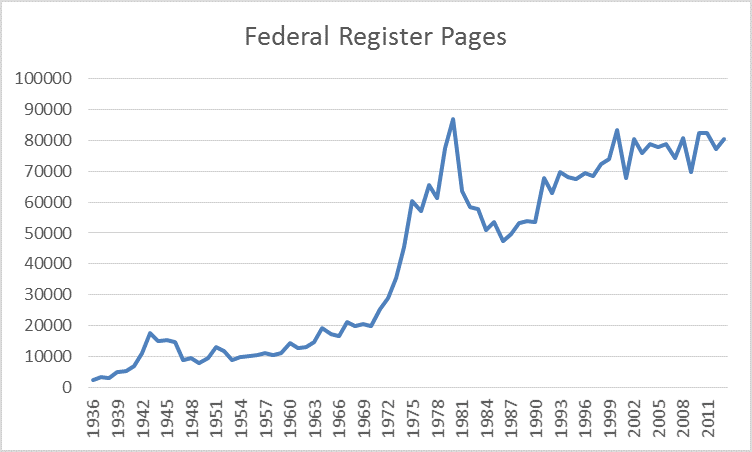
Pages added to the Federal Register per year are the same - more or less - as those under W Bush:

federal register pages

Here's a comparison to past president's who used executive power broadly:

These are push-the-envelope moves but strike me as within the bounds of the modern presidency. Some historical perspective:

First, the constitutional tug-of-war between the president and Congress is as old as the republic -- indeed, an essential element in the constitutional design. The framers were wary not only of creating a monarchical chief executive but also one hobbled by congressional interference.

Second, there is a robust history of presidents pushing ambiguous constitutional boundaries to engage in unilateral action. Jefferson executed the Louisiana Purchase despite his own doubts about its constitutionality.

Lincoln issued the Emancipation Proclamation, notwithstanding the Constitution's recognition of slavery and his own concerns about the proclamation's susceptibility to legal challenge.

Third, this trend toward broad presidential power has accelerated in recent decades, under presidents of both parties -- even before George W. Bush's aggressive use of signing statements, and his war on terror.

In a 2001 Harvard Law Review article, Elena Kagan, a veteran of the Clinton White House, traced the growth of presidential power over regulatory agencies to Ronald Reagan (in pursuit of efforts to loosen regulations) through Bill Clinton (in pursuit of more activist government, a way around a balky Congress, and political credit).

Clinton's unprecedented interventions, she wrote, represented a "significant enhancement of presidential power over regulatory matters."

Fourth, assessments of presidential overreach are inherently matters of situational ethics: How you judge whether a president is overstepping his authority is inevitably colored by whether you agree with the substance of that exercise.

Put more bluntly, much of the hoopla about presidential imperialism is politics dressed up in constitutional clothing, to be put on and off depending on which party holds the White House.

Thus, Democrats condemned what they saw as Bush's unilateral excesses, while Republicans remained largely silent and unconcerned. Now, the roles are precisely reversed.
In short - Obama's actions are probably best seen as part of a general trend towards expanded executive powers. For better or worse.

Tuesday, September 25, 2007

The Right to Travel

I use the right to travel as an example of the potential unalienable rights that might fall under the heading "among" in the Declaration of Independence - see below - but do it with tongue in cheek.

Maybe I should rethink this. The Daily Kos points out that a recent copy of the Federal Register contains something called the Secure Flight Plan which, they argue, will allow the Department of Homeland Security to take over pre-screening passengers, which means that the federal government will have to give you permission to get on an airplane before you can fly.

This has been in the works for a while and administration officials say that this will not violate individual liberties.

Sticklers among you will point out, correctly, that this does necessarily restrict travel, just a certain mode of transportation. But still, where does this end?