Showing posts with label NSA. Show all posts

Friday, January 6, 2017

From the U.S. Senate Committee on Armed Services: A hearing on "Foreign Cyber Threats to the United States"

Here's a link for more information related to the hearing below.

Aside for general information related to the specific question about possible Russian hacking during the 2016 election, it also offers 2305 students a look at one of the central functions of a congressional committee - the holding of hearing related to issues within the jurisdiction of the committee.

- Click here for the page dedicated to the hearing.

The witnesses provide an indication of what types of executive officials engage in activities within the jurisdiction of the committee. These positions are:

1 - The Director of National Intelligence.
2 - The Office of the Under Secretary of Defense for Intelligence.
3 - United States Cyber Command.
4 - National Security Agency.
5 - Central Security Service.

Here is information about the witnesses:

1 - James R. Clapper.
2 - Marcel J. Lettre.
3 - Michael S. Rogers.

These of course are people affiliated with the Obama Administration, In a later post I'll highlight the people Donald Trump has appointed to replace them.

Lawfare published an assessment of the hearing. The author points out how cordial and respectful members of the committee were towards the witnesses, and the intelligence community in general. This is in sharp contrast to comments by Trump.

- Click here for What Yesterday’s Senate Armed Services Committee Portends.

While John McCain, the committee chairman, was unspairing in his criticism of the Obama administration for not developing a cyber deterrence strategy, his demeanor towards the DNI was one of profound respect and cordiality. Others too made a point of thanking Clapper for his long service in various intelligence capacities and across administrations.
The message here was not merely one of fondness for the man himself, though that was evident at times; it was a way of conveying admiration and respect for the intellingence community that he and NSA Director Adm. Mike Rogers were there representing. Sometimes, this linkage was explicit. At one point, Clapper was asked to describe his career and its apolitical nature and was asked pointedly whether it was representative of others in the community. He was asked, more than once, for his opinion of Julian Assange and about how Assange is regarded within the community. (Needless to say, Clapper’s not a fan.) Nor was the love fest purely emanating from the Democratic side. The hearing, pretty much wall to wall, showcased the committee’s confidence in the intelligence community as a set of institutions with integrity. At a time when that integrity is under fire from the President-elect, it was a powerful statement.

Indeed, no defense of Trump’s position emerged in any significant way from any member of the committee. To be sure, Sen. Tom Cotton raised the question of whether Trump will be worse for Russia than Hillary Clinton would have been, given his commitment to increased defense spending. And he asked questions that aimed to clarify the relatively narrow scope of the IC’s findings with respect to Russia. Sen. Thom Tillis, doing his best imitation of Noam Chomsky, declared that “there is research done by a professor up at Carnegie Mellon that is estimating that the United States has been involved one way or another in 81 different elections Since World War II. That is not including the coups or regime changes. And Russa has done it 36 times.” But Tillis's Chomskyism was fainthearted and short-lived, and no Republican on the committee stood up for the proposition that the hack may not have been a Russian effort to influence the election. Mostly, Republican senators who weren’t leading the charge contented themselves instead with asking the witnessess about other foreign cybersecurity concerns.
And some GOP senators were really on fire. Sen. McCain set the tone when he opened the hearing by declaring that “there’s no escaping the fact that this committee meets today for the first time in this new Congress in the aftermath of an unprecedented attack on our democracy.”

Sunday, August 30, 2015

Appellate Court Decisions

Last week U.S. Circuit Courts of Appeals made a handful of decisions worth a look. This gives 2305 students an opportunity to look ahead to this specific institution and the judicial process as well.


- NYT: Ruling Limits Protests Outside Supreme Court.

A federal appeals court on Friday upheld 65-year-old limits on protesters’ First Amendment rights to gather and wave signs on the grand plaza in front of theSupreme Court, reversing a district court ruling that had found the restrictions “plainly unconstitutional.” A three-judge panel of the United States Court of Appeals for the District of Columbia Circuit ruled unanimously that restricting demonstrators to the wide sidewalks alongside the plaza was a reasonable limit to preserve the court’s decorum.

- Washington Post: Appeals court deals blow to lawsuit over NSA’s bulk phone data collection.

An appeals court in Washington dealt a setback Friday to an activist’s lawsuit against the government over the legality of the National Security Agency’s call records program, ruling that the plaintiff has not proved his standing to sue. A three-judge panel of the U.S. Court of Appeals for the District of Columbia Circuit ruled that ­public-interest lawyer Larry Klayman, the founder of Freedom Watch, has not proved that his own phone records were collected by the NSA — and so has not met a condition of bringing the lawsuit. It sent the case back to a lower court for further deliberation on the issue. The panel’s ruling also reversed a ban on the NSA’s collection that had been imposed — and temporarily stayed — by a district court judge in December 2013.

- Texas Tribune: Court: Texas Voter ID Law Violates Voting Rights Act.

Texas’ four-year-old voter ID law violates the Voting Rights Act but is not a “poll tax” barred under the U.S. Constitution, a federal appeals court has ruled. The U.S. 5th Circuit Court of Appeals on Wednesday ruled that the Texas voter ID law has a “discriminatory effect” that violates the federal law that prohibits racial discrimination in voting, but it is not an unconstitutional “poll tax.”

Friday, December 20, 2013

From the Hill: Five major NSA recommendations

Here's a close up look at the basic proposals made to change the NSA's surveillance program:

The basics:

1- End the government’s bulk data collection
2 - Give public advocates a voice on surveillance court
3 - Prevent agencies from forcing disclosure of information
4 - Put a civilian in charge of the NSA
5 - Clamp down on leaks

Thursday, December 19, 2013

Liberty and Security in a Changing World

That's the title of the recently released report from the task force assembled by President Obama to make proposals for how NSA should adjust its surveillance operations.

Click here for the report.

For commentary click here:
- NYT.
- National Journal.
- Washington Post.

These are the members of the commission:

- Richard A. Clarke 
- Michael J. Morell
- Geoffrey R. Stone
- Cass R. Sunstein
- Peter Swire


Tuesday, December 17, 2013

From the Washington Post: Judge: NSA’s collecting of phone records is probably unconstitutional

As reported by Ellen Nakashima and Ann E. Marimow:

A federal judge ruled Monday that the National Security Agency’s daily collection of virtually all Americans’ phone records is almost certainly unconstitutional.
U.S. District Judge Richard J. Leon found that a lawsuit by Larry Klayman, a conservative legal activist, has “demonstrated a substantial likelihood of success” on the basis of Fourth Amendment privacy protections against unreasonable searches.
Leon granted the request for an injunction that blocks the collection of phone data for Klayman and a co-plaintiff and orders the government to destroy any of their records that have been gathered. But the judge stayed action on his ruling pending a government appeal, recognizing in his 68-page opinion the “significant national security interests at stake in this case and the novelty of the constitutional issues.”
“I cannot imagine a more ‘indiscriminate’ and ‘arbitrary invasion’ than this systematic and high tech collection and retention of personal data on virtually every single citizen for purposes of querying and analyzing it without prior judicial approval,” said Leon, a judge on the U.S. District Court for the District of Columbia. “Surely, such a program infringes on ‘that degree of privacy’ that the founders enshrined in the Fourth Amendment.”
The strongly worded decision stands in contrast to the secret deliberations of 15 judges on the nation’s surveillance court, which hears only the government’s side of cases and since 2006 has held in a series of classified rulings that the program is lawful. It marks the first time a federal judge in open court has opined on the collection of lawfulness in a case not involving a criminal defendant.
A Justice Department spokesman, Andrew Ames, said Monday that the government was reviewing Leon’s decision. “We believe the program is constitutional as previous judges have found,” he said.

Saturday, June 8, 2013

What is the National Security Agency?

Here's the introductory paragraph from NSA's Wikipedia page:
The National Security Agency (NSA) is a cryptologic intelligence agency of the United States Department of Defense responsible for the collection and analysis of foreign communications and foreign signals intelligence, as well as protecting U.S. government communications and information systems,[1] which involves information security and cryptanalysis/cryptography.


Histories and descriptions can be found in multiple other places online:

- Time Topics: NSA.
- Federaltion of American Scientists: NSA.
- Here is the FAS's history of the NSA.
- Electronic Frontier Foundation: NSA.
- And the official website here.

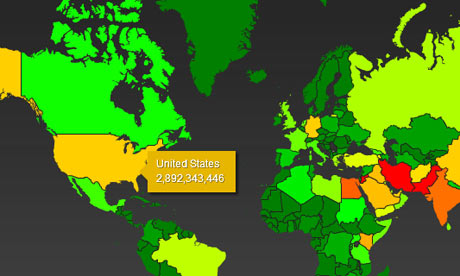
The World According to Boundless Informant

boundless heatmap

Click here for a larger map - it wont fit on this screen. Here's the caption in the Guardian:
The color scheme ranges from green (least subjected to surveillance) through yellow and orange to red (most surveillance). Note the '2007' date in the image relates to the document from which the interactive map derives its top secret classification, not to the map itself.


And more:
The focus of the internal NSA tool is on counting and categorizing the records of communications, known as metadata, rather than the content of an email or instant message.

The Boundless Informant documents show the agency collecting almost 3 billion pieces of intelligence from US computer networks over a 30-day period ending in March 2013. One document says it is designed to give NSA officials answers to questions like, "What type of coverage do we have on country X" in "near real-time by asking the SIGINT [signals intelligence] infrastructure."

An NSA factsheet about the program, acquired by the Guardian, says: "The tool allows users to select a country on a map and view the metadata volume and select details about the collections against that country."
Nice to know that Wikipedia already has pages on both PRISM and Boundless Informant.

PRISM and Boundless Informant

The Washington Post and the Guardian seem primarily responsible for revealing that the National Security Agency, and its British counterpart, has been collecting data from the servers of nine Internet companies that allow it to track phone records and computer activity.

Here's the description in the WaPo:
The National Security Agency and the FBI are tapping directly into the central servers of nine leading U.S. Internet companies, extracting audio and video chats, photographs, e-mails, documents, and connection logs that enable analysts to track foreign targets, according to a top-secret document obtained by The Washington Post.

The program, code-named PRISM, has not been made public until now. It may be the first of its kind. The NSA prides itself on stealing secrets and breaking codes, and it is accustomed to corporate partnerships that help it divert data traffic or sidestep barriers. But there has never been a Google or Facebook before, and it is unlikely that there are richer troves of valuable intelligence than the ones in Silicon Valley.

Equally unusual is the way the NSA extracts what it wants, according to the document: “Collection directly from the servers of these U.S. Service Providers: Microsoft, Yahoo, Google, Facebook, PalTalk, AOL, Skype, YouTube, Apple.”

Here are the previously top secret files which describe PRISM.

And a description of Boundless Informant.

The NYT provides background on the program - which can be traced back to 9/11 and has its defenders in Congress.


http://www.nytimes.com/2013/06/07/us/nsa-verizon-calls.html?smid=pl-share

Can we have a reasonable public debate about the proper extent of surveillance in a free society?

I promise to have some useful links up soon related to the National Security Agency's access to telephone and computer records, but since we've touched on the role of an educated population in a republic I thought this 2007 David Foster Wallace quote highlighted by the Dish recently raises an important question the ability the public to have this debate:
“In the absence of such a conversation, can we trust our elected leaders to value and protect the American idea as they act to secure the homeland? What are the effects on the American idea of Guantánamo, Abu Ghraib, Patriot Acts I and II, warrantless surveillance, Executive Order 13233, corporate contractors performing military functions, the Military Commissions Act, NSPD 51, etc., etc.? Assume for a moment that some of these measures really have helped make our persons and property safer—are they worth it? Where and when was the public debate on whether they’re worth it? Was there no such debate because we’re not capable of having or demanding one? Why not? Have we actually become so selfish and scared that we don’t even want to consider whether some things trump safety? What kind of future does that augur?”


Notice that he's not saying that we are prevented from having such a debate (though one could argue that that is the case if certain facts are kept from the public) but whether we can have such a debate. This seems to lie at the heart of some of the material I tried to present in the introductory lectures.

Read the short article this is pulled from - might make good fodder for conversation Monday.

Here's a provocative start:
What if we chose to regard the 2,973 innocents killed in the atrocities of 9/11 not as victims but as democratic martyrs, “sacrifices on the altar of freedom”?* In other words, what if we decided that a certain baseline vulnerability to terrorism is part of the price of the American idea? And, thus, that ours is a generation of Americans called to make great sacrifices in order to preserve our democratic way of life—sacrifices not just of our soldiers and money but of our personal safety and comfort?

Tuesday, June 22, 2010

Tension in Obama Administration

General McChrystal had tart words about members of the Obama Administration in a recent interview. He's since backed down, but his comments illustrate the tension common within presidential administrations and among advisers.

Saturday, September 15, 2007

Crusader Watch

While scrolling through other sites related to the Islamic State of Iraq I stumbled across Crusader Watch, which seems to be an Al Qaeda friendly blog. It'll worth a look from time to time.

Of course I'm sure this'll put me on some NSA watch list, but I'll blame my students. They put me up to this.