Showing posts with label voter ID. Show all posts

Wednesday, July 20, 2016

From the Texas Tribune: Texas Voter ID Law Violates Voting Rights Act, Court Rules

We discussed this in a lecture class today. Nice to see it in the news.

- Click here for the article.

Texas’ voter identification law violates the U.S. law prohibiting racial discrimination in elections, a federal appeals court ruled Wednesday.

The U.S. 5th Circuit Court of Appeals affirmed previous rulings that the 2011 voter ID law — which stipulates the types of photo identification election officials can and cannot accept at the polls — does not comply with the Voting Rights Act.
The full court's ruling delivered the strongest blow yet to what is widely viewed as the nation’s strictest voter ID law. Under the law, most citizens (some, like people with disabilities, can be exempt) must show one of a handful of types of identification before their ballots can be counted: a state driver's license or ID card, a concealed handgun license, a U.S. passport, a military ID card, or a U.S citizenship certificate with a photo.
Texas’ losing streak continued in its efforts to defend its law, fighting challenges from the U.S. Department of Justice, minority groups and voting rights advocates.

- Click here for the decision.

For more:

Courthouse News Service: Fifth Circuit Strikes Down Controversial Texas Voter ID Law.
Ballotpedia: Voter identification laws by state.
NCSL: VOTER IDENTIFICATION REQUIREMENTS | VOTER ID LAWS.
Frontline: Why Voter ID Laws Aren't Really about Fraud.

Thursday, April 21, 2016

From Oyez: Crawford v. Marion County Election Board

For 2306 - in 2008 the Supreme Court upheld Indiana's voter ID laws.

- Click here for the page.

The result:

By a vote of 6 to 3, the Court upheld the law, concluding that the photo I.D. requirement was closely related to Indiana's legitimate state interests in preventing voter fraud. The slight burden the law imposed on voters' rights did not outweigh these interests, which the Court characterized as "neutral and nondiscriminatory." Although there was no majority opinion, the Court's decision included concurring opinions written by Justices John Paul Stevens and Antonin Scalia. Justices David Souter and Stephen Breyer each wrote dissenting opinions. Justice Ruth Bader Ginsburg joined Justice Souter's dissent.


The court has yet to rule in Texas' voter ID laws, though they have allowed it to be used while the case proceeds.

- Supreme Court Allows Texas to Use Strict Voter ID Law in Coming Election.

From the Economist: Texas's voter-ID law - So, is it suppressing voters?

This is a year and a half old, but the evidence at the time was mixed.

- Click here for the article.

So, is Texas's voter-ID law deterring voters? The answer, so far, is hardly clear. Let's look at the early-voting period, which ended on October 31st: 19.11% of the registered voters in Texas’s 15 most populous counties weighed in, either in person or by mail. During this same period in 2010—the last non-presidential election year—the figure was 20.76%. Though the state has seen a steep rise in registered voters in recent years, the total number of early votes cast had ticked down, from 1,731,589 in 2010, to 1,715,731 this year.

Texas is known for its low turnout rate. Gerrymandered districts ensure few of the legislative races are competitive, and polls suggest that Republicans will once again win all the major races this year by whopping margins. Yet the decline in early voters is notable, as the state’s elections are busier and more exciting than usual this year. After more than a decade with Rick Perry at the helm, the state is getting a new governor; all of the top jobs in state government, in fact, are changing hands. And despite more than two decades of disarray, the Democrats started the cycle in a fighting mood. With Wendy Davis, a Fort Worth state senator, they have a high-profile candidate at the top of the ticket, and a number of impressive other candidates. In 2010 the party didn’t even have a candidate for comptroller; this year they chanced upon one
with a sterling record from the private sector. National Democrats have also made a splashy effort to rally the troops via an initiative called Battleground Texas, which reportedly raised about $6.6m so far this year. Yet Texas voters are apparently failing to respond to all of this hubbub.

Perhaps this means the state's new law is suppressing turnout. Several details seem to confirm this possibility. For starters, the figures from Texas are consistent with patterns evident in other states.
As Nate Silver wrote in 2012, laws requiring photo ID “seem to decrease turnout by about 2 percent as a share of the registered voter population.” It is also intriguing that while fewer Texans voted early in person this year, there has been a spike in the number voting by mail, which allows people to evade the photo-ID regulation as long as they can prove they are either disabled, aged 65 or older, travelling or confined in jail.

For more:

- Everything You’ve Ever Wanted to Know About Voter ID Laws.
- Measuring the Effects of Voter Identification Laws.
- Voters Turned Away Because of Texas Photo ID Law.

Sunday, August 30, 2015

Appellate Court Decisions

Last week U.S. Circuit Courts of Appeals made a handful of decisions worth a look. This gives 2305 students an opportunity to look ahead to this specific institution and the judicial process as well.


- NYT: Ruling Limits Protests Outside Supreme Court.

A federal appeals court on Friday upheld 65-year-old limits on protesters’ First Amendment rights to gather and wave signs on the grand plaza in front of theSupreme Court, reversing a district court ruling that had found the restrictions “plainly unconstitutional.” A three-judge panel of the United States Court of Appeals for the District of Columbia Circuit ruled unanimously that restricting demonstrators to the wide sidewalks alongside the plaza was a reasonable limit to preserve the court’s decorum.

- Washington Post: Appeals court deals blow to lawsuit over NSA’s bulk phone data collection.

An appeals court in Washington dealt a setback Friday to an activist’s lawsuit against the government over the legality of the National Security Agency’s call records program, ruling that the plaintiff has not proved his standing to sue. A three-judge panel of the U.S. Court of Appeals for the District of Columbia Circuit ruled that ­public-interest lawyer Larry Klayman, the founder of Freedom Watch, has not proved that his own phone records were collected by the NSA — and so has not met a condition of bringing the lawsuit. It sent the case back to a lower court for further deliberation on the issue. The panel’s ruling also reversed a ban on the NSA’s collection that had been imposed — and temporarily stayed — by a district court judge in December 2013.

- Texas Tribune: Court: Texas Voter ID Law Violates Voting Rights Act.

Texas’ four-year-old voter ID law violates the Voting Rights Act but is not a “poll tax” barred under the U.S. Constitution, a federal appeals court has ruled. The U.S. 5th Circuit Court of Appeals on Wednesday ruled that the Texas voter ID law has a “discriminatory effect” that violates the federal law that prohibits racial discrimination in voting, but it is not an unconstitutional “poll tax.”

Wednesday, August 5, 2015

The 5th U.S. Circuit Court of Appeals Strikes Down Texas' Voter ID Laws

The case is Texas Association of Hispanic County Judges and County Commissioners v Greg Abbott

- Click here for decision.

Here a few sources for the story:

- NBCDFW: Federal Court Strikes Down 'Discriminatory' Texas Voter ID Law.
- Huffington Post: Federal Appeals Court Rules Texas Voter ID Law Violates Voting Rights Act.
- Dallas Morning News: Fifth Circuit Court of Appeals says Texas voter ID law violates Voting Rights Act.

From the Huffington Post:

A federal appeals court on Wednesday found that Texas’ strict voter identification law violated Section 2 of the Voting Rights Act, in a victory for civil rights groups who had challenged the law.
The U.S. Court of Appeals for the 5th Circuit did not make a determination as to whether Texas legislators had a discriminatory purpose in passing the legislation, and sent that issue back to a lower federal court to re-evaluate the determination that it was purposefully discriminatory. But the appeals court did find that the Texas voter ID law would have a discriminatory impact, in violation of the Voting Rights Act.
In declining to find Texas legislators had a discriminatory purpose in passing the legislation, members of the appeals court said they recognized “the charged nature of accusations of racism, particularly against a legislative body,” but they also acknowledged “the sad truth that racism continues to exist in our modern American society despite years of laws designed to eradicate it.”
Because it found a violation of the Voting Rights Act, the federal appeals court declined to decide the question of whether the strict voter ID law violated constitutional rights under the First and 14th Amendments, and dismissed the claims. The court also suggested that a lower federal court could either reinstate voter registration cards as documents that allow someone to cast a ballot, or allow someone to sign an affidavit saying they do not have an acceptable form of identification before they were allowed to vote.
“We urge the parties to work cooperatively with the district court to provide a prompt resolution of this matter to avoid election eve uncertainties and emergencies,” the appeals court wrote.

This applies to both 2305 and 2306. The latter mostly because it highlights areas of conflict between the national and state governments. Texas is being made accountable to stipulations established in national law - the Voting Rights Act - which it tends it not like.

Some class topics illustrated in this story:

- voting rights
- disparate treatment
- disparate impact

Friday, November 7, 2014

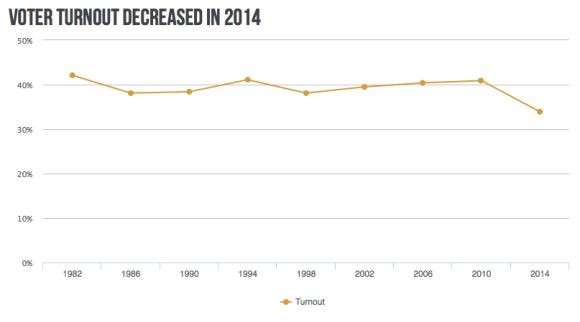
State by State Voter Turnout for Election 2014

From Al Jazeera:

Here are the national numbers.

Screen Shot 2014-11-06 at 6.40.51 PM

They report that that percentage of eligible voters in Texas that actually voted was 27%. Turnout decreased from 2010 in all but 10 states. Turnout decreased in all states that passed strict voter ID laws since 2010

Click here for a data sheet with the numbers from 1980 - 2014.


Tuesday, October 28, 2014

For 2306 today:

California voters will be able to decide if certain felonies can be reclassified as misdemeanors.
- The purpose is to reduce prison over crowding.
- Here's background from the New Yorker.

Derek Cohen and Deborah Fowler: Texas Legislature should decriminalize truancy.
- There may be better ways to handle truancy than pushing kids into the criminal justice system.
- The Texas Committee on Jurisprudence is holding hearings on whether civil penalties are more appropriate.

UT/TT Poll: Texans Favor Voter ID by 3-to-1 Margin.
- But the results are divided over partisan lines.

UTSA professor champions new approaches to criminal justice.
- He'd like a shift away from arrest and punish to "community justice and restorative justice."

A Plan to Cut Costs and Crime: End Hurdle to Job After Prison.
- Does Texas make it too tough for ex-felons to find jobs? Does this make it more likely that they will return to prison?

Editorial: The benefits of fighting abuse with education vs. jail time.
- Batterer prevention programs seem to work better than jail sentences.

Tuesday, October 21, 2014

For today's discussion in 2306 - 10/21/14

All of these are from the Texas Tribune;

Texas on Lonely Side of Battle Over Ozone Science.
- Who controls the Texas Commission on Environmental Quality?

Yale Survey: Most Texans Believe in Global Warming.
- But only 44% think it is due to human activity.

Analysis: Behind Voter ID, Federal Pre-Clearance.
- Do racial minorities in Texas still need federal protection from the Anglo majority?

Supreme Court to Decide What a Billboard is Worth.
- The court's decision could impact the cost of future highway projects.

Tuesday, October 22, 2013

Early voting begins in Texas

It actually began yesterday, October 21.

Click here for important 2013 election dates in Texas - this is from votetexas.gov.
Click here for similar information from the Secretary of State's office.

Texas Tribune reports that this election will provide an early indication of the impact of voter ID laws in the state.

Early voting is one of a handful of processes that make it easier for people to vote - Tuesday's can be difficult for working people. The NCSL provides a look at the range of methods used by different states. In addition to early voting, there's absentee voting - either with or without an excuse - and all mail voting.

Click here for detail and the map - suffice to say that the political culture in some states - in addition to the political interests in different states - lead to drives to enhance or restrict access to the polls. Texas historically has tended to restrict access, which leads to the suspicion by some that the intent of voter ID laws is to impact the tendency of certain groups to turn out.

Wednesday, September 4, 2013

Texas Voter ID requirements explained

More or less anyway.

From the Texas Secretary of State's office:

A voter who has not been issued a driver’s license or social security number may register to vote, but such voter must submit proof of identification when presenting himself/herself for voting or with his/her mail-in ballots, if voting by mail.  These voters’ names are flagged on the official voter registration list with the annotation of “ID.”  The “ID” notation instructs the poll worker to request a proper form of identification from these voters when they present themselves for voting, unless they are a voter with a permanent exemption on the voter registration certificate. The voter must present one of the seven (7) acceptable forms of identification:
  • Texas driver license issued by the Texas Department of Public Safety (DPS)
  • Texas Election Identification Certificate issued by DPS
  • Texas personal identification card issued by DPS
  • Texas concealed handgun license issued by DPS
  • United States military identification card containing the person’s photograph
  • United States citizenship certificate containing the person’s photograph
  • United States passport

From the Texas Tribune: Voter ID Tried in Local Elections, Not Yet in a Big One

While the new voter ID law in Texas has been used in smaller elections, its yet to be used in a big one. This means that despite the claims made for an against it, we really don't know what impact it will have.

Julian Aguilar goes on:

That’s the assessment of at least one opposition leader, Chad Dunn, an attorney with Houston-based Brazil and Dunn who represents plaintiffs in a current lawsuit seeking to block the law. It requires voters to furnish one of several specified forms of ID before casting a ballot, the most common being a state-issued driver’s license or ID card.
It’s hard to determine the effect before next year's state elections, Dunn added, because turnout for local elections is paltry. Elections have been held in Galveston and are ongoing in the Rio Grande Valley, but the true test will be a statewide or heavily contested election in a toss-up or majority-minority district.

. . .Also at play is how election officials handle complaints or missteps, Dunn said. In Bexar County, he said, officials are likely to resolve issues quickly regardless of political allegiance, race or any other factor. In others, not so much.

“In counties like Harris, which is completely on the voter suppression bandwagon, whatever problems there are, aren’t getting worked out,” he said.

This might impact the ongoing efforts of the federal Justice Department to sue Texas over the law because there may not be a substantive issue yet to sue about - the case may not be ripe. Its been a long haul so far and there is little reason to think it wont continue to be.

Wednesday, June 26, 2013

From the Texas Tribune: DPS to Offer Free Voter ID Cards

From the story:

Following the U.S. Supreme Court’s decision on Tuesday that paves the way for implementation of Texas’ voter ID law, the Texas Department of Public Safety announced it will begin processing applications for free voter ID cards this week.

On Wednesday, the department will begin issuing so-called election identification certificates for qualified voters. Offering the certificates is required by Senate Bill 14, a measure that passed in 2011 but was on hold until Tuesday's decision. 

The IDs are free and will be available to voters who do not yet have a viable form of ID, such as a driver’s license, a concealed handgun license, a passport or military ID. Applicants must go to a DPS driver’s license office to apply and show proof of citizenship. The IDs can only be used to vote, and are not acceptable forms of personal identification for other purposes.

To qualify, applicants must be U.S. citizens and Texas residents and be eligible to vote in Texas. They must prove it by showing a valid voter registration card or submitting a voter registration application when applying for the card. Most documents will be valid for six years, though they do not expire for citizens 70 or older.

An accepted list of documents that prove citizenship can be found here, and proof of identity documents can be found here.

Thursday, May 16, 2013

State voter laws

Here's an overview of four types of voter laws being considered in state legislatures and the partisan battles over each. Support depends on whether one's interests are helped by expanding or suppressing voter turnout.

1 - voter ID
2 - same day registration
3 - early voting
4 - online registration

Friday, January 4, 2013

Digging into the Red State / Blue State Divide

It turns out that if you dig into the data - and break down voters by various categories - the standard red / blue distinction between states gets complicated. If broken down by income for example, things look like this (the blank states were not polled for this study):


And this is what things look like broken down by age. This one ought to concern Republicans. I only see two moderately red states in the 18-29 map.

Tuesday, October 2, 2012

From the NYT: Pennsylvania Judge Puts Voter ID Law on Hold for Election

This seems similar to the decision affecting Texas' elections:

A Pennsylvania judge on Tuesday delayed full implementation of a highly contested state law requiring strict photographic identification to vote in next month’s election, saying that the authorities had not done enough to ensure that potential voters had access to the new documents.

The judge, Robert Simpson, who upheld the law in August when it was challenged by liberal and civil rights groups, was instructed by the state’s Supreme Court two weeks ago to hold further hearings. He was told to focus on the question of whether enough had been done to ensure “liberal access” to the picture ID cards or alternatives.
Judge Simpson said in his Tuesday ruling that for the presidential election of Nov. 6, voters in Pennsylvania could be asked to produce the newly required photo IDs, but if they did not have them could still go ahead and vote. The decision could still be appealed to the state Supreme Court.

Monday, September 3, 2012

From the DMN: Texas lost its own case on voter ID

In an editorial the Dallas Morning news states what it considerd the fatal flaw in Texas' arguments:

In the end, however, this critical case was decided on factual evidence that was unchallenged by both sides. That is very important because the debate over voter ID laws is fiercely partisan and easily derailed by allegations of widespread fraud at the polls, a phantom argument that nevertheless sways public opinion.

Texas had to prove that minorities in the state could obtain the required photo identification without major cost or inconvenience. Had it done so, the state would have met the standard under Section 5 of the federal law, which applies to Texas because of its history of voter discrimination. The state’s argument was doomed because the law it passed — the strictest in the nation — provided all the uncontested evidence needed to show that minorities would be adversely affected.

. . . . Texas . . . greatly limits the choices for those who do not have the required identification. The judges noted that legislators tabled or defeated amendments that would have greatly improved access and reduced costs — in effect bringing the law closer to Georgia’s version. Most damaging, however, was the decision in Texas to have the voter ID card issued only by the Department of Public Safety, which does not have offices in 81 counties.

All of this imposed a “substantial burden” on the right to vote, the judges ruled. That is a resounding condemnation of the GOP-controlled Legislature, which now bears the burden of righting this wrong.

Texas made obtaining a photo ID far more difficult than in other states. The court ruled that this created a substantial burden that other states with photo ID laws dis not impose.

The legislature overreached.

The Austin American Statesman agrees.

Thursday, August 30, 2012

From the WP: Texas voter ID law struck down

This is huge:

A federal court on Thursday blocked a controversial new voter ID law in Texas, ruling that the state failed to show that the law would not harm the voting rights of minorities.


The three-judge panel in the historic case said that evidence also showed that costs of obtaining a voter ID would fall most heavily on poor African Americans and Hispanics in Texas.


Evidence submitted by Texas to prove that its law did not discriminate was “unpersuasive, invalid, or both,” wrote David. S. Tatel, a judge on the U.S. Court of Appeals for the District of Columbia, in the panel’s 56-page opinion.

The ruling will likely have political implications in the coming elections. Republicans and Democrats have been arguing over whether increasingly tough voter ID laws discriminate against African Americans and Hispanics.

Monday, July 30, 2012

9 - Written Assignment GOVT 2305 #9

Voter ID Laws - those that have photo requirements - are based on the premise that there's lots of voter fraud out there, so much so that the possibility that some eligible voters may be denied the ability to vote is out weighed by the need to ensure that those who are not eligible do not vote.

But is the premise true?

I want you to research this and try to get a handle on whether there is in fact a lot of verified voter fraud in Texas and the US in general. If so, what type of fraud is there? Are photo ID requirements the best way to combat that fraud? What other options are there? Be sure to cite your sources. How do we know that there is in fact rampant voter fraud in the country?

Tuesday, July 17, 2012

7 - Written Assignment GOVT 2306 #7 and Summer 2 GOVT 2301 Assignment #2

Last week, attorneys from the state of Texas had to defend the voter ID law passed by the Texas Legislature last year during the 82nd Session before a federal court. Opponents to the law have argued that the law violates the 1965 Voting Rights Act by establishing a procedure that will affect eligible minorities more than Anglos. If the court agrees then the case will be appealled to the Supreme Court, but probably not before the election, so there's a good chance that the law will not be applied this election cycle regardless.

As a way to understand this conflict, I want you to look through avalaible news and outline the process (how the case got to this point?) and the debate (what arguments is each side making about the impact of voter ID laws?)

What can you tell me about the court that is hearing the case?

Here are a few links to get you going:
- Chron: Trial set to begin today in Texas’ battle with feds over state Voter ID law.
- Fox: Texas' attorney faces tough questions from judges on final day of voter ID case.
- NextGen: The Politics of Voter ID Laws.

- Lone Star Project (look for transcripts of the argument at the bottom of the page)

Feel free to add what you wish.