For nuts and bolts stuff, not the fluff.
FYI: The information below is about the conduction of the elections. This is not to be confused with the campaigns run by each of the candidates.
That's a different thing.
We will cover that separately.
Here is the relevant law:
- U.S. Election Code.
- Texas Election Code.
Here are the agencies that enforce that law statewide and locally:
From the Texas Secretary of State:
- Welcome to Texas Elections.
From the Brazoria County Clerk:
- Elections and Voter Registration.
Showing posts with label elections. Show all posts
Showing posts with label elections. Show all posts
Monday, September 2, 2024
Information about the 2024 Election


Sunday, August 18, 2024
Can the 2024 Presidential Election be stolen?
Critics of Donald Trump argue that this is a possibility.
How might they do this?
The thinking is that elections results will be challenged, and the results will not be certified by local officials.
Here are thoughts on that possibility:
- From The Guardian: ‘A different level than 2020’: Trump’s plan to steal election is taking shape.
- WBRU: How the 2024 U.S. presidential election could be stolen.
- New York Times: Here Is One Way to Steal the Presidential Election.
- Brennan Center for Justice: How States Can Prevent Election Subversion in 2024 and Beyond.
Rolling Stone: Biden Is Building a ‘Superstructure’ to Stop Trump From Stealing the Election.
Tuesday, June 4, 2024
Sunday, February 18, 2024
Regarding the upcoming primary elections in Brazoria County.
- Texas Secretary of State: Offices up for Election in 2024.
- Texas Secretary of State: Election Dates 2024.
- Brazoria County Elections Division.
- Brazoria County: Voter Registration.
- Brazoria County: Voter Precincts.
- Brazoria County: Candidate Information.
- Brazoria County Democratic Party Candidates.
- Democratic Sample Ballots.
- Brazoria County Republican Party Candidates.
- Republican Sample Ballots.
Wednesday, October 25, 2023
From the Houston Chronicle: Harris County election judges say they're ready for November, despite host of challenges
Early election is underway, Election day is November 7.
- Click here for the article.
Many veteran election judges said they're returning for duty despite recent changes and challenges to election administration. This comes as welcome news, given that Harris County will need 1,400 election judges to run its estimated 700 polling locations in the upcoming November election.
Another law went into effect that creates a provision for the state to remove those elected officials if a “recurring pattern of problems” is not rectified.
But the county's elections have been under increased scrutiny for years, dramatically escalating this year with state legislation eliminating its elections office, pending litigation challenging the results of last year's November election and an ongoing investigation by the Texas Rangers and the Harris County District Attorney's Office into a ballot paper shortage last year that had workers scrambling at a small percentage of the county's polling sites.
In addition to those developments, election judges have had to contend with several leadership changes — Hudspeth is the sixth person in six years to run Harris County elections — and new voting equipment, which debuted in 2021 but still presents some difficulties with processing a lengthy two-page ballot.
Despite the title, an election judge isn't a judicial position. Ordinary citizens — such as retirees, teachers and lawyers — are trained to run Harris County's polling locations while voting is underway. During a general election, like the one coming up in November, each polling place needs one judge from each party, in addition to a small staff of paid election workers supporting them.
For More:
- Harris County’s voter roll errors — if left unexplained — could fuel claims of voter fraud.
Wednesday, September 27, 2023
Tuesday, February 4, 2020
From Vox: Technical difficulties in Iowa caucuses lead to widespread confusion, delayed results
For 2305 and 2306, a story related to parties and elections.
- Click here for the article.
The Iowa caucuses melted down on Monday night after technical difficulties caused significant delays in reporting the results, which have not, as of Tuesday morning, been declared.
A smartphone app, which was reportedly made by a firm called Shadow, appears to be at the center of the confusion. The app was designed to help precinct chairs send the results to the Iowa Democratic Party headquarters, but reports that volunteers were unable to download or properly use the app suggest that this new way of doing things did not go smoothly. A number of volunteers resorted to calling the state party to report results, and many reported being left on hold indefinitely due to busy phone lines.
Tuesday, January 21, 2020
From the Texas Tribune: A ballot box found weeks after Election Day has flipped a $569 million school bond vote in Midland
Wow
For our look at how elections are actually run.
- Click here for the article.
County officials found the missing box in early December. Taking into account those 836 votes, plus one stray ticket found separately from the box that had also been misplaced, the results flipped again. The new version of final results, which Land said should finally lay the issue to rest, was 11,800 votes in favor of the bond and 11,826 against. The result means that Midland ISD will not receive the authority to build two new high schools.
For those scoring at home, the bond passed, then failed, then passed and then failed again. Political groups on both sides of the bond vote will now ask the Midland County judge to cement the most recent results so all sides can “go forward,” Land said.
"Though this is not the result that supporters of the 2019 school bond worked for, it was what we expected and were prepared for," We Choose Our Future, the group in favor of the bond, wrote in a statement on Facebook. "Today’s exercise was an opportunity to build trust in the process for future elections and bring closure to this election so that the work on another bond plan can begin."
Monday, May 13, 2019
From the Houston Chronicle: Three articles on the state pof political parties in the state
- GOP fights to keep Texas red amid rifts.
Analysts say the Texas Republican Party is at a critical juncture heading into the 2020 presidential election, with the possibility that an increasingly diverse population will make Texas a swing state. So far the risk is remote, but the number of people of color in Texas is rising. According to the Texas Demographic Center, people of color accounted for 58 percent of the state's population, up from 47 percent in 2000.
November's dismal election results for Republicans were a wake-up call, party officials say. Cruz barely pulled off a victory over O'Rourke, and the party lost two state Senate seats and 12 state House seats to the Democrats.
"I'm warning people: If we don't do the hard work that we must, we will not, nor would we, deserve to retain control of Texas," said James Dickey, chairman of the Republican Party of Texas. "We have to continue to earn the votes of rural Texas and increase the numbers in the major metro areas that are growing the fastest."
As Texas Republicans attempt to widen their reach, they're grappling with the party's standard-bearer, Trump, whose anti-immigrant, anti-Muslim rhetoric has emboldened some of the more extreme members of the party.
- Democrats flex in Texas Legislature, with an eye on 2020.
After picking up 14 seats in the midterm elections, Democrats are using their increased numbers this session to derail key Republican priorities in a state where the left has long been out of power.
In flexing their political muscle, Democrats have blocked Gov. Greg Abbott’s embattled secretary of state nominee and helped stop a sales tax hike that GOP leaders had championed in order to cut property taxes.
"This session more than other sessions, the Democratic caucus has stuck together more. We’ve communicated a lot better,” said Senate Democratic Leader José Rodríguez of El Paso. "I think the midterm elections may have had something to do with the caucus being much more united."
- Texas House passes bill to allow more third-party candidates.
With the memory of a heated 2018 election cycle still fresh, Texas House Republicans and Democrats were divided this week over how to treat third-party candidates who have the potential to siphon votes from the major parties.
Tuesday, May 7, 2019
From Ballotpedia: National Popular Vote Interstate Compact
- Click here for the article.
The National Popular Vote Interstate Compact (NPVIC) is an interstate compact to award member state's presidential electors to the winner of the national popular vote. The NPVIC would go into effect if states representing at least 270 electoral college votes adopt the legislation.[1][2]
Article II, Section 1 of the U.S. Constitution gives states the authority to determine how their electoral votes will be awarded: "Each State shall appoint, in such Manner as the Legislature thereof may direct, a Number of Electors…." This compact does not abolish the electoral college system; rather, the compacts awards all of the electoral votes from the member states to the candidate who receives the most votes nationwide.[1]
Sunday, February 19, 2017
From the Monkey Cage: Trump wants voter registration investigated. This is how 20 states are already doing it.
Here's a topic that bridges 2305 and 2306.
- Click here for the article.
- Click here for the article.
In a Wednesday morning tweet, President Trump returned to his campaign refrain of widespread electoral problems and called for “an investigation into voter fraud, including those registered to vote in two states.”
Within hours, it was revealed that at least five people close to Trump — daughter Tiffany, son-in-law Jared Kushner, adviser Stephen K. Bannon, treasury nominee Steven Mnuchin and press secretary Sean Spicer — are registered to vote in more than one state.
They are not alone. A 2012 Pew Charitable Trusts report estimated that 2.75 million Americans were on the voter rolls in more than one state and that 1.8 million dead people remained on the rolls.
Like Trump’s family members and associates, these are people who registered to vote legally, but when they moved or passed away, their names were not deleted from voter lists.
It’s not illegal to be registered to vote in more than one state, but it is illegal to vote more than once. By holding more than one registration, a voter could conceivably drive across state lines to cast ballots in different places. Or a voter could request an absentee ballot in one state and vote in person in another state. Such scenarios, even if only a few instances have actually occurred, concern many Americans.
Whose responsibility is it to ensure that voter lists are accurate?
Is it the job of the voters? When they move and register in a new state, should they remember to contact the clerk’s office in their former state to cancel their registration? Should relatives or friends of a person who just passed away be charged with notifying the county clerk?
Some diligent Americans do this. But most expect that the state will find out about a move or a death through government records. This is where the system breaks down.
Thursday, November 3, 2016
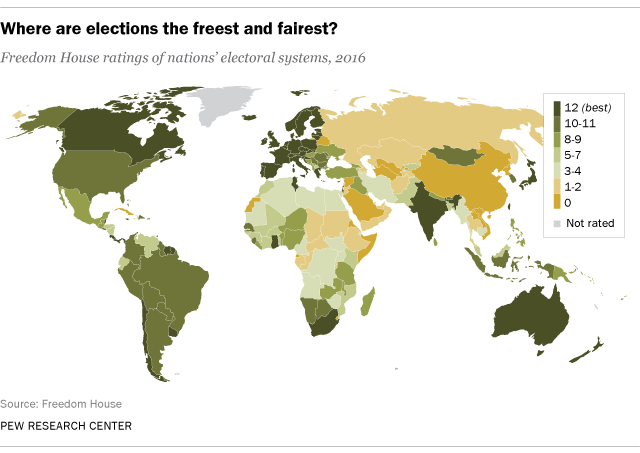
From the Pew Research Center: U.S. electoral system ranks high – but not highest – in global comparisons
As the long presidential campaign winds down, GOP nominee Donald Trump’s claims that the process is “rigged” against him – and suggestions that he might not accept the result as legitimate if he loses – seem to have struck a chord with his supporters. In a recent Pew Research Center survey, 56% of Trump voters said they have little or no confidence that the election will be “open and fair,” compared with 11% of Hillary Clinton backers. Among those who say they strongly back Trump, nearly two-thirds (63%) say they have little or no confidence that the election will be fair.
Given that level of skepticism, it’s worth noting that the U.S. generally ranks highly on the overall freedom and fairness of its elections when compared with other countries, though not without some caveats.
Freedom House, a nongovernmental organization (though it receives funding from the U.S. government), has ranked nations on political and civil rights for more than 40 years. In its most recent report, Freedom House gave the U.S. electoral process 11 out of 12 possible points on its “electoral process” scale – the same rating the nation has had since 2007 (when its score was raised from a 10).
The electoral process scale is one of seven that go into Freedom House’s overall ratings of countries as free, partly free or not free. It covers three major areas: whether the head of government or other chief national authority is chosen through free and fair elections; whether national legislators are chosen through free and fair elections; and whether a country’s electoral laws and framework are fair. Among the things that go into making elections “free and fair”: “Is the vote count transparent, and is it reported honestly with the official results made public?”
Of the 195 sovereign countries Freedom House ranked this year (using 2015 data), 61 scored 12 out of 12 on the group’s electoral process scale – among them Australia, Canada, Japan and the UK. Besides the U.S., 16 other countries received 11 points out of 12. Freedom House didn’t detail where the U.S. fell short, but commented in its report that “… its elections and legislative process have suffered from an increasingly intricate system of gerrymandering and undue interference by wealthy individuals and special interests.”
From ProPublica: America’s Most Important Workers on Election Day Aren’t Paid Like it
I can relate - you get paid about $11 an hour to run an election. Less if you aren't the election judge. But at ;east the hours are long!
Do we really want well run elections? we're not willing to pay for them.
- Click here for the article.
Do we really want well run elections? we're not willing to pay for them.
- Click here for the article.
Elections cost millions of dollars to organize and run, but some of the most crucial work is performed by low-wage workers, specifically poll workers.
American elections are run locally, which means government officials need to recruit and pay people to work at voting locations. But the requirements for the jobs, which include being available and able to work for 12 hours or more on Election Day, can make it difficult to find people willing to sign up.
“It is a predicament that plagues almost every jurisdiction in the country and it grows worse every year,” begins a 2014 report by the federal Election Assistance Commission.
The commission found that more than half of all states had jurisdictions that reported it was either “somewhat” or “very” difficult to recruit poll workers for the 2012 election. Every one of Louisiana’s parishes rated it somewhat difficult that year, while more than half of Indiana’s election-day voters live in counties where it was at least somewhat difficult to find poll workers. In 2014, all 120 counties in Kentucky reported that recruiting poll workers was very difficult.
Here’s why it matters: Without enough poll workers, voters can experience longer lines, polling places can open late, and there may not be workers available to tackle issues that voters might encounter.
Long waiting times are one of the most visible and significant issues that can occur on Election Day. And although they can have a number of causes, a lack of poll workers is an important factor, according to a study by the Brennan Center for Justice.
There are a few reasons why recruiting poll workers has gotten harder. The increased participation of women in the workforce and new technology that older Americans can find daunting have played a role. Under the Voting Rights Act, some polling places need to have poll workers with specific language skills. Then there’s the pay.
Monday, October 31, 2016
From Politifact: Clinton campaign says Comey letter violates Justice Department protocols
I'll hunt around for more on the FBI's protocol involving elections.
- Click here for the article.
- Click here for the article.
. . . the Justice Department — which oversees the FBI — not only explicitly prohibits employees from interfering with elections but urges employees avoid the appearance of interfering with elections.
In August 2008, President George W. Bush’s attorney general, Michael Mukasey, sent an internal memo entitled "election year sensitivities" to employees on the department’s policies on political activities. Part of it reads:
"Simply put, politics must play no role in the decisions of federal investigators or prosecutors regarding any investigations or criminal charges. Law enforcement officers and prosecutors may never select the timing of investigative steps or criminal charges for the purpose of affecting any election, or for the purpose of giving an advantage or disadvantage to any candidate or political party. Such a purpose is inconsistent with the Department's mission and with the Principles of Federal Prosecution."
Attorney General Eric Holder resent the memo in March 2012.
While the memos don’t discuss limitation of timing specifically, former U.S. attorneys have alluded to an unwritten guideline about not filing cases or commenting on investigations in the 60 days before an election.
Citing the policy, several former prosecutors and department employees have aired concerns and criticisms.
Two former deputy attorney generals under the Clinton and Bush administrations called Comey’s actions a departure from the department’s traditions and "real-time, raw-take transparency taken to its illogical limit."
Conservative Fox News host Jeanine Pirro, a former prosecutor and New York county court judge, said Comey’s letter "disgraces and politicizes" the bureau.
"You know I support Donald Trump and want him to win, but whether it's Hillary Clinton or anyone else, Comey's actions violate not only longstanding Justice Department policy … but the most fundamental rules of fairness and impartiality," Pirro said.
Daniel Richman, a former prosecutor and current Columbia Law School professor, noted that while the Justice Department’s election sensitivities policy does stand, Comey also had different obligations to consider.
Department policies "are subject to judgments by the highest officials in extraordinary circumstances," Richman said. "Less flexible is the FBI’s directors duty of absolute candor to Congress, requiring the correction of statements when new facts arise."
Sunday, October 30, 2016
From CNN: What is the Hatch Act -- and did James Comey break it?
Congress passed the Hatch Act in response to concerns that federal employees had been used to support candidates during the 1938 congressional elections. Its general intent is to greatly restrict the ability of most federal employees to engage in political campaign activities (such as soliciting campaign donations or actively working on behalf of individual candidates), especially while on the job -- or to otherwise "use [their] official authority or influence for the purpose of interfering with or affecting the result of an election."
And as its text suggests, the law does not require that the employee's wrongful conduct actually interfere with or affect the result of an election.
Of course, laws that restrict speech will often implicate the First Amendment. But the Supreme Court has twice rejected First Amendment challenges to the Hatch Act, and it has, more recently, taken a narrower view of the First Amendment rights of government employees -- especially when speaking in their official capacity.And although the law is 77 years old, it has been repeatedly amended by Congress, most recently in 2012 to, among other things, clarify the available penalties for violations of the Act and allow a broader class of employees to run for political office without resigning.
For more:
- Wikipedia: Hatch Act.
Tuesday, October 25, 2016
From the Brazoria County Elections Department: Election Results 2012 to present
For perusal in 2305 and 2306 today.
There's an argument that voter turnout is low in the Unites States - and especially Texas - because we have so many elections, and so many elected offices.
Here's evidence.
- Click here for the page.
There's an argument that voter turnout is low in the Unites States - and especially Texas - because we have so many elections, and so many elected offices.
Here's evidence.
- Click here for the page.
Thursday, October 13, 2016
What's on the Harris County Ballot?
Lot's more than on the Brazoria County ballot - as well as most of the country. Often it's the longest ballot presented to voters anywhere in the US, which means Harris County citizens have lot;s of homework to do it they are going to cast informed votes.
. . . if. ;)
- Click here for it.
We'll walk through it now and then.
. . . if. ;)
- Click here for it.
We'll walk through it now and then.
Wednesday, October 12, 2016
From ProPublica: Voting Has Started, and Electionland Is on the Case Much of the country will vote before Election Day. Starting this week, our Electionland project has begun looking for problems that prevent people from voting.
A look at how elections are being run across the country - early voting has started - with special emphasis on the problems that can arise.
- Click here for the article.
Here's a list of the problems they cite:
- Click here for the article.
Here's a list of the problems they cite:
- Long lines
- Polling place location and staffing problems
- Changed voting locations
- Provisional/Affidavit ballot use
- Enforcement of Voter-ID laws
- Deceptive mailers/ads
- Ballot design problems
- Hacking
- Voter impersonation
Monday, October 10, 2016
From 538: The Ross Perot Myth
The conventional wisdom is that Ross Perot pulled enough votes From HW Bush in 1992 to tip the election to Bill Clinton.
Here's a counter argument.
- Click here for the video.
Here's a counter argument.
- Click here for the video.
Subscribe to:
Posts (Atom)