- Texas Secretary of State: Offices up for Election in 2024.
- Texas Secretary of State: Election Dates 2024.
- Brazoria County Elections Division.
- Brazoria County: Voter Registration.
- Brazoria County: Voter Precincts.
- Brazoria County: Candidate Information.
- Brazoria County Democratic Party Candidates.
- Democratic Sample Ballots.
- Brazoria County Republican Party Candidates.
- Republican Sample Ballots.
Showing posts with label primary elections. Show all posts
Showing posts with label primary elections. Show all posts
Sunday, February 18, 2024
Regarding the upcoming primary elections in Brazoria County.


Tuesday, February 4, 2020
From Vox: Technical difficulties in Iowa caucuses lead to widespread confusion, delayed results
For 2305 and 2306, a story related to parties and elections.
- Click here for the article.
The Iowa caucuses melted down on Monday night after technical difficulties caused significant delays in reporting the results, which have not, as of Tuesday morning, been declared.
A smartphone app, which was reportedly made by a firm called Shadow, appears to be at the center of the confusion. The app was designed to help precinct chairs send the results to the Iowa Democratic Party headquarters, but reports that volunteers were unable to download or properly use the app suggest that this new way of doing things did not go smoothly. A number of volunteers resorted to calling the state party to report results, and many reported being left on hold indefinitely due to busy phone lines.
Thursday, October 13, 2016
From Vice: How Republicans Could Prevent the Rise of Future Trumps
Trump's rise was made possible by internal rules the Republican Party established to select a nominee. Normally these rules allow for an establishment candidate - normally the person considered next in line - to become the party's nominee. Democrats did that this year.
The author suggest those rules might be tweaked this year to prevent a similar candidate in the future.
- Click here for the article.
The article goes on to caution about over correcting. The rules changes following Romney's defeat in 2012 created Trump's opportunity.
- Click here for more on that.
The author suggest those rules might be tweaked this year to prevent a similar candidate in the future.
- Click here for the article.
"People look at Trump and say, 'Oh, that's who you are! That's who the Republican Party is!'" Mickey Edwards, a former Oklahoma congressman who is a prominent NeverTrump Republican, lamented to me.
In Edwards's estimation, a few problems converged to create the Trump phenomenon: a crowded primary field in which "everybody in our party knew that Hillary [Clinton] was extremely beatable, and that's why they ran"; the involvement of too many independent voters, "some of whom have never voted"; and a primary season that gave too much credence to the views of the fringe in vital early-voting states. "You can't just dismiss the idea of momentum," he explained.
Trump took advantage of all this by winning the early states of New Hampshire, South Carolina, and Nevada (he placed second to Ted Cruz in Iowa), taking the majority of delegates despite never getting a majority of votes in those states. And throughout primary season Trump won primaries open to voters who weren't registered Republicans, suggesting that he was less popular among people who were really committed to the GOP.
"We've created a very bad system that allows—I don't know whether you would say it's too democratic—but it basically dilutes the power of the people who really are the party," Edwards said. A functioning candidate-selection process, he feels, would be "a matter of making sure that you nominate someone qualified for the job, even if their policies are controversial." So in short, he wants a process that would keep another Trump from being the nominee.
"Another Trump" could be any charismatic populist Republican the party elites don't actually want in power, not necessarily someone with Donald Trump's particular, um,attributes or campaigning style. The term "Trump" as we're using it here could include another run from Trump himself, or a candidate like Sarah Palin, or David Duke, or Michelle Bachman, or the drill sergeant from Full Metal Jacket.
Earlier this year, Republican leaders unhappy with Trump were looking to change the primary rules to close them to independents in the future (on the theory that those people would be the most likely to back another Trump), but that effort still failed at the Republican National Convention. Edwards feels that significant changes were shot down in an attempt to suppress any sense that the party was questioning Trump.
Edwards blames party leadership for this, Reince Priebus in particular. "He and [Paul] Ryan, with the weight of their titles and positions, were strengthening the narrative that Trump was putting out there, that we would steal it from him."
The article goes on to caution about over correcting. The rules changes following Romney's defeat in 2012 created Trump's opportunity.
- Click here for more on that.
Sunday, July 17, 2016
From Politico: 'Never (Again) Trump' sets sights on 2020 - Grass-roots conservatives and party leadership are finding a common cause: Limiting Republican primaries to registered Republican voters.
This seems to call for a change to Texas' open primary rules.
- Click here for the article.
The Empire Strikes Back!
- Click here for the article.
Conservatives, still reeling over the looming nomination of Donald Trump, are pushing new Republican primary rules that might have prevented the mogul’s victory in the first place: shutting out independents and Democrats from helping to pick the GOP nominee.
Trump romped in “open primaries” where non-Republicans voted by the thousands and may have influenced the outcome — especially in early states that set the tone of the entire race. Trump’s most successful rival, Ted Cruz, thrived in states with closed primaries where only Republicans were permitted to participate.
Now, Cruz’s allies — hundreds of supportive convention delegates that he helped elect — hope to use the national convention in Cleveland to shove states toward closing their open primaries. And if they’re successful, it will not only go a long way toward warding off a Trump-like candidacy, it will tilt the primary toward conservative candidates in 2020 and beyond.
The advocates are finding a sympathetic ear at the very top of the party. Republican National Committee Chairman Reince Priebus has long supported closed primaries, but has never had a constituency to back him on it. "I believe that only Republicans should vote in Republican primaries," he said Friday at a Politico Playbook breakfast event, though he added that he respects the right of states to set their own primary rules.
The Empire Strikes Back!
Monday, July 4, 2016
From Vox: The single most important fact about American politics
I can't recommend this highly enough. It'll be a part of my look at political participation and political parties for some time. It tries to get to the root of party polarization in the US. These are observations based on a recent study by the Pew Research Center - click here for the study.
- Click here for the article.
Here is one of the factors the author sees as especially problematic. It's not just that the parties are divided ideologically, they hate and fear each other:
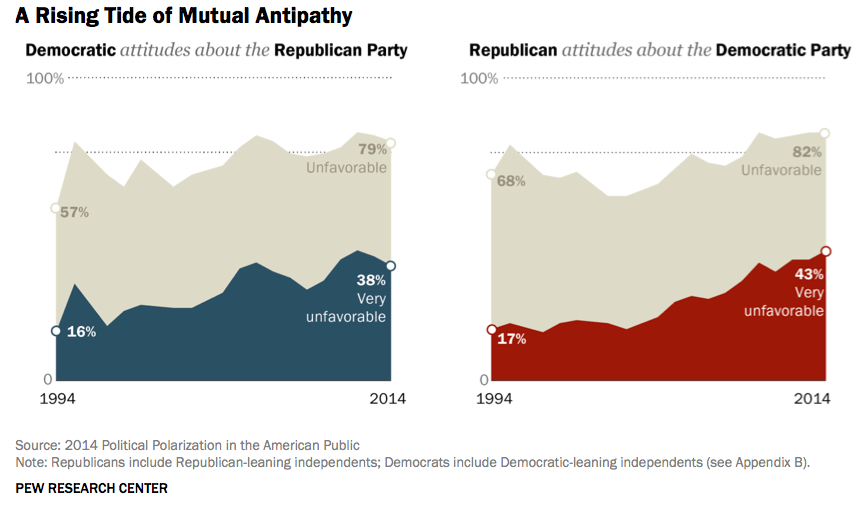
- Click here for the article.
Perhaps the single most important fact about American politics is this: the people who participate are more ideological and more partisan, as well as angrier and more fearful, than those who don't.
Here is one of the factors the author sees as especially problematic. It's not just that the parties are divided ideologically, they hate and fear each other:
Wednesday, April 20, 2016
From Slate: The Primaries Aren’t Democratic? They’re Not Supposed to Be Democratic. The parties are doing what parties are built to do: pick the candidates who best represent them.
A useful reminder of what parties are and what they do. Not that this matters.
- Click here for the article.
- Click here for the article.
. . . Trump wants Republicans and independents, “not the party bosses,” to choose the nominee. Lewandowski complains that in some states, delegates are chosen based on “whether they run for statewide office and how much volunteering they have done,” while other applicants are slighted “because they haven't been involved the last 25 years. That’s everything that’s wrong with the party system.”
Everything that’s wrong with the party system? Dude, that is the party system. A party is an organization. It has every right to award clout based on how much work you’ve put in over the years. Why should drive-by independents get more say than party bosses? I should know: I was one of those independents. In 2000, the Maryland Republican Party allowed people like me to vote in its presidential primary. I voted for John McCain over George W. Bush. McCain was a better fit for people like me. But was he a better fit for the party? And isn’t that the point of a Republican primary—to choose a candidate who will represent the GOP?
Wednesday, March 30, 2016
From the Pew Research Center: Contested presidential conventions, and why parties try to avoid them
Even before primaries and caucuses came to dominate presidential campaigns in the 1970s, parties generally didn’t welcome contested conventions, especially when they went past the first ballot. And for good reason: Candidates who needed multiple ballots to be nominated seldom went on to win the White House.
We looked at all 60 Democratic and Republican nominating conventions from 1868 (the first post-Civil War election) to 1984, the last time a convention presented even a glimmer of uncertainty. Over that time, 18 candidates (eight Republicans and 10 Democrats) were nominated on multiple ballots; of those, only seven were elected president (and four of them were running against another multiple-ballot nominee, so one of them had to win).
All told, of the 22 presidential elections held between 1868 and 1952 – the last multiple-ballot nomination to date, of Adlai Stevenson as the Democratic standard-bearer – 14 featured at least one major-party nominee who’d won on multiple ballots. (These often were referred to as “brokered conventions,” a term we’re avoiding here because of its connotations of shady backroom deals.)
Tuesday, March 1, 2016
From Vox: Primary voters don't really look like America
A point we've been making repeatedly in class.
- Click here for the article - and video!
- Click here for the article - and video!
We live in a country with a two-party system. We only get two real choices (usually) when it's time to pick a president. This means the people who decide each party's nominee play a hugely important role.
So who are these people?
For starters, it's a small group. Just 20 percent of American adults vote in presidential primaries. They tend to be older, whiter, and better-educated than your average general election voter.
Primary voters also tend to be highly partisan, which helps explain why ideas at the fringes of each party (free college for all, a giant wall along the Mexican-US border) gain traction during the primaries.
Thursday, February 25, 2016
Why vote? Maybe there's no need.
Some Texas Races Decided Before Voters Hit Polls.
We are just one week away from Super Tuesday but before a single ballot is counted in the March 1st Primary, we already know who some of the winners will be in November.
There are 16 seats up for grabs in the State Senate in the 2016 election. If you look at the list of Republican and Democratic candidates, 12 of these elections are one party races—meaning there are only Republicans or Democrats in the running.
Nine of the State Senate elections are one-person races—meaning there is only one candidate in the running.
According to their party’s websites, the Libertarian and Green Parties will challenge six of those seats in the general election but that still leaves three State Senators who are set to win the election by default.
It is still possible for other third party independent candidates to join the statewide races before the November election, but it’s difficult to win as an independent, especially when a candidate joins this late in the game.
The primaries narrow the list of candidates to determine who the Republican and Democratic nominees will be, but in many races, primary voters will only have one option within their party.
Between the State House and Senate Races, 47 percent of the Republican candidates will run unopposed in the primary election. The same goes for 45 percent of the Democratic candidates— they face no inner-party competition.
Some candidates will go completely unchallenged, with no bipartisan competition in the general election.
Of the 150 seats in the Texas House of Representatives, 48 candidates are set to run unopposed in both the primaries and that general election—that’s including competition from the Libertarian and Green parties.
In total, with the 48 seats in the State House and three senate seats, that’s more than 30 percent of state legislature who are set to get elected not by voters, but by default.
Political consultant David Butts said some argue this is not what a democracy should look like. “It’s more a ‘dollar-ocracy.’ It’s money basically controlling that system,” Butts said.
65 percent of all the elections in the state senate and house are one-party races and with only Republicans or only Democrats in the running, that means the winners will likely be determined in the primaries.
“Why spend money in a race when there is no chance of you winning?” Butts said, “Even if you spent $1 million in some of these seats, you couldn’t win.”
He said gerrymandering has become a “very refined art,” not just in Texas, but all across the U.S. “There is just no reason for running in them, they are either so Democratic or so Republican that no one can challenge them,” said Butts.
A political consultant with more than 30 years of experience in Texas politics, Butts said It’s not worth the opposing party’s time or money to enter a candidate in a race—especially when the dominate party has an incumbent in the running.
“You’re more likely to get struck my lightening then get one of those seats,” Butts said. “This is a numbers game, it’s math—you realize that the odds of you winning are very, very remote.”
The state’s voting districts were last drawn in 2011 by the Republican controlled legislature.
“Democrats do it, Republicans to do it and that leads to sort of a one party system that develops out of that,” Butts said, “The problem is that you have very few districts where you have a real contest.”
If election season is the time for voters to make their voices heard, Butts said a lack of competition gives them little say.
Monday, February 22, 2016
From Vox: The 1968 scandal that gave us the modern primary system (Part one)
Right now, presidential candidates are crisscrossing the country, begging primary voters for their support. So it's easy to forget that not too long ago, these voters had no say in who their party nominated for president.
But everything changed after the Democratic National Convention in 1968.
In the nation's early days, members of Congress picked their party's nominee. And for most of the 19th and 20th centuries, party bosses told delegates at the convention which candidate to support, and everybody else found out in the papers and on TV.
But things changed in 1968. The party was split over the Vietnam War: the incumbent Democratic president, Lyndon Johnson, supported it. Liberal voters were opposed. And when party elites nominated a pro-war candidate who hadn't won a single primary, all hell broke loose.
The riots, police violence, and lack of party unity paved the way for a Republican victory in the general election. And the Democrats decided they had to reform the way they picked their nominee.
Enter presidential primaries. Voters get a lot more say, but the new system is far from perfect.
Sunday, February 14, 2016
From the Green Papers: HOW DID WE GET HERE, ANYWAY? an historical analysis of the Presidential Nominating Process.
A manageable, but thorough look at the process.
- Click here for it.
Here's a bit of it:
- Click here for it.
Here's a bit of it:
In the original Constitutional framework, the Electoral College itself was to be the presidential nominating body- the equivalent of today's National Conventions. Each Elector was to choose two men for President without having any idea as to how his individual ballot would affect the ultimate cumulative vote of the Electors as a whole. With the proviso that no more than one of the Elector's two choices could be from the same State as the Elector himself, the assumption was that the Elector's first choice would, most likely, be some "favorite son" from the Elector's own home state while his second choice would be forced to be some other notable from perhaps the same region but, by constitutional edict, from a different state. Clearly, the Framers considered it more than likely that the second choices of various Electors would ultimately determine the five "nominees" for the office from whom the House of Representatives, voting by State not as individuals, would pick the next President (for it is doubtful any of them entertained the notion that- except in the case of George Washington- the Electoral College would ever produce a majority of the electoral vote for any of the Electors' choices for President); it is equally as clear that the Framers also believed that they had come up with a system that would keep faction/party from becoming a factor in the election of a President. They, of course, were very wrong.
From Vox: What are “superdelegates,” and what do they mean for the Democratic nomination?
Despite Sander's victory over Clinton in the New Hampshire Primary, concerns have sprung up that Clinton's delegate haul might be larger than deserved based on vote results. This is due to the "superdelegates" mentioned in the previous post. It's a principal ways that the Democratic establishment tries to control the outcome of primaries, and reduce the chaos that often accompanies the Democratic race.
Vox describes it.
- Click here for the article.
For more on the subject:
- Wikipedia: Superdelegate.
- Wikipedia: List of Democratic Party superdelegates, 2016.|
- The Green Papers: Democratic Detailed Delegate Allocation - 2016.
- Delegate Selection Materials for the 2016 Democratic National Convention.
- The Green Papers: Republican Detailed Delegate Allocation - 2016.
Vox describes it.
- Click here for the article.
As Elaine Kamarck writes in her book Primary Politics, the creation of superdelegates was a reaction to the messy 1980 Democratic convention, in which Ted Kennedy and his supporters challenged sitting President Jimmy Carter. Many Democrats felt that the democratization of the primary process had led to chaos, and resulted in many nominees that ended up losing. Therefore, they wanted to give party elites more of a say.
"We must also give our convention more flexibility to respond to changing circumstances, and, in cases where the voters' mandate is less than clear, to make a reasoned choice," Jim Hunt, who headed the commission that considered reforming the party's rules, said at the time, according to Kamarck's book. "We would then return a measure of decision-making power and discretion to the organized party."
Perhaps, as Hunt's quote suggests, the Democratic officials themselves believed this was a responsible way to ensure that the party nominated the right candidate. But it's much harder to believe that that they didn't foresee the undemocratic implications of bolstering the "decision-making power" of party leaders.
The Democratic nomination will be determined by 4,763 total delegates — 4,051 chosen by the voters and 712 who fit the "super" category.
The 712 superdelegates are made up of two major groups. One is prominent elected Democrats, including all of the party's governors, the president and vice president, and all of its members in Congress.
The second group consists of all members of the Democratic National Committee. That includes elected representatives, like mayors and county executives, as well as presidents of various Democratic organizations like the National Federation of Democratic Women and the College Democrats of America, according to the DNC's bylaws.
For more on the subject:
- Wikipedia: Superdelegate.
- Wikipedia: List of Democratic Party superdelegates, 2016.|
- The Green Papers: Democratic Detailed Delegate Allocation - 2016.
- Delegate Selection Materials for the 2016 Democratic National Convention.
- The Green Papers: Republican Detailed Delegate Allocation - 2016.
Ask Dr. Jefferies: Are super delegates an example of checks and balances?
Hi Professor Jefferies,
I'm a student in your online American Government class. Lately I've been learning more than I ever wanted to know about Superdelegates in the Democratic party and I had just one question. Would you consider Superdelegates as another, and more recent example, of checks and balances? I was watching an interview with the DNC chair and she seemed to indicate this was the case. So, I guess my question would be, is the Superdelegate there to prevent an excess of popular democracy from swinging the party too far to the left?
And I totally understand if you don't have time to answer this, I was just curious.
Cheers
____________
Dear Just Curious,
I wouldn't consider them part of the checks and balances as we discuss them in class because they are not intended to keep each governing institution in its place. A political party isn't considered to be a governing institution - with the caveat that members of Congress organize around political parties. Parties in Congress are some sort of weird hybrid.
That said, I can see merit in her comments. Super delegates (I'll define these in a later post) are used by the leadership in the Democratic Party to limit the impact of primary voters in the party. That would be a check party elites have on party activists. Since party activists in the Democratic Party tend to swing left, they would in fact be a check on that and ensure the party doesn't go so far to the left that it cannot win a general election. Republicans have ways to ensure the party does not swing too far to the right, thought they don't use super delegates. I'll ad detail about how they try to do this elsewhere - right now their efforts don't seem to be very successful.
No worries about me not having time to answer your questions - you're paying for my time so you've got it coming.
Does this help?
Thursday, February 11, 2016
From the Brookings Institute: Angry voters dominate the presidential primaries
This has been commonly remarked upon. Voters are angry. They tend to be so from time to time. The 1992 election comes to mind. Just what makes these voters angry is hard to pin down though. Might be worth a paper or two.
Here are a few thoughts on the subject.
- Click here for the article.
Here are a few thoughts on the subject.
- Click here for the article.
In 2008 fully 84 percent of the public said they were dissatisfied. And no wonder—we were in the midst of a long and questionable war on the brink of a major recession. But to really understand today’s angry voters, have a look at the response in 2014. Although there’s a bit of improvement, in the face of better economic numbers and withdrawal from Iraq, we still have fully 75 percent of the public expressing dissatisfaction with the way things are going. Unfavorable views of the Democratic Party have increased as have unfavorable views of the Republican Party. And, fifty-eight percent of the public thinks the two parties are doing such a bad job that a third party is needed.
That’s an angry electorate—one that is personified these days by Donald Trump but that emerged for the first time in the 2010 elections when the Tea Party surprised everyone, including the Republican Party establishment, with their strength. There is an inchoate feel to this anger when it comes to traditional public policy issues. Bernie Sanders’ voters are mad at Wall Street, but so are some of Trump’s voters. Everyone’s mad about the mess in the Middle East, but some would carpet bomb large swaths of territory while others would rely on Arab “coalitions,” and others would ignore them. As my colleague E.J. Dionne writes in his new book “Why the Right Went Wrong,” Americans today have become so divided that they “were now divided even in their alienation.”
But what does unite the angry voters is the profound sense that something is very, very wrong with today’s leaders. The anger at them goes a long way towards explaining how and why experience has become a dirty word in this campaign—just ask Hillary Clinton and Jeb Bush. Apparently some voters have concluded that only by breaking the mold in a big way—by electing a billionaire with no government experience or a Socialist—can America be saved.
Wednesday, February 10, 2016
Wednesday, January 20, 2016
From 538: Beware A GOP Calendar Front-Loaded With States Friendly To Trump And Cruz
We'll be looking at the primary calendar in class, and the impact that will have on who becomes the nominee for either party. Here's an analysis of the impact that the timing of the Republican primaries is likely to have on the eventual winner. The author charts possible paths to victory for the top three candidates - Trump, Cruz, and Rubio - and where each needs to be at which stage of the process in order to win the required number of delegates.
- Click here for the article.
Expect much more on primary elections as the semester progresses - both for 2305 and 2306.
- Click here for the article.
The GOP’s primary calendar is surprisingly front-loaded with states friendly to insurgents like Trump and Cruz. But because of Republican National Committee rules, all but one of these states will award their delegates on a proportional basis, intentionally making it difficult for any one candidate to build a durable or commanding lead.
Instead, Florida and Ohio, which tend to support more conventional Republicans, are likelier to shape the race’s destiny than Iowa or South Carolina. That’s because they will award a whopping 99 and 72 delegates, respectively, in huge winner-take-all primaries on March 15.
These are the findings of a new joint FiveThirtyEight and Cook Political Report project to map out each top GOP contender’s unique route to amassing the 1,237 delegates required to clinch the nomination at the national convention in Cleveland. Although there is still plenty of time for Trump or Cruz to falter or for another candidate to rival Rubio for the mantle of “establishment” front-runner, for now, this is functionally a three-man race.
The project relied on a three-step process. First, we utilized three variables — education, religious affiliation, and state and congressional district partisanship — to model Trump’s, Cruz’s and Rubio’s geographic support in primaries and caucuses from February through June.
Based on recent polling, we assume Trump will fare best in states and districts with small shares of college graduates, while Cruz’s hallmark will be strong support in places with large shares of evangelical protestants. We also assume that Rubio, like previous “establishment” favorites, will perform well in bluer and more highly educated states and districts, but will under perform in caucus states
Expect much more on primary elections as the semester progresses - both for 2305 and 2306.
Friday, January 8, 2016
From the Green Papers: 2016 Presidential Primaries, Caucuses, and Conventions Chronologically
I'll start posting a variety of items related to the upcoming elections.
For a full calendar of all the elections that will be held this year click here.
For information from Frontloading, click here.
For information from The New York Times, click here.
Here's a look - from politics1.com - of what's up this January and February:
For a full calendar of all the elections that will be held this year click here.
For information from Frontloading, click here.
For information from The New York Times, click here.
Here's a look - from politics1.com - of what's up this January and February:
JANUARY 8, 2016: Mississippi - Filing Deadline
JANUARY 26, 2016: Kentucky - Filing Deadline (Major Parties)
JANUARY 30, 2016: West Virginia - Filing Deadline (Major Parties)
FEBRUARY 1, 2016: Iowa - Presidential Caucuses
FEBRUARY 2, 2016: New Mexico - Filing Deadline (Major Parties)
FEBRUARY 3, 2016: Maryland - Filing Deadline (Major Parties)
FEBRUARY 5, 2016: Indiana - Filing Deadline (Major Parties)
FEBRUARY 9, 2016: New Hampshire - Presidential Primary
FEBRUARY 16, 2016: Pennsylvania - Filing Deadline (Major Parties)
FEBRUARY 20, 2016: South Carolina - Republican Presidential Primary
FEBRUARY 23, 2016: Nevada - Democratic Presidential Caucuses
FEBRUARY 27, 2016: South Carolina - Democratic Presidential Primary
Note the filing deadlines. This is the last day that candidates can file to be on the ballot of the party they wish to be nominated by. I'll post separately on who is on the Texas ballot. Our deadline was December 14th. So if you wanted to run, you missed the deadline.
I;ll also post separately on the Iowa Caucus and the New Hampshire Primary - these are the traditional opening events of the election season. Everything before this has been the campaigning, fundraising and organization building necessary to win those elections.
Sunday, December 6, 2015
Getting ready for the primary elections in Texas
Each party in Texas is gearing up for the March 1st primary election. Texas will be a part of a slate of states - including many southern states - that are attempting to collect their strength in order to influence the result of each race. Remember that these are party elections. A good number of internal party issues are settled in these elections. Currently the two major parties in the state are making preliminary decisions about how the primary elections will be conducted and what issues may or may not be on each party's ballot.
I won't ask nuanced question about these elections, but both 2305 and 2306 students should have a general familiarity with the concept of primary elections - and who runs them. Remember that states are given the responsibility of running elections in the United States. There really is no such thing as a national election in the US - national campaigns yes, elections no. The national government can oversee elections in order to determine if they are run in compliance with the equal protection clause, but little else.
Here are a few recent stories:
- Texas to have more prominent role in 2016 GOP presidential race.
- Texas GOP Votes Down Secession Proposal.
- Texas Democrats Approve 6 Ballot Referenda For Public Vote.
- Texas’ primary ballot begins to take shape.
For a broader look at the efforts of the presidential candidates to get on the ballots click on the following:
- The 2016 ballot wars begin: Each failure to appear on a ballot undermines a candidate’s credibility as a national figure.
Voting doesn’t begin for another two months but some presidential candidates have already failed their first big ballot test – actually getting on the ballot in all 50 states.
The business of getting a candidate’s name on the ballot is a costly and complex endeavor, a major drain of money and manpower that threatens to weed out the most underfunded campaigns and strain the others in what remains a historically unwieldy Republican field. Some states require thousands of signatures to qualify; others charge tens of thousands of dollars. Nationally, the price tag for ballot access can soar well past $1 million – more money than some campaigns have left in the bank.
“Right about now is the time when some desperation will set in,” said Ben Ginsberg, a veteran Republican political attorney who served as national counsel for Mitt Romney but is unaligned in 2016.
Sunday, November 8, 2015
From Ballotpedia: Ballot Access for Presidential Candidates
Here's the full rundown on how presidential candidates get on the ballot in each of the 50 states.
- Click here for it.
- Click here for it.
Saturday, November 7, 2015
The Conditional Motion for Preliminary Injunction on Implementation of 2013 Redistricting Plans for 2016 Election Cycle
A link in the Texas Tribune's story on the decision by federal judges to not require Texas' congressional districts to be redrawn prior to the 2016 election - click here for the story - has a link to the actual ruling.
Check it out if you wish.
- Click for it here.
Here's a chunk of the text highlighted by the Tribune:
Check it out if you wish.
- Click for it here.
Here's a chunk of the text highlighted by the Tribune:
“Even if movants could show a likelihood of success on the merits, the Court must balance the need to protect voting rights that may be affected by the 2013 plans with the need to avoid the adverse effect on voting rights that comes with delay and confusion during election time,” the three judges — Jerry Smith, Orlando Garcia and Xavier Rodriguez — wrote.
“If the Court enjoined the 2013 enacted plans and imposed yet another set of interim plans for the 2016 election, the shifting district and precinct lines would leave candidates in limbo, voters confused, and election officials with the burden of implementing new maps in a timely manner with very limited resources. It would be extremely difficult to implement new interim plans without tremendous interruption to the 2016 election schedule.”
Subscribe to:
Posts (Atom)