No, it is not inevitable that mob rule leads to dictatorship, though it is one possible outcome. The relationship between mob rule and dictatorship depends on various factors, including the broader political context, the strength of democratic institutions, the resilience of civil society, and the actions of political leaders and institutions during periods of unrest. Here’s why mob rule does not always result in dictatorship:
- 1. Strong Democratic Institutions
If democratic institutions (like a free press, independent judiciary, and functioning legislative bodies) are strong, they can act as a check on mob rule and prevent the rise of authoritarianism. In many cases, even during periods of public unrest or protests, these institutions can provide mechanisms for resolving conflict peacefully through negotiation, reforms, or legal processes, thus averting the need for a dictatorial figure to take control.
- 2. Effective Leadership and Mediation
When mob rule arises from widespread dissatisfaction, effective leadership can play a crucial role in steering the movement toward positive, democratic change rather than chaos or authoritarianism. Leaders who can mediate between competing interests, offer reforms, and build consensus can prevent the situation from devolving into an authoritarian regime. This type of leadership can redirect popular discontent into constructive political processes rather than allowing it to escalate into a demand for strongman rule.
- 3. Public Resistance to Authoritarianism
While mob rule can create an environment ripe for a dictatorship, public resistance to authoritarianism is also possible. In democratic societies or those with strong civil societies, people may resist the consolidation of power by a single leader. Civil society organizations, political movements, and international pressure can help prevent a shift from mob rule to dictatorship by organizing opposition, advocating for democratic norms, and promoting accountability.
- 4. Civil Unrest Can Lead to Reform Instead of Repression
Sometimes, mob rule, or mass protests, can lead to systemic reform rather than dictatorship. If the political system is responsive, the government may choose to address the grievances of the mob through reforms, elections, or new policies, which can avert the need for authoritarian control. Historically, there have been instances where civil unrest has prompted significant social or political reforms without leading to authoritarian rule.
- 5. International Support for Democracy
In a globalized world, international actors—such as foreign governments, international organizations, and NGOs—can play a role in supporting democratic processes and preventing the rise of dictatorship. International pressure, sanctions, or diplomatic support for democratic forces can undermine a leader’s ability to consolidate power through mob rule.
- 6. Historical Precedent of Non-Dictatorial Outcomes
Many instances of mob rule have not led to dictatorship. Revolutions, uprisings, or mass protests have sometimes resulted in democratic transitions, the establishment of new political systems, or peaceful negotiations. Examples include peaceful revolutions in places like Eastern Europe (e.g., the fall of communism in the 1980s) and nonviolent movements for change, such as the Indian independence movement led by Mahatma Gandhi.
Conclusion
While mob rule can certainly create conditions that allow for authoritarian figures to rise to power, it is not an inevitable outcome. The specific political environment, the strength of democratic systems, and the actions of political leaders and civil society all play a crucial role in determining whether mob rule devolves into dictatorship or whether it results in positive political change. Vigilance, effective leadership, and a commitment to democratic principles are key factors in preventing authoritarianism from taking hold.
Showing posts with label mob rule. Show all posts
Showing posts with label mob rule. Show all posts
Thursday, January 16, 2025
Ask ChatGPT: What is the difference between Democracy and Mob Rule?
The difference between democracy and mob rule lies primarily in the structure, processes, and outcomes of decision-making in each system.
Democracy:
Democracy is a system of government in which power is vested in the people. There are two primary types of democracy: direct democracy and representative democracy.
- Direct Democracy: In direct democracy, citizens participate directly in decision-making, usually through voting on laws or policies themselves. However, this is typically more feasible in small communities or specific issues.
- Representative Democracy: In representative democracy, the people elect representatives to make decisions on their behalf, based on their interests and the common good. The United States, for example, operates under a representative democracy.
Key features of democracy:
- Rule of Law: In a democracy, decisions are made according to established laws and principles. The rule of law ensures that the rights of individuals are protected and that the process is fair.
- Checks and Balances: Democratic systems often have mechanisms in place to ensure that power is not concentrated in one person or group. This includes separation of powers across branches of government (executive, legislative, judicial).
- Deliberation: In a well-functioning democracy, decisions are typically made after careful consideration, debate, and discussion. Elected representatives are expected to deliberate on issues before taking action.
- Protection of Minority Rights: A democracy strives to balance majority rule with the protection of minority rights, ensuring that the desires of the majority do not trample on the rights of individuals or minority groups.
Mob Rule:
Mob rule, also known as ochlocracy, refers to a chaotic and unrestrained form of decision-making, where the majority or a group of people act based on passion, anger, or emotion, rather than rational deliberation or respect for the rule of law. In mob rule, decisions are made impulsively, often without legal frameworks or protections for rights.
Key features of mob rule:
- Lack of Legal Structure: Mob rule operates outside of established legal frameworks, and decisions are made without consideration for existing laws or constitutional principles.
- Emotion-driven Decisions: In mob rule, decisions are often driven by emotions, such as anger or fear, rather than careful reasoning or the long-term common good.
- Unstable: Mob rule tends to be unstable, as it is based on the immediate passions of a group, leading to inconsistent actions, violence, and unpredictable outcomes.
- Suppression of Minority Rights: Under mob rule, there is little protection for minorities or dissenters. The majority can easily overpower minority views, leading to oppression or injustice.
Key Differences:
- Process: Democracy involves structured processes, such as elections, debates, and lawmaking, in which representatives make decisions with deliberation and consideration of the common good. Mob rule is unstructured and often chaotic, with decisions made hastily by groups driven by emotion rather than rational thought.
- Stability: Democracy provides stability through systems of checks and balances, protecting against sudden, impulsive actions. Mob rule tends to be unstable, as it is fueled by immediate passions and lacks a stable system of governance.
Rule of Law:Democracy operates within the framework of law, ensuring fairness and consistency.
Mob rule ignores or circumvents the rule of law, making decisions based on the will of the majority, regardless of fairness.
- Protection of Rights: Democracy safeguards individual and minority rights, even if they conflict with the majority opinion. Mob rule often leads to the oppression of minority groups, as the majority may act without regard for the rights of others.
Conclusion:
In essence, democracy is a form of governance that relies on the rule of law, deliberation, and respect for individual rights, while mob rule is the chaotic and often violent result of decisions made by a passionate majority, without regard for legal processes, stability, or minority protections. Democracy seeks to avoid the risks of mob rule by establishing systems that ensure reasoned, fair, and predictable governance.
Democracy:
Democracy is a system of government in which power is vested in the people. There are two primary types of democracy: direct democracy and representative democracy.
- Direct Democracy: In direct democracy, citizens participate directly in decision-making, usually through voting on laws or policies themselves. However, this is typically more feasible in small communities or specific issues.
- Representative Democracy: In representative democracy, the people elect representatives to make decisions on their behalf, based on their interests and the common good. The United States, for example, operates under a representative democracy.
Key features of democracy:
- Rule of Law: In a democracy, decisions are made according to established laws and principles. The rule of law ensures that the rights of individuals are protected and that the process is fair.
- Checks and Balances: Democratic systems often have mechanisms in place to ensure that power is not concentrated in one person or group. This includes separation of powers across branches of government (executive, legislative, judicial).
- Deliberation: In a well-functioning democracy, decisions are typically made after careful consideration, debate, and discussion. Elected representatives are expected to deliberate on issues before taking action.
- Protection of Minority Rights: A democracy strives to balance majority rule with the protection of minority rights, ensuring that the desires of the majority do not trample on the rights of individuals or minority groups.
Mob Rule:
Mob rule, also known as ochlocracy, refers to a chaotic and unrestrained form of decision-making, where the majority or a group of people act based on passion, anger, or emotion, rather than rational deliberation or respect for the rule of law. In mob rule, decisions are made impulsively, often without legal frameworks or protections for rights.
Key features of mob rule:
- Lack of Legal Structure: Mob rule operates outside of established legal frameworks, and decisions are made without consideration for existing laws or constitutional principles.
- Emotion-driven Decisions: In mob rule, decisions are often driven by emotions, such as anger or fear, rather than careful reasoning or the long-term common good.
- Unstable: Mob rule tends to be unstable, as it is based on the immediate passions of a group, leading to inconsistent actions, violence, and unpredictable outcomes.
- Suppression of Minority Rights: Under mob rule, there is little protection for minorities or dissenters. The majority can easily overpower minority views, leading to oppression or injustice.
Key Differences:
- Process: Democracy involves structured processes, such as elections, debates, and lawmaking, in which representatives make decisions with deliberation and consideration of the common good. Mob rule is unstructured and often chaotic, with decisions made hastily by groups driven by emotion rather than rational thought.
- Stability: Democracy provides stability through systems of checks and balances, protecting against sudden, impulsive actions. Mob rule tends to be unstable, as it is fueled by immediate passions and lacks a stable system of governance.
Rule of Law:Democracy operates within the framework of law, ensuring fairness and consistency.
Mob rule ignores or circumvents the rule of law, making decisions based on the will of the majority, regardless of fairness.
- Protection of Rights: Democracy safeguards individual and minority rights, even if they conflict with the majority opinion. Mob rule often leads to the oppression of minority groups, as the majority may act without regard for the rights of others.
Conclusion:
In essence, democracy is a form of governance that relies on the rule of law, deliberation, and respect for individual rights, while mob rule is the chaotic and often violent result of decisions made by a passionate majority, without regard for legal processes, stability, or minority protections. Democracy seeks to avoid the risks of mob rule by establishing systems that ensure reasoned, fair, and predictable governance.


Sunday, August 21, 2016
From the New Republic: The Anti-Democratic - Urge With populism on the rise in both parties, it has become fashionable for elites to bash the masses. But we need more democracy, not less.
Democracy has fallen under harsh times recently - with Trump and Sanders and Brexit and all. Elites have recently begun referring to democracy as "mob rule,"just like in the olden days. We may be witnessing a period of excess democracy that might spill over into tyranny, which was a concern of the Constitution's framers. But this author thinks that attitude is misplaced. Critics have it exactly wrong.
This applies to our ongoing discussion of the nature and merits of democracy.
- Click here for the article.
This applies to our ongoing discussion of the nature and merits of democracy.
- Click here for the article.
In reality, our political system is far less democratic than it was a generation ago. Over the past 40 years, we’ve seen unions crushed, welfare gutted, higher education defunded, prisons packed to overflowing, voting rights curbed, and the rich made steadily richer while wages stagnated. It’s not the frustration of the people that should terrify us, but rather the legitimate sources of their frustration, which have so long gone unaddressed. Regular citizens struggling to make ends meet have almost nowhere to turn, nothing to join. We shouldn’t wonder that so many voters have seized on this election to make a statement, even a nihilistic one. To insist that the only solution is for the people to get back in line is to refuse to acknowledge that the “establishment” bears any responsibility for the conditions that created the public’s outrage in the first place.
There's no quick fix for this mess. If Hillary Clinton wins in November, it will be tempting to view the ballot-box refutation of Trumpism as a restoration of political sanity. But a Clinton presidency won’t fundamentally change the conditions that led millions of Americans to turn to Trump or Sanders. The only way out is the hard way—building democratic outlets for change patiently, on the ground. We have to build durable movements that support and advance the twin causes of racial and economic justice in a lasting and meaningful manner. And we have to acknowledge that protests are a necessary but insufficient ingredient for social change: They can be galvanizing and clarifying, but, just like political campaigns, they tend to be short-lived and don’t always translate into the sustained, strategic organizing efforts we need.
Above all, in spite of the reports of political chaos—and yes, even stupidity—that daily flood our inboxes and Twitter feeds, we must resist the call of the elites and the tug of the anti-democratic urge. Knee-jerk contempt for democracy—insulting those we disagree with as idiotic, as incapable or unworthy of civic trust and responsibility—has a long and ugly history in this country, where the Founding Fathers were nearly as democracy-averse as Plato, and certainly more hostile to the prospect of redistributing wealth. The non-propertied, non-male, and nonwhite have all had to battle for basic political inclusion—and then real political power—pushing against reactionary conservatives and anxious liberals alike. Our job now is to advance this democratic march, rather than retreat from it in fear. Before we write democracy off, we should at least truly try it.
Thursday, February 11, 2016
From the Brookings Institute: Angry voters dominate the presidential primaries
This has been commonly remarked upon. Voters are angry. They tend to be so from time to time. The 1992 election comes to mind. Just what makes these voters angry is hard to pin down though. Might be worth a paper or two.
Here are a few thoughts on the subject.
- Click here for the article.
Here are a few thoughts on the subject.
- Click here for the article.
In 2008 fully 84 percent of the public said they were dissatisfied. And no wonder—we were in the midst of a long and questionable war on the brink of a major recession. But to really understand today’s angry voters, have a look at the response in 2014. Although there’s a bit of improvement, in the face of better economic numbers and withdrawal from Iraq, we still have fully 75 percent of the public expressing dissatisfaction with the way things are going. Unfavorable views of the Democratic Party have increased as have unfavorable views of the Republican Party. And, fifty-eight percent of the public thinks the two parties are doing such a bad job that a third party is needed.
That’s an angry electorate—one that is personified these days by Donald Trump but that emerged for the first time in the 2010 elections when the Tea Party surprised everyone, including the Republican Party establishment, with their strength. There is an inchoate feel to this anger when it comes to traditional public policy issues. Bernie Sanders’ voters are mad at Wall Street, but so are some of Trump’s voters. Everyone’s mad about the mess in the Middle East, but some would carpet bomb large swaths of territory while others would rely on Arab “coalitions,” and others would ignore them. As my colleague E.J. Dionne writes in his new book “Why the Right Went Wrong,” Americans today have become so divided that they “were now divided even in their alienation.”
But what does unite the angry voters is the profound sense that something is very, very wrong with today’s leaders. The anger at them goes a long way towards explaining how and why experience has become a dirty word in this campaign—just ask Hillary Clinton and Jeb Bush. Apparently some voters have concluded that only by breaking the mold in a big way—by electing a billionaire with no government experience or a Socialist—can America be saved.
Sunday, January 24, 2016
From the NYT: As Frustrations With Mexico’s Government Rise, So Do Lynchings
We'll touch on the need for a stable governing system to minimize mob violence - a key point made by the framers of the constitution.
- Click here for the story.
- Click here for the story.
By some accounts, there were more public lynchings this past year than at any other time in more than a quarter-century. There were at least 78 lynchings last year in Mexico, more than double the number the previous year, according to data collected by Raúl Rodríguez Guillén, a professor and an author of the book “Mexico Lynchings, 1988-2014.”
The mob actions were born of a sense of hopelessness and impotence shared by many in Mexico, where 98 percent of murders go unsolved and the state is virtually absent in some areas. By some estimates, just 12 percent of crimes are even reported in Mexico, largely because of a lack of faith that justice will ever be served.
Such a void, taken to extremes, has found its resolution in violence.
“There is a crisis in terms of the growth of violence and crime and a parallel erosion of authority and the rule of law,” Mr. Guillén said. “These lynchings acquire a double meaning. People lynch both the suspect and the symbol of authority.”
Sunday, August 30, 2015
From the TSHA: On this day in Texas history a mob masses at Mansfield
Last week we talked about democracy and it's tendencies towards mob violence. Here's an example from about 60 years ago. The resistance to US Supreme Court decisions regarding education for African-Americans foreshadowed similar - though less violent - responses to recent court decision about gay marriage.
For 2306 students it points out that Texas has a long history of being resistant to national efforts to expand the scope of the equal protection clause of the 14th Amendment.
- Click here for the story.
- Click here for Mansfield School Desegregation Incident.
For 2306 students it points out that Texas has a long history of being resistant to national efforts to expand the scope of the equal protection clause of the 14th Amendment.
- Click here for the story.
- Click here for Mansfield School Desegregation Incident.
On this day in 1956, an angry mob surrounded Mansfield High School to prevent the enrollment of three African-American students in what became known as the Mansfield School Desegregation Incident. The National Association for the Advancement of Colored People had sued the Mansfield school district over its segregation of black schoolchildren. When a federal court ordered the district to desegregate--the first time a Texas school district received such an order--many white citizens resisted. Vigilantes barred integration sympathizers from entering town, whites hanged three blacks in effigy, and downtown businesses closed in support of the demonstrations. Governor Allan Shivers authorized the Mansfield school board to transfer black students to Fort Worth, seventeen miles away, and dispatched Texas Rangers to uphold the district's policy of segregation. The successful defiance of the federal court order helped inspire the passage of state segregation laws in 1957, delaying integration for several years. The Mansfield school district finally desegregated in 1965.
Saturday, July 11, 2015
This day in Texas History: The Longview Race Riot of 1919
This seems related to the previous post below.
- Click here for this post from the TSHA.
I'm sorry to say that I'm unaware of this event - or the Red Summer it refers to. It's interesting to note that one of the factors leading to the conflict was a rumored interracial affair. In the wake of the gay marriage decision, some have revisited out history of laws against inter racial marriage and the Supreme Court decision that found them unconstitutional.
From the story:
And - of course - Wikipedia has a page on the Red Summer.
- Click here for it.
The riots are alleged to be tied into the end of WWI and fears of communism. Here's a taste:
- Click here for this post from the TSHA.
I'm sorry to say that I'm unaware of this event - or the Red Summer it refers to. It's interesting to note that one of the factors leading to the conflict was a rumored interracial affair. In the wake of the gay marriage decision, some have revisited out history of laws against inter racial marriage and the Supreme Court decision that found them unconstitutional.
From the story:
The Longview Race Riot occurred during the Red Summer, as May to October of 1919 has been called. It was the second of twenty-five major racial conflicts that occurred throughout the United States during these months. In 1919 Longview, a rural cotton and lumbering community in Northeast Texas, had a population of 5,700; 31 percent were black. Racial tension was especially high immediately before the riot because two locally prominent black leaders, Samuel L. Jones and Dr. Calvin P. Davis, had urged black farmers to avoid local white cotton brokers and sell directly to buyers in Galveston. Then an article in the July 10 issue of the Chicago Defender, a sensationalistic nationwide black newspaper, described the death of a young black man, Lemuel Walters, in Longview. The article reported that Walters and an unnamed white woman from Kilgore, Texas, were in love and quoted her as saying they would have married if they had lived in the North. Walters, according to the article, was safely locked in the Gregg County Jail until the sheriff willingly handed him over to a white mob that murdered him on June 17.
And - of course - Wikipedia has a page on the Red Summer.
- Click here for it.
The riots are alleged to be tied into the end of WWI and fears of communism. Here's a taste:
The riots followed postwar social tensions related to the demobilization of veterans ofWorld War I, both black and white, and competition for jobs among ethnic whites and blacks. The riots were extensively documented in the press, which along with the federal government conflated black movements with bolshevism.
Monday, May 26, 2014
From the Observer: From autocracy to democracy, to ‘mobocracy’
Some of the terms we've come to grips with in this class are all over this recent piece of commentary.
The author analyzes the results of recent revolutions in Egypt, Libya, Ukraine and Thailand and wonders if what had been a from autocracy to democracy is now becoming a shift from democracy to "mobocracy."
The ideals of democracy - where the people rule in a manner which benefits the general public - are often thwarted by the practical realities of how people in fact behave. Groups define their well being in terms of whatever groups they identify with and do whatever is necessary to obtain those benefits.
A well constructed constitution is meant to minimize the ability of a faction to undermine a democratic republic in large measure by establishing institutions that contain their actions, but the democratic masses in these nations see little reason to uphold those institutions - assuming that they even exist.
As the factors that existed to prevent democracy from slipping into mobocracy disappear, instability increases in each nation.
He is also critical of the leadership in other nations that have seen changes in their governing systems where elites have taken charge - Iraq, Juba, and Lebanon among them. In these cases democracy cannot take hold since no institutions exist to restrain the ambitions of the leadership (Egypt fits here as well).
This supports the argument we make in class that while it is true that democracies are difficult systems to establish, they are even more difficult to maintain. It was a chief concern of the Constitution's framers, and one of the points the authors of the Federalist Papers tried to make - that the Constitutional system they were able to develop would be able to restrain both the elites and the masses.
The author analyzes the results of recent revolutions in Egypt, Libya, Ukraine and Thailand and wonders if what had been a from autocracy to democracy is now becoming a shift from democracy to "mobocracy."
The ideals of democracy - where the people rule in a manner which benefits the general public - are often thwarted by the practical realities of how people in fact behave. Groups define their well being in terms of whatever groups they identify with and do whatever is necessary to obtain those benefits.
A well constructed constitution is meant to minimize the ability of a faction to undermine a democratic republic in large measure by establishing institutions that contain their actions, but the democratic masses in these nations see little reason to uphold those institutions - assuming that they even exist.
As the factors that existed to prevent democracy from slipping into mobocracy disappear, instability increases in each nation.
. . . while these ‘mobocrats’ tear down civilisations of centuries, they have no mechanism, means or ways to manage democracy, and propel themselves into peace, unity, security and prosperity.
To that effect, Libya after Col Gaddafi is neither a democracy nor an autocracy. National oil wells are being scrambled for by tribal militias and diplomats. In neighbouring Egypt, the former ‘democratic’ masses and their governors have now been labelled ‘terrorists’, as they continue to destroy what may need a new martial plan to reconstruct.
In Ukraine, the masses started off somewhat civilized, but sooner degenerated into destructive mobs against their “commonwealth”, as they demanded to belong to their maternal Europe, while the governors preferred to remain with their paternal Russia.
In Thailand, the masses demanded the stepping down of their elected lady prime minister. When she called for elections, to give them an opportunity to elect whoever they thought was a better choice, they did not want them.
These are the mobs and masses.
He is also critical of the leadership in other nations that have seen changes in their governing systems where elites have taken charge - Iraq, Juba, and Lebanon among them. In these cases democracy cannot take hold since no institutions exist to restrain the ambitions of the leadership (Egypt fits here as well).
This supports the argument we make in class that while it is true that democracies are difficult systems to establish, they are even more difficult to maintain. It was a chief concern of the Constitution's framers, and one of the points the authors of the Federalist Papers tried to make - that the Constitutional system they were able to develop would be able to restrain both the elites and the masses.
Wednesday, May 21, 2014
An example of demagoguery
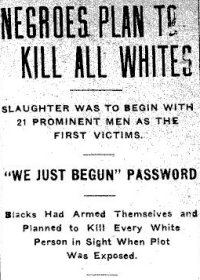
Building off the post below - a newspaper item intended to get the white majority agitated and ready to move.
Moore v. Dempsey and mobocracy
Mini 3's should prepare for finals questions related to the relative pros and cons of different systems of government (principally autocracy, oligarchy, and democracy). I pull a lot of material from the opening set of slides - Why do I have to take this class? You can expect to see maybe 5 - 10 finals questions from that set of slides.
As you'll note, the biggest suspicion the framers of the Constitution had about democracies was that they tended to turn into mobocracy - the fancy term is ochlocracy. The term is obviously biased. Who wants to be ruled by a mob? It can also refer to rule by a mass of people. The framers argued that these forms of government were unstable, and could lead to tyranny of the majority. A close reading of their comments reveals that they were also worried the democracies that were developing in the states under the Articles of Confederation were undermining their power.
One of their concerns was that an uneducated population could be persuaded to become violent by a demagogue - "a political leader in a democracy who appeals to the emotions, fears, prejudices, and ignorance of the lower classes in order to gain power and promote political motives." This could create the instability that could not only spell the end of the democratic republic they sought to establish, but also allow a numeric majority the ability to dominate a numeric minority.
This points out a tension between majority rules and minority rights that I try to highlight in key section of the class - it plays a key role in the design and role of the courts as well as the nature of the Bill of Rights.
Aside from pointing your attention in this direction, I'm writing this because as I was working on the notes for the Supreme Court and stumbled across the court case of Moore v. Dempsey which involves accusations that an Arkansas mob was preventing the criminal justice system from working in the neutral fashion we expect it to.
It seems to me to be a good example of mobocracy in action
Here are links for background on the case
- Moore v. Dempsey.
- Elaine Race Riot.
- Sharecropping.
- Progressive Farmers and Household Union of America.
- Robert L. Hill.
The incident appears to have begun when a group of African American sharecroppers met in order to develop a strategy for addressing grievances they had against the landlords they worked for. The meeting was interrupted by a group of white men, shots were exchanged (it was uncertain who shot first) and one of the white men was killed.
The links can give you detail on what happened next (lots of violence), but one of the eventual results was a trial process dominated by the majority white population. The rights of the African American defendants were not recognized, which raised issues that ultimately led the case to the U.S. Supreme Court.
The justices would rule that the national government had the power to compel state courts to provide due process guarantees for criminal defendants, especially if the process was tainted by the a dominant mob.
Click here for the decision.
As you'll note, the biggest suspicion the framers of the Constitution had about democracies was that they tended to turn into mobocracy - the fancy term is ochlocracy. The term is obviously biased. Who wants to be ruled by a mob? It can also refer to rule by a mass of people. The framers argued that these forms of government were unstable, and could lead to tyranny of the majority. A close reading of their comments reveals that they were also worried the democracies that were developing in the states under the Articles of Confederation were undermining their power.
One of their concerns was that an uneducated population could be persuaded to become violent by a demagogue - "a political leader in a democracy who appeals to the emotions, fears, prejudices, and ignorance of the lower classes in order to gain power and promote political motives." This could create the instability that could not only spell the end of the democratic republic they sought to establish, but also allow a numeric majority the ability to dominate a numeric minority.
This points out a tension between majority rules and minority rights that I try to highlight in key section of the class - it plays a key role in the design and role of the courts as well as the nature of the Bill of Rights.
Aside from pointing your attention in this direction, I'm writing this because as I was working on the notes for the Supreme Court and stumbled across the court case of Moore v. Dempsey which involves accusations that an Arkansas mob was preventing the criminal justice system from working in the neutral fashion we expect it to.
It seems to me to be a good example of mobocracy in action
Here are links for background on the case
- Moore v. Dempsey.
- Elaine Race Riot.
- Sharecropping.
- Progressive Farmers and Household Union of America.
- Robert L. Hill.
The incident appears to have begun when a group of African American sharecroppers met in order to develop a strategy for addressing grievances they had against the landlords they worked for. The meeting was interrupted by a group of white men, shots were exchanged (it was uncertain who shot first) and one of the white men was killed.
The links can give you detail on what happened next (lots of violence), but one of the eventual results was a trial process dominated by the majority white population. The rights of the African American defendants were not recognized, which raised issues that ultimately led the case to the U.S. Supreme Court.
The justices would rule that the national government had the power to compel state courts to provide due process guarantees for criminal defendants, especially if the process was tainted by the a dominant mob.
Click here for the decision.
Friday, October 26, 2012
Mob Justice in Nigeria
This is a pretty gruesome story and I only link to it because the author points out the speed of vigilante justice. It only takes seconds for a mob to decide to act against someone - which is hardly time to determine whether it is appropriate to do so. Remember that the purpose of a republic it to slow the procedures down so that reason, not passion, can be applied to disputes.
Thursday, February 3, 2011
A Riot is an Ugly Sink
I dug up a Young Frankenstein movie clip I mentioned in one of my classes last week. Madison's pure democracy perhaps?
Thursday, March 25, 2010
Thursday, March 26, 2009
Is the Media Hyping Border Violence?
Its a great story, and the level of violence in Mexico is horrific in places, but not everywhere, and apparently not in towns on the American side. The mayors of border cities are a bit miffed about the hysteria and concerned with its policy consequences.
But again, its a great story and its tough to put it down. We eat this stuff up. Its worth considering the degree to which public policy is more a response to media sensationalism than to pragmatic reality.
I see similarities between this story and the AIG bonus flap.
But again, its a great story and its tough to put it down. We eat this stuff up. Its worth considering the degree to which public policy is more a response to media sensationalism than to pragmatic reality.
I see similarities between this story and the AIG bonus flap.
Monday, September 24, 2007
The Little Rock Nine
Fifty years ago today, Eisenhower sent federal troops to enforce a federal court order to desegregate Central High School.
In his words, the troops were to ensure that "the mob" did not succeed in thwarting the legal process.
Ironically, given the recent controversy surrounding the Jena 6 and the recent court decisions that some argue have effectively overturned Brown v Board, some wonder how far as a society we have progressed since 1957.
This is also the anniversary of the last day the Brooklyn Dodgers played in Brooklyn.
In his words, the troops were to ensure that "the mob" did not succeed in thwarting the legal process.
Ironically, given the recent controversy surrounding the Jena 6 and the recent court decisions that some argue have effectively overturned Brown v Board, some wonder how far as a society we have progressed since 1957.
This is also the anniversary of the last day the Brooklyn Dodgers played in Brooklyn.
Subscribe to:
Posts (Atom)