Showing posts with label political participation. Show all posts

Monday, July 4, 2016

From Vox: The single most important fact about American politics

I can't recommend this highly enough. It'll be a part of my look at political participation and political parties for some time. It tries to get to the root of party polarization in the US. These are observations based on a recent study by the Pew Research Center - click here for the study.

- Click here for the article.

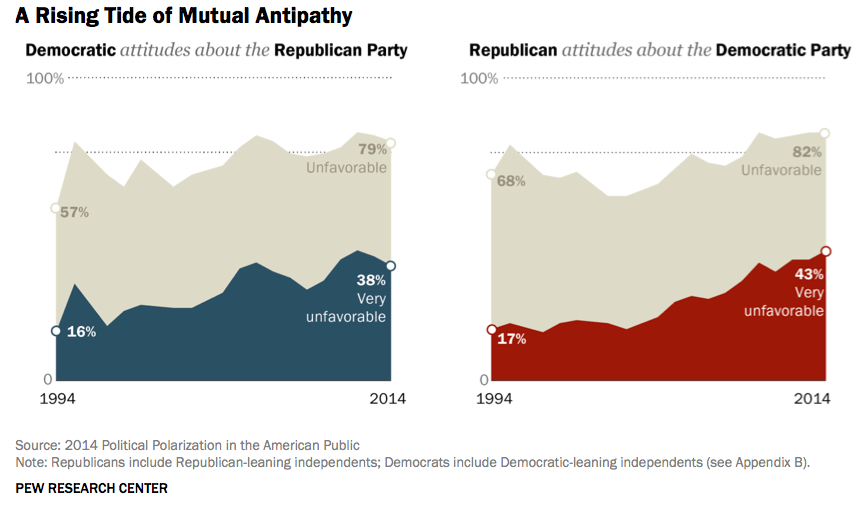
Perhaps the single most important fact about American politics is this: the people who participate are more ideological and more partisan, as well as angrier and more fearful, than those who don't.

Here is one of the factors the author sees as especially problematic. It's not just that the parties are divided ideologically, they hate and fear each other:

Partisan_hate

Partisan_hate

Wednesday, March 16, 2016

Here's a reason why you don't need to vote

I asked both 2305 and 2306 students whether it was their responsibility vote - yes or no. There was no reason to give a knee-jerk yes answer.

Here's a powerful argument from Salon that you shouldn't:

- Vote for Hillary, be a sucker: It’s OK to reject the choice of a tyrannical liberal or a right-wing tyrant
“Vote for Hillary or be responsible for Trump” is slogan of someone maintaining -- or being played -- by the system.

Nothing generates more insipid analysis than a U.S. presidential election. It’s a wonderful opportunity for two-party functionaries to distill American mythologies into the high-minded diction of corporate wonkery. I suppose it isn’t helpful to complain about election analysis by adding to the babble, but it does seem worthwhile to highlight the limitations of the genre.
I dislike voting as a model of political engagement, especially in a corrupt and constrained system that devalues grassroots organizing and tries to limit our imagination to mechanical support of stage-managed icons. Yet I accept that people find inspiration in public figures and express approval by casting votes, sometimes the only political commodity available to a disempowered public. We can critique U.S. elections without being contemptuous of their participants.
Most election skeptics actually value (and perhaps overvalue) their votes. Pundits who insist on voting as a precondition of respectability exhibit contempt for anybody who rejects the mythologies of U.S. exceptionalism. To be respectable, one mustn’t simply vote. One must vote correctly. Such entreaties preclude third-party candidates or acts of conscience deemed inadequately practical. We remain confined to a political canon that produced the greatest crisis of inequality in world history.
Americans are enamored of the vote as a symbol of collective power. The right to vote certainly shouldn’t be taken for granted, but deification of voting can prevent us from treating ourselves as something grander than a massive focus group curated by a few dozen affluent lickspittles. The mythography of voting has conditioned us to treat mediocrity as superior.

Thursday, February 4, 2016

Who controls the Republican Party?

An occasional question. Here's the latest I've found on it. The two major political parties in the United States are highly decentralized. Finding their center - or who is in charge of either at any moment in time - is very difficult. And the power center is often in flux. The author argues that the current Republican Party is controlled by media personalities, specifically talk radio hosts and Fox News.

- Ted Cruz and Donald Trump: Signs of conservative media's grip on GOP.
Over the course of the last three decades, these media personalities have surpassed party officials and even elected representatives in their influence, ascending to exalted status atop Republican leadership. Yet, they prioritize goals seemingly at odds with good governance, and often, even the party's sole purpose for existence.

Talking heads wresting control of the GOP from the traditional party power brokers benefits neither the party, nor the nation. Political parties, after all, exist to win elections. By surrendering issue control to entertainers on the fringe of contemporary thought, however, the Republican Party has limited its ability to reach the 42% of Americans who according to Gallup, regard themselves as independents in a national, general election.
. . . On the rare occasions when Republican elites have attempted to reassert control, they've been pounded into submission by the titans of talk and their allies in Congress. One example came last summer when House Oversight and Government Reform Chairman Jason Chaffetz (R-Utah) stripped Rep. Mark Meadows (R-North Carolina) of his subcommittee chairmanship as punishment for crossing the Republican leadership on a key procedural vote -- which violated a cardinal rule of party loyalty in the House.

When choosing sides between the maintenance of party order and discipline or support for a charter member of the House Freedom Caucus who was among the leaders who forced a government shutdown in 2013, one talk icon didn't hesitate.
While chatting with a Meadows' sympathizer, Ohio GOP Rep. Jim Jordan, a disgusted Laura Ingraham slammed the leadership for its shabby treatment of leaders like Jordan and Meadows.
"This is what the mafia does," Ingraham said. "You know, I'm sorry, but this is a political mafia up on Capitol Hill. That's the way I see it. I don't see this as a Republican Party that represents people like me."
Later in the show, Ingraham hosted Meadows, who she praised: "Mark Meadows, Republican (of) North Carolina who stood up for common sense and pragmatism in trade and was punished for it."
She shamed Chaffetz, exclaiming "there's a point where you just have to say, you know I voted the right way in your mind on trade, sir, but I will not do this. I won't be party to what you're doing to these good men. That's what he should have said."
Less than a week later, Chaffetz reversed course and restored Meadows to his position, signifying the toothlessness of the elected Republican leadership.

Monday, January 25, 2016

From Trib Talk: How to be heard

The author speculates that one reason political participation might be so low is that governments high and low make it difficult for citizen to meaningfully make their opinions heard. The opportunities that exist are not that easy of most of us to participate in. Maybe attitudes about government would change if this was easier.

- Click here for the story.
Ever been mad at government? Don’t answer that.
But have you ever spoken up? More importantly, have you ever felt heard?
Candidates for office are awfully focused on listening to prospective voters. Once those candidates are elected and in office, they don’t stop listening, but it can be much harder to get through to them — to weigh in on policy options they’re facing in a timely and meaningful enough fashion for it to affect their decision.
Odd, isn’t it? If you’re married or in a committed relationship, you’d probably prefer being consulted on decisions that affect you — where you’ll live, say, or where your kids go to school. It seems unlikely that a marriage or relationship would prosper if one person made major decisions without consulting another.
So, why do governments across Texas, at all levels, make it so difficult for those affected by policy decisions to affect those decisions? Most limit the public’s participation to public hearings (often held so late at night that it can be difficult for some to stay awake to hear the speakers) or generalized public comment periods, which often are monopolized by extremists spouting rhetoric unrelated to the government’s jurisdiction.
These hearings and comment periods may matter, but if they occur right before a vote, it's hard to see how. After all, we expect our politicians to do their homework before voting, so why should we expect them to disregard that homework just because someone makes a nice speech?
This limit on public participation in many communities and state agencies means that a very select few participate — those comfortable enough and able to spend hours waiting for a few minutes to take a stand and make a speech, in public, often televised and/or streamed live. That significantly skews an elected official’s perception of public opinion.
The choreography also works against the public. We structure these events like we would a church, a courtroom, or a lecture hall — with elected officials aloft on a dais, their “congregation” of citizens all wanting their ear but seated for a sermon. That does not convey a spirit of dialogue with the public affected by decisions, an open ear to hearing their views.

Sunday, December 27, 2015

From The Hill: Why Americans feel politically powerless

An early theme in class is the requirement that citizens in a republic be actively involved in its maintenance. I threw this quote at you for good measure:
The tyranny of a prince in an oligarchy is not so dangerous to the public welfare as the apathy of a citizen in a democracy.

It was from Charles de Montesquieu - one of the better regarded commentators around the time of the constitutional convention. The great danger to public welfare is if people just check out, this is something that can very easily happen if they feel unable to impact events. Here's an update on the notion.


- Click here for the article.

The author takes the general population to task for failing to live up to its responsibilities - and perhaps having an unreal expectation of what immediate impact they can have on the political system. His key point seems to be that government classes seem to paint an unrealistic picture of the relationship between the governed and the government. People in power will follow the will of the people because we think they are supposed, despite evidence that they tend to follow the money - or at least the engaged. The lesson seems to be "citizenship ain't easy." Not a bad one.

American citizens themselves are a part of the problem and largely responsible for their marginalized status in the world’s most celebrated self-rule democracy. Why have the American people, the popular sovereign of our democracy, not challenged this political take over by the fat cats?
In high school government and civics high school classrooms across America young citizens-to-be are indoctrinated with a version of democracy based more on historic and political myths than political reality.

Magruder's American Government, a widely used textbook revised and published annually since 1917, is a typical example of schoolbook democracy. Here students learn the U.S. Constitution is built on a few basic principles, including popular sovereignty: "In the United States, all political power belongs to the people. The people are sovereign. Popular sovereignty means that people are the only source of governmental power. Government can govern only with the consent of the governed.”

As school kids mature into young adults and gain their own first-hand experience of the political world around them, they soon realize how ill-prepared they—the sovereign people—are to compete with wealthy election campaign donors and professional corporate lobbyists who dominate, between elections, the behind the scenes deal making that determines who gets what.

In addition, studies show that once in office lawmakers give top priority to the care and feeding of their election campaign backers and corporate lobbyists, not the citizens who actually voted them into office.

No wonder citizens feel angry and politically powerless. But why don’t citizens unite and push back?
The late Yale professor Edmund Morgan, author of, Inventing the People: the Rise of Popular Sovereignty in England and America, provides a more complete explanation for the failure of American citizens to react more strongly against the outsourcing of their democracy.
Clinging to their classroom version of democracy in which they are the ultimate and legitimate political power in America, citizens, according to Morgan, willingly suspend their disbelief in schoolbook myths and pretend they are true——even with abundant real-life evidence that they are not.
“The success of government,” says Morgan, “requires the acceptance of fictions, requires the willing suspension of disbelief, requires us to believe that the emperor is clothed even though we can see that he is not…Government requires make-believe…Make believe that the people have a voice or make believe that the representatives of the people are the people.”

This tug-of-war between political myths and political reality has driven citizens out of the political arena and, in effect, outsourced the American democracy to wealthy campaign financiers and powerful corporations.
Saturday, December 19, 2015

From Vox: Are Americans losing faith in democracy?

Well this is depressing.

Scholars who study democracy like to point out that democratization happens in waves, Furthermore, waves come ins and waves come out. We've been through recent periods where an increasing number of countries become democracies. This does not appear to be one of them. Even in the United States there are indications that more and more people would prefer a more authoritative governing system - perhaps this explains Trump's appeal?

The author points about a variety of indications suggesting that democracy is falling out of favor. If this was a longer semester, I'd ask you to critically evaluate this statement, but you have enough on your plate right now.

- Click here for the article.

Here are his observations.

1) Americans trust their political institutions less2) Young Americans are giving up on politics3) Most millennials don’t think it’s essential to live in a democracy4) A growing number of young Americans think democracy is a bad way to run the country5) More Americans want the Pentagon to take over6) Support for illiberal alternatives to democracy is growing especially fast among wealthy Americans7) Public opinion is shifting away from democracy in many countries around the globe

Sunday, November 30, 2014

Political engagement is like running a marathon - a never ending marathon.


I just ran across this and thought it illustrated a point we made when discussing voter turnout and political participation generally. Elections are ongoing. Power tends to flow to those who understand this fact and participate regularly. People who vote once and then get upset because things don't immediately change as they want it to change are being unrealistic.