Showing posts with label campaign finance. Show all posts
Showing posts with label campaign finance. Show all posts
Thursday, June 13, 2024

Tuesday, May 7, 2019
From Open Secrets: Obama-tied operatives and Biden supporters launch $60 million ‘dark money’ group
- Click here for the article.
A new “dark money” group is labeling itself the strategy center for Democrats in 2020.
The recently-launched Future Majority will spend up to $60 million to target voters in swing states such as Pennsylvania, Michigan, Wisconsin and Ohio in the 2020 election, helping Democrats craft messaging that they are fighting for working people while countering conservative talking points, according to Politico.
The 501(c)(4) nonprofit, run by Democratic strategist Mark Riddle, is not required to disclose its donors. The group will reportedly “spend money through PACs,” potentially feeding a growing trend of dark money-funded super PACs spending to influence elections.
Earlier this year, Democratic fundraiser Matthew Tompkins formed a super PAC called America’s Future Majority Fund PAC. He is also listed as the custodian of records for an identically-named nonprofit run by Riddle and is listed as governor on incorporation records for Future Majority. The two long worked together at New Leaders Council (NLC), a nonprofit that helps recruit young progressive leaders.
The revolving door between the new nonprofit and NLC doesn’t end there. Incorporation records show Future Majority’s incorporator is Cathedral Strategies LLC, a limited-liability company with a paper trail linked to Brett Avery Seifried, who was general counsel of NLC.
With Tompkins, links between Future Majority and presidential contender Joe Biden begin to emerge. The Hill reported that Tompkins recently launched a pro-Biden super PAC, titled For the People PAC, with the aim of raising tens of millions of dollars to support Biden’s campaign.
The group hasn’t emerged in FEC filings yet, but the Washington Free Beacon reported that Tompkins established a committee called Biden PAC on April 26. The same day it was established, the PAC renamed itself to G Street and removed Tompkins as its treasurer.
Several of the operatives tied to Future Majority have long histories in former President Barack Obama’s political circles.
A new “dark money” group is labeling itself the strategy center for Democrats in 2020.
The recently-launched Future Majority will spend up to $60 million to target voters in swing states such as Pennsylvania, Michigan, Wisconsin and Ohio in the 2020 election, helping Democrats craft messaging that they are fighting for working people while countering conservative talking points, according to Politico.
The 501(c)(4) nonprofit, run by Democratic strategist Mark Riddle, is not required to disclose its donors. The group will reportedly “spend money through PACs,” potentially feeding a growing trend of dark money-funded super PACs spending to influence elections.
Earlier this year, Democratic fundraiser Matthew Tompkins formed a super PAC called America’s Future Majority Fund PAC. He is also listed as the custodian of records for an identically-named nonprofit run by Riddle and is listed as governor on incorporation records for Future Majority. The two long worked together at New Leaders Council (NLC), a nonprofit that helps recruit young progressive leaders.
The revolving door between the new nonprofit and NLC doesn’t end there. Incorporation records show Future Majority’s incorporator is Cathedral Strategies LLC, a limited-liability company with a paper trail linked to Brett Avery Seifried, who was general counsel of NLC.
With Tompkins, links between Future Majority and presidential contender Joe Biden begin to emerge. The Hill reported that Tompkins recently launched a pro-Biden super PAC, titled For the People PAC, with the aim of raising tens of millions of dollars to support Biden’s campaign.
The group hasn’t emerged in FEC filings yet, but the Washington Free Beacon reported that Tompkins established a committee called Biden PAC on April 26. The same day it was established, the PAC renamed itself to G Street and removed Tompkins as its treasurer.
Several of the operatives tied to Future Majority have long histories in former President Barack Obama’s political circles.


Thursday, October 6, 2016
From the Washington Post: How 10 mega-donors already helped pour a record $1.1 billion into super PACs
More support for the argument that we are more of a plutocracy than a democracy.
- Click here for the article.
- Click here for the article.
Super PACs seeking to influence the 2016 elections have collected more than $1 billion, a record haul driven by jumbo-sized contributions from rich donors on both sides of the aisle.
Just 10 mega-donor individuals and couples contributed nearly 20 percent of the $1.1 billion raised by super PACs by the end of August, according to a Washington Post analysis of federal campaign finance reports. The total exceeds the $853 million that super PACs collected in the entire 2012 cycle.
In a reflection of how once-reluctant Democrats have fully embraced the big-money system, the top givers were split roughly equally along party lines, with five Republicans, four Democrats and one independent, former New York mayor Michael Bloomberg.
On the left, large check writers have pumped millions into Priorities USA Action, the top super PAC allied with Democratic presidential nominee Hillary Clinton, who has struggled to demonstrate her independence from her wealthy supporters.
On the Republican side, the big money has largely flowed into super PACs working to keep GOP control of the Senate rather than to the muddled collection of competing groups supporting presidential nominee Donald Trump.
Together, super PACs seeking to sway the White House and congressional races have pumped more than $674 million into TV ads and other outreach through September, filings show. By the end of the 2012 elections, such groups had spent $608 million.
The figures illustrate how American campaigns have been reordered by the ability to give unlimited sums to political committees. In the six years since the Supreme Court’s Citizens United v. Federal Election Commission decision created new paths for massive contributions to flow into elections, a tiny sliver of donors with immense financial capacity have rushed to participate.
Tuesday, October 4, 2016
From Wired: Clinton and Trump Get Most of Their Campaign Funds from These 250 Neighborhoods
More support for the argument that despite the general idea that the US is a democracy, it is actually more of a plutocracy.
- government by the richest people- a country that is ruled by the richest people- Click here for the article.
- a group of very rich people who have a lot of power

The FEC, which compels political candidates to file regular reports on their fundraising and expenditures, provides data on funding by zip code in addition to tracking donations by employer and state. For the month of August, the 10 zip codes sending the most funding to Clinton are all on the east coast: eight in New York City, one in Washington DC, and one in Cambridge, Massachusetts. Last month wereported that Clinton took in lots of cash from the west side of Manhattan, and this month the trend continues: Clinton drew $364,000 from four West Side neighborhoods in August. Republican nominee Donald Trump, by contrast, raised that amount from his top 32 zip codes.
Sunday, April 10, 2016
What's with Citizens United? What's with Speechnow?
For 2305 tomorrow - a look at Citizens United v FEC.
- Oyez.
- ScotusBlog.
Here's a bit on Speechnow v FEC.
- Ballotpedia.
- Oyez.
- ScotusBlog.
Here's a bit on Speechnow v FEC.
- Ballotpedia.
Friday, January 22, 2016
Catching up on money in politics
Open Secrets lists the top donors here: 2016 Top Donors to Outside Spending Groups.
They also have a section devoted to spending on the 2016 Presidential Race.
For recent news stories:
- Lobby firms reap benefits of an active Congress.
They also have a section devoted to spending on the 2016 Presidential Race.
For recent news stories:
- Lobby firms reap benefits of an active Congress.
Many of the nation’s largest lobby firms saw a spike in revenue in 2015, driven by a more productive Congress and the continuing battles over environmental regulations, trade policy, taxes and health care. Seven of the 10 biggest lobby shops by revenue reported year-over-year gains in fees, according to year-end disclosure reports filed with the Senate on Wednesday.
- Obama weighs whether to force federal contractors to reveal political spending.
President Obama is weighing whether to invoke his executive authority to force federal contractors to disclose political contributions they make to independent groups, according to individuals briefed on the matter. The proposed executive order would require corporations that currently have federal contracts to disclose what they spend on political campaign efforts, including money forwarded through trade associations, such as the U.S. Chamber of Commerce and other advocacy groups.
- The Secrets of Charles Koch’s Political Ascent.
In a recent round of interviews, Charles Koch, the billionaire industrialist and political patron, has been stressing that he only recently became involved in politics. As he put it in an interview with Megyn Kelly on October 15, “I’ve never been that fond of politics and only got dragged into it recently kicking and screaming.” But according to what appear to be two never-before-seen documents—a paper Charles wrote in 1976 and an unpublished history of Charles’ political evolution—Charles began planning his ambitious remaking of American politics 40 years ago, transitioning from libertarian ideologue to conservative power broker. For his new movement, which aimed to empower ultraconservatives like himself and radically change the way the U.S. government worked, he analyzed and then copied what he saw as the strengths of the John Birch Society, the extreme, right-wing anti-communist group to which he, his brother David and their father, Fred Koch, had belonged. Charles Koch might claim that his entry into politics is new, but from its secrecy to its methods of courting donors and recruiting students, the blueprint for the vast and powerful Koch donor network that we see today was drafted four decades ago.
- What is political ‘dark money’ — and is it bad?
Why are so many people upset about dark money in politics?
Campaign finance reform activists argue that voters should know who is funding political advertisements. Such information, they assert, is essential to voters’ ability to evaluate the merits of political messages — and to know if certain special interests may be trying to curry favor with politicians. Fred Wertheimer, the founder and president of Democracy 21, for one, has said that “history makes clear that unlimited contributions and secret money are a formula for corruption.” Likewise, the Campaign Legal Center has called the emergence of dark money a “serious threat to our democracy.” In a portion of the controversial Citizens United decision, eight of the nine Supreme Court justices agreedthat disclosure of money in politics was important because “transparency enables the electorate to make informed decisions and give proper weight to different speakers and messages.”
- A Banner Year for 'Dark Money' in Politics.
The 2016 presidential campaign not only will feature more money than any since Watergate, but also more secret money than the days when black satchels of illicit cash were passed around.
The so-called dark money, or contributions that don't have to be disclosed, topped more than $300 million in the 2012 presidential race, and some experts believe that the levels may be far higher this time. There also is a risk that foreign money could be surreptitiously funneled into the presidential campaign because it wouldn't have to be publicly disclosed.
This flood of cash is occurring thanks to a ruse that permits political advocacy groups to claim that they are principally social welfare agencies and thus tax exempt and not subject to disclosure. These organizations court interest groups and rich donors, some of whom want the influence that political money brings but not the public association. It's a win for the interest groups and the candidates; the public is kept in the dark.
Tuesday, December 22, 2015
In the news today ....
- Texas Speaker Joe Straus has two Tea Party affiliated challengers to his seat in the upcoming primary election. Straus represents the 121st district in the Texas House. Tea Party opponents , who think Straus is too liberal, have failed to defeat him in two previous primary challenges. They think he might be more vulnerable if he has to face two challengers since he might not win a majority and could defeated in a run-off with low turnout: See Straus faces two-candidate challenge from the far right in Republican primary.
- I still need to post items detailing the recent spending bill. It contains a variety of items (riders) related to non-spending issues including rules loosening campaign spending rules. Some allowing greater use of what is called dark money - dark because its source can;t be traced. This a road we've been heading down for decades: See: White House surrenders on 'dark money' regulation.
- Dark money is also becoming more influential in state races. States vary in their policies regarding transparency - Texas requires little. Most of the additional money spent on campaigns since the Citizens United decision removed many caps on expenditures has been through channels that do not require disclosure. Much of this spending on state races comes from groups located in other states, but the precise source is difficult to determine, and there are sufficient loopholes in place to continue to make them secret. See: 'Dark money' grows in politics even as states try to stop it.
- Texas Lieutenant Governor Dan Patrick is continuing to shape the state panels by appointing people with more conservative bona-fides. This includes the Sunset Commission and the Legislative Budget Board. Among the recent appointees of the latter is area state senator Larry Taylor. See: Dan Patrick shows, through new panel picks, that he wants a more conservative Texas Senate.
- A common theme regarding the early race for the Republican nomination has been what impact Trump will have on the party and whether a division might emerge within it that leads to a third party run. Most previous analyses have looked at the possibility the Trump runs as a third party candidate is he looses the nomination. Here's a look at the possibility that a traditional Republican runs as a third party candidate if Trump wins the nomination. See: Will the GOP Mount a Third-Party Challenge to Trump?
- Is Trump's campaign organization playing with fire? Lot's of Trump's activities are being performed by people that work in many of his businesses, which creates problems since these are to be treated as campaign expenses, meaning that they are to be reported as such. Trump appears to be testing the limits of campaign funding law. See: Trump’s reliance on business questioned.
- I still need to post items detailing the recent spending bill. It contains a variety of items (riders) related to non-spending issues including rules loosening campaign spending rules. Some allowing greater use of what is called dark money - dark because its source can;t be traced. This a road we've been heading down for decades: See: White House surrenders on 'dark money' regulation.
- Dark money is also becoming more influential in state races. States vary in their policies regarding transparency - Texas requires little. Most of the additional money spent on campaigns since the Citizens United decision removed many caps on expenditures has been through channels that do not require disclosure. Much of this spending on state races comes from groups located in other states, but the precise source is difficult to determine, and there are sufficient loopholes in place to continue to make them secret. See: 'Dark money' grows in politics even as states try to stop it.
- Texas Lieutenant Governor Dan Patrick is continuing to shape the state panels by appointing people with more conservative bona-fides. This includes the Sunset Commission and the Legislative Budget Board. Among the recent appointees of the latter is area state senator Larry Taylor. See: Dan Patrick shows, through new panel picks, that he wants a more conservative Texas Senate.
- A common theme regarding the early race for the Republican nomination has been what impact Trump will have on the party and whether a division might emerge within it that leads to a third party run. Most previous analyses have looked at the possibility the Trump runs as a third party candidate is he looses the nomination. Here's a look at the possibility that a traditional Republican runs as a third party candidate if Trump wins the nomination. See: Will the GOP Mount a Third-Party Challenge to Trump?
- Is Trump's campaign organization playing with fire? Lot's of Trump's activities are being performed by people that work in many of his businesses, which creates problems since these are to be treated as campaign expenses, meaning that they are to be reported as such. Trump appears to be testing the limits of campaign funding law. See: Trump’s reliance on business questioned.
Tuesday, October 27, 2015
What is Dark Money?
Federal law has required that campaign contributions be disclosed since the passage of the 1910 Federal Corrupt Practices Act. The general idea is that voters should know who is funding a candidate's campaign. That tends to provide a good indication of what the candidate really stands for.
But contributors like to hide their contributions, and Congress does like to allow groups to be able to hide donors if their primary purpose is not politics and they principally want to educate the general population about the issues surrounding the campaign.
This creates an opportunity for clever people to avoid disclosure by calling themselves social welfare organizations and filing paperwork to the IRS stating such. These are the two categories that matter:
- Wikipedia: 501(c)(4) organizations.
- Wikipedia: 501(c)(6) organizations.
The increased use of these types of organizations as vehicles for campaign spending has led to the increase of what is called "dark money" since it is hidden, unregulated and growing fast.
For more:
- Wikipedia: Dark Money.
- Open Secrets: Political Nonprofits (Dark Money).
- Charles Koch Denies Dark Money Donations.
- Mother Jones: Follow the Dark Money.
- Newsweek: As Dark Money Floods U.S. Elections, Regulators Turn a Blind Eye.
But contributors like to hide their contributions, and Congress does like to allow groups to be able to hide donors if their primary purpose is not politics and they principally want to educate the general population about the issues surrounding the campaign.
This creates an opportunity for clever people to avoid disclosure by calling themselves social welfare organizations and filing paperwork to the IRS stating such. These are the two categories that matter:
- Wikipedia: 501(c)(4) organizations.
- Wikipedia: 501(c)(6) organizations.
The increased use of these types of organizations as vehicles for campaign spending has led to the increase of what is called "dark money" since it is hidden, unregulated and growing fast.
For more:
- Wikipedia: Dark Money.
- Open Secrets: Political Nonprofits (Dark Money).
- Charles Koch Denies Dark Money Donations.
- Mother Jones: Follow the Dark Money.
- Newsweek: As Dark Money Floods U.S. Elections, Regulators Turn a Blind Eye.
Thursday, June 11, 2015
From the Texas Tribune: Ethics Commissioners: Lawmakers Went Backward in 2015
At least one 2306 student is focusing on ethics reform in the recent legislative session - which is usually shorthand for campaign finance.
Though the governor named ethics reform as one of his priorities, its didn't happen. Unless the goal was to weaken exiting laws. That's the assessment of what the legislature did according to the Chair of the Texas Ethics Commission.
- Click here for the article.
Though the governor named ethics reform as one of his priorities, its didn't happen. Unless the goal was to weaken exiting laws. That's the assessment of what the legislature did according to the Chair of the Texas Ethics Commission.
- Click here for the article.
“If there was any ethics reform, it was in reverse,” Paul Hobby, chairman of the Texas Ethics Commission, said Thursday at a public meeting that came less than 10 days after lawmakers adjourned their 84th session with the following accomplishments:
- Creating a new loophole to protect lawmaker spouses from certain financial disclosure- Giving themselves and state bureaucrats hometown prosecution when they're accused of white-collar crimes in Austin- Failing to agree on and pass sweeping ethics reform
“There are some bills on the governor’s desk that just scare me to death,” Commissioner Jim Clancy, the body’s former chairman, said at the meeting.
The bipartisan commissioners largely focused on Thursday on measures awaiting Abbott’s signature that would open up a “spousal loophole” allowing politicians to shield information about their spouses’ financial holdings.
The proposals would essentially repeal an agency rule, drafted last year in the wake of ethics violations by a former House member, that spells out what must be included in personal financial statements filed by the governor, members of the Legislature and other high-ranking state officials – including certain information about their spouses’ property and financial activity.
The Tribune previously discussed the collapse of ethics reform here.
The legislature seems to have made it easier to keep financial information secret, meaning that the general public has little idea what interests are influencing legislators.
- Click here for all proposal made regarding ethics this past session.
Wednesday, April 9, 2014
From the National Journal: The End of Campaign Finance Reform? Wednesday's Supreme Court ruling is limited, but could lead to further rollbacks in regulations.
Despite the hype, the impact of the Supreme Court's decision striking down aggregate donation limits Wednesday is limited. The ruling doesn't mean that people can give unlimited amounts of money to candidates; it means a small pool of well-heeled donors can simply dole out donations to more candidates and party committees.
But campaign finance reform advocates are getting increasingly nervous over the longer-term impact of the Court's McCutcheon v. FEC decision, bolstered by other recent rulings on the subject. Experts see the possibility of a future battle over a more consequential subject: the decades-old cap on the amount an individual donor can give to a campaign.
Wednesday's 5-4 decision raised the possibility that the next step for those opposed to campaign finance regulations will be to contest the legality of individual donation limits, a bedrock principle of the current system. That such a move is even being discussed now is indicative of how much the courts have rewritten the laws governing money in politics.
Who is James Bopp Jr.?
He is one of the attorneys leading the charge to get the courts to overturn campaign finance laws - generally based on the idea that they violate free speech rights. He was mentioned in the post below on the Supreme Court's refusal to hear a case challenging Iowa's campaign finance laws. He was also involved in the McCutcheon decision. In class today we considered his being an example of an interest group - or policy advocate - using the courts as their preferred way of changing public policy.
Folks like this are responsible for many changes in public policy.
- Here's the Wikipedia on him.
Folks like this are responsible for many changes in public policy.
- Here's the Wikipedia on him.
On campaign finance, Bopp worked as a legal advisor to Citizens United leading up to their victory in the Supreme Court decision Citizens United v. Federal Election Commission.[7] Another of Bopp's initiatives was bringing a lawsuit challenging what he believes to be a low limit for reporting campaign donations and the open way in which information on such donations is shared in California.
According the Campaign Legal Center, Bopp filed 21 of the 31 lawsuits it associated with challenging campaign finance regulations. All told, Bopp has spent 30 years fighting limits on campaign spending and is credited with changing the political landscape of the 2012 election. According to the Center for Responsive Politics. “It’s safe to say that groups on the left and right have Jim Bopp to thank for their new-found freedom.”In an interview with PBS' Frontline in 2012, Bopp said he was defending a "basically absolute" interpretation of the right to political free speech under the First Amendment. As such, he said he is working to eliminate or significantly loosen campaign spending limits and to eliminate donor-name-reporting requirements.
Bopp represented Phil Thalheimer and Associated Builders & Contractors PAC versus City of San Diego.[11] According to how the case was viewed in Hawaii, provided a PAC made "solely independent expenditures ...the case foreclosed the argument that the State has a justifiable interest in preventing corruption or the appearance of corruption in regulating independent expenditures"
Tuesday, April 8, 2014
From the NYT: Justices Decline Cases on Gay Rights and Campaign Finance
Sometimes the Supreme Court acts by not acting.
- Click here for the article.
- Click here for the article.
The Supreme Court on Monday declined to hear closely watched cases on gay rights, campaign finance and lethal injections. As is their custom, the justices gave no reasons for turning down the appeals.
The gay rights case, Elane Photography v. Willock, No. 13-585, was an appeal from a wedding photographer in New Mexico who asserted a constitutional right to refuse to provide her services to gay and lesbian couples.
The issue was broadly similar to one argued before the court last month, over whether companies may refuse to provide insurance coverage for contraception on religious grounds. But the New Mexico case was based not on a claim of religious liberty but on one of free speech.
The photographer, Elaine Huguenin, objected to a New Mexico law prohibiting businesses open to the public from discriminating against gay men and lesbians. She said that requiring her to photograph same-sex weddings violated her First Amendment rights because she was forced to say something she did not believe.
She rejected a request from Vanessa Willock and Misti Collinsworth to document their commitment ceremony. The women, who hired another photographer, filed a discrimination complaint against Ms. Huguenin’s studio, Elane Photography.
The New Mexico Supreme Court ruled for the couple, saying Ms. Huguenin’s “services can be regulated, even though those services include artistic and creative work.” Laws banning discrimination, the court said, apply to “creative or expressive professions.”
Justice Richard C. Bosson issued an ambivalent concurrence expressing sympathy for Ms. Huguenin and her husband.
“The Huguenins are not trying to prohibit anyone from marrying,” he wrote. “They only want to be left alone to conduct their photography business in a manner consistent with their moral convictions.” Instead, they “are compelled by law to compromise the very religious beliefs that inspire their lives,” he added.
“Though the rule of law requires it,” Justice Bosson wrote, “the result is sobering.”
. . . The justices also declined to hear a campaign finance case, Iowa Right to Life Committee v. Tooker, No. 13-407, which was a challenge to an Iowa law that bans contributions from corporations but allows them from unions. The case was brought by James Bopp Jr., one of the lawyers on the winning side on Wednesday in McCutcheon v. Federal Election Commission, a major campaign finance case.
The McCutcheon decision struck down aggregate contribution limits in federal elections.
Mr. Bopp challenged the Iowa law on two grounds. He said distinguishing between corporations and unions violated equal protection principles. In any event, he added, “banning corporate political contributions violates the First Amendment.”
The Supreme Court also declined to hear two cases concerning whether death row inmates have a constitutional right to know what chemicals states plan to use to execute them.
The challenges said the court’s attention was needed to bring order to a capital justice system in disarray. Drug shortages and boycotts have caused prisons to scramble to find lethal chemicals, raising what opponents of the death penalty say is the possibility of executions so painful that they violate the Eighth Amendment’s ban on cruel and unusual punishment.
Saturday, April 5, 2014
The flip side of the McCutheon decision
Its not just that lobbyists and the wealthy can contribute more, its that incumbents know they can and will now demand more funding from them.
An ironic consequence of the decision.
- Click here for an article from The Hill making this argument.
An ironic consequence of the decision.
- Click here for an article from The Hill making this argument.
A collective groan went up on K Street Wednesday as the Supreme Court struck down aggregate limits on donations to candidate and party committees.
In a 5-4 decision, the Supreme Court said the cap on an individual's overall campaign contributions infringed on First Amendment rights. The ruling clears the way for donors to donate the maximum amount to as many candidates and political parties as they wish during a two-year election cycle.
That’s a dispiriting outcome for lobbyists, who are fixtures on the fundraising circuit but complain about being inundated with constant phone calls and emails asking for donations.
The ruling means that a common K Street excuse for brushing off fundraising requests — that they’ve already “maxed out” their donations under the cap — is now moot.
“The Supreme Court didn't give me more money. I have a budget. I don't have unlimited funds,” said Steve Elmendorf, president of lobby firm Elmendorf | Ryan.
A prime Democratic donor, Elmendorf has already made $97,000 in campaign contributions for the 2014 election cycle, according to the Center for Responsive Politics.
Several lobbyists typically come close to reaching the aggregate limit in campaign giving every two years. The Supreme Court ruling could allow them to expand their influence by giving more, but K Streeters told The Hill that they weren’t looking forward to revved-up fundraising pressure.
“You just can't afford to spend more money than that,” said Pat Raffaniello, a principal at Raffaniello & Associates, about the old aggregate limit.
“Lobbyists not happy...only increases their $$ exposure to fundraising calls,” tweeted Paul Equale, a Democratic consultant who has registered to lobby in the past.
Thursday, April 3, 2014
Is the U.S. now officially an oligarchy?
Some critics argue that we have been one all along and that any pretense that we are a viable democracy - rules by the people and all that - was an illusion. But now it may well be that there is no attempt to maintain that illusion.
That seem to be this author's point - other are making the same argument.
- Click here for the article.
That seem to be this author's point - other are making the same argument.
- Click here for the article.
When the dust from the McCutcheon demolition settles, all that’s left are base contribution limits in a larger campaign finance system where America’s oligarchs can choose between unlimited independent expenditures and unlimited aggregate contributions to buy all the political influence they will ever need. The one good thing you can say about the opinion is that maybe it will re-direct some of the money now being expended as independent expenditures to the major political parties in the form of large aggregate contributions, giving candidates and parties a chance to regain some control of the electoral agenda. In that sense, McCutcheon improves the configuration of Buckley’s airless room, but leaves American democracy trapped at “one dollar, one vote.” There is no ignoring the fact that American democracy is now a wholly owned subsidiary of Oligarchs, Inc.
From the Texas Tribune: Federal Contribution Limits Drift Toward Texas
The Tribune reports that yesterday's Supreme Court ruling make national campaign laws similar to this in Texas.
- Click here for the article.
- Click here for the article.
The federal campaign finance system moved a step closer to the Texas model Wednesday as the U.S. Supreme Court struck down some limits on political donations to federal candidates.
In a 5-4 decision, the justices struck down federal limits on how much an individual may make in total political contributions, also known as aggregate limits. Under the rules at issue in McCutcheon v. FEC, the Federal Election Commission has a $123,200 biennial limit on individual contributions in every two-year election cycle, with $48,600 allowed to go to candidates and $74,600 for political parties and political action committees.
Under the federal decision, the FEC’s rules will now be more in line with those of the Texas Ethics Commission, which has no aggregate limits on political donations.
Political donors in Texas fall under the federal rules only when giving to congressional candidates or candidates for president. Those donors are able to follow the more lenient state guidelines for donations involving Texas state government races, such as the governor, the Legislature and state courts.
Wednesday, April 2, 2014
From ScotusBlog: Opinion analysis: Freeing more political money
A look at the courts decision in McCutcheon.
- Click here for the post.
- Click here for the post.
The Supreme Court pressed ahead on Wednesday with the majority’s constitutional view that more money flowing into politics is a good thing — even if much of it comes from rich donors. By a five-to-four vote, the Court struck down the two-year ceilings that Congress has imposed on donations to presidential and congressional candidates, parties and some — but not all — political action groups.
The main opinion delivered by Chief Justice John G. Roberts, Jr., said confidently that corruption in politics will be kept in check by caps — left intact — on how much each single donation can be. Removing the ceilings on the total amounts that may given in each election cycle will not undermine those limits, Roberts predicted.
The decision was not as sweeping as the Court’s ruling four years ago, removing all restrictions on what corporations and labor unions can spend of their own money in federal campaigns (Citizens United v. Federal Election Commission), which has led to billions of dollars spent on politics through financing that is supposed to be independent of candidates or parties. The new ruling leaves that option open if a donor does not want to directly support a candidate or a party committee and stay within the per-donation caps.
Even so, the practical result of the new ruling is almost sure to be that wealthy individuals favoring specific candidates or party positions will be able to spread their money around among more candidates and political groups.
From the Washington Post: High court voids overall contribution limits
This came just in time for today's discussion of campaign finance rules. The case is McCutcheon v FEC.
- Click here for the article.
- Click here for the opinion.
- Click here for the article.
The Supreme Court has struck down limits in federal law on the overall campaign contributions the biggest individual donors may make to candidates, political parties and political action committees.
The justices said in a 5-4 vote Wednesday that Americans have a right to give the legal maximum to candidates for Congress and president, as well as to parties and PACs, without worrying that they will violate the law when they bump up against a limit on all contributions, set at $123,200 for 2013 and 2014. That includes a separate $48,600 cap on contributions to candidates.
But their decision does not undermine limits on individual contributions to candidates for president or Congress, now $2,600 an election.
- Click here for the opinion.
Thursday, March 20, 2014
From the Huffington Post: This Chart Shows How Little We Really Know About Where Political Money Comes From
The amount of money flowing into politics from undisclosed sources is increased. Most of these are from "social welfare organizations."
- Click here for the article.
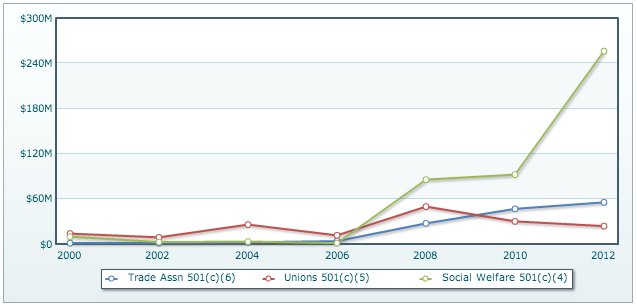
As seems typical, the culprit is the changing legal landscape following the Citizens United decision of a few years back:
- Click here for the article.
As seems typical, the culprit is the changing legal landscape following the Citizens United decision of a few years back:
The initial spike in dark money spending took place in 2008, after the Supreme Court’s 2007 Wisconsin Right to Life ruling. That ruling freed nonprofit 501(c) organizations to make “issue ads” mentioning candidates -- as long as they didn’t directly call for the election or defeat of a candidate.
Another dark money spike took place after the Supreme Court’s 2010 Citizens United ruling freed corporations, labor unions and nonprofit 501(c) organizations to spend political money directly calling for the election or defeat of a candidate. Both the Citizens United and the Wisconsin Right to Life allowed for unlimited spending.
“After Citizens United, voters are left more and more in the dark about who's funding campaigns,” said Robert Maguire, investigator for CRP. “It’s not a matter of free speech – it’s a matter of knowing who’s speaking.”
Dark money continued to flow freely in 2013, gearing up for the 2014 midterm elections. Conservative groups have already spent at least $15.8 million on issue ads to promote Republican candidates, according to an earlier HuffPost analysis. Americans for Prosperity, the nonprofit founded and funded by the billionaire Koch brothers, led all groups that year with at least $12.4 million spent on candidate-specific ads attacking Obamacare. Liberal dark money groups, meanwhile, spent at least $3.3 million on issue advocacy, mostly coming from the League of Conservation Voters.
Thursday, February 20, 2014
From ProPublica: Buying Your Vote
ProPublica devotes an entire section of its website to story related to dark money and big data.
- Click here for it.
- Click here for it.
Tuesday, February 18, 2014
From Pro-Publica: The Dark Money Man: How Sean Noble Moved the Kochs’ Cash into Politics and Made Millions
Still more on money in politics - this time who gets to profit from it. Take this as career advise:
- Click here for the story.
- Click here for the story.
For a brief, giddy moment, Sean Noble—a little-known former aide to an Arizona congressman—became one of the most important people in American politics.
Plucked from obscurity by libertarian billionaire brothers Charles and David Koch, Noble was tasked with distributing a torrent of political money raised by the Koch network, a complex web of nonprofits nicknamed the Kochtopus, into conservative causes in the 2010 and 2012 elections.
Noble handed out almost $137 million in 2012 alone -- all of it so-called dark money from unnamed donors -- from his perch atop the Center to Protect Patient Rights, a group run out of an Arizona post office box.
Much of it was channeled to obvious destinations: Groups supporting Republican presidential candidate Mitt Romney, for example.
But with Noble as ringmaster, Koch money also poured into efforts that didn’t surface until long after Election Day: To a political committee backing Wisconsin Gov. Scott Walker against a recall attempt; to a group blaming President Obama for high gas prices; even to a legal challenge to Arizona’s redistricting plan.
. . . his story shows how the Supreme Court’s landmark 2010 Citizens United ruling has given rise to a new breed of power brokers who control a growing pool of money raised in secret and spent to influence politics in ways that voters can’t always trace.
Much of Noble’s work in 2012 remained invisible to the public until the Center and dozens of other Koch-backed nonprofits released their tax returns late last year.
An examination of those tax returns, along with court records and filings with the Federal Election Commission, shows that the Center to Protect Patient Rights bent state election laws and federal tax rules governing how such groups are supposed to operate.
Millions of dollars the Center told the Internal Revenue Service it gave to other groups only for “tax exempt education and social welfare purposes” were actually spent on election ads and other political activities. Experts on nonprofit law said it’s the donor’s responsibility to follow up on grants if they were not spent as required.
One of the biggest beneficiaries of the Koch network’s money was Sean Noble himself, tax documents show. The Center paid three firms owned by Noble almost $24 million for consulting and other services in 2012—or more than $1 of every $6 it spent.
Subscribe to:
Posts (Atom)