Showing posts with label campaigns. Show all posts

Wednesday, April 13, 2016

From Campaigns and Elections: Organization and Analytics Help Take Down Trump in Iowa.

A nice inside look at how data driven campaigns are run. Obama started it all - at least in the digital age - but here is how things have progressed since then. This focuses on the recent fight between Rubio and Cruz.

- Click here for the article.

“The conventional wisdom has been destroyed. What you can do is rely on data,” Jeff Roe, Cruz’s campaign manager told the Washington Post at the time. In fact, Cruz’s camp had statisticians and behavioral psychologists from the firm embedded in order to help with what it called psychographic targeting, “which categorizes supporters into personality groups in order to target them with specially tailored messaging,” according to the company.
Rubio, meanwhile, was helped by hiring veteran hands from Mitt Romney’s successful 2012 bid for the GOP presidential nomination. Stuart Stevens, Romney’s top strategist in 2012, credited Rubio consultant Rich Beeson with forming data models that helped shape the Romney strategy four years ago.
“Every primary, Rich predicted the result before and was always right,” Stevens said. “His in-depth analytics then was tremendously important for us.” Beeson, a partner at FLS Connect, declined to comment for this piece.
Stevens also praised Roe, who has a reputation as an aggressive strategist.
“Data analytics helped them know where their vote is. I think Jeff Roe did a superb job,” said Stevens. “But Cruz really worked it. He did it the old fashioned way and voters rewarded him for it.”
Other consultants credited Cruz’s traditional campaign structure and put less emphasis on his data analytics for propelling him to victory.
“It was quite a concerted campaign, it wasn’t just data analytics,” said Bob Haus, an Iowa-based GOP consultant. “He traveled. He did all 99 counties and his message was consistent. There are some things data can tell you, but technology only gets you so far.”

Here's more on the topic:

- Cruz campaign credits psychological data and analytics for its rising success.

As Cecil Stinemetz walked up to a gray clapboard house in suburban Des Moines last week wearing his “Cruz 2016” cap, a program on his iPhone was determining what kind of person would answer the door.
Would she be a “relaxed leader”? A “temperamental conservative”? Maybe even a “true believer”?
Nope. It turned out that Birdie Harms, a 64-year-old grandmother, part-time real estate agent and longtime Republican, was, by the Ted Cruz campaign’s calculations, a “stoic traditionalist” — a conservative whose top concerns included President Obama’s use of executive orders on immigration.
Which meant that Stinemetz was instructed to talk to her in a tone that was “confident and warm and straight to the point” and ask about her concerns regarding the Obama administration’s positions on immigration, guns and other topics.
The outreach to Harms and others like her is part of a months-long effort by the Cruz campaign to profile and target potential supporters, an approach that campaign officials believe has helped propel the senator from Texas to the top tier among Republican presidential candidates in many states, including Iowa, where he is in first place, according to two recent polls. It’s also a multimillion-dollar bet that such efforts still matter in an age of pop-culture personalities and ­social-media messaging.

Wednesday, September 23, 2015

A look inside Walker's campaign

This helps explain what went wrong for a candidate some had high hopes for.

- From Politico: The emergency meeting that led Walker to quit: The governor left his closest supporters in the dark, even his biggest financial backers.

It’s almost always bad news when a candidate’s spouse calls an emergency meeting.
But that’s what happened late last week when Scott Walker’s wife, Tonette, and his campaign chairman, Mike Grebe, reached out to a small number of longtime Walker aides and summoned them to the governor’s mansion on Monday morning.
The topic was obvious: the future of Walker’s struggling presidential campaign.
Walker had just limped out of a disappointing second presidential debate. The governor had spent weeks preparing for the showdown, knowing his political life depended on it. He’d practiced giving punchier answers and making sure to use up all his allotted time.
But the reviews had been brutal. Donors were grousing, and money was drying up. It was a painful turn for Walker, who had quickly vaulted to the top of the Iowa polls, powered by a fiery January speech in Des Moines, only to drop precipitously in the summer amid Donald Trump’s rise. He had gone from front-runner to also-ran in a matter of months.
So on Monday morning, the group of advisers — including veteran Walker hands John Hiller, Bill Eisner, Ed Goeas, and Jim Villa — huddled with Scott and Tonette Walker. The top of the agenda, according to campaign sources: polling and fundraising. And the numbers were bad.
Shortly after the meeting wrapped, Walker arrived at his decision: He was out. It was a shocking and sudden move that blindsided many of Walker’s closest allies, threw the power of super PACs into doubt and opened opportunities for rivals to pick up patrons, staff, and supporters.

Thursday, August 27, 2015

Bathroom references in anti- HERO campaign tap into deep seated differences between liberals and conservaties

A Houston Chronicle commentator makes the following - correct - observation about the use of bathroom references in the campaign against the ordinance which would protect people in Houston from discrimination in employment and housing among other things based on a host of items including sexual orientation (being gay or trans gendered).

- Click here for the article.
A personal question today: How do you feel about public restrooms?
Do you see them as useful facilities whose benefits far outweigh the occasional untidiness?
Or, are you so disgusted by public restrooms that you avoid them at all costs, entering only in the case of an emergency, and then, only with pinched nose and value-sized pump of anti-bacterial lotion?

Your answer may reveal something about your politics, according to Jonathan Haidt, a moral psychologist at New York University's Stern School of Business. The more grossed out you are by public restrooms, the more conservative you are likely to be - and vice versa.
This is why bathrooms are the perfect tool for social conservatives trying to defeat Houston's equal rights ordinance.
The author touches on recent research that suggests that a person's ideological outlook may be genetic - or if not - based on deep seated emotional responses to the outside world.

- From Newsweek:
Conservatives and liberals really are wired differently. Scientists can accurately predict whether a subject is left-wing tree-hugger or a right-wing gun-toter based on how their brains respond to certain images, a new study in Current Biology has found.
P. Read Montague, a scientist at Virginia Tech, said his experiment was inspired by data that shows political affiliation, like height, can be inherited. "I the same sense that height is highly genetically specified, it's also true that it's not predetermined by genetics; nutrition, sleep, starvation, dramatic physical injury, and so on can serve to change one's ultimate height. However, tall people have tall children, and this is a kind of starting point [for the experiement]," he said.
Montague and his colleagues asked subjects to look at positive, negative, and disgusting images and examined functional magnetic resonance images (fMRI) of their brains. His team found that conservatives' and liberals' brains behave differently when confronted with disgusting imagery. "Disgusting images, and the mutilated body of an animal especially, generated neural responses that were highly predictive of political orientation. That was true even though the neural predictors didn't necessarily agree with participants' conscious rating of those disturbing pictures," the authors of the study said.
The test proved surprisingly accurate. "A single disgusting image was sufficient to predict each subject's political orientation," Montague said. "I haven't seen such clean predictive results in any other functional imaging experiments in our lab or others."
But wait! There's more:

- Liberal or conservative? Brain responses to disgusting images help reveal political leanings.
- Disgust Sensitivity, Political Conservatism, and Voting.
- Liberal or conservative? Reactions to disgust are a dead giveaway.

Friday, August 7, 2015

From the New Republic: Pro Wrestling Can Teach You Everything You Need to Know About the GOP Debate

An interesting take on the relationship between Donald Trump and the rest of the Republican candidates.

- Click here for the article.

Donald Trump is a heel. Not in the generic insult sense, but in the very specific World Wrestling Entertainment sense. In pro wrestling, which shares certain cultural sensibilities with the Republican Party, the heel is the bad guy—a rude, nasty cheater—who the good guy fights. The good guy is called the face. That was the Republican Party’s problem on the debate stage: It has a heel but no face.

Saturday, July 18, 2015

Can He Win?

This is the study referred to in a previous post on the SuperPac supporting Ted Cruz's presidential race.

- Click here for the post.
- Click here for the study.

Its a great example of electoral strategy. The points they make are debate-able, but they lay their opinions on the line.

Some highlights:

- The 2012 election was winnable, but Romney was the wrong candidate and ran a terrible campaign.
- They focus on 5 states that were close and critiques the strategy in each state.
- Hillary Clinton is the likely Democratic nominee and will likely not attract as many African-Americans and Hispanics as Obama, but will increase turnout from single women.
- Wedge issues are central to increasing turnout.
- Moderate candidates do not win elections
- Cruz is the strongest candidate along each of the five wedge issues they define.
- Evangelical and white voter turnout has dropped.
- The primary election schedule favors conservative candidates.
- Cruz runs well in states which have their primaries early.

It's worth pointing out that they also give credit to the quality of the campaign Obama ran in 2012 and argue they are in the best position to replicate it.

Monday, July 6, 2015

A for real academic article: Etch-a-Sketching: Testing the Post-Primary Moderation Hypothesis

The previous post links to it.

- Click here to check it out.

Its commonly assumed that candidates for the presidency - and by extension any office that involves a primary - have to moderate their stances on issues in order to win general elections. The rule of thumb is that candidates campaign to either extreme in order to win their party's nomination. This id because party identifiers dominate the primaries, but they are only a minority of voters in the general election. Extreme position do not help in general elections, so moderation is necessary.

But is this in fact true?

The author finds evidence that it is.

Here's his conclusion:

This research project moves American political research forward in two major ways. First, the research provides the first systematic evidence for the academic and popular intuition behind a substantial moderation in candidate messages after the primary campaign. By employing text analytic tools, this research gains leverage on a question that evaded empirical measurement for decades. Second, and perhaps more excitingly, this approach opens a new and fruitful area for future study. It remains an open question how well voters may, or may not, perceive subtle rhetorical differences. As with any campaign message, the fact that candidates seem to carefully craft their ideological moderation may not mean that the strategy has much of an effect on voters.


Thursday, April 30, 2015

The Supreme Court - narrowly - upholds limits on judicial elections.

In 2305 we've been discussing how the Supreme Court has overturned a number of laws limiting spending on elections base don the argument that such limitations do not serve the compelling public purpose required to clear the strict scrutiny standard.

Here's one that did.

The case is Williams-Yulee v. The Florida Bar, and here are the questions presented before the court:


Whether a rule of judicial conduct that prohibits candidates for judicial office from personally soliciting campaign funds violates the First Amendment.

The court narrowly decided that it does not. State judges are to be above the political fray. By soliciting contributions, judicial candidates may appear to be on take. The compelling public purpose is to maintain public confidence in the judiciary.

Here's a bit from the NYT coverage of the decision.

The Supreme Court on Wednesday ruledthat states may prohibit judicial candidates from personally asking their supporters for campaign contributions. The vote was 5 to 4, with Chief Justice John G. Roberts Jr. joining the court’s four-member liberal wing to form a majority.
“A state’s decision to elect judges does not compel it to compromise public confidence in their integrity,” Chief Justice Roberts wrote.
In dissent, Justice Antonin Scalia said the decision was a disguised attack on judicial elections that “flattens one settled First Amendment principle after another.”
The decision effectively upheld measures in 30 states that forbid judicial candidates to make personal appeals for money. Such solicitations, the states say, threaten the integrity of the judiciary and public confidence in the judicial system.
For more:

 
- Click here for a symposium on the decision in Scotublog.
- Oyez: Williams-Yulee v. The Florida Bar

Thursday, January 29, 2015

From 538: Everybody Hates Chris Christie

I'm not linking to this because it has anything to do with Governor Christie, but because of this graph the article (click here for it) contains:

enten-datalab-christiescatter

Here's a description of what you're looking at:

I’ve matched the net favorability rating (favorable rating minus unfavorable rating) of every major party nominee among their party’s members since 1980 against the percentage of party members who could form an opinion of them during the first six months of the year before the primaries.

Some nominees, such as Democrats Michael Dukakis and Bill Clinton, weren’t well known at this point in the campaign. Some, such as Republicans Bob Dole and Ronald Reagan, were very well known and popular. There was George W. Bush in 1999, who was particularly well liked, even if he wasn’t universally known. But no prior nominee had a net favorability rating more than 10 percentage points below where you’d expect given his name recognition.
Christie is 25 percentage points off the pace.
This provides another look at the range of candidates for the Republican nomination and compares them with where successful candidates in the past - for either party - fit in terms of recognition and favorability.


Thursday, December 18, 2014

FYI


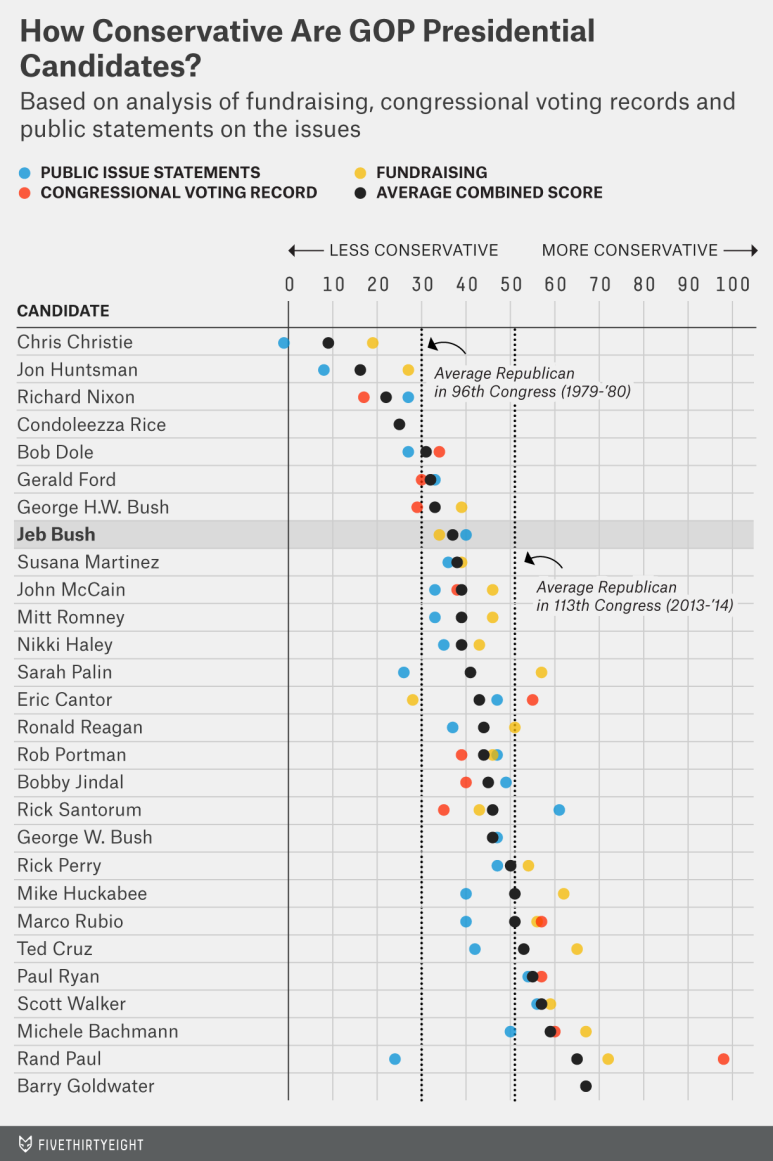
This is helpful for a variety of topics covered in class including campaigning, ideology, and the battle for the 2016 Republican presidential nomination in historical context.

The image comes from 538 - click here for the post.

This gets a bit geeky, but the story points out three separate ways that a candidate ideology can be measured.

DW-Nominate scores - which are based on a candidate’s voting record in Congress
CFscores - based on who donates to a candidate
 OnTheIssues.org scores - based on public statements made by the candidate 

Thursday, June 12, 2014

Randon items About Eric Cantor's loss

Eric Cantor - the U.S. House majority leader - was defeated in a primary election in Virginia Tuesday. The story caused quite a stir, not only because he was the first House majority leader to not be renominated by his party, but it was not expected. It also suggests the Tea Party - at least on states like Virginia - still has legs.

Here are a few items related to this event and how they illustrate class material:

- Eric Cantor Defeated by David Brat, Tea Party Challenger, in G.O.P. Primary Upset.

Read this for basic background about what happened.

- Cantor internal poll claims 34-point lead over primary opponent Brat.

All campaigns run their own polls in order to figure out how well they are doing, but not all polls are conducted well. The poll was taken in late May, so perhaps it did not take into consideration last minute shifts in Brat's direction - or perhaps it was just wrong.

- Tea Party Cannibalizes Cantor.

The author here argues that the major factor in Cantor's defeat was low voter turnout. We will discuss the importance of turnout - as well as the decision to not vote - at different times in this class. Low voter turnout cuts against the idea that democracies reflect the will of the majority of the people. They reflect the will of the majority of those who show up. In primary elections this number can be especially low. 
The key factor in this upset is a 12% voter turnout—meaning that 6.1% of the local electorate could make a majority. This is a paradise for activists and ideologues—Main Street voters, not so much. No one seriously doubts whether Cantor could have won a general election in his Virginia district. This is purely a numbers game. An unrepresentative turnout makes for an unrepresentative result. And for Republicans, it is perhaps the most pointed reminder of the dangerous game they’ve been playing by stoking the fires of furious conservative populism.
The Tea Party's strength has been due to their members' decision collectively to actually show up and vote.

- Cantor’s Loss a Bad Omen for Moderates.

Cantor was the last Jewish Republican. He may have been inadvertently gerrymandered out of his own district.

- Total Raised and Spent.

Cantor raised $5.4 million to his opponents $206,663. So despite what we say elsewhere about the influence of money in politics - and it remains important - it ain't everything.


Thursday, March 20, 2014

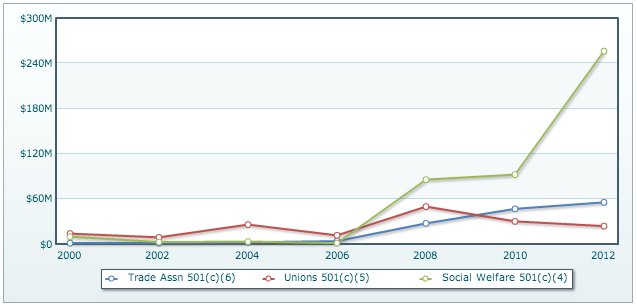
From the Huffington Post: This Chart Shows How Little We Really Know About Where Political Money Comes From

The amount of money flowing into politics from undisclosed sources is increased. Most of these are from "social welfare organizations."

- Click here for the article.

2014-03-18-ScreenShot20140318at2.44.56PM.png

As seems typical, the culprit is the changing legal landscape following the Citizens United decision of a few years back:

The initial spike in dark money spending took place in 2008, after the Supreme Court’s 2007 Wisconsin Right to Life ruling. That ruling freed nonprofit 501(c) organizations to make “issue ads” mentioning candidates -- as long as they didn’t directly call for the election or defeat of a candidate.

Another dark money spike took place after the Supreme Court’s 2010 Citizens United ruling freed corporations, labor unions and nonprofit 501(c) organizations to spend political money directly calling for the election or defeat of a candidate. Both the Citizens United and the Wisconsin Right to Life allowed for unlimited spending.

“After Citizens United, voters are left more and more in the dark about who's funding campaigns,” said Robert Maguire, investigator for CRP. “It’s not a matter of free speech – it’s a matter of knowing who’s speaking.”

Dark money continued to flow freely in 2013, gearing up for the 2014 midterm elections. Conservative groups have already spent at least $15.8 million on issue ads to promote Republican candidates, according to an earlier HuffPost analysis. Americans for Prosperity, the nonprofit founded and funded by the billionaire Koch brothers, led all groups that year with at least $12.4 million spent on candidate-specific ads attacking Obamacare. Liberal dark money groups, meanwhile, spent at least $3.3 million on issue advocacy, mostly coming from the League of Conservation Voters.

Thursday, March 13, 2014

The Donor Class

The article referred to in the previous post refers to what it calls the "donor class." These are the wealthy contributors who fund the elections of members of Congress and are - presumably - able to influence what they focus on once in office. Otherwise they might lose those supporters.

I typed "donor class" in a search engine and here's what popped up:

- In America; The Donor Class.
- Ambassador Appointment Draws Ire Inside Democratic Donor Class.
- The Rise of the Political Donor Class.
- The Minimum Wage: Popular With the Public, But Not the Donor Class.
- Head of the Donor Class.
- The Rise of the Donor Class.

Tuesday, February 4, 2014

Catching up with the 2014 campaign

A few stories worth perusing.

- Greg Abbott outraises Wendy Davis 3-1 in the dash for campaign cash.

Attorney General Greg Abbott is the undisputed money king in the race against Wendy Davis – collecting three times more cash last month than his Democratic foe. Abbott has amassed a sizeable war chest of nearly $30 million for the governor’s race, far ahead of Davis’ $10 million on hand with nearly a full year ahead of them before the November general election.

Davis stunned the Abbott team in January by reporting she raised more money in the second half of 2013. But the Republican attorney general stormed back in January, collecting $3.1 million compared to Davis’ $913,000. Both candidates have spent a lot of time raising money for a contest expected to cost each side at least $45 million. Davis will be in Chicago tonight for a fundraiser co-hosted by the national grassroots director of President Obama’s political group Organizing for America. The event – with tickets ranging up to $500 for a VIP reception and photo with Davis – is being held at the Paris Club.

- Texas Vote-Buying Case Casts Glare on Tradition of Election Day Goads.
In this Rio Grande Valley town of trailer parks and weedy lots eight miles from the Mexico border, people call them runners or politiqueras — the campaign workers who use their network of relatives and friends to deliver votes for their candidates. They travel around town with binders stuffed with the names and addresses of registered voters, driving residents to and from the polls and urging those they bump into at the grocery store to support their candidates.

Despite rumors that some politiqueras went over the line in encouraging voters, the tradition continued in Donna and other border towns and cities, and campaigns for nearly every local office or seat have paid politiqueras to turn out the vote in contested races.

- Cornyn warchest at $6.5 million.

Sen. John Cornyn raised another $1.48 million in the final quarter 2013, leaving him with $6.5 million in the bank heading into the March 4 primary.

“Thanks to tremendous support across Texas and an early, aggressive investment in online, TV and radio advertising, Senator Cornyn holds a commanding lead over all his opponents with less than thirty days to go,” said Cornyn campaign manager Brendan Steinhauser.

Cornyn had just under $7 million in the bank at the end of September.

Of the seven other Republicans Cornyn faces in the primary,none has shown signs of fund-raising anything near that league. Rep. Steve Stockman had $47,207 on hand as of Dec. 31, according to his year end report.

- Report: Texas AG Greg Abbott received more from payday lenders than previously stated.

Attorney General Greg Abbott received 60 percent more in contributions from the payday lending industry last year than an earlier analysis said he did.

Abbott, the Republican candidate for governor, received $88,000 over the six-month period that ended Dec. 31, according to an analysis published Monday by the watchdog group Texans for Public Justice. A preliminary analysis of campaign-finance reports that were released Jan. 15 put Abbott's payday contributions in the second half of 2013 at $55,000.

"We did a more in-depth analysis and found more donors who were connected with the industry," said Craig McDonald, director of Texans for Public Justice.

Thursday, January 23, 2014

Its more hip for politicians to solicit political contributions from high tech than big oil or trial lawyers

So says this article in Politico. Soliciting money from Silicon Valley is different than doing so from others:

It’s not just contributions that the officeholders are seeking. Many also are eager for association with an industry that — while clearly as self-serving about its economic interests as any other — projects an aura of glamour and new-economy dynamism that the typical Washington pol, to put it mildly, does not enjoy.
But raising money from high tech is an art form of its own, requiring special techniques for finding the erogenous zones of rich people who tend to take themselves and their ideas very seriously. Tech leaders see Silicon Valley not just as a special place, but as unique — almost a nation within a nation that drives innovation, economic growth and the very way Americans live their lives. So capital lawmakers who don’t come prepared risk confirming the typical tech industry view of Washington politicians as clueless buffoons.
Here, based on interviews with tech political players in Washington and the West Coast, is a user’s guide for how candidates can loosen the wallets of technology tycoons.
Any evening on Capitol Hill there is a familiar ritual: A lawmaker stops by an event, gives a little speech and goes home with campaign checks. This simply won’t work for reaping tech dollars.
Just look at what happened to former Sen. Olympia Snowe. The Maine Republican sat on the powerful Commerce and Finance committees — both key for the tech industry. But during one Silicon Valley swing, she didn’t convince tech execs she cared for their industry or understood their policy desires, according to a technology source. Her perfunctory effort drew equally perfunctory results, yielding only about $20,000.
Snowe knew one thing — that most big players expect the politician to come to them — visiting with tech players in their native habitat. But what’s even harder for many pols: The tech money players usually want to do at least as much talking as the politicians. They insist on knowing that the politicians are really listening. As a general rule, the first meeting is not the right time to ask for money.
“Lesson One: We’re old-fashioned; we don’t like to kiss on the first date,” said Carl Guardino of the Silicon Valley Leadership Group, a tech industry advocacy organization. “Prove that you care about our policy before reaching for our purse. I find that all too often, members of Congress treat Silicon Valley like an ATM machine and expect to come out here without establishing themselves on our policy, without building personal relationships, and simply want to reach into our purse. And that rarely works, and it certainly doesn’t work more than once.”

Tuesday, November 19, 2013

From the New Yorker: On the Face of It: The Psychology of Electability

We just finished talking about how personal characteristics can influence voters. When we cover the media, we will see the impact that television has had on how candidates are evaluated.

Looks matter.

Here's a more exhaustive look at these factors:


In 2003, the Princeton psychologist Alexander Todorov began to suspect that, except for those people who have hard-core political beliefs, the reasons we vote for particular candidates could have less to do with politics and more to do with basic cognitive processes—in particular, perception. When people are asked about their ideal leader, one of the single most important characteristics that they say they look for is competence—how qualified and capable a candidate is. Todorov wondered whether that judgment was made on the basis of intuitive responses to basic facial features rather than on any deep, rational calculus. It would make sense: in the past, extensive research has shown just how quickly we form impressions of people’s character traits, even before we’ve had a conversation with them. That impression then colors whatever else we learn about them, from their hobbies to, presumably, their political abilities. In other words, when we think that we are making rational political judgments, we could be, in fact, judging someone at least partly based on a fleeting impression of his or her face.

Starting that fall, and through the following spring, Todorov showed pairs of portraits to roughly a thousand people, and asked them to rate the competence of each person. Unbeknownst to the test subjects, they were looking at candidates for the House and Senate in 2000, 2002, and 2004. In study after study, participants’ responses to the question of whether someone looked competent predicted actual election outcomes at a rate much higher than chance—from sixty-six to seventy-three per cent of the time. Even looking at the faces for as little as one second, Todorov found, yielded the exact same result: a snap judgment that generally identified the winners and losers. Todorov concluded that when we make what we think of as well-reasoned voting decisions, we are actually driven in part by our initial, instinctive reactions to candidates.


Friday, September 20, 2013

The 2003 Texas Redistricting

The case involving Tom Delay stemmed from his efforts to obtain a Republican Majority in the Texas House in the election of 2002, which would have been the first time the Republican Party had controlled the institution since Reconstruction.

Of course it was a very different Republican Party back then - nationalist in outlook and supportive of - Civil Rights.

What made this controversial was that DeLay's intent was to enable the Republican Party to draw new districts for the House of Representatives and give the Republican majority in the House a few extra seats. These are normally only redrawn in the legislative sessions immediately following the census when House seats are reapportioned. The Democratic Party still controlled the Texas Senate though, so Republicans were unable to dominate the redistricting process.

The legislature elected in 2000 was able to draw the US House districts that allowed the Democratic Party to continue to dominate the state delegation - there were 17 Democrats to 15 Republicans. The one elected in 2002 was able to redraw the districts, target certain Democrats - mostly white males - and result in a scheme that elected 21 Republicans and 11 Democrats.

This demonstrates the effectiveness of gerrymandering.

What got DeLay into trouble was that the manner in which donations from corporation were funneled to candidates. Corporate financing for candidates was illegal at that time. Prosecutors argued that DeLay circumvented those rules by funneling corporate money through his account to those of the Texas Senate candidates. The appellate court seems to have argued that these funds were not meant for the campaign, but rather to have access to DeLay.

As we should expect, a Wikipedia page exists that provides an overview of the 2003 redistricting effort.

We will discuss elections in Texas soon enough - this gives us a head start.

Here are more sources:

- The Texas Gerrymander
- Justice staff saw Texas districting as illegal
- The Killer D's
- Sourcewatch

Monday, June 17, 2013

From the NYT: Justices Reject Arizona Voting Law Requiring Proof of Citizenship

Click here for the story:

Arizona may not require documentary proof of citizenship from prospective voters, the Supreme Court ruled in a 7-to-2 decision on Monday.
Justice Antonin Scalia, writing for the majority in Arizona v. Inter Tribal Council of Arizona, No. 12-71, said a federal law requiring states to “accept and use” a federal form displaced an Arizona law.
The federal law, the National Voter Registration Act of 1993, allows voters to register using a federal form that asks, “Are you a citizen of the United States?” Prospective voters must check a box for yes or no, and they must sign the form, swearing under the penalty of perjury that they are citizens.
The state law, by contrast, required prospective voters to prove that they were citizens by providing copies of or information concerning various documents, including birth certificates, passports, naturalization papers or Arizona driver’s licenses, which are available only to people who are in the state lawfully.
A divided 10-judge panel of the United States Court of Appeals for the Ninth Circuit had ruled that the two sets of requirements “do not operate harmoniously” and “are seriously out of tune with each other in several ways.”
Full detail from ScotusBlog here.

Wednesday, June 12, 2013

From Wired: Big Data and Analytics

There was talk in class today - in relation to the assigned book on the 2012 election - about whether data and analytics were good for campaigns. Is the public better served when candidates have such detailed information about what makes them tick? Should candidates have to physically confront potential voters in order to determine what their preferences are? Does data and analytics make manipulation more possible?
Its a legitimate subject.

This Wired author points out that the brave new world of big data and the analytical ability to process it provides all sorts of possibilities - some good, some bad. But you can't have one without the other:
If you think about all the hype generated about consumer privacy and enterprises collating and analyzing information for a more targeted and personal experience, customer segmentation and demographics, location-based and real-time marketing what the NSA exposure has taught us is that there really is no privacy in the 21st century and we should just get used to it. Our data is anonymized unless it’s being used specifically for our purpose and benefit but the fact is we are happily generating it for them to use in any case.

But Big Data is no longer creepy. Sorry but it’s not. You must live in painful ignorance if you think that every nuance of a digital interaction hasn’t been collected by someone and analyzed. What’s clear is that analytics and big data seem to be labelled as only for marketers to hound us with or for banks to sell us more debt laden products. We forget, for example, about the medical and scientific boundaries being broken that rely on data analytics and human generated information to help it along.

At some point there will be consumer based tools affordable enough for people to make sense of the data they generate themselves, and why not, it’s all part of the equation. Personal graph analysis will become a reality as much as its parent will be wielded by enterprises.

So, you see, we have heroes and villains even in data analytics but it’s all a matter of perspective. The NSA are deemed evil for breaching our liberties and analyzing data without our consent to understand terrorist activities, and medical science is a force of good for helping us cure diseases using data sourced from all manner of places.

Tuesday, April 2, 2013

The campaign process according to Richard Kimball

I though this quote from the wikipedia site on Project Vote Smart was good enough to highlight separately:

"Understand what we do to you. We spend all of our time raising money, often from strangers we do not even know. Then we spend it in three specific ways: First we measure you, what it is you want to purchase in the political marketplace — just like Campbell's soup or Kellogg's cereal. Next, we hire some consultants who know how to tailor our image to fit what we sell. Lastly, we bombard you with the meaningless, issueless, emotional nonsense that is always the result. And whichever one of us does that best will win."

Kimbal founded Project Vote Smart after losing a Senate race in 1986.

Friday, November 16, 2012

The nerds are taking over

The Atlantic profiles some of the techies that ran Obama's campaign.