Lots going on here. Think about this in terms of party polarization.
Who is Charlie Sykes?
. . . an American political commentator who was editor-in-chief of the website The Bulwark. From 1993 to 2016, Sykes hosted a conservative talk show on WTMJ in Milwaukee, Wisconsin. He was also the editor of Right Wisconsin which was co-owned with WTMJ's then-parent company E. W. Scripps. Sykes is a frequent commentator on MSNBC.
In an era when the national success of Rush Limbaugh was inspiring similar call-in talk radio shows around the U.S., Sykes started hosting talk radio in 1989 as a substitute host for Mark Belling at WISN in Milwaukee. Sykes got his own show on WISN by 1992. Lacking a contract with WISN, Sykes jumped to WTMJ within a year and hosted a morning show there until December 19, 2016.
In 2002, Sykes and fellow WTMJ host Jeff Wagner gained prominence in leading a campaign to recall Milwaukee County Executive Tom Ament, who was embroiled in scandal for changing the county pension policy to give himself and close aides large payouts; Ament controversially retired at the end of February 2002, rather than resign, to retain his pension.
In a 2005 speech, Jay Heck, executive director of the Wisconsin branch of the liberal political advocacy group Common Cause referred to Sykes' influence on local politicians. "The Sykes Republicans from southeastern Wisconsin are worried that he will castigate them by calling them RINOs, 'Republicans in name only.' So (he makes it) very difficult for Republicans to be independent of the party line on any issue."
. . . In October 2016, Sykes announced that he had decided late in 2015 to quit his radio show for unspecified personal reasons. In December 2016, Sykes wrote an op-ed for The New York Times suggesting that the conservative movement had lost its way during the 2016 campaign, saying "...as we learned this year, we had succeeded in persuading our audiences to ignore and discount any information from the mainstream media. Over time, we'd succeeded in delegitimizing the media altogether — all the normal guideposts were down, the referees discredited."
Showing posts with label Congress. Show all posts
Showing posts with label Congress. Show all posts
Tuesday, April 9, 2024
Friday, October 27, 2023
From Wikipedia: Gag rule (United States)
A restriction on congressional speech in the mid 19th Century.
- Click here for the entry.
In United States history, the gag rule was a series of rules that forbade the raising, consideration, or discussion of slavery in the U.S. House of Representatives from 1836 to 1844.
This procedure became unworkable in 1835, when, at the instigation of the new American Anti-Slavery Society, petitions arrived in Congress in quantities never before seen. Over the gag rule period, well over 1,000 petitions, with 130,000 signatures, poured into the United States House of Representatives and the United States Senate praying for the abolition or the restriction of that allegedly beneficial "peculiar institution", as it was called in the South. There was a special focus on slavery in the District of Columbia, where policy was a federal, rather than state, matter. The petitions also asked Congress to use its Constitutional power to regulate interstate commerce to end the interstate slave trade, The petitions were usually presented by former president John Quincy Adams, who as a member of the House of Representatives from strongly anti-slavery Massachusetts, identified himself particularly with the struggle against any Congressional abridgement of the right of citizens to petition the government.
The pro-slavery forces controlled Congress. The faction responded with a series of gag rules that, much to the disgust of Northerners, automatically "tabled" all such petitions, prohibiting them from being printed, read, discussed, or voted on. "The effect of these petitions was to create much irritation and ill feeling between different parts of the Union."


Wednesday, January 4, 2017
On This Day in History (ok this was originally flagged November 18) 1883: Railroads create the first time zones
This is from History.com and it touches on points I like to make in class about the interrelationship between business and the national government in the expansion of the nation, as well as the expansion of the authority of the national government. The setting of time seems to have been primarily a local matter until technological change (faster transportation) made it necessary for localities to yield this power.
Railroad companies instigated the change, which were then adopted by many state legislatures. It would later be made legal by the national government - most likely under the constitutional authority of the interstate commerce clause, though I've yet to see that stated clearly anywhere. As you'll see below, the power to oversee was given to the Interstate Commerce Commission. That's a give away.
- Click here for the article.
The law referenced above was the Standard Time Act of 1918, which was passed during the 65th Session of Congress after being introduced by Senator William Calder, a Republican from New York. This was the Congress responsible for declaring war on Germany. Not surprisingly the bulk of the laws passed by Congress were related to WWI. The creation of a uniform time system - along with the more controversial daylight saving provision, was considered key to the wear effort. The uniformity was far less controversial that the daylight savings component.
The 65th Congress also passed the Child Labor Act of 1919, which would be found unconstitutional in the case of Bailey v. Drexel Furniture. The law placed an excise tax on the profits of companies that employed children. The Supreme Court ruled the tax was really a penalty, which was unconstitutional. The court has since argued that this process is in fact constitutional. Time zones in the United States are currently regulated by the system put in place by the Uniform Time Act, which was passed in 1966 by the 89th Congress.
For a look at the language in the U.S. Code that relate to time zones, click here:
- 15 U.S. Code Sec. 261: Zones for standard time; interstate or foreign commerce.
For more on the Interstate Commerce Commission, which originally implemented the law, click here:
- Wikipedia: Interstate Commerce Commission.
The ICC was the first independent agency established by Congress. It exists outside the tradition executive departments, which gives it greater autonomy from the president. The ICC's jurisdiction expanded considerably over its history. It began with regulating railroads and would eventually also regulate trucking, telephone, telegraph, and wireless companies. It was commonly argued to have been captured by the railroad companies, meaning that its regulations served to enhance - not limit - the power of railroads.
It is one of the few executive agencies that have ever been terminated. This was done in the ICC Termination Act of 1995 which was passed by the 104th Congress (the Contract With American Congress) and signed by President Clinton. Its functions were shifted to the newly created Surface Transportation Board, an agency within the Department of Transportation. This includes the implementation of policies related to time zones. For detail on the purpose of the shift, click here to read President Clinton's Statement on Signing the ICC Termination Act of 1995.
Railroad companies instigated the change, which were then adopted by many state legislatures. It would later be made legal by the national government - most likely under the constitutional authority of the interstate commerce clause, though I've yet to see that stated clearly anywhere. As you'll see below, the power to oversee was given to the Interstate Commerce Commission. That's a give away.
- Click here for the article.
The need for continental time zones stemmed directly from the problems of moving passengers and freight over the thousands of miles of rail line that covered North America by the 1880s. Since human beings had first begun keeping track of time, they set their clocks to the local movement of the sun. Even as late as the 1880s, most towns in the U.S. had their own local time, generally based on “high noon,” or the time when the sun was at its highest point in the sky. As railroads began to shrink the travel time between cities from days or months to mere hours, however, these local times became a scheduling nightmare. Railroad timetables in major cities listed dozens of different arrival and departure times for the same train, each linked to a different local time zone.
Efficient rail transportation demanded a more uniform time-keeping system. Rather than turning to the federal governments of the United States and Canada to create a North American system of time zones, the powerful railroad companies took it upon themselves to create a new time code system. The companies agreed to divide the continent into four time zones; the dividing lines adopted were very close to the ones we still use today.
Most Americans and Canadians quickly embraced their new time zones, since railroads were often their lifeblood and main link with the rest of the world. However, it was not until 1918 that Congress officially adopted the railroad time zones and put them under the supervision of the Interstate Commerce Commission.
The law referenced above was the Standard Time Act of 1918, which was passed during the 65th Session of Congress after being introduced by Senator William Calder, a Republican from New York. This was the Congress responsible for declaring war on Germany. Not surprisingly the bulk of the laws passed by Congress were related to WWI. The creation of a uniform time system - along with the more controversial daylight saving provision, was considered key to the wear effort. The uniformity was far less controversial that the daylight savings component.
The 65th Congress also passed the Child Labor Act of 1919, which would be found unconstitutional in the case of Bailey v. Drexel Furniture. The law placed an excise tax on the profits of companies that employed children. The Supreme Court ruled the tax was really a penalty, which was unconstitutional. The court has since argued that this process is in fact constitutional. Time zones in the United States are currently regulated by the system put in place by the Uniform Time Act, which was passed in 1966 by the 89th Congress.
For a look at the language in the U.S. Code that relate to time zones, click here:
- 15 U.S. Code Sec. 261: Zones for standard time; interstate or foreign commerce.
For more on the Interstate Commerce Commission, which originally implemented the law, click here:
- Wikipedia: Interstate Commerce Commission.
The ICC was the first independent agency established by Congress. It exists outside the tradition executive departments, which gives it greater autonomy from the president. The ICC's jurisdiction expanded considerably over its history. It began with regulating railroads and would eventually also regulate trucking, telephone, telegraph, and wireless companies. It was commonly argued to have been captured by the railroad companies, meaning that its regulations served to enhance - not limit - the power of railroads.
It is one of the few executive agencies that have ever been terminated. This was done in the ICC Termination Act of 1995 which was passed by the 104th Congress (the Contract With American Congress) and signed by President Clinton. Its functions were shifted to the newly created Surface Transportation Board, an agency within the Department of Transportation. This includes the implementation of policies related to time zones. For detail on the purpose of the shift, click here to read President Clinton's Statement on Signing the ICC Termination Act of 1995.
Tuesday, November 15, 2016
From ATTN: How to Make Your Congressman Listen to You
Useful advice - in a series of tweets.
- Click here for the article.
A sample:
- Click here for the article.
A sample:
Are you noticing a pattern here? The staff are the ones who run the ground game for Congress. Work on helping them understand and learn.
Because, if the staff knows you, when they have a question about a piece of legislation or amendment, they will be the one you call.
Thursday, September 22, 2016
From the Christian Science Monitor: Prayer and politics in Congress - How prayer meetings on Capitol Hill inspire fellowship and foster bipartisan lawmaking, though some argue it is too much religion under the rotunda.
Does this violate the establishment clause?
Or does it help create unity?
- Click here for the article.
Or does it help create unity?
- Click here for the article.
Prayer has always been a presence on Capitol Hill. In the 19th century, religious services were actually held in the House chamber because it was the biggest space in a town still under construction and lacking public buildings.
“The House was used for church services, but it wasn’t a church,” says Donald Ritchie, former Senate historian. “It was used for funerals, but it wasn’t a funeral parlor. It was a space that was available.”
Those practices ended in the 1840s, when enough churches had been built to accommodate lawmakers and their families. What still survives from the First Congress of 1789 to this day – and which many secularists object to – are two chaplains, one for the House and one for the Senate, underwritten by US taxpayers. The chaplains, or a guest, offer a prayer at the opening of each day that Congress is in session, and they minister to the members, their staffs, and their families.
When he was the Senate historian, Mr. Ritchie says he often had to answer queries from outraged citizens and visitors who viewed the chaplaincy and opening prayers as a violation of the separation of church and state. But Article 1 of the Constitution allows the chambers to “chuse” their officers, and the chaplains have always been officers, the historian says. As the current Senate chaplain, Barry Black, notes on his web page, the chamber honors the separation of church and state, “but not the separation of God and State.”
The Supreme Court agrees. In 1983, it held that a chaplaincy and opening prayers in legislatures do not violate the Constitution (Marsh v. Chambers). In 2014, it upheld opening prayers at municipal meetings, so long as the practice is not discriminatory. That ruling could soon get a test. Dan Barker, an atheist who founded the Freedom From Religion Foundation, is suing the House chaplain and speaker for barring him from offering a secular invocation in Congress. The group also objects to the prayer breakfasts, which are organized by the lawmakers.
Wednesday, September 21, 2016
From the Christian Science Monitor: Politics is crippling the US economy, Harvard study says - According to an annual competitiveness survey, dysfunction within federal government is the single biggest barrier to economic progress in the United States.
Dysfunction has a real, tangible cost.
- Click here for the article.
- Click here for the article.
Despite somewhat encouraging news this week that the middle and lower-wage workers appeared to see relief in 2015 as the US median household income finally rose, most Americans are much worse off than they were two decades ago.
This is not the product of the natural dips and bumps that typically punctuate our economy. According to a study released Thursday by Harvard Business School, the biggest threat to US competitiveness is our crippled political system and the “unrealistic and ineffective national discourse on the reality of the challenges facing the U.S. economy,” study authors reported.
“A lot of people think that what’s going in is we had a bad recession and that we’re just recovering,” Michael Porter, a study author and co-chair of Harvard’s Competitiveness Project, which conducts an annual survey of US business leaders, tells CNBC. “What we find is that all the major data points that started moving in the wrong direction started in the late 90s and 2000s.”
These data points plot a picture that doesn’t bode well for small businesses and average American workers, whose pay and job opportunities are declining as they’re competing with workers around the globe.
"We used to have the most skilled workers in world; now we don’t,” Dr. Porter says.
Thursday, September 15, 2016
From XKCD: A History of the United States Congress
One of the great graphics of all time.
It's worth devoting an entire class.
- Click here for the full version.
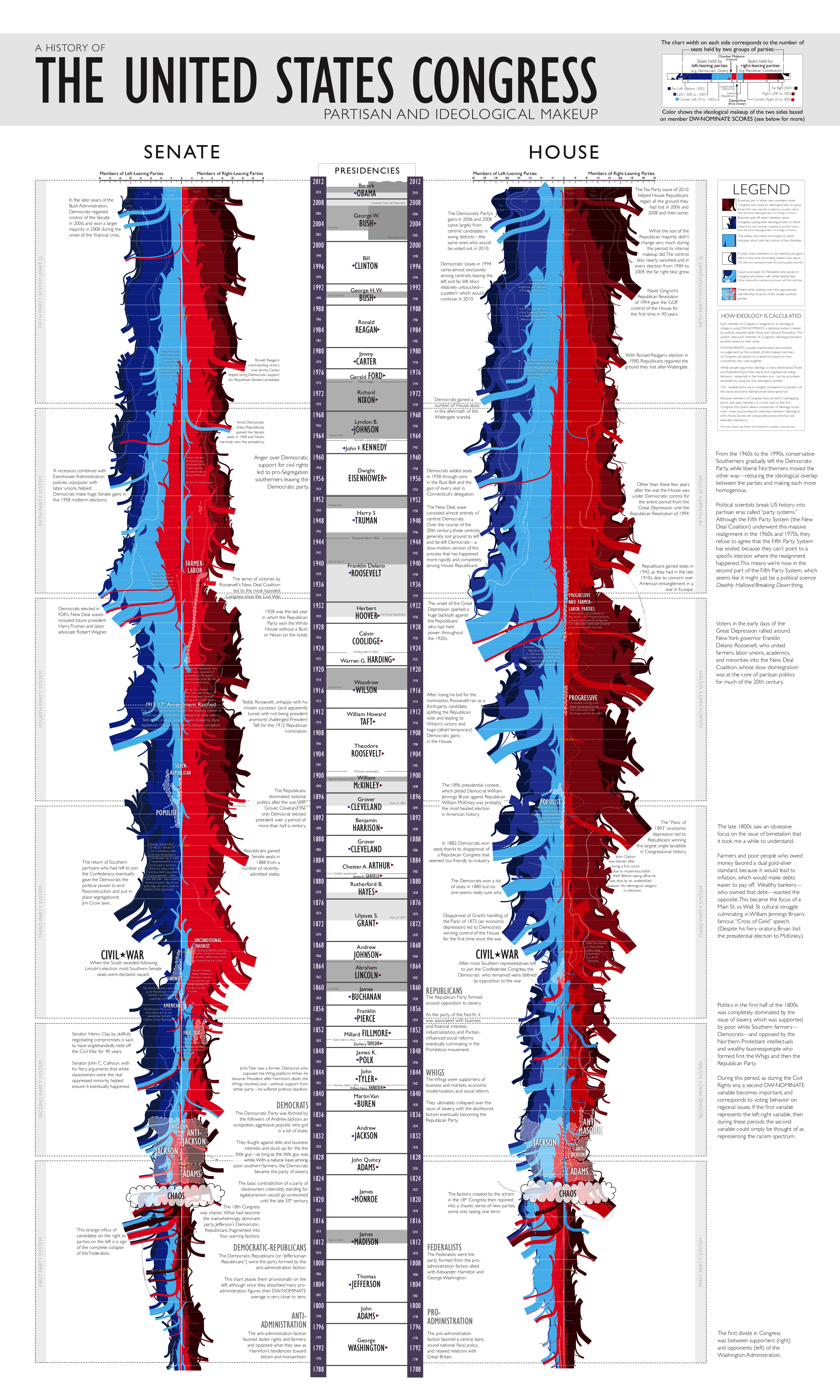
It's worth devoting an entire class.
- Click here for the full version.
Wednesday, June 29, 2016
From the Guardian: Why elections are bad for democracy Our voting system worked well for decades, but now it is broken. There is a better way to give voice to the people
Is there a better way for people to make decisions? One that checks sudden fickle urges?
Perhaps we should substitute elections with lotteries.
- Click here for the article.
Perhaps we should substitute elections with lotteries.
- Click here for the article.
What kind of democracy is appropriate to an era of fast, decentralised communication? How should the government deal with all those articulate citizens who stand shouting from the sidelines?
Imagine having to develop a system today that would express the will of the people. Would it really be a good idea to have them all queue up at polling stations every four or five years with a bit of card in their hands and go into a dark booth to put a mark next to names on a list, names of people about whom restless reporting had been going on for months in a commercial environment that profits from restlessness?
People care deeply about their communities and want to be heard. But a much better way to let the people speak than through a referendum is to return to the central principle of Athenian democracy: drafting by lot, or sortition as it is presently called. In ancient Athens, the large majority of public functions were assigned by lot. Renaissance states such as Venice and Florence worked on the same basis and experienced centuries of political stability. With sortition, you do not ask everyone to vote on an issue few people really understand, but you draft a random sample of the population and make sure they come to the grips with the subject matter in order to take a sensible decision. A cross-section of society that is informed can act more coherently than an entire society that is uninformed.
Experiments with sortition have been successfully applied in the US, Australia, and the Netherlands. The most innovative country so far is certainly Ireland. In December 2012, a constitutional convention began work in order to revise several articles of the constitution of Ireland. Its members were not just a committee of MPs working behind closed doors, but a mixture of elected politicians and ordinary people: 33 elected politicians and 66 citizens, drafted by lot, from both Ireland and Northern Ireland. This group met one weekend per month for more than a year.
For more: Is It Time to Take a Chance on Random Representatives? Selecting legislators by lottery was good enough for the ancient Athenians. Why not good enough for Congress?
Thursday, January 7, 2016
Apparently, the House sponsor of one the principle pieces of gun control legislation - the Violent Crime Control and Law Enforcement Act of 1994 - was Jack Brooks, who represent the local area from 1975 to 1995, when he was defeated in the Republican congressional landslide of 1994. This was the campaign run on the 'Contract with America." The fact that he sponsored such a bill indicates how much the local area has changed, but then again he was defeated after sponsoring the law so that tells us something.
For background:
- Violent Crime Control and Law Enforcement Act.
- Jack Brooks.
- United States House of Representatives elections, 1994.
- Contract with America.
For background:
- Violent Crime Control and Law Enforcement Act.
- Jack Brooks.
- United States House of Representatives elections, 1994.
- Contract with America.
Friday, December 18, 2015
Catching up with Congress
I'll spend the bulk of today adding content related to Congress. The current Congress is the 114th Congress - since it's the 114th time it has met since the he first Congress met from 1789 to 1791. Here are a few places you - 2305 M3 students - can go to familiarize yourself with it prior to digging into class material. I'll add content related to recent activity soon.
For a look at past - hopefully helpful - blog posts, click on these>
- Congress.
- 114th Congress.
- bill making.
For other places to go:
- U.S. House of Representatives.
- U.S. Senate.
- Congress.gov.
- GovTrack.
- The Hill.
- Roll Call.
For a look at past - hopefully helpful - blog posts, click on these>
- Congress.
- 114th Congress.
- bill making.
For other places to go:
- U.S. House of Representatives.
- U.S. Senate.
- Congress.gov.
- GovTrack.
- The Hill.
- Roll Call.
Thursday, November 12, 2015
From the Fiscal Times: Looks Like Congress Can’t Stand the Idea of an Independent Federal Reserve
The Federal Reserve is designed to be insulated from the political branches so that it makes its decisions according to economic, not political, factors. Nevertheless members of Congress - as should be expected from any group of ambitious people - want to control it.
Here's a look at what is driving this desire. The new chair of the Ways and Means Committee - area rep Kevin Brady - is at the center of these efforts.
- Click here for the article.
Here's a look at what is driving this desire. The new chair of the Ways and Means Committee - area rep Kevin Brady - is at the center of these efforts.
- Click here for the article.
Friday, October 30, 2015
What made the 91st Congress so cooperative?
A close look at the graph below shows that the 91st Congress - which met from 1969 - 1971 - was the least polarized and most cooperative in the past few decades. This is based on visual analysis anyway. If you look through the graph below, its the one that has the greatest degree of overlap between the Democrats and Republicans.

I have no idea why, but its worth exploring (I'm thinking this might be a good subject for a weekly written assignment for 2305). Its worth noting that the 91st Congress elected in the critical election of 1968 - the one that kicked off the 6th party era - maybe that matters. It was dominated by Democrats and dealt with the initial two years of Richard Nixon's presidency. Again - maybe that matters.
Here's an overview of it from Congress.gov:
And some of the major laws passed:
- The Equal Rights Amendment.
- Organized Crime Control Act of 1970.
- The Legislative Reorganization Act of 1970.
- Controlled Substances Act.
- National Environmental Policy Act.
For general information about that session of Congress click on these.
- House.gov: 91st Congress.
- Wikipedia: 91st Congress.
- Wikipedia: Legislative record of the 91st Congress.
- Richard Nixon: Statement About the Legislative Record of the 91st Congress.
I have no idea why, but its worth exploring (I'm thinking this might be a good subject for a weekly written assignment for 2305). Its worth noting that the 91st Congress elected in the critical election of 1968 - the one that kicked off the 6th party era - maybe that matters. It was dominated by Democrats and dealt with the initial two years of Richard Nixon's presidency. Again - maybe that matters.
Here's an overview of it from Congress.gov:
The 91st Congress (1969–1971) faced several daunting challenges: an unpopular war in Vietnam, race riots in the cities, a rising crime rate, and an economic recession. College campuses erupted in protest when President Richard Nixon ordered U.S. troops into Cambodia and escalated the Vietnam War. Congress defeated the President’s attempt to change welfare policy, and rejected two of Nixon’s nominees to the Supreme Court. As animosity mounted between the White House and Capitol Hill, Congress reorganized itself in 1970 to foster transparency with new voting rules, a new budget process, and a more professional staff.
And some of the major laws passed:
- The Equal Rights Amendment.
- Organized Crime Control Act of 1970.
- The Legislative Reorganization Act of 1970.
- Controlled Substances Act.
- National Environmental Policy Act.
For general information about that session of Congress click on these.
- House.gov: 91st Congress.
- Wikipedia: 91st Congress.
- Wikipedia: Legislative record of the 91st Congress.
- Richard Nixon: Statement About the Legislative Record of the 91st Congress.
Thursday, October 29, 2015
Whats drives polarization?
The article referred to in the previous post has some valuable information in its introduction which I think is worth highlighting separately.
- Click here for the article.
Prior to detailing the focus of their study, they offer a list of factors that are commonly attributed to have lead to partisan polarization. Here's what they have to say (I've edited the format for emphasis):
The authors investigate whether the party affiliation of legislators make a difference as well, They find that it does, and is diminishing the ability of members of Congress to cooperate:
They make an observation I think is worth sharing:
Perhaps the tendency of people to support ideologically driven partisans is minimizing the ability to Congress to function.
- Click here for the article.
Prior to detailing the focus of their study, they offer a list of factors that are commonly attributed to have lead to partisan polarization. Here's what they have to say (I've edited the format for emphasis):
Americans today are represented by political figures who struggle to cooperate across party lines at an unprecedented rate, resulting in high profile fiscal and policy battles, government shutdowns, and an inability to resolve problems or enact legislation that guides the nation’s domestic and foreign policy.
Partisanship has been attributed to a number of causes, including
1 - the stratifying wealth distribution of Americans
2 - boundary redistricting
3 - activist activity at primary elections
4 - changes in Congressional procedural rules
5 - political realignment in the American South
6 - the shift from electing moderate members to electing partisan members
7 - movement by existing members towards ideological poles
8 - and an increasing political, pervasive media
The authors investigate whether the party affiliation of legislators make a difference as well, They find that it does, and is diminishing the ability of members of Congress to cooperate:
We find that despite short-term fluctuations, partisanship or non-cooperation in the U.S. Congress has been increasing exponentially for over 60 years with no sign of abating or reversing. Yet, a group of representatives continue to cooperate across party lines despite growing partisanship.
They make an observation I think is worth sharing:
This increase in non-cooperation leads to an interesting electoral paradox. While U.S. voters have been selecting increasingly partisan representatives for 40 years, public opinion of the U.S. Congress has been steadily declining. This decline suggests that voters cast their ballots on a local basis for increasingly partisan representatives whom they view as best representing their increasingly partisan concerns, leaving few if any moderate legislators to connect parties for a more cohesive Congress. Elected representatives are increasingly unable to cooperate at a national Congressional level but are re-elected at least 90% of the time, reflecting an evasion of collective responsibility. Voters might believe that highly partisan candidates will ‘tip the scale’ in one party’s favor. However, based on correlations shown here, a partisan candidate may lack cooperation needed to pass legislation. More moderate legislators may have a competitive advantage in negotiating for their party’s legislation.
Perhaps the tendency of people to support ideologically driven partisans is minimizing the ability to Congress to function.
Another graphical look at polarization in Congress over time

It was produced by some political scientists for a paper titled The Rise of Partisanship and Super-Cooperators in the U.S. House of Representatives.
- Click here if you are ambitious.
Vox comments on it here. Wonkblog comments on it here.
Monday, October 19, 2015
From the Monkey Cage: No, Americans have not become more ideologically polarized
It's not about polarization, its about "sorting."
- Click here for the article.
- Click here for the article.
The polarization of Democrats and Republicans in Congress is so well-known that it seems natural to conclude that the American public is polarizing, too. A recent Pew Research Center report generated headlines such as “Polarization is dividing American society, not just politics.” Ezra Klein called polarization “The single most important fact about American politics.” A prominent political scientist wrote a book titled “The Polarized Public.” And in the pages of this very blog, another prominent political scientist declared, “Americans are so polarized, they’re even polarized about polarization.”
This narrative is badly skewed. In fact, scholars do not agree that the American public has actually become more polarized. Our new research, forthcoming at the Journal of Politics, shows that although Americans disagree about many political issues, they have not become more polarized over the past 60 years.
Our research takes advantage of everything we know about people’s issue positions from the longest running and most respected survey in political science, the American National Election Studies. Unlike previous research, which tends to focus on changes in a few policy attitudes between two time periods, we use all of the survey questions about domestic policy that are available to us in 27 different surveys over 60 years.
Wednesday, September 30, 2015
Here's the secret to Boehner's success - as it were.
From Roll Call: McCarthy Raises Campaign Cash, But He's No Boehner.
House Majority Leader Kevin McCarthy is one of the strongest campaign fundraisers in his conference, but he still can't hold a candle to outgoing SpeakerJohn A. Boehner, say Republicans mulling McCarthy as Boehner's successor.
Boehner’s fundraising operation was so extensive and successful — he donated tens of millions to his colleagues and candidates via multiple campaign committees and PACs — that his departure will leave a massive hole in Republican Party and GOP candidate coffers.
McCarthy is a Boehner protégé who has emulated the speaker’s fundraising practices — something that gives him a huge leg up in the contest to replace Boehner.
The only other House Republican considered in McCarthy’s league as a political money rainmaker is House Ways and Means Chairman Paul D. Ryan, a former vice presidential candidate who chairs a fundraising arm of the Republican National Committee known as the Presidential Trust. Ryan has taken himself out of the running for the speakership.
McCarthy has netted $13.1 million for his campaign committee and his personal leadership PAC since the beginning of 2014, according to the Center for Responsive Politics, a nonprofit that tracks political money. In the 2014 election cycle, a lucrative McCarthy joint fundraising committee known as the McCarthy Victory Fund pulled in $4.2 million.
But in that same election cycle, Boehner’s joint fundraising committee netted eight times that amount, with $35.4 million in receipts for the 2014 midterms alone. The Boehner for Speaker joint fundraising committee — a type of campaign account that raises large contributions and divvies them up amongst smaller committees — collected more than $71 million during Boehner’s tenure as speaker, CRP data show.
“The political operation that Speaker Boehner put together, I think, is unmatched, unparalleled,” said Dirk Van Dongen, president of the National Association of Wholesaler-Distributors. “He just raises a phenomenally large sum of money for members of the House and for candidates, and it remains to be seen what the future of the organization will be.”
Thursday, September 24, 2015
About those joint meetings of Congress
One happened today - Pope Francis spoke before Congress for about an hour. He's the fourth foreign leader to speak before a joint meeting of Congress - since he's the head of Vatican City he's considered to be both a religious and political leader.
The House website provides background:
- Foreign Leaders & Dignitaries Who Have Addressed the U.S. Congress.
And - of course - Wikipedia has a list of all joint meeting and sessions of Congress since day one.
- Click here for it.
As well as information about the event.
- Click here for that.
The House website provides background:
- Foreign Leaders & Dignitaries Who Have Addressed the U.S. Congress.
And - of course - Wikipedia has a list of all joint meeting and sessions of Congress since day one.
- Click here for it.
As well as information about the event.
- Click here for that.
Sunday, September 20, 2015
From Congress.Gov: The Legislative Process
The Library of Congress has a series of videos - nine in total - that detail the legislative process.
- Click here for it.
Enjoy - you'll learn more from them than from me.
And they have this handy graphic:

- Click here for it.
Enjoy - you'll learn more from them than from me.
And they have this handy graphic:
Thursday, September 10, 2015
From the Baltimore Sun: The death of the congressional committee
Woodrow Wilson once observed: "Congress in committee is Congress at work." But what was once a keen observation is now little more than an anachronism describing a Congress that no longer exists. In theory, the committee structure is crucial to a functioning Congress. By dividing the work among specialized "mini-congresses," the committee system allows Congress to become greater than the sum of its parts. Committees allow Congress to overcome the challenges of managing a diverse and numerous body through specialization and structure. Perhaps of greater import, committees offer the promise of deliberation, moderation and compromise as a multitude of voices contribute to the crafting of legislation … in theory.
In reality, the committee system in Congress has become increasingly irrelevant, especially with regard to what might be considered major or controversial legislation. Instead, most major policy decisions are made, not through a process of deliberation, but through the concerted efforts of party leadership and often with the total exclusion of not only minority party members but most of the rank and file membership of the majority party as well.
For more:
- Wikipedia: United States congressional committee.
Wednesday, September 9, 2015
Why does Congress recess each August?
Congress is back in session as of 9/8/15 - it takes each August off. Why?
- Here's an explanation from the U.S.Senate's website.
It's about the heat:
A congressional staffer argues that the recess makes life better for everyone.
Since the explanation mentioned the Legislative Reorganization Act of 1970, here's a bit on it:
- Wikipedia: Legislative Reorganization Act of 1970.
- Public Law 91-510.
- Here is the description of the reorganization from House.gov:
If you feel ambitious read the following:
- A Brief History of Congressional Reform Efforts.
- Here's an explanation from the U.S.Senate's website.
It's about the heat:
Each year, Congress recesses for the month of August. During the Senate's early years, senators typically convened a session in December and adjourned in the spring, before the summer heat overwhelmed them and their small staff. When the Senate moved to its current chamber in 1859, senators were optimistic about its "modern" ventilation system, but they found the new system ineffective. The 1920s brought "manufactured weather" to the Senate chamber, but even modern climate control could not cope with the hottest days, forcing 20th-century senators to find ways to escape the summer heat. By the mid-20th century, a more modern air conditioning system brought relief, but year-long sessions presented new problems. By the 1950s the job of a U.S. senator was a full-time, year-round job and there were very few breaks built into the legislative calendar. In 1963, for example, the Senate met from January to December without a break longer than a three-day weekend. Consequently,members of Congress sought a way to establish a summertime recess. In 1970, finally facing the reality of year-long sessions, Congress mandated a summer break as part of the Legislative Reorganization Act. Today, the August recess continues to be a regular feature of the Senate schedule, a chance for senators to spend time with family, meet with constituents in their home states, and catch up on summer reading.
A congressional staffer argues that the recess makes life better for everyone.
Since the explanation mentioned the Legislative Reorganization Act of 1970, here's a bit on it:
- Wikipedia: Legislative Reorganization Act of 1970.
- Public Law 91-510.
- Here is the description of the reorganization from House.gov:
Proposed by the Joint Committee on the Organization of Congress, the legislation overhauled congressional internal procedures and administration for the first time in a generation. The House passed the final version of the bill on October 8, 1970. The reforms made House and Senate processes more transparent by making all committee hearings (excluding national security meetings and Appropriations) public, as well as by permitting televised broadcasts of many of these committee hearings. The most extraordinary change to the House of Representatives was the addition of electronic voting to the House Chamber. The state of the art million-dollar system eventually went into operation on January 23, 1973. The first vote was a 15 minute roll call vote of Members, which prior to the electronic system took on average 30 to 45 minutes.
If you feel ambitious read the following:
- A Brief History of Congressional Reform Efforts.
Subscribe to:
Posts (Atom)