Showing posts with label party eras. Show all posts

Thursday, August 10, 2023

Political Eras / Party Systems of the United States

Definition: 

- Wikipedia: Political eras of the United States:

Political eras of the United States refer to a model of American politics used in history and political science to periodize the political party system existing in the United States.

- - First Party System

The First Party System was the political party system in the United States between roughly 1792 and 1824. It featured two national parties competing for control of the presidency, Congress, and the states: the Federalist Party, created largely by Alexander Hamilton, and the rival Jeffersonian Democratic-Republican Party, formed by Thomas Jefferson and James Madison, usually called at the time the Republican Party (which is distinct from the modern Republican Party).

federal assumption of state debt
a tariff to pay off those debts
a national bank to facilitate financing
encouragement of banking and manufacturing
a standing army and navy
foreign policy: France or Britain.

- - Second Party System


The Second Party System was the political party system operating in the United States from about 1828 to 1852, after the First Party System ended. The system was characterized by rapidly rising levels of voter interest, beginning in 1828, as demonstrated by Election Day turnouts, rallies, partisan newspapers, and high degrees of personal loyalty to parties.
centralization of the national government
the central bank
abolition of slavery
enfranchisement
ratification of Texas
war with Mexico
- - Third Party System

The Third Party System was a period in the history of political parties in the United States from the 1850s until the 1890s, which featured profound developments in issues of American nationalism, modernization, and race. This period, the later part of which is often termed the Gilded Age, is defined by its contrast with the eras of the Second Party System and the Fourth Party System.

It was dominated by the new Republican Party, which claimed success in saving the Union, abolishing slavery and enfranchising the freedmen, while adopting many Whig-style modernization programs such as national banks, railroads, high tariffs, homesteads, social spending (such as on greater Civil War veteran pension funding), and aid to land grant colleges.
industrialization
national banks
railroads
tariffs
western expansion
homesteading
veterans pensions
land grant colleges

- - Fourth Party System

The Fourth Party System was the political party system in the United States from about 1896 to 1932 that was dominated by the Republican Party, except the 1912 split in which Democrats captured the White House and held it for eight years.

American history texts usually call the period the Progressive Era. The concept was introduced under the name "System of 1896" by E. E. Schattschneider in 1960, and the numbering scheme was added by political scientists in the mid-1960s.

The period featured a transformation from the issues of the Third Party System, which had focused on the American Civil War, Reconstruction, race, and monetary issues.
progressivism
race
monetary issues
isolationism
WW1
immigration

- - Fifth Party System

The Fifth Party System, also known as the New Deal Party System, is the era of American national politics that began with the election of Franklin D. Roosevelt to President of the United States in 1932. Roosevelt's implementation of his popular New Deal expanded the size and power of the federal government to an extent unprecedented in American history, and marked the beginning of political dominance by the Democratic Party that would remain largely unbroken until 1952. This period also began the ideological swapping of Democrats and Republicans into their modern versions, largely due to most Black voters switching from the Republican Party to the Democratic Party, while most conservative, White, usually southern Democrats shifted to the Republican Party as Democrats began increasingly prioritizing civil rights;

New Deal
roll of government in the economy
social security
labor laws
segregation
Cold War
Women's Rights
- - Sixth Party System

The Sixth Party System is the era in United States politics following the Fifth Party System. As with any periodization, opinions differ on when the Sixth Party System may have begun, with suggested dates ranging from the late 1960s to the Republican Revolution of 1994. Nonetheless, there is agreement among scholars that the Sixth Party System features strong division between the Democratic and Republican parties, which are rooted in socio-economic, class, cultural, religious, educational and racial issues, and debates over the proper role of government.

- - Seventh Party System (?)

Since the election of Donald Trump in 2016, the Republican Party's more moderate, neoconservative faction has been increasingly ostracized by a growing far-right, paleoconservative faction, most commonly known as Trumpists. Peter J. Katzenstein, Professor of International Studies at Cornell University, believes that Trumpism rests on three pillars, namely nationalism, religion, and race. According to Jeff Goodwin, Trumpism is characterized by five key elements: social conservatism, capitalism, economic nationalism, nativism, and White nationalism.

Monday, October 31, 2016

From Roll Call: Minnesota Blue Dog Isn't Ready to Give Up His District - Collin Peterson’s seat will almost certainly flip when he retires

Not that many Blue Dog Democrats can be found anymore - these were brought in one of my classes recently. This is one of the last of a dying breed of conservative Democrats.

- Click here for the article.


Collin C. Peterson is the last thing keeping Minnesota’s 7th District blue.
Democrats are always worried that the 13-term congressman is going to retire. Because if he does, his heavily agricultural district will almost certainly send a Republican to Congress.
But Peterson, one of the original and last surviving Blue Dog Democrats in the House, is giving no hints of slowing down. In fact, the 72-year-old says he’s enjoying Congress more these days, which likely comes as good news to Democrats already looking to minimize House losses in the 2018 midterms.
“As long as I think I’m making a difference, I’ll probably keep going,” Peterson said in an interview last week at a fish fry for his Democratic-Farmer-Labor colleague, 8th District Rep. Rick Nolan.
Peterson said he’s had a better time in Congress the last couple of years because his attitude has changed slightly.
“I lightened up a little bit,” Peterson said. “I just figured there’s so much stuff I can’t do anything about anyway, so I just pay attention to what I can do something about and don’t worry about the rest of it.”

For more on Blue Dogs:

- A BRIEF HISTORY OF: Blue Dog Democrats.
- What is a Blue Dog Democrat?
- Yellow Dog and Blue Dog Democrats.
- Bye-bye, blue dog “Democrats”: What the end of conservative Dems means for America.

Wednesday, October 19, 2016

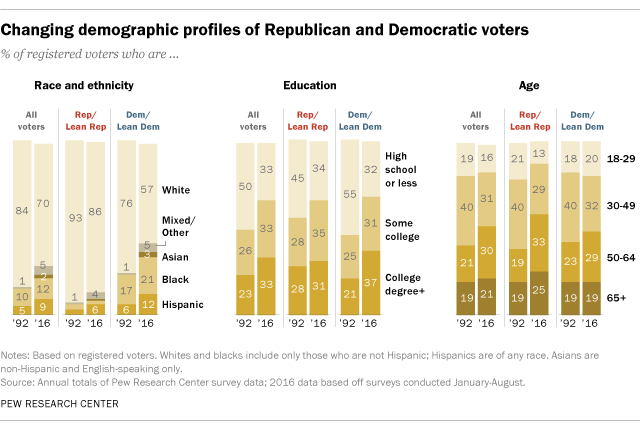
From the Pew Research Center: The Parties on the Eve of the 2016 Election: Two Coalitions, Moving Further Apart

More on the shifts in party identification that seem to be underway this electoral cycle, but in greater detail.

Also some detail on what's driving party polarization.

- Click here for the report.

Ahead of the presidential election, the demographic profiles of the Republican and Democratic parties are strikingly different. On key characteristics – especially race and ethnicity and religious affiliation – the two parties look less alike today than at any point over the last quarter-century.
The fundamental demographic changes taking place in the country – an aging population, growing racial and ethnic diversity and rising levels of education – have reshaped both party coalitions. But these changes, coupled with patterns of partisan affiliation among demographic groups, have influenced the composition of the two parties in different ways. The Democratic Party is becoming less white, less religious and better-educated at a faster rate than the country as a whole, while aging at a slower rate. Within the GOP the pattern is the reverse: Republican voters are becoming more diverse, better-educated and less religious at a slower rate than the country generally, while the age profile of the GOP is growing older more quickly than that of the country.

Thursday, October 6, 2016

From Bloomberg: Education Level Emerges as Sharp Dividing Line in Clinton-Trump Race

This is the third article making the same basic claim about an emerging dividing line among Republican identifiers - and the electorate in general.

- Click here for the article.

There are many demographic fault lines emerging in this year’s presidential campaign, but few are deeper than the division among likely voters based on educational attainment.
Those with the least number of years of education are far more likely to support Donald Trump, while those who have had the most schooling are much more likely to back Hillary Clinton, according to a Bloomberg Politics national pollreleased this week.
“The presence or absence of a college degree is more predictive of the vote in this election than we’ve seen in past elections,” said pollster J. Ann Selzer, who oversees many political surveys for Bloomberg Politics.

Another trend may also be developing in the campaign that could pose a threat to Clinton: apathy among potential voters under age 35.
Both of these subplots were revealed in the new poll, with educational level offering the starkest contrast.
Clinton wins the college-educated segment by 25 percentage points, 59 percent to 34 percent. Trump’s edge among those without a college education is 10 points, 52 percent to 42 percent.
Trump’s lead is 4-to-1 among white men with less than a college degree, 76 percent to 19 percent. Clinton’s advantage with college-educated women is 64 percent to 31 percent.
That’s vastly different from what was recorded in the 2012 presidential election, when exit polling showed 47 percent of voters were college graduates. In that contest, President Barack Obama only narrowly beat Republican challenger Mitt Romney among college graduates, 50 percent to 48 percent.
It’s also different from the two presidential contests before that. In 2008, Obama won among both those who did and did not graduate college by almost identical margins over Senator John McCain of Arizona (53 percent to 45 percent, and 53 percent to 46 percent).
In 2004, President George W. Bush beat then-Senator John Kerry of Massachusetts among those with no college degree, 53 percent to 47 percent. Among those with college degrees, the two men tied at 49 percent.

From 538: Trump’s Doing Worse Than Romney Did Among White Voters

More support for the argument that college educated white voters are realigning from the Republican to Democratic Party just as those without a college degree have been headed in the opposite direction.

The only question is whether this shift will last more than one electoral cycle.

- Click here for the article.

Donald Trump’s strategy in this campaign has been fairly clear from the beginning: Drive up Republican support among white voters in order to compensate for the GOP’s shrinking share among the growing nonwhite portion of the electorate. And Trump has succeeded in over performing among a certain slice of white voters, those without a college degree. But overall, the strategy isn’t working. Trump has a smaller lead among white voters than Mitt Romney did in 2012, and Trump’s margin seems to be falling from where it was when the general election began.
. . . Perhaps, it would be better news for Trump if he were at least trending in the right direction with white voters. But he’s moved backward compared with polls back in May and early June. Back then, Trump led Clinton by 17 percentage points, on average, among white voters. In other words, the longer white voters have had a chance to listen to Trump’s message, the more they have been put off by it as a group.
To be more specific, Trump is trading one type of white voter for another. Even as he piles up support among white men without a college degree, he’s on track for a record poor performance for a Republican among white voterswith a degree. And right now, that tradeoff is a net negative for Trump, compared with Romney. If a ton of new white voters without a degree flooded into the electorate, that could change the math for Trump. But such a surge doesn’t look like it’s in the offing.

Tuesday, October 4, 2016

From Slate: The Democratic Party’s Racial Reckoning

The article is harsh on Trump supporters, but it offers analysis supporting the argument that a realignment is occurring that will change the coalitions within each party for the next few elections. We may finally be on the dawn of a new party era.

Or maybe not.

The racial dynamics have shifted since Bill Clinton has been in office.

- Click here for the article.


The Democratic Party of Bill Clinton relied on voters who were unfriendly—even hostile—to racial liberalism. And it moved accordingly. Bolstered by the economy as well as these cultural moves, Clinton would claim the center of American politics, winning an easy re-election and eventually ending his term as one of the most popular presidents in recent memory, despite scandal and an impeachment attempt.
But that was then. Today, those voters—among them millions of working-class white men—are lost to the Democratic Party, in a shift that began under George W. Bush but accelerated under the presidency of Barack Obama. Democrats today win a smaller share of white voters—and the white workers in particular—than ever before. The home for those voters is in the GOP, under Trump, who turned a substantial majority with working-class whites into an overwhelming one, enough to win Ohio and Iowa and possibly other Midwestern states. But there’s been a backlash to this backlash. Trump’s success with working-class whites has come at the expense of the Republican Party’s historic advantage with college-educated and professional whites, who now favor Hillary Clinton. Increasingly, the Democratic electorate is shorn of those voters who are skeptical of racial and cultural liberalism or who vote on that skepticism.
Hillary demonstrated her distance from racists just as her husband used Sister Souljah to demonstrate his independence from black interests.
Bill Clinton distanced himself from anything that smacked of identity politics or traditional liberalism. Hillary Clinton has not. This speaks to a larger reality in American politics. Racism—either virulent or implicit—is the enemy of progressive political coalitions. It’s either an obstacle to building those coalitions in the first place, or it’s a part of the process that unravels them. White departure from the Democratic Party cost it the Oval Office for nearly 20 years, and the effort to win those whites back yielded a disappointing and myopic centrism. But now those whites aren’t as central to Democratic presidential fortunes, and it has given many in the party the space they need to move in a more liberal direction. And looking at the tenor of Democratic policy debates over the past year—debates over how the welfare state should expand, not if it should—they have. Which is to say that the great upside of this shift is for the blacks, Latinos, and young people who form a critical part of the Democratic Party’s national electorate. Their demands for criminal justice reform, immigration reform, and broader economic reform—as channeled through the primary campaign of Bernie Sanders—aren’t a deal-breaker for national Democratic politicians.

Thursday, August 25, 2016

From Politico: The 1965 Law That Gave the Republican Party Its Race Problem

For 2305 - and 2306. It wasn't just the Civil Rights Act that set the stage for the current political environment.

- Click here for the article.

During the long, three-year debate over the immigration act of 1965, members of Congress debated the wisdom and morality of removing 1920s-era quotas on immigration to the United States. Not far from the center of this debate was the nettlesome issue of race.

“The people of Ethiopia have the same right to come to the United States under this bill as the people from England, the people of France, the people of Germany, [and] the people of Holland,” griped Senator Sam Ervin, a conservative Democrat from North Carolina. “With all due respect to Ethiopia, I don’t know of any contributions that Ethiopia has made to the making of America.”

President Lyndon Johnson, hoping to tamp down concerns about the immigration act at a time when Congress was engaged in an even more ferocious debate over the voting rights act, sought to downplay the implications of the proposed immigration law: “This bill that we will sign today is not a revolutionary bill,” he said upon signing it. The president, like many other of the law’s supporters, sincerely believed that Europeans were most likely to take advantage of less stringent U.S. immigration policy.

He was wrong.

The Hart-Celler Act, so-called after its co-sponsors New York Congressman Emanuel Celler and Michigan Senator Philip Hart, opened the floodgates to new immigrants when it went into effect in 1968. But the vast majority of them didn’t come from Europe; they came instead from Latin America, Africa and Asia. In 1965, non-Hispanic whites comprised over 85 percent of the American population. Fifty years later, that portion is just 62 percent, and falling.

This is also why, 50 years later, Donald Trump is
winning 52 percent of the white vote (to Hillary Clinton’s 40 percent) on a platform uniquely unappealing to minority voters—but losing the election, according to almost every poll. The Hart-Celler Bill of 1965 turned out to be not only revolutionary, but perhaps also the most revolutionary act of the 1960s. It is certainly the piece of Great Society legislation that has had the most impact on the presidential election of 2016.

Monday, August 22, 2016

From the New York Times: 50 Years of Electoral College Maps: How the U.S. Turned Red and Blue

Another look at a story we cover in both 2305 and 2306 about how the major parties realigned after the election of 1964 - including Texas.

The along graphics are worth your time.

- Click here for the article.

It really begins with the election of 1948 when Southern states pulled support from the Democratic Party following Truman's support for civil rights policies.

- Click here for that story.

By 1947, as the Cold War with the Soviet Union intensified and the nation was becoming increasingly anti-Communist and intolerant, Harry Truman astonished everyone by suddenly supporting civil rights. Truman had been outraged at the murder and assaults on dozens of black veterans of World War II. Although he once held strong racial biases -- he had used the word "nigger" freely in his speech -- in 1947 he decided to make civil rights a national issue. He authorized a fifteen-man committee on Civil Rights to recommend new legislation to protect people from discrimination. Speaking from the steps of the Lincoln Memorial, Truman became the first president of the United States to address the NAACP. He promised African Americans that the federal government would act now to end discrimination, violence, and race prejudice in American life. Shortly afterward, his panel issued its report confirming that segregation, lynching, and discrimination at the polls had to be ended.
In the election year of 1948, Truman continued to push for civil rights, partially because he felt that it was the right thing to do, and partially because he knew that he had to win the black vote in order to be elected. Although most political analysts predicted a Republican landslide, Truman believed that the election would depend on a handful of cities in the North where the balance of power would be held by black votes. Senator Hubert Humphrey, who was deeply committed to civil rights, had successfully maneuvered the Democratic Party to support a strong civil rights plank in its campaign platform -- much stronger than Truman wanted. One of Truman's strongest arguments in favor of civil rights was that American and Russia were now locked in a deadly "Cold War" and the Russians were using America's Jim Crow policies to win support from the rest of the world. Southerners replied that the civil-rights program was supported by Communists.

Strom Thurmond, Governor of South Carolina, and a group of Southern delegates walked out of the Democratic Convention when the civil-rights platform passed. The dissidents formed the States' Rights party, whose members came to known as Dixiecrats.

Sunday, April 24, 2016

Are liberals driving working class whites out of the Democratic Party?

Have elites driven away working class voters from a party they once dominated? Here are two thoughts on the subject: 

- Yes: The smug style in American liberalism.
- No: Is Liberalism Really “Smug”?Vox says smugness has reshaped the Democratic Party. How droll

From the former:

Beginning in the middle of the 20th century, the working class, once the core of the coalition, began abandoning the Democratic Party. In 1948, in the immediate wake of Franklin Roosevelt, 66 percent of manual laborers voted for Democrats, along with 60 percent of farmers. In 1964, it was55 percent of working-class voters. By 1980, it was 35 percent.
The white working class in particular saw evensharper declines. Despite historic advantages with both poor and middle-class white voters, by 2012 Democrats possessed only a 2-point advantage among poor white voters. Among white voters making between $30,000 and $75,000 per year, the GOP has taken a 17-point lead.
The consequence was a shift in liberalism's intellectual center of gravity. A movement once fleshed out in union halls and little magazines shifted into universities and major press, from the center of the country to its cities and elite enclaves. Minority voters remained, but bereft of the material and social capital required to dominate elite decision-making, they were largely excluded from an agenda driven by the new Democratic core: the educated, the coastal, and the professional.
It is not that these forces captured the party so much as it fell to them. When the laborer left, they remained.

From the latter:

That liberal smugness might deter the white working class from the Democratic Party seems reasonable, if unfalsifiable. But to suggest that it is a prime mover in their alienation from the party is to ignore the actual dynamics at work. The driving reason working-class whites abandoned the Democratic Party is race. The New Deal coalition Rensin describes was devoured by its own contradictions, chiefly, the racism needed to secure white allegiance even as the party tried to appeal to blacks.

Pressed by those blacks, Democrats tried to make good on their commitments, and when they did, whites bolted. The Democratic Party’s alliance with nonwhites is what drove those whites away, not the sniffing of comedians on cable television. And, looking at the politics of the last seven years, it’s still keeping them away. (It’s worth noting that, up until left-leaning whites and minorities elected Barack Obama president, Democrats suffered little loss with working-class whites outside of the South.)

Tuesday, April 19, 2016

From Slate: How the GOP Is Losing Its Grip on Working-Class Republicans 409 87 447 The Tea Party was a red herring. The real revolt of the Republican rank-and-file is upon us.

The author does a better job describing the historical context of the shift that seems to be going on within the Republican Party than I've been able to so far. We will look this over in 2305.

- Click here for it.

A brief history of white working-class voters in America: Between 1932 and 1964, they were diehard Democrats, core constituents of Franklin D. Roosevelt’s New Deal. Lyndon B. Johnson severed that bond when he committed his noblest deed in signing the landmark Civil Rights Act of 1964. “I think we’ve just delivered the South to the Republican Party for the rest of my life and yours,” Johnson told his aide Bill Moyers.
George Wallace, the segregationist governor of Alabama, began fulfilling Johnson’s prophecy when he led Southern whites out of the Democratic Party. Wallace formed the American Independent Party, which took five Southern states and helped deliver the White House to Richard Nixon in 1968—incidentally, the last time a third party carried any state in a U.S. presidential election. Wallace’s Southern voters and their Northern brethren increasingly supported Republicans thereafter, becoming a pillar of the Reagan coalition in the 1980s.

Now a version of that old split has emerged on the right. The Reagan Democrats have become the Trump Republicans, and signs point once again to a breach with the party they have reflexively supported for decades. At one level, the cause is the same as in 1964: reaction against social change that has eroded the value of white privilege. But at another level, this is a revolt by Republican voters who no longer believe that their party supports their basic economic interests.

For more:

- Factions in the Democratic Party.
- Factions in the Republican Party.

Wednesday, April 6, 2016

From The Atlantic: Conservatives Face an Impossible Choice They can back Trump, or run a candidate of their own—but either way, they’ll bring this era of American politics to a close.

The author - a well regarded political strategists - seen Trump splitting the party and ushering a new party era.

- Click here for the article.

When people bolt their party, the party changes behind them.
Take, for example, the Progressive Republicans. When they bolted the party to follow Teddy Roosevelt’s independent campaign in 1912, they left conservatives in control of the Republican apparatus. Before 1912, it was very much an open question whether the reformist movements of the 20th century would find their home in the Republican or Democratic Party. After 1912, the most important of those reforms would be carried out at the federal level by Democrats, and opposed by Republicans. When Republicans regained the White House in 1920, it would be under the leadership of the man who’d delivered the nominating speech for William Howard Taft at the 1912 convention. The young people who’d looked to Teddy Roosevelt for change in 1912 would in many cases end up as followers of his cousin Franklin in 1932—most notably, the former Bull Moose who ran most of the early New Deal, Interior Secretary Harold Ickes.
Or consider the example of George Wallace. When he bolted from the Democratic Party in 1968, he offered downscale Southern whites the same political mix they’d supported since Reconstruction: populist economics joined to racial conservatism. His bolt was intended to frighten national Democrats to jettison Kennedy-Johnson liberalism and return to something like the old ways. Instead, the 1968 election confirmed the Democrats as the party of black interests and black votes. Wallace accelerated the great political realignment of the 1970s: minorities and highly educated whites moving into the Democratic party; downscale whites leaving it, especially in the South.

Or take Ross Perot’s 1992 insurgency. The Republican Party dominated presidential politics from 1968 through 1988, winning every election except 1976, and gaining in 1972 and 1984 two outright landslides: 60.7 percent and 58.8 percent of the vote, respectively.
But in 1992, Perot smashed the old Nixon-Reagan coalition. He won over 20 percent of the vote in the state of California—a solid Republican state before 1992, and never again thereafter. His very best state—Maine—had likewise been a Republican stronghold before 1992, and would never vote Republican again. Perot exposed Republican vulnerabilities in the new purple states of the South, notably North Carolina, where Bill Clinton finished within less than one point of George H.W. Bush.
The white voters most resistant to the Perot message were those who attended church most often. Post-1992, the GOP redefined its base vote in religious rather than economic terms. And while that redefinition reestablished the party’s competitiveness, it also denied it the majority support it had enjoyed pre-Perot. Only once after 1992, in 2004, would the Republican win more than 50 percent of the vote in a presidential election—and then only barely.
Which brings us to the present day.
An anti-Trump bolt will appeal to ideological conservatives, to libertarian leaners, and to the most religiously observant Republicans: what Republican strategist Grover Norquist has called the “leave us alone coalition.” What happens if that coalition does not run strongly in 2016? If it picks up something more like John Anderson’s 1980 6.6 percent of the vote, rather than Ross Perot’s nearly 20 percent? John Anderson ran as a liberal Republican who could not accept Ronald Reagan’s leadership—a group we have not heard much from since 1980. That’s the risk of political tests of strength: Sometimes you lose, and afterward nobody fears you ever again.

A “true conservative” independent race for president may offer anti-Trump Republicans a way to vote their consciences without endorsing Hillary Clinton. But it may also expose “true conservatism” as a smaller factor in U.S. presidential politics than it’s been regarded as since the advent of the Tea Party. And it will leave the instrumentalities of the GOP in the hands of people who were willing to work with Trump, and whose interest post-Trump-defeat will be in adapting his legacy to the future rather than jettisoning it.
Which is not to argue against it. Sometimes a political movement must and should go down fighting. Many conservatives will feel that way about opposing Trump in November 2016. The alternative—ticket-splitting between Hillary Clinton at the top and Republicans down-ballot—also carries daunting dangers. But whatever is decided by conservatives who refuse to board the Trump train, that decision is best made without illusions and false hopes. This election closes a long period in American politics. Whatever comes next, that period will not return.

Tuesday, April 5, 2016

From the NYT: Why Trump Can’t Break the G.O.P.

Parties are more than their presidential candidates. This - says the author - is why Donald Trump cannot damage the party as much as skeptics think.

- Click here for the article.

. . . the modern Republican Party is a rags-and-riches story. After 1988, it has struggled in presidential contests: The Republican candidate has won the popular vote just once, in 2004.
But this unimpressive presidential record has not signaled a party on the verge of collapse. On the contrary, Republicans have done quite well — holding the House, the Senate or both for much of the past three decades while increasing their tally of governorships and state legislatures. They have done so, moreover, without undertaking the kind of adjustment Democrats did after Walter Mondale’s landslide loss in 1984 (nurturing “new Democrats” like Bill Clinton).
Instead, on major issues, the party’s standard-bearers have moved steadily to the right, at least until Mr. Trump came on the scene. Solving this puzzle is key to understanding why grand electoral losses haven’t killed the G.O.P..
The White House is a major prize, but in our system of checks and balances, the president legislates with Congress. In the context of a divided electorate, highly polarized parties and nonstop combat in an unending string of elections to fill national and state offices, presidential contests are less likely to usher in dominance than to invite opposition.
That’s in part because presidential election years — with high and demographically diverse turnout and more or less equal weighting of votes across the country — look very different from the more frequent elections that fill these other institutions. As the political scientist Thomas F. Schaller argued in his book “The Stronghold,” the Republican Party has become centered in Congress, reflecting the geography of its changing base of support.
Over the last generation, Republicans have gained strength in rural areas. This creates a formidable advantage in the Senate, where less populous states get just as many seats as more populous ones.
This structural edge applies to the House. Many Democratic votes are “wasted” in majorities piled up in cities. Republicans can maintain a majority even while Democrats win more votes. In 2012, Republicans had a more than 30-seat edge in the House despite receiving a minority of votes cast in House races.
Our frequent elections offer another structural advantage for Republicans: Voter turnout has always steeply dropped from presidential elections to off-year elections. What is new is the big advantage Republicans now enjoy in the low-turnout environment of nonpresidential years, fed largely by the shift of older voters (who have the highest turnout rates) from the Democratic Party to the Republicans. The imbalance helps explain Republican success in elections for governor, more than four-fifths of which do not coincide with presidential elections.
The electorate is changing in ways that will weaken the Republican advantage in the future — in particular, it’s becoming much more diverse. But Republicans have managed to hold back this tide to some extent by making voting harder (with voter ID laws and the like) and by mobilizing their core voters even more aggressively. And they’ve mobilized them not in spite of their presidential disadvantage, but often by virtue of it.
It is not simply that the G.O.P. enjoys these structural advantages. More and more, it feeds on the failure of its presidential standard-bearers.

Sunday, March 20, 2016

From 538: When Political Parties Splinter

Since conventional wisdom seems to be that Trump's success indicates a shift is underway between the political parties - one that might be fatal to the Republican Party as we know it today - I'll post what I can find relevant to it. It's timely for our upcoming look at political parties in both 2305 and 2306.

Here's the first. It looks at previous splits in American history - they don't happen all the time, but they are not that rare.

- Click here for the article.

The emerging fight within the Republican Party doesn’t look exactly like any of the major party splits of the past. There’s not a clear issue difference at the center of it. Trump is coming in from outside the party; he’s not a former president like Theodore Roosevelt. And party organizations have changed to place more emphasis onvoter input — one of Roosevelt’s chief goals — even as elites play a significant role in managing conflict among factions. That role may become even more important as we head into the later primaries and the convention.
If the GOP does split, it may be for only one or two election cycles, with Trump playing the role of Roosevelt. It’s also possible, however, that the rise of Trumpism within the Republican Party will alienate the Plains states and interior West. How those states vote during the GOP primary could provide some clues (few have voted so far, but Trump has underperformed in Kansas and Oklahoma). Or maybe if Trump wins the nomination, the #NeverTrumps will sleep on the couch for a couple of months but all will be forgiven by the time the general election rolls around.
Regardless, the mere fact that a party splitting seems so plausible is pretty amazing — it doesn’t happen often.


Friday, November 20, 2015

From Vox: Woodrow Wilson was extremely racist — even by the standards of his time

This is a pretty effective hit job on Wilson, but I add it here mostly to illustrate a point we've gone over in class. That the Democratic Party - as we tend to forget - originated as the party of the South and was protective of first slavery and then segregation. Wilson was the first southerner elected to the White House after the end of the Civil War and re-segregated a number of federal agencies. Things would change when the next Democrat - FDR - was elected to the presidency, but this gives you an idea of how tight the relationship between the South and the Democratic Party was at that time, and how much it revolved around race.

- Click here for the article.
Easily the worst part of Wilson's record as president was his overseeing of the resegregation of multiple agencies of the federal government, which had been surprisingly integrated as a result of Reconstruction decades earlier. At an April 11, 1913, Cabinet meeting, Postmaster General Albert Burleson argued for segregating the Railway Mail Service. He took exception to the fact that workers shared glasses, towels, and washrooms. Wilson offered no objection to Burleson's plan for segregation, saying that he "wished the matter adjusted in a way to make the least friction."
Both Burleson and Treasury Secretary William McAdoo took Wilson's comments as authorization to segregate. The Department of Treasury and Post Office Department both introduced screened-off workspaces, separate lunchrooms, and separate bathrooms. In a1913 open letter to Wilson, W.E.B. DuBois — who had supported Wilson in the 1912 election before being disenchanted by his segregation policies — wrote of "one colored clerk who could not actually be segregated on account of the nature of his work [and who] consequently had a cage built around him to separate him from his white companions of many years." That's right: Black people who couldn't, logistically, be segregated were put in literal cages.
Outright dismissals were also common. Upon taking office, Wilson himself fired 15 out of 17 black supervisors in the federal service and replaced them with white people. After the Treasury and Post Office began segregating, many black workers were let go. The head of the Internal Revenue division in Georgia fired all his black employees, saying, "There are no government positions for Negroes in the South. A Negro's place in the corn field." To enable hiring discrimination going forward, in 1914 the federal government began requiring photographs on job applications.

Friday, October 30, 2015

What made the 91st Congress so cooperative?

A close look at the graph below shows that the 91st Congress - which met from 1969 - 1971 - was the least polarized and most cooperative in the past few decades. This is based on visual analysis anyway. If you look through the graph below, its the one that has the greatest degree of overlap between the Democrats and Republicans.


Fig 1.  Probability density functions of same-party and cross-party pairs over time.


I have no idea why, but its worth exploring (I'm thinking this might be a good subject for a weekly written assignment for 2305). Its worth noting that the 91st Congress elected in the critical election of 1968 - the one that kicked off the 6th party era - maybe that matters. It was dominated by Democrats and dealt with the initial two years of Richard Nixon's presidency. Again - maybe that matters.

Here's an overview of it from Congress.gov:

The 91st Congress (1969–1971) faced several daunting challenges: an unpopular war in Vietnam, race riots in the cities, a rising crime rate, and an economic recession. College campuses erupted in protest when President Richard Nixon ordered U.S. troops into Cambodia and escalated the Vietnam War. Congress defeated the President’s attempt to change welfare policy, and rejected two of Nixon’s nominees to the Supreme Court. As animosity mounted between the White House and Capitol Hill, Congress reorganized itself in 1970 to foster transparency with new voting rules, a new budget process, and a more professional staff.

And some of the major laws passed:

- The Equal Rights Amendment.
- Organized Crime Control Act of 1970.
- The Legislative Reorganization Act of 1970.
- Controlled Substances Act.
- National Environmental Policy Act.

For general information about that session of Congress click on these.

- House.gov: 91st Congress.
- Wikipedia: 91st Congress.
- Wikipedia: Legislative record of the 91st Congress.
- Richard Nixon: Statement About the Legislative Record of the 91st Congress.

Tuesday, October 13, 2015

From the Nation: Why Today’s GOP Crackup Is the Final Unraveling of Nixon’s ‘Southern Strategy’

We will be looking at the role the southern strategy played in helping the Republican Party reassert its strength following the New Deal. This author argues that the effort was only helpful in the short term.

- Click here for the article.

Here's a relevant chunk:

Nixon’s reconfiguration brought together “polar opposites among white Americans,” Lilly noted. The traditional wing of the party— “country club” Republicans, who include corporate leaders, financiers and investors—became partners with poor, rural, church-going voters, among them the Southern “segs” who had previously always voted for Democrats. Black Southerners didn’t count in the equation, since they were still mostly being blocked from voting.
After Congress enacted the 1964 Civil Rights Act, Lyndon Johnson confided to a White House aide, “I think we just delivered the South to the Republican Party for a long time to come.” Nixon’s new Republicans became a formidable national party, Lilly explained, but they always straddled the tension between rich and poor.
“The problem,” Lilly said, “is that this latter group has almost nothing in common with the country club wing.… The country clubbers don’t care about prayer in the public schools, gun rights, stopping birth control, abortion and immigration.” On the other hand, common folks don’t worry over marginal tax rates, capital formation, or subsidies for major corporations.
“If they ever fully understood that their more prosperous party brethren were contemplating deep cuts in Medicare and Medicaid to pay for those policies, they would be in open rebellion,” Lilly observed.

Friday, August 7, 2015

On This Day in History: Teddy Roosevelt nominated as Bull Moose candidate

Ironically - given the concerns about Trump's possible run as a third party candidates - on this day in history the most consequential third party candidate was nominated. Roosevelt and Taft split the Republican vote - in an era when Republicans dominated - and the Democrat Woodrow Wilson won.

- Click here for the article.

Theodore Roosevelt, the former U.S. president, is nominated for the presidency by the Progressive Party, a group of Republicans dissatisfied with the renomination of President William Howard Taft. Also known as the Bull Moose Party, the Progressive platform called for the direct election of U.S. senators, woman suffrage, reduction of the tariff, and many social reforms. Roosevelt, who served as the 26th president of the United States from 1901 to 1909, embarked on a vigorous campaign as the party’s presidential candidate. A key point of his platform was the “Square Deal”–Roosevelt’s concept of a society based on fair business competition and increased welfare for needy Americans.
On October 12, 1912, minutes before a campaign speech in Milwaukee, Roosevelt was shot at close range by anarchist William Schrenk. Schrenk, who was immediately detained, offered as his motive that any man looking for a third term ought to be shot. Roosevelt, who suffered only a flesh wound from the attack, went on to deliver his scheduled speech, declaring, “You see, it takes more than that to kill a Bull Moose!” The former “Rough Rider” later collapsed and was rushed to the hospital. He recovered quickly but in November was defeated by Democratic candidate Woodrow Wilson, who benefited from the divided Republican Party.

We cover this episode in the section on political parties - the party eras specifically - but this marks the time when the progressives begin to drift away from the Republican Party and towards the Democratic Party. The process would be complete by 1932, but their increased power in the party would lead the southern conservatives to begin to slowly distance themselves from the Democratic Party and align with the Republicans. This process has only recently been completed.

The wheels of political history keep spinning.

For more:

- Progressive Party.
- 1912 Republican National Convention.
- United States Presidential Election, 1912.

Thursday, April 3, 2014

The election of 1800 and the dawn of party based decision making in Congress

The article linked to in the previous post (click here for it) makes an interesting reference to teh election of 1800. We mentioned this election in 2305 as having inaugurated the first party era.

The author makes a provocative statement that the initial vision of what governance in the US would be was transformed by that election. It gets to the heart of what a political party is. This quote picks up with a discussion of whether contributions pose a rick of "quid pro quo" corruption - a donation made with the expectation of a service performed. If I understand the argument - the author seem to suggest that the decision ignores the likelihood that such corruption can occur through an umbrella agency that impacts a significant number of members of Congress, rather than a single members.

The idea of a Congress composed of separate individuals acting independently ended a long time ago - with the 1800 election:

The argument is a simple one. If the base contribution limit defines the point at which a risk of quid pro quo corruption is present, adhering to that base limit should take care of the corruption risk, no matter how many base contributions are made, rendering the aggregate limits unnecessary. Watching the government twist in that airless room trying to build Rube Goldberg scenarios explaining how a $3.2 million aggregate contribution can seep down to individual candidates or entities in amounts that exceed the base limit would have been funny, if so much weren’t at stake. You knew that five Justices, dead set against the regulations, would reject the government’s scary stories as either unlikely, or subject to other forms of regulation. And that’s just what the McCutcheon plurality does, insisting that the real-world prospect of a single donor cutting a check for millions of dollars to an umbrella entity poses little or no risk that any of the money would find its way to constituent entities in ways that threaten quid pro quo corruption. After all, if you don’t believe that massive independent expenditures on behalf of a candidate pose a risk of electoral corruption, why would you be concerned that even unequal distribution of aggregate contributions poses a risk of quid pro quo corruption of any given recipient? Even on its own terms, the Roberts plurality simply ignores the fact that political decisions are not always, or even usually, the result of atomistic decisions by individual legislators. That was the initial vision of the Founders. All agree that the Founders’ vision did not survive the election of 1800, and that today’s politics take place in the shadow of collective decision-making by political parties, or other less formal political groupings. To the extent the Roberts plurality has a technical flaw, it is the failure to address the risk of quid pro quo corruption in the context of a deal with a group. But I’m afraid that train has left the station.


Thursday, November 7, 2013

From the National Journal: The Whigs Are Partying Like It's 1856

A blast from the past:

The Whigs are making a comeback.

Well, sort of. On Tuesday, 36 Philadelphia voters elected Whig candidate Robert Bucholz as the judge of election for the Fifth Division of the 56th Ward. He beat Democratic opponent Loretta Probasco, who secured 24 votes.

The Whigs haven't been a major political party in the United States since the mid-1800s. The Whigs produced four U.S. presidents in their brief history—William Henry Harrison, John Tyler, Zachary Taylor, and Millard Fillmore—and had several national leaders among its members, including Henry Clay and Daniel Webster.

The party, however, dissolved following the failed presidency of Fillmore that ended in 1853. It also showed deep divides in the party on the issue of slavery.

But in 2007, a group of Iraq and Afghanistan veterans wanted to change that and started the Modern Whig Party.

Its symbol an owl, the party is based in Washington and claims it has 30,000 members across the country. While many of the issues for the party have changed in the last 150 years or so, party members claim its basic political philosophy is the same: moderation and compromise.

. . . A closer comparison of the platforms of the party from 150 years ago to today shows many similarities:

1852:
- Emphasize states rights on most issues.
- Limit foreign entanglements.
- Modernize the economic system through the markets and industrialization.
- Promote higher tariffs on trade, not higher taxes.
- Support a national bank.
- Use government-funded programs to expand the road and canal systems throughout Middle America.
- Create public schools and promote private institutions, like colleges and charities.

2013:

- Give states the power to handles budget issues.
- Develop alternative energy resources and reduce dependency on foreign oil.
- Reform education and add an emphasis on space, oceans, medicine, and nanotechnologies in the public and private sectors.
- Be progressive on social issues, advocating the government stay out of "legislating morality."
- Give veterans proper benefits.