An example of due process, specifically a search and seizure. The back and forth between Dallas police and the Diocese interests me.
- Click here for the article.
An affidavit Dallas police used to obtain a search warrant Wednesday to raid Dallas Catholic Diocese offices laid out allegations against five priests and suggested the church subverted police efforts to obtain more information.
The affidavit, signed by Detective David Clark, who is working full-time on sex abuse allegations within the Diocese, sought to seize Diocese records because the church hadn’t handed over all the records it had about allegations against the priests.
All five priests are on the Diocese’s list of 31 “credibly accused” priests, which the church released in January. That list included only accusations against priests that the Diocese concluded were credible after a review by former law enforcement officials and the Diocean Review Board.
Showing posts with label police departments. Show all posts
Showing posts with label police departments. Show all posts
Thursday, May 16, 2019
Tuesday, October 4, 2016
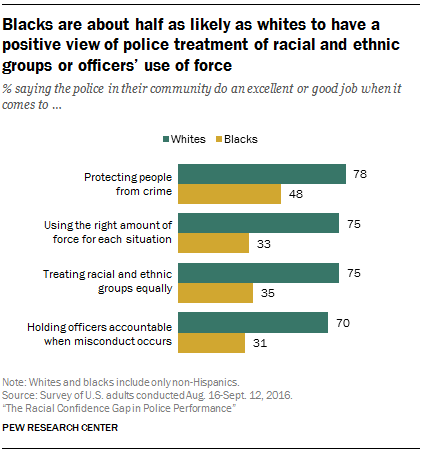
From the Pew Research Center: The Racial Confidence Gap in Police Performance - Blacks, whites also have dramatically different views on causes of fatal encounters between blacks and police
For our look at public opinion, especially group differences.
- Click here for the article.
- Click here for the article.
The deep racial tensions seen in many areas of American life underlie how blacks and whites view police in their communities, as well as their reactions to the deadly encounters in recent years between blacks and law enforcement officers, according to a new survey by Pew Research Center.
Only about a third of blacks but roughly three-quarters of whites say police in their communities do an excellent or good job in using the appropriate force on suspects, treating all racial and ethnic minorities equally and holding officers accountable when misconduct occurs. Roughly half of all blacks say local police do an excellent or good job combating crime – a view held by about eight-in-ten whites.
Blacks and whites also differ over the root causes of the fatal incidents between police and blacks in recent years. Even before the recent lethal encounters between police and black men in Tulsa and Charlotte, the survey found that blacks are 25 percentage points more likely than whites to say the deaths of blacks during encounters with police in recent years are signs of a broader societal problem and not merely isolated incidents.
At the same time, whites and blacks both see the complexity of the situation. Majorities of each race say that both anti-police bias and a genuine desire to hold officers accountable for their actions play a part in fueling the protests that have often followed these fatal incidents, though whites are more skeptical than blacks about the demonstrators’ motives. There is less agreement on which is the more important motivator: For whites, it is anti-police bias (85% vs. 63% who see a sincere desire to promote accountability); for blacks it’s reversed (79% of blacks cite accountability, 56% opposition to the police).
The survey, conducted Aug. 16-Sept. 12 online and by mail among 4,538 U.S. adults, also found that about eight-in-ten blacks and a larger share of whites favor the use of body cameras by police to record encounters with citizens. Majorities of both races also believe that the use of so-called body cams would prompt officers to act more appropriately when dealing with the public.


Wednesday, August 31, 2016
From the Texas Tribune: Unholstered - When Texas Police Pull the Trigger
Among the criminal justice reforms that might be considered in the 85th session of the legislature is shooting by police. The trouble is that very little data exists about these incidents. It's tough to solve a problem little is known about.
- Click here for the report.
From the intro:
- Click here for the report.
From the intro:
Police officers in Texas unholstered their guns and fired at suspects in at least 656 incidents between 2010 and 2015.
At least.
That total is undoubtedly incomplete. It includes only 36 of the state's largest cities from which The Texas Tribune was able to obtain information, often by prying it out of reluctant departments through public records requests. The level of detail provided for individual incidents varied by city, and some said they don't track data on shootings in which no one is hurt.
If information is key to understanding when and why Texas police officers shoot at people, the public, police officials and state lawmakers are working with woefully incomplete facts and figures, and are left to guess at the realities of police use of lethal force. Because there is no consistent, statewide effort to collect such data, discussions and policy debates are largely driven by the most recent, most controversial shootings.Shelby TauberA police officer patrols downtown Austin.
Anyone interested in knowing, for instance, whether Texas police disproportionately shoot at minorities, or are good at de-escalating situations without resorting to lethal force, are flying blind.
“When we don’t have a really solid knowledge base or data to pull from, people will tend to fall back on anecdotal cases they hear reported in the media,” said Kevin Buckler, a criminal justice professor at the University of Houston.
The Texas Tribune spent almost a year attempting to collect information on police shootings from departments in the state’s 36 largest cities, which have a population of 100,000 or more, and was able to confirm 656 fatal and nonfatal shooting incidents involving 738 individuals that occurred between 2010 and 2015. Those 36 cities make up almost half of the state’s population.
Tuesday, July 12, 2016
Introducing: Police - The Law Enforcement Magazine
For our occasional look at the media - a specialty magazine for the police community.
- Click here for it.
Here is one of their articles. It involves the Federal Order of Police - one of the national largest intergovernmental unions.
- FOP Wants Justice Department to Investigate Dallas Sniper Attack as Hate Crime.
- Click here for it.
Here is one of their articles. It involves the Federal Order of Police - one of the national largest intergovernmental unions.
- FOP Wants Justice Department to Investigate Dallas Sniper Attack as Hate Crime.
The nation’s largest police union is calling on the Justice Department to investigate the fatal shooting of five police officers in Dallas Thursday night as a hate crime — and is criticizing President Obama for his response to the shootings so far.
“We’d like to see the president make one speech that speaks to everybody instead of one speech that speaks to black people as they grieve and one speech that speaks to police officers as they grieve,” said Jim Pasco, the executive director of the Fraternal Order of Police, which represents 330,000 officers. “We don’t need two presidents, we only need one. We need one who works to unify the United States.”
Thursday, March 5, 2015
From the NYT: A City Where Policing, Discrimination and Raising Revenue Went Hand in Hand
This is an interesting take on policing. Its as much about revenue collection as it is about keeping the peace.
- Click here for the article.
- Click here for the article.
A 32-year-old black man was sitting in his car, cooling off after playing basketball in a public park in the city of Ferguson, Mo. Then a police officer pulled up.
The officer approached him and demanded his identification. He then accused the man of being a pedophile, since there were children in the park, and ordered him out of his car. When the man objected, the officer arrested him and charged him with eight violations of Ferguson’s municipal code, including a charge for not wearing a seatbelt, even though he was in a parked car.
This encounter in summer 2012 in some ways appeared to be exactly how the criminal justice system in Ferguson had been designed to work, according to an investigation of the Ferguson Police Department released on Wednesday by the United States Justice Department. As described in the report, Ferguson, which is a majority black city but where nearly all city officials are white, acts less like a municipality and more like a self-perpetuating business enterprise, extracting money from poor blacks that it uses as revenue to sustain the city’s budget.
The DOJ report on the Ferguson, Missouri Police Department.
The equal protection clause, along with the rest of the 14th Amendment, allows the national government the opportunity to review a variety of actions on the part of state and local governments.
Using the that authority, the Justice Department issued a report detailing such violations by the police department of Ferguson, Missouri.
- Remarks by the Attorney General.
- The DOJ Report.
Here's media coverage.
- Ferguson Police Routinely Violate Rights of Blacks, Justice Dept. Finds.
- Justice Department: Ferguson Police Biased Against Blacks, Scornful of Constitutional Rights.
Using the that authority, the Justice Department issued a report detailing such violations by the police department of Ferguson, Missouri.
- Remarks by the Attorney General.
- The DOJ Report.
Here's media coverage.
- Ferguson Police Routinely Violate Rights of Blacks, Justice Dept. Finds.
- Justice Department: Ferguson Police Biased Against Blacks, Scornful of Constitutional Rights.
Thursday, June 26, 2014
From the Guardian: The Pentagon's slush fund is arming a War Zone on Main Street. Let's end the local-cop addiction to backyard battle
This picks up a bit on the previous post since it concerns police behavior.
But in this case it focuses on the increased use of military weapons by local police forces. The weaponry has been made available by the military that has lots of it to sell.
- Click here for the article.
But in this case it focuses on the increased use of military weapons by local police forces. The weaponry has been made available by the military that has lots of it to sell.
- Click here for the article.
A few years ago, the police chief in Keene, New Hampshire (population: 23,000) announced plans to patrol the hamlet's "Pumpkin Festival and other dangerous situations" with a 19,000-pound armored vehicle called the BearCat (price tag: $285,933, courtesy of a federal Homeland Security grant).
The cops in nearby Nashua had already purchased one of the so-called "rescue vehicles" – typically reserved for Swat missions and, you know, IEDs – with hundreds of thousands in drug forfeiture money, but given that the town of Keene has had just three homicides in the last 11 years, some locals thought the gun ports, rotating hatch, battering ram and tear-gas deployment nozzle all might just be a little much.
"The police are already pretty brutal," said one resident. "The last thing they need is this big piece of military equipment to make them think they're soldiers."
What many other communities across America have learned since is that we're living in what the writer Radley Balko calls the age of the "warrior cop". And when warrior cops want a straight-outta-Baghdad toy, it's increasingly and unnecessarily simple for them to use a federally enabled slush-fund to wreak havoc – particularly against minorities, and even at a pumpkin festival. It's also pretty simple to start accounting for all the high-tech violence.
"Before another small town's police force gets a $700,000 gift from the Defense Department that it can't maintain or manage," Rep Hank Johnson of Georgia told me this week, "we need to press pause and revisit the merits of a militarized America."
Sunday, April 6, 2014

Friday, December 13, 2013
Rise of the Warrior Cop: The Militarization of America's Police Forces
Here's a link to the book referred to in the previous post.
Might be worth assigning to a future class.
Might be worth assigning to a future class.
From Mother Jones: How Every Part of American Life Became a Police Matter
This touches on issues we raise in 2306 when we talk about criminal justice policy and the tendency of legislatures to try to solve certain problems by criminalizing them.
The author outlines the range of activities now criminalized and questions how far this has gone. Are we now, for all practical purposes, a police state?
The author outlines the range of activities now criminalized and questions how far this has gone. Are we now, for all practical purposes, a police state?
If all you've got is a hammer, then everything starts to look like a nail. And if police and prosecutors are your only tool, sooner or later everything and everyone will be treated as criminal. This is increasingly the American way of life, a path that involves "solving" social problems (and even some non-problems) by throwing cops at them, with generally disastrous results. Wall-to-wall criminal law encroaches ever more on everyday life as police power is applied in ways that would have been unthinkable just a generation ago.
By now, the militarization of the police has advanced to the point where "the War on Crime" and "the War on Drugs" are no longer metaphors but bland understatements. There is the proliferation of heavily armed SWAT teams, even in small towns; the use of shock-and-awe tactics to bust small-time bookies; the no-knock raids to recover trace amounts of drugs that often result in the killing of family dogs, if not family members; and in communities where drug treatment programs once were key, the waging of a drug version of counterinsurgency war. (All of this is ably reported on journalist Radley Balko's blog and in his book, The Rise of the Warrior Cop.) But American over-policing involves far more than the widely reported up-armoring of your local precinct. It's also the way police power has entered the DNA of social policy, turning just about every sphere of American life into a police matter.
Tuesday, November 19, 2013
From the Death Penalty Information Center: The 2% Death Penalty: How a Minority of Counties Produce Most Death Cases At Enormous Costs to All
Some of this we already knew, but according to this report a small number of counties are responsible for most of the death penalty cases in the United States.
Harris County makes the list, but the report raises questions about the fairness of the system and whether the HPD crime lab has produced tainted evidence for prosecutors. Some people convicted of murder have since been exonerated.
Story probably helps illustrate how the political culture in the local area differs from that elsewhere and nationally.
The Huffington Post reviews the report:
Harris County makes the list, but the report raises questions about the fairness of the system and whether the HPD crime lab has produced tainted evidence for prosecutors. Some people convicted of murder have since been exonerated.
Story probably helps illustrate how the political culture in the local area differs from that elsewhere and nationally.
The Huffington Post reviews the report:
The county that's home to Houston is also the most execution-friendly county in America. Under former District Attorney Johnny B. Holmes and his infamous handlebar mustache, Harris County by itself sent more people to death row (more than 200) than all 49 states other than Texas. When reform-minded District Attorney Pat Lykos (a pro-death penalty Republican, by the way) took over in 2008, she set out to look for innocent people convicted under the lock-'em-up-and-throw-away-the-key approach of her predecessors. Since 2008, there have been 11 exonerations Harris County.
The county has also been beset by scandals at its crime lab. In 2002, an investigation "found cases in which lab results appeared to have been changed to bolster police testimony in criminal cases." As Houston defense attorney John T. Floyd explains, five years later ...
On June 13, 2007, former U.S. Justice Department Inspector Michael Bromwich issued a 400-page report that concluded the crime lab’s DNA and serology departments had made hundreds of “serious and pervasive” mistakes in homicide and sexual assault cases. Bromwich two-year investigation examined more than 3500 cases processed by the crime lab over the previous quarter century. 135 of those were DNA cases handled by the crime lab between 1992 and 2002, Bromwich’s investigators found “major issues” in 43 of those cases, and, even more disturbing, found “major issues” in 4 of the 18 death penalty cases it examined . . .
For more than two decades forensic analysts with the lab appear to have deliberately presented false or misleading testimony designed to satisfy the District Attorney’s Office need for a conviction. And when the analysts were not giving false testimony, they were neglecting to conduct tests that would have either exonerated the accused or cast doubt on the test findings the prosecution needed for conviction.
As late as April 2013, Harris County was investigating how a crime lab technician remained on the job for years, helping to win convictions in thousands of cases, despite "a high error rate," and "a dubious understanding of the chemistry involved in the job."
Lykos was defeated last year in her bid for reelection, in part because of her efforts to divert first-time DWI offenders, and a policy of not pressing felony charges for "trace" amounts of drugs. Former state judge Mike Anderson beat Lykos in the Republican primary with a promise to return to "the good old days," by which he presumably meant Holmes and his death penalty machine.
In a training session for his assistant district attorneys, conducted earlier this year, Anderson was captured on video giving tribute to Holmes. At one point, he celebrated how Holmes didn't press criminal charges against the Houston police officers who shot and killed Pedro Navaro in 1998. Navarro was unarmed. The police shot the 22-year-old man 21 times during a botched drug raid -- nine times in the back.
Anderson then referred to the Innocence Project -- a group that works to get innocent people out of prison and off death row -- as the "enemy" of prosecutors. He also went on to praise prosecutors who fought against DNA testing in innocence cases. Harris County was already known among prosecutors for negotiating the destruction of DNA evidence into plea bargains, meaning that innocent suspects coerced into false confessions couldn't later ask for the tests that could clear their names. The Houston Chronicle editorialized that the video confirmed critics' "worst fears" about returning to the conviction culture that we now know produced so many exonerations.
Anderson passed away in October. His widow Devon was appointed to replace him, and now serves as the Harris County DA.
Friday, April 12, 2013
Cops in schools = kids in jail
File this under policy evaluation.
The NYT reports on a point made previously in class, that putting police officers in schools makes it more likely that disciplinary issues will turn into criminal issues. This is likely because that is what police officers do - they act on what they perceive to be criminal activity. Placing police officers in school in order to protect the school from mass shootings has an unintended effect.
The NYT reports on a point made previously in class, that putting police officers in schools makes it more likely that disciplinary issues will turn into criminal issues. This is likely because that is what police officers do - they act on what they perceive to be criminal activity. Placing police officers in school in order to protect the school from mass shootings has an unintended effect.
As school districts across the country consider placing more police officers in schools, youth advocates and judges are raising alarm about what they have seen in the schools where officers are already stationed: a surge in criminal charges against children for misbehavior that many believe is better handled in the principal’s office.
Since the early 1990s, thousands of districts, often with federal subsidies, have paid local police agencies to provide armed “school resource officers” for high schools, middle schools and sometimes even elementary schools. Hundreds of additional districts, including those in Houston, Los Angeles and Philadelphia, have created police forces of their own, employing thousands of sworn officers.
Last week, in the wake of the Newtown, Conn., shootings, a task force of the National Rifle Association recommended placing police officers or other armed guards in every school. The White House has proposed an increase in police officers based in schools.
The effectiveness of using police officers in schools to deter crime or the remote threat of armed intruders is unclear. The new N.R.A. report cites the example of a Mississippi assistant principal who in 1997 got a gun from his truck and disarmed a student who had killed two classmates, and another in California in which a school resource officer in 2001 wounded and arrested a student who had opened fire with a shotgun.
Yet the most striking impact of school police officers so far, critics say, has been a surge in arrests or misdemeanor charges for essentially nonviolent behavior — including scuffles, truancy and cursing at teachers — that sends children into the criminal courts.
Tuesday, April 9, 2013
Alvin also gets a new police chief.
Tis the season I suppose:
After a split vote, the city council namedhas announced the city’s new Police Chief. Robert E. Lee, who currently works as Assistant Police Chief in DeSoto, Texas, with a police force of 71 officers, was named to fill the vacancy left when Police Chief Mike Merkel retired in December. City Manager Terry Lucas recommended the hiring of Lee during the Council’s Executive Session at last Thursday night’s council meeting.
When Council Members returned following the Executive Session, a suggestion was made to call the roll for the vote. Council Member Jim Landriault was the first member to cast his vote by approving Lee’s hiring.
Scott Reed followed by voting yes for the recommendation. Council Member Adam Arendall voted against the recommendation. After taking several minutes to think, Council Member Brad Richards also voted against the recommendation. Terry Droege also voted against the recommendation while Greg Bullard voted for Lee to fill the position.
At that point, the vote was tied at three to three. Council Member Roger Stuksa was the last to cast his vote. He asked to be able to speak prior to casting his vote and he was granted permission to do so. “I am not qualified to understand the skills needed to work as a Police Chief, so I feel I have to respect the recommendation of our City Manager, who previously worked as a Captain at the Alvin Police Department. I vote yes,” he concluded.
With that, there were three no votes and four yes votes. Lee will be the new Police Chief of Alvin.
Meet Manvel's new police chief
His name is Thomas Traylor, and he does not like to smile.

He is in the middle, the guy on the left is the city manger Kyle Jung, and Mayor Dolores Martin is on the right.
From the Alvin Sun-Advertiser:
He is in the middle, the guy on the left is the city manger Kyle Jung, and Mayor Dolores Martin is on the right.
From the Alvin Sun-Advertiser:
During last week’s Manvel City Council Meeting, members voted to hire Thomas (Keith) Traylor as the new Manvel Police Chief. More thann 100 candidates had submitted applications for the position. “Pending the results of the required pre-employment drug screen and physical examination, he will be sworn in as Manvel’s Police Chief in April,” said Manvel City Manager Kyle Jung.
Prior to coming to Manvel, Traylor has been employed by the Lake Jackson Police Department for 28 years. He also spent two years prior to that with the El Campo Police Department. While in Lake Jackson, he has served as the Assistant Police Chief, a patrol officer and a Lieutenant.
“His education includes: a Masters Peace Officer certification through the Texas Commission on Law Enforcement Officers Standards and Education (TCLEOSE). He also attended both the FBI Command College and the Law Enforcement Management nstitute. He has more than 2,800 hours of in-service training,” Jung added.
Subscribe to:
Posts (Atom)