Showing posts with label police powers. Show all posts

Tuesday, February 16, 2016

From Atlas Obscura: THE MANHATTAN BURIAL CRISIS OF 1822 MAKES EVERY CEMETERY TODAY SEEM AMAZING

For 2306, as we start to take a more in-depth look at local governments and their functions.

We don't think of the management of cemeteries - and the general disposal of dead bodies - as a function of local government, but it is. An important one too. Here's a look at how the issue developed in New York City.

- Click here for it.

The development of New York continued without pause for the dead, even in times of epidemic. Greenwich Village, still very much a village in the early 19th century, became a destination for Lower Manhattanites fleeing the “infected districts” during outbreaks of yellow fever. Nonetheless, as the population soared and available space shrank, residents and local leaders alike knew that the city needed to address the bodies, ceaselessly piling up. In the burgeoning metropolis, even Manhattan’s underground was quickly becoming a real estate commodity.
While the odor of decaying bodies was unpleasant enough, New Yorkers also worried that the smell was quite literally making the people of the city sick. When the city suffered its five outbreaks of yellow fever between 1798 and 1822, the cause of the disease was still unknown. (Not until the late 19th century would doctors prove mosquitoes to be its carrier). In a desperate attempt to locate and stop the source of the 1822 epidemic, prominent New York doctors and city leaders noted that the fever’s first case was but a block away from Trinity on Washington and Rector streets. And until the outbreak ended with the first frosts of November, the disease would remain mostly concentrated in the neighborhood just west to the graveyard. Miasma, or polluting vapors that might arise from filth or decay, was long thought to be the cause of disease. The decaying bodies in Trinity churchyard, many of which belonged to victims of yellow fever, and the “noxious air” they produced, might very well be sickening local residents. Manhattan’s burial crisis became a public health crisis too.

Friday, September 11, 2015

Substantive Rant of the Day


From one of your fellow students:
I use the road both as an automobile driver and a cyclist. I’ll begin with my perspective from a raging war between automobile drivers and cyclists.

Drivers seem to have forgotten basic rules of the road when they took the driving test so many years ago. Bicycles are considered a vehicle and have equal rights to the road. However, that doesn’t seem to matter to most drivers, especially in Houston. I’ve been swerved at, yelled at, smoked out by country bumpkins in their giant diesel pickup trucks, and run off the road on several instances. Check out any cycling video or news story and you will see the amount of hate in the comments. Cyclists are a minority here especially and drivers feel they are entitled to the entire road. They complain that cyclists hold them up, that we should ride on the sidewalk, that we don’t stop at stop signs, and we don’t pay taxes. The ignorance is appalling.

Sure, there are some cyclists who don’t follow the law like stopping at stop signs, just like there are drivers who fail to stop. The problem is a clear bias toward the automobile that leads to drivers failing to see those who do actually follow the law, of which I am one. It’s almost laughable to consider the complaint that we should ride on the sidewalk. They simply fail to consider the WORDS they’re saying…”sideWALK”! In the city, it’s actually illegal to ride on the sidewalk, however as a road cyclist riding ~20+ mph, it’s also incredibly dangerous. Sidewalks are just that, for walking. Also the argument that cyclists don’t pay taxes is complete crap. Most cyclists, especially here, are recreational, which means we also own car(s). We ride for physical fitness, for the comadre of others who share the interest and competitive nature of the sport, and for a sense of freedom. We therefore pay taxes, have insurance, and share the road with all road users alike.

Another problem is the lack of legal support when a cyclist is hit by an automobile. The classic line, “He came out of no where” seems to be a get out of jail free card for a driver hitting a cyclist, yet use that same line when they hit another automobile and they are cited for causing a collision. Too often a cyclist is hit and injured or killed while the driver escapes with no penalty at all. It seems when someone is behind the wheel, they forget that fellow road users are also human beings; fathers, mothers, sons, daughters, etc. Which brings me to the second part.

As another automobile driver, I can’t count how many inconsiderate pricks I’ve seen on the road. The most annoying are those who cut all the way to the front of a long line of cars in traffic, crossing the solid lines, just to cut right in front of the line. My second rant is the failure to use a turn signal. So annoying sitting there waiting at a stop sign when someone pulls up, then turns on you with no warning. Really?! I could go on, but that about covers the bulk of my rants about drivers. I hear other parts of the country are worse, but Houston I believe was recently ranked as one of the worst.

For related items. Click on Houston Ghost Bike.
And I think this is an interesting read: The forgotten history of how automakers invented the crime of "jaywalking"

Saturday, April 18, 2015

From CityLab: The Murky Law on Free-Range Kids

This hits some of the themes the story about vaccinations discussed previously this semester hit. How much latitude are we willing to give parents in how they raise their kids, especially if the general public believes the choices parents are making put their kids at risk. Being an area where states have the ability to make this decision, the rules vary across the nation.

- Click here for the story.

On April 12, it happened again: Rafi and Dvora Meitiv, the “free-range kids” of Silver Spring, Maryland, were picked up and detained by police. The siblings, aged 10 and six, were playing unsupervised in their neighborhood when a man walking his dog spotted them and called the authorities.
Back in December, Rafi and Dvora made national headlines when police picked them up as they walked home from a local park. The children’s parents, Danielle and Alexander Meitiv, subscribe to the philosophy of “free-range” parenting, which holds that children develop self-reliance by exploring their neighborhoods or riding public transportation on their own, if their parents judge them ready. (Disclosure: the Meitiv children attend the same school as my son, though I don’t know them or their parents.)
After the first incident, Montgomery County Child Protective Services investigated and found the senior Meitivs responsible for “unsubstantiated neglect.” Now an attorney for the couple says they will file a lawsuit over their family’s treatment. In fact, the law is not clear on free-range parenting in the state of Maryland, or anywhere else in the country: states and cities generally do not specify the youngest age at which a child can play or walk outside alone.
A few states have laws stipulating the minimum age when a child can be lefthome alone. In Illinois it is 14, in Maryland, eight, and in Oregon, 10. Maryland’s law further stipulates that a young child left in the care of a person under 13 is “unattended.” Many more states offer home-alone guidelines, which vary as widely as the laws do (age six in Kansas, age 12 in Mississippi).
In North Carolina, the state fire code prohibits leaving children younger than eight home alone. Rarely, a city will have its own ordinance establishing the home-alone age, as Albuquerque does (the age there is 10). In most cases, whether such home-alone rules extend to outdoor spaces is something lawyers could argue either way.

Thursday, September 11, 2014

The problem with Ferguson? Big small government

This author continues a line of argument begun here - one stemming from Madison's criticisms of local government. The problem in Ferguson is that small government are more intrusive in individual rights - especially those of minorities - than are larger governments.

2305 students should note how he couches the argument in terms of ideology.

- Click here for the article.


When the town of Ferguson, Missouri, exploded last month, there was an effervescent moment when right and left agreed on the problem. The problem, Democrats and Republicans concurred, was militarized police. It was the perfect trans-ideological nightmare, combining the right’s fear of centralized authority with the left’s fear of excessive military force.

In point of fact, police militarization bore only the faintest responsibility for the tragedy in Ferguson. At worst, the weaponry at the disposal of the town’s cops made them more aggressive in responding to protesters. But old-fashioned policing tools were all the Ferguson police needed to engage in years of discriminatory treatment, to murder Michael Brown, and to rough up journalists covering the ensuing protests. Police militarization was a largely unrelated problem that happened to be on bright display. Over the ensuing days, it grew apparent that demilitarizing the police might save the government some money but would not address the crisis’s underlying cause, and the momentary consensus evaporated.

The shame of it is Ferguson has exposed a genuine opening for thinking about public life in a way that cuts across traditional ideological lines. The problem is what you might call Big Small Government.

. . . In very different ways, both right and left have exhibited forms of this mental block. The most concise encapsulation of the dynamite on the right is two sentences that appeared in Rand Paul’s widely ballyhooed opinion piece in Time during the Ferguson protests: “There’s a systemic problem with today’s law enforcement. Not surprisingly, big government has been at the heart of the problem.”

Here was Paul laying bare the mechanics of his ideology. Any problem, by definition, is caused by big government. The most identifiable policy relating to big government at work in Ferguson was a program to arm the local police. Therefore, militarization was the problem.

Paul was expressing an almost axiomatic belief on the right that bad government equals big government, and big government equals centralized government. It is not that American conservatives consistently favor the expansion of state and local government, but merely that they see it as inherently superior to the federal version. (In the words of Paul Ryan, “government closest to the people governs best.”) Thus, conservatives have directed their energies primarily against Washington. The association is so deeply rooted that even figures who are staring directly at a different kind of problem—at Big Small Government—simply cannot see it.

Thursday, September 4, 2014

From the New Republic: The Greatest Threat to Our Liberty Is Local Governments Run Amok: And only a strong federal government can stop them

Here's a provocative article.

It's something we can talk about in both 2305 and 2306, and it reminds me of  counter-intuitive point we will see in Federalist #10. James Madison though that the lack of diverse points of view in local governments were more likely to allow for tyrannical majorities to emerge and threaten unpopular minorities.

Being a wealthy landowner, as were the rest of the Founders, he was worried about what the property less would do to the propertied class. They were in fact a numerical minority. But the same logic applies to any minority group. Local governments - he claims - are dangerous, and the federal government is needed to limit that danger.

The fault lies in the increased number of states that are dominated by one political party, the demise of the press and an increase in voter ignorance about the working of local government. We are not really aware of the abuses happening at the local level because we tune them out.

This is worth a good discussion in class, but its worth noting that a key point he makes is contrary to what we saw in a previous post suggesting that local government are very responsive to the preferences of the electorate. But if the government is responsive only to the majority, and the majority wishes to violate the rights of the minority, there's little to stop them other than the state or federal government.

Here's a bit from the article - note the use of the terms autocracy and oligarchy.

These are boom times for provincial autocrats. In many chunks of the country, state and local politics were once a competitive affair; there was an opposing political party ready to pounce on its foe’s malfeasance. That sort of robust rivalry, however, hardly exists in an era in which blue and red states have become darker shades of themselves. Thirty-seven states now have unified governments, the most since the early ’50s. And in many of these places, there’s not even a remote chance that the ruling party will be deposed in the foreseeable future. The rise of one-party government has been accompanied by the evisceration of the local press and the near-extinction of metro-desk muckrakers (14,000 newsroom jobs have vanished in the last six years), crippling the other force most likely to call attention to official misdeeds.
The end of local media hasn’t just removed a watchdog; it has helped to complete a cultural reversal. Once upon a time, Jefferson and Tocqueville could wax lyrical about local government, which they viewed as perfectly in sync with the interests of its yeoman citizenry. Whether this arcadia ever truly existed is debatable. But it certainly hasn’t persisted into the age of mass media. Nowadays, most Americans care much more passionately about national politics than they do about the governments closer to their homes. They may harbor somewhat warmer feelings toward states and localities, but those sentiments are grounded in apathy. Most Americans can name their president. But according to a survey conducted by Georgetown University’s Dan Hopkins, only 35 percent can identify their mayor. The nostrum that local government is actually closer to the people is now just a hollow piece of antique rhetoric.

With so many instances of unobstructed one-party rule, conditions are ripe for what the political scientist Jessica Trounstine calls “political monopoly”—officials and organizations who have so effectively defeated any potential predators that they can lazily begin to gorge. She writes: “When politicians cease to worry about reelection, they become free to pursue government policy that does not reflect constituent preferences. They acquire the ability to enrich themselves and their supporters or pursue policies that would otherwise lead to their electoral defeat.”

Thursday, May 30, 2013

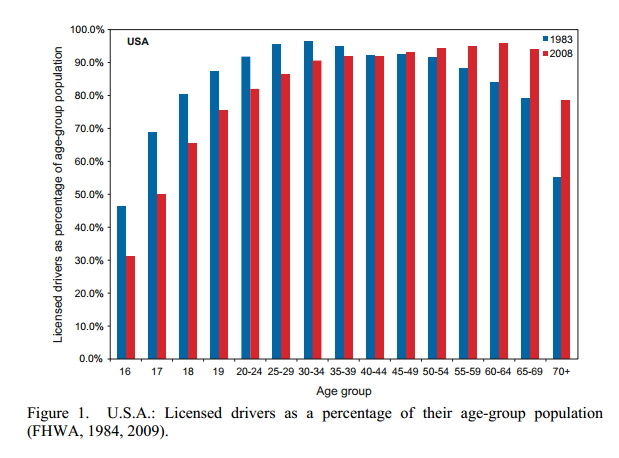
The young are driving less, the old are driving more

Andrew Sullivan has the story. American car culture may be waning. Walking and biking are more and more popular among the young. It might be worth considering what this means for traffic safety. Fewer younger drivers means fewer risk takers on the road, but having a larger number of elderly drivers may pose its own set of problems.

How might state and city ordinances respond to this shift? It would be worth checking on these data on a state by state basis. I have a hunch this does not apply to Texas.

dish_driverdata

Tuesday, August 28, 2012

From My SA: Rules for towing companies differ, city to city

Something to consider when we look at local governments, and their place in the federal system.

What rules apply for towing automobiles? And who gets to establish them? I'm unaware of any national policies regarding this, or what it would take to justify such policies. This seems to fit comfortably in the "many and undefined" powers of the state governments, which then delegate them to the local governments.

From the story:

Want to tow a car parked illegally in an apartment complex lot in Houston? You can charge a $155 base fee. In Dallas, that will be $121, please. In San Antonio, the most the city allows companies to charge for private property tows is $85. The city set that cap in 2002. A decade later, it remains unchanged.

In that same time period, Dallas, Austin and Houston all raised their limits on private property tows.

But San Antonio has distinguished itself from the rest of the pack in another way: A war has erupted between the city and Bexar Towing, the largest company doing private property tows here. Bexar Towing has sued the city, arguing officials failed to raise the private property tow fee to a reasonable amount in a reasonable period of time, and did not perform what's called a tow fee study, required by the state, to determine where to set the cost.


In case you are wondering what a tow fee study is, click here and enjoy.

Monday, March 12, 2012

Does the Second Amendment protect an individual right to carry a gun outside the home?

The Washington Post weighs in on a current controversy, fitting for my 16 week 2301s since they've been reading through the Bill of Rights and how the court tends to reinterpret it from time to time - occasionally finding rights beyond those explicitly listed. 8 week 2301 students will be hitting this subject soon enough.

Last week, a federal judge in Maryland concluded that it does and in the process struck down a Maryland licensing provision for carrying concealed weapons in public.


. . . Judge Legg agreed, building on the 2008 Supreme Court decision that the Second Amendment protects an individual right to keep and bear arms. The court emphasized the saliency of the right especially in the home and especially for self-defense. Judge Legg concluded that the Constitution and the high court’s holding must also be read to protect an individual’s right to carry weapons outside the home. Maryland’s “good and substantial” requirement impermissibly infringed on that right, he said.


The paper editorializes that the decision ought to be reviewed by the federal courts, and there's little doubt that they will. This is worthy of discussion. Does the state's interest in preserving public peace (as it sees fit) trump individual rights?

- An editorial from the Daily Caller.

Friday, November 18, 2011

Are the Occupy Wal Street Protests Covered by the First Amendment?

From Slate, a contemplation of the conflict between First Amendment rights to assemble and protest and the rights of government to secure health and safety:

You cannot fault Bloomberg for his goals; they embrace the fundamental tension at the heart of the First Amendment and public protest. Case law dealt the Occupy movement some fairly heavy cards. Their speech, on matters of core political concerns, sits at the top of the pantheon of what the First Amendment protects. And while Zuccotti Park is technically private, it functions as a public park, and was dedicated under local zoning laws for round-the-clock public enjoyment in 1968. Public parks enjoy an exalted status in the geography of the First Amendment, enshrined in the sort of language men like the first Justice Roberts used to conjure images of the Periclean agora:

Wherever the title of streets and parks may rest, they have immemorially been held in trust for the use of the public and, time out of mind, have been used for purposes of assembly, communicating thoughts between citizens, and discussing public questions. Such use of the streets and public places has, from ancient times, been a part of the privileges, immunities, rights, and liberties of citizens.

But practice First Amendment law long enough, and you learn that for every uplifting paragraph like that, there are a thousand cases bending an abstract right to the prosaic realities of protest.

Friday, February 25, 2011

Obama Administration Will not Defend DOMA

From the NYT:

President Obama, in a striking legal and political shift, has determined that the Defense of Marriage Act — the 1996 law that bars federal recognition of same-sex marriages — is unconstitutional, and has directed the Justice Department to stop defending the law in court, the administration said Wednesday.

Attorney General Eric H. Holder Jr. announced the decision in a letter to members of Congress. In it, he said the administration was taking the extraordinary step of refusing to defend the law, despite having done so during Mr. Obama’s first two years in the White House.
- Letter from Justice Department.

Commentary:
- Is this an Executive Power Grab?
- Does the President Have a Duty to Defend Laws Passed by Congress?

Tuesday, March 31, 2009

On Flags and Homeowner Associations

Thanks to Peter for sending me this story about a conflict between a patriotic homeowner who wants to display a flag (on a lighted flag pole in front of his house) and a homeowners' association that wants a more discreet display, and is fining the homeowner $25 a day for each day he refuses to remove the flag pole.

We can talk it over in both 2301 and 2302. Is there a right to display a flag that cannot be denied by a governing institution? If so, what right is that? Do police powers preclude that right? How is this dispute best resolved? Assuming there is a resolution.

Thursday, March 26, 2009

On Sobriety Checkpoints

Grits for Breakfast has a great post on a sobriety checkpoint bill being considered by the Texas Senate.

Sobriety checkpoints can help secure the greater good, if they are designed -- procedurally -- to narrowly focus on drunk driving. If not, they allow for random, arbitrary fishing expeditions, a hallmark of totalitarianism (at its most extreme anyway).

He outlines a bill designed to do just that, which he still opposes on principle, but his discussion helps clarify how procedural restrictions are essential in order to both protect the general welfare while securing individual liberty. In essence, this is a Fourth Amendment issue. What makes a search reasonable?

Friday, February 15, 2008

Federalism, Civil Liberties and Sex Toys

Got you attention didn't I? Who says federalism can't be fun?

The US 5th Circuit court, by a 2-1 vote, overturned a Texas law banning the promotion or sale of sex toys. The individual's right to privacy against governmental interference is now applied to . . . well you know. Note the the 14th amendment makes a loose 1st amendment liberty apply to the state.

Here's Wapo's coverage--note the comments.

Here is a link to the actual opinion--we might want to cover this more in 2301 when we discuiss civil liberties.

Wednesday, September 5, 2007

To Sting or not to Sting

The arrest of Larry Craig highlights the police powers of the state, that is the right to protect the health, safety, morals and welfare of the citizens.

For the bulk of American history this has been a function of the state and--primarily--local governments. It is something that many people approve of since it keep citizens in line with what the majority think is proper, but also controversial since majoritarian prejudices can enter into decisions regarding what police powers are focused upon. It can be the means by which unpopular groups can be kept out of the mainstream.

This is especially true for morality issues, particularly those that involve activity in public spaces. Which brings us to Senator Craig.

Apparently, due to a history of "activity" in a particular Minnesota airport restroom, police placed an undercover officer in the restroom as a lure to would be, let's say, partners. According to the police report (plus the audio), the Senator gave every indication that he was available, and was arrested. His guilty plea was intended to keep the story suppressed, which was obviously a poor decision.

Now he is waffling on a possible resignation, and the Republican Party is weighing its options.

This story has so many angles it's tough to pin them all down, but I'll try my best to link to the various stories that highlight them.

1--He just can't admit that he is gay.
2--Overturning a guilty plea is not easy to do.
3--He may be protected from arrest due to Article One, Section 6 of the Constitution.
4--How did the story go unnoticed for two months?
5--Don't cops have something better to do?
6--Republicans are hypocrites on moral values.
7--The police are out of control.
8--This is why "don't ask don't tell" does not work in the military.

And it goes on and on. Things got even better when the Senator left a voice mail message on what he thought was his lawyer's phone, telling him he was about to announce his "intention" to resign, and that he was to start to aggressively defend him through the media. A great example of how politics really works.