Showing posts with label transportation. Show all posts

Monday, September 5, 2016

From Houston Public Media: Galveston County Holds First Ever Transportation Conference

Area rep Randy Weber attended, along with other national, state and local figures. Transportation is one of the policy areas impacted the most by federalism. Not only is each level of government involved, the impact is horizontal as well since the decisions of one local government impact the traffic in others. This was an attempt to begin an ongoing dialogue among the stakeholders in Galveston County.

One take-away: more constriction on I-45!

A second: It's tough to tell people when they can and can't evacuate from a hurricane.

- Click here for the article.

The U.S. Census Bureau says Galveston County’s population grew by close to 11-percent between 2010 and 2015.
And while the county is happy to add to its tax base, local officials say there’s still worried: How do you evacuate all those people before a major hurricane?
That was one of the big topics at the first-ever Galveston County Transportation Summit.
Precinct 2 Commissioner Joe Giusti says it’s extremely important for Galveston to evacuate first. Because history shows that it will be very difficult for residents to leave the coast.
“Then I have a situation like we did during Hurricane Rita when Galveston County’s at the back of a stack when Harris County and everybody else is leaving early,” Giusti says. “And we have people dying in traffic, that’s my biggest fear.”

But officials say some new road projects should help more people evacuate faster.
In 2019, TxDOT hopes to start the process of widening I-45 from FM 1764 to the Galveston Causeway. It will go from six lanes to eight.
Precinct 4 Commissioner Ken Clark believes it will help

“If we can get people to leave in a staged fashion, it should really make an evacuation not only efficient but very smooth also,” Clark says.
State Highway 146 is also being widened in Seabrook and that includes a new bridge near the Kemah Boardwalk.

Thursday, September 1, 2016

From the Texas Tribune: Texas Lawmakers Learn Details of Ride-Hailing Laws in Several Other States

An example the state acting as laboratories of democracy, and more on what might be covered the next legislative session.

- Click here for the article.

As Texas lawmakers consider filing legislation next year related to ride-hailing companies, they learned Tuesday that more than 30 states have passed laws calling for some level of regulation of companies like Uber and Lyft.

A report presented by Texas A&M University's Transportation Institute analyzed state and municipal regulations since 2012. It found that 24 states passed legislation requiring ride-hailing apps, sometimes referred to as transportation network companies, must apply for a state permit before operating. The report also found that 30 states require background checks on the driver before or a specific amount of time after the driver begins working.

“Transportation network companies have expanded rapidly to cities worldwide,” Ginger Goodin, a senior research engineer and director at the institute, told House Transportation Committee members at a hearing Tuesday. “However, they do not fit neatly within our current regulatory schemes.”
Although committee members didn’t discuss future bills at the hearing, it’s no secret a handful of lawmakers have plans to draft legislation for the 2017 session, which starts in January.

Thursday, February 4, 2016

About the traffic: Does building more highways make things worse?

That argument has floated around a while. New lanes alleviate traffic for a little while, but it encourages people to buy more cars. Soon enough traffic is just as bad as it was before - maybe worse. Click here for a critical assessment of the consequences of widening I-10 - a $2.8 billion project. Should alternative means be used to lessen traffic? Apparently power brokers in Houston increasingly think so, including the newly elected mayor.

In a recent speech, the mayor called for a "paradigm shift." Instead of concentrating on widening highways and encouraging more use of autos - with single occupants - the city broaden the types of transportation opinion available to residents.

For more on the subject:

- Houston Mayor Calls for “Paradigm Shift” Away From Highway Widening. 
- Talking Points for Turner's speech to the Texas Transportation Commission.
- Turner's transportation platform.
- New Houston Mayor to Texas DOT: Wider Roads Mean More Traffic.

As of yet, these are still merely proposals. Texas continues on a trajectory the focuses primarily on highways construction. Much of this is built into the Texas Constitution. Funding for highways is designated in the document and strong constituencies exist to continue highways construction in the state. There's lots of money spent on highways, and the businesses who profit from those expenditures are not anxious to give it up. As of now the Texas Department of Transportation plans to continue widening highways stateside and in the local area.

- Click here for an announcement of current plans.

Here's what s planned for the Houston area, more widening of highways lie ahead:

• I-45 Gulf Freeway widening from NASA to FM 518. This project is expected to cost $112 million. Congestion relief funding will be $106.4 million. Construction is proposed to begin in Spring 2017 and be completed by Summer 2020. This project will aid in improving mobility on a heavily traveled hurricane evacuation route and primary freight corridor. This project is part of the overall project to widen IH 45 Gulf Freeway from NASA 1 to Galveston Island.
• I-10 Katy Freeway widening from FM 359 to the Brazos River in Waller County. This project is expected to cost $242 million. Congestion relief funding will be $131.8 million. Construction is proposed to begin in Summer 2017 and be completed by Spring 2021. This project is one of the pieces of the overall project to add two lanes on I-10 between Houston and San Antonio. The project will aid in improving connectivity as well as improving mobility on a hurricane evacuation route and primary freight corridor.
• IH 610 West Loop/ IH 69 interchange improvements. This project includes the reconstruction of multiple connector ramps and is projected to cost $287 million. Congestion relief funding will be $209.2 million. Construction is proposed to begin in Summer 2017 and be completed by Spring 2021. Reconstruction of the I-610/I-69 interchange

The battle over the future of transportation in the state promises to heat up - perhaps this winds up on the agenda of the 85th session.

Saturday, June 7, 2014

The Houston Airport System and the Orion Capsule

For 2306 students, and to a lesser extent 2305.

When you start on the section on local government in Texas - and on the parts that discuss cities - you'll see repeatedly stated that cities are different entities than nations, or states, or counties. Those are all defined governing districts that start out with strict borders and then get to the business of getting filled in with people and stuff like that.

Cities start out as groups of people, and if they become economically viable they get the ability to create borders and pass and implement laws, collect taxes and stuff like that. They are economic entities primarily.

- Click here for past blog posts on cities.
- Click here for past blog posts on Houston.

The health of a city ebbs and flows based on how well it makes decisions that enhance its economic viability. Houston - famously - has done pretty well on that front, It helps when the key industry in town is doing quite well. But city leaders have to stay ahead of the efforts of other cities to cut in to what works well for the town, and to re-position itself for the future.

With that in mind I stumbled on this story on the development of the Orion - NASA's latest space capsule. A variety of nearby clicks took me to efforts by the Houston Airport System to turn Ellington field into a commercial spaceport. This is next step in commercial aviation, and promises to continue to ensure that the city continues to have transportation options available to it. This is an endeavor actively sought by the city government. If it does not do so now, the city may lose the opportunity to dominate the industry - which would be a pity given NASA's prominence here:

“This is not a science fiction-type conversation where we have to imagine how this industry might operate if it did in fact exist,” Mario Diaz, HAS’s aviation director, told the crowd. “This industry exists today, these launches have already taken place.”

HAS started aggressively moving forward with its spaceport plans in July, when it secured approval from Houston City Council for a $718,000 contract for a consulting firm to study how Ellington Airport can obtain a spaceport launch site operator’s license. However, HAS has been looking into developing a spaceport in Houston since early 2011. The ideal Ellington spaceport would allow for space tourism, astronaut training and commercial space experiments, HAS said.
In addition to unveiling the spaceport renderings on Sept. 4, HAS hosted a panel of members of the Commercial Spaceflight Federation. The panel, which was comprised of former astronauts who are now working at companies that are in the process of creating commercial spaceflight vehicles, such as SpaceX and Boeing Co. (NYSE: BA), spoke about their progress. Click here to read more about the panel.
Most of the panelists noted how their work is directly tied with Houston — all of them were trained as astronauts in Houston, and many work with the Johnson Space Center on developing their technologies used in spaceflight.


Houston's founding was based in large measure on its location. It lied on a potential transportation stream connecting the raw materials within Texas (first lumber, then cotton, then oil, etc...) with consumers around the world.

The development of the Port of Houston, then the airport system are all part of this process. These latest efforts fit within those previous ones. That it continues to do so illustrates the city's aggressiveness when it comes to business development.

While city's are primarily economic entities, not all play the game successfully.

Monday, April 14, 2014

From Atlantic Cities: Can Houston Learn to Love Light Rail?

For 2306 - a look at transportation policy in the city of Houston, specially efforts to provide residents with additional choices in how to get around.

- Click here for the article.

Once every two weeks or so, in the six months after Houston's first light rail line opened in 2004, a car crashed into the dazzling fountain that flanks the tracks downtown. In the first year of operation, the light rail was involved in 67 collisions. Folks took to calling it the Wham-Bam-Tram. Some drivers never learned to coexist with the newcomer at all, opting instead for parallel side streets. With its lush lawns, large floor plans and sprawling footprint, Houston is a famously spacious city. But the roads never seem wide enough.

Ten years later, the city is in the midst of a second burst of light rail expansion. Five additional miles of track opened in December; two new lines are set to follow later this year. At the center of Greater Houston, a metro area the size of Massachusetts, two-dozen miles of track may not seem like much. (Even some supporters of the project refer to it as the "toy train.") Yet in America's fourth largest city, light rail remains a political and cultural flashpoint far out of proportion to its modest size.

To opponents, it is a prime example of government waste — a vanity project flawed not only in its execution but in its aim of enabling Houstonians to travel without cars. Houston's sprawling size is coupled with a year-round average high temperature of 80 degrees, which critics say make walkable design a pipe dream. Congressman John Culberson, who represents West Houston in Washington and is light rail's chief political adversary, recalls a 19th-century saying that still explains the local love for cars: A Texan will not walk if he can ride a horse. "People's attitudes haven't changed," he says. "You are dead in the water in Houston if you don't have a car."

But the people themselves have changed — no American metro has grown faster than Greater Houston over the last quarter-century, making it one of the most diverse areas in the United States — and they might be taking the city with them. Stephen Klineberg, co-director of the Kinder Institute for Urban Research at Rice University, divides Houston's history into three periods: the sleepy streetcar town, the city structured by the freedom of the automobile, and the metropolis yearning for freedom from the automobile. "There's a vision: retail downstairs, residents upstairs, shade trees, sidewalk cafes," says Klineberg. "This is, in general, a city self-consciously reinventing itself for the 21st century."

Tuesday, April 1, 2014

From the Texas Tribune: Houston, Dallas, Fort Worth Mayors Back Bullet Train

Here's a more current story - and one that fits within the context of economic development. It also illustrates the revolving door that connects public officials (ex-public officials more properly) with other organizations - including private property.

- Click here for the article. 

The mayors of Houston, Dallas and Fort Worth on Thursdayannounced their unified support for the construction of a privately funded bullet train between the two metropolitan regions.
“If successful, Houstonians will have a reliable, private alternative that will help alleviate traffic congestion and drastically reduce travel times,” Houston Mayor Annise Parker said at a press conference at Houston City Hall.
Texas Central Railway announced in 2012 its plans to build a 200 mph rail line that would transport passengers between Dallas and Houston within 90 minutes. The company has said it will not require any public subsidies to fund the multibillion-dollar project, which it is developing in partnership with a Japanese firm, Central Japan Railway.
The mayors praised the project and predicted it would aid the state economically and environmentally by reducing the number of people traveling by car.
“Not only will high-speed rail significantly reduce travel times and traffic congestion for Dallas and Houston area residents, but it will also create new, high-paying jobs and stimulate economic growth,” Dallas Mayor Mike Rawlings said.

The president of Texas Central Railway is the former Harris County Judge Robert Eckels. His father served a Harris County Commissioner.

- Click here for a Houston Chronicle story about him considering various private sector offers from the private sector while county judge.

One of the advosors to the company is Tom Schieffer, who was appointed by George W. Bush to be Ambassador to Japan (where the Central Japan Railway is located). He is the younger brother of Bob Schieffer - host of CBS's Face the Nation.

My advice to you is to cultivate whatever connections you may have.

Tuesday, September 24, 2013

From the Atlantic: These 2 Charts Prove American Drivers Don't Pay Enough for Roads

While most Americans would argue they are overtaxed, the author argues that we are in a road funding crisis because we are not paying enough for roads and our infrastructure suffers as a result.

He points out that the federal gas tax has not been raised since 1993, and that Highway Trust Fund is expected to run out of money in two years as a result.

Chart one shows that we pay more for roads than we earn in road revenue, especially when compared to other nations:


Chart two show how much less American pay in road taxes than other nations. The authors point out that this means that funding for roads has to diverted from other sources.


They suggest that our current model for funding roads is unsustainable.

Thursday, May 30, 2013

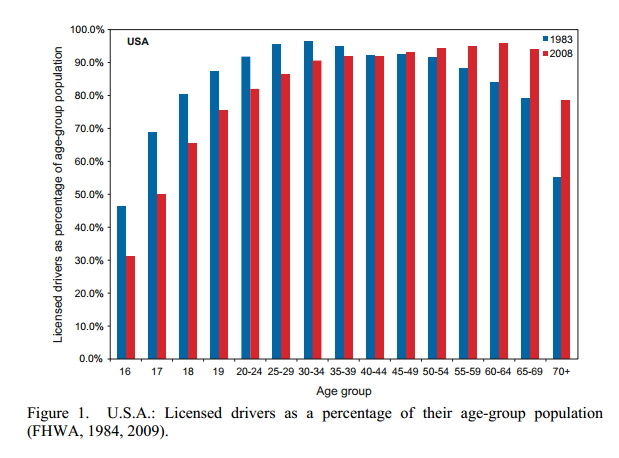
The young are driving less, the old are driving more

Andrew Sullivan has the story. American car culture may be waning. Walking and biking are more and more popular among the young. It might be worth considering what this means for traffic safety. Fewer younger drivers means fewer risk takers on the road, but having a larger number of elderly drivers may pose its own set of problems.

How might state and city ordinances respond to this shift? It would be worth checking on these data on a state by state basis. I have a hunch this does not apply to Texas.

dish_driverdata

Wednesday, April 17, 2013

Governor Perry supports dedicated car sales tax to fund highways

From the Texas Tribune:

Gov. Rick Perry on Friday came out in support of dedicating a portion of future sales tax revenue from car sales to the state’s highway fund, while also leaving the door open to spending more of the Rainy Day Fund on infrastructure projects that he had proposed three months ago.

. . . The remarks put Perry in lockstep with the main proposal put forth by Senate Transportation Chairman Robert Nichols, R-Jacksonville, and House Transportation Chairman Larry Phillips, R-Sherman. Both have filed bills gradually dedicating a portion of future vehicle sales tax revenue to the highway fund.

. . . While Perry and Williams may be moving toward agreement on the Rainy Day Fund, the two don’t see eye to eye on whether the state should dedicate tax revenue from car sales to road projects. In a recent interview with the Tribune, Williams said such a plan would make things difficult for future legislatures as, over time, a bigger portion of state tax revenue gets automatically dedicated to roads. He has said he prefers raising the registration fee to raise more money for transportation.

“We’re going to have a great discussion on that, and I totally respect Tommy’s position,” Perry said. He said he prefers dedicating the vehicle sales tax over other proposals “because it’s not a new tax. It’s not a new fee.”

Perry also reiterated his support for ending diversions of the state gas tax to areas other than transportation, an issue budget writers in the Legislature have said they still hope to address this session.

By combining all his ideas on transportation funding, Perry said, “Texas would be able to capitalize more than $41 billion in transportation projects over the next 20 years. That should be enough to take care of the major improvements we need in this state.”

Transportation has been a politically tricky issue for Perry over the last decade. In 2002, he proposed the Trans-Texas Corridor, a hugely ambitious plan to blanket the state in a network of privately operated toll roads, railroad tracks and utility lines. He later scrapped the plan once public opposition mounted and virtually the entire Legislature disowned it.

Tuesday, April 16, 2013

How should Texas fund its transportation projects?

It's dawned on state leaders that Texas' growth requires investments in transportation infrastructure, but there is little consensus about how to pay for it.

From the Texas Tribune:

“We say we have a $4 billion shortfall for budget for transportation. I believe it’s closer to $7 to $9 billion to do what we really need to do to be successful," said House Transportation Committee Chairman Larry Phillips, R-Sherman.

To help fill that hole, Phillips has filed a bill this session that would dedicate future motor vehicle sales taxes to road construction. Right now that money is sent straight to the state’s general fund, where it can be gobbled up by any state agency.

State Sen. Robert Nichols, R-Jacksonville, has the same bill in the Senate. Both phase in the shift to roads to soften the blow of removing $3 billion from other agencies.

“The way I described it, in a 10-year period it’s $13 billion, so $13 billion of new congestion-relieving projects could be on their way under development," Nichols said.

But that’s just one idea. Late last week, a constitutional amendment was proposed that would draw $3.5 billion from the state’s Rainy Day Fund to set up an account that would dole out grants to leverage public and private money to get roads built.

Even Perry is calling for using Rainy Day Fund money to jump-start the state’s plan to catch up on roads. But not all of Perry’s supporters like the idea.

Friday, April 12, 2013

Two local items from Houston

1 - Houston's mayor announced two related projects. One designed to reforest Memorial Park - which was hit hard by Hurricane Ike and the ongoing drought - and address traffic issues in the Galleria area by creating "Bus Rapid Transit Lanes" in the median on Post Oak.

Funding these projects will be augmented by expanding the Uptown Tax Increment Reinvestment Zone 16 by adding almost 1,800 acres to it.

- From yourhoustonnews.
- From the Chron.

Here's a map of the uptown TIRZ.


2 - HISD has announced the creation of two magnet schools "specializing in two key Houston industries: health care and energy. Both are set to open in the fall. The middle school will involve a collaboration with Baylor College of Medicine, and the high school will be a partnership with the Independent Petroleum Institute of America."

Cities are primarily economic entities, and these two efforts seem designed to enhance the area's economic focus on the energy and health sectors.

Wednesday, April 10, 2013

From the Texas Tribune: Roadblocks Emerge for Transportation Funding in Texas

TxDOT gets creative:

The Texas Department of Transportation has been warning lawmakers for months that it needs $4 billion a year in extra revenue just to keep the current level of traffic around the state from getting worse.

With less than two months left in the legislative session, some key lawmakers are signaling that they may find more money for TxDOT but will probably fall short of that $4-billion-a-year goal. Several people working on the issue cited a lack of a sense of urgency, particularly in the House.

“I think what you’ll see is incremental progress,” state Sen. Tommy Williams, R-The Woodlands, the Senate’s chief budget writer, said in a recent interview.

House Transportation Committee Chairman Larry Phillips, R-Sherman, struck a similar tone at a public conversation last week hosted by The Texas Tribune, where he was joined by Senate Transportation Committee Chairman Robert Nichols, R-Jacksonville. Referring to the figure offered by TxDOT Chief Executive Officer Phil Wilson, Phillips said, “I don’t quarrel with that number, but if we can meet him somewhere in there, that’s what we need to be focused on.”

The funding ideas that lawmakers appear most inclined to approve include restoring $400 million of the money Texans pay in gas taxes that are currently diverted to the Department of Public Safety and putting perhaps $1.7 billion from the Rainy Day Fund toward a revolving infrastructure fund to finance certain transportation projects.

Tuesday, February 12, 2013

Who sets transportation policy?

Free Press Houston looks at the politics behind Segment E of the Grand Parkway - the world's longest "ring road," which will eventually have a segment near our campus.

The story involves the ability of supporters of the road to build over wetlands and an archaeological site.

Monday, January 7, 2013

Is Houston designed to encourage drunk driving?

Houston has more fatal crashes involving intoxication than most other cities in the US. Is there something about the cities design, including its reliance on automobiles, that makes guarantees this outcome? Cities like New York, Boston and Washington are all low on the list.

- The Geography of Drunk DrivingThe Geography of Drunk Driving

Friday, December 28, 2012

Driverless cars will require news laws

One of the themes I hit in class is that legislation tends to follow the emergence of new technologies. The same is true for court decisions because new types of disputes present themselves and judges sometimes have to wing it when deciding issues of liability.
If you are rear ended by one, who is responsible? The owner or the programmer? A court will undoubtedly have to sift this through. Of courser this is a trick question at the moment since no one has yet to be rammed by one when it is in driverless mode - only when it is driven by a human.

Andrew Sullivan points to a story about the legal consequences of the development of the driverless car. Some of what they can do may never be legal.

There's a wide gap between having a prototype and going to market, and it's particularly gaping for anything with a combustion engine. The law has a lot to say about cars, especially about who’s allowed to drive them, and answering all the legal questions could easily take the rest of the decade.

For instance, when a self-driving car gets in a fender bender, who's liable for the damages? Should a computer choose to hit an animal or swerve off the road? How does the DMV give a robot an eye exam?

As the technical limitations fall away, these legal questions are becoming the self-driving car's biggest challenge. Unfortunately for Google, the solutions will have to come from lawyers and legislators rather than engineers.

. . . This is the nitty gritty of automotive law, not just the rules of who gets on the road but the web of regulations and statutes that decide what happens once you're there. For automated drivers, most of these rules have yet to be written, and they'll need to be handled extremely delicately. If the liability laws are too punitive towards driver bots, letting Paul and Julie join in a suit against the self-driving-tech developer, then companies might avoid the sector entirely. On the other hand, if the laws leave car-owners on the hook for anything the new gadgets do, consumers may be scared away from buying them. There's a balance to be struck, but it will have to be made across multiple courts and stand up to countless civil challenges.


Public policy formation ain't easy

Friday, December 21, 2012

Houston's Metro Chief to Step Down

Culture Map reports on George Greanias' decision to resign as CEO.

Greanias was brought on board to help guide Metro's development of light rail. The recent approval of a referendum that diverted some funding to other transit projects is believed to have led to his decision, even to his being possibly pushed out of the office.

With our renewed attention to local politics in class I'll be building up information about Metro, as well as the overall issues about how to handle transportation issues in the greater Houston area. This is an especially difficult issue because while we all share a need for efficient and effective transportation, there is little agreement over what that entails. Even more difficult is the fact that the greater metro are is composed of small autonomous governing units that can make their own decisions about transportation - and there is little reason why these decisions make work together in a rational way.

Self government is seldom efficient government.

Some useful links:

- METRO.
- Wikipedia: METROrail.
- Support Houston Transit.

Tuesday, July 3, 2012

Mass Transit v Road Subsidies

Here's a look at a major issue for state and local governments - with some federal involvement also: subsidies for transportation, both road and mass transit. Here's a critical look at where transportation dollars come from and where do they go.

Friday, March 21, 2008

Road Trip

I've just finished a road trip on Route 66 from Ludlow, California to Tulsa, Oklahoma and will start the regular postings soon. The civility papers--for my 16 week classes--will be graded beginning next week. We will also start discussing the next paper assignment--the one on Plutarch's Lives--after the next round of quizzes are over.

The development and demise of Route 66 provides an interesting case study of the impact of technology on the relationship between the national and state and local governments. It evolved slowly after each separate state and city along the route developed independent roads in response to the increase popularity of automobiles. Eventually policy entrepreneurs, Cyrus Avery among others, began to organize in order to connect these roads so that people could more easily travel west.

Technology at this point advantaged smaller towns which were able to provide services to travellers, but additional technological developments, in addition to Eisenhower's push to develop an interstate highway system, allowed these towns to be bypassed. Route 66's development evolved because the federal government was able to facilitate a cooperative relationship between the states. Its demise occurred because the federal government was able to impose itself on the states.

What remains is a fascinating time capsule of life as lived in the 30s, 40s, and 50s.