Showing posts with label laboratories of democracy. Show all posts

Thursday, January 19, 2017

From CityLab: The Great Texas Pension Fix - Houston owes its police, fire, and city workers about $7.8 billion, and it doesn’t exactly have the cash on hand. Their hard-fought solution could serve as a model for the rest of Texas, and the nation.

Not only does this story touch on city budgets, but it also illustrates the concept of states - in this case cities - as laboratories of democracy.

- Click here for the article.

When Houston Mayor Sylvester Turner took office last year, he inherited a sweeping pension crisis. The city had an unfunded liability of $5.6 billion, a figure representing Houston’s obligations to its fire, police, and municipal pension systems.

Then it got worse: After he took office and got a closer look at the books, Turner saw the revised figure—$7.8 billion.

Pensions are the storm clouds on the horizon that threaten to wash out the so-called
Texas Miracle, the wave of new jobs that kept the Lone Star State afloat through the Great Recession. Taken together, the four largest cities in Texas—Houston, Dallas, Austin, and San Antonio—owe more than $22 billion in pension shortfalls. Dallas and Houston rank second and fourth, respectively, on the list of cities nationwide with the largest unfunded pension liabilities, per a ranking by Moody’s. (At number one? Chicago.)

The road to pension crises is paved with good intentions. Officials in Houston and elsewhere tend to plan for funding pensions with sunny days in mind. When markets tank, the investments contributing to pension funds wither. And when the economy stumbles, cities sometimes withhold pension contributions to make up budget gaps. These effects add up over time, and correcting course usually involves contentious politics. Texas cities may have it worse than most because the local political climate is so hostile to tax revenues (even when Texas cities experience miraculous growth). Anywhere, though, officials and employees tend to kick the can down the road. It’s retirement, after all.

Admitting that you have a problem is the first step toward solving it; cities in Texas, whether they like it or not, are being forced to take that step.

Houston is further along than most. A proposal that the city will put before the Texas legislature this year would restructure the city’s obligations. The new dispensation would include benchmarks for bringing all parties back to the table to renegotiate terms, as necessary, until the unfunded liability is funded. It would also set a time period for meeting that obligation: a 30-year amortization schedule, something resembling a traditional home mortgage.

Thursday, September 1, 2016

From the Texas Tribune: Texas Lawmakers Learn Details of Ride-Hailing Laws in Several Other States

An example the state acting as laboratories of democracy, and more on what might be covered the next legislative session.

- Click here for the article.

As Texas lawmakers consider filing legislation next year related to ride-hailing companies, they learned Tuesday that more than 30 states have passed laws calling for some level of regulation of companies like Uber and Lyft.

A report presented by Texas A&M University's Transportation Institute analyzed state and municipal regulations since 2012. It found that 24 states passed legislation requiring ride-hailing apps, sometimes referred to as transportation network companies, must apply for a state permit before operating. The report also found that 30 states require background checks on the driver before or a specific amount of time after the driver begins working.

“Transportation network companies have expanded rapidly to cities worldwide,” Ginger Goodin, a senior research engineer and director at the institute, told House Transportation Committee members at a hearing Tuesday. “However, they do not fit neatly within our current regulatory schemes.”
Although committee members didn’t discuss future bills at the hearing, it’s no secret a handful of lawmakers have plans to draft legislation for the 2017 session, which starts in January.

Friday, January 22, 2016

Policy evaluation in the news: California's Criminal Sentences. Misdemeanor Penalties. Initiative Statute

This actually applies to a variety of topics in both 2305 and 2306, including:

- federalism.
- initiatives.
- laboratories of democracy.
- public policy process.

The law converted a variety nonviolent offenses from felonies to misdemeanors and was passed as an initiative presented to voters  in California in November 2014. It's considered to be part of a broad effort to scale back the drug war. There have been efforts to decriminalize nonviolent crime in Texas. Negative assessments of the impact of this change may well impact that trend.

For background read these:

- Wikipedia: California Proposition 47 (2014).
- Ballotpedia: California Proposition 47, Reduced Penalties for Some Crimes Initiative (2014).

Much like Texas is dealing with the fallout associated with the implementation of the open carry laws, California is doing the same with the consequences of the reduction in punishment associated with these crimes. Little surprise that police are opposed to the initiative, but here's a look at a variety of groups assess this policy change. Collectively, their assessments will give us a hint abut whether other states will change their policing policies as well.

- California Cops Frustrated With 'Catch-And-Release' Crime-Fighting.
- What we learned from California's Prop 47 in 2015.
- Unintended consequences of Prop. 47 pose challenge for criminal justice system.
- A ‘virtual get-out-of-jail-free card’.
- Did California Prop. 47 Cause State Crime Boost?.

Thursday, December 3, 2015

From Vox: Big Marijuana is coming — and even legalization supporters are worried

This story applies to 2305 - since it touches on the influence of interest groups on both the legislative and administrative process - and 2306 because it hits on changed attitudes about marijuana. Modest changes were made in the 84th session of the legislature to criminal law regarding possession and medical marijuana, but some floated the idea of outright legalization.

It appears that some groups promoting legalization also want a monopoly on selling it - we noticed that that was the condition in Ohio when voters were offered the chance to legalize marijuana for recreational use, but only on the condition that sales be restricted to a monopoly.

I flagged the following labels for the story: monopolies, initiatives, lobbying, laboratories of democracy, criminal law, agency capture, 

- Click here for it.

Last month, Ohioans rejected a very unusual marijuana legalization proposal. Beyond legalizing pot, the ballot initiative would have given campaign donors direct rights to the state's 10 pot farms as an explicit gift for their support. It was, even legalization advocates argued, a flagrant display of would-be members of the pot industry trying to cash in on a movement motivated primarily by social justice issues.
But while Ohio's measure was rare in its blatant cash grab, some legalization backers are increasingly concerned that something like Ohio's initiative will become standard — and the interests of the pot industry, which will grow more and more as legalization spreads, will take priority over the public's best interests.
Dan Riffle, the former director of federal policy at the Marijuana Policy Project (MPP), a legalization advocacy group, recently told me that these concerns pushed him to leave MPP. In a revealing interview, he said that "the industry is taking over the movement."
"We used to talk three or four years ago about how we're creating this industry, yet nobody in the industry gives to MPP," Riffle said. "But now that they do give at least a little, it's like, 'Be careful what you asked for.' Because we owe them now, and they get to drive the agenda."
More than posing as a concern for the face and heart of the legalization movement, the worry that the industry will take over poses some challenges on the policy end as well. As support for marijuana legalization continues to grow, the question is quickly shifting from whether to legalize to how to legalize. And a movement that's led by a pot industry has different interests than the public and policy reformers might have.

Thursday, October 29, 2015

From Governing: Are States Still 'Labs of Democracy'?

We talked about this concept early in 2306 - as well as 2305 - when we discussed the advantages of state control of public policy making. They get to experiment and everyone learns from what succeeds and what fails.

- Click here for the article.
Writing recently in The New York Times, Duke University business professor Aaron Chatterji painted a discouraging picture of the states’ current status as “laboratories of democracy.” He argued that “just when we need their innovative energies, the states are looking less and less likely” to be generating new ideas for federal policy. Has the flame of state creativity somehow gone out?
That would be a tough case to make to Michigan Gov. Rick Snyder, who is proposing a massive remake of federally funded job training, social welfare and health programs. Snyder has set out a “river of opportunity” plan that he hopes will make Michigan first in the nation in training for skilled trades, lift all third-graders to proficiency in reading and launch what he calls “Medicaid expansion done right.” To accomplish his aim, Snyder has created a new department designed to weave together an assortment of federal grant programs and to combine state programs dealing with health, welfare and families.
Key to the plan are federal waivers. Snyder estimates that his program could require 145 different waivers of federal rules -- “the mother of all waivers,” as he told the editorial board of The Detroit News. If he can pull it off, Snyder’s “river of opportunity” plan will unquestionably be the next big thing in intergovernmental policy.

Monday, October 12, 2015

A few stories covered in class today

These first three regard the Texas Lieutenant Governor's effort to direct what types of issues will be considered in the 85th session beginning on 2017.
- Patrick Urges Senators to Study Jail and Police Safety.
- Religious Liberty, Ethics on Senate To-Do List.
- Interim Committee to Take a Closer Look at Jail Safety.

These stories highlight two three bills signed by California Governor Jerry Brown.
- Governor Jerry Brown OKs automatic voter registration through DMV.
- California governor signs bill legalizing physician-assisted suicide.
- Gov. Brown signs climate change bill to spur renewable energy, efficiency standards.

Each is an example of both the concept of states as "laboratories of democracy" and of the differences that exist between states based on each state's political culture. As opposed to Texas, California is one of a handful of states which makes it easy to register to vote. What could be easier than automatic registration?

Friday, February 21, 2014

Meth Labs of Democracy

The National Journal highlights a fun video from the Daily Show featuring some of the more creative laws passed by state legislatures recently.

- Click here for the article.

Thursday, February 20, 2014

From The Dish: The Expanding Right To Bear Arms

Andrew Sullivan calls attention to appellate court cases where the extent of the Second Amendment is not only expanded, but limits the ability of state and local governments to restrict the ability to carry guns outside the home.

- Click here for the story.

This story applies to a good handful of topics we cover in class. Civil liberties, how the judiciary interprets civil liberties - most recently the 2nd Amendment, checks and balances and federalism among them. Something for 2306 students to consider is how this affect that idea that states can serve as "laboratories of democracy." This seems to limit that possibility. The recognition of rights by the U.S. Supreme Court limits the ability of states to fine tune policies and act as laboratories of democracy. This is because once something is considered to be a "right" it cannot be limited by electorate.

Sullivan links to Lyle Denniston's ScotusBlog report, which I highly recommend reading since it details the process these cases have taken through the courts and the issues they raise, Like the NRS v MGraw case referred to below, the courts are being asked to consider whether the second amendment right - broadly interpreted - to have guns in the home for self defense purposes applies outside the home as well.

The states have been moving in the direction of more lenient gun laws - the Supreme Court may end up making that mandatory. A similar dynamic is underway with gay marriage and possibly marijuana laws. Maybe the death with dignity movement might follow this trajectory one day as well.

Here's a look at the expansion of gun rights in the states, and the growth of "Shall Issue Laws."

Click here for an explanation of shall issue, may issue, no issue and unrestricted states.


Sunday, February 9, 2014

From the NYT: ‘Aid in Dying’ Movement Takes Hold in Some States

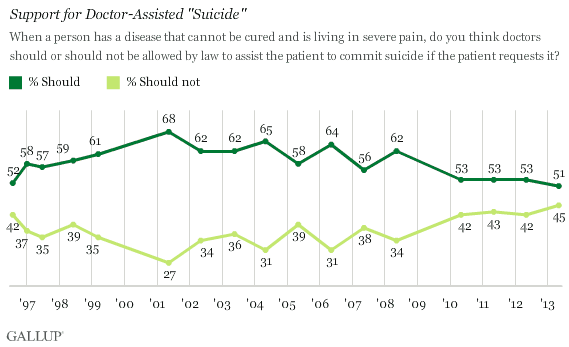
Add this to the list of stories on states as laboratories of democracy. Its a report on the what used to be called doctor assisted suicide, but now is called aid in dying. Put a more positive spin on it. The movement started in Oregon a few years back and seems to be on the move.

From the NYT:

In January, a district court in New Mexico authorized doctors to provide lethal prescriptions and declared a constitutional right for “a competent, terminally ill patient to choose aid in dying.” Last May, the Vermont Legislature passed a law permitting it, joining Montana, Oregon and Washington. This spring, advocates are strongly promoting “death with dignity” bills in Connecticut and other states.

Public support for assisted dying has grown in the past half-century but depends in part on terminology. In a
Gallup Poll conducted in May, for example, 70 percent of respondents agreed that when patients and their families wanted it, doctors should be allowed to “end the patient’s life by some painless means.” In 1948, that share was 37 percent, and it rose steadily for four decades but has remained roughly stable since the mid-1990s.

Yet in the same 2013 poll, only 51 percent supported allowing doctors to help a dying patient “commit suicide.”
Here's the graph from the Gallup Poll linked to above. Perhaps this movement will join marijuana and same sex marriage as policy areas where major changes are happening on the state level.
Trend: Support for Doctor-Assisted "Suicide"
The shift might have a lot to do with how the policy is framed. Death with dignity sounds better than suicide.


Thursday, February 6, 2014

From James Q Wilson: American Exceptionalism

From a few years back, a look at how the American constitutional system system impacts governing, and how that contrasts with other nations.

- Click here for the article.

Its worth reading. Here are some nuggets from it.

On the nature of American democracy:


- Democracy, of course, means rule by the people. But the devil is in the details. By one count, the number of democracies quintupled in the second half of the twentieth century, but there are freedom-loving and freedom-disdaining democracies. Fareed Zakaria calls the latter "illiberal democracies." Among them are Kazakhstan, Pakistan, Ukraine, and Venezuela.

The number of democratic regimes has grown rapidly in the last several decades, but what has grown is not like American-style democracy. Though most democracies have certain things in common--popular elections, the rule of law, and rights for minorities--we should never suppose that what we hope will appear in the Middle East and elsewhere will look like American government any more than Britain, France, Germany, India, Japan, or Turkey look like us. Recall that American democracy contains some strikingly undemocratic features, such as an Electoral College, two senators for each state regardless of state populations, and an independent judiciary.

On the consequences of separated powers and winner take all elections:

- America was slow to adopt welfare programs, social security, unemployment insurance, and government supported health care, while Europe adopted these policies rapidly. We have kept our tax rate lower than it is in most of Europe. The central difference is not that Europeans are either smarter or dumber than we, but that a parliamentary system permits temporary popular majorities to make bold changes rather quickly, whereas a presidential system with a powerful, independent, and internally divided Congress requires that big changes undergo lengthy debates and substantive accommodations. On occasion America does act like a parliamentary system, as it did under Franklin Roosevelt during the Great Depression and under Lyndon Johnson when he commanded extraordinary majorities in both houses of Congress.

The system a country uses to elect its rulers also makes a difference. In a recent study, political scientists Torben Iversen and David Soskice have shown that, among 17 large democracies, those that elect their legislators using proportional representation (PR) are three times more likely than those electing them by majority vote to have leftist governments that redistribute income from rich to poor.

On federalism and the states as "laboratories of democracy:"

- When welfare reform began at the national level, it built on new ideas being tried in several states. When limits on aggressive medical malpractice suits began, they came first in states and are only now being considered in Washington. These changes confirm the argument by Justice Louis Brandeis that federalism is valuable because it creates "laboratories of democracy." He was explaining why much good comes from political alternatives. Not only can government choose what to do, people can choose among states where it is done. People who want medical marijuana, tough environmental laws, lenient criminal justice penalties, and alternative life-styles can live in one place; people who prefer the opposites of these can live elsewhere.

On the benefits of not having an established church:

- for most people, religion is a reality, not a dodge. Tocqueville understood that, contrary to the prediction of European philosophers, freedom and enlightenment would not extinguish religious zeal. On the contrary: here freedom largely explains our persistent religiosity.

That is because a nation that never had an established church and did not grant money or privileges to existing churches left religion in the hands of spiritual entrepreneurs. These people were sometimes domestic missionaries and sometimes local citizens eager to create and govern a religious organization. Protestant churches had to compete in a spiritual marketplace, with many new churches emerging every year, people changing their affiliations frequently, and a few mega-churches emerging under the guidance of the most successful ministers. The system of natural liberty that Adam Smith said would benefit the economy has also aided religion.

On the growth of the power of the judiciary:


- . . . it is true that we have, in proportion to our population, three times as many lawyers as does Great Britain and 25 times as many as Japan.

But we are not more litigious because we have more lawyers; we have more lawyers because we are so litigious. Not even the framers of the Constitution anticipated this. As Alexander Hamilton put it in Federalist Number 78, "the judiciary…has no influence over either the sword or the purse, no direction of either the strength or the wealth of the society, and can take no active resolution whatever." As a result, "the judiciary is beyond comparison the weakest of the three departments of power." Things turned out a bit differently than Hamilton supposed. The courts have become immensely powerful for two reasons: the existence of an independent judiciary and the beliefs Americans have about the foundation of their government.

Courts that are independent of the legislative and executive branches will inevitably become the referee that determines when a law or order violates the Constitution. That document did not say this, but it did say that it was the supreme law of the land. That being so, there must be some organization that will defend that claim. Early on, the Supreme Court under the leadership of John Marshall became that entity, and since then no one has doubted it. As the federal government grew in size and authority, more and more issues arose that implicated the Constitution, and so more and more often the Court decided how that document should be read. Since 1789, the Supreme Court has declared more than 160 laws to be unconstitutional.

On what countries can and cannot become democracies:


There are many different kinds of democracy that can be spread, and Americans should never suppose that what may take hold in another country will closely resemble what has grown up here. A few may be illiberal ones, many will be elitist ones, but most will enhance the freedom of their people, change governments peacefully after an election is held, and refrain from the use of force to conquer other nations.

Some Americans are skeptical that democracy can be exported, especially to the Middle East. These countries lack what we had: a successful war against a colonial power, wise statesmen who drafted our Constitution, and a political culture that will sustain democratic authority and protect human freedom. But most nations that have become democracies lack some or all of these traits: there was no revolutionary war, few wise statesmen, and no democratic political culture in France, Germany, Italy, and Japan. England, the nation that became democratic a few decades after the United States was created, did have many helpful precursors: no feudalism, many independent farmers who owned their own land, and an early experience with an independent judiciary. England's former colonies--not only America, but Australia, Canada, India, and New Zealand--became the leading democracies of the world.

But other countries have become democratic despite internal terrorism (France), domestic autocracy (Germany), a weak political culture (Japan), a lack of territorial integrity (Italy) and a Muslim population (Turkey and increasingly Indonesia). The fact that not all democracies (in fact, almost none) will look like ours and that radicalism and despotism will make democratic progress painfully slow in many countries are not arguments against encouraging the spread of democracy; they are only arguments against hoping that our system can be exported intact and that we will see democracy in the most resistant nations in our (or our children's) lifetimes. Though American democracy got off to a good start in 1789, we had to fight a bloody civil war before much more progress could be made.

But we have left a legacy that many people wish to emulate. When people in Lebanon, Jordan, Morocco, and Indonesia are asked whether western-style democracy can work in their countries, the overwhelming majority say "yes.

Saturday, January 25, 2014

States experiment on cutting jobless benefits

We introduced the phrase "laboratories of democracy" in 2306 and mentioned that it is considered to be one of the benefits of granting the states leeway in implementing different policies. State experimentation with policy proposals allows for a pragmatic evaluation of those proposals. Instead of resting opinions on ideological assumptions, they can be based on facts.

As Congress considers cutting unemployment insurance - which has been expanded considerably following the financial crash of 2008 - and legislators debate the consequences of doing so, North Carolina went ahead and did it this past July.

Wonkblog analyses the consequences, but points out that the data does not tell a clear story:

So what happened in North Carolina? As it turns out, the data is still fairly ambiguous and there are two conflicting interpretations here:
1) Many workers may have dropped out of the labor force. Everyone agrees that North Carolina's unemployment rate kept dropping, much as it did in the rest of the country, after benefits got cut.
But that might have been a bad omen: According to data from the Bureau of Labor Statistics, the number of people in the labor force has plummeted in North Carolina since last summer (even as it rebounded slightly in the rest of the nations).
. . . some people who saw their jobless benefits lapse may well have found jobs — perhaps they decided to take a lower-paying gig than they otherwise would have, out of desperation. But a greater number of workers appeared to have simply given up looking altogether, possibly because jobs are still extremely difficult to come by, and they no longer have to keep searching to qualify for benefits.
2) ...or perhaps employment actually increased. Yet other data sets seem to tell a different tale. A more optimistic view of what happened in North Carolina comes from a new paper (pdf) led by Marcus Hagedorn of the University of Oslo. He and his three co-authors sifted through the Census Bureau's "household survey" and the "establishment survey" for the same period. And the results were striking.
What they found is that overall employment has actually gone up in North Carolina since benefits got cut in June of 2013. The household survey in particular showed a big increase in both employment and labor force participation. But both surveys suggested that North Carolina's labor force is growing, not shrinking.
Hagedorn's paper suggests that, by and large, workers in North Carolina do seem to be finding jobs ever since unemployment insurance got cut. And it's not clear that these are lesser jobs or lower-paying jobs: The data suggests that overall hours in North Carolina went up, and there was little change in wages and earnings.

Evaluating the outcomes of a policy change seems to be trickier than one would expect. Does this throw cold water on the "states as laboratories of democracy" thesis?