Showing posts with label framing. Show all posts

Thursday, April 2, 2015

Framing effects on polling results on RFRA

Looking ahead to a future discussion in 2305 on public opinion and polling - and sticking with our look at RFRA - Vox responds to an argument that polls show that small majority of Americans support these laws by pointing out that attitudes about religious freedom's impact on discriminatory behavior are influenced by how the questions are worded.

- Click here for the post.

What is a framing effect? The idea that our decisions are impacted by the way that choices are presented. In other words, people can be enticed to make answers that contradict each other if questions present the same issue in different ways.

Here's a definition from the 538 glossary in the NYT
How a survey question is structured can change the way individuals respond. In a well-known example from the General Social Survey, researchers found that people responded much more positively when asked about assistance to the poor than when asked about welfare, even though the questions are logically equivalent. These framing effects often work by drawing particular ideas or emotions to the fore, or by presenting a short vignette before asking respondents for their opinion.

Regarding RFRA, people tend to favor both religious freedom and the ability of individuals to be treated equally. People seem to support whichever position is emphasized in the question asked by the pollster:

- According to a March edition of the Marist poll, 54 percent of Americans agreed with "allowing First Amendment religious liberty protection or exemptions for faith based organizations and individuals even when it conflicts with government laws."

- Consider a June 2014 Public Religion Research Institute poll that asked, "Do you think that a small-business owner in your state should be allowed to refuse to provide products or services to individuals because they are gay or lesbian if it violates their religious beliefs?" Eighty percent of respondents said no.
- . . . a September 2014 Pew poll showed a much closer split. That poll asked, "If a business provides wedding services, such as catering or flowers, should it be allowed to refuse those services to same-sex couples for religious reasons, or required to provide those services as it would to all other customers." Forty-seven percent said they should be allowed to refuse, and 49 percent said they should not be allowed to refuse.

Friday, March 14, 2014

How to frame environmentalism so centrists and conservatives support it

2305's sections on public policy, public opinion and campaigning discuss the importance of framing. This is simply the attempt to influence how people think about a specific issue by condition the frames of reference that people use to think about that issue.

Public policy issues can be complex, meaning that aspects of it can be positive or negative and one's view point towards the policy can be tweaked by presenting it in a specific way.

An author in the American Prospect wonders if environmentalists - whose ends are primarily supported by the left - can entice centrists and conservatives to rethink opposition to environmental programs by rethinking the frames of reference they use to present the issue.

- Click here for the article.

The author suggest using terms like sustainability - which has been used to frame the debt issue:

Dr. John Roemer, a professor of political science and economics at Yale, wrote in a 2005 paper with Woojin Lee and Karine van der Straeten that “the Left might attempt to exploit global warming the way the Right has exploited racism.” He says that the issue is even more salient today, although the right is currently in a state of “cognitive dissonance” because of their anti-government ideology. His own upcoming book, Sustainability for a Warming Planet, uses terms like “intergenerational equity” and “sustainability” that are commonly used by centrists like David Brooks and Joe Scarborough, who worry that the federal debt is unfair to future generations and on an unsustainable course. Such leaders thrive on issues like the federal debt and sustainability, a leftist concept that is intellectually harmonious with stewardship, a right-wing one. By using the language of responsibility and intergenerational equity, as well as homespun wisdom about “living within our means,” the left could create a broad umbrella coalition encompassing concerned centrists.

And point out how candidates have framed the issue to make it more enticing to conservative voters. Hit their sweet spot:

In America, some left-wing candidates have won in heavily right-wing parts of the country by using conservationist rhetoric. Bernie Sanders won his Senate seat in Vermont—a rural, white state that holds the record for longest-consecutive streak voting Republican in presidential elections—by, according to David Sirota, “visiting hunting lodges to talk about protecting natural resources for hunting and fishing and establishing a connection with [hunters].” In Montana, a state that has voted Republican in all but one of the last ten presidential elections, Governor Brian Schweitzer won twice (the second time in a landslide) partially by wooing hunters and fisherman with land and stream access. In Wyoming, the most conservative state in the country, Governor David Freudenthal’s administration focused on a long-term strategy for resource extraction that included, among other things, preserving the state’s forests and regulating hydraulic fracking. The result: a re-election margin of 20 percent and a reputation as one of the most popular governors in the country with 66 percent approval among Republicans.

The message could be tied into religion and other conservative values as well:

In hindsight, the potency of the environmentalist message should not be surprising. Religious traditions have always stressed the importance of living in harmony with the environment, and the very idea behind conservatism is not radically re-inventing the world in which one lives, lest unintended consequences ensue.

The trick will be figuring out who sends this message out. Studies suggest that who relays a message is at least as important as the content of the message. It creates a frame of reference that tells the listeners whether the content of the message should be believed.


Tuesday, February 18, 2014

From Politico: The Word That Changed the Debt Ceiling Debate

This applies to the bill making process, budgeting and public opinion. The author points out that Democrats were able to spin public opinion in their favor in the recent debate over the debt ceiling by using the word "default" to describe the proposal to not increase it.

This is a common tactic - define a policy or proposal in terms favorable to one's preferred outcome. Republicans have generally bee more successful doing so than Democrats, for example calling the estate tax a death tax. Democrats seem to have learned the lesson.

- Click here for the article.
When Treasury Secretary Jack Lew recently gave notice that the federal government would once again hit the debt ceiling in February, the response from congressional Republicans—who twice took the nation to the brink of default—was decidedly muted.
The official line? “We believe that defaulting on our debt is the wrong thing,” says House Speaker John Boehner (R-Ohio). “We don’t want to do that.” On Tuesday, the House duly voted to raise the debt limit without conditions, sending the action over to the Senate.
This move represents a 180-degree turn from the previous strategy of trying to extract concessions from Democrats by threatening to send the country into economic chaos.

Why such a stark softening of the party line? Republicans’ retreat from the debt-limit battlefield, which they entered so boldly in the spring of 2011 and again last year, began with a shift in the Democrats’ rhetorical strategy. A simple turn of phrase turned the tables on the GOP.
The short history of debt-limit brinksmanship offers a useful lesson in the power of a word to reframe a national debate and drive public opinion in a new direction.
When Republicans first played the debt-limit card in 2011 to force budget concessions from Democrats, the GOP held the rhetorical upper hand. The dialogue was framed in terms of the policy question at hand: Should the national debt limit be raised, so that the Treasury could borrow more money to pay outstanding bills?

. . . Democrats undermined their own position by talking too much about raising the debt limit—and not talking about the consequences of sending the country into default. As seen in the word frequency chart above, the word “default” didn’t even show up in the debate during the first round of this fight in 2011.
We shared this linguistic analysis with top Democrats and recommended a simple, but critical, change in their message: Stop talking about the “debt limit.” Start the conversation with the word “default.”
It was a straightforward switch in vocabulary—but it started a whole new conversation. When high-profile messengers in the Obama administration and Congress started talking about the danger of “default,” the prominence of that idea quickly increased in news coverage. Commentators began discussing it more, and the theme was amplified in social media.
Democrats also dialed up the emotional resonance of the message by saying that a default could cause an economic “catastrophe.” Emotion works with cognition in the brain to help us with attention, retention and motivation. A message must create an emotional reaction for people to notice it, much less remember it.
Within weeks of Democrats adopting this new tack, the polls began to shift. A Pew survey in July 2011 showed the percentage of respondents concerned about default had increased by seven points—while opposition to raising the debt limit had decreased by one.

Sunday, February 9, 2014

From the NYT: ‘Aid in Dying’ Movement Takes Hold in Some States

Add this to the list of stories on states as laboratories of democracy. Its a report on the what used to be called doctor assisted suicide, but now is called aid in dying. Put a more positive spin on it. The movement started in Oregon a few years back and seems to be on the move.

From the NYT:

In January, a district court in New Mexico authorized doctors to provide lethal prescriptions and declared a constitutional right for “a competent, terminally ill patient to choose aid in dying.” Last May, the Vermont Legislature passed a law permitting it, joining Montana, Oregon and Washington. This spring, advocates are strongly promoting “death with dignity” bills in Connecticut and other states.

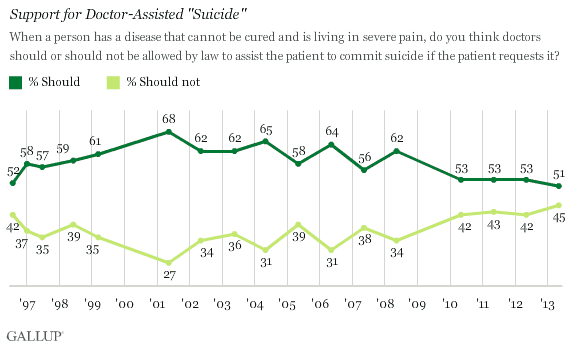
Public support for assisted dying has grown in the past half-century but depends in part on terminology. In a
Gallup Poll conducted in May, for example, 70 percent of respondents agreed that when patients and their families wanted it, doctors should be allowed to “end the patient’s life by some painless means.” In 1948, that share was 37 percent, and it rose steadily for four decades but has remained roughly stable since the mid-1990s.

Yet in the same 2013 poll, only 51 percent supported allowing doctors to help a dying patient “commit suicide.”
Here's the graph from the Gallup Poll linked to above. Perhaps this movement will join marijuana and same sex marriage as policy areas where major changes are happening on the state level.
Trend: Support for Doctor-Assisted "Suicide"
The shift might have a lot to do with how the policy is framed. Death with dignity sounds better than suicide.


Thursday, April 21, 2011

Politicians Put Positive Spin On Budget Battle Words

From NPR:

The budget battle is all about numbers: how much the government takes in, and how much it spends. But it's also a battle over words. Both sides have put a lot of energy into coming up with new ways of describing old concepts. It's part of the process of selling their ideas to the public. At the end of the day, the budget battle is political, and both sides choose their words carefully. Democrats, for example, don't like to talk about government spending, which has a bad connotation, so they talk about making investments in the country's future. Republicans say they want to get rid of the "death tax" — also known as the estate tax.

Tuesday, February 15, 2011

Shaping the Budget Fight

From the NYT:

Republicans and Democrats in Washington took to the airwaves and flooded social media networks in a furious attempt to spin the year’s fight over the 2012 budget proposal released by President Obama Monday morning.
Read on for an overview of the positions each side is taking as this goes forward.

Thursday, February 10, 2011

What if we Called Taxes Bunnies?

Then we wouldn't have such a problem raising them. Its all in how you articulate a policy proposal.

Thanks to my 2302-03 for bringing this up, this is why I teach.

In all seriousness though, this comment hits on the importance of framing issues. Those who can frame the terms of a debate often win that debate.

Saturday, October 2, 2010

Selling the Health Care Law

Campaigns are all about public relations, how to sell ideas to the electorate. The health care law has presented Democrats with a problem. The public seem to be divided over the general idea of the health care law, but supports some specifics within it. How then do they deal with this in an election?

Do they run away from the law in general? Or do they try to reframe how the public thinks of the law?

It is commonly argued that the ability to do the latter is the a key indicator of political power.

Tuesday, August 31, 2010

Stories for 8/31/10

A few relevant items today:

- A Washington Post story illustrating the difficulty party's have enforcing unity among their members: A freshman Republican goes against the leadership on Afghanistan.

- The National Beer Wholesalers Association works the Hill.

- Wall Street turns on Obama.

- Does Language Shape How You Think? Politicians have known that words matter for quite some time. An entire industry has emerged around determining which words lead people to think a particular way. Can an entire language do the same?

- Glenn Beck follows his rally with a launch of a new web site.

- The electoral landscape looks better and better for Republicans.

Tuesday, June 15, 2010

Some National News for Today: 6/15/10

A few things to chew over today from Ezra Klein at the Washington Post:

Obama will try to reinvigorate a climate bill in his address tonight, reports Mike Allen: Obama plans to include a call for an energy bill in his Oval Office address about the Gulf on Tuesday night. And the Obama administration has told key senators that 'an energy deal must include some serious effort to price carbon as a way to slow climate change,' according to a Senate Democratic leadership aide."

And Obama's top pollster is circulating a memo to lawmakers arguing that a big energy bill makes good political sense. But the memo never mentions "global warming" or "climate change," so it's clear those word don't make good political sense. Read it:
http://politi.co/aKhagF

Henry Waxman and energy committee oversight chair Bart Stupak are alleging that BP took "shortcuts" on the exploded oil rig,
report Steven Mufson and Anne Kornblut: "In one instance, four days before the April 20 explosion, Brett Cocales, one of BP's operations drilling engineers, sent an e-mail to a colleague noting that engineers had not taken all the usual steps to center the steel pipe in the drill hole, a standard procedure designed to ensure that the pipe would be properly cemented in place. '[W]ho cares, it's done, end of story, will probably be fine and we'll get a good cement job,' he wrote."

The campaign disclosure bill being considered in the House will exempt the NRA,
reports John Bresnahan: "The proposal would exempt organizations that have more than 1 million members, have been in existence for more than 10 years, have members in all 50 states and raise 15 percent or less of their funds from corporations. Democrats say the new language would apply to only the NRA, since no other organization would qualify under these specific provisions. The NRA, with 4 million members, will not actively oppose the DISCLOSE Act, according to Democratic sources."

Tuesday, May 4, 2010

Measuring Political Rhetoric

For our ongoing discussion of framing, a study of the positive and negative reactions various and phrases elicits from people. Most positive? Family Values. Most negative? Militia. My hunch is that ll of this is old news to political consultants.

Monday, May 3, 2010

Implementing Health Care Reform

With apologies to the National Journal, I copied and posted a recent piece detailing the issues associated with implementing the recently passed health care legislation.

Writing The Rules For The Health Law: The new law offers some benefits this year, but a quick turnaround on writing regulations could prove difficult.

by Marilyn Werber Serafini
Saturday, May 1, 2010

The Obama administration faces a monumental task this year in implementing the first changes dictated by the new health care reform law, not to mention laying the groundwork for the bigger changes to come in 2014.

On the political front, meanwhile, Obama and his team have a challenge in selling the public on health reform's benefits before November's congressional elections. Surveys show that opposition has grown since the law was enacted on March 23, with various April polls finding 40 to 54 percent of respondents unhappy. The White House announced last week that Stephanie Cutter, who handled the president's nomination of Sonia Sotomayor to the Supreme Court and advised first lady Michelle Obama on her childhood obesity initiative, will spearhead the effort to bolster public understanding of and support for the reforms. (See "
Winning the Perception Game," NJ, 4/24/10)

Democrats wrote the law so that some of its most appealing reforms come this year -- a good strategy so long as those changes happen smoothly and on time. "The major benefits of the law -- the coverage expansions, subsidies, and insurance market reforms -- do not kick in until 2014," Drew Altman, president of the Kaiser Family Foundation, wrote on the foundation's website. "To compensate for that, the architects of the legislation built in a long list of early deliverables so the public would see tangible and understandable benefits right away -- from allowing dependent children to stay on family policies until age 26, to beginning to eliminate the prescription drug doughnut hole for seniors."

These early reforms will help only a modest number of people, he cautioned, and premiums and out-of-pocket costs will continue to rise faster than wages. "So, on the one hand, the law might not provide the kind of help people are expecting in the first few years. On the other hand, the sky will not immediately fall, as many people seem to believe it might."
Altman predicted that few people will see any changes in the near term. "If the benefits and timetable for the law are communicated effectively, the expectations gap should be manageable; over time, the benefits the law provides will be highly valued by the American people, but it will be crucial to develop mechanisms to answer people's questions and link them to the benefits the law provides."

The Health and Human Services Department and other federal agencies are tasked with producing regulations for the changes that take effect this year. Nancy-Ann DeParle, director of the White House Office of Health Reform, is confident the administration can move quickly, although some observers predict missed deadlines.

The law provides $1 billion to help HHS implement the new law -- probably not enough, said Mark McClellan, director of the Engelberg Center for Health Care Reform at the Brookings Institution. As the Medicare administrator in the Bush administration, he launched the program's huge prescription drug benefit enacted in 2003. The Congressional Budget Office has estimated that HHS and the Internal Revenue Service will need $10 billion to $20 billion over 10 years to carry out health reform.

McClellan said that speeded-up hiring procedures helped him implement the drug benefit but added that HHS no longer has such authority. Even with that boost, he said, he needed six to nine months to get key staff on board, and he faced his share of criticism. As the program geared up, the media trumpeted stories of seniors who were turned away from pharmacies empty-handed because of confusion over coverage. The program's telephone help line sometimes kept frustrated seniors on hold too long and then provided incorrect advice. Still, McClellan was able to smooth the wrinkles quickly enough to earn good marks for the program in opinion polls.

The "biggest challenge coming up fast" for HHS, he said, is ensuring that states and the federal government meet a June 23 deadline for establishing subsidized high-risk insurance pools for the people who are hardest to insure. More than 30 states operate such pools, and they may enhance those programs or let the federal government step in.

Georgia's insurance commissioner last month announced that his state would let the feds take over. It will be much easier (and cheaper) if states build on their existing pools, said McClellan, who agreed with other health care experts that the $5 billion to fund the pools until 2014 won't be enough; that amount might not last even a year, he said. If the funding runs out, the administration will have to ask Congress for another appropriation. Conversely, if the money lasts, it would probably signal that the pools are reaching too few people.

"Insurance availability for people who can't get it now is expected to be a high-profile issue," McClellan said. "If programs are not working, then that would confirm some views of the critics and create momentum for change. On the other hand, if the initial provisions go well and the administration can point to people who are benefiting, it keeps the overall package on track."

Also this year, Medicare beneficiaries who hit the so-called doughnut hole -- a gap in their prescription coverage -- will get a $250 rebate. Under the drug program, when spending on an individual has reached $2,250 on prescriptions in a given year, the person must pay 100 percent of the cost of their medications unless and until spending reaches $5,100. The doughnut hole, which Congress created to lower the cost of the program, has been an irritant for seniors and Democrats, who have long vowed to close the coverage gap as soon as possible.

Small businesses that have up to 25 workers and pay average wages under $50,000 are eligible for tax credits to help cover their employees. States may also draw down federal matching money this year if they begin expanding Medicaid to people who earn up to 133 percent of the federal poverty level (about $14,400 for an individual). Moreover, the government will reimburse employers up to 80 percent of the cost if they offer health insurance to retirees over 55 who don't qualify for Medicare. Regulations must spell out all of this in detail, and Health and Human Services Secretary Kathleen Sebelius has significant leeway in defining such concepts as pre-existing conditions and dependent care.

By the end of September, the act will prohibit insurers from imposing cost-sharing on patients for preventive medical services identified by the U.S. Preventive Services Task Force. In addition, insurers must cover young adults up to age 26 on their parents' policies and must not exclude children under age 19 from coverage because of pre-existing medical conditions. Insurers are forbidden to cancel anyone's policy unless the initial application was fraudulent, or to impose lifetime benefit limits.

Sebelius is encouraging insurers to voluntarily make some changes sooner, and already a handful of carriers have agreed to speed up their coverage of young adults on their parents' policies. The secretary announced last week that Blue Cross Blue Shield plans, Kaiser Permanente, and Humana will begin covering young adults before the end of September.

The law requires HHS and other agencies to take a number of other steps by the end of the year, including:

• Reduce annual increases in Medicare payments for inpatient hospital, home health, skilled nursing, hospice, and other services.

• Increase the Medicaid drug rebate for brand-name drugs.

• Create a process for the approval of generic versions of biologic drugs.

• Launch a nonprofit institute to research and compare the effectiveness of medical services.

• Establish a committee to develop a national health care workforce strategy.

• Administer a 10 percent tax on indoor tanning services.

The federal government, states, employers, insurers, and medical providers have all begun laying the groundwork for the massive changes to come in 2014 and beyond. Washington will need to work with states to establish health insurance exchanges and expand Medicaid programs. Federal administrators will also have to prepare for new taxes (and tax breaks), and for Medicare pilot projects to test such concepts as accountable care organizations and bundled payments.

Tuesday, April 27, 2010

Thursday, April 22, 2010

Framing Financial Reform

From Politico, a story about a debate regarding where the idea emerged that opposition to financial aid reform is best done by framing it as being a "permanent bailout."

Thursday, April 15, 2010

Framing Democracy

George Lakoff highlights a great example of framing effects. The lesson is: Ballot language matters a great deal. For 2301s, this further confuses whether poll results necessarily reflect public opinion.

Tuesday, April 13, 2010

The Overton Window

I've never heared of this before.

The Overton Window refers to a strategy -- used by politicians to influence public response to policy proposals, but almost certainly useful to most of us -- where a clearly unacceptable option is presented to the public first, with the hope that a second option would be seen as being more acceptable, and more acceptable had that second option been presented first.

Suppose in order to balance the budget, taxes have to be raised 5%. The public will not want that to happen. But suppose that the the first proposal presented is a 15% tax increase. Opposition would be heated, but as a compromise, a 5% increase will be accepted because it seems palatable by comparison.

Nate Silver argues that this might be happening in the names Obama is floating for potential Supreme Court picks.

Monday, April 12, 2010

Goldman Sachs Works on its Image

Story here. And a link to the firm it hired to help it out here. You can follow them on Twitter!

For 2301s: think both free press and public opinion.

Sunday, April 11, 2010

Framing the Governor's Race

For my 2301s: We discussed how public opinion is often influenced by the frames of reference placed around whatever the public might be thinking about. Real power stems from being able to influence the context people use to form opinions about someone or something. This often determines the conclusions people make about those people or things. Its one of the goals of a successful campaign.

I was thinking about this when I saw the following effort by Governor Perry's campaign to frame Bill White a "liberal trial lawyer" rather than an ex-mayor.