
Showing posts with label 2012 U.S. Budget. Show all posts
Showing posts with label 2012 U.S. Budget. Show all posts
Tuesday, April 16, 2013
Military spending in the US
The Economist reports that we still spend more than any other country, and almost as much as the rest of the developed world combined.


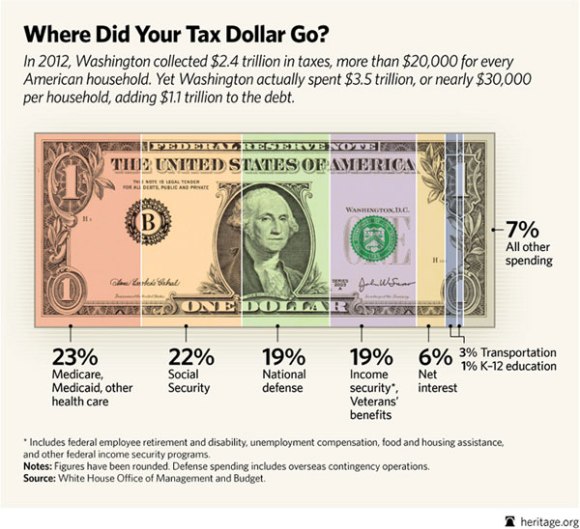
Where did your tax dollar go?
The Dish flags a graphic from the Heritage Foundation showing where federal dollar were spent in 2012:
Monday, April 18, 2011
Monday, April 11, 2011
mutually assured destruction
That's the term Nate Silver uses to describe the brinksmanship over whether to extend the debt ceiling.
Sunday, April 10, 2011
A Few Random Posts on Friday's Agreement on Appropriations
- Before Deal, Angst Over Effects of Shutdown.
- Budget Deal to Cut $38 Billion Averts Shutdown.
- Republicans and Democrats Alike Claim Successes in Averting a Federal Shutdown.
- President Adopts a Measured Course to Recapture the Middle.
- Next on the Agenda for Washington: Fight Over Debt.
- Obama to Offer Details of Plan to Reduce U.S. Budget Deficit.
Wednesday, April 6, 2011
Republicans Bet Public Will Reward Them for Proposing Cuts
We've discussed whether Tea Party efforts to make drastic cuts in the U.S. budget (Texas too for that matter) will lead to a backlash, but there's always the possibility that they will be able to convinced the bulk of the population that these cuts are necessary and that they then become -- maybe not popular -- but palatable. If so, then there are fewer electiral drawbacks to the strategy.
Here's a related story. From the NYT:
Republicans in the House of Representatives are poised to place a dramatic political bet. Led by the wonkish Representative Paul Ryan of Wisconsin, they will unveil a 2012 budget on Tuesday that wagers their political futures on the assumption that voters are ready to accept tough changes in the most sacrosanct government programs.
The budget they are preparing to embrace in the coming days would slash federal government spending by more than $6 trillion over the next 10 years, mostly by reinventing the nation’s largest social programs in ways that Republicans have talked about for years.
....
But the open question for Republicans as they approach the 2012 election cycle is whether voters will reward them for confronting those challenges even if — as has been the case in past legislative efforts of this kind — the changes they seek prove to be highly unpopular.
Tuesday, April 5, 2011
This is why voter turnout matters
From the NYT:
The Republican budget released on Tuesday is a daring one in many ways. Above all, it would replace the current Medicare with a system of private health insurance plans subsidized by the government. Whether you like or loathe that idea, it would undeniably reduce Medicare’s long-term funding gap — which is by far the biggest source of looming federal deficits.
Yet there is at least one big way in which the plan isn’t daring at all. It asks for a whole lot of sacrifice from everyone under the age of 55 and little from everyone 55 and over. Representative Paul Ryan, the Wisconsin Republican who wrote the plan, calls the budget deficit an “existential threat” to the United States. Then he absolves more than one-third of all adults from responsibility in dealing with that threat.
This decision doesn’t make him unique in Washington. There is nearly a bipartisan consensus that any cuts to Medicare and Social Security should spare the baby boomers and the elderly. And, certainly, retirees or people on the verge of retirement shouldn’t have their benefits changed radically. But the consensus, like Mr. Ryan’s plan, goes too far.
The reason is partly political. Older people vote in larger numbers than younger adults. Children, of course, can’t vote at all. But beyond politics, Washington’s age bias depends on a basic misunderstanding of the budget — namely, that older people have already paid for their Medicare benefits.
They haven’t. For most Americans, Medicare resembles a giant welfare program. They receive far more in government benefits than they ever pay in taxes and premiums. The gap for a typical household runs to several hundreds of thousands of dollars.
Tuesday, March 8, 2011
Pimco and Primary Dealers
This post is meant to add to my collection about the bond market and their role in the budgeting process
- Wikipedia: Pimco.
- Wikipedia: Primary Dealers.
- Wikipedia: Pimco.
- Wikipedia: Primary Dealers.
Tuesday, March 1, 2011
The Latest From the CBO
The CBO director gave a recent address about the outlook for the economy and the budget complete with slides I plan to steal for future lectures.
Wednesday, February 23, 2011
How to Read a Budget
Bruce Bartlett walks through the budget. He makes the following observation about tax revenues:
According to the historical tables, federal revenues will only consume 14.4 percent of GDP this year – the lowest percentage since 1950. The postwar average is about 18.5 percent and there were many very prosperous years when revenues were considerably higher. In the late 1990s, they averaged more than 20 percent of GDP, which was a key reason why we ran budget surpluses.
The budget somewhat implausibly assumes that the ineffective Bush tax cuts will finally be allowed to expire at the end of 2012, as they are scheduled to do under current law. This causes revenues to raise to 17.9 percent of GDP in 2013, 18.7 percent in 2014, 19.1 percent in 2016, and 19.3 percent in 2016. In the long run, the budget assumes that revenues will remain at about 20 percent of GDP, even though total government spending will continue to rise to more than a third of GDP by 2080.
Tuesday, February 15, 2011
Shaping the Budget Fight
From the NYT:
Republicans and Democrats in Washington took to the airwaves and flooded social media networks in a furious attempt to spin the year’s fight over the 2012 budget proposal released by President Obama Monday morning.
Read on for an overview of the positions each side is taking as this goes forward.
Republicans and Democrats in Washington took to the airwaves and flooded social media networks in a furious attempt to spin the year’s fight over the 2012 budget proposal released by President Obama Monday morning.
Read on for an overview of the positions each side is taking as this goes forward.
Obama calls for ending breaks in oil, gas and coal
From the Chron:
Obama is calling for the elimination of a dozen tax breaks for oil, gas and coal companies to raise $46 billion over 10 years. These funds would be diverted to help pay for putting 1 million electric vehicles on the road by 2025, doubling the share of electricity from clean energy by 2035 and increasing the efficiency of energy use in buildings by 20 percent.
- More from the Hill.
- And of course the oil industry isn't happy about it.
Some Random Posts Commenting on Obama's Proposed Budget
A few comments seem universal. 1 - The cuts aren't deep enough to impact the deficit meaningfully. 2 - The cuts are drawn mostly from the small percentage of the budget that is non-defense discretionary spending. 3 - This is the first step of a political process that will involve a great deal of bargaining and posturing. No one wants to stake a position now that will prove politically problematic next November.
- Stress Testing the Budget.
- Andrew Sullivan is unimpressed here, and here. But he isn't sure Republicans will take advantage of an opportunity.
- David Brooks.
They'll be much more to come.
- Stress Testing the Budget.
- Andrew Sullivan is unimpressed here, and here. But he isn't sure Republicans will take advantage of an opportunity.
- David Brooks.
They'll be much more to come.
The Battle over Texas School Districts
For 2301, a good example of federalism, in this case the ongoing battle between the federal state and local governments over education. The 2012 budget presented yesterday contains language that would allow Texas school districts to bypass the states and apply directly to the federal government for funding. Expect pushback from the governor.
President Obama's budget includes a provision aimed at Texas Gov. Rick Perry and state Education Commissioner Robert Scott.
The budget would set aside $900 million to award school districts who win a new Race to the Top competition and expand it to include early childhood and higher education competitive grant programs. The Early Childhood Learning Program would be created using $350 million and $150 million for a post-secondary program.
Perry refused to apply in 2010 for Race to the Top funding, much to the chagrin of many school districts. Race to the Top aims to raise education standards and align them across states. However, Perry and Scott maintain that would be hazardous to the education system already in place in Texas and the initiatives currently under way. If Perry opts Texas out of competitive grants again, the state has few options for federal funding.
In related news, Governor Perry is asking House Republicans to roll back requirements that Texas comply with federal education standards.
Monday, February 14, 2011
Thursday, February 10, 2011
House Tea Party Flexes its Muscle, Forces Republican Leadership to Cut More From the Budget.
From Politico:
Faced with a revolt on the right, House Republicans scrambled Wednesday to adjust their budget strategy and come up with tens of billions of dollars in additional savings — including a possible across-the-board cut — to appease tea party supporters.
The day began with the once-proud House Appropriations Committee previewing what it saw as an unprecedented package of more than $40 billion in reductions from current domestic and foreign aid funding. But even as the numbers were released, conservatives at a morning caucus demanded twice the reductions. And by late in the day, the committee’s cardinals were closeted away in the Capitol, fending off talk of across-the-board cuts but also admitting they will most likely need days more to come up with an alternative.
More than any single event in the new Congress, the standoff captured what’s become a rhetorical nightmare for GOP leaders — having pledged to cut $100 billion from spending this year but then single-mindedly targeting just one narrow segment of the budget covering domestic programs and foreign aid.
Tuesday, February 8, 2011
The Latest From Bipartisan Talks on Reducing the Budget Deficit
From Politico:
As key senators met Monday evening on a bipartisan deficit reduction plan, President Barack Obama faced increased pressure to articulate a strategy for himself and his party, already so edgy about spending cuts that many Democrats seem prepared to ignore the consequences for policy.
Indeed, Obama and House Republican leaders share this much in the coming budget wars: Both are racing to catch up with the train. And just as the president must contend with panicky Democrats, Speaker John Boehner (R-Ohio) faces tea party freshmen wanting to more than double the $32 billion in reductions now proposed by the GOP for the last seven months of this fiscal year.
The Looming Battle Over Federal Budget Cuts
The NYT editorializes:
After months in a defensive crouch, Democrats are arising to challenge the severe budget cuts planned by House Republicans, which would almost certainly make unemployment worse. And it is not a moment too soon because when the stopgap resolution that is financing the government expires on March 4, the House will have significant leverage to get its way. Without a new spending bill, the government will shut down — a prospect that seems to delight many newly elected Republicans.
- The Budget Calendar.
Subscribe to:
Posts (Atom)