Friday, February 24, 2012

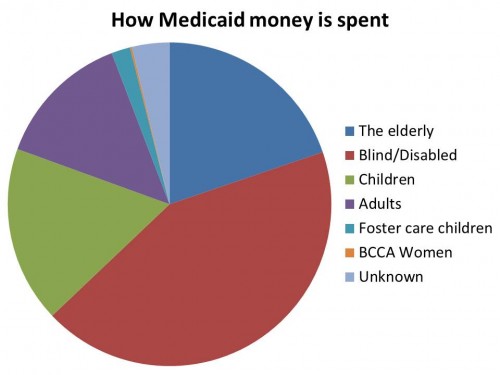
A breakdown of Medicaid spending

In 2302 we discussed the problems associated with actually cutting spending, especially given the constituencies that support the bulk of specific programs that exist. Here's an analysis of the difficulty of cutting spending on Medicaid, especially considering that about 80% of the spending goes to the blind and disabled, the elderly and children.


The story contains the following link to a story pointing out that many people who benefit from the social "safety net" who don't realize they do.

- What is the safety net, anyway?
- Basic info about Medicaid spending.

From the Texas Tribune: Interactive: Texas vs. the Federal Government

2301s will start looking at federalism next week. The following story - which highlights disputes between the federal government and Texas - should help set the stage for it.

In the fight for states’ rights, no other state comes to mind before Texas. Gov. Rick Perry has pitted the state's interests against those of the federal government on a variety of issues — including health care reform and environmental standards — arguing that the 10th Amendment grants state governments more autonomy than many of the laws passed by the federal government allow.

Texas has 17 lawsuits currently pending against the federal government, and we updated this interactive to include the most recent lawsuit filed, which challenges the constitutionality of the so-called contraception rule in the federal Patient Protection and Affordable Care Act. Flip through this interactive to see the nature of the fights and the arguments of Texas Attorney General Greg Abbott and U.S. Attorney General Eric Holder.

Cick on the story to get details.

From the Texas Tribune: Texas Supreme Court Rules For Landowners in Water Case

Here's a subject that ties in our recent look at water policy with the Texas Judiciary. A recent decision may make it difficult for local governments to regulate water use. This might make water policy very difficult to implement. 

In a case with potentially vast implications for groundwater rules in Texas, the state supreme court has unanimously ruled in favor of two farmers in the San Antonio area who challenged the local aquifer authority's sharp restrictions on their use of a water well on their land.

The much-anticipated ruling is "going to make life much more complicated for groundwater districts," said Gregory Ellis, an attorney and the former general manager of the Edwards Aquifer Authority (EAA).

Texans wanting to put a well on their land generally must go to their local groundwater conservation district for permission to withdraw a certain amount of water, as part of an effort to keep aquifers healthy.


Is the Republican Party alienating independents?

Charlie Cook thinks so. This is due to the increased strength of conservatives within the party:


Republicans should be concerned that Mitt Romney’s numbers among independents have been tanking in recent weeks; he went from double-digit leads over Obama in some polls, including one by the Pew Research Center, to a 9-point deficit. He is considered the “most electable” Republican. If other GOP contenders have equally dismal or worse approval numbers among independents, you have to wonder whether this could end up as a choice election, with Republicans coming out on the losing end.

It is becoming quite clear that the conservative base of the Republican Party is driving the car. These voters prefer someone from the pull-no-punches brand of conservatism that created the tea party movement in 2009 and handed Republicans their House majority in 2010. It’s certainly the GOP’s right and choice to do that. The calendar, though, says 2012. The mood of the broader electorate—and, specifically, independents—appears to be very different. If you see any of Obama’s advisers looking bruised from head to toe, it might be from pinching themselves in disbelief.

Congress is still polarized

The National Journal is out with its annual measurement of polarization in Congress and "For the second year in a row but only the third time in the 30 years that National Journal has published these ratings, no Senate Democrat compiled a voting record to the right of any Senate Republican, and no Republican came down on the left of any Senate Democrat. (The first time this happened was 1999.),"

- Find the ratings here.
- Divided we Stand.

So whose political model is superior? The United States' or China's?

I strongly recommend you read the two articles linked to below:

The pro-China author has some interesting points to make about our democratic system - which should sound familiar to my students:

In the history of human governance, spanning thousands of years, there have been two major experiments in democracy. The first was Athens, which lasted a century and a half; the second is the modern West. If one defines democracy as one citizen one vote, American democracy is only 92 years old. In practice it is only 47 years old, if one begins counting after the Voting Rights Act of 1965 — far more ephemeral than all but a handful of China’s dynasties.
Why, then, do so many boldly claim they have discovered the ideal political system for all mankind and that its success is forever assured?

The answer lies in the source of the current democratic experiment. It began with the European Enlightenment. Two fundamental ideas were at its core: the individual is rational, and the individual is endowed with inalienable rights. These two beliefs formed the basis of a secular faith in modernity, of which the ultimate political manifestation is democracy.

. . . The American Federalists made it clear they were establishing a republic, not a democracy, and designed myriad means to constrain the popular will. But as in any religion, faith would prove stronger than rules.

The political franchise expanded, resulting in a greater number of people participating in more and more decisions. As they say in America, “California is the future.” And the future means endless referendums, paralysis and insolvency.

In Athens, ever-increasing popular participation in politics led to rule by demagogy. And in today’s America, money is now the great enabler of demagogy. As the Nobel-winning economist A. Michael Spence has put it, America has gone from “one propertied man, one vote; to one man, one vote; to one person, one vote; trending to one dollar, one vote.” By any measure, the United States is a constitutional republic in name only. Elected representatives have no minds of their own and respond only to the whims of public opinion as they seek re-election; special interests manipulate the people into voting for ever-lower taxes and higher government spending, sometimes even supporting self-destructive wars.


In essence he is arguing that the limits that had allowed for stability in American politics have been eroded and we may be less able, as a nation, to solidly address our current problems. We are, he says, too democratic - less the republic than we once were. 2301s - who have just finished Fed 10, should understand the point he is making.

He argues that the greater restrictions on popular participation placed on China's people by their leadership will make it easier for the nation to handle and respond to ongoing changes in the economic and political environment.

Frank Pasquale sees flaws in the argument and suggest that China's model is not quite as stable as is suggested, and may be suffering from the same divisive factors that are impacting us.
Should prisons be privatized?

Texas - and a handful of other states - have been privatizing prisons for many years now. Private providers of services are assumed to be able to do so more efficiently then the public sector. But some argue that private organizations should not be granted the coercive power that properly should only belong to a government whose powers rest on the consent of the governed.

Here are thoughts about that issue.

The author points out that: In 2009, the Israeli Supreme Court ruled that prison privatization violates “the constitutional rights to personal liberty and human dignity of inmates who are supposed to serve their sentence in that prison. This is because of the actual transfer of powers of management and operation of the prison from the state to a private concessionaire that is a profit-making enterprise.”

This is likely also applicable to the increased tendency of private entities to carry out military and security functions.

2301s: we can talk this out next week when we start in on federalism.
2302s: this applies to our discussion of the ever expanding power of the executive.

Reminder: No written assignment this week

Some students are not following info on the blog. Maybe I should lie and tell them to write something. Should I be mean?

Thursday, February 23, 2012

An analysis of the proposed budgets of the Republican candidates

A report from the Committee for a Responsible Federal Budget, and commentary from Andrew Sullivan.

Proposals made to lower corporate tax rates

President Obama suggests lowering the corporate rate from 35% to 28% while removing tax breaks in the code, while adding some for manufacturing and renewable energy.

Andrew Sullivan has a links to various responses to the proposal.

No one seems to think that fundamental tax reform is likely to happen in an election year.

A federal district court states that pharmacists with religious objections are exempt from dispensing emergency contraceptives

This might give an indication about how the courts would settle any cases arising from the Obama Administration's recent decision on contraception coverage.

Eugene Volokh highlights critical parts of the judge's decision, and USA Today has an item on it as well.

What does "probable cause" apply to?

I'm not completely sure I understand the consequences of this court decision, but its seems to suggest that police can use their authority to search under the probable cause standard in the 4th amendment not only for items related to the accusation that one has committed a crime, but for items that will allow the prosecution to build the case against the accused that involves others not related to the crime.

Evidence can be obtained that can "impeach witnesses and respond to potential defenses."

This seems to me to be a problematic expansion of search and seizure, but this is beyond my expertise.

US v Alvarez argued before the Supreme Court

The constitutionality of the Stolen Valor Act was argued before the Supreme Court yesterday. Kiran Bhat at ScotusBlog has a thorough roundup of the media coverage, so no sense trying to compete:  

The Court heard arguments in two cases yesterday morning, with United States v. Alvarez garnering most of the media’s attention. The case involves a First Amendment challenge to the Stolen Valor Act, which criminalizes lies about having received military decorations. Writing for this blog, Lyle Denniston reports that the government urged the Court to interpret the law narrowly; other coverage comes from Nina Totenberg of NPR, Adam Liptak of the New York Times (who also discussed the oral argument for the paper’s At War blog), David G. Savage of the Los Angeles Times, James Vicini of Reuters, Michael Doyle of McClatchy Newspapers,  Mark Sherman of the Associated Press, Mike Sacks of the Huffington Post, and Warren Richey of the Christian Science Monitor.

Commentary on the argument came from the editorial boards of the Washington Post and New York Times, both of which urged the Court to find the Act unconstitutional. At the Constitutional Law Prof Blog, Ruthann Robson analyzed the argument, concluding that Justice Alito seemed to believe that “Congress has broad authority to criminalize falsehoods” but that the other Justices did not give away their opinions during arguments; at ACSblog, she argued that “federal laws should criminalize fraudsters, not braggarts.”  At the Volokh Conspiracy, Eugene Volokh observed that the Justices appeared interested in the issue of when “knowing lies [should] be restrictable on the ground that they cause emotional distress,” while Douglas A. Berman puts a “sentencing spin” on the arguments at Sentencing Law and Policy.

As with similar cases, the justices seemed concerned that the law may invite additional legislation criminalizing - meaning sending people to jail for telling - other types of lies. Having a high school diploma? Having had an extra-marital affair? Is there a clear line stating how far is too far?

Catching up With Darrell Issa

The Washington Post details Darrell Issa's busy year as chair of the House Oversight and Government Reform Committee:

Issa issued 22 subpoenas and published 11 investigative GOP staff reports, and the panel sent 748 letters seeking information from the White House and federal agencies in his first year, according to the panel’s records.

. . .“Do we send a lot of letters out? Yes,” he said recently. “When we hear about it, we send letters. And when we get answers, we very quickly say, ‘We’re all set, thank you very much, we’re done.’ ”


In addition, Issa and his aides noted that the administration faced virtually no serious congressional oversight in its first two years, when Congress was controlled by Democrats.


Click here for an interview with Rep Issa.

2301s should file this under "ambition counteracting ambition."
2302s should see this as an example of congressional oversight.
It also highlights points we make about divided government.

The Supreme Court will hear a challenge to UT's affirmative action program

You can find detail from the NYT here, and the Washington Post here. Some helpful text:

The new case, Fisher v. University of Texas, No. 11-345, was brought by Abigail Fisher, a white student who says the University of Texas denied her admission because of her race. The case has idiosyncrasies that may limit its reach, but it also has the potential to eliminate diversity as a rationale sufficient to justify any use of race in admission decisions — the rationale the court endorsed in the Grutter decision. Diversity, Justice Sandra Day O’Connor wrote, encourages lively classroom discussions, fosters cross-racial harmony and cultivates leaders seen as legitimate. But critics say there is only a weak link between racial and academic diversity.
The Grutter decision allowed but did not require states to take account of race in admissions. Several states, including California and Michigan, forbid the practice, and public universities in those states have seen a drop in minority admissions. In other states and at private institutions, officials generally look to race and ethnicity as one factor among many, leading to the admission of significantly more black and Hispanic students than basing the decisions strictly on test scores and grades would.

- Click here for commentary from the Volokh Conspiracy.
- And from ScotusBlog, plus the relevant documents associated with the case.

2301s should expect a written question about this when we start out discussion of civil rights.

Tuesday, February 21, 2012

State and local budget problems

- Texas Remains $4.1 billion short on its budget:

The chairman of the Legislative Budget Board John O'Brien told lawmakers Tuesday that they did not appropriate enough to cover state expenses for Medicaid and other programs. The state is short more than $4.1 billion in the current budget.

The chief revenue estimator for the Texas comptroller, John Heleman, said the Texas economy had rebounded faster than the rest of the nation. He also said that the state had recovered more than 440,000 jobs, but that many people had moved to Texas since 2008 and have not found jobs.

- Houston grappling with decade of deficit spending:

The city of Houston has been papering over multimillion-dollar budget deficits for nine years by borrowing money, tapping its rainy day fund, selling buildings and just plain putting off bills to the future, according to city finance officials.


Numbers in a report from the city's Long-Range Financial Management Task Force, an ad hoc group that recently submitted more than 100 ideas on how to address Houston's looming fiscal problems, indicate that three consecutive mayors and their city councils have taken their own approaches to adhering to the city's balanced budget law while spending more than they took in.

More on Texas water troubles . . .

This will be a continuing theme given the strong possibility that we might be in the midst of a prolonged drought which might drive changes in how we treat the stuff:

- From the Texas Water Resources Institute: Expect changes in water policy if the drought continues.

- Water management agencies - like the Lower Colorado River Authority - are expected to announce that they will not release water to rice farmers in three counties: Wharton, Matagorda, and Colorado.

- As a consequence of the drought, the percentage of Houston's water supply that once - err - passed through the bodies of people in Dallas has increased. If the drought continues, the percentage will increase. It seems that last year, the water was not diluted at all. As bad as that sounds, DFW seems to be finding ways to reuse their own waste water, which means less down here. Houston uses a half billion gallons of water a day during the summer. Apparently Houston does not recycle its own waste water. Ain't local government sexy?

- Here's commentary last summer about the need for a long term water policy, and our inability so far to implement anything: Significant water supply planning strategies designed to protect our growing economy and communities from drought have not been implemented. Fourteen major reservoir sites designated by the Legislature in 2007 remain undeveloped due to lack of funding and federal regulatory interference. Regulatory hurdles preclude our ability to transfer water from bountiful rivers to areas in need. We need to take greater strides toward implementing water-smart conservation practices and technologies, including re-use and desalination.
Underlying each of these water supply strategies is the need for a consistent, reliable funding source for our water plan. Reservoirs, pipelines, and water desalination plants are expensive. Texas will need to invest $30 billion or more on water supply projects like these if we are to meet our needs in the coming decades. As the strings to our state's budget grow tighter, we may need to consider ways to raise revenues to finance these projects.

Spending cuts conceptually and in reality

Building off last week's 2302 discussion of budgeting and the problems with trimming the budget, here is a year old Gallup poll showing that - with the exception of foreign aid - a majority of Americans oppose cutting specific budgetary items, even while saying that there is too much spending overall. This is a common finding, one that is repeatedly yearly and points to the difference in how the same issue can be seen in two different ways depending on whether it is an abstract consideration, or a specific, tangible  one that can hit us in the pocketbook. We really don't like cuts in those areas that benefit us.

Here are the results:


Clearly Education, Social Security and Medicare are programs that everyone believes benefits themselves - at least at some point in their lives. Not so foreign aid, which probably explains why a sizable majority supports cuts. They see no tangible benefit to it. Some do clearly so its probably worth wondering whether those who support it live somewhere the economy is tied into trade.

The other point to be made about attitudes towards foreign aid - and it could be applied to other areas as well - is that people tend to greatly over-estimate how much money is spent on it:

Asked to estimate how much of the federal budget goes to foreign aid the median estimate is 25 percent. Asked how much they thought would be an "appropriate" percentage the median response is 10 percent.

In fact just 1 percent of the federal budget goes to foreign aid. Even if one only includes the discretionary part of the federal budget, foreign aid represents only 2.6 percent.

This is quite the ironic result.

A some random stories regarding the federal bureaucracy

Three stories for 2302 students to chew on:

1 - The Food and Drug Administration eases rules in order to deal with the shortages of two cancer drugs. Key part of the story:

There is a years-long backlog of applications for new generic drugs at the F.D.A. because the government does not have the money to hire enough reviewers to analyze the applications or inspectors to visit the facilities, many of them abroad. The generic drug industry tired of waiting for Congress to fully finance the F.D.A.’s generic drug office and this year proposed providing the agency with $299 million in annual fees to finance the review process.


- The Food and Drug Administration (Wikipedia)
- From Wikipedia: History of the Food and Drug Administration.
2 - The Securities and Exchange Commission is worried that energy companies are over estimating their natural gas reserves. Recent rules changes loosened the process companies used to claim how much natural gas they were able tap into. Since these affect the value of a company's stock, there is an incentive to over estimate. Some would like those rules reversed.

- The Securities and Exchange Commission (Wikipedia)
- History.

3 - Is Obama preparing midnight regulations in case he is defeated in November? These would be ways to preserve programs he has passed while in office. Somethimes these are more difficult to rescind than you might think.

4 - The Economists argues that Ameica is both over and poorly regulated:

America needs a smarter approach to regulation. First, all important rules should be subjected to cost-benefit analysis by an independent watchdog. The results should be made public before the rule is enacted. All big regulations should also come with sunset clauses, so that they expire after, say, ten years unless Congress explicitly re-authorises them.

More important, rules need to be much simpler. When regulators try to write an all-purpose instruction manual, the truly important dos and don’ts are lost in an ocean of verbiage. Far better to lay down broad goals and prescribe only what is strictly necessary to achieve them. Legislators should pass simple rules, and leave regulators to enforce them.

From the Washington Post: Congress looks for ways around Supreme Court

File this story under checks and balances. 2301s are studying the separated powers this week, and how this separation is maintained by a system of checks and balances. As we will see, some of these are spelled out in the Constitution (the veto, overriding vetoes, Senate confirmation of appointments etc...), while others have evolved over time (judicial review, oversight, etc...).

In the spirit of the latter, here's a story about how Congress is attempting to get around recent Supreme Court decisions by rewriting laws - and proposing amendments - to explicitly, if not negate, temper the impact of those decisions:

Two years after the court drastically altered the landscape of campaign finance rules with its Citizens United v. Federal Election Commission decision, some legislators are still trying to write new disclosure laws that comport with the ruling. Separately, a handful of senators are seeking to draw more attention to their proposed constitutional amendment explicitly allowing Congress to regulate campaign funding.

Another 2010 decision, Skilling v. United States , is also still reverberating in the Capitol. With the ruling having gutted an oft-used tool for prosecuting federal corruption cases, the House and Senate split last week on whether new anti-bribery language should be included in the STOCK Act, which seeks to ban insider trading by members
.

Members of Congress argue - without explicitly saying so - that the dispute ultimately stems from the basic difference in the design of each institution:

A common theme for congressional critics of the court is that the nine justices don’t live in the real world, particularly when it comes to modern politics.

“I’m not sure they grasped the practical effects of the decision they were rendering,” Sen. Michael F. Bennet (D-Colo.), a co-sponsor of the constitutional amendment on campaign finance, suggested last week.

Sen. Tom Udall (D-N.M.), the amendment’s lead author, complained: “None of the Supreme Court justices have run for office in this system. I don’t think they understand.”
The last sentence is especially telling - they don't have to run for office for the explicit reason that they are not intended to be tied into any external constituency. They are free to interpret the laws and the Constitution as they see fit. And then there's this:

“This is saying to the court: ‘We are going to regulate and legislate on campaign finance. We are taking it back,’ ” Udall said.
While this story focuses on current disputes, this type of conflict is actually quite common throughout US history. In fact the first amendment added to the Constitution after the Bill of Rights - the 11th Amendment -  was written following an unpopular Supreme Court decision. So there's nothing truly new here, but it does point out the flexible nature of the checks and balances.

Monday, February 20, 2012

Keynes vs. Hayek

Click here for a review in Reason Magazine of a recent book detailing the conflict between John Maynard Keynes and Frederick Hayek over what, if any, measures should have been made by government to intervene in the Great Depression. The reviewer argues that the book falls short of outlining the dispute adequately, but fill in the gaps for us.

From the Gallup Poll: Americans Judge Reagan, Clinton Best of Recent Presidents

Story here, key graphic below: