Monday, March 2, 2015

On the origins of a Supreme Court case

Vox explains how King v Burwell came to be.

- Click here for the article.
A lawyer, a law professor, and a libertarian spent the last three years struggling to convince first themselves and then national Republicans that a "glitch" in the Affordable Care Act could be the law's undoing.
This week they can drop the sales pitch. The Supreme Court will hear oral arguments in the case, King v. Burwell, on Wednesday, which will decide whether the Obama administration has the legal authority to dole out billions in tax subsidies to Obamacare enrollees.
Unlike the last time conservatives took Obamacare to the Supreme Court — when the Republican party, major activists, and 26 attorneys general joined forces — the new challenge has a more surprising backstory for a big case. It is the result of the key players working loosely, overcoming lawsuit fatigue in conservative circles, pushing an argument that seems more technical than substantive, and even a bit of luck.
"I think people imagine a eureka moment. It was nothing like that."
"There is nothing very organized about it," Michael Greve, a law professor at George Mason University who supports the case, has written. "The litigation has no single mastermind or man behind the curtain. The campaign is the product of a loose conservative-libertarian infrastructure."
The case is now in front of the Supreme Court, despite the unusual route it took. So while supporters might have viewed it as a nonsense legal challenge — never taking it as seriously as the individual mandate case — they still find themselves back where they were three years ago: fearing that the law could fall apart with just one court decision.

From the Texas Tribune: High Court Ruling Protects Insurers from Lawsuits

- Click here for the article.

To peruse today:

- 5 Things To Watch In SCOTUS' Obamacare Arguments.

- For GOP, Changing Washington Isn’t So Easy After All.

From the Texas Tribune: The Top GOP Donors and Bundlers in Texas

A look at at the deep pockets in Texas who determine which GOP candidates are and are not viable.

- Click here for it. 

While Iowa and New Hampshire have the first presidential nominating contests, there’s also a key Republican primary fight going on right now in Texas: the money chase.
The ring-kissing is occurring in every metropolitan area in the state and in oil-rich Midland.
. . . Here’s a look at 10 Texas GOP donors and 10 bundlers — super fundraisers — who are in high demand during the money chase. This list is based on interviews with two dozen state and national operatives, Federal Election Commission records and data compiled by the Center for Responsive Politics. While dozens of influential Texas Republican donors and bundlers are not on this list, their impact could expand as the 2016 presidential race further takes shape.
. . . Few developments changed politics more radically than the introduction of super PACs in 2010.

These outside groups, which are often aligned with but not allowed to coordinate with candidates, mean that Texas billionaires are no longer restricted in how much money they can spend to support a presidential contender.

Friday, February 27, 2015

From the Dallas Morning News: Abbott says schools, roads, border — and tax cuts — are priorities

This is a bit late - the speech was given on 2/17 - but this contains a list of the five items the governor granted emergency status.

- Click here for the article.

Abbott declared five topics “emergency items” for lawmakers — early childhood education, higher education research initiatives, road funding, the border and ethics.
It’s a mostly symbolic designation. The governor’s declaration sidesteps the state constitution’s prohibition on lawmakers passing bills in the session’s first 60 days — or before March 13.
With some House and Senate committees just holding their first meetings, though, Abbott didn’t so much speed up the process as highlight issues he deems important. He has stressed most of them during his gubernatorial campaign and since.

Guide to Texas Legislative Information

A useful guide for 2306 as we start to wade into the legislative branch next week.

- Guide to Texas Legislative Information.

Thursday, February 26, 2015

From Vox: 70 maps that explain America

This fits with 2306's look at the expansion of states across the United States.

- Click here for it.

For 2306's look at counties

Ten years for county commissioner who turned corruption 'into an art’

A top Maverick County official convicted in a widespread bribery scheme that bilked $1.3 million from the county described the effect of his crimes as he was sentenced Monday to 10 years in prison.
“Every second, I just think of the damage I’ve done to my family and to my hometown,” said former County Commissioner Rudy Heredia, 56, who’s been in jail since his arrest in October 2012.
Federal Judge Alia Moses kicked off the sentencing Monday of 15 people who were convicted in an FBI investigation of corruption in nearby Eagle Pass. Heredia was one of five people sentenced Monday. Most of the others will face Moses today.
Heredia was at the center of a scheme to raid a multimillion-dollar grant fund from the Texas Department of Transportation to improve roads and drainage in the county’s poor, unincorporated colonias. In some cases, contractors inflated their bids and kicked back a portion of the profits to commissioners. Other times, they accepted payment for work that was never done.

Last Week Tonight with John Oliver: Elected Judges (HBO)


Vox comments on this here.

Catching up with tax proposals in the Leg

We'll build this up over the semester. Tax reform is on the minds of people in the legislature - as well as the governor. Here's what's being written about the various proposals so far:

- Support builds for plan to boost TxDOT funding with vehicle sales tax revenue.
- House leaders: Texas tax cuts could top $4 billion.
- Lawmakers Want Property Tax Cut That Folks Notice.
- Texas House leaders say they can top Senate in tax relief.

I'll add to this over time.

Criminal justice reform in the leg

Some odds and ends:

- Marijuana bills could be debated in Legislature.
- The Surprise Issue in the Legislature: Marijuana Laws.
- HB 325 - Relating to the prosecution of and penalties for possession of 0.35 ounces or less of marihuana.
- Marijuana bill has roots in Houston.
- Why The Right-Meets-Left Alliance On Justice Reform Is Not As Odd As It Seems.

More to come.

From the Washington Post: The FCC approves strong net neutrality rules

- Click here for the article.

The Federal Communications Commission approved strict new rules for Internet providers Thursday in a historic vote that represents the government's most aggressive attempt to make sure the Web remains a level playing field.
The rules would dramatically expand the agency's oversight of the country's high-speed broadband providers, regulating them like a public utility. They were adopted by a 3-to-2 margin with the commission's Republican members voting against them.
Under the rules, it will be illegal for companies such as Verizon or Cox Communications to slow down streaming videos, games and other online content traveling over their networks. They also will be prohibited from establishing "fast lanes" that speed up access to Web sites that pay an extra fee. And in an unprecedented move, the FCC could apply the rules to wireless carriers, such as T-Mobile and Sprint, in a nod to the rapid rise of smartphones and the mobile Internet.

What is net neutrality?

- What Is Net Neutrality And Why Should I Care? The Non-Geek’s Guide.

And what is the FCC?

- Wikipedia: FCC.
- Website: FCC.gov.
- FCC Rulemaking.

Federalism at its most confusing

All three levels of government are involved in this:

- Feds Nullify State Laws on City Internet: Net neutrality may get more attention, but the FCC is also making a major push for community Internet service—a priority for Obama.

The Federal Communications Commission voted Thursday to overturn laws in Tennessee and North Carolina that restrict the ability of local government to provide Internet service to their own residents.
Chattanooga, Tenn., and Wilson, N.C., first filed petitions last year asking the FCC to overturn their states' laws on local broadband. Both cities are currently providing Internet service, but their state governments had prevented them from expanding the projects to more residents. Last month, President Obama urged the FCC to grant the petitions as part of his push to expand access to high-speed Internet.
Telecom and cable companies have been lobbying for the state laws around the country, arguing that it's not fair for them to have to compete with government-owned Internet providers. The companies contend that the city projects discourage private investment and are often expensive failures.
But FCC Chairman Tom Wheeler argued that if cities want to invest their own money to ensure that homes and businesses have access to high-speed Internet, then state laws shouldn't stand in their way.

The Keystone Veto

Just in time for our look at the checks and balances:

- Obama vetoes Keystone XL bill.
- Read Obama's Keystone veto statement.
- Wikipedia: List of United States presidential vetoes.
- Obama Almost Never Vetoes Bills. That's About to Change.
- GOP Will Try To Override Obama's Keystone XL Pipeline Veto.

Reasonable commentary (in my opinion):

- The Symbolic Politics of Keystone XL.

What is this thing anyway?

- Wikipedia: Keystone Pipeline.

Keystone Pipeline Route


The fight over local control

We've been following this in class - home rule authority is being challenged by the legislature

For details:

- Cities, state start fighting over who has local control.
- States Are Blocking Local Regulations, Often at Industry’s Behest.

as always - more to come.

Tuesday, February 24, 2015

Paper Proposals for 2306

Here is a list of what's been sent in so far. I'll add to these as they come.

- What impact will falling oil prices have on the state budget?
- An analysis of bills related to water - SB78 / SB 329.
- The conflict over border security.
- What are the prospects for criminal justice reform?
- The debate over disability policy.
- The controversies over fracking.
- How likely will marijuana sentencing reforms pass this session?
- How does existing policy affect the ability of felons to find employment after prison?
- What the impact will the dip in oil prices have on the Texas economy?
- What changes are likely to the Texas Dream Act?
- What will the consequences be of the sunset review of the Texas Facilities Commission
- What impact will the change in the 2/3rds rule have on democracy in Texas?
- What is the cost effectiveness of the death penalty?

Sunday, February 22, 2015

Gov. Greg Abbott | Full State of the State Address

Paper Proposals for 2305

Here are a few of the proposals so far. Some are more developed than others. I'll add material relevant to these subjects over the next few weeks to help students develop their ideas. If you're a students and have yet to get your in, please do so and I'll add it to the list.

- How much can you criticize religion in the US?
- Is there a viable third party movement underway nationally? Will a third party candidate emerge in 2016?
- Did the president abuse his powers when he made changes to the ACA without congressional approval?
- Does the freedom of speech include the right to be disrespectful?
- What skills does a president need and do the announced candidates posses them?
- What are the current prospects for immigration reform?
- What will the impact of funding be on the presidential campaign?
- Defending the 113th Congress.
- An analysis of the SOTU speech in comparison to past speeches.
- What is the source of controversy over the Second Amendment?
- What determines the value of the dollar?
- Is there a relationship between illegal immigration and disease?
- How have presidential positions on same sex marriage evolved?
- Why are there such low opinion rates for Congress?

Tuesday, February 17, 2015

This week in 2306 - 2/16 - 2/20

- Texas big-city mayors voice opposition to efforts to limit cities’ property tax revenue growth
- Tax-cut promise vs. fiscal demands.
- Texas' every two-year Legislature isn’t so 'part time'
- State Rep. Jason Villalba files bill to remove judges, county officials from straight-party voting.


The History of the FAA

I'm highlighting the following from the Wikipedia on the Federal Aviation Administration since it illustrates points we will make later about the gradual development of the size and scope of the national government.

Notice the role Congress plays in establishing the agencies that eventually become the FAA and in defining the broad parameters of its powers. Also notice that the aviation industry pushed for the creation of the agency in order to enhance commerce - and look ts the role the (constitutionally mandated) post office played in it as well.

- Click here for the section.


The Air Commerce Act of May 20, 1926, is the cornerstone of the federal government's regulation of civil aviation. This landmark legislation was passed at the urging of the aviation industry, whose leaders believed the airplane could not reach its full commercial potential without federal action to improve and maintain safety standards. The Act charged the Secretary of Commerce with fostering air commerce, issuing and enforcing air traffic rules, licensing pilots, certifying aircraft, establishing airways, and operating and maintaining aids to air navigation. The newly created Aeronautics Branch, operating under the Department of Commerce assumed primary responsibility for aviation oversight.

In fulfilling its civil aviation responsibilities, the Department of Commerce initially concentrated on such functions as safety regulations and the certification of pilots and aircraft. It took over the building and operation of the nation's system of lighted airways, a task that had been begun by the Post Office Department. The Department of Commerce improved aeronautical radio communications and introduced radio beacons as an effective aid to air navigation.

. . . In 1938, the Civil Aeronautics Act transferred the federal civil aviation responsibilities from the Commerce Department to a new independent agency, the Civil Aeronautics Authority. The legislation also expanded the government's role by giving them the authority and the power to regulate airline fares and to determine the routes that air carriers would serve.

. . . In 1967, a new U.S. Department of Transportation (DOT) combined major federal responsibilities for air and surface transport. The Federal Aviation Agency's name changed to the Federal Aviation Administration as it became one of several agencies (e.g., Federal Highway Administration, Federal Railroad Administration, the Coast Guard, and the Saint Lawrence Seaway Commission) within DOT (albeit the largest). The FAA administrator would no longer report directly to the president but would instead report to the Secretary of Transportation. New programs and budget requests would have to be approved by DOT, which would then include these requests in the overall budget and submit it to the president.


From the NYT: F.A.A. Rules Would Limit Commercial Drone Use

This gives us an early look at the rule-making process. Both 2305 and 2306 will look at this process further when we get to the executive branch on each level of government.

- Click here for the article.

In an attempt to bring order to increasingly chaotic skies, the Federal Aviation Administration on Sunday proposed long-awaited rules on the commercial use of small drones, requiring operators to be certified, fly only during daylight and keep their aircraft in sight.

The rules, though less restrictive than the current ones, appear to prohibit for now the kind of drone delivery services being explored by Amazon, Google and other companies, since the operator or assigned observers must be able to see the drone at all times without binoculars. But company officials believe the line-of-sight requirement could be relaxed in the future to accommodate delivery services.

The proposed regulations would cover only nonrecreational unmanned aircraft weighing up to 55 pounds, and would not apply to the recreational use of drones, which have become hugely popular with hobbyists and are covered by other rules. However, the F.A.A. said it was considering additional rules to cover some uses of the smallest drones, so-called microdrones, weighing less than 4.4 pounds.

Some drone evangelists believe that in the next few decades, robotic aircraft will prove as useful and transformative to government, commerce and home life as the personal computer. But the exploding number of domestic drones has been accompanied by increasing safety problems, including reports of near misses involving passenger airliners and the crash of a small drone on the White House grounds last month.

- Click here for the rulemaking page on the FAA's website.
- Wikipedia: Federal Aviation Administration.
- FAA website.


From the Texas Tribune: Texas vs. the Feds: A Look at the Lawsuits

For 2306 primarily.

- Click here for the link.

One of our themes so far is the conflict between the state of Texas and the national government. As attorney general, Greg Abbot used the courts repeatedly to push back against the national government with mixed success.

The Texas Tribune reviews his efforts and provides details. This might help clarify paper topics for some of you.

Here is a list of areas of conflict:

- Air Quality
- Business Regulation
- Climate Change
- Education
- Health Care
- Immigration
- Natural Resources
- Voting

From the NYT: Obama Immigration Policy Halted by Federal Judge in Texas

For out upcoming look at checks and balances:

- Click here for the article.

A federal judge in Texas has ordered a halt, at least temporarily, to President Obama’s executive actions on immigration, siding with Texas and 25 other states that filed a lawsuit opposing the initiatives.

In an order filed on Monday, the judge, Andrew S. Hanen of Federal District Court in Brownsville, prohibited the Obama administration from carrying out programs the president announced in November that would offer protection from deportation and work permits to as many as five million undocumented immigrants.

The first of those programs was scheduled to start receiving applications on Wednesday and the immediate impact of the ruling is that up to 270,000 undocumented immigrants nationwide who came to the United States as children will not be able to apply for deportation protection under an expansion of an existing executive program. A larger new program is scheduled to begin in May.

Judge Hanen, an outspoken critic of the administration on immigration policy, found that the states had satisfied the minimum legal requirements to bring their lawsuit. He said the Obama administration had failed to comply with basic administrative procedures for putting such a sweeping program into effect.

The administration argued that Mr. Obama was well within long-established federal authority for a president to decide how to enforce the immigration laws. But Texas and the other states said the executive measures were an egregious case of government by fiat that would impose huge new costs on their budgets.

The White House responded to the judge’s ruling in a statement early Tuesday, saying the president had acted within the law and with decades of legal precedent behind him in issuing the guidelines.

For more info:

- Website: United District Court: Southern District of Texas.
- Wikipedia: Judge Andrew S. Hanen.
- Judge Hanen's site.

It's worth charting our who favors the president's executive order and who opposes it.


Thursday, February 12, 2015

From the NYT: Left and Right Align in Fighting Obama’s Trade Agenda

For our discussion of ideology - areas where each side works together. In this case the conflict over free trade seems to straddle parties:

- Click here for the story.

An odd marriage of convenience between liberal Democrats and Tea Party Republicans is squeezing President Obama on his ambitious trade agenda, forcing the White House and top Republicans to fight a two-front war on an international economic effort the president hopes to secure before he leaves office.
An alliance between the likes of Representatives Louie Gohmert and Dana Rohrabacher — two of the House’s most conservative members — and Rosa DeLauro and Louise Slaughter — ardent liberals — is unlikely enough. But as the political fringes expand on each end, they are challenging another strange-bedfellows alliance between Mr. Obama and Republicans like Representative Paul D. Ryan and Senator Orrin G. Hatch, who have joined together in a push to secure “fast-track” trade promotion authority before the administration completes a major trade agreement with 12 partners along the Pacific Rim.

For more on the Trans Pacific Partnership, click here.

Here's the latest version of the Texas Constitution

This includes the amendment approved in the November 4, 2014 election.

- Click here for it.

Akhil Reed Amar: "America's Symbolic Constitution"


Is there more to the "Constitution" than just the Constitution?

A few more charts on the spending side of the US budget

To build on info related to the president's recently submitted budget:

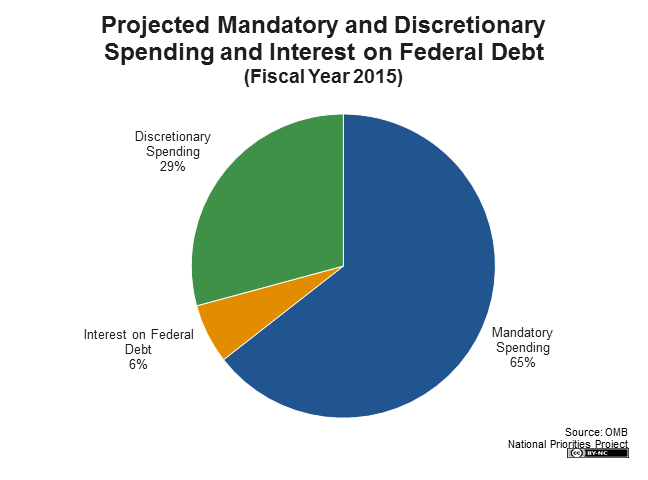
Here's the breakdown on mandatory versus discretionary spending:


Here are the spending areas that are mandatory - meaning that they are required by law to be spent. Unless the law is changed, these areas have to be spent each year.


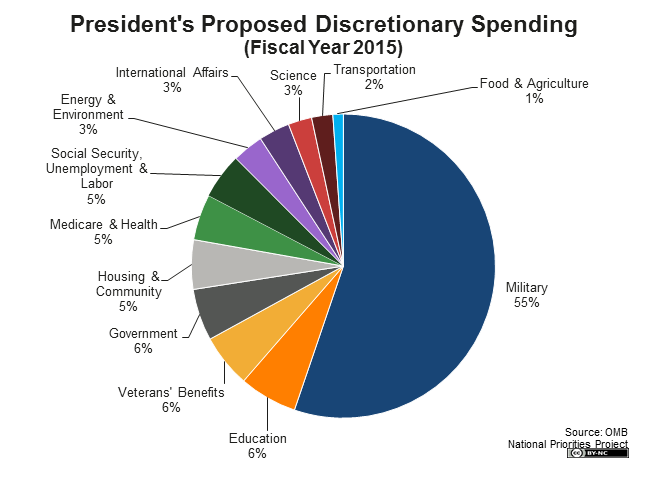
Here are the spending areas that are discretionary - meaning that they are not required by law and can be cut at will each year - assuming that powerful constituencies don;t get in the way.


The organizational flowchart for DHS

To elaborate on point below.

Click here for it.

This week in 2305: 2/9/15 - 2/13/15

A few topical items that might help put things in perspective - or not:

- So Far, a Congress About Nothing. The Republican Conference still appears to be difficult for party leaders to manage.

- Funding Is Still Elusive for Homeland Security. One of the areas of disagreement is in funding the Department of Homeland Security. Funding has been held up to pressure the president to undo executive decisions on immigration, but they've failed to gain traction. Principle tension seems to be between Republicans in the House and those in the Senate.

- White House Seeking Support Of Congress In Fight Against ISIS. A tug of war over how to go forward against the terrorist group:
The president has been asking Congress to pass an Authorization for the Use of Military Force (AUMF) against ISIS for months now, and for months Republicans in Congress have demanded that the White House draft the language. That language is now being finalized after numerous discussions between the White House and members of Congress from both parties, discussions requested by Congressional leaders.
- Here's the White House Request for the Use of Force Against the Islamic State. Click here for the document.

- Wikipedia: Authorization for Use of Military Force Against Terrorists. Here's some history. The president argues that this document still authorizes his ability to act if he chooses.

- Obama's big new resolution on ISIS is really about limiting presidential power. A look at the politics behind the effort to get Congress on board the battle against ISIS.

- House Passes Keystone Bill Despite Obama’s Opposition. The bill now goes to the Senate, but it is not considered likely to get the 2/3rds support to override a promised veto.


Tuesday, February 10, 2015

Speaking of national / state conflict ...

Vox explains the current conflict between the state of Alabama and the national government over same sex marriage.

- Click here for the article.

Commentary to follow - but all this flows from the fact that we live in a federal system with two levels of government with (more or less) independent sovereign status.

From the Houston Chronicle: Harris County DA calls for grand jury reform - Prosecutor urges end to judges' 'pick a pal' way of selection

Here's the full text of a story linked to below

This is important for both 2305 and 2306. The right to a grand jury is a chief component of the due process established in the bills of rights on the national and state levels, but there is little clarity in what makes a grand jury fair. The Harris County DA seems to know what it isn't:

Harris County District Attorney Devon Anderson on Sunday called for lawmakers to abolish the way judges pick grand juries, citing a growing lack of confidence in the system, which critics have said does not adequately represent a diverse population.
Texas judges tasked with empaneling 12-person grand juries - who decide whether enough evidence exists to formally charge a suspect with a crime - often have named their friends as grand jury commissioners who then pick their friends to fill the remaining spots, leading to panels of people who are socioeconomically and demographically similar.

Anderson, who has led the state's largest district attorney's office for the past 17 months, had remained neutral on calls from critics of the "pick-a-pal" system.

In a two-page Letter to the Editor of the Houston Chronicle on Sunday, she offered her full-throated support for changing the law on how grand juries are selected.

"The public is losing confidence in the grand jury system," Anderson wrote. "I support the efforts in the Texas Legislature to abolish the jury commissioner system."

Anderson, who called the current system "a historical anachronism," joins a chorus of calls for reform in the midst of fierce national debate over the diversity of the people picked to be grand jurors, an issue that has been spotlighted by several high-profile cases across the country.

In November, riots broke out in Ferguson, Mo., after a grand jury decided not to indict a white police officer in the shooting of an unarmed black teenager. A month later, protesters took to the streets in New York City when a grand jury decided not enough evidence existed to go forward with charges against a white police officer whose chokehold, which was captured on video, led to the death of an unarmed black man.

A Houston Chronicle analysis in 2013 showed that Houston police officers shot 121 civilians - 25 percent of them unarmed - between 2008 and 2012 without a single officer being indicted.

Whitmire's bill

State Sen. John Whitmire, who authored the bill to abolish the "key man" system, said recent events and local reporting reinforced his concern about how grand juries are put together and convinced him it is time for a change.

"People of all colors have lost confidence in the system," he said. "We don't need a handpicked group of the judge's friends making these decisions."

Whitmire said he attended a town hall meeting where it was apparent that minority communities in Houston have lost faith in the current system.

"I've become convinced from personal observation and knowing people - judges, prosecutors - that it's a flawed system," he said. "It's alarming when you hear the examples of what some judges are doing."

Whitmire applauded Anderson's decision to support the effort to create more diverse grand juries. He said he looked forward to partnering with her administration.

"She's the district attorney of the largest DA's office in Texas. I'm the Chair of the Senate Criminal Justice Committee," he said. "I'm a Democrat, she's a Republican, so I'm sure we'll be able to get some things done."

The problem, according to people who are reticent to make changes, is the enormous time commitment individual grand jurors have to make.

Houston's 22 felony judges are tasked with empaneling grand juries who serve two days a week for three months.

Each grand jury hears hundreds of cases and decides whether enough evidence exists to formally charge a suspect with a crime. More than 40,000 felony charges are filed in Houston every year. If enough evidence exists, the grand jury votes to hand down an indictment. If not, the grand jurors "no-bill" the suspect.

Throughout Texas, most judges use the key man system in which a judge chooses up to five commissioners, sometimes friends or past grand jurors, who then pick the other 11 grand jurors.

State District Judge Susan Brown, who is the current administrative judge in Harris County, said picking grand juries is the most difficult part of a judge's job because of the time commitment.

When she last chose a grand jury, Brown brought 30 people from the jury room to her court and explained that a commissioner makes a time commitment and is responsible for bringing in names of more prospective grand jurors. She had five volunteers. Of those, only four showed up again and only one brought in the name of another prospective grand juror.

"The reality for us is that it's really hard," she said. "I'm an advocate for whatever way gets a cross-section of the community," she said.

Judges often have relied on their friends, acquaintances and recommendations from colleagues when selecting commissioners, leading to accusations of a "good old boy system" of grand jurors.

Critics have long said judges should take their friends out of the process and instead use a random jury "wheel" to bring in prospective jurors to ensure diverse grand juries.

Several judges have said it is not as easy as it sounds.

"There's a lot of people on the wheel who probably mean well and say they'll do it, but I don't know that they will," said state District Judge Ruben Guerrero. He said he prefers to personally screen prospective grand jurors and select retired people who have the time to serve. He noted that his grand juries generally have "a good cross section of African Americans and Hispanics."

A Houston Chronicle analysis in December showed there are three times more adult Hispanics living in Harris County than the number who serve on grand juries.

Jury commissioners

A former state district judge herself, Anderson has said that she would use a random jury pool if she were still on the bench.

On Sunday, she called for an end to the current system.

"The use of jury commissioners to select grand jurors unnecessarily gives critics of the grand jury system ammunition to challenge the jurors' independence and integrity," she wrote.

She noted that other jurisdictions have used random jury wheels for years. The federal court system abolished the key man system in 1968.

"Whatever concerns the remaining district court judges have about using jury pools for selecting grand jurors should have been assuaged long ago," she wrote. "Other district courts have been using the jury pool system successfully for long enough that its viability cannot be questioned."

Anderson was appointed in September 2012 after her husband - then the district attorney - died a month earlier. She was elected in November after a bitterly fought campaign, during which she said that she does not have the authority to force any of the 22 state district judges, who are elected, to change their process.

"Getting those 22 people to agree on anything is like herding cats," she said in September.

Indeed, an informal survey of the current judges reveals most use a "hybrid" system of their own device, like personally approaching prospective jurors randomly, then asking their commissioner to consider putting them on the grand jury.

Other judges find people who are interested in being grand jurors and then conduct in-depth interviews and background checks.

If Whitmire's bill passes, it would give the judges and their staffs a standardized way to empanel grand juries with a random jury wheel.

More diversity

Carmen Roe, president of the Harris County Criminal Lawyers Association, said abolishing the commissioner system is a good first step.

"There's no question that everyone in Harris County realizes that the key man system does not result in a diverse grand jury," Roe said.

In addition to abolishing "pick a pal," Roe said the law needs to mandate that jurors are selected from a random panel without judges intervening.

"We have to go one step further and make sure that the first 12 qualified grand jurors are seated," Roe said. "Not the 12 people that the trial judge or someone else thinks should be seated."
The Chronicle provides the following links to related stories:
· Anderson: Let's rethink how grand juries are selected· Judge denies Perry request for grand jury witnesses· Falkenberg: Another Jasper case, another pick-a-pal grand jury

Monday, February 9, 2015

This week in 2306: 2/9/15 - 2/13/15

A few stories to kick things off this week. Any of these could be good paper topics.

- State law allows for lobbying deep in the shadows of Texas. There are very few - if any - substantive rules on lobbying in Texas. Those that exist are barely enforced, so money flows freelu in Texas politics.

- Conflict brews as counties push for city to fund roads. An inside look at the battle over funding roads in local areas - cities versus counties versus utility districts.

- Texas Senate health chief opposes Villalba bill to limit vaccine exemptions. Texas legislators are responding warily to a proposal to make it more difficult for parents to opt out of vaccinating their kids.

- Texas school choice advocates gaining ground. Lt. Gov Patrick pet issue might be gaining traction this session.

- Harris County DA calls for grand jury reform. The content of this story will be printed up elsewhere, but this could be considered more fall out from the police shooting in Ferguson, Missouri. It called attention to problems with how grand juries are selected. They tend to not reflect the general population, which leads to questions about whether the justice system here and nationally is fair.

- Bill Would Expand DNA Testing for Criminal Cases. More proposed reforms to the criminal justice system - this time as a result of the wrongful murder conviction of Michael Morton. This would make it easier for DNA testing to be allowed post conviction.

- Hearing set on open carry, campus carry gun bills. The Senate State Affairs Committee is set to consider two of the many gun bills that have been introduced in the legislature.


Saturday, February 7, 2015

From Vox: Confessions of a congressman 9 secrets from the inside

I want to make this required reading.

- Click here for it.

It's allegedly from a sitting member of Congress and makes the following arguments:

1) Congress is not out of touch with folks back home
2) Congress listens best to money 
3) Almost everyone in Congress loves gerrymandering 
4) You have no secret ballot anymore 
5) We don't have a Congress but a parliament 
6) Congressional committees are a waste of time 
7) Congress is a stepping-stone to lobbying 
8)The best people don't run for Congress 
9) Congress is still necessary to save America, and cynics aren't helping

Thursday, February 5, 2015

Was King John really that bad?


This video makes the case that he was. It also suggests that this was politically inexpedient and led the barons to see common interest in opposing him. This is good background for understanding the factors leading up to Magna Carta.

A peek at the three branches

For today's 2305. An sample of what's up in each branch of government:

The Legislature:
- The Pitfalls of a New Majority.

The Executive:
- FCC Chairman Wheeler Backs Regulating Internet As Public Utility.

The Judiciary:
- Supreme Court will review use of lethal injections.

From You Tube: Simon de Montfort and the Emergence of Parliament


This is a companion piece to the previous video. While the barons had been promised the right to establish an assembly, in the Magna Carta, later kings were reluctant to actually allow them to do so. This video illustrates that point. It also tells how and why the scope pf people who could participate in parliament began to expand. Power can only be contained with power.

For more about this period of time click here: De Montfort's Parliament.

From You Tube: Magna Carta and the Emergence of Parliament


This might be a helpful way for 2305 students to get a handle on the gradual process by which the power of British Monarchs were contained. The most effective way to do so - in a relatively permanent manner - was for the barons to get the king to agree that they could establish a group that could oversee the actions of the king and ensure that he could be held to the agreements he made in the Magna Carta.

From the Texas Tribune: The Hotlist

This might help 2306 students hone in on a topic for the 1000 word essay.

The Texas Tribune's page on the 84th Legislature lists what it considers to be the dominant issues in the current legislative session. These are topics they highlight. Each links back to the Tribune. If you are in 2306 you could do worse than draw from these for your paper proposal.

Ethics
- The fight over dark money.
- Former legislators as lobbyists.

Environment
- Reforming how groundwater is managed.
- Chipping away at environmental regulations.
- Addressing the effects of oil and gas drilling.

Transportation
- Ensuring all gas tax revenue goes to the highway fund.
- Dedicating car sales taxes to the highway fund.
- Banning texting while driving.
- Reviewing state policies on toll roads.

Health and Human Services
- Reforming end-of-life care
- Medicaid expansion or its alternatives
- Consolidating Texas’ health agencies

Higher Education
- Tuition revenue bonds for campus construction
- In-state tuition for undocumented students
- Reining in rising tuition

Law and Order
- Efforts to change voter ID
- Reducing penalties for marijuana possession
- Enhancing gun rights
- Changing the age of adulthood for criminal charges

Energy
- Acting on the EPA's "Clean Power Plan"
- Combating local drilling ordinances
- Responding to volatile oil prices

Public Education
- Improving educator quality
- Reforming Pre-K
- School choice and vouchers

Social Issues
- Efforts to defund Planned Parenthood providers
- Gay rights legislation
- Expanding gambling in Texas
- Further restrictions on abortion

Immigration and Border Security
- Banning “sanctuary cities”
- Border security spending and operations
- Mandating the use of E-verify

Budget and Taxes
- Reforming contracting and procurement
- Reducing property taxes
- Cutting margins taxes
- Budget fallout from school finance lawsuit

Tuesday, February 3, 2015

From GovTrack: recent votes by Representatives Olson and Weber

Feb 2, 2015 6:58 p.m. — Vote
H.R. 361: Medical Preparedness Allowable Use Act
- Passed 377/2
Rep. Olson [R-TX22]: Yea
Rep. Weber [R-TX14]: Yea

Feb 2, 2015 7:06 p.m. — Vote
H.R. 615: Department of Homeland Security Interoperable Communications Act
- Passed 379/0
Rep. Olson [R-TX22]: Yea
Rep. Weber [R-TX14]: Yea

Feb 2, 2015 7:15 p.m. — Vote
H.R. 623: Social Media Working Group Act of 2015
- Passed 328/51
Rep. Olson [R-TX22]: Nay
Rep. Weber [R-TX14]: Nay

The Organizational Chart for the Justice Department

To help with a future discussion of the federal bureaucracy:

Today in the Checks and Balances: the Senate Judiciary Committee questions Attorney General nominee Loretta Lynch

Nothing in the U.S. Constitution about this part of the process, but members of this committee have special jurisdiction over the Treasury Department. If approved by the committee, the nomination goes to the floor of the Senate. This part is mandated by the Constitution. Here's the relevant part:

Article 2, Section 2, Clause 2:

He shall have Power, by and with the Advice and Consent of the Senate, to make Treaties, provided two thirds of the Senators present concur; and he shall nominate, and by and with the Advice and Consent of the Senate, shall appoint Ambassadors, other public Ministers and Consuls, Judges of the supreme Court, and all other Officers of the United States, whose Appointments are not herein otherwise provided for, and which shall be established by Law.

- Click here for historical detail from Findlaw.

The Hill reports that the nominee will likely sail through the process. The committee may simply be exhausted from fighting with the current Attorney General for so long. A breather may be in order.

Here's some - hopefully useful - background reading. This touches on issues we will cover soon enough in class.

- US Attorney General: This was one of the first executive positions established by Congress - the AG was the chief lawyer of the U.S. government and served bit the president and Congress. The first was Edmund Randolph. He served - along with the three others as members of Washington's first cabinet. The office was established in the same bill that established the process for the writ of mandamus that would be lead to the development of the power of judicial review.

- Senate Judiciary Committee: The committee was established in 1816. Click here for a history of the committee from its webpage and here for a look at the history of the committee system in the Senate. Until 1816, committees were informal and ad-hoc and members often met at theirs desks. The growth of the nation and the increased complexity of the law making process led the Senate to establish standing committees in 1816. The judiciary committee was one of the first. Aside from having oversight authority over the Justice Department it also considers nominations to the federal judiciary.

- Department of Justice: This was established in 1870 after the House Committee on the Judiciary recommended that the office of Attorney General be made full time and that the attorneys involved in various aspects of governance be put under one roof. These attorneys represented the national government in all legal matters and oversaw the prosecution of federal crimes.

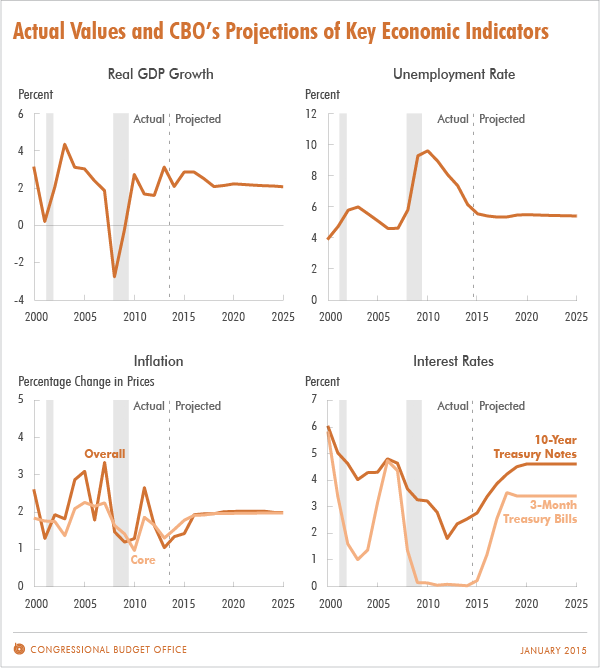
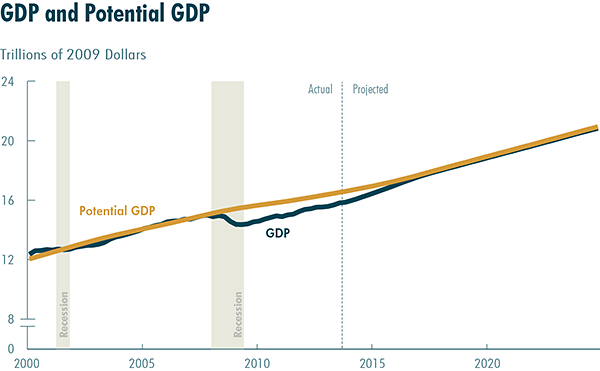
From the Congressional Budget Office: The Budget and Economic Outlook: 2015 to 2025

This was produced in preparation for consideration of the 2016 budget.

- Click here for it.

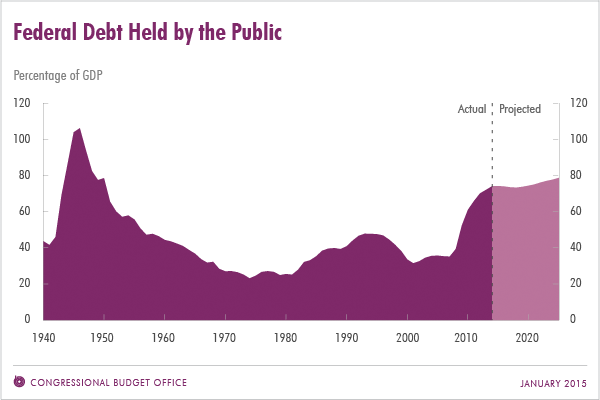
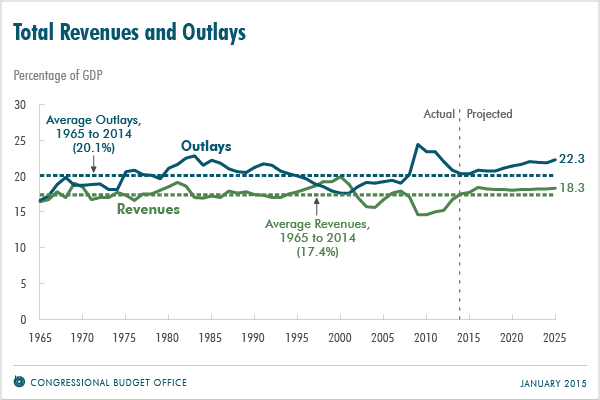
It provides data about recent economic performance as well as the level of outlays and revenue collection. Using economic forecasts it also - as is required by law - projects both ten years into the future. This provides guidelines for the future size of the deficit.

- Click here for the Wikipedia on the CBO.
- Click here for the CBO's website.

Here are some graphs from the report:

Federal Debt Held by the Public

Total Revenues and Outlays

Actual Values and CBO's Projections of Key Economic Indicators


President Obama sends budget to Congress

2305 students will be looking through the budgetary process soon enough. To prime the pump, here's a look at the president's budget - which has just been sent to Congress.

- The President's Budget for Fiscal Year 2016.

And here's the president's message to Congress on the budget:

- Click here for it.

It builds on themes - middle class economics - introduced in the state of the union address.

And some random background and commentary:

- NYT: Obama’s Budget: Beyond the Boldness, Nuggets With G.O.P. Appeal.
- The Hill: Obama proposes $4T budget with tax hikes on the wealthy.

More detail to follow as this goes through Congress.

Monday, February 2, 2015

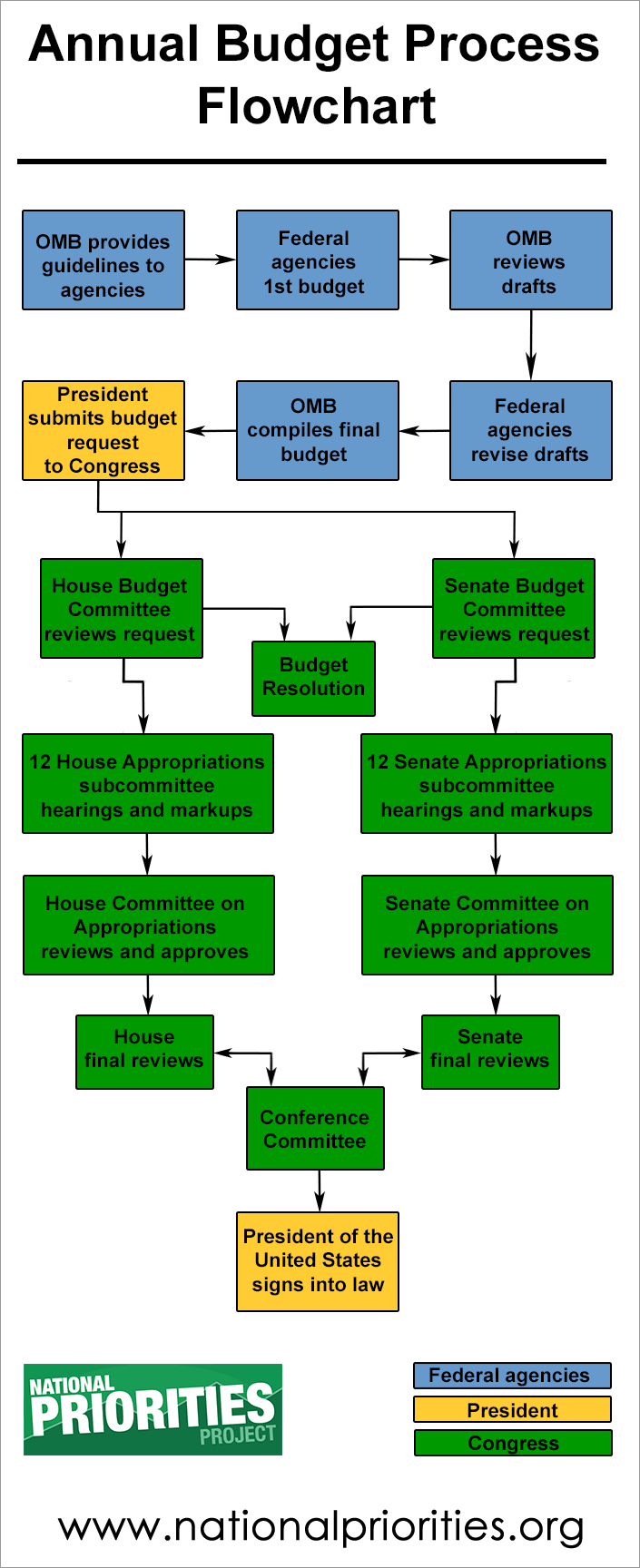
The United States' budgeting process

To put our look at the recently released 2016 federal budget in context - here's a flowchart of the process.


And for more detail and description:

- Wikipedia: United States budget process.
- House Budget Committee: Budget Process.
- CBPP: Policy Basics: Introduction to the Federal Budget Process.

Sunday, February 1, 2015

From Vox: Re-reading is inefficient. Here are 8 tips for studying smarter.

This might be pretty important.

- Click here for the article.

And here's the condensed version of the suggestions (read the thing for explanations). Some of this is for you - some of this id for me.

1) Don't just re-read your notes and readings
2) Ask yourself lots of question
3) Connect new information to something you already know
4) Draw out the information in a visual form
5) Use flashcards
6) Don't cram — space out your studying
7) Teachers should space out and mix up their lessons too
8) There's no such thing as a "math person"

I'll try to incorporate some of these in the classroom. Numbers 2, 3, and 7 especially

Thursday, January 29, 2015

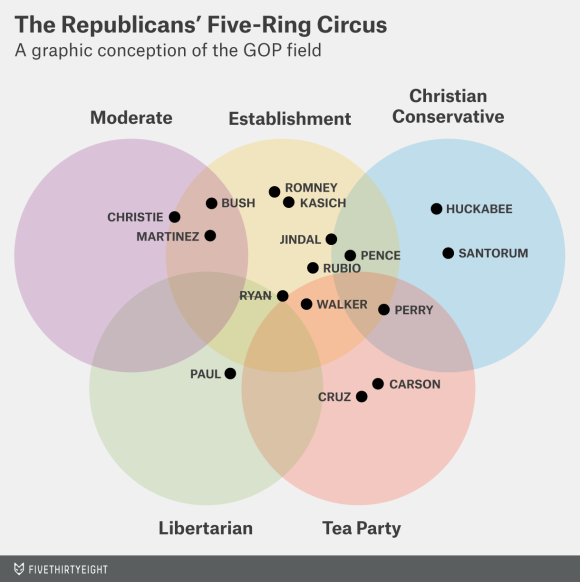
From 538: Everybody Hates Chris Christie

I'm not linking to this because it has anything to do with Governor Christie, but because of this graph the article (click here for it) contains:

enten-datalab-christiescatter

Here's a description of what you're looking at:

I’ve matched the net favorability rating (favorable rating minus unfavorable rating) of every major party nominee among their party’s members since 1980 against the percentage of party members who could form an opinion of them during the first six months of the year before the primaries.

Some nominees, such as Democrats Michael Dukakis and Bill Clinton, weren’t well known at this point in the campaign. Some, such as Republicans Bob Dole and Ronald Reagan, were very well known and popular. There was George W. Bush in 1999, who was particularly well liked, even if he wasn’t universally known. But no prior nominee had a net favorability rating more than 10 percentage points below where you’d expect given his name recognition.
Christie is 25 percentage points off the pace.
This provides another look at the range of candidates for the Republican nomination and compares them with where successful candidates in the past - for either party - fit in terms of recognition and favorability.


What is a college education? David Ray at TEDxOU


One of your fellow students sent this to me and I think it might be worth your time to watch it. This fits with the theme of the opening section of both 2305 and 2306.

Enjoy!

Tuesday, January 27, 2015

From the Washington Post: Arizona will require high school students to pass citizenship test to graduate. Can you pass?

They want their high school students to know as much as newly naturalized citizens.

- Click here for the article.

Arizona high school students will have to pass the same test that immigrants must take to obtain citizenship before they graduate under a new law signed Thursday by Gov. Doug Ducey (R).
The first-of-its-kind law will require students to take the U.S. Immigration and Naturalization civics test, a set of 100 basic questions on U.S. government and history. Students will have to get 60 of the 100 questions correct in order to graduate.
The measure passed the state House and Senate in a single day. It’s one of the first measures Ducey, inaugurated earlier this week, signed into law.
Arizona is just the first state to require citizenship tests for high school students. The Civics Education Initiative is pursuing similar legislation in dozens of states, with the goal of mandating the test in all 50 states by Sept. 17, 2017 — the 230th anniversary of the U.S. Constitution. In Arizona, CEI’s effort was spearheaded by former senators Dennis DeConcini (D) and Jon Kyl (R).
In total, 18 states are likely to consider civics test requirements this year. North Dakota legislators this week advanced their own version through a state House committee.

We'll take some of this in class.

From the NYT: Koch Brothers’ Budget of $889 Million for 2016 Is on Par With Both Parties’ Spending

Much has been - and will continue to be - written about the influence of money in politics, especially that of deep pocketed individuals with agendas. The Koch Brothers stand out from the crowd because of their aggressiveness.

Soon enough - in 2305 - we will discuss the Citizens United decision and its impact on the amount of money private individuals can spend on campaigns, but here's an interesting twist. The Koch Brothers reportedly plan to spend as much money as either of the major political parties on the next presidential election. Meaning that they effectively are establishing their own political party - or at least put themselves in a position where they can influence the candidates of either party they choose.

This news was leaked from a recent retreat held by the brothers that was attended by several potential 2016 candidates.

- Click here for the NYT article. 

“It’s no wonder the candidates show up when the Koch brothers call,” said David Axelrod, a former senior adviser to Mr. Obama. “That’s exponentially more money than any party organization will spend. In many ways, they have superseded the party.”
The group’s budget, disclosed by a conference attendee, reflects the rising ambition and expanded reach of the Koch operation, which has sought to distinguish itself from other outside groups by emphasizing the role of donors over consultants and political operatives.
While the Koch’s expansive network houses groups with discretely political functions — a data and analytics firm, a state-focused issue-advocacy group and affinity groups aimed at young voters and Hispanics — it also includes groups like Freedom Partners, a trade organization overseen by Koch advisers that plans the retreat and helps corral contributions; Americans for Prosperity, a national grass-roots group; and Concerned Veterans for America, which organizes conservative veterans
While almost no Republican Party leaders were invited to the Koch event, it has become a coveted invitation for the party’s rising stars, for whom the gathered billionaires and multimillionaires are a potential source of financing for campaigns and super PACs. Officials said this year’s conference was the largest ever.
At least five potential presidential candidates were invited this year, and four attended, including Gov. Scott Walker of Wisconsin. On Sunday evening, three of them — Senators Marco Rubio of Florida, Rand Paul of Kentucky and Ted Cruz of Texas — took part in a candidate forum on economic issues.

From the Monkey Cage: The decline of local news is threatening citizen engagement

The authors find that the loss of local newspapers - and presumably less information about local matters - leads to less interest and engagement. The problems this posses for "keeping the republic" seem obvious.

Just as interesting, the authors argue that the decline in competitive races for the US House of Representatives has led to less coverage of these races, which in turn has led to less knowledge about them and then less engagement.

And there's more: The increasing number of options available for information has meant that those who follow politics know more and more because they have access to more information and those who want to avoid it have other places to go. They know less and less.

File this under: "important thing to read"

- Click here for the article.

The author does link to this cool cat video.

Monday, January 26, 2015

These guys do a better job than I do outlining the legislative process.

From The Texas Tribune: Patrick Sets Committees; Taylor Gets Education

Lieutenant Governor Patrick announced his committee picks, along with his decision about who will chair these committees, for this session. This is a key power granted to the lieutenant governor and provides a degree of control over the legislative process in that chamber.

ACC's state senator Larry Taylor will chair the Education Committee.

- Click here for the article.

I found this an interesting look at power in the chamber:

There had been speculation among Capitol observers that the higher education committee, chaired by Seliger, who has been an occasional critic of Patrick's, might be folded into the education committee. Not only did it survive, however, but Seliger, who sponsored a fundraiser for Patrick and contributed to his campaign, retained his chairmanship.

And there's this about Taylor:

Who Patrick would pick to chair Education, the committee he headed as a state senator, was a subject of much discussion heading into the session.
Taylor, a sophomore, served on the committee he will now lead during the 2013 legislative session. Before elected to the Senate in 2012, he spent 10 years in the House.
During his time in the lower chamber, he was perhaps best known for leading the charge, along with tort reform groups, to overhaul the Texas Windstorm Insurance Association, a state-funded insurance pool that has paid out millions in damages for hurricane-related lawsuits. The fight became a proxy battle between Texans for Lawsuit Reform and the Texas Trial Lawyers Association, and later resulted in top trial lawyer and Democratic donor Steve Mostyn pouring money into an unsuccessful attempt to defeat Taylor's bid for Senate in 2012.
In his first year as a senator, Taylor carried two education bills, both co-sponsored with Patrick. One was a so-called "parent trigger" bill, which requires the state to convert failing campuses to charter schools if enough parents petition. The other was legislation similar to House Bill 5, which ultimately became law, making changes to curriculum requirements and reducing the number of state standardized tests for high school students.

Texas Legislature set to limit scope of city ordinances

Despite the historical importance of local government in the state, the legislature - with the support of Governor Abbott - will try to place restrictions on the ability to cities to pass ordinances on a variety of matters.

He frames the matter in ideological terms we're covering in 2305: individualism v collectivism.

The tension reflects the ideological differences between the state government and local governments.

- New Texas Governor Adds To Tension Between State, City Governments.

"The truth is, Texas is being California-ized with bag bans, fracking bans, tree-cutting bans," Abbott said. "We're forming a patchwork quilt of bans and rules and regulations that is eroding the Texas model."
The Texas model Abbott refers to is a conservative vision of the state's business interests unburdened by regulation, legal obligations and taxes. But while state government is Republican through and through, Texas cities are mostly Democratic.
As the Texas Legislature has become more and more conservative, it's become clear to the state's cities that if they don't pass environmental regulations — requiring business permits for junkyards, charging developers for clear-cutting lots, surcharges on plastic grocery bags — nobody will.

The Dallas Morning News thinks this effort is misguided

- Editorial: Since when did a plastic bag ordinance become a collectivist plot?

Gee, we didn’t think a city ban on polluting plastic bags meant we were turning into socialists. Collectivism? We just have bags in trees.
. . . When possible, decision-making should rest in the hands of local officials and citizens who are trying to solve a specific problem. Certainly, there are exceptions; we’ve favored a few. But the burden of proof for the exception should be on Austin to make its case. Short of that, we would urge Abbott to respect the decisions of cities like Dallas and Denton that don’t want noisy, polluting fracking operations and have found solutions that fit their communities. The same is true for plastic bags and junk yards and other local quality-of-life issues.
Enacting local limits on drilling or tree cutting or plastic bags or junk dealers isn’t collectivism. It’s good local government.

Friday, January 23, 2015

From Vox: The real state of the union, in 33 maps and charts

If you like maps and charts, you'll like this page.

- Click here for it.

It contains info about both the state of the union and the relative status of each state. So it's useful for both 2305 and 2306.

Here's a sampling:


Thursday, January 22, 2015

From boom to bust?

The Dallas Morning News thinks we're in bad shape.

- Click here for the article.

I'll look for other opinions, but think about this in terms of revenue collection for the state.

The Texas Legislature Online

For 2306 students, this should be a go to site this semester. It's the best place to track bills, among other things.

- Click here for it.

Tracking the 84th Legislature - Part One

Here's the first batch of articles related to the recently begun legislative session in Austin. I have some catching up to do, but this should give you an idea about what's up so far.

We'll go over highlights in class.

- Dan Patrick Moves to Set Agenda at Lege.
- Dan Patrick Kills the Two-Thirds Rule.

The Texas Tribune highlights four key issues this session:

1 - Consolidating Texas’ health agencies.
The Sunset Advisory Commission has recommended that lawmakers in 2015 consolidate the state’s five health departments into one “mega-agency,” a move the commission says would make Texas’ health bureaucracy less fragmented and more efficient.
- Click here for the Sunset Advisory Commission.

2 - Combating local drilling ordinances.
Texas officials have become acutely aware of Denton, home to two universities, 277 gas wells and, now, Texas’ first ban on hydraulic fracturing. In November, voters in the Barnett Shale town overwhelmingly supported a ballot proposal to ban the oil and gas extraction method — widely known as fracking — within city limits.
Proponents called the measure a last-ditch effort to address noise and toxic fumes that spew from wells just beyond their backyards, after loopholes and previous zoning decisions rendered changes to the city’s drilling ordinance unenforceable. Critics — including Republican state regulators and lawmakers — argue that state drilling regulations trump Denton’s. And because of current shale economics, they argue that the measure amounts to a ban on all drilling — denying mineral owners their property rights.
Just hours after voters approved the ban, the Texas General Land Office and Texas Oil and Gas Association challenged it in separate lawsuits. Some state lawmakers have also promised to fight the ban in the statehouse, though Denton-area Republicans say they will leave the decision to the judges.
 3 - Enhancing gun rights.
Since 1995, Texans have been able to carry concealed handguns if they take training and obtain a license. Today, it is one of six states that specifically prohibit the unconcealed display of handguns. Multiple bills have been filed targeting handgun restrictions, and one calls for lifting licensing requirements altogether.

4 - Reducing property taxes.
State lawmakers, and Lt. Gov. Dan Patrick in particular, have expressed a strong interest in finding a way to reduce property taxes this session. The Texas Constitution prohibits a statewide property tax and empowers local governments and schools and special districts to levy those taxes. Most property tax revenue goes to public schools.
The state has previously attempted to ease pressure on higher local property tax rates by increasing what it spends on education. But the state cannot set the local rates because of the constitutional ban on state property taxes, and other local taxing entities, including counties and cities, also collect property taxes.

Proposals likely to draw interest include capping how much local entities can increase property taxes and increasing the homestead exemption.

Today's Chart


Lower and middle classes have done worse in the United States than in comparable countries.

Catching up with the "Donor Class"

The new attention given to the middle class is very likely in response to the rise of the donor class - the relatively small groups of wealthy people who have the funds - and recently the legal ability - to bankroll the candidacies of their preferred politicians.

At some point in class we'll look over the question about how democratic the United States and Texas really are. If these small groups can control who wins and what they stand for, then doesn't that make us an oligarchy?

- The Rise of the Political Donor Class.
- Clinton plans to astound, intimidate with fundraising ‘like nothing you’ve seen’
- In America; The Donor Class.
- Why the 'donor class' matters, especially in the GOP presidential scrum.

"middle-class populism"

That seems to be the phrase used most often to refer to the proposals the president made in Tuesday's speech - so it's the new hip political buzzword. It stems from the multiple proposals the president made the direct resources and benefits to the middle class - as opposed to the wealthy or the poor. These proposals include tax credits and no tuition for community college. Both parties seem attuned finally to the fact that middle class wages have stagnated for several decades.

The section on ideology discusses populism - here's are a few definitions, some positive, some negative:

- "A political philosophy supporting the rights and power of the people in their struggle against the privileged elite."
- "A political strategy based on a calculated appeal to the interests or prejudices of ordinary people."
- "An egalitarian political philosophy or movement that promotes the interests of the common people."
- "A political doctrine that appeals to the interests and conceptions (such as hopes and fears) of the general people, especially contrasting those interests with the interests of the elite."

The Tea Party is often described as a middle class populist movement as well, so perhaps these proposals are intended to defuse the movement a bit - perhaps bring some back into the Democratic fold. Obama is out of office in two years so any animosity towards the party that is based attitudes toward him will likely dissipate - assuming Democrats nominate a candidate that doesn't punch the same nerves as Obama has with that part of the electorate.

Here's a sampling of news items using the phrase "middle-class populism."

- Time: Barack Obama Is Ready to Rejoin the Battle.
- Vox: America just got its first glimpse at Hillarynomics — here's what it looks like.
- Michael Gerson: The reality conservatives must face.
- The Brooklyn Rail: WHITHER THE REPUBLICAN PARTY? The 2014 Election and the Future of Capital’s “A-Team”


From the Dish: Obama Has Changed The Debate

This might help 2305 students formulate answer to this week's written assignment. It touches on the ideological implications of Obama's SOTU speech, and how it might frame the issues of concern in the 2016 election.

- Click here for the post.

A debate concerning the proper foundation of governments

SOTU word graph

This think is pretty fun.

- Click here for it.

You can compare the frequency of words used in SOTU's over American history.

From the New Critereon: Augustus & the birth of the West

The Dish flags a the latest story on the person most responsible for Romes' shift from republic to empire - Augustus Caesar. He recently turned 2000.

- Click here for the Dish's appraisal.
- Click here for the article - which is behind a paywall.

Along with his better known uncle Julius - Augustus was considered a warning by the framers of the Constitution. An ambitious person who was able to consolidate power and rule directly - no input was necessary from the general population unless he thought it expeditious.

The irony is that despite all this, it's the Roman Empire (with the coliseum and aqueducts and the rest) that we remember and what is emulated in the architecture American government. Consolidated governments can sometimes enhance peace and prosperity - at least for a while. This creates the obvious dilemma.

From the article:

Bereft of historical sensitivity and untutored in the milestones of world history, Americans let slip by, all but unnoticed, the bimillennium of the death of one of the truly towering figures in Western history. While the works of Alexander the Great and Napoleon disappeared with their exit from the stage of history, and where George Washington and Winston Churchill worked on a smaller canvas, Imperator Caesar Divi Filius Augustus created and dominated a political system that set the Western world on its path for the succeeding two thousand years. In forgetting the death of Rome’s first emperor and ignoring his legacy, Americans continue to impoverish their understanding of the world they now bestride.
. . . After the Ides of March, the teenaged Octavian figured in no one’s political calculations. Mark Antony was the dominant figure, and Brutus and Cassius retained significant forces. Yet within just a few years, it would be Antony and Octavian fighting for the ultimate supremacy of the Western world. To read of Octavian’s cautious, calculating, and sure moves during the two decades of civil war, leading to his victory at Actium in 31 B.C., is to encounter political genius of the rarest kind. With his indispensable partner, Agrippa, Octavian then did what had escaped even the great Caesar: establish a durable and impregnable political system to capitalize on his military victory. Thus ended both a century of civil war and Rome’s traditional freedoms. To a world desperate for stability, Augustus was accepted as the unquestioned and irreplaceable arbiter of order.
Augustus’s legacy did not stop with politics, for the Rome of our dreams, too, is largely his creation, carried to its ultimate expression by his successors. The world might not still be fascinated with a city of brick had not Augustus left it one of marble, to paraphrase his famous saying. The fora, baths, Colosseum, and palaces of eternal Rome maintained, even enhanced, their spell over men’s imaginations by their ruins, as much as in their pristine prime. Even the anti-monarchical Americans drew legitimacy from Rome’s material forms. Washington, D.C. is modeled more on imperial Rome than Greece, with its Capitol Hill and classic architecture.

Wednesday, January 21, 2015

Dates of Interest for the 84th Texas Legislative General Session

For context in GOVT 2306:

Tuesday, March 4, 2014
Primary election for legislative and other offices is held
[Election Code, Sec. 41.007]

Tuesday, May 27, 2014
Primary runoff election for legislative and other offices is held
[Election Code, Sec. 41.007]

Tuesday, November 4, 2014
General election for legislative and other offices is held
[Election Code, Sec. 41.002]

Monday, November 10, 2014
Prefiling of legislation for the 84th Legislature begins
[House Rule 8, Sec. 7, and Senate Rule 7.04(a)]

Session Begins

Tuesday, January 13, 2015 (1st day)
84th Legislature convenes at noon
[Government Code, Sec. 301.001]

Friday, March 13, 2015 (60th day)
Deadline for filing bills and joint resolutions other than local bills, emergency appropriations, and bills that have been declared an emergency by the governor
[House Rule 8, Sec. 8; Senate Rules 7.07(b); Senate Rule 10.01 subjects joint resolutions to the rules
governing proceedings on bills]

Monday, June 1, 2015 (140th day)
Last day of 84th Regular Session; corrections only in house and senate
[Sec. 24(b), Art. III, Texas Constitution]

Session Ends

Sunday, June 21, 2015 (20th day following final adjournment)
Last day governor can sign or veto bills passed during the regular legislative session
[Sec. 14, Art. IV, Texas Constitution]

Monday, August 31, 2015 (91st day following final adjournment)
Date that bills without specific effective dates (that could not be effective immediately) become law
[Sec. 39, Art. III, Texas Constitution]

Tuesday, November 3, 2015
Uniform election date in November
[Election Code, Sec. 41.001]

Transcripts and fact checks of the SOTU and the Republican response

For 2305's first assignment:

- Transcript of the SOTU.
- Fact check from Politifact.
- Transcript of the GOP response.
- Fact check from Politifact.

A sampling of legislative agendas for the 84th Session

For 2306's first written assignment, here are a few links to legislative agendas from different groups in the state. Remember that I'd like you to focus on conflict between conservative groups - primarily because that's where conflict is likely to be during the session.

- Young Conservatives of Texas.
- Texas Association of Business.
- Move Texas Forward.
- Texas Climate News.
- Texas Partnership for Out of School Time.
- Texas Freedom Network.
- Dan Patrick Moves to Set Agenda at Lege.
- One Texas Legislature, many agendas.

I'll add more - but here's a start for you.

Tuesday, January 20, 2015

From RCP: Top 10 State of the Union Addresses

Here's the first of a few random posts related to the state of the union address.

Real Clear Politics lists its top ten speeches and explains why:

- Click here for the article.

#1? Lincoln's 1862 address - his second - click here for it.

Here's their description of it:

In 1862, Lincoln used his annual message to Congress to make a clear connection between the preservation of the Union and the abolition of slavery. "Without slavery the rebellion could never have existed; without slavery it could not continue," he argues.
The message came a little more than two months after Lincoln announced the Emancipation Proclamation (it would officially go into effect a month later, on January 1, 1863). It also took place in the wake of an electoral rebuke to his Republican Party in the November elections. As a result, Lincoln attempts to strike a conciliatory tone, acknowledging the "great diversity of sentiment, and of policy, in regard to slavery, and the African race amongst us." He pushes a plan of "compensated emancipation" that would compensate states that abolished slavery before 1900, making more of a practical and financial case for the policy than a moral case.
He concludes, however, by returning to his thematic centerpiece, contending that freedom for the slaves is integral to the survival of the nation.

Welcome to class

The spring semester starts today, so hopefully you've found your way here.

I'll post material related to the class - especially whatever relates to current events and your written assignments. Feel free to email me items you think are worth posting.

Good luck.