The governor made these two of his four emergency items, which allows them to head to the Senate floor earlier than normal.
- Click here for the article.
Tuesday, February 7, 2017
From the Texas Tribune: High-speed train developer withdraws lawsuits against Texas landowners
This might be pertinent to our discussion of how eminent domain is treated in the Texas Bill of Rights.
- Click here for the article.
- Click here for the article.
The private developer of a planned bullet train between Dallas and Houston has withdrawn more than a dozen lawsuits against Texas landowners that sought court orders allowing the company access to private property to survey land for the 240-mile project.
Texas Central Partners officials said they are instead going to try and have an “open dialogue” with landowners about letting the company onto their land.
“We’re stepping back and going back to conversations and taking some of the heat out of our process,” said Texas Central President Tim Keith.
. . . In court filings, the company argued that state law allows it to enter private property to survey land that may be used for a potential route because it is a railroad. A group called Texans Against High-Speed Rail have said the company shouldn't be considered a railroad because it doesn't currently operate any rail lines.
In one Harris County lawsuit, attorneys for a landowner echoed that argument. A trial on the merits of those legal arguments was set for July, according to the Harris County District Clerk’s office.
Keith said Tuesday that the company was confident it would have secured a ruling in its favor. Texas Central and landowners had already settled 21 other similar legal filings. The company said the decision to withdraw the remaining suits was largely based on the fact that it's already reached access and land-purchase options with more than 3,000 landowners.


Monday, February 6, 2017
From the New York Times: Trump and Staff Rethink Tactics After Stumbles
An early look inside the decision making process in the Trump White House.
- Click here for the article.
- Click here for the article.
During his first two dizzying weeks in office, Mr. Trump, an outsider president working with a surprisingly small crew of no more than a half-dozen empowered aides with virtually no familiarity with the workings of the White House or federal government, sent shock waves at home and overseas with a succession of executive orders designed to fulfill campaign promises and taunt foreign leaders
. . . “We are moving big and we are moving fast,” Mr. Bannon said, when asked about the upheaval of the first two weeks. “We didn’t come here to do small things.”
But one thing has become apparent to both his allies and his opponents: When it comes to governing, speed does not always guarantee success.
The bungled rollout of his executive order barring immigrants from seven predominantly Muslim countries, a flurry of other miscues and embarrassments, and an approval rating lower than that of any comparable first-term president in the history of polling have Mr. Trump and his top staff rethinking an improvisational approach to governing that mirrors his chaotic presidential campaign, administration officials and Trump insiders said.
This account of the early days of the Trump White House is based on interviews with dozens of government officials, congressional aides, former staff members and other observers of the new administration, many of whom requested anonymity. At the center of the story, according to these sources, is a president determined to go big but increasingly frustrated by the efforts of his small team to contain the backlash.
“What are we going to do about this?” Mr. Trump pointedly asked an aide last week, a period of turmoil briefly interrupted by the successful rollout of his Supreme Court selection, Judge Neil M. Gorsuch.
Chris Ruddy, the chief executive of Newsmax Media and an old friend of the president’s, said: “I think, in his mind, the success of this is going to be the poll numbers. If they continue to be weak or go lower, then somebody’s going to have to bear some responsibility for that.”
From Lawfare: Does Trump Want to Lose the EO Battle in Court? Or is Donald McGahn Simply Ineffectual (or Worse)?
The author is a former official in the W. Bush Administration, and offers commentary on Tramps recent actions - tweets - opposing the decisions of the federal judge that halted his immigration decision. He speculates on what Trumps actions means for judicial independence.
- Click here for the commentary / analysis.
- Click here for the commentary / analysis.
I’m starting to believe that either Donald Trump wants courts to strike down the Immigration Executive order, or that his White House Counsel is incompetent or ineffectual.
The Immigration EO has a surprisingly strong basis in law but was issued in haste, without proper interagency coordination, without proper notice, without adequate consideration of its implications, and with a media strategy, if it was that, that suggested that the EO was motivated by discrimination against Muslims. These factors combined with the subject matter and scope of the EO to alarm many people and to invite a fierce initial legal reaction from civil society groups, states, and judges across the country.
. . . Here is what I meant. The clearly foreseeable consequence of the roll-out combined with Trump’s tweets is to weaken the case for the legality of the EO in court. Why might Trump want to do that? Assuming that he is acting with knowledge and purpose (an assumption I question below), the only reason I can think of is that Trump is setting the scene to blame judges after an attack that has any conceivable connection to immigration. If Trump loses in court he credibly will say to the American people that he tried and failed to create tighter immigration controls. This will deflect blame for the attack. And it will also help Trump to enhance his power after the attack. After a bad terrorist attack at home, politicians are always under intense pressure to loosen legal constraints. (This was even true for near-misses, such as the failed Underwear bomber, which caused the Obama administration to loosen constraints on its counterterrorism policies in many ways.) Courts feel these pressures, and those pressures will be significantly heightened, and any countervailing tendency to guard against executive overreaction diminished, if courts are widely seen to be responsible for an actual terrorist attack. More broadly, the usual security panic after a bad attack will be enhanced quite a lot—in courts and in Congress—if before the attack legal and judicial constraints are seen to block safety. If Trump assumes that there will be a bad terrorist attack on his watch, blaming judges now will deflect blame and enhance his power more than usual after the next attack.
Many people responded to my tweet last night by saying that I was giving Trump too much credit. He is not that clever, they said. His tweets are an angry impulsive reaction, not part of a plan. Perhaps these criticisms are right; I don’t know. But if they are right, then the White House has a different problem (among others): An ineffectual or incompetent White House Counsel.
One person who must bear responsibility for the awful rollout of the EO is White House Counsel Donald McGahn. The White House Counsel is charged with (among other things) ensuring proper inter-agency coordination on important legal policies and with protecting the President from legal fallout. McGahn should have anticipated and corrected in advance the many foreseeable problems with the manner in which the EO was rolled out. And he should have advised the President after his first anti-Robart tweet, and after the other more aggressive ones, that the tweets were hurting the President’s legal cause.
If McGahn did not do these things, he is incompetent, and perhaps we can attribute impulsive incompetence to the President. But if McGahn did do these things—if he tried to put the brakes on the EO, and if he warned his client about the adverse impact of his tweets—then he has shockingly little influence with the President and within the White House (i.e. he is ineffectual). And if McGahn is ineffectual as opposed to just incompetent—if he did, in other words, warn the President about the impact of his tweets and was ignored—then that lends credence to the suspicion that Trump knows the consequences of his actions and wants to lose in court, with the most plausible explanation being that he is planning for after the next attack.
Documents related to the court actions against Trumps immigration ban
These were all highlighted in the Washington Post story below.
- Declaration of national security officials.
- 9th Circuit order denying initial Justice Department appeal.
- Nearly 100 tech companies file an amicus brief opposing the ban.
- The Justice Department's appeal to restore the Trump immigration ban.
- Declaration of national security officials.
- 9th Circuit order denying initial Justice Department appeal.
- Nearly 100 tech companies file an amicus brief opposing the ban.
- The Justice Department's appeal to restore the Trump immigration ban.
From the Washington Post: Former top diplomats, tech giants blast immigration order as court showdown looms
More pushback against the president's immigration order.
- Click here for the article.
- Click here for the article.
Fresh challenges to President Trump’s court-frozen immigration order took shape Monday with two former secretaries of state claiming the White House was undermining national security and nearly 100 Silicon Valley tech companies arguing it will keep the best minds from coming to America.
The powerful new voices were added with another legal showdown coming as early as Monday. The suspension of the order, meanwhile, has allowed those previously banned more time to try to reach the United States.
. . . A decision Sunday by the U.S. Court of Appeals for the 9th Circuit preserved a lower judge’s order to temporarily halt the ban — and based on a schedule the court outlined, the stop will remain in place at least until sometime on Monday. The Justice Department said it would not elevate the dispute to the Supreme Court before that.
. . . Hours earlier, a host of technology giants — including Apple, Facebook, Google, Microsoft, Netflix, Twitter, Uber — were part of a “friend of the court” legal brief by 97 companies opposing the Trump administration’s immigration order.
The brief claimed the order was a “significant departure” from U.S. immigration policies and “makes it more difficult and expensive for U.S. companies to recruit, hire, and retain some of the world’s best employees.
. . . Vice President Pence said Sunday on NBC’s “Meet The Press” that White House officials felt that Trump was “operating within his authority as president, both under the Constitution and under clear statutory law.” Legal analysts have said the president has broad authority to set immigration policy, although civil liberties advocates have countered that the order essentially amounts to a discriminatory ban on Muslims that has no real national security purpose.
“We’re very confident that we’re going to prevail,” Pence said. “We’ll accomplish the stay and will win the case on the merits. But again, the focus here is on the safety and security of the American people.”
A few items for 2306
All of these are from the Texas Tribune:
- Analysis: A $100 million reinterpretation of Texas school finance law.
- Analysis: A $100 million reinterpretation of Texas school finance law.
After reconsideration of an 18-year-old law, state education officials are adjusting their school finance calculations in a way that could save several dozen school districts roughly $100 million — while costing the state the same amount in revenue. One of the apparent beneficiaries is Houston ISD, where the change means taxpayers will be sending about $60 million less to the state for public education than they had expected. At issue is a calculation for recapture — the state’s term for the money that districts with higher property wealth send to the state for use in districts with lower property wealth.
- House Republican eyes alternative approach to "bathroom bill"
A Republican in the Texas House is pitching an alternative to the “bathroom bill,” saying he wants to focus more on local control than on bathrooms.
State Rep. Matt Shaheen, R-Plano, filed legislation Monday that would prohibit local governments from setting restroom policies for private businesses. The measure, House Bill 1362, also says public schools cannot adopt policies that allow "more than one sex or gender" to use use the same "multi-occupancy private spaces."
The bill is similar to Senate Bill 6, a measure deemed a priority by Lt. Gov. Dan Patrick, which would require people to use restrooms in Texas public schools and government buildings based on their biological sex. SB 6 also pre-empts local nondiscrimination ordinances that allow transgender Texans to use the bathroom that corresponds with their gender identity.
Shaheen said he supports SB 6 but wanted to focus on the issue from a local control standpoint. One catalyst for his legislation was a proposed Houston ordinance in 2015 that would have made it illegal to discriminate based on sexual orientation and gender identity. Houston voters soundly rejected the measure.
- Human Rights Campaign to open Texas offices to fight “bathroom bill”
With Texas Republicans working to pass their own version of a “bathroom bill,” one of the nation’s most prominent LGBT civil rights organizations is opening offices in Texas to fight it.
The Human Rights Campaign is setting up three field offices in Austin, Houston and Dallas for the legislative session and have set their eyes on defeating Senate Bill 6 and other anti-LGBT legislation that’s been proposed by Texas lawmakers. This is the first time the organization will have full-time staff in the state, and they will be working with organizers on the ground in Austin, Houston, Dallas and San Antonio.
"This is a significant investment that we'll be making here in the state," the organization's president Chad Griffin told The Texas Tribune. "There's an estimated nearly 800,000 LGBTQ eligible voters in this state ... and they are ready to be organized and activated."
- Senate committee advances anti-sanctuary cities bill.
After a 16-hour hearing that included tears, heckling, bursts of anger and warnings from lawmakers to witnesses to respect the rules of the Capitol’s upper chamber, the Texas Senate’s State Affairs Committee voted 7-2 along party lines early Friday morning to advance a controversial state-based immigration bill to the full Senate.
Senate Bill 4, commonly known as the anti-sanctuary cities bill, would punish local government entities and college campuses that refuse to cooperate with federal immigration officials or enforce immigration laws.
The bill, if passed, would allow local police to enforce immigration laws if the officer is working with a federal immigration officer or under an agreement between the local and federal agency. It would also punish local governments if their law enforcement agencies — specifically county jails — fail to honor requests, known as detainers, from federal Immigration and Customs Enforcement officers to hand over immigrants in custody for possible deportation. The punishment would be a denial of state grant funds.
Sunday, February 5, 2017
From the Texas Tribune: With Trump on their side, Abbott and Cruz hopeful for term limits on Congress
Terms limits have been off the table for while, but there's an effort to bring them back.
- Click here for the article.
- Click here for the article.
As President Donald Trump casts his election victory as a rebuke against career politicians, the idea of imposing term limits on Congress has drawn renewed attention. Two Texas Republican leaders are pushing different approaches on how to get there.
Last month, U.S. Sen. Ted Cruz, R-Texas, proposed a constitutional amendment with U.S. Rep. Ron DeSantis, R-Fla., that would limit members of Congress to serving a maximum of three terms in the House and two in the Senate.
“In one word, [the amendment] is excellent,” said Philip Blumel, president of U.S. Term Limits, an organization that advocates for limiting the time elected officials serve at all levels of government. “It’s simple, straightforward, and it’s exactly the type of term limits amendment that polls show Americans are clamoring for.”
From the Pew Research Center: Americans divided in views of use of torture in U.S. anti-terror efforts
An early look at public opinion - as well as polarization and ideology.
- Click here for the article.
- Click here for the article.
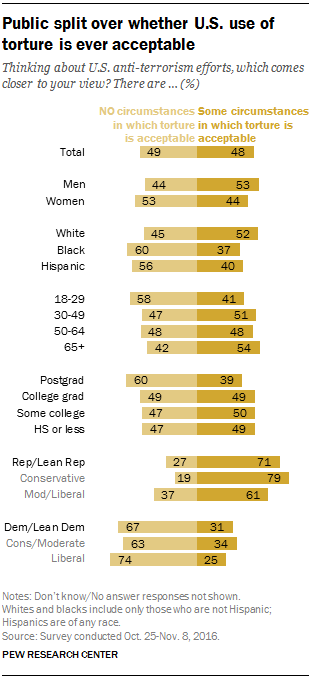
As Donald Trump’s administration reviews U.S. policies on the detainment and interrogation of terrorism suspects, the public is divided over whether it is ever acceptable for the country to use torture in anti-terror efforts.
Overall, 48% say there are some circumstances under which the use of torture is acceptable in U.S. anti-terrorism efforts; about as many (49%) say there are no circumstances under which the use of torture is acceptable.
Trump has said he personally believes torture works, but that he will confer with his Cabinet before considering any changes to U.S. policy. The use of torture by the military and all other government agencies is currently banned under U.S. law.
The national survey of 4,265 adults conducted just before the presidential election (Oct. 25-Nov. 8) on Pew Research Center’s nationally representative American Trends Panel finds wide demographic and political differences in views of torture.
From the Harvard Business Review: What So Many People Don’t Get About the U.S. Working Class
Further analysis of the 2016 election.
- Click here for the article.
- Click here for the article.
For months, the only thing that’s surprised me about Donald Trump is my friends’ astonishment at his success. What’s driving it is the class culture gap.
One little-known element of that gap is that the white working class (WWC) resents professionals but admires the rich. Class migrants (white-collar professionals born to blue-collar families) report that “professional people were generally suspect” and that managers are college kids “who don’t know shit about how to do anything but are full of ideas about how I have to do my job,” said Alfred Lubrano in Limbo. Barbara Ehrenreich recalled in 1990 that her blue-collar dad “could not say the word doctor without the virtual prefix quack. Lawyers were shysters…and professors were without exception phonies.” Annette Lareau found tremendous resentment against teachers, who were perceived as condescending and unhelpful.
Michèle Lamont, in The Dignity of Working Men, also found resentment of professionals — but not of the rich. “[I] can’t knock anyone for succeeding,” a laborer told her. “There’s a lot of people out there who are wealthy and I’m sure they worked darned hard for every cent they have,” chimed in a receiving clerk. Why the difference? For one thing, most blue-collar workers have little direct contact with the rich outside of Lifestyles of the Rich and Famous. But professionals order them around every day. The dream is not to become upper-middle-class, with its different food, family, and friendship patterns; the dream is to live in your own class milieu, where you feel comfortable — just with more money. “The main thing is to be independent and give your own orders and not have to take them from anybody else,” a machine operator told Lamont. Owning one’s own business — that’s the goal. That’s another part of Trump’s appeal.
Hillary Clinton, by contrast, epitomizes the dorky arrogance and smugness of the professional elite. The dorkiness: the pantsuits. The arrogance: the email server. The smugness: the basket of deplorables. Worse, her mere presence rubs it in that even women from her class can treat working-class men with disrespect. Look at how she condescends to Trump as unfit to hold the office of the presidency and dismisses his supporters as racist, sexist, homophobic, or xenophobic.
Trump’s blunt talk taps into another blue-collar value: straight talk. “Directness is a working-class norm,” notes Lubrano. As one blue-collar guy told him, “If you have a problem with me, come talk to me. If you have a way you want something done, come talk to me. I don’t like people who play these two-faced games.” Straight talk is seen as requiring manly courage, not being “a total wuss and a wimp,” an electronics technician told Lamont. Of course Trump appeals. Clinton’s clunky admission that she talks one way in public and another in private? Further proof she’s a two-faced phony.
From the Washington Post: Judge halts deportations as refugee ban causes worldwide furor
More resistance to recent immigration moves by the Trump Administration - a current example of checks and balances.
- Click here for the article.
- Click here for the article.
A federal judge in New York blocked deportations nationwide late Saturday of those detained on entry to the United States after an executive order from President Trump targeted citizens from seven predominantly Muslim countries.
Judge Ann Donnelly of the U.S. District Court in Brooklyn granted a request from the American Civil Liberties Union to stop the deportations after determining that the risk of injury to those detained by being returned to their home countries necessitated the decision.
Minutes after the judge’s ruling in New York, another came in Alexandria when U.S. District Judge Leonie Brinkema issued a temporary restraining order to block for seven days the removal of any green-card holders being detained at Dulles International Airport. Brinkema’s action also ordered that lawyers have access to those held there because of the ban.
Several hours after the judicial rulings, the Department of Homeland Security said it would continue to implement Trump’s executive order. In a statement released early Sunday, the agency said “less than one percent” of international air travelers arriving Saturday in the U.S. were “inconvenienced” by the executive order.
“President Trump’s Executive Orders remain in place — prohibited travel will remain prohibited, and the U.S. government retains its right to revoke visas at any time if required for national security or public safety,” the statement said. “No foreign national in a foreign land, without ties to the United States, has any unfettered right to demand entry into the United States or to demand immigration benefits in the United States.”
From the Washington Post: Retired Gen. John F. Kelly confirmed as secretary of homeland security
This is also a bit late.
- Click here for the article.
For more on the DHS:
- Wikipedia: Department of Homeland Security.
- Click here for the article.
The Senate confirmed John F. Kelly as secretary of homeland security on Friday, putting the blunt-spoken retired Marine general in charge of securing the nation’s borders, including construction of the controversial southwest border wall that was a centerpiece of President Trump’s campaign.
Senators approved Kelly’s nomination to run the Department of Homeland Security, a sprawling entity of more than 240,000 employees who do everything from protecting the president to safeguarding the nation’s electrical grid.
Kelly, who retired in February as chief of the U.S. Southern Command, is part of the first wave of Cabinet secretaries who will begin to implement the expansive plans of the nation’s 45th president.
DHS will be at the forefront of some of the most highly charged parts of that agenda, including the wall, which would be designed to keep out illegal immigrants. Kelly appeared to play down the wall’s importance at his recent confirmation hearing, telling a Senate committee that “a physical barrier in and of itself will not do the job’’ and that technology such as drones and sensors are also needed to secure the border.
For more on the DHS:
- Wikipedia: Department of Homeland Security.
From the Washington Post: Retired Gen. James Mattis is confirmed as defense secretary, breaking with decades of precedent
I'm a bit late on this post, but here's a look at out new Defense Secretary.
- Click here for the article.
For more on the defense department:
- Wikipedia: Department of Defense.
- Click here for the article.
Retired Marine Gen. James N. Mattis was confirmed and sworn in as President Trump’s defense secretary Friday, breaking with decades of precedent as a recently retired general became the Pentagon’s top civilian leader.
Mattis, 66, was approved with a 98-1 vote after the presidential inauguration and then sworn in by Vice President Pence. The new Pentagon chief released a statement to U.S. troops afterward that credited not only them, but intelligence personnel as “sentinels and guardians of our nation” — rhetoric that is in line with Mattis’s past statements, but stands in contrast to the way Trump has criticized the value of U.S. intelligence in recent weeks.
. . . Many lawmakers and long-time foreign policy observers hope Mattis can be a moderating voice of experience in an administration that has notably few senior officials with national security experience in Washington. He will lead the Defense Department’s 1.9 million active-duty service members and reservists and oversee a budget of more than $580 billion as Trump prepares to expand the military.
Mattis becomes the first senior military officer to serve as defense secretary since President Truman nominated Army Gen. George C. Marshall for the job in 1950, as the U.S. military struggled in the Korean War. Mattis retired in spring 2013 as the chief of U.S. Central Command after a career in which he became one of the most influential officers of his generation and commanded troops in Iraq and Afghanistan.
For more on the defense department:
- Wikipedia: Department of Defense.
From the American Assiciation for the Advancement of Science: AAAS Responds to Moves to Halt EPA and USDA Public Communications
We'll be looking at the efforts different groups are using to push back against the initiatives of the Trump administration. The AAAS is an advocacy group.
- Click here for the article.
- Click here for the article.
Holt responded Tuesday to moves by the Trump administration to bar employees at the Environmental Protection Agency and the Department of Agriculture from communicating with the media or engaging on social media.
“We are concerned about reports that federal agencies – including the Department of Agriculture and the Environmental Protection Agency – have issued directives to staff that may silence the voices of scientific researchers and others working for the federal government,” said Holt in a statement.
Holt held out hope that the measures are temporary and being taken as the agencies await Senate confirmation of President Donald Trump’s nominees for the two departments. “Our hope is that this is a temporary measure put into place until the new government agency heads are confirmed by the Senate,” Holt said.
But Holt sounded concern about potential ethical and policy implications of such moves.
“Many federal agencies have existing scientific integrity policies that prohibit political interference in the public dissemination of scientific findings,” added Holt. “As the AAAS Council stated in 2006: Censorship, intimidation, or other restriction on the freedom of scientists employed or funded by governmental organizations to communicate their unclassified scientific findings and assessments not only to each other but also to policymakers and to the public is inimical to the advance of science and its appropriate application in the policy domain."
For more on the agencies referred to above:
- Wikipedia: EPA.
- Wikipedia: Department of Agriculture.
More for the AAAS: First 100 Days.
Thursday, February 2, 2017
For 2306: Emergency Bills, the State of the Judiciary, and the State Board of Education on Evolution
All from the Texas Tribune:
- In State of State, Abbott imposes hiring freeze, declares 4 issues "emergencies"
- Legislature should prioritize judicial security, Texas Supreme Court chief justice says.
- In preliminary vote, State Board of Education keeps controversial evolution standards.
- In State of State, Abbott imposes hiring freeze, declares 4 issues "emergencies"
Texas Gov. Greg Abbott on Tuesday laid out a largely expected agenda for the 85th legislative session while declaring four issues as emergencies for lawmakers to take up immediately: banning so-called "sanctuary cities," overhauling the state's broken child welfare system, implementing ethics reform and approving a resolution to support a convention of states to amend the U.S. Constitution.
In his State of the State address, Abbott said Texas remained "exceptional" and expressed optimism that the state's economy would bounce back from an oil downturn. At the top of his priority list for lawmakers was the child welfare system, which a federal judge declared broken in 2015 and lawmakers have since been scrambling to overhaul.
- Legislature should prioritize judicial security, Texas Supreme Court chief justice says.
The state of the Texas judiciary is strong — because of judges like Julie Kocurek, Texas Supreme Court Chief Justice Nathan Hecht said Wednesday during a joint meeting of the Texas House and Senate.
Kocurek, a state district judge in Travis County, was shot outside her home in late 2015 by a man who once appeared in her courtroom. She was hospitalized for several weeks, had almost 30 surgeries and lost a finger, Hecht said during his State of the Judiciary address.
"I asked Julie about her plans," the chief justice said. "She could retire. She was eligible. But if she left the bench, people would think you can threaten a judge and scare her off, maybe scare off other judges, intimidate them, show that justice cannot stand up to violence. She would not do that."
The attack on Kocurek highlighted gaps in security for judges, courthouses and their staff, Hecht said. He said those gaps include "inadequate training, communication and security protocols; inadequate resources; no state-level direction; and the ready availability of judges' personal information in publicly searchable government databases." Hecht said he wants legislation named in Kocurek's honor.
- In preliminary vote, State Board of Education keeps controversial evolution standards.
The Texas State Board of Education on Wednesday voted preliminarily for science standards that would keep in language that some say opens the door to creationism.
The votes came a day after the board heard from scientists begging them to remove the language. Board members are set to hold a second public hearing and take final votes on the changes to the science standards in April.
The process began in July, when the board convened a teacher committee that recommended the deletion of several high school science standards, including four controversial biology standards they said would be too complex for students to understand. In their recommendation for deleting a clause requiring students examine explanations on the "sudden appearance" of organism groups in the fossil record, they included the note, "Not enough time for students to master concept. Cognitively inappropriate for 9th grade students."
Republican board member Barbara Cargill led the charge Wednesday to keep three of those four standards in some form — arguing that they would actually help students better understand the science and keep teachers away from creationist ideas.
From the Washington Post: Trump’s intervention into policing, voting and immigration sets up showdown with America’s largest cities
For out look at federalism.
- Click here for the article.
- Click here for the article.
In an executive order signed Wednesday, Trump directed the Department of Homeland Security to find ways to defund cities and jurisdictions out of step with his immigration priorities. That action — which could cost sanctuary cities including Washington, New York and Los Angeles millions of dollars — is the latest in a series of moves where Trump has appeared willing to step on state-level or municipal prerogatives.
In the scuffle, U.S. mayors have emerged as key players in the resistance to Trump’s agenda.
“Cities know how important local control is, because we are in touch with the people we represent most closely. This is a president who’s been clear that he wants to centralize as much authority as he can in himself,” Minneapolis Mayor Betsy Hodges said Wednesday. “That is dangerous for our democracy, I believe, and he is using the levers of our democracy to centralize his authority.”
At the center of the sanctuary city debate is a disagreement over whether local police officers should be required to help immigration officials enforce federal immigration laws. Many liberal mayors, including Los Angeles Mayor Eric Garcetti and New York City’s Bill De Blasio, have argued that requiring local police departments to assist immigration agents with deportations could sow distrust among immigrant populations. It could also discourage undocumented victims or witnesses from coming forward to report crimes.
“This is a federalism issue,” said Jorge Elorza (D), the mayor of Providence, R.I., who is the son of immigrants. “The idea of local control is deeply embedded in American history, and what we have now is a very aggressive attempt by the federal government to commandeer our local police departments to become immigration agents.”
He vowed “massive and aggressive lawsuits,” a resistance echoed by several local leaders.
Kevin de Leon, the Democratic president pro tempore of the California state Senate, said the state legislature is prepared to “explore all of our legal options” to fight the order.
“Singling out states and cities with punitive threats and withholding federal resources as today’s order on sanctuary cities does is unconstitutional,” de Leon said. “It’s not the job of our local and county and state law enforcement to turn the cogs on President Trump’s deportation machine.”
Monday, January 30, 2017
From CNN: Full text of Trump's executive order on 7-nation ban, refugee suspension
Catching up with this weekend's events.
- Click here for the story, which includes the order.
And from the New York Times:
- President Trump’s Immigration Order, Annotated.
The National Review thinks the reaction to the order is out of line.
- Trump’s Executive Order on Refugees — Separating Fact from Hysteria.
- Click here for the story, which includes the order.
And from the New York Times:
- President Trump’s Immigration Order, Annotated.
The National Review thinks the reaction to the order is out of line.
- Trump’s Executive Order on Refugees — Separating Fact from Hysteria.
Friday, January 27, 2017
From the Texas Tribune: Federal court blocks Texas fetal remains burial rule
For our look at federalism.
- Click here for it.
- Click here for it.
U.S. District Court Judge Sam Sparks ruled Texas cannot require health providers to bury or cremate fetuses, delivering another blow to state leaders in the reproductive rights debate.
The ruling comes more than a month after the Texas Department of State Health Services slated the mandate to go into effect Dec. 19. Lawyers for the Center for Reproductive Rights, which sued in December to stop the rule, won a temporary restraining order to halt its implementation, and earlier this month Sparks delayed his decision, saying he needed more time to review the evidence.
The agency initially released the proposed burial rule in July just days after the U.S. Supreme Court overturned Texas’ abortion provider restrictions. The rule announcement spurred intense debate between reproductive rights groups and anti-abortion groups.
During two public hearings, department leaders heard stories of abortions, miscarriages, and general grief over losing a baby. While anti-abortion groups argued that the rule was a means to bring human dignity to the fetuses, reproductive rights advocates said the rule was another way for Texas to punish women who chose an abortion, saying the cost of the burials would be passed on to patients, making abortions harder to obtain for low-income Texans.
From the National Constitution Center: Podcast: Has President Trump violated the Emoluments Clause?
In a couple weeks I'll ask 2305 students about the emoluments clause of the Constitution.
Here's a head start on it.
- Click here for the podcast.
Here's a head start on it.
- Click here for the podcast.
On January 23, the nonprofit legal watchdog group CREW filed a lawsuit alleging that President Donald Trump is violating the Foreign Emoluments Clause in Article 1, Section 9, which states: “[N]o Person holding any Office of Profit or Trust under them, shall, without the Consent of the Congress, accept of any present, Emolument, Office, or Title, of any kind whatever, from any King, Prince, or foreign State.”
CREW points out that foreign governments are doing business at Trump hotels and other buildings in the United States, and that the Trump organization is conducting business abroad.
There are also questions about the Domestic Emoluments Clause in Article II, Section 1, which states that “The President shall, at stated Times, receive for his Services, a Compensation … and he shall not receive … any other Emolument from the United States, or any of them.”
Joining We the People to discuss are two experts in constitutional law who are actively writing and thinking on these issues.
From the U.S. Supreme Court: Lee v. Tam
In the second GDHS class this morning we discussed another free speech case, Lee v. Tam. The case also touches on the copyright clause of the U.S. Supreme Court. While the free speech clause protects the ability of people to say disparaging things, these cannot be copyrighted since that would suggest that the national government approves of it.
- Here's the transcript.
- Here's the audio.
- Here's detail from ScotusBlog.
Here is the question presented to the court:
For background,
- Here is the Lanham Act
- Here is background on U.S. Trademark Law.
And here's a bit from ScotusBlog on the controversy in the case.
For more on viewpoint discrimination, click here.
- Here's the transcript.
- Here's the audio.
- Here's detail from ScotusBlog.
Here is the question presented to the court:
Issue: Whether the disparagement provision of the Lanham Act, 15 U.S.C. 1052(a), which provides that no trademark shall be refused registration on account of its nature unless, inter alia, it “[c]onsists of . . . matter which may disparage . . . persons, living or dead, institutions, beliefs, or national symbols, or bring them into contempt, or disrepute” is facially invalid under the Free Speech Clause of the First Amendment.
For background,
- Here is the Lanham Act
- Here is background on U.S. Trademark Law.
And here's a bit from ScotusBlog on the controversy in the case.
The debate over trademark rights and free speech has a long history. We shouldn’t forget it now, when trademark registration has become a First Amendment flashpoint. Trademark protection can promote expression, but it can also chill speech and debate. The dual nature of trademark means that sometimes limiting trademark rights – for example, by declining to register disparaging marks – actually advances First Amendment goals by curtailing private control over contested vocabulary and imagery.
In early trademark cases, courts understood that trademark claims were a form of commercial appropriation of language. Judges were accordingly skeptical about allowing private businesses to assert exclusive rights to words or phrases. Limiting expansive trademark claims was a way of keeping language in the public domain. As one court explained in 1883, the English language is “the common property of mankind,” belonging to all of us in “equal share.” Since those early days, doubts about the social benefit of robust trademark protection have faded. But the debate over who should “own” trademarked words and symbols, and to what degree, remains as relevant as ever.
In Lee v. Tam, the Supreme Court will consider a request by Simon Tam, an activist and the founder of an Asian rock band, to register his band’s name, “THE SLANTS,” as a federally protected trademark. The dispute in this case centers on a relatively obscure provision of the federal trademark statute, which denies registration to marks that “may disparage” individuals, institutions, beliefs or national symbols. Tam contends that his band’s name challenges stigmatizing stereotypes, but the U.S. Patent and Trademark Office denied registration after finding THE SLANTS disparaging to people of Asian ancestry. To Tam, the result is unconstitutional viewpoint discrimination and suppression of speech – all the more harmful and arbitrary because of his record of political activism and advocacy on behalf of Asian-American groups.
For more on viewpoint discrimination, click here.
Viewpoint discrimination is the term the Supreme Court has used to identify government laws, rules, or decisions that favor or disfavor one or more opinions on a particular controversy. For example, a government official who permitted ‘‘pro-life’’ proponents to speak on government property but banned ‘‘pro-choice’’ proponents because of their views would be engaged in ‘‘viewpoint discrimination.’’ Courts may also describe this constitutional requirement by saying that government laws and decisions must be ‘‘viewpoint neutral.’’ In recent decades, viewpoint discrimination has been distinguished from content or subject matter discrimination, which involves government regulation of an entire topic or subject, such as abortion, war, or sexual speech, either by punishing those who use this kind of speech (such as obscenity) or by completely excluding the subject from discussion on particular government property or in public forums.
From the U.S. Supreme Court: Expressions Hair Design v. Schneiderman
We briefly walked through this case in the first class at GDHS this morning. It involves the free speech clause of the First Amendment and pricing.
- Here's the transcript.
- Here's the audio.
- Here's detail from ScotusBlog.
This is question presented to the court:
New York does not allow different prices for cash and credit card purchases - this is commonly done for gas around here. Doing so gives you an indication - communicates to us, which is speech - of what credit card transactions cost. Is New York violating a merchant's free speech rights by limiting their ability to set different prices? Is pricing speech?
- Here's the transcript.
- Here's the audio.
- Here's detail from ScotusBlog.
This is question presented to the court:
Issue: Whether state no-surcharge laws unconstitutionally restrict speech conveying price information (as the Eleventh Circuit has held), or regulate economic conduct (as the Second and Fifth Circuits have held).
New York does not allow different prices for cash and credit card purchases - this is commonly done for gas around here. Doing so gives you an indication - communicates to us, which is speech - of what credit card transactions cost. Is New York violating a merchant's free speech rights by limiting their ability to set different prices? Is pricing speech?
Wednesday, January 25, 2017
From the Washington Post: Trump to sign executive orders enabling construction of proposed border wall and targeting sanctuary cities
Today's executive actions.
These appear to be actual orders, not memorandums.
- Click here for the article.
These appear to be actual orders, not memorandums.
- Click here for the article.
President Trump plans to sign executive orders Wednesday enabling construction of his proposed wall on the U.S.-Mexico border and targeting cities where local leaders refuse to hand over illegal immigrants for deportation, according to White House officials familiar with the decisions.
The actions, part of a multi-day focus on immigration, are among an array of sweeping and immediate changes to the nation’s immigration system under consideration by the new president. The moves represent Trump’s first effort to deliver on perhaps the signature issue that drove his presidential campaign: his belief that illegal immigration is out of control and threatening the country’s safety and security.
Trump’s immigration blitz this week is widely seen inside the White House as a victory for the self-described populist wing of his inner circle — which includes chief strategist Stephen K. Bannon, attorney general nominee Jeff Sessions and top policy adviser Stephen Miller.
But discussions were ongoing Tuesday about just how far to go on some policies, in particular the Deferred Action for Childhood Arrivals program, known as DACA. The 2012 initiative has given temporary protection from deportation to hundreds of thousands of people who arrived in the United States as children. Trump vowed during the campaign to reverse it.
It was not yet clear late Tuesday whether DACA would be addressed as part of Trump’s immigration actions, according to a White House official, because of differing views among Trump’s advisers and associates about the timing, scope and political benefits of ending the program or suspending it for new entries.
From NPR: Trump Gives Green Light To Keystone, Dakota Access Pipelines
Tuesdays executive actions - both are presidential memorandums:
- Click here for the article.
You can read the three memorandums here:
- Dakota Access Pipeline
- Keystone XL Pipeline
- Construction of American Pipelines
- Click here for the article.
President Trump on Tuesday gave the go-ahead for construction of two controversial oil pipelines, the Keystone XL and the Dakota Access.
As he signed the paperwork in an Oval Office photo op, Trump said his administration is "going to renegotiate some of the terms" of the Keystone project, which would carry crude oil from the tar sands of western Canada and connect to an existing pipeline to the Gulf Coast.
The pipelines had been stopped during the Obama administration. The State Department rejected a permit for the Keystone XL pipeline, and President Obama ordered work halted on the Dakota pipeline after Native American groups and other activists protested its route near culturally sensitive sites in North Dakota.
Trump said the Keystone XL pipeline will mean "a lot of jobs, 28,000 construction jobs, great construction jobs."
You can read the three memorandums here:
- Dakota Access Pipeline
- Keystone XL Pipeline
- Construction of American Pipelines
From the Tyler Morning Telegraph: State versus local control expected to be overarching theme in 85th Texas Legislature
The Texas Legislature seems intent on usurping local power.
- Click here for the article.
The article goes on to highlight areas of contention. Could be useful for 2306 students looking for a paper topic.
For opinion on the issue: TEXAS VIEW: Local control is the only way to go.
- Click here for the article.
For years, the real battles in the Texas Legislature haven’t been Democrats versus Republicans - they’ve been urban versus rural interests.
That’s changing. When the Legislature convenes on Jan. 10, the new battle will be local control versus state prerogatives. On big issues ranging from sanctuary cities to revenue caps and rules for ride booking apps such as Uber and Lyft, to smaller issues such as plastic bag bans and whether employers can ask job applicants about their criminal histories, lawmakers will contend with cities about the appropriate level of local control.
This flips the script. Local control has been a watchword of conservatives in years past, as they sought to limit rules and unfunded mandates coming out of Austin.
Now, though, it’s the conservatives who say the state is sovereign and that larger cities - which in Texas these days are often more liberal than the Legislature - enact their own rules that go beyond what some lawmakers see as appropriate.
On the right, the conservative Texas Public Policy Foundation sees the matter as a proper restoration of the state’s role in policy matters that affect freedom and economic development.
“There’s a big conversation over local control,” said James Quintero, director of the TPPF’s Center for Local Governance. “Local control’s proper use is to rein in government and protect liberty. But it has been misused by those on the left to advance bad policy.”
On the left, the Austin-based Center for Public Policy Priorities agrees that the flashpoints during the upcoming session will be local versus state control.
“That’s exactly what the problem is,” said the Center’s Senior Fiscal Analyst Dick Lavine. “And we want to see local control over local matters. The government closest to the people understands the feelings of the people in the community. And elections keep officials accountable.”
The article goes on to highlight areas of contention. Could be useful for 2306 students looking for a paper topic.
For opinion on the issue: TEXAS VIEW: Local control is the only way to go.
From the Saturday Evening Post: The Civil Rights Act vs. States’ Rights
A look at the tension between the two.
- Click here for the article.
- Click here for the article.
Goldwater recognized that the Civil Rights Act would split the liberal and conservative wings of the Democratic Party. For years, the Democrats had been able to hold these two warring factions together, but as the liberal wing began supporting the growing civil rights movement, many white, conservative Democrats began withdrawing their support of the party their families had supported for generations.
The day would come, Goldwater predicted in a 1963 Post article, “The G.O.P. Invades the South,” when the region would vote solidly Republican. He noted that Republican candidates were already winning elections in Florida, North Carolina, and Georgia. The South would shift its party allegiance, he said, because of “a profound evolution of political thinking and acting.”
It had nothing to do, he asserted, with white voters being angry with liberal Democrats’ support of integration. Southerners were leaving the party, he said, because they believed in “state’s rights,” and limiting the role of the federal government. They viewed the Civil Rights Act as an intrusion that, Goldwater argued, would eventually lead to “the creation of a police state.”
Civil rights were important, Goldwater believed, but they were “resolved more safely and soundly on the state or local level.”
But the local level, as Anthony Lewis wrote, was precisely where the problem lay. (“Goldwater Is Wrong On Civil Right” September 26, 1964) The law in southern states and towns was vigorously enforcing racist policies, using intimidation and violence to deprive African Americans of their rights.
The U.S. Government had tried Goldwater’s approach for nearly a century, Lewis argued. When states were left on their own to handle race relations, “the result was massive inequality, injustice, and cruelty that shocked the conscience of this nation…The law has been cynically manipulated to maintain white supremacy, in defiance of the most elementary rights of a citizen.”
Federal intervention was necessary, he said, to prevent state officials from enforcing racist politics
From Bloomberg BNA: Scott Pruitt Could Tip Regulatory Power From EPA to States
Pruitt is Trump's nominee to head the Environmental Protection Agency.
Note the use of the terms "cooperative federalism" in the story.
- Click here for it.
For More:
- The National Environmental Policy Act.
- The Environmental Protection Agency.
- Scott Pruitt.
Note the use of the terms "cooperative federalism" in the story.
- Click here for it.
State regulators could see more autonomy and a new seat at the table as the Environmental Protection Agency drafts federal regulations under Oklahoma Attorney General Scott Pruitt, President-elect Donald Trump’s pick to run the agency.
Pruitt has conceded the federal government does play a role in protection of the environment, particularly when pollution crosses state lines, even though he has joined challenges to just such regulations offered by the Obama administration.
“I believe the EPA has an important role to play in our republican form of government. There are clearly air and water quality issues that cross state lines and sometimes that can require federal intervention,” Pruitt said during a House Science Committee hearing in May 2016. “At the same time the EPA was never intended to be our nation’s foremost environmental regulator. The states were to have regulatory primacy.”
Pruitt, who will appear before the Senate Environment and Public Works Committee for his confirmation hearing Jan. 18, could tip the balance of power on environmental protection toward states. As attorney general, Pruitt has fought back against federal regulations he argues encroach on state authorities—even setting up a federalism division in his office—and has questioned the EPA’s primacy when protecting the environment.
“What does turning more authority back to the states look like to states? What it looks like is flexibility and respect for state decision making and state choices. Right now, I would say there’s room for improvement,” Alexandra Dapolito Dunn, executive director and general counsel of the Environmental Council of the States, told Bloomberg BNA.
. . . William Yeatman, a senior fellow at the Competitive Enterprise Institute . . . predicted Pruitt would also be extremely deferential to states, even those that choose to pursue policies on greenhouse gases, while Dunn said a key area to watch in the coming months is how strongly Pruitt would advocate on behalf of states in a key area of water regulation.
Though the Clean Water Act allows states to ask for regulatory authority over the dredging and filling of their wetlands, Dunn said the Army Corps of Engineers has often denied these requests. Currently, only two states have successfully taken over wetland regulation from the federal government, though Dunn said many others have tried.
She would like to see Pruitt work harder than his predecessors did to try to persuade the Army Corps on this issue.
“This is where, if [he] is truly about getting authority to states that desire this authority, here’s a classic example where he can show leadership,” she said.
Some lawmakers and advocacy groups have praised Pruitt precisely for his approach to cooperative federalism, including Republicans such as Senate Majority Leader Mitch McConnell (Ky.).
Sen. John Barrasso (Wyo.), the chairman of the Senate committee leading the confirmation hearing of Pruitt, touted in a Jan. 17 editorial on Fox News that Pruitt has a strong record of “standing up for states’ rights.”
For More:
- The National Environmental Policy Act.
- The Environmental Protection Agency.
- Scott Pruitt.
From the New York Times: Trump’s Health Plan Would Convert Medicaid to Block Grants, Aide Says
Some of my 2305 classes are covering federalism, which includes a discussion of categorical and block grants. Here's a story illustrating the latter.
- Click here for it.
For more:
- Wikipedia: Block Grants.
- Wikipedia: Categorical Grants.
- Reason: The Problem With Block Grants.
- Washington Post: The GOP plan to fund Medicaid through block grants will probably weaken it.
- Click here for it.
President Trump’s plan to replace the Affordable Care Act will propose giving each state a fixed amount of federal money in the form of a block grant to provide health care to low-income people on Medicaid, a top adviser to Mr. Trump said in an interview broadcast on Sunday.
The adviser, Kellyanne Conway, who is Mr. Trump’s White House counselor, said that converting Medicaid to a block grant would ensure that “those who are closest to the people in need will be administering” the program.
A block grant would be a radical change. Since its creation in 1965, Medicaid has been an open-ended entitlement. If more people become eligible because of a recession, or if costs go up because of the use of expensive new medicines, states receive more federal money.
If Congress decides to create block grants for Medicaid, lawmakers will face thorny questions with huge political and financial implications: How much money will each state receive? How will the initial allotments be adjusted — for population changes, for general inflation, for increases in medical prices, for the discovery of new drugs and treatments? Will the federal government require states to cover certain populations and services? Will states receive extra money if they have not expanded Medicaid eligibility under the Affordable Care Act, but decide to do so in the future?
Ms. Conway, speaking on the NBC program “Sunday Today,” said that with a block grant, “you really cut out the fraud, waste and abuse, and you get the help directly” to intended beneficiaries.
. . . Governors like the idea of having more control over Medicaid, but fear that block grants may be used as a vehicle for federal budget cuts.
“We are very concerned that a shift to block grants or per capita caps for Medicaid would remove flexibility from states as the result of reduced federal funding,” Gov. Charlie Baker of Massachusetts, a Republican, said this month in a letter to congressional leaders. “States would most likely make decisions based mainly on fiscal reasons rather than the health care needs of vulnerable populations.”
Gov. Robert Bentley of Alabama, a Republican, said that if a block grant reduced federal funds for the program, “states should be given the ability to reduce Medicaid benefits or enrollment, to impose premiums” or other cost-sharing requirements on beneficiaries, and to reduce Medicaid spending in other ways.
In Louisiana, Gov. John Bel Edwards, a Democrat, said he was troubled by the prospect of a block grant with deep cuts in federal funds. “Under such a scenario,” he said, “flexibility would really mean flexibility to cut critical services for our most vulnerable populations, including poor children, people with disabilities and seniors in need of nursing home and home-based care.”
Gov. John W. Hickenlooper of Colorado, a Democrat, said that block grant proposals could shift costs to states and “force us to make impossible choices in our Medicaid program.”
“We should not be forced to choose between providing hard-working older Coloradans with blood pressure medication or children with their insulin,” Mr. Hickenlooper said.
For more:
- Wikipedia: Block Grants.
- Wikipedia: Categorical Grants.
- Reason: The Problem With Block Grants.
- Washington Post: The GOP plan to fund Medicaid through block grants will probably weaken it.
Tuesday, January 24, 2017
From Vox: Donald Trump just named a net neutrality foe to head the FCC
Another indication of a major policy shift from the Obama years
- Click here for the article.
- Click here for the article.
Under President Barack Obama, the Federal Communication Commission passed regulations that provided strong legal protections for network neutrality. These rules, which were strongly opposed by telecommunications giants such as Comcast and Verizon, were designed to create a level playing field for online companies.
Now Donald Trump has taken the first step toward gutting those regulations: He has named Ajit Pai to be the next chair of the FCC.
Pai has served as a Republican member of the five-member FCC since 2012. He’s known for his deregulatory views generally and his opposition to network neutrality in particular. In a December speech, he complained that there was too much “regulatory underbrush” at the FCC, and vowed to “fire up the weed whacker and remove those rules that are holding back investment, innovation, and job creation.”
Network neutrality is likely to be at the top of Pai’s hit list. But supporters of network neutrality rules say that repealing them would be a disaster for the open internet and online innovation.
“Consumers need to be worried about what this means for their access to the internet,” argues Chris Lewis of the pro-net neutrality group Public Knowledge. He warns that in a world without network neutrality rules, big ISPs like Comcast or Verizon could block access to certain websites or force customers to pay extra to reach sites they don’t own.
The president can appoint an existing FCC member chair without Senate approval, according to Ryan Radia, a legal expert at the Competitive Enterprise Institute. So Pai won’t have to go through the confirmation process in order to assume his new role.
Republicans will have a majority on the FCC and in Congress, so there’s likely nothing Democrats or liberal groups can do to stop Republicans from rolling back network neutrality rules. But it’s going to be a long, ugly fight that could tie up the FCC in the courts for years to come.
I can't vouch for this graphic, but its provocative

It's one person's analysis of the reliability of news sources combined with partisanship. Ideology seems inversely correlated with reliability. I should note that I tend to use all the sources in the upper middle bubble.
For more:
- MarketWatch: How does your favorite news source rate on the ‘truthiness’ scale? Consult this chart.
1/23/17 - Trump signs three presidential memorandums
Here's the skinny:
1 - Withdraws the U.S. from the Trans-Pacific Partnership - click here for it.
2 - Imposes a freeze on the hiring of Federal - non-military - civilian workers - click here for it.
3 - Reinstates the "Mexico City policy" aka: a block on funds for international family planning charities unless they agree to not discuss abortion - click here for it.
- What is a presidential memorandum?
- For more: Presidential memoranda vs. executive orders. What's the difference?
For stories related to each:
- NPR: Trump Signs 3 Memorandums, Including Withdrawal From Pacific Trade Deal.
- Chicago Tribune: Trump signs executive orders on TPP exit, federal hiring freeze, global abortion policy.
- NYT: Trump Abandons Trans-Pacific Partnership, Obama’s Signature Trade Deal.
- The Atlantic: Here's What Trump's Latest Executive Orders Do.
1 - Withdraws the U.S. from the Trans-Pacific Partnership - click here for it.
2 - Imposes a freeze on the hiring of Federal - non-military - civilian workers - click here for it.
3 - Reinstates the "Mexico City policy" aka: a block on funds for international family planning charities unless they agree to not discuss abortion - click here for it.
- What is a presidential memorandum?
a type of executive instrument typically issued by the President of the United States to manage and govern the actions, practices and policies of the various departments and agencies found under the executive branch of the United States government. Presidential memoranda and executive orders are closely related, both have the force of law on the Executive Branch. While executive orders are numbered a presidential memorandom is not. Presidential memoranda are generally considered less prestigious than executive orders. Presidential memoranda do not have an established process for issuance or publication.
- For more: Presidential memoranda vs. executive orders. What's the difference?
For stories related to each:
- NPR: Trump Signs 3 Memorandums, Including Withdrawal From Pacific Trade Deal.
- Chicago Tribune: Trump signs executive orders on TPP exit, federal hiring freeze, global abortion policy.
- NYT: Trump Abandons Trans-Pacific Partnership, Obama’s Signature Trade Deal.
- The Atlantic: Here's What Trump's Latest Executive Orders Do.
From the Texas Tribune: Texas Senate takes first step toward school finance overhaul - The Senate has tasked a new budget working group with coming up with ways to overhaul the state's school finance system.
This is a tall order that may or may not be accomplished by the end of the session
- Click here for the article.
- Click here for the article.
Leaders in the Texas Senate are vowing to find ways to overhaul the state’s school finance system, saying a recent Texas Supreme Court decision granted them a prime opportunity to shake up the heavily criticized status quo.
On Monday, they announced the creation of a Senate budget working group — led by Friendswood Republican Larry Taylor — to tackle the issue. That group will work with the Senate Education Committee, which Taylor chairs, to propose replacements for the current school finance system.
“The opportunity is huge for us to get it right,” said Jane Nelson, chairwoman of the Senate’s powerful Finance Committee. “We need a whole new method of school finance.”
They'll face an uphill climb in a session where legislators face several obstacles to major reform, not the least of which is money. The announcement comes a week after the Senate unveiled its preliminary budget, which did not include additional funding for public education.
. . . The current system funds Texas public school districts arbitrarily and inequitably across the state and is held together by short-term fixes that have not been revisited in decades. Educators have repeatedly asserted the funding formulas do not provide them with enough money to meet the state's academic standards.
In May, the Texas Supreme Court upheld the state's existing funding system as constitutional, and at the same time tasked state legislators with reforming it.
"We're left with a question mark as to what this effort will mean by the Senate," said Lynn Moak, a school finance expert at the Austin-based consulting firm Moak, Casey & Associates. The main question is "whether they're trying to reform school finance within existing dollars or looking for possible additional dollars to fund the system."
Nelson last week unveiled the Senate’s $213.4 billion two-year budget proposal, calling it a bare-bones starting point for financial discussions in what promises to be a particularly tight-fisted year. That proposal did not touch funding formulas for public education.
The House’s base budget — also released last week — included an additional $1.5 billion that could be spent on public education only if the Legislature reforms the school finance system.
From the Texas Tribune: Thousands of school choice advocates expected to rally at Texas Capitol
File this under agenda setting - among other things.
- Click here for the article.
- Click here for the article.
Thousands of students, activists and family members are expected to flood the Texas Capitol lawn Tuesday morning in a sea of signature yellow scarves as the Legislature prepares for a fight on whether to let parents use public money for private school tuition.
In advance of the "National School Choice Week" rally, an event that has become a session tradition over the past decade, organizers said they feel closer than ever to actually seeing a bill for private school choice make it to the governor's desk. For the first time, Gov. Greg Abbott and Lt. Gov. Dan Patrick will headline this year's rally, scheduled for 10 a.m. on the Capitol's south steps.
Patrick is expected to unveil his bill this week advocating for education savings accounts — state-issued debit cards that parents can use for private school tuition and other education expenses. A former chairman of the Senate Education Committee, Patrick has championed private school choice legislation since he first became a state senator in 2007.
Abbott last month was more vocal than ever in his support of private school choice, saying he would sign the "most pro-school choice law" arriving on his desk.
From the Texas Tribune: Texas colleges fret about $1 billion in expected funding missing from budget plan
Higher education in Texas is prepared for a hit.
- Click here for the article.
- Click here for the article.
Texas universities entered the 2017 session of the Texas Legislature gearing up for fights over tuition and who can use what bathroom.
But with the session underway, the schools have instead found themselves fighting for an arcane budgeting trick — one that could affect up to $1 billion worth of appropriations for higher education items such as museums, research projects and new academic programs. The House has signaled plans to keep the trick essentially in place. The Senate's first crack at the state budget almost doesn't use it at all.
. . . The trick is known as a “special item,” and in higher education it’s a way for lawmakers to insert money for particular university programs into the state budget outside the standard appropriations formulas. In 2015, the Legislature allocated 362 special items worth a combined $1.1 billion.
But when the House and Senate filed their first versions of the proposed state budget for 2018-19, there was a huge disparity. The House kept special items for universities at about the same level. The Senate included almost none.
Many university officials were surprised by the Senate’s first crack. They say their schools could lose serious money if the Senate budget holds up. That’s especially true for newer, growing schools, which depend heavily on the items.
“If those [special items] are not reinstated, we will have real difficulty keeping our doors open,” said Emily Cutrer, president of Texas A&M University – Texarkana.
But one key Senate leader says the schools shouldn’t panic. The budget is a work in progress, and months of negotiations between the House and Senate will happen before the final spending plan is produced. Special items are one of the key differences between the two chambers' plans. Nonetheless, it's likely that some funds will be added in even before the Senate finishes its version of the budget.
Monday, January 23, 2017
From the Texas Tribune
A handful to discuss:
- Analysis: Luckily for Texas, voters don’t get report cards.
- Travis County sheriff announces new "sanctuary" policy.
- Gov. Abbott demands Travis County reverse new "sanctuary" policy.
- Supreme Court rejects Texas voter ID appeal — for now.
- In West Texas, abandoned well sinks land, sucks tax dollars.
- Analysis: Spinning numbers in lawmakers’ proposed budgets.
- After GOP appeal, Texas Supreme Court agrees to take up same-sex marriage case.
From the Gallup Poll: Obama Averages 47.9% Job Approval as President
I'll begin posting a variety of items regarding Obama's tenure as president.
Here's a look at his approval rates as measured by the Gallup Poll.
- Click here for it.

For more:
- President Obama Leaves White House With 58% Favorable Rating.
- What is the Gallup Poll?
-- Wikipedia: Gallup Poll.
Here's a look at his approval rates as measured by the Gallup Poll.
- Click here for it.
Obama's highest individual job approval measurement in office was 69%, in January 2009 during the first few days of his presidency. He is one of only three presidents, along with Richard Nixon and Reagan, never to register an approval rating in the 70s.
And while he never achieved extremely high ratings, neither did he achieve extreme lows. At various points in his presidency his approval ratings dipped to 38%. This included in August and October 2011 after contentious negotiations over the debt ceiling limit and subsequent downgrading of the U.S. credit rating. Obama also failed to generate sufficient support for legislation designed to address the still-weak employment situation.
Obama's approval ratings also fell to 38% in September 2014, shortly after the Islamic State terrorist group released videos showing the beheadings of U.S. journalists captured overseas. Those incidents came on the heels of a summer of increased international tensions between Russia and Ukraine, and between Israel and the Palestinians.
Domestically, the deaths of young black men Eric Garner and Michael Brown in confrontations with white police officers led to increased racial tensions.
All other presidents except Eisenhower and Kennedy fell below 38% at some point in their presidencies, with five different presidents receiving ratings below 30%.
For more:
- President Obama Leaves White House With 58% Favorable Rating.
- What is the Gallup Poll?
-- Wikipedia: Gallup Poll.
On this day in history: London merchants petition for reconciliation with America
This is a part of the history of the revolutionary war I am not familiar with - though thats a long list to be honest. Discontent with British policies towards the colonies were not confined to the
- Click here for the article.
- Click here for the article.
On this day in 1775, London merchants petition Parliament for relief from the financial hardship put upon them by the curtailment of trade with the North American colonies.
In the petition, the merchants provided their own history of the dispute between the colonies and Parliament, beginning with the Stamp Act of 1765. Most critical to the merchants’ concerns were the £2 million sterling in outstanding debts owed to them by their North American counterparts.
The merchants claimed that, a total stop is now put to the export trade with the greatest and most important part of North America, the public revenue is threatened with a large and fatal diminution, the petitioners with grievous distress, and thousands of industrious artificers and manufacturers with utter ruin. The petitioners begged Parliament to consider re-implementing the system of mercantile trade between Britain and the American colonies, which had served the interests of all parties in the empire prior to 1764.
Following the Coercive Acts of 1774, the colonies had quickly agreed to reinstate the non-importation agreements first devised in response to the Stamp Act in the autumn of 1765. They threatened to enter non-exportation agreements if Britain failed to meet their demands by August 1775. Because debts the colonies owed British merchants were generally paid in exports, not currency, such an action would indeed have caused tremendous financial loss to the British economy. Non-importation had a comparatively minor impact, because British merchants could and did find other markets. However, no one else would pay the vast debts owed to the merchants by tobacco planters like Thomas Jefferson or New England shipping magnates like John Hancock.
From the Pew Research Center: On Eve of Inauguration, Americans Expect Nation’s Deep Political Divisions to Persist
Polarization shows little signs of abating
- Click here for the study.

For more:
- LONG DIVISION: Measuring the polarization of American politics.
- Click here for the study.
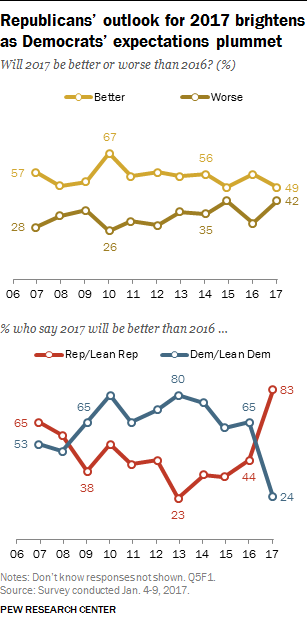
The current mood stands in stark contrast to January 2009, before Barack Obama took office. At that time, just 46% said the nation was more politically divided. But a few months into Obama’s first term, the share saying the country was more divided politically had risen to 61%.
The nature of the country’s political divisions is a rare point of partisan agreement: Comparable majorities of Democrats and Democratic leaners (88%) and Republicans and Republican leaners (84%) say the country is more divided these days than in the past.
The latest national survey by Pew Research Center, conducted Jan. 4-9 among 1,502 adults, finds little optimism that the country’s political divisions will subside any time soon: 40% expect the country to be about as politically divided in five years as it is today, while 31% think it will be even more divided; just 24% expect divisions to lessen.
In the wake of Trump’s election, there has been an increase in the share of Republicans who think the country will be less divided five years from now. Still, just 36% of Republicans say this; even fewer Democrats (16%) expect the country’s political divisions to narrow in the coming years.
For more:
- LONG DIVISION: Measuring the polarization of American politics.
From the Washington Post: The traditional way of reporting on a president is dead. And Trump’s press secretary killed it.
File this under commentary, but the author - Margaret Sullivan - makes an interesting point about the changing relationship between the media and the presidency under Trump.
- Click here for the article.
- Click here for the article.
Official words do matter, but they shouldn’t be what news organizations pay most attention to, as they try to present the truth about a new administration.
White House press briefings are “access journalism,” in which official statements — achieved by closeness to the source — are taken at face value and breathlessly reported as news. And that is over. Dead.
Spicer’s statement should be seen for what it is: Remarks made over the casket at the funeral of access journalism.
As Jessica Huseman of ProPublica put it: “Journalists aren’t going to get answers from Spicer. We are going to get answers by digging. By getting our hands dirty. So let’s all do that.”
She’s right. So was Tim O’Brien, executive editor of Bloomberg View and a Trump biographer, who urged journalists to remember that the White House briefing room is “spoon-feeding and Trump is a habitual fabulist.”
There’s a deeper story here, beyond a single briefing, no matter how memorable. Saturday made clearer than ever that President Trump intends to make the American media his foremost enemy.
During his first official visit to the CIA, Trump once again attacked the media, as he did throughout the campaign as he blacklisted news organizations and called reporters “scum.”
Journalists shouldn’t rise to the bait and decide to treat Trump as an enemy. Recalling at all times that their mission is truth-telling and holding public officials accountable, they should dig in, paying far more attention to actions than to sensational tweets or briefing-room lies — while still being willing to call out falsehoods clearly when they happen.
For more:
- What is "access journalism?"
-- The Price of Admission: Andrew Ross Sorkin’s debut and the limits of access journalism.
-- 'Access journalism' ... and the Silicon Valley reporter.
-- So Long, “Access Journalism” — & Good Riddance?
- Who is Press Secretary Sean Spicer?
-- Wikipedia: Sean Spicer?
- What is a White House Press Secretary?
-- Wikipedia: White House Press Secretary.
- Who is Washington Post reporter, and public editor, Margaret Sullivan?
-- Wikipedia: Margaret Sullivan.
- What is a public editor?
-- Wikipedia: Public Editor.
Sunday, January 22, 2017
From Fox News: Trump reportedly forced to part with beloved cellphone
Trump is not a private citizen anymore.
- Click here for the article.
- Click here for the article.
President Trump on Friday was forced to hand over his beloved Android cellphone in favor of a new encrypted phone he will use during his term in office, The New York Times reported.
The Times called Trump's Android his “Linus blanket” that held hundreds of contacts. The report said that security officials have also asked Trump to stop using the Twitter handle @RealDonaldTrump and to use @POTUS.
Trump recently told a friend that he had given up his phone, as security agencies had urged him to do. It was unclear whether he was following the lead of President Obama, the nation's first cellphone-toting president, who exchanged his personal device for a Blackberry heavily modified for security purposes.
The presidency has long been a lonely, isolating office, with security concerns keeping the commander in chief at a distance from the public.
Under Obama, worries about cyber intrusions — particularly by foreign governments — pulled the president's technology deeper into the security bubble as well. Many of the functions on Obama's Blackberry were blocked and only a handful of people had his phone number or email address.
Trump doesn't email, but he uses his phone to tweet — something he's made clear he plans to continue in office. He's known to make calls early in the morning and late at night, often seeking input from multiple sources when making a decision. Sometimes he leaves a voicemail.
Sen. Bob Corker, R-Tenn., called Trump "amazingly accessible," saying the president-elect picks up his phone even when he doesn't know who is calling.
"My phone says, No Caller ID, so I'm not saying that it has anything to do with me," Corker said. "Nobody knows who it is that's calling when I'm calling."
From the NYT: With Trump in Charge, Climate Change References Purged From Website
Another indication of change in the Trump presidency, though it should be noted that Rick Perry acknowledged that human activity has contributed - at least a little - to climate change.
- Click here for the article.
- Click here for the article.
Within moments of the inauguration of President Trump, the official White House website on Friday deleted nearly all mentions of climate change. The one exception: Mr. Trump’s vow to eliminate the Obama administration’s climate change policies, which previously had a prominent and detailed web page on whitehouse.gov.
The purge was not unexpected. It came as part of the full digital turnover of whitehouse.gov, including taking down and archiving all the Obama administration’s personal and policy pages. That also included a page devoted to lesbian, gay, bisexual, and transgender issues. At the same time, the official White House Twitter handles also changed over, allowing Mr. Trump to now post on Twitter as @POTUS.
But the digital change, which flashed into place at noon on Friday, immediately placed into sharp relief some of the starkest differences between the old president and the new. And for advocates of climate change policy, it presented the first concrete sign that Mr. Trump remains, as he was on the campaign trail, skeptical and dismissive of the established science of human-caused climate change, and committed to blocking policies to curb it.
Scientists fear the online deletions will extend far beyond changes to introductory websites and into the realm of government data. Climate change data gathered and stored by the United States government is considered among the most authoritative in the world. But scientists worry the data will be deleted during the Trump administration.
Since Mr. Trump’s election, about 50 scientists at universities around the country have volunteered their time — and computer servers — to save and store government data stored on the websites of the Environmental Protection Agency, NASA, NOAA, and the United States Geological Services. Those websites keep records of key climate data such as atmospheric temperature trends, greenhouse gas emissions levels, and sea level rise.
The scientist gatherings have been organized by 314 Action — a nonprofit group named for the first three numbers of the mathematical concept Pi — which aims to make science more accessible to the public.
Subscribe to:
Posts (Atom)