Tuesday, June 18, 2013

From Slate: This Time, Scalia Doesn’t Want to See Your Papers

I'm linking to this because the story highlights a part of the constitution we went over in class today and how it explains Justice Scalia's decision to vote against Arizona in the case regarding whether a state can require additional requirements to register to vote beyond what is required by the national government.

Here is the constitutional text - From Article One:
"The Times, Places and Manner of holding Elections for Senators and Representatives, shall be prescribed in each State by the Legislature thereof; but the Congress may at any time by Law make or alter such Regulations, except as to the places of chusing Senators."
The author comments further:

So the states get to make the rules, and then Congress gets to remake them. Scalia says this was the framers’ way of making sure that the states wouldn’t refuse to provide for elections to the U.S. House of Representatives.  Apparently “widespread vociferous opposition to the proposed Constitution” made this a live possibility back in the day. (Now, of course, we like to elect our own representatives to the House and wish that everyone else’s would stay home.)
But the minority opinion points out that other language in the Constitution supports Arizona's argument that they have full discretion over who gets to vote in the state from another part of Article One - which we also discussed in class:

The House of Representatives shall be composed of members chosen every second year by the people of the several states, and the electors in each state shall have the qualifications requisite for electors of the most numerous branch of the state legislature.
This means that the states get to determine who gets to vote in federal elections (except for the modifications we noted in the 15th, 19th, 24th and 26th Amendments). Scalia acknowledges this, and states that the states have to go through an additional process in order to place the additional requirement of submitting proof of citizenship as a precondition for being able to register to vote:
Thomas is right that the states get to decide who may vote in federal elections. This state authority lies in another part of the Constitution. (For House elections, look in Article I. For Senate elections, it’s in the 17th Amendment.) Doesn’t that mean Arizona can in fact require aspiring voters to be citizens, as it has since becoming a state in 1912?
Here is the neat answer Scalia comes up with to that question: Yes, Arizona can require proof of citizenship to register to vote—the state just can’t do it by passing a law superseding the federal form. Instead, Arizona has to go to the federal Election Assistance Commission to ask for a change to the federal form, so that it will include all the information the state says is needed to decide voter eligibility. If the EAC turns Arizona down, the state can sue. Arizona hasn’t done this yet, but the court says the state still could. Never mind, as Alito points out, that the EAC has no actual commissioners at the moment. Arizona still has to try to compel the agency to act.
I may be looking at this the wrong way, but I'm drawn to stories that point out areas where the Constitution contradicts itself - or at least creates tensions - and this seems to be one.

Monday, June 17, 2013

From the NYT: Justices Reject Arizona Voting Law Requiring Proof of Citizenship

Click here for the story:

Arizona may not require documentary proof of citizenship from prospective voters, the Supreme Court ruled in a 7-to-2 decision on Monday.
Justice Antonin Scalia, writing for the majority in Arizona v. Inter Tribal Council of Arizona, No. 12-71, said a federal law requiring states to “accept and use” a federal form displaced an Arizona law.
The federal law, the National Voter Registration Act of 1993, allows voters to register using a federal form that asks, “Are you a citizen of the United States?” Prospective voters must check a box for yes or no, and they must sign the form, swearing under the penalty of perjury that they are citizens.
The state law, by contrast, required prospective voters to prove that they were citizens by providing copies of or information concerning various documents, including birth certificates, passports, naturalization papers or Arizona driver’s licenses, which are available only to people who are in the state lawfully.
A divided 10-judge panel of the United States Court of Appeals for the Ninth Circuit had ruled that the two sets of requirements “do not operate harmoniously” and “are seriously out of tune with each other in several ways.”
Full detail from ScotusBlog here.

Saturday, June 15, 2013

Real Politik: Obama to provide limited arms to Syrian rebels.

The NYT describes the White House's decision to do so after waiting on the decision whether to intervene in the Syrian Civil War for two years. Advisers have been conflicted about going forward - and still are apparently.
. . . the Obama administration remains deeply divided about whether to take more forceful action to try to quell the fighting, which has killed more than 90,000 people over more than two years. Many in the American government believe that the military balance has tilted so far against the rebels in recent months that American shipments of arms to select groups may be too little, too late.Some senior State Department officials have been pushing for a more aggressive military response, including airstrikes to hit the primary landing strips in Syria that the Assad government uses to launch the chemical weapons attacks, ferry troops around the country and receive shipments of arms from Iran. But White House officials remain wary, and on Thursday Benjamin J. Rhodes, one of Mr. Obama’s top foreign policy advisers, all but ruled out the imposition of a no-fly zone and indicated that no decision had been made on other military actions.

The decision has angered some of Obama's supporters and pleased some critics, but I think the most interesting arguments are from those who suggest the decision is based on realpolitik, which is defined as "politics based on practical considerations: politics based on pragmatism or practicality rather than on ethical or theoretical considerations."

Here's a quote pulled fromt the wikipedia page on the subject:
"The study of the powers that shape, maintain and alter the state is the basis of all political insight and leads to the understanding that the law of power governs the world of states just as the law of gravity governs the physical world."
President Nixon was argued to base his foreign policy on the it - meaning that he was guided less by principle and theory than on the need to deal with the powers that existed in the world in a pragmatic manner. Increasingly President Obama is argued to have a similar approach in his foreign policy. Ideals - including human rights - take a backseat to whatever is necessary to check the powers of world nations.

Here's a suggestion that this is behind not only the delayed response to the civil war, but the limited support for the rebels right now. There are forces behind both the existing regime and the rebels that we do not care for, and that we consider destabilizing. Iran and Hezbollah is backing Assad, and groups affiliated with radical Islam are backing at least some of the rebels. While we are not anxious to have either side win, a long drawn out resource depleting conflict between the two could make all less capable to be disruptive in the Middle East.

A prolonged war may be in our best interest.
But there could be another reason for doing just enough to keep the two sides fighting. The Assad regime is increasingly relying on Hezbollah to fight throughout the country. The rebels for their part are relying on jihadist and al Qaeda allies to fight back. Keeping two of the United States’ most active terrorist enemies fighting each other might be seen in some circles as not such a bad thing.

This allows for human rights abuses, but realpolitik does not take that into consideration as a valid issue.

Perry uses line item veto authority to cut funding for the Texas Public Integrity Unit

The Governor has been threatening to do so unless the Travis District Attorney - who had been arrested for DWI earlier this year - resigned. She didn't, so he did. This means the unit - which is responsible for investigating fraud and corrpution in state government - will lose $7.5 million. It doesn't shut it down, but it compromises its ability to carry out its mission.


The Texas Tribune decribes the impact of the cut here.
Click here for the governor's message on all line item vetoes. This is the part that relates to the Public Integrity Unit. 
Article IV - The Judiciary

Judiciary Section, Comptroller's Department
D.1.4 Strategy: PUBLIC INTEGRITY UNIT, $3,742,829 $3,830,597
TRAVIS CO & UB

Public Integrity Unit, 53rd Judicial District.

Despite the otherwise good work the Public Integrity Unit's employees, I cannot in good conscience support continued State funding for an office with statewide jurisdiction at a time when the person charged with ultimate responsibility of that unit has lost the public's confidence. This unit is in no other way held accountable to state taxpayers, except through the State budgetary process. I therefore object to and disapprove of this appropriation.
Click here for information about the Public Integrity Unit from the Texas Tribune.

And here for a list of stories related to the unit from the same source.
The Texas Republican Party has sought to eliminate the unit for many years. It highlights the political conflict that exists between the liberal leaning elected officials of Austin and Travis County and the more conservative officials elected state-wide. The unit had investigated Tom Delay among other prominent officials. The current DA's arrest may have simply given the governor cover for accomplishing a goal he has sought for some time. If she resigns, he gets to appoint a replacement - which woudl certainly be a Republican less anxious to investigate the governor.

Here's a story about a past attempt to get rid of the unit in 2011, and to remove the authority to investigate fraud from the Travis County DA's office to the Attorney General's office.

Texans for Public Justice have filed a complaint about the governor's veto, but the complaint was filed with the Public Integrity Unit, which creates some obvious problems. They argue that the governor's actions overstepped his authority.

Governor Perry vetoes a total of 26 pieces of legislation from the 83rd session

Here is the official statement from the governor's office about the final bunch.

And a list of all vetoes, again from the governor's office, and a similar list from the Texas Legislature Online.

I'll detail the reasoning behind each of these vetoes in separate posts.

Here's further commetary:

- The Dallas Morning News criticizes his decision to veto two ethics bils and to use line item veto authority to stop funding of the Public Integrity Unit which is investigating the cancer research center. They suggest the cut might actually be illegal.

Friday, June 14, 2013

Written Assignment #3 - GOVT 2306

I want you to apply some of the ideas and arguments presented in the assigned book on Allen Shivers and the Rise of the Republican Party in Texas to the current governing landscape in the state.

Specifically I want you to review the rsults of the recently completed regular session of the 83rd Legislature and determine whether or not its activities can be directly traced to the types of policies covered in the book.

History tends to have a linear component, what happens today is related to what happened yesterday, let's see if this is true for Texas Politics. So review the policies promoted in the legislative sessions Shivers was involved in from the 30s through the 50s and see if they set the stage for what the legislature is currently involved in.

Give at least 150 words - you may write as much as you wish - and send the result through blackboard.

Nice long thorough answers get nice high grades.

Written Assignment #3 - GOVT 2305

This week I want you to write about something other than the assigned book.

In the lecture class we have been discussing the recent revelation of a previously somewhat revealed NSA program where telephone and online search records of Americans have been collected in order to facilitate future searches of terrorist suspects. I've had posts of related stories here on the blog for online students to follow.

We have also been looking at the overall structure of the U.S. Constitution, with a special emphasis on the basic principles within it - especially the separated powers and checks and balances. Remember that powers are separated in order to prevent tyranny - the ability of one person or group to legislate, execute and adjudicate the law.

One of the concerns that has emerged is that secrecy surrounding this NSA project - and secrecy in general - might compromise the checks and balances.

In at least 150 words I want you to weigh in this issue. Do secret surveillance programs negate the checks and balances? Does this present a threat to the republic? Why or why not. Long comprehensive, well reasoned arguments get A's.

Send in through BlackBoard - make it interesting.

Rare disciplinary process to be used to investigate 5th Circuit Judge Edith Jones

Judge Jones is said to have made racist remarks at a meeting of the Federalist Society chapter at the University of Pennsylvania law school. The review stems from a complaint filed by the Texas Civil Rights Project.

The Huffington Post details the content of the complaint: 
Her comments were not recorded, but five students and one attorney who were in attendance signed affidavits swearing to what they heard.

The complaint alleges that Jones said certain "racial groups like African-Americans and Hispanics are predisposed to crime," and that they are "prone to commit acts of violence" and be involved in more violent and "heinous" crimes than people of other ethnicities. The judge also allegedly said Mexicans would prefer to be on death row in the U.S. than serve prison terms in their native country, and that it's an insult for the U.S. to look to the laws of other countries such as Mexico.

The allegations were laid out in a 12-page complaint backed by several Texas groups and filed Tuesday in New Orleans, where the appeals court is based. The complaint said Jones engaged in conduct that, among other things, "undermines public confidence in the integrity and impartiality of the judiciary, and creates a strong appearance of impropriety."


The Houston Chronicle points out that the decision by the U.S. Supreme Court Chief Justice to have the review of her condust conducted by the DC Circuit Court is highly unusual. From the justice's letter: 
"I have selected the Judicial Council of the District of Columbia Circuit to accept the transfer and to exercise the powers of a judicial council with respect to the identified complaint and any pending or new complaints relating to the same subject matter," Roberts said in a letter addressed to the D.C. circuit's chief judge that was posted on the 5th Circuit's website.

It is only one of a handful of times in U.S. history that a federal circuit judge has been the subject of a public judicial misconduct complaint and a formal disciplinary review. Normally such matters are secret under federal law.

 More from the Huffington Post here. And more detail from the American Constitution Society. For background on Edith Jones and past controversies involving here, click on her Wikipedia page. This process is a new one for me. When we discuss the judiciary we will discuss its inherent weakness - in 2305 we review Hamilton's arguments to that point. For all its bluster, court decisions have proven easy for other institutions to ignore. All it has is the sense that it judges in a fair manner. This investigaton seems intended to ensure that that appearance is maintained. I have no idea what can occur as a result of the review process or how quickly a decision will be made. This is worth followign closely.

Thursday, June 13, 2013

Merry Christmas Bill

Governor Perry signed HB 308, which intends to protect school districts from lawsuits related to religious expression:


Under the new law, as long as displays include more than one religious symbol — or at least one secular symbol — and don't encourage adherence to a particular religious belief, districts can put up decorations like nativity scenes, Christmas trees and menorahs on school property. Public school staff and students can also offer each other seasonal greetings like Merry Christmas and Happy Hannukah.

House Bill 308 was intended to help protect school districts from lawsuits, said state Rep. Dwayne Bohac, the Spring Branch Republican who carried the legislation, adding that it would "restore some sanity" to "political correctness run amuck." He said he hoped the bill, which passed overwhelmingly in both the House and Senate, would become a model for other states.


Texas public schools have seen several high-profile lawsuits attempting to define students' rights to religious expression, including the landmark 2000 U.S. Supreme Court decision Santa Fe ISD v. Doe. In that case, the court outlawed student-led prayer over the loudspeakers at football games, saying it amounted to government endorsement of religion, a violation of the First Amendment’s establishment clause. More recently, a state district court judge ruled in favor of cheerleaders who sued their East Texas high school after they were told to stop displaying Bible verses at school events. The school district is appealing the ruling. 


Though the cheerleaders' situation remained an example of the oppression facing those who want to express their faith publicly, Perry said, the new law would not directly apply to their case.


"It's a shame that a bill like this one I'm signing today is even required. But I'm proud that we are standing up for religious freedom in the state," he said. "Religious freedom does not mean freedom from religion.
ion." 

Does the public want Congress to compromise?

Maybe not:
The public wants Congress to compromise. Except that they really don’t.
Here’s why.

1. Everyone likes the idea of compromise — both in politics and in life more generally. We all like to think of ourselves as reasonable people who are always looking for the common-sense middle ground on a given issue and we want our politicians to reflect that approach. But, our desire for compromise goes out the window when it’s an issue that matters to us and/or where we are convinced we are right. Same goes for politics.

2. Compromise doesn’t mean the same thing to everyone.  One man’s compromise is another’s concession. Detailing what a compromise might actually look like in, say, talks about a grand bargain on debt and spending, would send many compromise-seekers running away from the negotiating table.

3. Compromise isn’t rewarded politically.  Remember that large majorities of the House — Democrats and Republicans — face only one real threat to their political careers: a challenge from their ideological left or right. Redistricting, the decennial line-drawing process in all 435 House districts, is one reason for such lopsided districts. Compromise is a dirty word in primaries where the electorate tends to be the most conservative (or most liberal) voters who prize philosophical convictions over pragmatic legislating. There is not only no incentive to compromise then but there is actually a disincentive to do so.

Perhaps Congress is dysfunctional because we like it that way.

From the Washington Post: Supreme Court rules human genes may not be patented

Just released:


The Supreme Court ruled unanimously Thursday that human genes cannot be patented, a decision that could shape the future of medical and genetic research and have profound effects on pharmaceuticals and agriculture.
The ruling was a split decision for Myriad Genetics Inc., which holds patents on genes that have been linked to breast and ovarian cancer.

Justice Clarence Thomas, writing for the court, said merely isolating those specific genes -- called BRCA1 and BRCA2 — was not worthy of a patent.

“Myriad found the location of the BRCA1 and BRCA2 genes, but that discovery, by itself, does not render the BRCA genes . . . patent eligible,” Thomas wrote.

On the other hand, Thomas wrote, Myriad’s creation of a synthetic form of DNA — called cDNA -- based on its discovery does deserve patent protection.

“The lab technician creates something new when cDNA is made,” Thomas wrote.


A list of the proposed amendments to the Texas Constitution.

  SJR 1     The constitutional amendment providing for the creation of the State Water Implementation Fund for Texas and the State Water Implementation Revenue Fund for Texas to assist in the financing of priority projects in the state water plan to ensure the availability of adequate water resources.      
  SJR 18     The constitutional amendment to authorize the making of a reverse mortgage loan for the purchase of homestead property and to amend lender disclosures and other requirements in connection with a reverse mortgage loan.      
  HJR 24     The constitutional amendment authorizing the legislature to provide for an exemption from ad valorem taxation of part of the market value of the residence homestead of a partially disabled veteran or the surviving spouse of a partially disabled veteran if the residence homestead was donated to the disabled veteran by a charitable organization.      
  SJR 42     The constitutional amendment relating to expanding the types of sanctions that may be assessed against a judge or justice following a formal proceeding instituted by the State Commission on Judicial Conduct.      
  SJR 54     The constitutional amendment repealing Section 7, Article IX, Texas Constitution, which relates to the creation of a hospital district in Hidalgo County.      
  HJR 62     The constitutional amendment authorizing the legislature to provide for an exemption from ad valorem taxation of all or part of the market value of the residence homestead of the surviving spouse of a member of the armed services of the United States who is killed in action.      
  HJR 79     The constitutional amendment eliminating an obsolete requirement for a State Medical Education Board and a tate Medical Education Fund, either of which is operational.      
  HJR 87     The constitutional amendment authorizing a home-rule municipality to provide in its charter the procedure to fill a vacancy on its governing body for which the unexpired term is 12 months or less.      
  HJR 133     The constitutional amendment to authorize a political subdivision of this state to extend the number of days that aircraft parts that are exempt from ad valorem taxation due to their location in this state for a temporary period may be located in this state for purposes of qualifying for the tax exemption.      
  HJR 147     The constitutional amendment repealing Section 7, Article IX, Texas Constitution, which relates to the creation of a hospital district in Hidalgo County.  

The Texas Tribune reports that the Kumbaya Session is over

Contentious issues had been kept off the table in the regular session of the legislature, but the Governor has made them central to the special session. Aside from being called in order to deal with redistricting - which always bring out partisan daggers - Perry has also added abortion and juvenile justice to to agenda.

From the Texas Tribune:


“The regular session overall was collegial and productive. We saw bipartisan work for the benefit of public education, water infrastructure and other priorities,” he said. “In contrast, the special session appears to be largely about partisanship and scoring political points. I think that’s unfortunate.”

Democrats can’t do much about it. Republicans have a 95-55 majority in the House and a 19-12 advantage in the Senate. Though Senate Democrats normally can block controversial legislation using the so-called two-thirds rule that gives the minority party real power, Dewhurst — who presides over the upper chamber — is dropping that procedure for the special session.

Jim Henson, director of the Texas Politics Project at the University of Texas at Austin and a Texas Tribune pollster, said Perry’s recent moves highlight a “fairly shrewd use of his position” and are likely to play well with Republican voters who have controlled the outcome of statewide races in Texas for years.

While his power is somewhat limited in regular sessions, the governor can call an unlimited number of special sessions and has the sole discretion to decide what goes on the agenda.

“He’s taking full advantage of the moment in which he has optimal leverage,” Henson said. “It burnishes his image as a leadership figure in the party.”

Its well past time to consider the governor's office to be weak. Perry has been able to determine how to expand his power and implement his agenda. Of course it helps if you have been elected to office repeatedly.

Proposed changes to Alvin's City Charter

A variety of changes to the Alvin City Charter were presented to the voters in May. Click here for the results of the election. We will consider the significance of these changes in class.

Proposed amendments to the Texas Constitution from the 83rd session

I assume this is the full list - I'll confirm soon - of proposed revisions according to the Legislative Reference Library of Texas. Notice that these are joint resolutions - as required by the Texas Constitution - and that the governor need not sign them.

These have to be ratified by the electorate in an election coming up this November in order to take effect.

Wednesday, June 12, 2013

Is Edward Snowden a traitor?

In 2306 we looked at the sections of the Texas Bill of Rights which define treason - which contains language very similar to what we will see in Article III of the U.S. Constitution. The language is very specific and narrow, yet a variety of people are arguing that Snowden - who leaked the information about PRISM - qualifies.

The Speaker of House says he is, saying the revelation of " important national security programs to help keep Americans safe and give us tools to help fight the terrorist threat we face . . . puts Americans at risk." I'm no expert, but I'm not quite sure that the revelation of a program that has already been referred to constitutes a risk. I'd be interested in a discussion of whether this revelation jeoparizes national security.

Two U.S. Senators tweeted that he is, but without giving a reason.

A University of Chicago law professor says he is not a traitor, but is "a criminal who deserves serious punishment. . . . Snowden knowingly accepted a position of trust in his relation to the government. He did not have to accept his job, but he did. A clear condition of that job was his voluntary agreement not to disclose any classified information - that is, information the disclosure of which could reasonably endanger the security of the nation."

He argues that is Snowden had concerns about the program, there are legal processes in place that involve constitutional officers where that decision can be made.

Jeffrey Toobin agrees that Snowden is a criminal, but does not seem to comment on the question of whether he is a traitor according to the Constitution.


A writer in Bloomberg criticizes the Speaker and other for not knowing what "treason" is. It does not fit within the narrow reading of the Constitution, in fact few cases do:
Treason cases, in fact, are rare: Fewer than 30 Americans have ever been charged with the crime, and none since the aftermath of World War II.

Not even John Walker Lindh, who fought alongside the Taliban when the U.S. invaded Afghanistan, was accused of treason. Lindh was originally charged with conspiracy to commit murder and terrorism, but he took a plea bargain on two yet lesser offenses.

. . . Why do U.S. prosecutors avoid treason charges? One reason is that the standards of evidence are high: The Constitution requires "two witnesses to the same overt act." Another likely explanation, however, is that treason convictions simply aren't worth the trouble. Most traitors can be put away for life on several counts of espionage and conspiracy. That's less work for the prosecution.

So the answer seems to be no.


Partisan positions on NSA tracking have shifted since 2006

This is not a surprising finding. Partisanship matters in forming opinions on certain events.

The Washington Post finds that partisan attitudes about NSA surveillance shift when there is partisan change in the White House. Party identification remains a lense through which the public determines whether it approves of disapproves of governmental activity.
Overall, 56 percent of Americans consider the NSA’s accessing of telephone call records of millions of Americans through secret court orders “acceptable,” while 41 percent call the practice “unacceptable.” In 2006, when news broke of the NSA’s monitoring of telephone and e-mail communications without court approval, there was a closer divide on the practice — 51 percent to 47 percent.

General priorities also are similar to what they were in 2006: Sixty-two percent of Americans now say it’s more important for the government to investigate terrorist threats, even if those investigations intrude on personal privacy, while 34 percent say privacy should be the focus, regardless of the effect on such investigations.

But with a Democratic president at the helm instead of a Republican, partisan views have turned around significantly.

Sixty-nine percent of Democrats say terrorism investigations, not privacy, should be the government’s main concern, an 18-percentage-point jump from early January 2006, when the NSA activity under the George W. Bush administration was first reported. Compared with that time, Republicans’ focus on privacy has increased 22 points.

The reversal on the NSA’s practices is even more dramatic. In early 2006, 37 percent of Democrats found the agency’s activities acceptable; now nearly twice that number — 64 percent — say the use of telephone records is okay. By contrast, Republicans slumped from 75 percent acceptable to 52 percent today.

From Wired: Big Data and Analytics

There was talk in class today - in relation to the assigned book on the 2012 election - about whether data and analytics were good for campaigns. Is the public better served when candidates have such detailed information about what makes them tick? Should candidates have to physically confront potential voters in order to determine what their preferences are? Does data and analytics make manipulation more possible?
Its a legitimate subject.

This Wired author points out that the brave new world of big data and the analytical ability to process it provides all sorts of possibilities - some good, some bad. But you can't have one without the other:
If you think about all the hype generated about consumer privacy and enterprises collating and analyzing information for a more targeted and personal experience, customer segmentation and demographics, location-based and real-time marketing what the NSA exposure has taught us is that there really is no privacy in the 21st century and we should just get used to it. Our data is anonymized unless it’s being used specifically for our purpose and benefit but the fact is we are happily generating it for them to use in any case.

But Big Data is no longer creepy. Sorry but it’s not. You must live in painful ignorance if you think that every nuance of a digital interaction hasn’t been collected by someone and analyzed. What’s clear is that analytics and big data seem to be labelled as only for marketers to hound us with or for banks to sell us more debt laden products. We forget, for example, about the medical and scientific boundaries being broken that rely on data analytics and human generated information to help it along.

At some point there will be consumer based tools affordable enough for people to make sense of the data they generate themselves, and why not, it’s all part of the equation. Personal graph analysis will become a reality as much as its parent will be wielded by enterprises.

So, you see, we have heroes and villains even in data analytics but it’s all a matter of perspective. The NSA are deemed evil for breaching our liberties and analyzing data without our consent to understand terrorist activities, and medical science is a force of good for helping us cure diseases using data sourced from all manner of places.

Is data mining helping reduce the number of murders in Chicago?

This is topical since the NSA surveillance issue is all about obtaining information to efficiently solve a problem (that puts it mildly I suppose).

From the NYT:

So far in 2013, Chicago homicides, which outnumbered slayings in the larger cities of New York and Los Angeles last year, are down 34 percent from the same period in 2012. As of Sunday night, 146 people had been killed in Chicago, the nation’s third-largest city — 76 fewer than in the same stretch in 2012 and 16 fewer than in 2011, a year that was among the lowest for homicides during the same period in 50 years.
In recent months, as many as 400 officers a day, working overtime, have been dispatched to just 20 small zones deemed the city’s most dangerous. The police say they are tamping down retaliatory shootings between gang factions by using a comprehensive analysis of the city’s tens of thousands of suspected gang members, the turf they claim and their rivalries. The police also are focusing on more than 400 people they have identified as having associations that make them the most likely to be involved in a murder, as a victim or an offender.

A couple stories regarding the equal protection of the law

1 - Stand your ground laws seem to be enforced differently for white and black defendants.

2 - Where do transgendered people use the bathroom?

How does PRISM work?

An inside look - sort of anyway - at the NSA program.

What Gallup got wrong in 2012

The Gallup Poll predicted Mitt Romney would win the 2012 presidential election and consistently overestimated his support. This can be bad for business, so they have tried to figure out why that happened:

Here is a link to their report.

The review, led by Mr. Newport and Michael Traugott of the University of Michigan, was conducted by a team of statisticians, methodologists and analysts from Gallup, assisted by outside consultants. After identifying more than 20 possible elements that could have been related to the Republican skew in Gallup’s polls, the team isolated four factors as the likely causes.


Gallup’s model for identifying those most likely to vote — a series of seven questions — seemed to have failed in 2012, and the organization is re-evaluating its formula for ranking voters who will turn out.

Just as technology has changed the way campaigns work, it has altered the way survey researchers gather data. A change in the way that Gallup called respondents on land lines may have been a contributing factor that led to its sample to be older and more Republican. Half of their respondents, however, were reached on cellphones — a proportion that is at or above industry standards.

In addition, there were too many respondents from certain time zones. In the South and the Midwest, there were more respondents from the Central Time Zone, which tends to be more Republican, than the Eastern Time Zone, which skews Democratic.

Finally, the way Gallup asked callers about their race overrepresented some groups.

Tuesday, June 11, 2013

From The Atlantic: Secrecy Undermines the Ability of Congress to Function as the Framers Intended

Does the surveillance state - or the "deep state" - undermine the system of checks and balances?
Congress cannot act as a check on the executive branch in the way the Framers intended when hugely consequential policies it is overseeing are treated as state secrets. The Senate, intended as a deliberative body, cannot deliberate when only the folks on the right committees are fully briefed, and the Ron Wyden types among them think what's happening is horribly wrong, but can't tell anyone why because it's illegal just to air the basic facts.

Our senators have literally been reduced to giving dark hints.

And the House of Representatives? Members are up for reelection every two years because the body is supposed to respond to the will of the people. But by some accounts, the people are only now finding out about surveillance that some House members signed off on three or four election cycles in the past.

Not that we know all the details even now.

It's one thing to keep the identities of CIA agents and the location of our nuclear arsenal classified. But this is something different. The national-security state, as currently constituted, is removing many of the most important moral and strategic policy questions we face from the realm of democratic debate and accountability. In a real sense, our current approach is preventing our system of government from functioning in very basic ways that the Framers intended.

Metadata is not protected by the Fourth Amendment.

Foreign Policy magazine finds this troubling.

The mere collection of data about telephone and internet usage is not a violation of the 4th Amendment. That only becomes an issue when that data is searched for patterns of usage.

Are Americans committed to civil liberties?

Wonkblog wonders, and flags a handful of stories that suggest people are willing to live with the surveillance state:

- Most Americans back NSA tracking phone records, prioritize probes over privacy.
- Will NSA leaks put surveillance programs in legal jeopardy? Experts have doubts.
- NSA leaks put focus on intelligence apparatus's reliance on outside contractors.
- Carney declines to comment on Snowden, defends U.S. surveillance policy.
- Top Secret America.

Special session agenda expanded to include transportation funding

From the Texas Tribune:
Gov. Rick Perry on Monday added transportation funding to the agenda of the special session.

In his directive, Perry asked the Legislature to consider the “funding of transportation infrastructure projects” during the 30-day session, which began late last month.

“Texas’ growing economy and population demand that we take action to address the growing pressure on the transportation network across the state,” Perry said in a statement. “As we enjoy the benefits of a booming economy, we have to build and maintain the roads to ensure we sustain both our economic success and our quality of life.”

Perry called lawmakers back in session to consider redistricting proposals, but transportation advocates had been pushing Perry to expand the agenda to include road funding

.

3,000 vs 364,000

From 1999 - 2010 3,000 Americans were killed by terrorist attacks while 364,000 were killed by guns, but while the former has led to legislative response, the latter has not.

Why? What forces pushes responses to terrorism through the public policy process, but not measures to curb gun violence?

Is a surveillance state compatible with civil liberties and democratic governance?

This question has become increasingly important following 9/11 and has resonated more with the revelations of the gathering of telephone and internet records by the NSA.

The wikipedia entry on surveillance state points out that such states have existed in the past, but are far easier to establish given technological developments:
Examples of fully realised surveillance states are the Soviet Union, and the former East Germany, which had a large network of informers and an advanced technology base in computing & spy-camera technology.

But they did not have today's technologies for mass surveillance, such as the use of databases and pattern recognition software to cross-correlate information obtained by wire tapping, including speech recognition and telecommunications traffic analysis, monitoring of financial transactions, automatic number plate recognition, the tracking of the position of mobile telephones, and facial recognition systems and the like which recognise people by their appearance, gait, etc.


The Washington Post points out the inevitability of the development of surveillance apparatus and discusses a paper (The Constitution in the National Surveillance State) highlighting two types of surveillance states authoritarian and democratic an suggest that we living under the former rather than the latter.
What do authoritarian surveillance states do? They act as “information gluttons and information misers.” As gluttons, they take in as much information as possible. More is always better, indiscriminate access is better than targeted responses, and there’s a general presumption that they’ll have access to whatever they want, at any time.

But authoritarian surveillance states also act as misers, preventing any information about themselves from being released. Their actions and the information they gather are kept secret from both the public and the rest of government.

. . . A democratic surveillance state would limit the data it collects to the bare minimum. Meanwhile, maximum transparency and accountability across branches would be emphasized. Congress and the public would need to be far more involved.

A democratic surveillance state would also place an emphasis on destroying the data that the government collects. Amnesia used to be the first line of defense against surveillance. People just forgot things with time, giving citizens a line of defense against intrusion. In the age of digital technology, however, amnesia no longer exists, so it needs to be mandated by law.

A democratic surveillance state would also require public accountability for the proper conduct of private companies that deal and sell in private information. It’s easy for people to be cynical about not being able to control their privacy when it comes to the government when they also feel powerless against private agents as well.

Having a “democratic surveillance” state sounds like an oxymoron, like having a cuddly hand grenade. Perhaps it would be better to just dismantle the surveillance state entirely and be done with it. And indeed removing the laws associated with the Global War on Terror would do much to remove the authoritarian elements of this state.

Monday, June 10, 2013

An energy regulations "fixer"

The Chronicle ran a Sunday profile of a woman who has made a career of advising oil companies on how to navigate the federal regulatory process. She's a fixer, someone who has a good understanding of hwo a specific institutional arrangement works and offers that knowledge to clients. Worth a look to see how policies regarding the personal relationships that can determine how public policies are actually implemented.
"Jodie is legendary in my mind," said Frank Paskewich, a Coast Guard veteran who was captain of the port in New Orleans and now is executive director of the spill oil response cooperative Clean Gulf Associates. "Everyone knows her. She has single-handedly done more for the exploration and production industry than anyone I have come across in the last 20 years. She is very, very knowledgeable and very up-to-date on keeping track of the pending and existing regulations, interpreting them and getting the industry to comply with the regulations."


That knowledge also draws admiration from captains of industry.

"She has a pulse on everything and anything working with the government - it gives you great confidence," said Tom Young, vice president of business development for Deep Gulf Energy. "All our operations are on federal lands and you have to have a firm understanding and great relation with the agencies; they can make or break you. She keeps up with the rules and has the relationships to get beyond the black and white to understand what makes regulators tick."


Co-Founder of Texans for Lawsuit Reform dies

The Houston Chronicle details the life of Leo Linbeck Jr. a recently deceased construction company executive who founded one of the more consequential interests groups in Texas: Texans for Lawsuits Reform.
He co-founded Texans for Lawsuit Reform to overhaul the state's tort laws and Americans for Fair Taxation to lobby for reform to the federal tax structure.


"Leo was a gentleman and a scholar whose knowledge, wisdom and vision have been gifts to his family and friends," said Dick Trabulsi, president of Texans for Lawsuit Reform. "His contribution to his community and to public policy cannot be calculated, nor expressed adequately."

He also had a hand in creating Americans for Fair Taxation.
In 1995, Linbeck joined forces with Robert McNair, owner of the Houston Texans, and investor Jack Trotter to create a grassroots group that advocates replacing federal income tax with a national consumption tax, repealing the 16th Amendment and eliminating the Internal Revenue Service.

Sunday, June 9, 2013

Recent Houston fire may drive changes in fire code

An example of the public policy process at the local level. A recent tragedy seems likely to place the existing fore code - and the lack of a requirement for sprinkler systems in hotels - on the public agenda.

From the Houston Chronicle:
Houston officials say the recent deaths of four firefighters in an aging hotel that had no sprinkler system - and was not required to - may lead them to consider revising city fire codes.


Mayor Annise Parker said the question of whether to require old motels to install sprinklers is a worthy policy discussion, but she said it must be pursued cautiously and only after investigations into the May 31 blaze at the Southwest Inn are complete.

"Anytime we do a retroactive code change, we have to really balance the safety needs against the costs of these kind of retrofits," Parker said. "Essentially we'd be putting a lot of these small motels, the older motels - and there are not very many of them and they're gradually falling by the wayside - but we'd be putting them out of business."


A look at the existing code suggests that much of its content is the result of past events, including fires.

Click here for the HFD Standards and Codes.

While we're at it, here's similar info for the Alvin Fire Department.

Written Assignment #2 - GOVT 2305 and 2306

This week I'd like your proposal for the 1000 word report. Remember that this is to be drawn from the assigned book. I do not want a book report. I want you to select a specific item from the book and develop a brief research / critical thinking project based on it. If you have questions, let me know and I will help you develop the idea.

This is to be submitted through blackboard - consult it for the relevant due dates.

Saturday, June 8, 2013

What is the National Security Agency?

Here's the introductory paragraph from NSA's Wikipedia page:
The National Security Agency (NSA) is a cryptologic intelligence agency of the United States Department of Defense responsible for the collection and analysis of foreign communications and foreign signals intelligence, as well as protecting U.S. government communications and information systems,[1] which involves information security and cryptanalysis/cryptography.


Histories and descriptions can be found in multiple other places online:

- Time Topics: NSA.
- Federaltion of American Scientists: NSA.
- Here is the FAS's history of the NSA.
- Electronic Frontier Foundation: NSA.
- And the official website here.

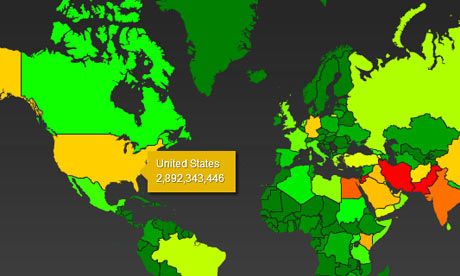
The World According to Boundless Informant

boundless heatmap

Click here for a larger map - it wont fit on this screen. Here's the caption in the Guardian:
The color scheme ranges from green (least subjected to surveillance) through yellow and orange to red (most surveillance). Note the '2007' date in the image relates to the document from which the interactive map derives its top secret classification, not to the map itself.


And more:
The focus of the internal NSA tool is on counting and categorizing the records of communications, known as metadata, rather than the content of an email or instant message.

The Boundless Informant documents show the agency collecting almost 3 billion pieces of intelligence from US computer networks over a 30-day period ending in March 2013. One document says it is designed to give NSA officials answers to questions like, "What type of coverage do we have on country X" in "near real-time by asking the SIGINT [signals intelligence] infrastructure."

An NSA factsheet about the program, acquired by the Guardian, says: "The tool allows users to select a country on a map and view the metadata volume and select details about the collections against that country."
Nice to know that Wikipedia already has pages on both PRISM and Boundless Informant.

PRISM and Boundless Informant

The Washington Post and the Guardian seem primarily responsible for revealing that the National Security Agency, and its British counterpart, has been collecting data from the servers of nine Internet companies that allow it to track phone records and computer activity.

Here's the description in the WaPo:
The National Security Agency and the FBI are tapping directly into the central servers of nine leading U.S. Internet companies, extracting audio and video chats, photographs, e-mails, documents, and connection logs that enable analysts to track foreign targets, according to a top-secret document obtained by The Washington Post.

The program, code-named PRISM, has not been made public until now. It may be the first of its kind. The NSA prides itself on stealing secrets and breaking codes, and it is accustomed to corporate partnerships that help it divert data traffic or sidestep barriers. But there has never been a Google or Facebook before, and it is unlikely that there are richer troves of valuable intelligence than the ones in Silicon Valley.

Equally unusual is the way the NSA extracts what it wants, according to the document: “Collection directly from the servers of these U.S. Service Providers: Microsoft, Yahoo, Google, Facebook, PalTalk, AOL, Skype, YouTube, Apple.”

Here are the previously top secret files which describe PRISM.

And a description of Boundless Informant.

The NYT provides background on the program - which can be traced back to 9/11 and has its defenders in Congress.


http://www.nytimes.com/2013/06/07/us/nsa-verizon-calls.html?smid=pl-share

Federalist 70 and presidential secrecy

The NSA surveillance (issue? - can this be called a scandal?) along with the aggressive investigations of leakers, whistleblowers and the journalists who feed off them raises questions about secrecy, and what should and should not be revealed, not so much by the government - but specifically by the president.

Which takes us to the reasons why the executive branch is designed as it is - with one person at its top. A handful of Federalist Papers describe the reasons why it has this unitary design, the most important is generally held to be #70. In it Hamilton argues that part of the justification is that one person can keep a secret better than a multitude:
That unity is conducive to energy will not be disputed. Decision, activity, secrecy, and despatch will generally characterize the proceedings of one man in a much more eminent degree than the proceedings of any greater number; and in proportion as the number is increased, these qualities will be diminished.
Worth perusing soon enough.

Can we have a reasonable public debate about the proper extent of surveillance in a free society?

I promise to have some useful links up soon related to the National Security Agency's access to telephone and computer records, but since we've touched on the role of an educated population in a republic I thought this 2007 David Foster Wallace quote highlighted by the Dish recently raises an important question the ability the public to have this debate:
“In the absence of such a conversation, can we trust our elected leaders to value and protect the American idea as they act to secure the homeland? What are the effects on the American idea of Guantánamo, Abu Ghraib, Patriot Acts I and II, warrantless surveillance, Executive Order 13233, corporate contractors performing military functions, the Military Commissions Act, NSPD 51, etc., etc.? Assume for a moment that some of these measures really have helped make our persons and property safer—are they worth it? Where and when was the public debate on whether they’re worth it? Was there no such debate because we’re not capable of having or demanding one? Why not? Have we actually become so selfish and scared that we don’t even want to consider whether some things trump safety? What kind of future does that augur?”


Notice that he's not saying that we are prevented from having such a debate (though one could argue that that is the case if certain facts are kept from the public) but whether we can have such a debate. This seems to lie at the heart of some of the material I tried to present in the introductory lectures.

Read the short article this is pulled from - might make good fodder for conversation Monday.

Here's a provocative start:
What if we chose to regard the 2,973 innocents killed in the atrocities of 9/11 not as victims but as democratic martyrs, “sacrifices on the altar of freedom”?* In other words, what if we decided that a certain baseline vulnerability to terrorism is part of the price of the American idea? And, thus, that ours is a generation of Americans called to make great sacrifices in order to preserve our democratic way of life—sacrifices not just of our soldiers and money but of our personal safety and comfort?

"the last of the New Deal liberals"

Aside from being one of the last WWII veterans, Lautenberg has also been called one of the "the last of the New Deal liberals."

Since we covered ideology and federalism recently and will start looking at political parties soon enough, this gives us an opportunity to discuss this transitional period in history. With his death, we are sloso given the chance to speculate further on what factors lead to changes in public policy. Often it has less to do with people changing opinions on certain matter, but instead generations with shared opinions replacing generations with others.

Some related readings - If you are inclined:

- Frank Lautenber, the last of the New Deal Liberals.
- Wikipedia: Liberalism in the United States.
- Wikipedia: New Deal

I'd recommend this one especially:

- How classical liberalism morphed into New Deal liberalism.

I like its introductory paragraph. 2305s should especially recognize the point the author is making here: 
Classical liberalism is synonymous with a faith in reason, which had arisen out of the Enlightenment as a reaction to claims of divine rule by the clergy and royalty of the late Middle Ages. It found expression in the thoughts of many writers across Europe and the British Isles, including John Stuart Mill, John Locke, Baron de Montesquieu, Voltaire, David Hume, and Immanuel Kant, as well as in the political arguments of America’s founders, particularly Thomas Jefferson, Thomas Paine, and James Madison. Liberal freedoms were primarily freedoms of the mind: freedom of thought, of expression, of religion, and of self-invention without regard to the customs of caste, creed, or crown. Above all, liberalism implied both an ability and a responsibility of people to think for themselves, to create their own destinies, and to follow their own consciences. Examining the evolution of liberal belief since its founding, the liberal theologian Reinhold Niebuhr observed in an article published on July 4, 1955, in The New Republic, that liberalism in the broadest sense was characterized by a commitment “to free the individual from the traditional restraints of a society, to endow the ‘governed’ with the power of the franchise, to establish the principle of the ‘consent of the governed’ as the basis of political society; to challenge all hereditary privileges and traditional restraints upon human initiative.”

Congress now has only two WWII veterans remaining

And both are the House - Ralph Hall (TX) and John Dingell (MI). Frank Lautenberg was the last veteran in the Senate.

Michael Barone describes the domininance this generation had on politics for the bulk of the late 20th Century. It had a greater inpact on any other group of veterans since the Civil War.
Not much notice was paid when the last Spanish-American War veteran in Congress, Barratt O'Hara, died in 1969.

Nor was much attention directed at the retirement from Congress in the 1970s of the last two World War I veterans -- Sen. Mike Mansfield of Montana (who lied about his age to enlist) and Sen. John Sparkman of Alabama (who served in the Students Army Training Corps).

In contrast, World War II veterans made a big splash in politics starting shortly after the war ended. Dozens of young veterans were elected to Congress in 1946, including future Presidents John Kennedy and Richard Nixon.


The Washington Post speculates on what his retirement might mean for the the institution and veteran's policies:
But with the death Monday of Frank R. Lautenberg (D-N.J.), not a single one of the 115 World War II veterans who served in the Senate remain, the latest evidence of the rapid decline in members of Congress with military service.

The passing of Lautenberg and the dearth of veterans in Congress is a concern for veterans advocates, who have seen a number of senior senators with clout and sympathy toward their positions pass from the scene in recent years.

“It’s a sad day,” said Louis Celli, national legislative director for the American Legion. “These were some of the most ferocious advocates for veterans that we had. We as veterans counted on the senior leadership, the World War II veterans, to represent us. We respected them, they respected us, and without them, there’s going to be a void.”

Lautenberg “was a real champion for veterans,” said Bob Wallace, executive director of Veterans of Foreign Wars. “He was very proud of the fact that he served in World War II and got educated on the GI Bill. He wanted to do the same for younger veterans, no matter what generation they served.”


Both stories highlight an interesting factoid:
For a time, the Senate was home to three men — Inouye, Bob Dole of Kansas and Phil Hart of Michigan — who had recuperated at the same Army hospital from serious wounds incurred in World War II combat.


The Washington Post story points out that while WW2 veterans flooded Congress (115 would eventually serve) soon after the end of the war, very few veterans of Iraq and Afghanistan have ben elected. They don't point out - but its worth noting - that no Vietnam Veterans have been elected to the presidency. The three who ran - Gore, Kerry, and McCain - were defeated.

Are there too many old people in Congress?

Some smart types debate the issue following the death of one Senator - New Jersey's Frank Lautenberg -at 89. He was far from the oldest Senator by the way. That would be Strom Thurmond.

- One thinks we - and incumbents - should change our "norms about incumbency" and that more party members should be willing to make primary challenges, which discounts the advantage of seniority of seniority. There should be more turnover in the Senate says he.

- Another points out that a disadvantage of having elderly Senators is that they have no idea what problems face younger Americans, and if they are incapacitated their unelected staffs take over their duties. Is this a good idea? She aregues for more retirements in the Senate.

- The historian emeritus of the Senate reminds us that the word "senate" comes from the Latin "sen" meaning old or an elder - so the Senate is supposed to composed of indviduals with age and experience. The reason there are elderly people in the Senate is because constituents vote for them. Dealing with elderly Senators who are also infirmed can be tricky however.

- An ex-member of Congress thinks we have better things to worry about: . . . "term limits and age limits are antithetical to the power given to the voters. Furthermore, as Americans live longer and healthier lives the people who represent them should reflect the very makeup of the constituents they serve.:

Wednesday, June 5, 2013

Social Interaction Potential

In 2306 we discussed the uniqueness of cities in the American federal system, and mentioned that cities are different that states and counties - and probably nations as well - since they are economic entities primarily. Here's an argument that the best cities are those that are organized so that people are likely to interact with each other physically. This makes it easier to make friends.

Click here for the research paper the idea stems from.

Should urban policy - land use and transportation decisions - have as a goal the ability of people to bump into each other?

Patent trolls back on the public agenda

I can't quite say why, but the patent trolls are back on the public agenda. This American Life has run a couple stories on the issue and reports of someone claiming to have patented the "podcast" and sued podcasters for patent infringment have circulated. Perhaps thats what done it.

Wikipedia offers the following definition of a patent troll: 
Patent troll is a pejorative term used for a person or company that enforces its patents against one or more alleged infringers in a manner considered unduly aggressive or opportunistic, often with no intention to manufacture or market the product. A related, less pejorative expression is non-practicing entity (NPE) which describes a patent owner who does not manufacture or use the patented invention.

The Electronic Frontier Foundation offers the following:
A patent troll uses patents as legal weapons, instead of actually creating any new products or coming up with new ideas. Instead, trolls are in the business of litigation (or even just threatening litigation). They often buy up patents cheaply from companies down on their luck who are looking to monetize what resources they have left, such as patents. Unfortunately, the Patent Office has a habit of issuing patents for ideas that are neither new nor revolutionary, and these patents can be very broad, covering everyday or commonsense types of computing – things that should never have been patented in the first place. Armed with these overbroad and vague patents, the troll will then send out threatening letters to those they argue infringe their patent(s). These letters threaten legal action unless the alleged infringer agrees to pay a licensing fee, which can often range to the tens of thousands or even hundreds of thousands of dollars.


Media reports define patent trolling as a form of extortion which inhibit innovation, which contradicts the intent of the patent clause of the U.S. Constitution. Lawsuits filed by patent trolls are clogging the courts.

Congress attempted to address this issue in 2011 with the America Invents Act, (co-wriiten by Texas Rep Lamar Smith) but critics argue that provisions of the law may have contributed to the increase in lawsuits. Rather than address the current problem with additional legislation - which can be problematic in the current contentious legislative environment - President Obama has opted to use executive orders instead. The NYT outlines the proposals:
On Tuesday, President Obama took direct aim at the companies and their practices, announcing several executive orders “to protect innovators from frivolous litigation” by patent trolls.

Mr. Obama ordered the Patent and Trademark Office to require companies to be more specific about exactly what their patent covers and how it is being infringed. The administration also told the patent office to tighten scrutiny of overly broad patent claims and said it would aim to curb patent-infringement lawsuits against consumers and small-business owners who are simply using off-the-shelf technology.


A major criticism right now is that they are granting patents to obvious and superficial ideas, and not necessarily actual products. Some software companies express concerns about the proposals however. Here is an editorial suggesting that judges already have the power to limit the number of lawsuits filed by patent trolls by increasing the costs of litigation. So there's a dispute over the best way to address this issue.

2305 students are about to pour through the Constitution and we will note that one of the delegated powers is the patent clause - which tend to be topical. Click here for past blog posts related to it.

It might be worth investigating the history of the Patent and Trademark Office.  And here is a history of the U.S. Patent system.

Obama appoints Susan Rice as national security adviser

From the NYT:
President Obama announced on Wednesday afternoon that Susan E. Rice, the American ambassador to the United Nations, would replace Tom Donilon, who is resigning, as national security adviser in a major shakeup of his foreign-policy inner circle.
The appointment, which Mr. Obama made in a Rose Garden ceremony, puts Ms. Rice, 48, an outspoken diplomat and a close political ally, at the heart of the administration’s foreign-policy apparatus.

It is also a defiant gesture to Republicans who harshly criticized Ms. Rice for presenting an erroneous account of the deadly attacks on the American mission in Benghazi, Libya. The post of national security adviser, while powerful, does not require Senate confirmation.
Mr. Obama also named Samantha Power, a National Security Council official, as Ms. Rice’s replacement at the United Nations. Ms. Power, who has written extensively about genocide, is closely allied with Ms. Rice on human rights issues.
. . . a senior official in the Executive Office of the President who serves as the chief advisor, stationed in the White House, to the President of the United States on national security issues. This person also participates in the meetings of the National Security Council. The National Security Advisor's office is located in the West Wing of the White House. He or she is supported by the National Security Council staff that produces research, briefings, and intelligence for the APNSA to review and present either to the National Security Council or directly to the President.
History of the National Security Council.

“perhaps the most important criminal procedure case that this Court has heard in decades”

That's the assessment of Justice Samuel Alito on Maryland v King.

In a 5-4 decision the Supreme Court ruled that Maryland's DNA Collection Act was constitutional. ScotusBlog has full info on the case and its background.

From the NYT:
The federal government and 28 states authorize the practice, and law enforcement officials say it is a valuable tool for investigating unsolved crimes. But the court said the testing was justified by a different reason: to identify the suspect in custody.
“When officers make an arrest supported by probable cause to hold for a serious offense and they bring the suspect to the station to be detained in custody,” Justice Anthony M. Kennedy wrote for the majority, “taking and analyzing a cheek swab of the arrestee’s DNA is, like fingerprinting and photographing, a legitimate police booking procedure that is reasonable under the Fourth Amendment.”
A little detail about the case here:
Maryland v. King, No. 12-207, arose from the collection of DNA in 2009 from Alonzo Jay King Jr. after his arrest on assault charges in Wicomico County, Md. His DNA profile, obtained by swabbing his cheek, matched evidence from a 2003 rape case, and he was convicted of that crime.
The Maryland Court of Appeals ruled that a state law authorizing DNA collection from people who had been arrested but not yet convicted violated the Fourth Amendment’s prohibition of unreasonable searches.
Justice Kennedy wrote in the majority opinion that the “quick and painless” swabbing procedure was a search under the Fourth Amendment, meaning it had to be justified as reasonable under the circumstances. It was, he said, given “the need for law enforcement officers in a safe and accurate way to process and identify the persons and possessions they must take into custody.”
Such identification, he said, “is no different than matching an arrestee’s face to a wanted poster of a previously unidentified suspect; or matching tattoos to known gang members to reveal a criminal affiliation; or matching the arrestee’s fingerprints to those recovered from a crime scene.”
The information retrieved through DNA testing as performed by law enforcement officials is limited, Justice Kennedy wrote, and whether “the testing at issue in this case reveals any private medical information at all is open to dispute.”

Antonin Scalia wrote the dissent and questioned the purpose of collecting the DNA swab:
Justice Antonin Scalia summarized his dissent from the bench, a rare move signaling deep disagreement. He accused the majority of an unsuccessful sleight of hand, one that “taxes the credulity of the credulous.” The point of DNA testing as it is actually practiced, he said, is to solve cold cases, not to identify the suspect in custody.
But the Fourth Amendment forbids searches without reasonable suspicion to gather evidence about an unrelated crime, he said, a point the majority did not dispute. “Make no mistake about it: because of today’s decision, your DNA can be taken and entered into a national database if you are ever arrested, rightly or wrongly, and for whatever reason,” Justice Scalia said from the bench.
The comments flow:

Akhil Reed Amar and Neal K. Katyal think the decision was correct and that Scalia got his history wrong:
His opinion opened with these lines: “The Fourth Amendment forbids searching a person for evidence of a crime when there is no basis for believing the person is guilty of the crime or is in possession of incriminating evidence. That prohibition is categorical and without exception; it lies at the very heart of the Fourth Amendment.”
But the Fourth Amendment’s text is not nearly so simple as he makes it out to be. It merely requires that all searches and seizures be not “unreasonable.” Its words do not distinguish between intrusions seeking “evidence of crime” and other sorts of intrusions — say, to collect revenue, or preserve public safety.
Justice Scalia failed to identify even one source from the founders articulating the ultraprecise rule that he claims is the central meaning of the Fourth Amendment. And his version of the Fourth Amendment would lead to absurd results.
Scalia concludes his inspiring dissent by noting the tremendous stakes in the case, and the dangers posed by the Court’s uncritical approval of DNA testing of arrestees—a decision that will affect the “nearly one-third of Americans [who] will be arrested for some offense by age 23.” He predicts that although “the Court disguises the vast (and scary) scope of its holding by promising a limitation it cannot deliver”—namely, that DNA testing will be limited to those arrested for serious crimes such as felonies—the logic of the decision would, in fact, allow DNA tests to “identify” those arrested for traffic offenses. He then directly addresses American citizens, in rousing words that he read from the bench: "Make no mistake about it: As an entirely predictable consequence of today’s decision, your DNA can be taken and entered into a national DNA database if you are ever arrested, rightly or wrongly, and for whatever reason.” And he ends with one of his most memorable images: “Perhaps the construction of such a genetic panopticon is wise.  But I doubt that the proud men who wrote the charter of our liberties would have been so eager to open their mouths for royal inspection.

Written Assignment #1 - GOVT 2305 & 2306

On Blackboard you'll notice two assignments. The first (the introductory assignment) simply asks you to send me a quick hello along with any questions you might have about the class. The second (Written Assignment #1) asks you to skim the assigned book, outline its topic and the argument it makes. Also pull out a few specific items from the book.

This is to prep you for next week's assignment where I will ask you for a topic for your 1000 word report. It is to be on some aspect of the assigned book.

Tuesday, June 4, 2013

From the Dallas Morning News: Texans not very engaged as citizens, nonpartisan study finds

An appropriate topic as we begin our summer classes. Is the Texas population fit to govern itself?


Texans are not highly engaged voters and citizens  — and, by some measures, not very active members of their communities, a nonpartisan study has found.
In 2010, the state ranked 51st among the states and the District of Columbia in voter turnout, 49th in the share of its citizens who contacted public officials, 47th in how many trust most of their neighbors and 43rd in the percentage who give to charities.

The study, released Monday, is the first-ever Texas Civic Health Index, a joint effort by the Annette Strauss Institute for Civic Life at the University of Texas at Austin and the National Conference on Citizenship, a congressionally chartered group that tries to evaluate civic participation.

Regina Lawrence, the UT journalism professor who runs the Strauss Institute, said the findings should alarm Texans. She noted that just 36 percent cast ballots in 2010.

“A good definition of democracy is not one in which two-thirds of voters don’t show up,” Lawrence said. “What we saw was a very active minority of citizens really determining the future of the state in that election.”