Wednesday, October 16, 2013

Does a state violate the equal protection clause when it bans affirmative action with a constitutional amendment?

That's the question the court faces in Schuette v. Coalition to Defend Affirmative Action.

Oral arguments were held yesterday.

NPR details the history of this dispute - which involves a previous Supreme Court case.
The U.S. Supreme Court takes up the issue of affirmative action again Tuesday, but this time the question is not whether race may be considered as a factor in college admissions. Instead, this case tests whether voters can ban affirmative action programs through a referendum.

In 2003, the the University of Michigan Law School's affirmative action policy. The next day, opponents of affirmative action launched a referendum campaign to bar such programs, and in 2006, voters overwhelmingly approved a ballot initiative amending the state constitution to ban affirmative action programs in higher education.

Michigan's state colleges and universities promptly abandoned any use of race or ethnicity to promote diversity, and minority enrollment plummeted. In 2012, a federal appeals court ruled that the referendum itself was discriminatory, and the U.S. Supreme Court stepped in to decide the issue.

. . . opponents of the referendum claim that the ballot initiative rigged the system. They note that other state admissions policies are set by the popularly elected boards of regents of the three state universities. Indeed, affirmative action defenders observe that some regent elections have focused on the issue of affirmative action. If that process isn't working, they argue, the state Legislature could give the power to set all admissions policies to another body. Or the Legislature could enact a different system to promote diversity — for instance, guaranteeing admission to students graduating in the top 10 percent of their high school classes.

"The one thing they can't do," says the American Civil Liberties Union's Mark Rosenbaum, "is to take our political process, to take the way that decisions are made with respect to higher education, and say, 'There will be one set of rules for race, which are particularly onerous, and another set of rules for all other admissions policies, including all other preferences.' "

Rosenbaum will tell the justices on Tuesday that passage of the referendum means that the only way for minority groups to reinstate affirmative action programs is to re-amend the state constitution. That task is extremely difficult — and, he asserts, doubly difficult and costly, given that the state is 79 percent white. In contrast, if other Michigan citizens want to change other preferences in university admissions — for example, the preference for the children of alumni — they can lobby the regents.

"They have created a separate and unequal system when it comes to considering racial matters," he says.

Will the Tea Party become its own party?

Normally the winner take all rules embedded in the American electoral system prevents this, but this author suggests that Tea Party Republicans - since they already hold office and have established funding sources - might be able to pull it off:


Advocates of a big shake-up in the partisan landscape, whether in the centre or on the right or left, tend to talk about building new political parties from the ground up by fielding candidates in elections. This is vanishingly unlikely to work in the first-past-the-post American system; third-party candidates almost always lack the resources and the name recognition to compete. Voters tend to stick with one of the two major parties in order to avoid the risk of wasting their vote. So upstart parties like the Greens on the left, the Libertarians on the right, or Ross Perot's United We Stand America in the centre face tremendous hurdles, and in practice none have been successful.

A factional split in an existing party reduces that wasted-vote risk. When a faction cleaves from an existing party, it comes with ready-made political power in Congress, and can even play the role of kingmaker. A party that already has members in Congress is a more serious contender in subsequent elections. A strong regional base would probably be needed to stay in contention in any first-past-the-post system; a splinter party that draws 10% of the vote nationwide probably won't win many seats, but a splinter party that draws 10% of the vote concentrated in 25% of the country could.

The biggest weakness in a top-down effort to form a third party via congressional revolt, rather than a bottom-up party-building effort, would be a lack of ideological coherence or connection with voters. A collection of members of Congress disaffected with their leadership will probably not have a strong organic link to any common voter base. But if those members of Congress already come from a common movement with shared organisations and voter bases that had helped elect them, they might take that organisation with them when they split off. Or national political organisations and movements that wanted to form a third party might themselves be the ones pressuring sitting members of Congress to form a breakaway faction.

He doesn't think this is very likely right now, but events might make this more likely to occur:

Of course, there's not much incentive for tea-party Republicans to leave the party right now, since they've succeeded in bending it to their will. But if moderate Republicans finally revolt and dump their agenda, I think tea-party Republicans would have a better shot at launching a sustainable third party than we've seen in America in a long time. Not that it would be a particularly good shot; the segregationist Dixiecrats had a similar combination of congressional power, loyal voter blocs and a unifying ideology when they tried to set up the States' Rights Democratic Party in 1948, and it didn't last past that one election. Still, for anyone who does want to see American politics shaken up through the entrance of a third party, it's worth thinking about the congressional-revolt strategy in combination with the bottom-up one.


From The Hill: Fitch eyes downgrade amid chaos

In its announcement, Fitch said it believed the debt ceiling could be raised but criticized Washington politics for undermining international confidence in the U.S. system.
“Although Fitch continues to believe that the debt ceiling will be raised soon, the political brinkmanship and reduced financing flexibility could increase the risk of a U.S. default,” the rater said in a statement.
“The U.S. risks being forced to incur widespread delays of payments to suppliers and employees, as well as Social Security payments to citizens — all of which would damage the perception of U.S. sovereign creditworthiness and the economy.”
Investors on Tuesday showed tepid interest in a weekly offering of Treasury bonds amid growing concern about the reliability of U.S. debt. Citigroup reportedly told analysts it was getting rid of any Treasury debt due to mature around the end of the month.
Outside experts believe the government could be in danger of a default anytime between Oct. 22 and Nov. 1.
The stock market has yet to show any dramatic swings, but markets closed before the House canceled its plans for a vote. The Dow Jones Industrial Average ended the day down 135 points.
A spokesman for Standard & Poor’s, which downgraded the nation in the aftermath of the 2011 debt limit fight, said that rater still expects a last-minute deal to emerge. And Moody’s Investors Service said earlier this month it sees no risk of a default even if the debt limit is not raised, saying the Treasury would ensure interest payments on debts were made above all others.

From Bloomberg: Five Reasons to Fear the Debt Ceiling

A quick primer:

1. Global markets will see the U.S. government as grossly and dangerously incompetent.2. Forced spending cuts will kill the economic recovery.3. The U.S. government might actually default on its debts.4. A default could trigger a global crash.5. The government’s fiscal problems will only get worse.

Tuesday, October 15, 2013

More on fragmentation within the Republican Party

Here are a few more stories that amplify the theme of the previous one:

- Whither the GOP? Republicans Want Change, But Split over Party’s Direction
- A tea party exit would be a blessing for GOP
- The GOP Can't Survive Without the Tea Party

From TNR: The Last Days of the GOP We could be witnessing the death throes of the Republican Party

I can't comment on whether this author's broader claims are true, but this article contains great information on how the contemporary Republican coalition came to be. It'll add to a forthcoming look at political parties in the US and the forces that shift the balance of power from one to the other.

The authors point is that the current coalition that has formed the core of the Republican Party for a couple decades at least is starting to unravel. The fight over the shut down and debt ceiling is driving it:

The battle over the shutdown has highlighted the cracks and fissures within the party. The party’s leadership has begun to lose control of its members in Congress. The party’s base has become increasingly shrill and is almost as dissatisfied with the Republican leadership in Washington as it is with President Obama. New conservative groups have echoed, and taken advantage of, this sentiment by targeting Republicans identified with the leadership for defeat. And a growing group of Republican politicians, who owe their election to these groups, has carried the battle into the halls of Congress. That is spelling doom for the Republican coalition that has kept the party afloat for the last two decades.

American party coalitions are heterogeneous, but they endure as along as the different groups find more agreement with each other than with the opposition. After Republicans won back the Congress in 1994, they developed a political strategy to hold their coalition together. Many people contributed to the strategy including Newt Gingrich, Karl Rove, Paul Coverdell, Paul Weyrich, and Ralph Reed, but the chief architect was probably Grover Norquist, a political operative who, along with Rove and Reed, came of age in the early Reagan years. The strategy was based on creating an alliance between business, which had sometimes divided its loyalties between Republicans and Democrats, and the array of social and economic interest groups that had begun backing Republicans.

In weekly meeting held on Wednesdays at the office of his Americans for Tax Reform, Norquist put forth the idea that business groups, led by the U.S. Chamber of Commerce and the National Federation of Independent Business (NFIB), but also including the specialized trade associations, should back socially conservative Republican candidates, while right-to-life or gun rights organizations should back tax cuts and deregulation. What would bind the different parts together was a common opposition to raising taxes, which Norquist framed in a pledge he demanded that Republican candidates make. Business could provide the money, and the single-issue and evangelical groups the grassroots energy to win elections.

The strategy worked reasonably well, especially in House races. The Chamber and NFIB became election-year arms of the Republican Party. In Congress, a succession of leaders, including Gingrich, Dennis Hastert, Tom DeLay, and Roy Blunt, followed the strategy. Gingrich initially overreached, and DeLay took ethical end-runs, but by the time John Boehner became Minority Leader in 2007, it had been refined. Its economic approach consisted of promoting cuts in taxes, spending, and regulation. Boehner, as lobbyists close to him explained to me, wanted to use the battle over continuing resolutions and the debt ceiling to achieve incremental changes on these fronts. He did not contemplate shutting down the government or allowing the government to default on its obligations.

But now the strategy does not seem to be working. Tea Party activists and evangelicals seem unwilling to bend to business interests.

Under pressure from grassroots radicals and the new outsider groups, the old Republican coalition is beginning to shatter. The single-issue and evangelical groups have been superseded by right-wing populist groups, which are generally identified with the Tea Party, although there is no single Tea Party organization. These groups can’t easily be co-opted by the party’s Washington leadership. And the business groups in Washington, who funded the party over the last two decades, have grown disillusioned with a party that appears to be increasingly held hostage by its radical base and by outsider groups. The newspapers are now filled with stories about business opposition to the shutdown strategy, and there are even hints of business groups backing challenges to Tea Party candidates. “The business community has got to stand up and say we are not going to back the most self-described conservative candidate. We are going to back the candidates that are the most rational,” says John Feehery, a former aide to DeLay and Hastert who is now president of Quinn Gillespie & Associates, a Washington lobbying firm.

Business interests have not been shy about donating to the occasional Democrat - that might continue.


In Washington, today’s business lobbies may come to understand what the lobbies of the ‘50s grasped—that the Democratic Party is a small “c” conservative party that has sought to preserve and protect American capitalism by sanding off its rough edges. Joe Echevarria, the chief executive of Deloitte, the accounting and consulting firm, recently told The New York Times, “I’m a Republican by definition and by registration, but the party seems to have split into two factions.” Echevarria added that while the Democrats also had an extreme faction, it had no power in the party, while the Republican’s extreme faction did. “The extreme right has 90 seats in the House,” he said. “Occupy Wall Street has no seats.” That realization could lead business to resume splitting its contributions, which would spell trouble for the Republicans.

Republicans in Washington could repudiate their radical base and shun the groups that appeal to it. That is roughly what people like Feehery are suggesting. But the question, then, is what would be the Republican base? How would Republicans win elections? Are there enough rational Republicans to make up for the loss of the radical ones?
What is happening in the Republican Party today is reminiscent of what happened to the Democrats in the late 1960s and early 1970s. At that time, the Democrats in Washington were faced by a grassroots revolt from the new left over the war in Vietnam and from the white South over the party’s support for civil rights. It took the Democrats over two decades to do undo the damage—to create a party coalition that united the leadership in Washington with the base and that was capable of winning national elections. The Republicans could be facing a similar split between their base and their Washington leadership, and it could cripple them not just in the 2014 and 2016 elections, but for decades to come.

If the South can realign to the Republican Party anything is possible.  This is a must read article for 2305 students.

For this week's look at the Texas budget in GOVT 2306

The plan is to look at both the budgetary process and the description of spending in the Fiscal Size Up.

Click here for past posts on the Texas budget - the topics vary depending on what was topical on a given day.

And here are a few random items topical today.

- Lawyer updates Fort Bend leaders on state finance lawsuit.

The massive cuts to public education budget in the 82nd Session of the legislature led to a - still ongoing - lawsuit by 600 school districts against the legislature alleging they violated the Texas Constitutions mandate that appropriate funds be provided to public education in the state. A Texas district judge agreed, but some funds were added in the 83rd Session - which led to a delay in the final verdict.

This story contains an appraisal of what the budget cuts will mean for the quality of the public education system.

- Leap backwards: TxDOT downgrading paved roads to gravel prompts new funding.


A "citizen activist" walks through the problems involved in Texas' method for funding roads in the state - especially roads in rural areas that are being heavily damaged by the increased activity associated with fracking. Not only are insufficient funds being made available for repair - leading the Department of Transportation to propose converting many of these roads to gravel - but few funds area available to police these areas.

The state is reaping the benefits of these increased revenues, but the areas where the drilling is occurring are not.

-Rep. Donna Howard Talks Family Planning, Education, and the Future of the Legislature

A member of the Texas legislature's Women's Health Caucus discusses efforts to undo cuts to women's health and family planning programs.
-Higher ed funding fails. 

Disagreements over how to distribute over $2 billion in tuition revenue bonds prevented the legislature from authorizing any new campus construction for higher education.


58% of Texans support legalizing marijuana - area Congressman cosponsors bill requiring federal officials to comply with state marijuana laws

Two related stories provide further evidence that attitudes about marijuana are changing.

First
A majority of Texas voters would like to see the state go the way of Washington and Colorado and legalize possession of marijuana, according to a new poll conducted by Public Policy Polling for the Marijuana Policy Project.

According to the poll, 58 percent of the 860 respondents said they either "strongly support (41 percent)" or "somewhat support (17 percent)" changing the law in Texas to regulate marijuana similarly to alcohol, licensing stores to sell the substance to adults age 21 and older. Of those in opposition, 14 percent "somewhat oppose" the full legalization of marijuana and 24 percent "strongly oppose" such a change.

Sixty-one percent of respondents said they would like to remove criminal penalties for those in possession of an ounce or less of marijuana and make it a civil rather than criminal offense, punishable by a fine of up to $100 with no jail time. Under the current law, a person in possession of a small amount of the drug faces up to a year in jail and a fine of up to $2,000.

"I would take this poll seriously, because it does generally track with Gallup and Pew polls nationwide," said Nathan Jones, a postdoctoral fellow in Drug Policy at Rice University's Baker Institute.

"This shows that a majority of Texans are in support of fully legalizing marijuana."

Jones attributes the poll results in part to Texans' libertarian attitudes on spending tax dollars to enforce the state's marijuana policy and the cost of incarcerating drug offenders. The state also loses money due to lost productivity, when a non-violent offender is released from prison and is unable to find a good job.

Notice that some of the support for legalization has less to do with attitudes about the drug than concerns over the costs of prosecution.
Second

Texas Rep. Steve Stockman, R-Friendswood, has recently backed a bill to require federal officials to comply with state marijuana laws, which was introduced in April and has since garnered support from Congressmen on both sides of the aisle.

The Respect State Marijuana Laws Act of 2013, introduced by California Rep. Dana Rohrabacher, a Republican, would bar federal drug enforcement agents from penalizing any person abiding by the marijuana laws in their own state.

The law “shall not apply to any person acting in compliance with State laws” — that is, people who are in compliance with their state laws regarding possession, manufacture or use of marijuana will not be subjected to federal penalties.

Twenty-one states and Washington, D.C. have already legalized medical marijuana, and both Washington and Colorado legalized marijuana for both medicinal and recreational use.

Stockman’s name was added to the bill as a sponsor on Saturday. He currently is the only Texas Congressman to cosponsor the bill, which has a total of 19 cosponsors. The bill was referred to to the Subcommittee on Crime, Terrorism, Homeland Security, and Investigations in April.

Prop 2 - Texas Constitutional Amendment - 2013

Here's what the ballot wording will look like:

The constitional amendment eliminating an obsolete requirement for a State Medical Education Board and a State Medical Education Fund, neither of which is operational.

The purpose seem to just clean up the Texas Constitution of an extraneous section.

Click here for detail from the Texas Legislative Council.


The Texas Constitution currently requires a constitutional State Medical Education Board and State Medical Education Fund.  The program, created in 1952, did not ultimately serve its intended purpose so the loans from the fund were discontinued in 1988.  The Texas Higher Education Coordinating Board absorbed the State Medical Education Fund as part of its overall duties for scholarships and student loans, making the constitutional board and fund obsolete.  HJR 79 eliminates the constitutional requirement to continue the board and fund.

Supporters Say: This constitutional amendment repeals an obsolete provision in the Texas Constitution. The State Medical Education Fund is operated by the Texas Higher Education Coordinating Board, so there is no need to maintain the discontinued program in the constitution.

Opponents Say: No opposition.


All you need to know about Perry, Abbott and Davis from the Texas Tribune

I anticipate that they'll do something similar for other politicians, but they provide pages devoted to all the stories compiled for these noted Texas politicos.

- Perrypedia.
- Abbott Archives.
- Davis Digest.

Thursday, October 10, 2013

Classes cancelled Thursday 10/10 and Monday 10/14

I made this announcement in class and elsewhere, but in case you haven't heard, I'll be out of town through Tuesday the 15th.

The next round of assessments might be a posted a bit late, but we will get back on track next week.

Wednesday, October 9, 2013

McCutcheon v. Federal Election Commission

Oral arguments were heard yesterday over whether limits on contributions violate free speech rights.

- ScotusBlog has full detail here.
- The transcript of the argument can be found here.
- Why Limit Political Donations?

Houston's mayoral debate

The six candidates for Houston's mayoral race met last night in a debate. The Chronicle reports that roads, city finances and public transportation were dominant themes.

Many House Republicans doubt default will result in economic crisis.

From the NYT:

As President Obama steps up his declarations about the dire consequences of not raising the debt limit, increasing numbers of Congressional Republicans are disputing that forecast, as well as the timing of when the Treasury might run out of money and the implications of a default, further complicating the negotiating situation for both Mr. Obama and Speaker John A. Boehner, who must find a way out of the impasse.
Both men were counting on the prospect of a global economic meltdown to help pull restive Republicans into line. On Wall Street, among business leaders and in a vast majority of university economics departments, the threat of significant instability resulting from a debt default is not in question. But a lot of Republicans simply do not believe it.
A surprisingly broad section of the Republican Party is convinced that a threat once taken as economic fact may not exist — or at least may not be so serious. Some question the Treasury’s drop-dead deadline of Oct. 17. Some government services might have to be curtailed, they concede. “But I think the real date, candidly, the date that’s highly problematic for our nation, is Nov. 1,” said Senator Bob Corker, Republican of Tennessee.
Others say there is no deadline at all — that daily tax receipts would be more than enough to pay off Treasury bonds as they come due.

One critics calls them debt ceiling truthers.

Tuesday, October 8, 2013

What does the 14th Amendment say about public debt and why?

We already spent time in 2305 discussing Section One of the 14th Amendment - which established national citizenship and contains the equal protection clause among other things - but Section Four contains language which might apply to the current standoff:

Section 4. The validity of the public debt of the United States, authorized by law, including debts incurred for payment of pensions and bounties for services in suppressing insurrection or rebellion, shall not be questioned. But neither the United States nor any State shall assume or pay any debt or obligation incurred in aid of insurrection or rebellion against the United States, or any claim for the loss or emancipation of any slave; but all such debts, obligations and claims shall be held illegal and void.

Why is it here? It has to do with the politics following the Civil War once the southern states were allowed to send representatives back to Congress. What consequences would follow?

The threat of debt default and its impact on national security was very much on the minds of those who drafted the Fourteenth Amendment to the Constitution. The historian Franklin Noll has explained how representatives of the former Confederate states, now back in Congress, were highly disinclined to tax their constituents to pay the debts of the Civil War’s victors – the Confederate debt was repudiated, only the Union debt was repaid. Consequently, the threat of default was a very real one in the immediate postwar period.

From the abstract of Noll's article:

From 1865 to 1870, a crisis atmosphere hovered around the issue of the massive public debt created during the recently concluded Civil War, leading, in part, to the passage of a Constitutional Amendment ensuring the “validity of the public debt.” However, the Civil War debt crisis was not a financial one, but a political one. The Republican and Democratic Parties took concerns over the public debt and magnified them into panics so that they could serve political ends — there was never any real danger that the United States would default on its debt for financial reasons. There were, in fact, three interrelated crises generated during the period: a repudiation crisis (grounded upon fears of the cancellation of the war debt), a repayment crisis (arising from calls to repay the debt in depreciated currency), and a refunding crisis (stemming from a concern of a run on the Treasury). The end of the Civil War debt crisis came only when there was no more political advantage to be gained from exploiting the issue of the public debt.

Bruce Bartlett On The Debt Limit

More on "brinksmanship."

This article has been called a must read by some smart folks

Bartlett walks through the consequences of not extending the debt ceiling, then discusses President Obama's options, but argues that if necessary he must continue to borrow money to fund the government even if it means defying Congress over the debt ceiling.

He wouldn't be the first president to do so.
Previous presidents have also faced the dilemma of being under insurmountable pressure to act in various circumstances with no clear legal authority or conflicting legal demands. Thomas Jefferson concluded that he did not have the authority to buy the Louisiana territory, but did so anyway because it was essential to the national interest.
During the Civil War, Abraham Lincoln often had to take extra-constitutional actions, such as suspending the writ of habeas corpus. In a message to Congress on July 4, 1861, he explained that when forced by grave necessity to break the law, the president must do so, choosing the least unconstitutional option. As Lincoln put it, “To state the question more directly, are all the laws, but one, to go unexecuted, and the government itself go to pieces, lest that one be violated?”
Franklin D. Roosevelt suspended the enforcement of gold clauses in private contracts fully expecting that the Supreme Court would rule against him.

Word of the day: Brinksmanship

From Wikipedia:

Brinkmanship (also brinksmanship) is the practice of pushing dangerous events to the verge of—or to the brink of—disaster in order to achieve the most advantageous outcome. It occurs in international politics, foreign policy, labour relations, and (in contemporary settings) military strategyinvolving the threatened use of nuclear weapons.
This maneuver of pushing a situation with the opponent to the brink succeeds by forcing the opponent to back down and make concessions.

As applied to current news:

- 11th-Hour Brinkmanship Before Government Shutdown.
- CR Blues: Constant Brinkmanship Brings Fatigue
- Boehner can't let go of brinkmanship
- Brinkmanship in US Congress as debt ceiling looms

Americans like their member of Congress more than they like Congress itself

This is a common finding.

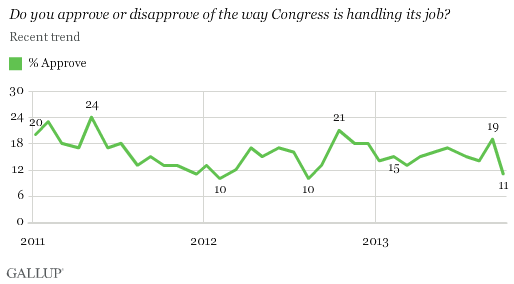
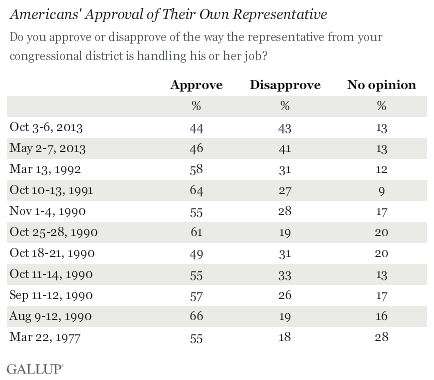
11% approve of Congress, 44% approve of their member of Congress.

The Gallup poll shows dips in both, but the numbers for Congress overall is close to a record low.

Do you approve or disapprove of the way Congress is handling its job?

The number for the individual member is a record low - but its 4 times the number for Congress.

Americans' Approval of Their Own Representative

Notice the persistence of the difference in these two figures. There's lot to be made of it. I always found it interesting that we have a lower collective opinion of the institution we have the connection too, but it is also composed of individuals from across the country, many of whom have opinions we loath. It's democratic and messy.

Abbott v. Davis

The Economist looks ahead to the governor's race. We will. too.

From Wonkblog: A snapshot of today's college students

Most of the discourse on college education seems based on a incorrect assumption of who college students really are. A plurality g to community colleges, a quarter have children, and most are independent.

But you probably knew that already.

college_breakdown

The Tea Party is not interested in compromise

That's the theme of a handful of recent stories. Here are a couple examples

- ‘People don’t fully appreciate how committed the tea party is to not compromising'
- The Tea Party Doesn’t Want Compromise; It Wants Surrender

Most highlight a recently published book which tries to detail how Tea Party members are distinct from other Republican Party identifiers. The authors uses surveys and other methods to determine that Tea Party members are far more likely to be reactionary (take may country back) and conspiratorial than other Republicans.

- This focus group report on Tea Party members hits the same point.

Some quotes from the book's author: 

So if you look at this postwar discourse in the National Review Online you have some content about limited government, some about social conservatism, and some about national security. That content accounts for 76 percent of that National Review online. Now if you look at the Tea Party Web sites, that only accounts for 30 percent. Then there’s this conspiratorial discourse Hofstadter talks about that says government is really trying to bring about socialism, etc. That’s only about five percent of what you find at the National Review. On tea party Web sites it’s about a third.
So it’s not just that we’re seeing results like 76 percent of tea partiers want to see Obama fail. We also ask if people think Obama is destroying the country. We asked this question of all self-identified conservatives. If you look at all conservatives, 35 percent believe that. If you look at tea party conservatives and non-tea party conservatives, only six percent of non-tea party conservatives believe that vs. 71 percent of tea party conservatives.
So to draw this together, the reason people should believe us is we have disparate data sources that collapse on the same answer. It’s that these people are not the traditional, mainstream conventional conservatives. If you look at tea party conservatives, or as we call them in the book, reactionary conservatives, they don’t want change at all. They want to go back in time.
. . . You’ve got about 52 members of the Republican conference who are affiliated with the tea party in some official way. That’s a bit less than a quarter of all House Republicans. That’s enough in the House. They refuse to compromise because, to them, compromise is capitulation. If you go back to Hofstadter’s work when he’s talking about when the John Birch Society rode high, he talks about how conservatives would see people who disagree as political opponents, but reactionary conservatives saw them as evil. You can’t capitulate to evil.

Sunday, October 6, 2013

From The Hill: ‘Citizens United II’ could open floodgates

The Hill points attention to another Supreme Court case which promises to allow for more money from wealthy donors into the political system.

The case is McCutcheon v. Federal Election Commission.
Here's detail:

At issue in the case are aggregate contribution limits – the maximum amount that a donor can give to federal candidates and political party committees throughout the course of a two-year election cycle.

Dubbed “Citizens United II” by watchdogs, they worry without the limits, donors’ influence will only grow.
“If the court strikes down these limits they will leave the nation unable to protect itself from the wholesale corruption of our officeholders and of government decisions,” said Fred Wertheimer, president of Democracy 21, which lobbies for stronger campaign finance laws.
Now set at just over $123,200, the limits were enacted by Congress in the early 1970s and upheld by the court’s 1976 decision in a case dubbed Buckley v. Valeo.
“Congress was surely entitled to conclude… that contribution ceilings were a necessary legislative concomitant to deal with the reality or appearance of corruption inherent in a system permitting unlimited financial contributions,” the court found.
The Supreme Court has taken up numerous campaign finance cases since then, but has declined until now to revisit the Buckley finding.

The justices will consider the case of Shaun McCutcheon, an Alabama businessman and GOP backer who is challenging the limits as unconstitutional. His central argument is simple: limiting donations hampers contributors’ free speech and their participation in the political system.
“Contributing to candidates is protected by the First Amendment,” said the Bopp Law Firm’s James Bopp, lead counsel for the Republican National Committee, which has partnered with McCutcheon on the case to oppose the aggregate limit.
“When you have a law that prevents you from contributing to candidates that you want to, which this law does, it is prohibiting speech, which is what a contribution is,” he said.

Some of the major cases before the SC

A quick look at the principle questions to be raised this term - drawn from the USA Today's preview.

Affirmative Action
- Schuette v Coalition to Defend Affirmative Action
- Question: Does a state constitutional amendment barring racial preferences in public university admissions violate the Equal Protection Clause of the Constitution.

Legislative Prayer
- Town of Greece v Galloway
- Question: Does a town;s policy of having local clergy recite prayers at government meetings violate the First Amendment's establishment clause when nearly all prayers are Christian?

Housing Discrimination
- Mount Holly v Mt. Holly Gardens Citizens in Action
- Question: Is a government policy, such as redeveloping a blighted neighborhood, permitted under the Fair Housing Act of 1968 if it has a disparate impact on racial minorities?

EPA
- EPA v EME Homer City Generation
- Can the federal government supersede states' authority by setting emissions reduction plans for power plants, based in part on pollution that travels to downwind states?

Recess Appointments
- NLRB v Noel Canning
- Can the president use his recess appointment power to sidestep Senate confirmation during intra-session recesses, or when the vacancy predates the recess, or when the Senate is Meeting every three days in pro-forma sessions?

Abortion Buffer Zones
- McCullen v Coakley
- Can a state set up a buffer zone around reproductive health care facilities that perform abortions, on order to separate patients from protesters?

Medical Abortion
- Cline v Oklahoma Coalition for Reproductive Justice
- Can the state limit the administration of abortion-inducing drugs to the protocols specified on their labels, thereby restricting so-call;ed medical abortions?

Health Care Contraception
- Sebelius v. Hobby Lobby Stores
- Can a family owned corporation whose owners oppose abortion refuse to offer health insurance policies that include coverage of contraceptives, as required by President Obama's health care law?

Cell Phones
- Riley v. California
- Can police search the data in a suspect's cellphone during a routine search incident to arrest, without first getting  warrant?

The Supreme Court reconvenes

The US Supreme Court reconvenes the first Monday of each October.

Which is tomorrow.

Here's are a few stories detailing what lies ahead:
- NYT: The Supreme Court Returns.
- CSM: Campaign finance and public prayer top new term agenda.
- LAT: In new term, Supreme Court may steer to right on key social issues.
- USA Today: Supreme Court poised to tilt further to the right.

For 2305 tomorrow

A look through the provisions of the Patient Protection and Affordable Care Act.

This will be in addition to glancing through Rivals for Powers.

Written Assignment #9

This is the last of the core assessments.

Critical Thinking

Operational Definition: Upon completion of a degree plan at Alvin Community College, students will demonstrate the successful application of higher order analyses, innovative interpretation of evidence, and creative cognitive processes.

Enhancing the Right to Vote: Voter Suppression vs. Voter Fraud

At the heart of the debate over voter the requirement that photo identification be presented in order to vote is whether the move is a legitimate means to curtail voter fraud, or an illegitimate means to suppress the vote on the part of the population that may find it difficult to obtain adequate ID.

In a critical essay I want you to determine how best to promote the right to vote while ensuring that votes are legitimate. How much effort should be made by the government (be it local, state, or nation) in enhancing access to the polls all the while ensuring that the votes cast are in fact legitimate.

While you do so, also evaluate the claims on the one side that voter ID measures are intended to suppress the votes of certain populations – thus biasing election results – and on the other that voter fraud is rampant.

Speculate also on the political feasibility of passing legislation that enhances access to the polls.


150 words at a minimum

Due October 28

Written Assignment #8

This is the next core assessment required by the state of Texas.

Social Responsibility

Operational Definition: Student will understand the importance of making a personal investment in the well-being of others, the community and/or the planet while showing respect for the ideas and beliefs of others.

What is Your Responsibility to Keeping the Republic

One of the themes of this class – at least one that was introduced early in the semester – was that you are a citizen (or at least a resident) in a democratic republic, and one of your responsibilities is to sustain it. Remember Franklin’s alleged response to the woman who asked him what they had produced in the constitutional convention.

Based on what we have covered this semester so far, what does this mean?

Keep in mind that while you have certain rights and liberties, so do others. What do you have to do to comply with your responsibility to help keep the republic? What are your responsibilities? You might want to take on Franklin however. Perhaps you don’t think this is your responsibility. If so, make a persuasive case.


Again - write at least 150 words.

Due October 21

Written Assignment #7

This question is directed at one of the core assessment items established by the state of Texas.

Personal Responsibility

Operational Definitions: Students will demonstrate the ability to connect choices, actions and consequences to ethical decision making.

The Ethics of Voting

Despite your young age (at least at heart), you have already been bombarded with messages about the importance of voting and participating in the politics, including in this class. But both voting and participation carry with it the responsibility that you stay informed in order to make sensible, justifiable – ethical - decisions. As you also know, in the complex political world American live in, this takes time. We also have lives to live and other responsibilities that require out attention.

I want you to address this issue in the following question(s): How much time and effort should reasonable, ethical citizens spend educating themselves prior to deciding how to position themselves on public policy issues and how to vote? What types of shortcuts are and are not acceptable? Is there a responsibility for citizens with low information to not vote in an election?

You can take this in as many directions you choose, but your answer should focus on what it takes to be a responsible citizen and the degree to which this involves informed voting.


Write at least 150 words, turn it in by October 14

Is the US now ungovernable?

The Economist worries that it is:

. . . Republicans are setting a precedent which, if followed, would make America ungovernable. Voters have seen fit to give their party control of one arm of government—the House of Representatives—while handing the Democrats the White House and the Senate. If a party with such a modest electoral mandate threatens to shut down government unless the other side repeals a law it does not like, apparently settled legislation will always be vulnerable to repeal by the minority. Washington will be permanently paralysed and America condemned to chronic uncertainty.
It gets worse. Later this month the federal government will reach its legal borrowing limit, known as the “debt ceiling”. Unless Congress raises that ceiling, Uncle Sam will soon be unable to pay all his bills. In other words, unless the two parties can work together, America will have to choose which of its obligations not to honour. It could slash spending so deeply that it causes a recession. Or it could default on its debts, which would be even worse, and unimaginably more harmful than a mere government shutdown. No one in Washington is that crazy, surely?

Like other commentators, they argue the fault lies in the polarization facilitated by gerrymandered districts.

The solution is to reform the electoral process by establishing independent commissions to draw electoral districts instead of parties in state legislatures:

What can be done? In the short term, House Republicans need to get their priorities straight. They should pass a clean budget resolution without trying to refight old battles over Obamacare. They should also vote to raise the debt ceiling (or better yet, abolish it). If Obamacare really does turn out to be a flop and Republicans win the presidency and the Senate in 2016, they can repeal it through the normal legislative process.
In the longer term, America needs to tackle polarisation. The problem is especially acute in the House, because many states let politicians draw their own electoral maps.
Unsurprisingly, they tend to draw ultra-safe districts for themselves. This means that a typical congressman has no fear of losing a general election but is terrified of a primary challenge. Many therefore pander to extremists on their own side rather than forging sensible centrist deals with the other. This is no way to run a country. Electoral reforms, such as letting independent commissions draw district boundaries, would not suddenly make America governable, but they would help. It is time for less cliff-hanging, and more common sense.

Good luck with that. California is using one, but I doubt it would have much of a chance in Texas.

Medicaid Expansion in the 83rd Session

For both 2305 and 2306: One of the major questions facing the 83rd Texas legislative session was whether Texas should participate in the expansion of Medicaid encouraged by the ACA.

Texas ultimately opted to not do so. Opposition was driven by top statewide elected officials and Republican Party. Local government however were much more supportive of the expansion, as were health care providers.

- Here's a Texas Tribune story from January 26, 2013 which claimed the state would benefit from the expansion:

Expanding Medicaid is a "smart, affordable and fair" decision for Texas, according to a report issued by Billy Hamilton, a nonpartisan consultant commissioned by Methodist Healthcare Ministries of South Texas and Texas Impact, a statewide interfaith network.
“If politics are set aside, the right decision is obvious,” wrote Hamilton, a former deputy comptroller of public accounts who was once the state’s chief revenue estimator. He argued that for an investment of $15 billion, Texas could draw down $100 billion in federal funds and expand health care coverage to 2 million low-income Texans over 10 years.
. . . In contrast to arguments that the Medicaid expansion would cost Texas too much money, Hamilton finds state spending on the Medicaid expansion could be met “many times over” with existing funds that the state, local jurisdictions and hospitals already spend on unreimbursed charity care for low-income adults. An estimated $1.8 billion in new state revenue generated by the expansion could offset the state’s match for the Medicaid expansion from 2014 to 2017, Hamilton says, adding that an estimated 231,000 jobs, $2.5 billion in local revenue and $67.9 billion in total economic output could be generated by 2016.

Here are a few other random stories related to the proposed expansion:

- Texas Hospital Association argues in favor of expansion.
- Texas Public Policy Foundation argues against it.
- The Legislative Reference Library lists the bills filed in the 83rd session concerning expansion.
- Texas Matters: The Cost of Not Expanding Medicaid.
- Texas Legislature Passes Measure To Prevent Medicaid Expansion.

How many are uninsured in Texas?

Some links:

- Texas Medical Association: The Uninsured in Texas.
Texas is the uninsured capital of the United States. More than 6.3 million Texans - including 1.2 million children - lack health insurance. Texas' uninsurance rates, 1.5 to 2 times the national average, create significant problems in the financing and delivery of health care to all Texans. Those who lack insurance coverage typically enjoy far-worse health status than their insured counterparts.
- Wonkblog: Why Texas has the highest percentage of uninsured people in the U.S.

They cite four reasons. Many Texas jobs don;t offer health insurance. The Medicaid program is relatively limited, generally only the federally mandated minimum coverage is provided. The insurance market is unregulated, which can make it expensive and unobtainable for many potential customers. And many of the uninsured are immigrants, a group which tends to not be insured.
- Gallup Poll: Texas Uninsured Rate Drifts Further From Other States.

Ten States with Highest Percentage of Uninsured Residents


From the NYT: Millions of Poor Are Left Uncovered by Health Law

One part of the ACA encourages states to provide access to health care to the poor by expanding Medicaid. As opposed to Medicare - which is a fully federally run program that provides medical assistance for the elderly - Medicaid is funded by the national government but run largely by the states. This allows the states some control over who gets funding and who does not.

Originally the ACA required states to expand coverage to people with incomes up to 133% of the federal poverty level or risk losing all Medicaid funding. This was the only major part of the ACA that was found unconstitutional. States were allowed to be able to opt out of the expansion while still retaining existing benefits.

Many states, including Texas, have done so.

The NYT discusses the consequence of this decision, which had created a group of 8 million or so people a bit too wealthy to qualify for Medicaid, but not wealthy enough to qualify for subsidies for health insurance.

Click here for a map showing where the poor and uninsured live.

The Dish flags this chart showing Medicaid eligibility levels in different states and whether that state has accepted Medicaid expansion.

medicaid_eligibility_by_state


Are government shutdowns the new normal?

This author thinks so, and does not see this as a good thing.

He also suggests that threats of shutdowns will join other procedural changes to make governing more and more difficult:

Just take a look at what’s happened to the Senate in recent years. Once, filibusters were rare exceptions. Now, they are constant. Nearly every bill, no matter how trivial, requires 60 votes for passage in a body that historically required a mere majority.
Similarly, presidential nominations are now routinely blocked for reasons only occasionally having to do with the qualifications of the nominee. Lawmakers have learned that they can take a nominee hostage in order to send an ideological message or convince an administration to change a regulation.
As a result, behavior that was once rare has become as routine as the Senate’s daily prayer.
The same thing has happened with the budget process. Over the past four decades, various efforts to manage the deficit eventually failed in the same way: Each included special rules aimed at waiving their spending limits in the event of an emergency. But lawmakers soon learned they could use these exceptions whenever they wanted. They got addicted, the waivers became the legislative norm, and efforts to control spending withered.
I fear the same is about to happen with government shutdowns. Once those who would use the shutdown as a useful legislative lever succeed, it will become a tool of choice. True, it couldn’t be used in every circumstance, but there would be enough opportunities to make it the next filibuster.

Saturday, October 5, 2013

Have Republicans hit a sweet spot in their gerrymandering strategy?

The Economist suggest that they have.

In the redistricting that happened after the 2010 census - and the 2010 election where Republicans did very very well which allowed them to control a large number of state legislatures - a large districts were drawn where Republicans dominated, but not too much. Republican votes were spread enough to guarantee majorities in a large enough number of districts to ensure control of legislature despite having fewer overall votes than Democrats.

They guaranteed themselves a majority, with a maximum number of safe seats. This makes them immune to negative opinion about things like shutting government down.

It was a neat trick:

Republicans have managed to both make their seats safer, and ensure there are more of them, despite the fact that they lost the overall popular congressional vote. How did they do that?
By finding the golden mean. The ideal strategy for elections is to make sure your districts have just enough of a partisan tilt to ensure you'll almost certainly win them, but not so much that you win them overwhelmingly and waste your votes. Meanwhile, you want to cram the opposition's voters into districts which they win by overwhelming margins and thus waste their votes. Republicans can make sure their seats are both safer and more numerous by achieving lots of districts where they're likely to win by a safe but not extravagant margin, say 15-30%. If they pursue this strategy, they should wind up with relatively fewer seats that tilt overwhelmingly Republican. Meanwhile for Democrats, whose votes have been "cracked" or "packed" such that they lose more districts, the districts that they do hold would be more likely to be overwhelmingly Democratic than is the case for Republicans.
And this is what the Republicans' redistricting appear to have achieved. Of members of congress who won their districts with a margin of 60% or more in 2012, 18 were Republicans, while 29 were Democrats. In the crucial safe-but-not-overwhelming zone, with victory margins between 15% and 30%, Republicans won 92 seats while Democrats won 42. The average margin of victory for Republicans was 28.6%; for Democrats, it was 35.7%.
So there you go. This is one big reason why Republicans in the House are likely to react to widespread anger over the shutdown by becoming more, rather than less, confrontational. The vote distributions in their districts would have to swing by 10% or more for any sizable number of them to lose their seats, and that's not very likely to happen.

Thursday, October 3, 2013

From Slate: Conscience Creep: What’s so wrong with conscience clauses?

A Slate writer discusses one of the newer - relatively - areas of religious freedom: the conscience clause.

These are designed to allow for people to opt out of following certain laws because doing so violates their conscience. It's not entirely new - a conscience clause was originally proposed to be part of the Bill of Rights, and conscientious objectors have been able to resist the draft - but it has become more and more common for religious groups to use these to try to avoid following laws they find objectionable.

Not surprisingly, many involved sexual morays - specifically birth control and homosexuality.

The author argues that the impact of these laws are spreading more and more into vast areas of public policy. She calls this conscience creep:

. . . what’s really wrong with conscience clauses? We all have consciences and laws that exist to protect us from being forced to violate our religious and ethical principles should be welcome on the left and right. The problem isn’t conscience clause legislation so much as what we might call conscience creep: a slow but systematic effort to use religious conscience claims to sidestep laws that should apply to everyone. Recalibrating who can express a right of conscience (i.e do corporations have a conscience?) and what the limits of that conscience might be, may well be the next front in the religious liberty wars being waged in courts around the country.
In the current craze to deploy conscience arguments to scuttle unpopular provisions of the Affordable Care Act, birth control is just the tip if the iceberg.

The explosion in conscience claims was kicked off by the decision in Roe v. Wade, which led to a national wave of legislation protecting those with religious objections from participating in abortions. States and the federal government rushed to promulgate conscience clauses for health care workers seeking to be exempt from providing or assisting in abortions. Passed in 1973, the Church Amendment provided that “receipt of federal funds did not require an individual or institution to perform sterilizations or abortions if it would be contrary to ... religious beliefs or moral convictions.” Since then, most states and the federal government have passed laws allowing health care providers to opt out of procedures that offend their religious convictions.

But it hasn’t stopped at health care providers, and the list of objectors now encompasses pharmacists and ambulance drivers, cashiers in supermarkets and business owners who object to same-sex marriage. Last year, for instance, a prison guard withheld an abortion pill from a prisoner who’d been raped on the grounds that it violated her personal religious beliefs. And it hasn’t stopped at abortion, birth control, or sterilization, but may include activities like counseling rape victims or teaching AIDS patients about clean needles.

From the Atlantic: If Congress Won't Raise the Debt Ceiling, Obama Will Be Forced to Break the Law

A look ahead at the looming fight over raising the debt ceiling.

Regardless of how the current shutdown crisis ends, it seems there will be a second debt-ceiling crisis two weeks from now. And the questions are flying again: Is the debt-ceiling statute unconstitutional? Can Obama “invoke” Section Four of the Fourteenth Amendment and assert authority to breach the debt ceiling to pay “the public debt of the United States, authorized by law”? Or can one party, decisively defeated in a nationwide election and controlling only the lower house of the legislature, threaten the full faith and credit of the United states — and the health of the world economy — in pursuit of its short-term partisan advantage?

30 Republicans are forcing the shutdown

2305 students should remember Madison's comment in Fed 10 that minority factions can clog the administration and convulse the society - here's your proof.

- How 30 House Republicans are forcing the Obamacare fight.
- 8 million to 1 ratio.

Can a discharge petition be used to end the shutdown?

Some commentators argue that there are enough moderate Republicans willing to vote with Democrats on a clean continuing resolution - one that does not contain language denying funding for the ACA - to pass it, even over the objections of the House Speaker.

It involves the use of a discharge petition - which we discussed a bit in 2305 when we walked through the bill-making process. Not everyone agrees that this is likely to happen.

For detail:

- Wikipedia: Discharge Petitions.
- Democrats can use this one weird trick . . .
- CRS: The discharge rule in historical context.
- Why the discharge rule wont help Democrats . . .

From the Fiscal Times: GOP Moderates Rally to Stop the Government Shutdown

Some see evidence that moderates within the Republican Conference might be willing to split with the Tea Party Caucus and possibly join with Democrats to end the shut down - no guarantee of that though.
Several GOP congressmen are openly rebelling against their hardline colleagues—whose insistence on gutting Obamacare has led to the first government shutdown in 17 years.
Going into the third day of the shutdown, the criticisms of this tactic by this group of GOP pragmatists has become louder, offering the first sign of hope that the government might reopen.
The fissure inside the Republican Party has become undeniable, even as House Speaker John Boehner (R-OH) continues to side with the Tea Partiers who have demanded that the 2010 Affordable Care Act be derailed. Moderates including Rep. Peter King (R-NY) and Rep. Charlie Dent (R-PA) are pressuring Boehner to ditch the dozens of Tea Party types who have controlled the caucus in recent weeks – but for now that seems unlikely given Boehner’s unyielding statement after leaving a meeting with Obama and Democratic congressional leaders at the White House late Wednesday.

The House and Senate Rules for the 113th Congress

We mentioned these in class, so I though direct links here would be helpful:

- The House Rules
- The Senate Rules

Remember that the Constitution allows each chamber to set their own procedural rules. Here they are.

Wednesday, October 2, 2013

Prop 1 - Texas Constitutional Amendment - 2013

Click here for detail.

Allows the surviving spouse of a member of the United States military that was killed in action a complete property tax exemption on their residential homestead until the surviving spouse remarries.  The amount of the property tax exemption can be transferred from the home the serviceman and spouse owned at the time of death to another property. 

Sample Ballot for the November 5, 2013 Brazoria County Election

Click here for Brazoria County's elections page.

ACC is in precinct 41, so here's the actual ballot voters registered here will be presented.

It contains the nine Texas constitutional amendments and an up or down vote on a proposed $212 million bond for AISD.

Analyses of the proposed amendments to the Texas Constitution

A look at all nine from the Texas Legislative Council.

Time for a new state constitution?

The Dallas Morning News editorializes that we do.


Our state has many things going for it, but our constitution probably isn’t one. Mostly, it’s a relic of a bitter, bygone era after the Civil War and Reconstruction left Texans in ill humor when it came to trusting state leaders.

The solution was a constitution that takes power from the elected and gives it to the electorate. That may sound well and good, but in Texas, voters must return to the polls every two years, usually the November after a Legislature, to ratify or reject many issues that barely register on statewide public radar.

Turnout is typically less than 10 percent — often far less. Does an entire state need to weigh in on whether El Paso County can tax itself to create a parks district (2011)? Important, perhaps, in El Paso County, but the other 253 have their own situations.

This year, every Texas voter can help decide whether to repeal a constitutional provision on creating a hospital district in Hidalgo County. Again, no small issue there, but elsewhere? Still, it’s on the list as Proposition 8 among nine amendments on the Nov. 5 ballot.

Unlike the U.S. Constitution — which has been amended 27 times — the Texas Constitution functions as a limiting document. With no equivalent of the “necessary and proper clause,” our state’s document has grown like kudzu. It may not be the longest in America, but it’s a contender (Alabama and California are even worse).

After Nov. 5, Texas voters will have weighed in on more than 660 amendments, many of the intensely local or fabulously obscure variety. To date, about 73 percent have been approved.

This editorial board will research and dutifully recommend outcomes on the nine amendments this year and publish them in the coming days. It’s the least we can do.
The least our leaders could do is give some serious thought to whether this is any way to run a state. If nothing else, asking each of Texas’ 254 counties to hold these elections every two years costs money that could better go elsewhere.

More on the weakness of parties in Congress

At least that of the current Republican Party. The Democratic Party organization is quite string in comparison. It's getting to be quite the meme. Outside pressure groups have more influence on individual members than either the party, or their members. This author suggests that more partisanship would actually be beneficial. This suggests that Boehner's perceived weakness as Speaker is really the result of the influence of outside groups that are more influential to members of Congress - and have a greater ability to benefit their careers - than the traditional party leadership structure.

From the New Republic:

The current Democratic Party, which trims and disciplines the aspirations of its core progressive activists, is a good example of a fairly strong party, which is why it’s consistently frustrating to the left.
But the modern Republican Party is not strong. It’s something more like a loose association of independent forces, including Tea Party–backed members, those with their own sources of campaign money from ideological backers, many with seats so safe that they can happily ignore all their non-conservative constituents, and outside agents like Heritage Foundation President Jim DeMint, who Businessweek recently described as the de facto Speaker of the House. Many of its politicians have deliberately cut themselves off from all the incentives that traditionally moderate and stabilize politics—earmarks, constituent service (many offices say they won’t help constituents maneuver the ACA), and infrastructure spending. With safe seats, and hearing little dissent at home, they are able to do so. Cutting themselves off from the incentive to build and maintain a strong and viable party is part of the same story.

Consider the difference between House Speaker John Boehner and his shutdown forerunner, Newt Gingrich. Gingrich was a partisan in the original sense, and the first truly partisan Speaker. Although a conservative, he always had strong support from moderate Republicans because he cared about their party’s strength above all else. Many House Republicans felt they owed him their political careers, thanks to early support from his GOPAC. Following his own shutdown debacle, he was able to lead his party into a period of effective bargaining with the Clinton White House that included the budget deal of 1997. Boehner has no such capacity to manage or discipline his caucus, and that’s not mainly a reflection of his personal failings. No one owes him or the party anything. Paul Ryan or Eric Cantor could do no better.

The role of Senator Ted Cruz, who prodded the embers of the House shutdown gang even while he couldn’t do anything meaningful in his own chamber, exemplifies the undisciplined, loose association that the Republican Party has become. Backed by ideological donors including the Koch brothers, he has no need for the National Republican Senatorial Committee and his presidential aspirations are better off without the support of the party establishment. Like his almost-colleague DeMint, Cruz will likely endorse primary challengers to incumbents of his own party, something that was once almost unheard of in either party. That’s the opposite of putting party first.

The way money works in politics certainly has something, though not everything, to do with this splintering. SuperPACs, political non-profits, and other outside spenders do more than just bring the corrupting influence of corporations and wealthy individuals into the process. They also destabilize and decenter the process, replacing the long-term interests of the party with those of individual donors. The Campaign Finance Institute reported yesterday that outside groups outspent political action committees for the first time in 2012. We’ve seen a massive shift in electoral politics away from parties, candidates and formal groups like PACs, and toward outside groups; it should be no surprise that we are now seeing a similar shift in the base of power in legislative politics.

From Bloomberg: Jim DeMint, Congressional Republicans' Shadow Speaker

Bloomberg Businessweek argues that recently resigned Senator Jim DeMint - who now heads the Heritage Foundation - is the de facto Speaker of the House - or at least the guy who helps determine its agenda far more than John Boehner.

They describe how he developed the idea of using the continuing resolution process to defund Obamacare and has been pitching the idea for months. Many Republicans in Congress have been opposed to doing so, but DeMint appears ready to play hardball:

Many Republicans looked on in horror as the defund movement gained steam. If the government shuts down, polls suggest blame will fall most heavily on the GOP. North Carolina Senator Richard Burr calls DeMint’s plan “the dumbest idea I’ve ever heard.” Representative Tom Cole, a veteran Oklahoma Republican, has likened the shutdown threat to “putting the gun to your own head. You’re basically saying, do what I want or I’ll shoot.” DeMint doesn’t see why his ploy should hurt Republicans. “Democrats will be shutting down the government to protect Obamacare,” he insists. As DeMint sees it, if Republicans would just toughen up and start singing from the same hymnal, public opinion might swing to their side. And if they won’t, he plans to turn his legions of supporters inside and outside of government against them.

The story highlights a growing division within the Republican Party, a fight over how to regain power, and suggests that the current level of dysfunction in Congress is due to this internal conflict:

When most Americans look at Washington, they see a broken Congress, riven by partisanship and lurching from crisis to crisis. While the hostility between Republicans and Democrats is indeed severe, it isn’t the real reason the engine of government keeps seizing up. What’s causing the malfunction is a battle within the GOP over how to return the party to its former glory after two consecutive losses to Obama and setbacks in the House and Senate. It’s a fight that pits uncompromising, Heritage-style conservatives against more cautious Republican elders. What makes it so contentious is that both sides have radically different—and mutually exclusive—ideas about how to move forward.

Boehner and his allies want to avoid direct confrontation. DeMint and company do not. DeMint also seems to be building one of the external organizations that may have more influence on the positions taken by Republican members of Congress than their elected leaders.

Are Republicans winning the battle over spending?

Looks like it.

compromise

People like the Affordable Care Act more than they like Obamacare

Words matter.

There's nothing new here.

From Wonkblog: Why Boehner doesn’t just ditch the hard right?

Here's a good insiders look at the difficulty the Speaker is facing managing the Republican Caucus.

Party leaders don't have the tools they once had to build cohesion in their parties. External forces are gaining strength, which tempers the argument that parties are the dominant institution within Congress.

Key bit from the interview in the story I linked to above:

What we're seeing is the collapse of institutional Republican power. It’s not so much about Boehner. It’s things like the end of earmarks. They move away from Tom DeLay and they think they're improving the House, but now they have nothing to offer their members. The outside groups don't always move votes directly but they create an atmosphere of fear among the members. And so many of these members now live in the conservative world of talk radio and tea party conventions and Fox News invitations. And so the conservative strategy of the moment, no matter how unrealistic it might be, catches fire. The members begin to believe they can achieve things in divided government that most objective observers would believe is impossible. Leaders are dealing with these expectations that wouldn't exist in a normal environment.

Tuesday, October 1, 2013

Happy Fiscal New Year!

Though the players may not be willing to compromise, the governing system may be forcing it to anyway.

A lengthy but worthwhile read from Jonathan Rauch:

A funny thing happened on the way to legislative gridlock and fiscal meltdown in the past few years. In paralyzed, polarized Washington, where Democrats refuse to reduce spending without revenue increases that Republicans peremptorily reject, Democrats have accepted spending cuts, Republicans have accepted tax increases, and deficits have come down.
It is true that all of that happened in an ugly, piecemeal fashion, with the two parties lurching from one self-created crisis to another. At one stage, Republicans seemed willing to default on the national debt rather than compromise; at another, an automatic "sequestration" cut spending in what everyone agreed was a nonsensical fashion.

Instead of joining hands in the grand bargain so ardently desired by pundits and much of the public, Congress and President Obama fought their way through a series of stopgaps, each of them greeted as disappointing if not appalling.

Yet the results bear pondering. The cumulative effect of Washington's serial muddling has been to stabilize the national debt as a share of gross domestic product over the coming decade, according to Congressional Budget Office projections. The resulting level, by many accounts, is still too high, and more remains to be done about long-term increases in health-care spending and other entitlement costs. But the near-term debt emergency is over.

To get here, Congress cut spending by about $2.6 trillion over ten years, and raised taxes by about $700 billion (according to the Center on Budget and Policy Priorities). After adjusting for padding and assorted gimmicks on the spending side, that ratio of spending cuts to tax increases looks remarkably close to the ratio of between 2-to-1 and 3-to-1 recommended by many of the mainstream economists and pundits who called for a grand bargain.

And at least as important, all of that fiscal tightening happened at a pace that slowed but did not abort a delicate economic recovery. Too much deficit reduction would have caused a recession, aggravating the debt problem; too little would have left the underlying crisis untended. Unlike Europe, America seemed to have gotten both the pace and the magnitude of the fiscal adjustment about right.

In short, the system acquitted itself quite well, and better than any of the individual actors within it — steering a course between hostile political factions and dangerous economic outcomes. Somewhere, James Madison is smiling.

From the Texas Tribune: State Gets Waiver From No Child Left Behind

From 2306's look at both federalism and education policy:


After nearly a year of negotiations, the state has finally secured a waiver from No Child Left Behind, the Texas Education Agency announced Monday.
 

With the reprieve, only the lowest-performing 15 percent of schools will be subject to a series of federally prescribed interventions, instead of what would have been nearly all of the state's school districts next year because of a failure to meet the law's requirement that 100 percent of their students pass reading and math exams by 2014. Struggling school districts will also no longer be required to set aside 20 percent of their funding for remedial tutoring services.

“The underlying message throughout our negotiations with the federal government has been Texans know what’s best for Texas schools,” TEA commissioner Michael L. Williams said in a statement. “I believe our school districts will appreciate the additional flexibility this waiver provides while also adhering to our strong principles on effective public education.”
U.S. Secretary of Education Arne Duncan said in a letter to the agency that he had granted the waiver for the 2013-14 school year with the condition that Texas continue development of a new teacher evaluation system. The Obama administration has pushed for student achievement on standardized tests to be included as a review of teacher performance, while the agency has said it does not have the authority to require districts to use a specific evaluation measure.


From the Texas Tribune: Federal Government Shutdown to Keep Texas Workers Home

How will the federal shutdown affect the state? Many federal workers live in Texas. That's lots of lost revenue.

Thousands of “nonessential” Texas federal employees will be off the job until Congress passes legislation to turn the government’s lights back on.

Texas has the nation's third-highest concentration of federal employees, according to the University of Texas at Austin's Texas Politics Project, and many of those 140,000 workers will go without a paycheck.

. . . NASA, headquartered in Houston, is slated to close, with 97 percent of its employees at home. The Department of Homeland Security will temporarily halt its E-Verify program, preventing business owners from checking the immigration status of prospective employees. Border Patrol agents will remain on the job, but their paychecks will most likely be delayed. The Department of Energy will run on a third of its staff, with employees working on nuclear materials and power grids still on the clock.

Military personnel would have been paid by IOUs following a shutdown, but a last-minute bill signed by the president two hours before the deadline Monday night extended military salaries into fiscal year 2014.

While federal employees will feel the initial pinch, state agencies reliant on federal funding are scrambling to cover budget holes to carry them through the shutdown. The stalemate will be “catastrophic” if it lasts longer than a few weeks, said Tory Gunsolley, president of the Houston Housing Authority, which distributes housing vouchers to low-income families. October payments for the Housing Choice Voucher Program are already promised by Washington, but November’s are not.

“There simply isn’t enough money to be able to make good on our obligations without the federal government because there is not another source of money,” Gunsolley said. The Houston Housing Authority provides rental assistance for 60,000 people, costing about $10 million per month.

From the Texas Tribune: Dallas Hair Braider to Sue Over Regulations

One of the reserved powers of the state is the ability to set regulations for occupations.

These are contained in the Texas Occupations Code and overseen by the Texas Department of Licensing and Regulation.

A Dallas hair braider thinks the state's requirement that she have 2,250 hours of training and have a 2,000 square foot facility in order to teach hair braiding is not just excessive, but unconstitutional.


On Tuesday, she will file a lawsuit against the Texas Department of Licensing and Regulation, alleging in federal court that the state’s rules violate her constitutional right to equal protection under the 14th Amendment. Brantley will ask the court to exempt her from the regulations and grant an injunction preventing the state from applying the rules to other hair braiders.

“This lawsuit means economic liberty for my community,” Brantley said in a statement. “Economic liberty is especially important for black women. This is our new civil rights movement.”
An official at the state regulating agency acknowledged that the rules for barber schools could be difficult for hair braiders to comply with.

Since its a 14th Amendment issue - this would proceed through the federal courts. Should be fun.

From the Washington Post: Everything you need to know about life under Obamacare

We'll walk through the bill in some classes soon enough, but here's a primer before we do.

Here's why House Republicans will not face backlash against government shutdown

Because they - like Democrats as well - represent safe gerrymandered districts. Which might distort the original intent of the design of the House.

From Slate: 

When optimists try to predict the end of the government shutdown/debt limit wars, they suggest that Republicans will, eventually, have to buckle. Polls showthat most voters blame them, not the president, for the quagmire—hey, who can argue with polls? History shows that Republicans were blamed for the winter shutdown of 1995–1996—who can argue with history?
Republicans can, and they do. The gerrymanders of 2011 added to their natural geographic advantage over urban/suburban Democrats and gave them a House they simply don’t think they can lose. In 2012 they proved it, winning 1.36 million fewer votes than Democratic candidates but keeping a 33-seat majority.According to the Cook Political Report, 205 of 435 House districts are solidly Republican, basically impossible to lose without an unexpected bribery or sexting scandal. Only 163 districts are solidly Democratic. If Democrats swept the table and won all the districts currently rated as tossups or “leaning” Republican, they’d win 213 seats, five short of a majority.
That was always the long-term Republican plan. In 2010, when voter anger was already guaranteeing a fantastic party comeback, groups like the Redistricting Majority Project (nicknamed REDMAP) told donors that “the party controlling that effort controls the drawing of the maps—shaping the political landscape for the next 10 years.”

Some random items on the roll out of the health insurance exchanges.

The insurance exchanges roll out today though coverage won't take effect until January 1.

For class discussion:

- Insurance Exchange 101: Here's What you Need to Know.
- Timeline: Patient Protection and Affordable Care Act.
- Some Fear Impact of State Rules in Health Navigators.
- Quiz: What are my insurance options under Obamacare?
- Obamacare to open amid shutdown drama.
- Wikipedia: Health Insurance Marketplace.