Don't limit yourself to just these topics, but these deserve special attention:
the articles of the Constitution
what are the delegated, implied, reserved and denied powers?
the Bill of Rights
Substantive and procedural liberties
civil liberties
civil rights
the equal protection clause
the powers of the president
differences between the House and the Senate
judicial review
apportionment
political parties
the two party system
party coalitions
Oliver Wendell Holmes
freedom of speech
republics
direct democracies
iron triangles
the due process of the law
agency capture
components of democracy
separated powers
checks and balances
strict scrutiny
intermediate review
autocracy
the grievances in the Declaration of Independence
Federalist 10, 45, 51, 78
voter turnout
constitutional interpretation
the public policy process
parties in Congress
purpose of foreign policy
wall of separation
purpose of social welfare policy
minority rights
suffrage
state sovereign immunity
sub-governments
the Missouri Compromise
federalism
national v. state v. local government
elections to national office
the role of states in elections
executive departments
suspect classifications
rational basis review
the right to petition
nominating conventions
liberalism
conservatism
tyranny
free exercise of religion
the establishment clause
the freedom of speech
searches and seizures
grand juries
winner take all elections
constitutions
the judiciary
service during good behavior
John Locke
the consent of the governed
the Supreme Court
procedure in the courts
how bills become law
military power
unified and divided government
committees in Congress
the Security Clause
the right to privacy
Baker v Carr
Brown v Board of Education
Marbury v Madison
inherent powers
the New Deal
party eras
critical elections
the origins of political parties
the free rider problem
the rights of criminal defendants
the presidency
There's no guarantee, but if you have a firm grasp of these concepts you just might be able to pass this class.
Friday, December 12, 2014
Tuesday, December 9, 2014
A few things to think about for the GOVT 2306 final
For your consideration. It's not complete, but its a start. Be familiar with at least the following:
Basic facts about the Texas Constitution
The Texas Bill of Rights
The role of cities and counties
The basic rules governing parties and elections
Primary elections
Basic facts about the Texas Legislature
The Texas Speaker
The Plural Executive
The State Board of Education
Jacksonian Democracy
Basic facts about the Texas Judiciary
The types of state courts
Mayors and city managers
K-12
Elections officials
Article 4 of the U.S. Constitution
The budgeting process
The governor’s powers of appointment
The criminal justice process
The Texas Declaration of Independent
States within the national federal system
Political culture
Popular sovereignty
Republics
The Rainy Day Fund
The history of parties in Texas
The rise of the Republican Party in Texas
The design of city governments
The limits of national and state power
Revenue in Texas
Spending in Texas
Education spending
The voter registration process
Districting in Texas
The bill making process
Committees in Texas
The temporary and permanent party organizations
Term limits
Term lengths
Board of regents
Interest group strength
gerrymandering
The 14th Amendment
Job descriptions in the executive branch
County officials
City councils
Single purpose governments
Executive agencies
The jury system
Suffrage in Texas
The general session of the legislature
The Voting Rights Act
Checks and balances
Basic facts about the Texas Constitution
The Texas Bill of Rights
The role of cities and counties
The basic rules governing parties and elections
Primary elections
Basic facts about the Texas Legislature
The Texas Speaker
The Plural Executive
The State Board of Education
Jacksonian Democracy
Basic facts about the Texas Judiciary
The types of state courts
Mayors and city managers
K-12
Elections officials
Article 4 of the U.S. Constitution
The budgeting process
The governor’s powers of appointment
The criminal justice process
The Texas Declaration of Independent
States within the national federal system
Political culture
Popular sovereignty
Republics
The Rainy Day Fund
The history of parties in Texas
The rise of the Republican Party in Texas
The design of city governments
The limits of national and state power
Revenue in Texas
Spending in Texas
Education spending
The voter registration process
Districting in Texas
The bill making process
Committees in Texas
The temporary and permanent party organizations
Term limits
Term lengths
Board of regents
Interest group strength
gerrymandering
The 14th Amendment
Job descriptions in the executive branch
County officials
City councils
Single purpose governments
Executive agencies
The jury system
Suffrage in Texas
The general session of the legislature
The Voting Rights Act
Checks and balances


Proposals for the 84th Session
A small selection - more to come
Pro-life Group Wants Planned Parenthood Defunded, Even For Cancer Screening.
- A groups that helped tighten access to abortion in the 83rd Session wants to continue doing so in this session. This describes an attempt to do so through the budgetary process.
Tax relief figures high on legislative budget priorities.
- This includes cuts to property taxes and the business tax, but there are also calls to increase spending on border security, pre-K education and traffic congestion.
These Cannabis Bills Could Change Toking in Texas for Good.
- The Marijuana Policy Project is hoping to decriminalize marijuana this year, among other things.
Pro-life Group Wants Planned Parenthood Defunded, Even For Cancer Screening.
- A groups that helped tighten access to abortion in the 83rd Session wants to continue doing so in this session. This describes an attempt to do so through the budgetary process.
Tax relief figures high on legislative budget priorities.
- This includes cuts to property taxes and the business tax, but there are also calls to increase spending on border security, pre-K education and traffic congestion.
These Cannabis Bills Could Change Toking in Texas for Good.
- The Marijuana Policy Project is hoping to decriminalize marijuana this year, among other things.
About those grand juries
Recent events in Ferguson, Missouri and Staten Island - the fact that two grand juries refused to indict two police officers in shooting of unarmed men - has brought a number of things to light, including how grand juries work.
In 2305 we simply looked at grand juries in terms of the procedures put in place to limit the arbitrary actions of governing officials.
In 2306 we looked at them a bit more in-depth since we look at the criminal justice system more carefully there.
Here are a few stories that have been published about grand juries in the past few weeks:
Should Texas abolish rather than reform grand juries?
- Grits for Breakfast points out legislation introduced to change how grand juries operate in the state, but wonders more broadly whether they ought to just be abolished.
Whitmire would eliminate 'key man' system for grand juries.
- The Houston Senator prefers a system where jurors are selected from the jury pool.
Is it Time to Ditch Texas' Key Man Grand Jury System?
- The "key man system" is also referred to as pick-a-pal. The author points out that Governor Perry was indicted by a grand jury that was randomly selected, a method she argues is superior.
England abolished grand juries decades ago because they didn't work.
- Too much discretion given to a district attorney.
How a Grand Jury Works.
- The article points out that no judge is present - and only the prosecutor presents evidence, Which is why grand juries usually issue indictment.
How Does a Grand Jury Work?
- Here's similar - probably better - information from FindLaw.
Lone Star grand jury selection and independence.
- And yet more background from the a governmental interest group - the Texas District & County Attorneys Association.
Another Jasper case, another pick-a-pal grand jury.
- A story from our general area.
In 2305 we simply looked at grand juries in terms of the procedures put in place to limit the arbitrary actions of governing officials.
In 2306 we looked at them a bit more in-depth since we look at the criminal justice system more carefully there.
Here are a few stories that have been published about grand juries in the past few weeks:
Should Texas abolish rather than reform grand juries?
- Grits for Breakfast points out legislation introduced to change how grand juries operate in the state, but wonders more broadly whether they ought to just be abolished.
Whitmire would eliminate 'key man' system for grand juries.
- The Houston Senator prefers a system where jurors are selected from the jury pool.
Is it Time to Ditch Texas' Key Man Grand Jury System?
- The "key man system" is also referred to as pick-a-pal. The author points out that Governor Perry was indicted by a grand jury that was randomly selected, a method she argues is superior.
England abolished grand juries decades ago because they didn't work.
- Too much discretion given to a district attorney.
- The article points out that no judge is present - and only the prosecutor presents evidence, Which is why grand juries usually issue indictment.
How Does a Grand Jury Work?
- Here's similar - probably better - information from FindLaw.
Lone Star grand jury selection and independence.
- And yet more background from the a governmental interest group - the Texas District & County Attorneys Association.
Another Jasper case, another pick-a-pal grand jury.
- A story from our general area.
Monday, December 8, 2014
Israel's ruling coalition comes apart, the legislature dissolves and elections are set for next March
We mentioned in both 2305 and 2306 that the winner take all elections common in the United States, are not used in most other nations. Proportional representation is far more common. I use Israel as an example mostly because the website of the Knesset does a great job showing how votes are translated into seats, and how this method leads to multiparty systems as opposed to the two party system we have in the Unites States.
- Click here for their explanation of how they do business.
As it turns out, Israel will be having elections soon. So to get an idea about how elections and parties work in a different country, click on these:
- Israel’s ruling coalitions coming apart sooner.
- Israeli Knesset dissolves, sets date for elections.
- Israeli Knesset to Dissolve Itself for Early Elections on 17 March.
- Click here for their explanation of how they do business.
As it turns out, Israel will be having elections soon. So to get an idea about how elections and parties work in a different country, click on these:
- Israel’s ruling coalitions coming apart sooner.
- Israeli Knesset dissolves, sets date for elections.
- Israeli Knesset to Dissolve Itself for Early Elections on 17 March.
Sunday, December 7, 2014
The Supreme Court will hear a case about the confederate flag on license plates
The case - no big surprise - comes from Texas.
It's called Walker v. Texas Division, Sons of Confederate Veterans, Inc.
Here's the question presented to the court:
Here's a description from ScotusBlog:
Sounds fun, here's info from other sources:
NYT: Supreme Court to Hear Cases on License Plates and Mentally Disabled Death Row InmatesWP: Supreme Court to hear Confederate-flag license plate case from Texas.
It's called Walker v. Texas Division, Sons of Confederate Veterans, Inc.
Here's the question presented to the court:
Issue: (1) Whether the messages and images that appear on state-issued specialty license plates qualify as government speech immune from any requirement of viewpoint neutrality; and (2) whether Texas engaged in “viewpoint discrimination” by rejecting the license-plate design proposed by the Sons of Confederate Veterans, when Texas has not issued any license plate that portrays the confederacy or the confederate battle flag in a negative or critical light.
Here's a description from ScotusBlog:
The Supreme Court agreed this afternoon to rule on a state government’s power to set up a specialty license plate program that controls the messages that may be displayed. It accepted for review an appeal by the state of Texas, seeking to defend a state agency’s refusal to allow an organization to use a Confederate flag on a specialty plate because it found that display offensive.
. . . The key issue in the license plate case (Walker v. Sons of Confederate Veterans) is whether the messages that are displayed on specialty tags are a form of government speech, so that officials can decide which to allow or to forbid. If, however, they represent the views of the car or truck owner, then the government’s power to veto a message is more tightly restricted.
In a 1977 ruling, in Wooley v. Maynard, the Court treated a license plate message as a form of private speech displayed on private property, but it did not rule explicitly whether this was government speech or private speech more generally. In the 2009 decision in Pleasant Grove City v. Summum, the Court decided that a government entity has a right to speak for itself, and thus has the authority to refuse to accept a symbolic monument for display in a public park.
The Court was asked in the Texas case, and in a separate North Carolina case that is now apparently being kept on hold, to clarify a split among federal appeals courts on whether vanity plate messages are to be treated as government or private expressions. In the Texas case, a group that seeks to preserve the memory and reputation of soldiers who fought for the Confederacy sought state approval for a plate design that included the Confederate battle flag.
Ultimately, after a series of conflicting votes, a state agency turned down that design, saying that many people regard the rebels’ flag as associated with hatred toward groups. The Texas Division of the Sons of Confederate Veterans sued, and ultimately won a decision by the U.S. Court of Appeals for the Fifth Circuit, declaring that specialty plate messages are a form of private speech, and that the state agency had engaged in forbidden viewpoint discrimination.
Sounds fun, here's info from other sources:
NYT: Supreme Court to Hear Cases on License Plates and Mentally Disabled Death Row InmatesWP: Supreme Court to hear Confederate-flag license plate case from Texas.
From the NYT: The Demise of the Southern Democrat Is Now Nearly Complete
With the defeat of Mary Landrieu there are no Democrat holds statewide office in any southern state outside of Florida and Virginia. The trend that started slowly when LBJ signed the Civil Rights Act of 1964 seems to now be complete. The Atlantic ran a recent article calling Landrieu The Last Southern Democrat.
- Click here for the article.
Here's the proof:
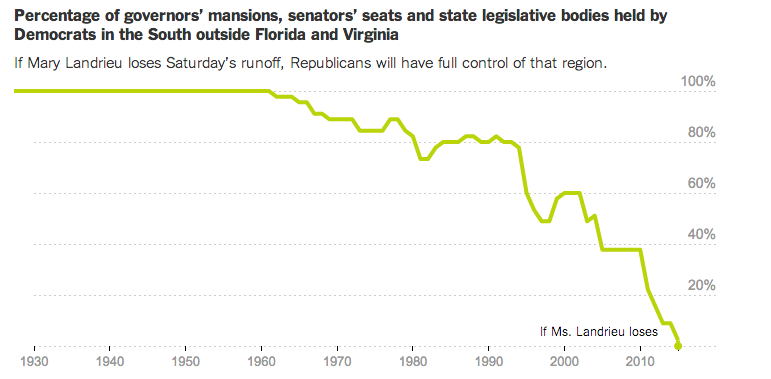
The article hits on themes we cover in both 2305 and 2306. What we seem to be seeing is white flight from the party.
Here's a taste:
- Click here for the article.
Here's the proof:
The article hits on themes we cover in both 2305 and 2306. What we seem to be seeing is white flight from the party.
Here's a taste:
The timing of the demise of the Southern Democrat is not coincidental. It reflects a complete cycle of generational replacement in the post-Jim Crow era. Old loyalties to the Democratic Party have died along with the generation of white Southerners who came of age during the era of the Solid South, before Brown v. Board of Education, before the Civil Rights Act.
Yet it also reflects the very specific conditions of 2014. Today’s national Democratic Party is as unpopular in the South today as it has ever been, in no small part because the party has embraced a more secular agenda that is not popular in the region.
“It’s a completely different party than it was 20 or 30 years ago,” said Merle Black, a professor of political science at Emory University. “When the Democratic Party and its candidates become more liberal on culture and religion, that’s not a party that’s advocating what these whites value or think.”
The party is also led by an unpopular president who has never appealed to the region’s white voters. President Obama won about 17 percent of white voters across the Deep South and Texas in 2012, based on an analysis of pre-election polls conducted by the Pew Research Center, census data and election results.
Finals start Thursday
Classes officially end this week. Finals start Thursday.
I'll continue to post a variety of stories designed to focus attention on the types of questions that will be on the final. It might be worthwhile to check in from time to time.
And just so you know - I'll open the tab where you can turn in the final version of the 1000 word essay this Thursday.
I'll continue to post a variety of stories designed to focus attention on the types of questions that will be on the final. It might be worthwhile to check in from time to time.
And just so you know - I'll open the tab where you can turn in the final version of the 1000 word essay this Thursday.
Monday, December 1, 2014
For 2305 - 12/1&2/14
In addition to reviewing more for the final - I want to wrap up our look at public policy tomorrow and Tuesday. This will open Wednesday and Thursday up for a look at the freedom of speech.
Here are a few stories related to the three areas of public policy we cover in class:
Social Welfare Policy:
In fact, U.S. is a big welfare state.
- If we take into account all spending on social welfare - direct and indirect - only France spends more than we do. The authors suggests that we come to grips with that reality.
From War to Welfare: How taxes and entitlements begin with militarism.
- The author argues that the rise of the welfare state is due less to the New Deal than to our increased use of the military.
What Role Should Government Play in Combating Obesity?
- A back and forth between some public health policy types.
Economic Policy:
Fiscal policy after the mid-terms: The governance test.- A look at the looming fight over the budget.
Monetary policy: Quite enough.
- Some commentary on recent actions by the Federal Reserve.
Foreign Policy:
Exaggeration Nation.
- Are threats like ISIS as bad as we are led to believe?
Embrace the Chaos.
- We are in a new era of foreign policy.
The Myth of the Indispensable Nation.
- The world is doing fine without us.
Here are a few stories related to the three areas of public policy we cover in class:
Social Welfare Policy:
In fact, U.S. is a big welfare state.
- If we take into account all spending on social welfare - direct and indirect - only France spends more than we do. The authors suggests that we come to grips with that reality.
From War to Welfare: How taxes and entitlements begin with militarism.
- The author argues that the rise of the welfare state is due less to the New Deal than to our increased use of the military.
What Role Should Government Play in Combating Obesity?
- A back and forth between some public health policy types.
Economic Policy:
Fiscal policy after the mid-terms: The governance test.- A look at the looming fight over the budget.
Monetary policy: Quite enough.
- Some commentary on recent actions by the Federal Reserve.
Foreign Policy:
Exaggeration Nation.
- Are threats like ISIS as bad as we are led to believe?
Embrace the Chaos.
- We are in a new era of foreign policy.
The Myth of the Indispensable Nation.
- The world is doing fine without us.
Sunday, November 30, 2014
Political engagement is like running a marathon - a never ending marathon.
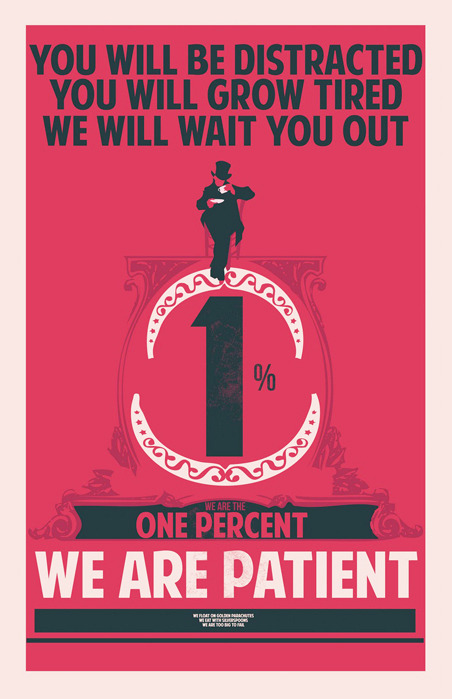
I just ran across this and thought it illustrated a point we made when discussing voter turnout and political participation generally. Elections are ongoing. Power tends to flow to those who understand this fact and participate regularly. People who vote once and then get upset because things don't immediately change as they want it to change are being unrealistic.
Texas Court of Criminal Appeals Rules that Drawing DWI suspect blood without warrant unconstitutional
I had a hunch this would happen sooner or later.
This puts a damper on no refusal weekends, when the police could force someone they pull over to give blood to determine alcohol levels on the grounds that it enhanced public safety. But questions about its constitutionality - based on either the Texas or US Constitutions - remained. Here's a defense attorney's take on the issue.
Now they need a warrant.
Here's a bit from the Chron:
And a few other sources:
- Court records related to the case.
- ScotusBlog: Missouri v. McNeely.
- Tex. Transp. Code § 724.012.
-
This puts a damper on no refusal weekends, when the police could force someone they pull over to give blood to determine alcohol levels on the grounds that it enhanced public safety. But questions about its constitutionality - based on either the Texas or US Constitutions - remained. Here's a defense attorney's take on the issue.
Now they need a warrant.
Here's a bit from the Chron:
"We hold that a nonconsensual search of a DWI suspect's blood conducted pursuant to the mandatory-blood-draw and implied-consent provisions in the Transportation Code, when undertaken in the absence of a warrant or any applicable exception to the warrant requirement, violates the Fourth Amendment," Judge Elsa Alcala of the Texas Court of Criminal Appeals wrote on behalf of the five majority opinion judges. Four members of the nine-judge court dissented.
The ruling stems from the 2012 case of David Villarreal, who was pulled over in Nueces County for a traffic violation. After refusing to perform sobriety tests in the field, Villarreal was arrested and taken to a local hospital to have his blood drawn against his will and without a warrant. The arresting officer said the move was legal because state law requires the taking of a breath or blood sample of anyone previously convicted two or more times of driving while intoxicated.
And a few other sources:
- Court records related to the case.
- ScotusBlog: Missouri v. McNeely.
- Tex. Transp. Code § 724.012.
-
For the final . . . .
Most of the reviewing for lecture classes will be done in class, but if you look at these past posts you can get a general idea about the subject matter of the questions that will be on the final.
- You can also click here to get them.
Online students should use these as their primary source of information about the review.
- You can also click here to get them.
Online students should use these as their primary source of information about the review.
Monday, November 24, 2014
From the Dish: The Norms Obama Broke
Andrew Sullivan is worried that Obama's executive order on immigration contributes to expanded executive power.
- Click here for the article.
- Click here for the article.
A few posts on Obama's immigration
Obama's immigration executive order: Here are the details. This walks through the executive order.
Some explainers from Vox.com - click here for their section on immigration.
11 key facts about Obama's immigration initiative.
Obama’s huge new immigration plan, explained.
Obama's executive action on immigration, explained in 2 minutes.
Some explainers from Vox.com - click here for their section on immigration.
11 key facts about Obama's immigration initiative.
Obama’s huge new immigration plan, explained.
Obama's executive action on immigration, explained in 2 minutes.
Thursday, November 20, 2014
From OpenSecrets: Senate Keystone “Yea” Votes Took In Six Times More Oil & Gas Money Than Opponents
Here's the story. It fits with this week's look at interest group influence.
Here's the breakdown of contributions - red indicates money to Republican senators, blue to Democrats.

Senate Democrats successfully blocked a bill Tuesday that would have approved construction of the Keystone XL pipeline. The controversial measure fell one vote shy of overcoming a filibuster, with 59 senators supporting it and 41 opposing. The vote followed the bill’s approval in the House by a much wider margin, with 252 lawmakers voting to advance the pipeline.
The vote largely fell along party lines. All Senate Republicans supported construction of the pipeline but they were joined by 14 Democrats, including three of the four Democrat incumbents who lost their re-election bids earlier this month. For Sen. Mary Landrieu (D-La.), the bill’s main sponsor, the vote was considered an important test of her effectiveness in advance of a Dec. 6 runoff that will determine whether she keeps her seat. In the House, 31 Democrats crossed the aisle to side with the Republican majority.
Here's the breakdown of contributions - red indicates money to Republican senators, blue to Democrats.
Tuesday, November 18, 2014
More for 2306:
Texas' Emptiest County Filling Up with Oil Workers, Hope.
- I'll post anything about Loving County.
Textbook Battles Heat Up as SBOE Approval Nears
- Battles continue over what students will be told about US and Texas history.
Abbott Campaign Credits Sophisticated Turnout Machine.
- Lots under the radar in the Abbott campaign.
DuPont Plant Where Workers Died Reported Recent Violations
- Citations weren't enough to change practices at the plant.
- I'll post anything about Loving County.
Textbook Battles Heat Up as SBOE Approval Nears
- Battles continue over what students will be told about US and Texas history.
Abbott Campaign Credits Sophisticated Turnout Machine.
- Lots under the radar in the Abbott campaign.
DuPont Plant Where Workers Died Reported Recent Violations
- Citations weren't enough to change practices at the plant.
Monday, November 17, 2014
For today's 2306
Analysis: As Lineup Changes, So Will Balance of Power.
- With a new governor and lieutenant governor, things will be different this session.
Texas Beef Council Turns Focus to Younger Eaters.
- Here's an interest groups you may not be familiar with.
Straus Backers Claim Support of Most of GOP Caucus.
- Strauss' speakership is likely to continue.
Despite State Order, Charter Schools Stay Open.
- For our upcoming look at education policy in the state.
Health regulation makes for strange bedfellows.
- For our upcoming look at health policy in the state.
Friday, November 14, 2014


From the Pew Research Center: 7 things to know about polarization in America
We've been discussing polarization in 2305 and you can't do better than this to explain the factors driving it.
- Click here for the article.
The top seven reasons:
- Click here for the article.
The top seven reasons:
1. The share of Americans who express consistently conservative or consistently liberal opinions has doubled over the past two decades, from 10% to 21%.
2. Partisan antipathy has risen.
3. “Ideological silos” are now common on the right and, to a lesser extent, the left. About six-in-ten (63%) consistent conservatives and 49% of consistent liberals say most of their close friends share their political views.
4. Differences between the right and left go beyond politics.
5. The center has gotten smaller: 39% of Americans currently take a roughly equal number of liberal and conservative positions, down from 49% in surveys conducted in 1994 and 2004.
6. The most ideologically oriented Americans make their voices heard through greater participation in every stage of the political process.
7. To those on the ideological right and left, compromise now means that their side gets more of what it wants.
From the Hill: Obama veers left after red wave
The President seems to be itching for a fight with Congress, but doing so also helps rally Democrats behind him.
- Click here for the article.
- Click here for the article.
President Obama has taken significant steps to the left since his party’s devastating losses in the midterm elections.
In a surprise, he announced a major deal on climate change with China during a trip to Beijing Tuesday. That followed another unanticipated move — a Monday statement pressuring the Federal Communications Commission to adopt new net neutrality rules for the Internet.
The moves are helping to rally a dispirited Democratic base while re-establishing Obama’s political leadership after he was sidelined during the midterms.
“He’s at his best when his back is against the wall,” said Democratic strategist Bob Shrum. “Jeremiah Wright in 2008, Scott Brown’s election in 2009, after the first debate in 2012 — he comes back and tends to fight pretty hard.”
“He’s a fourth-quarter player, and he’s in the fourth quarter of his presidency,” Shrum added.
The moves are also prompting questions about whether Obama is shifting to the left in his final two years in office, or if the moves are meant to cushion the blow when he moves to the center to negotiate with a Republican-controlled Congress.
Thursday, November 13, 2014
/cdn2.vox-cdn.com/uploads/chorus_asset/file/2447528/CountryVersusElectorate_JP.0.png)
From Vox: Australia makes everyone vote. What would happen if the US did too?
Voting is compulsory in almost two dozen countries, and they make the electorate look like the general population. Here's a look at how this works in Australia.
- Click here for the article.
- Click here for the article.
Why did people not vote?
From Wonkblog, using data from the Pew Research Center.

A full two-thirds said they simply didn't have enough time to vote. More than half of this group - 35 percent of the total - said that scheduling conflicts with work or school kept them from getting to the polls last Tuesday. Another 34 percent of the total said they were simply too busy, or that they were sick, out of town, or forgot about election day.
Twenty percent said they didn't like the candidates, didn't know enough to vote, or simply didn't care. And another 10 percent said that technical difficulties kept them from the polls - a missed registration deadline, a recent move or lack of transportation.
In short, voters didn't make it to the polls for two overarching reasons - either they were indifferent and couldn't be bothered, or there were structural forces conspiring against them - rigid job/school schedules or difficulties with the voting process overall.
Leaders for the 114th Congress selected
Lot's of links - but there's lot's to do:
Democrats in the Senate:
- Time for Dems to elect new leaders?
- Democratic Caucus Keeps Reid as Leader, but Airs Frustration.
- Senate Dems unveil new leadership team.
- Tester Named to Chair DSCC
- Dems fault leaders for brushing off losses.
- Warren’s Leadership Job Could Be Liberal Liaison
- McConnell elected Senate GOP leader- Warren joins Dem leadership
- Frustrated Democratic Senators Vent, but Re-Elect Reid to Be Their Leader.
- After Calls for His Ouster, Reid Adds New Leaders to Mend Fences.
Democrats in the House:
Republicans in the Senate:
Wicker Picked to Lead National G.O.P. Senatorial Committee
Republicans in the House:
- Boehner reelected as Speaker.
- Tea Party critics will hold noses, vote for Boehner as Speaker.
- For Returning GOP Leaders, New Governing Challenges.
-10 freshmen who could trouble leadership
-Committee chairmanships are up for grabs
Democrats in the Senate:
- Time for Dems to elect new leaders?
- Democratic Caucus Keeps Reid as Leader, but Airs Frustration.
- Senate Dems unveil new leadership team.
- Tester Named to Chair DSCC
- Dems fault leaders for brushing off losses.
- Warren’s Leadership Job Could Be Liberal Liaison
- McConnell elected Senate GOP leader- Warren joins Dem leadership
- Frustrated Democratic Senators Vent, but Re-Elect Reid to Be Their Leader.
- After Calls for His Ouster, Reid Adds New Leaders to Mend Fences.
Democrats in the House:
Republicans in the Senate:
Wicker Picked to Lead National G.O.P. Senatorial Committee
Republicans in the House:
- Boehner reelected as Speaker.
- Tea Party critics will hold noses, vote for Boehner as Speaker.
- For Returning GOP Leaders, New Governing Challenges.
-10 freshmen who could trouble leadership
-Committee chairmanships are up for grabs
From the National Journal: Why Texas Could Remain a Republican Stronghold for Another Generation
Talk about Texas turning blue might have been overblown.
Republicans have been trying to lure Latinos to identify with the party:
Republicans have been trying to lure Latinos to identify with the party:
Governor-elect Greg Abbott won with 44 percent of the Latino vote, and Sen. John Cornyn won 48 percent, both improvements over the 38 percent Gov. Rick Perry earned when he was elected in 2011 for his third term.
Republican strategists in the state point out tha Abbott made 17 visits to the heavily Hispanic Rio Grande Valley during his campaign and ran months' worth of ads featuring his Latina wife and mother-in-law. His campaign ran his first Spanish-language spot during the World Cup game between Mexico and Brazil.
"The Latino voters cannot be taken for granted. The right candidate with the right message can make a difference," says Jorge Lima, the policy director for the LIBRE Institute, a nonprofit that promotes free-market principles in the Hispanic Community.
Another factor, Republicans say, that helped Abbott win Latino voters and undermined Democratic efforts in the state, was the candidate Abbott was running against. His Democratic opponent, Wendy Davis, had burst onto the national scene as a fierce defender of abortion rights. Latino voters, however, tend to be much more socially conservative than other Democratic constituencies. While reproductive rights might motivate millennials and single women voters, it's not an issue that drives Latinos to the polls for Democrats in droves.
"The results were partly a backlash against that blatant liberalism from the Davis campaign and from Battleground Texas," Texas-based Republican strategist Ray Sullivan says. "The message she delivered did not play with Hispanic Texans."
From ScotusBlog: Fisher case on way back to the Court
Affirmative action at the University of Texas is back on the court docket. UT can still still use race in a limited manner, but that might subject to change.
Click here for the article.
Click here for the article.
Over the dissents of five judges, the full U.S. Court of Appeals for the Fifth Circuit refused on Wednesday to rehear the sequel of the University of Texas affirmative action case, Fisher v. University of Texas at Austin. The order is here. That decision, supported by ten judges, leaves intact a divided three-judge panel ruling upholding some use of race in selecting the university’s incoming freshman classes. The panel ruled after the Supreme Court ordered it to take a new look.
A statement by the organization that has arranged Abigail Fisher’s challenge, indicating that the case will be taken back to the Supreme Court, is here. Ms. Fisher sued the flagship university after being denied admission; she claimed her rejection was due to her race — she is white.
After a Fifth Circuit panel had upheld the university’s first-year admissions program, which made some use of race, the case went to the Supreme Court. The Justices overturned that decision, finding that the university had not given an adequate justification for the role that race had played in the process.
The Fifth Circuit panel upheld the plan again in July, and Ms. Fisher pursued en banc review by the full Fifth Circuit. The majority of ten judges did not explain their refusal to vote for further review. Circuit Judge Emilio M. Garza, who had dissented from the panel decision, wrote a one-page opinion dissenting from the denial of en banc review. He referred mainly to his prior dissent.
He was joined in dissent by Circuit Judges Edith Brown Clement, Edith H. Jones, Priscilla R. Owen, and Jerry E. Smith.
It is doubtful that the new case will reach the Supreme Court in time to be decided in the current Term, even if review is granted. Ms. Fisher has ninety days to file for review.
Will Texas join other states in expanding Medicaid under the Afforable Care Act?
A board handpicked by Governor Perry thinks Texas should.
- Click here for a Texas Tribune article in the subject.
Comment: I bet Perry supports the move. He's done running for office in the state and wants to position himself for a run for the presidency. This type of shift to the middle will increase his base of supporters. It's like Lyndon Johnson and civil rights.
- Click here for a Texas Tribune article in the subject.
Comment: I bet Perry supports the move. He's done running for office in the state and wants to position himself for a run for the presidency. This type of shift to the middle will increase his base of supporters. It's like Lyndon Johnson and civil rights.
The Bowie Knife is Illegal in Texas
We've had some fun in 2306 going over the bills being pre-filed for the 84th Session of the Texas Legislature, especially one flagged by the Texas Tribune which changes the definition of an illegal knife - HB 92. We had no idea what to make of it. The bill mentions Section 46.01 if the Texas Penal Code, and then it all started to make sense.
The Penal Code reads as follows:
"Illegal knife" means a:
(A) knife with a blade over five and one-half inches;
(B) hand instrument designed to cut or stab another by being thrown;
(C) dagger, including but not limited to a dirk, stiletto, and poniard;
(D) bowie knife;
(E) sword; or
(F) spear.
The Bill would amend it to read:
"Illegal knife" means a:
(A) knife with a blade over five and one-half inches;
(B) hand instrument designed to cut or stab another by being thrown;
(C) dagger, including but not limited to a dirk, stiletto, and poniard;
(D)bowie knife;
(E) sword; or
(E) spear
(F)
So it's just about making bowie knives legal. Why don't they just say so? It can be next to impossible to figure out what bills are really about sometimes.
And who knew bowie knives were illegal in Texas? That's like John Wayne movies being illegal in the state or naming things after Tom Landry, or Chuck Norris.
Here's a question - could someone argue that this restriction violates the 2nd Amendment? Is a knife an "arm?"
The Penal Code reads as follows:
"Illegal knife" means a:
(A) knife with a blade over five and one-half inches;
(B) hand instrument designed to cut or stab another by being thrown;
(C) dagger, including but not limited to a dirk, stiletto, and poniard;
(D) bowie knife;
(E) sword; or
(F) spear.
The Bill would amend it to read:
"Illegal knife" means a:
(A) knife with a blade over five and one-half inches;
(B) hand instrument designed to cut or stab another by being thrown;
(C) dagger, including but not limited to a dirk, stiletto, and poniard;
(D)
(
(E) spear
(
So it's just about making bowie knives legal. Why don't they just say so? It can be next to impossible to figure out what bills are really about sometimes.
And who knew bowie knives were illegal in Texas? That's like John Wayne movies being illegal in the state or naming things after Tom Landry, or Chuck Norris.
Here's a question - could someone argue that this restriction violates the 2nd Amendment? Is a knife an "arm?"
The Supreme Court hears arguments about Alabama's gerrymandered districts
The court has a long history of hearing cases claiming that a minority's voting power has been been minimized by the majority. These two are the latest:
- Alabama Legislative Black Caucus v. Alabama
- Alabama Democratic Conference v. Alabama
ScotusBlog previews the case here, and a transcript of the arguments can be found here.
ScotusBlog also analyses the argument here.
The appellants argue that Alabama packed African American voters into a small number of districts in order to ensure that the percentage of African American representatives would be less than the percentage of African Americans in the general population. Alabama responds - as best I can tell - by saying that race had nothing to do with it, while also saying they wished to comply with the requirements of the Voting Rights Act. The gerrymandering was based on party - which is legal - not race - which is illegal.
It's OK to hurt Democrats by gerrymandering, but not OK to disenfranchise blacks. But since the parties - especially in the South - are becoming more polarized by race on might as whether there is a significant difference between the two.
Here are media reports on the case:
- The Supreme Court’s Gerrymandering Conundrum.
- In a divided America, partisan and race-based redistricting are indistinguishable.
- Supreme Court weighs role of race in Alabama voter redistricting case.
- Alabama Legislative Black Caucus v. Alabama
- Alabama Democratic Conference v. Alabama
ScotusBlog previews the case here, and a transcript of the arguments can be found here.
ScotusBlog also analyses the argument here.
The appellants argue that Alabama packed African American voters into a small number of districts in order to ensure that the percentage of African American representatives would be less than the percentage of African Americans in the general population. Alabama responds - as best I can tell - by saying that race had nothing to do with it, while also saying they wished to comply with the requirements of the Voting Rights Act. The gerrymandering was based on party - which is legal - not race - which is illegal.
It's OK to hurt Democrats by gerrymandering, but not OK to disenfranchise blacks. But since the parties - especially in the South - are becoming more polarized by race on might as whether there is a significant difference between the two.
Here are media reports on the case:
- The Supreme Court’s Gerrymandering Conundrum.
- In a divided America, partisan and race-based redistricting are indistinguishable.
- Supreme Court weighs role of race in Alabama voter redistricting case.
Tuesday, November 11, 2014
From the NYT: With Fear of Being Sidelined, Tea Party Sees the Republican Rise as New Threat
One of the themes of the election is the marginalization of the Tea Party.
As opposed to Texas - where the movement remains strong - the Republican Party has returned to the mainstream. The betting is that this means they are less likely to be confrontational during the next two years.
As opposed to Texas - where the movement remains strong - the Republican Party has returned to the mainstream. The betting is that this means they are less likely to be confrontational during the next two years.
Establishment Republicans, who had vowed to thwart the Tea Party, succeeded in electing new lawmakers who are, for the most part, less rebellious. And when the new Congress convenes in January, the Republican leaders who will take the reins will be mainly in the mold of conservatives who have tried to keep the Tea Party in check.
But they have not crushed the movement’s spirit.
As Republicans on Capitol Hill transition from being the opposition party to being one that has to show it can govern, a powerful tension is emerging: how to move forward with an agenda that challenges the president without self-destructing.
Some conservatives believe that the threat of another shutdown is their strongest leverage to demand concessions on the health care law and to stop the president from carrying out immigration reform through executive order. Yet their leadership has dismissed the idea as a suicide mission that could squander the recent gains.
How Billionaire Oligarchs Are Becoming Their Own Political Parties
Who needs parties when you have money to burn? And the Supreme Court has allowed it to influence the political process. While attention has focused on the rise of the Republican Party due to last week's election, the bigger story might be the increased influence of the donors that determine what the party does.
In 2010, the Citizens United decision by the Supreme Court effectively blew apart the McCain-Feingold restrictions on outside groups and their use of corporate and labor money in elections. That same year, a related ruling from a lower court made it easier for wealthy individuals to finance those groups to the bottom of their bank accounts if they so chose. What followed has been the most unbridled spending in elections since before Watergate. In 2000, outside groups spent $52 million on campaigns, according to the Center for Responsive Politics. By 2012, that number had increased to $1 billion.
The result was a massive power shift, from the party bosses to the rich individuals who ran the super PACs (as most of these new organizations came to be called). Almost overnight, traditional party functions — running TV commercials, setting up field operations, maintaining voter databases, even recruiting candidates — were being supplanted by outside groups. And the shift was partly because of one element of McCain-Feingold that remains: the ban on giving unlimited soft money to parties. In the party universe, rich players like the Wylys, Tom Steyer or the Kochs were but single planets among many. The party bosses had to balance their interests against those who brought just as much to the table in the form of money or votes. A party platform has to account for both the interests of the oil industry and those of the ethanol industry; those of the casino industry and those of the anti-gambling religious right; those of Wall Street and those of labor.
From Open Secrets: Money Won on Tuesday, But Rules of the Game Changed
The Center for Responsive Politics points out a few facts regarding spending on the 2014 election:
Perhaps the most striking is this: More money was contributed in this election, but it was received from fewer contributors. Does this mean more power is held by fewer people?

Perhaps the most striking is this: More money was contributed in this election, but it was received from fewer contributors. Does this mean more power is held by fewer people?
A royalist presidency?
The Dish flags a book that suggests we that the presidency is not only based on the British model, but that the colonists - prior to becoming revolutionaries - wanted the king to balance the interests of the colonial legislatures with Parliament, as well as among themselves.
Their principle grievance was with Parliament, not the king:
Their principle grievance was with Parliament, not the king:
Resistance leaders and the Continental Congress repeatedly urged George III to take their side in the struggle against Parliament’s assertion that it possessed unlimited authority to enact laws governing the colonies “in all cases whatsoever.” In their view, the king should act as a wholly independent monarch who would treat each of his empire’s representative assemblies as possessing essentially the same authority. If Parliament overstepped its power in enacting laws for the colonists, the king should intervene, wielding his royal veto against unjust legislation. He should act, as Thomas Jefferson memorably wrote in 1774, as “the balance of a great, if a well poised empire.” Far from clinging unthinkingly to the Glorious Revolution settlement of 1688 and its aftermath, which made the British king a decidedly constitutional and limited monarch, George III should reclaim his prerogative and vigorously exercise the independent powers that custom and theory located in the executive.
Pre-filing begins
Newly elected - or re-elected - members of the Texas Legislature could start filing bills Monday the 10th.
The bill can be found on the Texas Legislature Online.
- Click here for the ever updated list.
The Texas Tribune summarizes what's been introduced so far.
The bill can be found on the Texas Legislature Online.
- Click here for the ever updated list.
The Texas Tribune summarizes what's been introduced so far.
Republicans dominate state races
As well as Republicans did in national races - they did better in state wide races. They now control more state legislatures and governorships than at any time in the past century.
Republicans now have historic majorities in state legislatures. That's a really big deal.
- The process for doing so has been underway for a long time and could provide advantages to the party for decades.
- The financial effort to fund these races has been underway for several years.
Red Shift in States Creates Conservative Opportunities.
- Future candidates for nation office may be groomed at the state level.
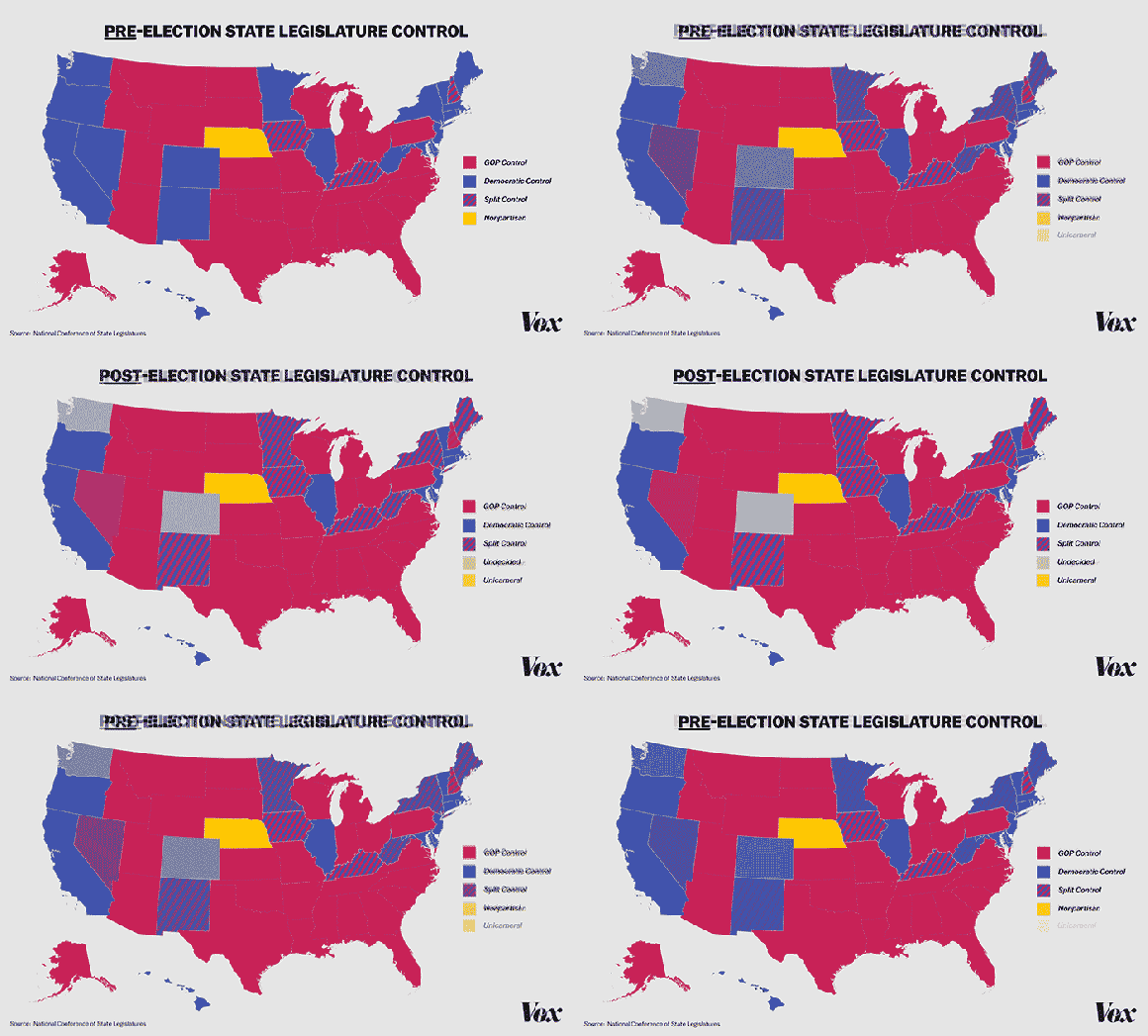
Republicans now have historic majorities in state legislatures. That's a really big deal.
- The process for doing so has been underway for a long time and could provide advantages to the party for decades.
A National Strategy Funds State Political Monopolies.
- The financial effort to fund these races has been underway for several years.
Red Shift in States Creates Conservative Opportunities.
- Future candidates for nation office may be groomed at the state level.
Denton votes to ban fracking in the city. The oil industry is not very happy about it.
The voters in Denton chose to ban fracking in the city, and neither the oil industry or state regulators are happy about it. It's a good example of not only local - state conflict in the city, but of the limits of democracy.
Denton, Texas Voters Are First In State To Ban Fracking.
- Read this for background. Similar bans were on the ballot in other cities, some passed some didn't.
How the Denton Fracking Ban Could Work.- Some detail on the initiative process, how this got to the ballot to begin with.
Denton Voted To Ban Fracking. So Now What?- Responses by industry, the state and landowners were expected.
Denton Fracking Ban Could Spur Wider Legal Clash.- The current conflict was anticipated.
Texas Oil Regulator Says It Will Not Honor Town’s Vote To Ban Fracking.
- The chair of Railroad Commission will continue to issue permits to drill in the city.
First Lawsuits Filed Over Denton's New Fracking Ban.
- Details here on the lawsuits filed by affect groups.
Denton, Texas Voters Are First In State To Ban Fracking.
- Read this for background. Similar bans were on the ballot in other cities, some passed some didn't.
How the Denton Fracking Ban Could Work.- Some detail on the initiative process, how this got to the ballot to begin with.
Denton Voted To Ban Fracking. So Now What?- Responses by industry, the state and landowners were expected.
Denton Fracking Ban Could Spur Wider Legal Clash.- The current conflict was anticipated.
Texas Oil Regulator Says It Will Not Honor Town’s Vote To Ban Fracking.
- The chair of Railroad Commission will continue to issue permits to drill in the city.
First Lawsuits Filed Over Denton's New Fracking Ban.
- Details here on the lawsuits filed by affect groups.
6th Circuit upholds state gay marriage bans
. . . which creates a conflicts the Supreme Court can sink its teeth into. Remember that earlier this semester the court opted to not review appellate court cases that all overturned bans on same sex marriage. The appellate courts were in unison, until now.
Background:
- Appeals court upholds gay marriage bans, reversing trend.
- Gay marriage is going to the Supreme Court — and it's probably going to win.
Background:
- Appeals court upholds gay marriage bans, reversing trend.
- Gay marriage is going to the Supreme Court — and it's probably going to win.
Monday, November 10, 2014
Explaining the reduction in voters in Texas
Was it due to Voter ID? From the Texas Tribune:
Texas turnout, already the worst in the country, dropped. The state’s population is larger than it was in 2010. More than 14 million Texans registered to vote, according to the secretary of state — up from 13.3 million in 2010. Turnout that year was 37.5 percent. Turnout this year (the numbers are unofficial) was 33.6 percent.
The people who did not show up appear to be Democrats. The Republican numbers were up in the governor’s race, while the Democratic numbers were way down.
At a post-election discussion last week, Gilberto Hinojosa, chairman of the Texas Democratic Party, suggested the voter ID law might be to blame for the decline, implying that Democrats are more numerous among non-voters than Republicans. His opposite on the Republican side — Steve Munisteri — guffawed at that, instead crediting his own party’s turnout efforts, the state’s recent voting history and the national trend against Democrats.
Munisteri skeptically answered a question about whether Texans should be allowed to register and vote on the same day. He fears that would introduce an opportunity for fraud — the same concern cited by proponents of the voter ID law. Actual cases of the type of in-person voter fraud targeted by that law are scarce. And it will take some time to know whether the new law was to blame for the decline in voter turnout.
From the Texas Trubune: White Democrats Continue to Fall in Texas Legislature
This continues a trend.
Some argue its part of a deliberate attempt to make the Democratic Party the Party of minorities. Some don't.
Some argue its part of a deliberate attempt to make the Democratic Party the Party of minorities. Some don't.
Texas Democrats acknowledge that Republicans have been particularly successful in defeating white Democrats in rural districts.
Republicans have focused on white Democrats in a “very calculated” way “because they wanted to push this idea that the Democratic Party was just about minorities, which is not true,” said Jim Dunnam of Waco, a former representative who lost his seat to a Republican in 2010.
Political analysts said Democrats have been losing in rural areas because they are easier targets. Jerry Polinard, a political-science professor at the University of Texas-Pan American, said Republicans have focused on capturing districts with a majority of white residents, lightly redrawing district lines to favor their candidates.
Districts made up largely of minorities, which tend to lean Democratic, are not easily redrawn without inciting legal challenges, Polinard said.
“Obviously, in terms of the demographics of voting, Republicans pull much more strongly from the white vote,” Polinard said. Historically, minorities in Texas tend to vote Democratic.
Sunday, November 9, 2014
From Vox: The 2014 midterm elections, explained in 4 minutes
A neat little video if you have time to kill.
And they list the winners of last week's election - which includes stoners in Oregon and DC.
And they list the winners of last week's election - which includes stoners in Oregon and DC.
Party Coalitions - 2014
In 2305 we'll be covering party coalitions. Here are a few stories detailing what we know about how these coalitions for each of the main parties held up last week:
Midterm Elections 2014: Coalitions Persist, but Turnout Favors GOP.
- Women, racial minorities and the young still voted Democrat - but turnout over all declined compared to 2010. So Democrats were successful in reaching out to these groups, they just didn't get them to the polls.
The Tectonic Plates of 2014.
- The same point is repeated, but more emphatically. Democrats have increasingly become the party of racial minorities who are more likely to vote in presidential than midterm elections. This has driven older white voters to the Republican Party, including blue collar rural voters that had voted for Clinton. They are more likely to vote in all elections. This give Republicans a structural advantage over Democrats.
Two midterm elections have hollowed out the Democratic Party.
- The Democrats may have trouble reaching out to the young in the future. Victories at the state level might give Republicans a deeper bench.
Altogether these suggest that Democrats lost nationally due to low turnout, not because they lost significant parts of their party coalition.
Here's a look at divisions based on issues:
The Divide Between Republican And Democratic Voters On Major Issues.
- The only area of agreement is on increased military action against ISIS. There is only a 7 percentage point difference between partisans there. Everything else - from abortion to global warming to immigration reform - is far more contentious.
Midterm Elections 2014: Coalitions Persist, but Turnout Favors GOP.
- Women, racial minorities and the young still voted Democrat - but turnout over all declined compared to 2010. So Democrats were successful in reaching out to these groups, they just didn't get them to the polls.
The Tectonic Plates of 2014.
- The same point is repeated, but more emphatically. Democrats have increasingly become the party of racial minorities who are more likely to vote in presidential than midterm elections. This has driven older white voters to the Republican Party, including blue collar rural voters that had voted for Clinton. They are more likely to vote in all elections. This give Republicans a structural advantage over Democrats.
Two midterm elections have hollowed out the Democratic Party.
- The Democrats may have trouble reaching out to the young in the future. Victories at the state level might give Republicans a deeper bench.
Altogether these suggest that Democrats lost nationally due to low turnout, not because they lost significant parts of their party coalition.
Here's a look at divisions based on issues:
The Divide Between Republican And Democratic Voters On Major Issues.
- The only area of agreement is on increased military action against ISIS. There is only a 7 percentage point difference between partisans there. Everything else - from abortion to global warming to immigration reform - is far more contentious.
Friday, November 7, 2014

From the Pew Research Center: Voter turnout always drops off for midterm elections, but why?
Here's the data:

And an explanation:
And an explanation:
Though political scientists long have noted the midterm dropoff, they don’t agree on precisely what it means. In an influential 1987 article, James E. Campbell theorized that “the surge of interest and information in presidential elections” typically works to the advantage of one party or the other; that party’s partisans become more likely to vote, while those of the disadvantaged party are more likely to stay home during presidential elections. Independents, “lacking a standing partisan commitment…should divide disproportionately in favor of the advantaged party.” Midterm elections lack that “wow” factor, according to Campbell, and turnout among both partisans and independents return to more normal levels and patterns.
A recent paper by Brown University researcher Brian Knight seeks to evaluate that surge-and-decline theory, as well as two competing explanations of why the president’s party nearly always loses seats at the midterms: a “presidential penalty,” or general preference among midterm voters for expressing dissatisfaction with the president’s performance or ensuring that his party doesn’t control all the levers of government, and recurring shifts in voter ideology between presidential and midterm elections. Knight concluded that while all three factors contribute to what he calls the “midterm gap,” the presidential penalty has the most impact.
State by State Voter Turnout for Election 2014
From Al Jazeera:
Here are the national numbers.
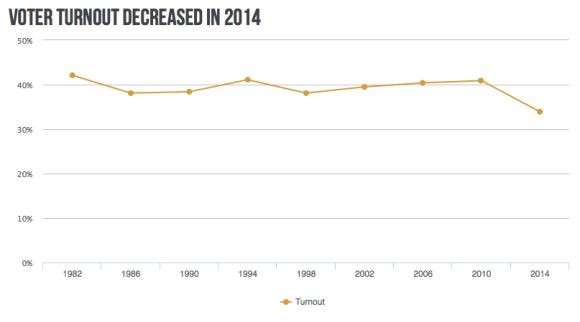
They report that that percentage of eligible voters in Texas that actually voted was 27%. Turnout decreased from 2010 in all but 10 states. Turnout decreased in all states that passed strict voter ID laws since 2010
Click here for a data sheet with the numbers from 1980 - 2014.
Here are the national numbers.
They report that that percentage of eligible voters in Texas that actually voted was 27%. Turnout decreased from 2010 in all but 10 states. Turnout decreased in all states that passed strict voter ID laws since 2010
Click here for a data sheet with the numbers from 1980 - 2014.
Thursday, November 6, 2014
Election links for 2305:
Election 2014: Coverage and Results.
- A look at all of the national races.
2014 Election Scoreboard.
- Find out how the Texas delegation did. Hint: They were almost all protected by gerrymandering.
Republicans’ First Step Was to Handle Extremists in Party.
- The empire struck back. Aside from in Texas - where their brand of politics is the norm - the Tea Party was largely neutered.
The Democrats Have Two Choices Now: Gridlock or Annihilation.
- The Democrats have not been able to mobilize the voters they excited in 2008. This might give Republicans a lock on Congress until the next redistricting.
The Most Detailed Maps You’ll See From the Midterm Elections
- Nice graphics.
Script Will Be Flipped in 2016 Senate Majority Battle.
- Republicans will have to defend the seats won during the Tea Party wave of 2010.
5 Things That Could Get Done in a Divided Government.- The 114th Congress may not be dead in the water.
Meet The Real Next Senate Majority Leader: Ted Cruz.
- Our junior senator might be the driving force behind the new Senate. Might.
How to Land a Job Working for a New Member of Congress
- Here's your chance to get that DC career going.
- A look at all of the national races.
2014 Election Scoreboard.
- Find out how the Texas delegation did. Hint: They were almost all protected by gerrymandering.
Republicans’ First Step Was to Handle Extremists in Party.
- The empire struck back. Aside from in Texas - where their brand of politics is the norm - the Tea Party was largely neutered.
The Democrats Have Two Choices Now: Gridlock or Annihilation.
- The Democrats have not been able to mobilize the voters they excited in 2008. This might give Republicans a lock on Congress until the next redistricting.
The Most Detailed Maps You’ll See From the Midterm Elections
- Nice graphics.
Script Will Be Flipped in 2016 Senate Majority Battle.
- Republicans will have to defend the seats won during the Tea Party wave of 2010.
5 Things That Could Get Done in a Divided Government.- The 114th Congress may not be dead in the water.
Meet The Real Next Senate Majority Leader: Ted Cruz.
- Our junior senator might be the driving force behind the new Senate. Might.
How to Land a Job Working for a New Member of Congress
- Here's your chance to get that DC career going.
Election links for 2306:
A few items related to Tuesday's election as it impacts Texas and local areas:
Election Scorecard.
- The Texas Tribune has an easy to follow list of all races in the state. As expected, Republicans did very well.
Click here for Brazoria County results.
Click here for Harris County results.
Map: Comparing the 2010 and 2014 Governor's Races.
- The Tribune points out that Wendy Davis did less well against Greg Abbott than Bill White did against Rick Perry.
Tallying the vote for Texas governor: Why Abbott won. - A brief summary of findings from exit polls.
Davis Campaign Marked by Failed Tactics, Muddled Messages.- Davis' campaign gets low marks.
Konni Burton, Tea Party Activist, Takes Back Wendy Davis' State Senate Seat.
- adding insult to injury.
Texas Voter Turnout Down Compared To 2010.
- The trend continues. 33.4% of registered voters this year as opposed to 38% in 2010.
How Democratic Turnout Tumbled Across Texas.- Both parties got fewer votes this year than in 2010, but Democrats got fewer.
Should City Voters Pick the Ag Commissioner?
- Since we are in increasingly urban state, does it make sense for urban voters to select the person in charge of what is essentially a rural department? Should it be an appointed position?
Election Scorecard.
- The Texas Tribune has an easy to follow list of all races in the state. As expected, Republicans did very well.
Click here for Brazoria County results.
Click here for Harris County results.
Map: Comparing the 2010 and 2014 Governor's Races.
- The Tribune points out that Wendy Davis did less well against Greg Abbott than Bill White did against Rick Perry.
Tallying the vote for Texas governor: Why Abbott won. - A brief summary of findings from exit polls.
Davis Campaign Marked by Failed Tactics, Muddled Messages.- Davis' campaign gets low marks.
Konni Burton, Tea Party Activist, Takes Back Wendy Davis' State Senate Seat.
- adding insult to injury.
Texas Voter Turnout Down Compared To 2010.
- The trend continues. 33.4% of registered voters this year as opposed to 38% in 2010.
How Democratic Turnout Tumbled Across Texas.- Both parties got fewer votes this year than in 2010, but Democrats got fewer.
Should City Voters Pick the Ag Commissioner?
- Since we are in increasingly urban state, does it make sense for urban voters to select the person in charge of what is essentially a rural department? Should it be an appointed position?
Monday, November 3, 2014
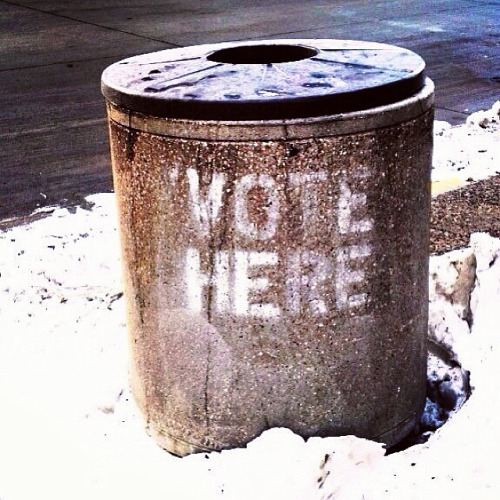
Thursday, October 30, 2014
And for today's 2305
Lincoln's Media Strategy.
- There's nothing new about president's manipulating how the press covers them.
The Bumpkinification of the Midterm Elections.
-We're just like you - and not even that smart.
Why Is It Illegal to Not Vote in Most of Latin America?
- More than a few nations make voting compulsory.
If the Republicans win the Senate...
- More gridlock? Or might there be incentives to actually govern?
- There's nothing new about president's manipulating how the press covers them.
The Bumpkinification of the Midterm Elections.
-We're just like you - and not even that smart.
Why Is It Illegal to Not Vote in Most of Latin America?
- More than a few nations make voting compulsory.
If the Republicans win the Senate...
- More gridlock? Or might there be incentives to actually govern?
For Thursday's 2306 - 10/30/14
Settled Into GOP, Lozano Hopes to Hold District.
- Can the Texas Republican Party lure more Latinos into the fold?
Do Falling Oil Prices Threaten the Budget?
- What's good for your wallet is not necessarily good for the state's.
The quickest way to vote in Texas.
- . . . is to vote straight ticket, but it can create problems.
Fort Worth is ground zero for Texas governor’s race.
- It's the reddest big county in the state, but also home to the Democratic gubernatorial candidate.
In Blue Dallas County, Republicans Play Defense
- Big D is surprisingly liberal.
Vote Set on San Antonio's Historic Water Gamble
- San Antonio needs the water.
Tuesday, October 28, 2014
And for 2305:
League City target of civil rights audit.
- The audit stems from the city's ban on undocumented minors being housed in the city and might impact block grant money they receive from the national government.
Density Of Industrial Hog Farms In North Carolina Prompts Civil Rights Investigation.
- The EPA will helps determine whether the location of hog farms in the state creates a negative impact on the health of minority communities.
George Zimmerman not expected to face civil rights charges in Trayvon Martin death.
- Insufficient evidence exists to determine whether the killing was motivated by race.
Eric Holder's Expansive Vision of Civil Rights.
- This helps explain at least some of the animosity directed against him.
True net neutrality needed to protect civil rights.
- Online access is the next front in the battle for civil rights.
Civil Rights Movement knocks on the door of the FCC.
-
- The audit stems from the city's ban on undocumented minors being housed in the city and might impact block grant money they receive from the national government.
Density Of Industrial Hog Farms In North Carolina Prompts Civil Rights Investigation.
- The EPA will helps determine whether the location of hog farms in the state creates a negative impact on the health of minority communities.
George Zimmerman not expected to face civil rights charges in Trayvon Martin death.
- Insufficient evidence exists to determine whether the killing was motivated by race.
Eric Holder's Expansive Vision of Civil Rights.
- This helps explain at least some of the animosity directed against him.
True net neutrality needed to protect civil rights.
- Online access is the next front in the battle for civil rights.
Civil Rights Movement knocks on the door of the FCC.
-
For 2306 today:
California voters will be able to decide if certain felonies can be reclassified as misdemeanors.
- The purpose is to reduce prison over crowding.
- Here's background from the New Yorker.
Derek Cohen and Deborah Fowler: Texas Legislature should decriminalize truancy.
- There may be better ways to handle truancy than pushing kids into the criminal justice system.
- The Texas Committee on Jurisprudence is holding hearings on whether civil penalties are more appropriate.
UT/TT Poll: Texans Favor Voter ID by 3-to-1 Margin.
- But the results are divided over partisan lines.
UTSA professor champions new approaches to criminal justice.
- He'd like a shift away from arrest and punish to "community justice and restorative justice."
A Plan to Cut Costs and Crime: End Hurdle to Job After Prison.
- Does Texas make it too tough for ex-felons to find jobs? Does this make it more likely that they will return to prison?
Editorial: The benefits of fighting abuse with education vs. jail time.
- Batterer prevention programs seem to work better than jail sentences.
- The purpose is to reduce prison over crowding.
- Here's background from the New Yorker.
Derek Cohen and Deborah Fowler: Texas Legislature should decriminalize truancy.
- There may be better ways to handle truancy than pushing kids into the criminal justice system.
- The Texas Committee on Jurisprudence is holding hearings on whether civil penalties are more appropriate.
UT/TT Poll: Texans Favor Voter ID by 3-to-1 Margin.
- But the results are divided over partisan lines.
UTSA professor champions new approaches to criminal justice.
- He'd like a shift away from arrest and punish to "community justice and restorative justice."
A Plan to Cut Costs and Crime: End Hurdle to Job After Prison.
- Does Texas make it too tough for ex-felons to find jobs? Does this make it more likely that they will return to prison?
Editorial: The benefits of fighting abuse with education vs. jail time.
- Batterer prevention programs seem to work better than jail sentences.
Thursday, October 23, 2014
About those Texas Courts ....
For today's look at the judiciary in 2306:
Texas Supreme Court case set water groundwater rules for state.- The court is about to make a major decision impacting the ability of the state to manage water supplies in the state.
Texas Supreme Court May Hear Kountze ISD Cheerleader Case.
- The court will help clarify the precise meaning of the establishment clause in Texas.
Some Judicial Opinions Require Only 140 Characters.
- One of our Texas Supreme Court Justices loves that Twitter.
Texas Supreme Court case set water groundwater rules for state.- The court is about to make a major decision impacting the ability of the state to manage water supplies in the state.
Texas Supreme Court May Hear Kountze ISD Cheerleader Case.
- The court will help clarify the precise meaning of the establishment clause in Texas.
Some Judicial Opinions Require Only 140 Characters.
- One of our Texas Supreme Court Justices loves that Twitter.
Tuesday, October 21, 2014
For today's discussion in 2305 - 10/21/14
Supreme Court Will Consider Police Searches of Hotel Registries.
- Motel owners don't like a city ordinance that requires them to open up their books whenever the police want them to.
Why House Republicans Alienate Hispanics: They Don’t Need Them.
- At least this year - 2016 might be different. Gerrymandering plays a role, as does the distribution of population.
- More and more of what's spent on campaigns is hidden.
Political Polarization & Media Habits.
- Liberals and conservatives get their news from entirely different news sources.
- Motel owners don't like a city ordinance that requires them to open up their books whenever the police want them to.
Why House Republicans Alienate Hispanics: They Don’t Need Them.
- At least this year - 2016 might be different. Gerrymandering plays a role, as does the distribution of population.
- More and more of what's spent on campaigns is hidden.
Political Polarization & Media Habits.
- Liberals and conservatives get their news from entirely different news sources.
For today's discussion in 2306 - 10/21/14
All of these are from the Texas Tribune;
Texas on Lonely Side of Battle Over Ozone Science.
- Who controls the Texas Commission on Environmental Quality?
Yale Survey: Most Texans Believe in Global Warming.
- But only 44% think it is due to human activity.
Analysis: Behind Voter ID, Federal Pre-Clearance.
- Do racial minorities in Texas still need federal protection from the Anglo majority?
Supreme Court to Decide What a Billboard is Worth.
- The court's decision could impact the cost of future highway projects.
Texas on Lonely Side of Battle Over Ozone Science.
- Who controls the Texas Commission on Environmental Quality?
Yale Survey: Most Texans Believe in Global Warming.
- But only 44% think it is due to human activity.
Analysis: Behind Voter ID, Federal Pre-Clearance.
- Do racial minorities in Texas still need federal protection from the Anglo majority?
Supreme Court to Decide What a Billboard is Worth.
- The court's decision could impact the cost of future highway projects.
Thursday, October 16, 2014
All clear?
The malware scare might be over - so I'll get back to posting things for class.
Thanks to the student that cleared this up.
Thanks to the student that cleared this up.
Thursday, September 25, 2014
Blog suspended indefinitely due to malware
Some of you have been getting a notice that this blag has been infected with malware, so its best to avoid it for a while. Make Blackboard your primary destination for the rest of the semester.
I'll post all material relevant to the class there.
Sorry for the trouble - but its best to be safe.
I'll post all material relevant to the class there.
Sorry for the trouble - but its best to be safe.
Sunday, September 21, 2014
This week - 5 - in GOVT 2306
We have a little unfinished business with local governments to complete, in addition to a discussion of the nature of separated powers - I want to describe as much as possible the difference between the ways powers are separated on the national and state levels. We'll also look through the material on state and local governing institutions. This will set us up for a more detailed look at the nature of each in Texas.
This week's quizzes include a look at the monstrously large Article 3 - which includes both the basic design of the Texas Legislature and the language inserted over the course of Texas history which has allowed for the sale of bonds for various purposes.
A separate section allows for a more in-depth look at how bills are made in the legislature - which won't happen until next spring of course. We'll also look at the nature of the city councils in local cities.
This is what's opened this week.
- The Texas Legislature - Constitutional Design.
- Texas Bill Making.
- Local City Councils
This week - 5 - in GOVT 2305
In lecture classes we will be reviewing material related to federalism and the Bill of Rights - and also start in on the issues surrounding religious liberty, specifically how the Supreme Court has defined and redefined "establishment" and "free exercise."
It would be a good idea also to clarify a few issues associated with how the Constitution gets interpreted by the Supreme Court as well as conflicts over the court's role in helping set public policy. We need to get comfortable with the pros and cons of strict and loose interpretations of the document as well as the restrained and activist courts.
Remember that I cancelled the section on due process, but we will touch on the concept since it's pretty important to know how the rules associated with police behavior - among other things - is impacted about court decisions.
The quizzes that have opened this week concern the power of the legislature. The three sections follow a pattern that will be used when we look at the executive and judicial power as well.
- The Legislature - Definition and Historical Background. This section tries to define what a legislative institution is and provides basic information about the Congress so you have a general sense of what it is prior to digging into detail.
It also tries to trace the history - British - of the development of legislative power. As we've discussed loosely before, the increase of actual power within the legislative branch was necessary in order to place meaningful limits on the executive branch. As you may have figured out - I like referring back to the execution of Charles the First in order to make this point. More importantly is the fact that Parliament demanded that the co-monarchs William and Mary sign the British Bill of Rights in order to attain the throne. Parts of this document will be incorporated into the Constitution. So the broader point here is that the more we know this history, the more we know why our Constitution looks the way it does.
- The US Legislature - Constitutional Design. Here we start reading closely the content of Article One of the Constitution and come to terms with what the Constitution does - and does not - say about Congress and the nature of legislative power.
- Parties and Committees in Congress. Once we find out what the Constitution does not say about Congress we will turn to how Congress has evolved over time. We will note that institutions like political parties developed in the early Congress before branching out into the general population. We will also look at the development of committees. The principle point here will be to understand how power flows within the institution, and how that can change from time to time.
This is where will also catch up with the nature of the current Congress - the 113th - which some argue may be the worst in recent memory.
It would be a good idea also to clarify a few issues associated with how the Constitution gets interpreted by the Supreme Court as well as conflicts over the court's role in helping set public policy. We need to get comfortable with the pros and cons of strict and loose interpretations of the document as well as the restrained and activist courts.
Remember that I cancelled the section on due process, but we will touch on the concept since it's pretty important to know how the rules associated with police behavior - among other things - is impacted about court decisions.
The quizzes that have opened this week concern the power of the legislature. The three sections follow a pattern that will be used when we look at the executive and judicial power as well.
- The Legislature - Definition and Historical Background. This section tries to define what a legislative institution is and provides basic information about the Congress so you have a general sense of what it is prior to digging into detail.
It also tries to trace the history - British - of the development of legislative power. As we've discussed loosely before, the increase of actual power within the legislative branch was necessary in order to place meaningful limits on the executive branch. As you may have figured out - I like referring back to the execution of Charles the First in order to make this point. More importantly is the fact that Parliament demanded that the co-monarchs William and Mary sign the British Bill of Rights in order to attain the throne. Parts of this document will be incorporated into the Constitution. So the broader point here is that the more we know this history, the more we know why our Constitution looks the way it does.
- The US Legislature - Constitutional Design. Here we start reading closely the content of Article One of the Constitution and come to terms with what the Constitution does - and does not - say about Congress and the nature of legislative power.
- Parties and Committees in Congress. Once we find out what the Constitution does not say about Congress we will turn to how Congress has evolved over time. We will note that institutions like political parties developed in the early Congress before branching out into the general population. We will also look at the development of committees. The principle point here will be to understand how power flows within the institution, and how that can change from time to time.
This is where will also catch up with the nature of the current Congress - the 113th - which some argue may be the worst in recent memory.
Friday, September 19, 2014
Weekly Written Assignment #5
As promised - this week I want you send me a detailed proposal for your 1000 word essay.
Base it on the assigned work. I'll give you some feedback. I'd like you to a good job - really!
The better job you do here the easier it will be to write the paper.
Base it on the assigned work. I'll give you some feedback. I'd like you to a good job - really!
The better job you do here the easier it will be to write the paper.
Thursday, September 18, 2014
What did the House actually vote on yesterday?
An amendment to the continuing resolution needed to keep the government funded after October 1st - but only until mid - December.
- Here's the vote.
- House approves Obama’s Iraq-Syria military strategy amid skepticism.
- House approves Obama request for Syria in broad bipartisan vote.
- Here's the vote.
- House approves Obama’s Iraq-Syria military strategy amid skepticism.
- House approves Obama request for Syria in broad bipartisan vote.
Who voted for the House amendment to fund training Syrian rebels?
According to a writer in Slate:
To me this supports the idea that the House of Representatives tracks public opinion - at least in certain areas. The general population - and presumably the voters who will go to the polls - supports the war, so if you are in a close race, you know what you need to do.
Everybody in competitive races. Georgia Rep. John Barrow, Minnesota Rep. Collin Peterson, and West Virginia Rep. Nick Rahall are among the very last Democrats in districts that voted for the Romney-Ryan ticket in 2012. They went "aye." So did Iowa Rep. Bruce Braley and Michigan Rep. Gary Peters, both Senate candidates in tough races. On the Republican side, Senate candidates Tom Cotton and Steve Daines voted "aye," as did Colorado Rep. Mike Coffman and Florida Rep. Steve Southerland. They're the only two Republicans in seats that appear now to be toss-ups, with strong Democratic challengers cutting through the headwind.
To me this supports the idea that the House of Representatives tracks public opinion - at least in certain areas. The general population - and presumably the voters who will go to the polls - supports the war, so if you are in a close race, you know what you need to do.
Attention GOVT 2305 students
I dropped the section on due process - it's not quite ready for prime time.
From the Courthouse News Service: Judge Sides With Texas Against Churches
Texas election laws places limits on the ability of churches to campaign. Two churches in Texas filed suit in federal court trying to have this restriction overruled as limit on their freedoms of both religion and speech.
The suit failed - but who knows if this has legs and might be the subject of a successful appeal?
- Click here for the article.
The suit failed - but who knows if this has legs and might be the subject of a successful appeal?
- Click here for the article.
Texas does not illegally prevent churches from campaigning for the recall of elected officials, a federal judge ruled.
Two Houston churches, the Houston First Church of God and Joint Heirs Fellowship Church, and Faith Outreach International Center, a San Antonio congregation, sued Texas Ethics Commission Director Natalia Ashley in January.
The lawsuit challenged parts of the state's election code that the churches claim illegally prevents them from supporting recall efforts.
At the time a campaign was under way in San Antonio to recall former Mayor Julian Castro and seven City Council members, for proposing an ordinance the churches say violated their freedoms of religion and speech.
The churches wanted to work together to support the San Antonio recall, through signature gathering, fund raising and speaking from the pulpit.
They alleged in an amended complaint that Texas law illegally restricts their political activities because they "cannot be involved in supporting the recall efforts through raising money, donating money, coordinating people's activities, promoting the recall effort on church websites, [or] allowing petitions to be signed and distributed on church grounds."
U.S. District Judge Sim Lake dismissed the lawsuit Tuesday, finding the incorporated churches lacked standing to challenge a law that bans corporations or labor organizations from making political contributions, including circulating petitions, for a recall election.
Because the churches are free to form a "direct campaign expenditure only committee" and Texas election officials would be barred from prohibiting their contributions to the committee under an injunction imposed by the 5th Circuit, Lake found the churches do not have standing.
A representative of the churches testified that they are against registering a political committee in any form.
. . . Lake found the statute was neither vague nor overbroad "because a person of ordinary intelligence can generally understand whether they are making an indirect transfer to a political committee by examining whether they coordinated with that committee with regard to a particular activity."
Plaintiffs' attorney Jerad Najvar said the ruling left in place a law that infringes the free speech rights of churches.
"The point that bears the most emphasis here is that our clients are churches whose First Amendment rights remain chilled under a law - a ban on corporate contributions to recall efforts - that even the Texas Ethics Commission refused to defend on the merits," Najvar told Courthouse News in an email.
"This is a critical issue. Churches are the natural hub of free association on some of the most important political issues of the 21st century, just as they were integral to organization preceding the American Revolution and on various issues of the 20th century, including civil rights. We are evaluating the court's decision and all of our options, including an appeal," Najvar said.
From The Texas Tribune: A New Gig for Todd Staples
 He will go from being Agriculture Commissioner to head of a major lobbying group - as these folks tend to do. Another example of the revolving door.
- Click here for the article.
Agriculture CommissionerTodd Staples lost out on his bid to be lieutenant governor, but he might be in line for another job before his term ends in January.
The Tribune's Jim Malewitz is reporting that Staples is set to be named the next head of the Texas Oil and Gas Association (TXOGA), the state’s largest and oldest petroleum group. Malewitz cites a source close to Staples saying an announcement is expected today.
"Staples would take over at a time of historic growth in oil and gas production. Spurred by technological advances like hydraulic fracturing, Texas has reached production numbers unseen in more than three decades, helping the state's Rainy Day Fund grow to $8 billion," Malewitz wrote. "The industry has also drawn increased scrutiny from those who have raised concerns about the industry’s impact on the environment, public health and local infrastructure."
Staples would replace Rob Looney, the longtime head of the association, who said in March that he was leaving, Malewitz wrote.
Does fear of diversity drive Houstonians to the suburbs?
That seems to be the conclusion of this recent essay in Houstonia:
- Click here for the article.
- Click here for the article.
A large part of this distrust [of cities] is driven by the fear of what urbanism brings: Poor people. Immigrant people. People who aren’t like us. That’s what drives our sprawl—that distrust, that fear of The Other. Diversity is no problem, as one longtime Houstonian once said, until we have to live together.
A hundred-plus years ago, the first American suburbs were created to afford escape from the masses of Eastern and Southern European immigrants – “the mongrel classes,” as they were known – that filled eastern cities. Now the descendants of those Polish and Italian immigrants live in places like Kingwood and League City, where they watch Fox News and send fevered Tweets about Ebola-infested Mexican babies crowding our inner cities.
Thirty years ago, a law professor named Jonathan Simon wrote a prescient essay, “The Emergence of the Risk Society,” in which he argued that in the emerging American cities, all of the old divisions – race, culture, religious affiliation – would become irrelevant, leaving only one question: Can you get credit and insurance, or can’t you? Simon saw our cities bifurcating into “grey zones”—filled with the poor, the sick, the poorly educated, and others considered “bad risks”—and “safe zones” of gated communities with first-class amenities, populated by well-educated professionals, the kind of people who have no problem getting approved for a bank loan.
We are living in the city Simon envisioned. An acquaintance once told me that his upscale Sugar Land enclave was “more diverse” than my slightly gone-to-seed subdivision in Alief, “because you have just one kind of people, and we have true diversity.” What he meant was that in his neighborhood, some of the Anglos and Latinos and Asians and African Americans were MBAs, and some were physicians, and some were attorneys, while in my neighborhood everybody was just poor. Poor is its own race, its own religion, and those who aren’t Poor fear it, distrust it, want to be as far away from it as they can. That’s how you end up with concentric circles of toll roads, and suburbs that stretch halfway to Dallas.
Wednesday, September 17, 2014
Today in GOVT 2305
The plan is to finish through Federalist #10, then hit the main parts of Federalist #51, and look through the powers delegated to the national government in Section 8 of Article One of the Constitution.
This handy little chart on the checks and balances should be helpful also.

This handy little chart on the checks and balances should be helpful also.
From the Washington Post: For the first time, there are more single American adults than married ones, and here’s where they live
This marks a significant demographic shift. We should consider what changes might result in the types of items that come to the public agenda as a result.
- Click here for the article.
Singles dominate most metropolitan areas:

- Click here for the article.
Singles dominate most metropolitan areas:
From the Texas Tribune: Is it Time to Ditch Texas' Key Man Grand Jury System?
Here's something related to our look at the Texas Bill of Rights in 2306 - notably the guarantee that people do not have to face trial unless they have been indicted by a grand jury. This is meant to limit the executive and ensure that the decision to go to trial is not abused, but questions exist about whether the grand jury system in fact places limits on the executive. Will indict whoever the district attorney wishes indicted?
The Texas Tribune mentions that each county determines how to put grand juries together and some use the "key man system" as opposed to a random selection process. They are critical of its use:
- Click here for the article.
It's an important question: should grand juries be selected in the same way the trial juries are selected? Will that result in a fairer process for determining who faces trial and who does not?
The Texas Tribune mentions that each county determines how to put grand juries together and some use the "key man system" as opposed to a random selection process. They are critical of its use:
- Click here for the article.
Many Texas courts in larger cities rely on a so-called “key man” selection process, where judges choose a commissioner responsible for recruiting a panel of grand jurors. That method — one that is unusual nationally — was not chosen for Perry’s grand jury because the visiting judge overseeing the case comes from a part of the state where random selection is preferred.
But as the Perry case moves to trial, it is prompting questions about Texas’ quirky key man grand jury system — and whether it is time to ditch it entirely. Critics of the key man system suggest that using random selection in Perry’s case was a good defense against perceived or actual bias — and that it should be used in all Texas criminal cases.
“The difficulty is, where did the ‘key man’ come from?” asked Larry Karson, a criminal justice professor at the University of Houston-Downtown who in 2004 studied the key man system. “What is the relationship of the key man to the judge? And what is the relationship of the potential grand juror to the key man?”
Texas law allows judges in its 254 counties to decide for themselves whether to have grand jurors chosen at random or selected by a key man — a method frequently used by judges in Austin, Dallas and Houston.
It's an important question: should grand juries be selected in the same way the trial juries are selected? Will that result in a fairer process for determining who faces trial and who does not?
Subscribe to:
Posts (Atom)